Showing posts with label Syria. Show all posts

Wednesday, June 25, 2025

Pope Leo XIV prays for victims of Syria church bombing; expresses solidarity with all Middle Eastern Churches


Turning to all Christians in the Middle East, the Pope expressed his solidarity with them.Turning to all Christians in the Middle East, the Pope expressed his solidarity with them.  (@Vatican Media)

Pope Leo to Christians in Middle East: ‘The whole Church stands with you’

Pope Leo XIV expresses his closeness with the Christians of the Middle East and calls once again for the paths of diplomacy and dialogue to be chosen.

By Kielce Gussie

During his Wednesday General Audience, Pope Leo XIV remembered the “vile terrorist attack” on the Mar Elias church in Damascus, Syria on June 22. He entrusted the victims to God’s mercy and offered his continued prayers for those who were wounded and their families.

Turning to all Christians in the Middle East, the Pope expressed his solidarity with them. “I am close to you, and the whole Church stands with you.” He argued this recent attack highlights “the deep fragility” that Syria continues to live through after years of instability and violence.

Pope Leo called on the international community to “not turn its gaze away from this country.” Rather, he continued, it must offer support “through acts of solidarity and a renewed commitment to peace and reconciliation.”

Let diplomacy be chosen

The Pope also shared that he continues to closely and hopefully follow the situation in Iran, Israel, and Palestine.

He once again called for an end to violence in the region and reiterated the need for peace, referencing the words of the prophet Isaiah: “Nation shall not lift up sword against nation, neither shall they learn war anymore.”


Members of the clergy attend the funeral of victims of the suicide bombing at the Mar Elias Church


Pope Leo expressed his desire that the prophet's voice ring out and that “the wounds caused by the bloody events of recent days be healed.”

Before closing his remarks, he pushed for the rejection of domination and revenge to be seen as the options. Instead, he encouraged everyone to chose “the path of dialogue, diplomacy, and peace be chosen with determination.”

Tuesday, June 24, 2025

Prayers continue for the victims of the devastating church bombing in Damascus, Syria.


Vigil, prayers for victims of suicide bombing at Damascus churchVigil, prayers for victims of suicide bombing at Damascus church (ANSA)

Damascus church bombing: ‘There is no justification’

Following the bombing of the St. Elias Church in Damascus, Syria, the Assembly of the Catholic Ordinaries in Holy Land issues a statement condemning the violence and calling for protection of Christians.

By Kielce Gussie

Following the suicide bombing of St. Elias Church in Damascus—which killed 25 people and injured 63 others—the Assembly of Catholic Ordinaries of the Holy Land issued a statement expressing its “profound shock and deep revulsion.”

An act of unspeakable evil

The Assembly of the Catholic Ordinaries in Holy Land (ACOHL) brings together the Bishops/Eparchs/Exarchs of the Catholic Church holding jurisdiction over the territory of the Holy Land in Jerusalem, Palestine, Israel, Jordan, and Cyprus.


“There is no justification—religious, moral, or rational—for the slaughter of innocents, least of all in a sacred space,” the ACOHL statement continued. The Assembly argued that claiming faith as the reason to justify this violence “is a grave perversion of all that is holy.”

It is an act of “unspeakable evil—a crime against humanity and a sin before God.”

Referencing the Pope Francis-signed Document on Human Fraternity (Abu Dhabi, 2019), the Assembly highlighted that this attack violated the right to worship in peace and safety:

“The protection of places of worship—synagogues, churches and mosques—is a duty guaranteed by religions, human values, laws and international agreements. Every attempt to attack places of worship or threaten them by violent assaults, bombings or destruction, is a deviation from the teachings of religions.”

May they live in peace

Moreover, the Assembly extended its condolences to the Greek Patriarchate of Antioch and All the East, condemning the “barbaric act” and rejecting “ideologies that seek to justify violence in the name of religion.”

Expressing their solidarity with all the Christian communities in Syria who have been living for years with persecution, the statement offered prayers for the victims, healing for the wounded, and comfort for the families affected.


People attend a mass inside Mar Elias Church in the Dweila neighborhood of Damascus that was damaged following the suicide bombing on Sunday, in Damascus

In addition, the Assembly urged the Syrian authorities to work to ensure the protection and freedom of Christians around the country, so “that they may live in safety and contribute fully to the life of their homeland.”

Reflecting on Pope Leo XIV’s words from his Angelus address on June 22, the statement ended, praying that “the swamps of hatred and fanaticism be decisively eradicated so that the peoples of the Middle East—and beloved Syria in particular—may finally live in peace, dignity, and shared humanity.”

Tuesday, December 24, 2024

In Syria, Christians and others protest the burning of a Christmas tree


Protests in Syria over Christmas tree burning


Protesters chanted as they marched through Damascus


Lina Sinjab & Jacqueline Howard

BBC News, Damascus and London


Protests have broken out in Syria over the burning of a Christmas tree, prompting calls for the new Islamist authorities to take steps to protect minorities.

A video posted on social media showed the tree on fire in the main square of Suqaylabiyah, a Christian-majority town in central Syria.

Hayat Tahrir al-Sham (HTS), the main Islamist faction which led the uprising that toppled President Bashar al-Assad, said foreign fighters had been detained over the incident.

HTS representatives have promised to protect the rights and freedoms of religious and ethnic minorities in Syria.

Footage on social media appeared to show masked men dousing the Christmas tree with an unidentified liquid the night before Christians in Syria prepared to celebrate Christmas Eve. It was unclear whether they were trying to put the fire out or help it spread.

Videos of the aftermath showed a religious figure from the governing HTS rebel group assuring crowds who had gathered in Suqaylabiyah that the tree would be repaired before the morning.

The man then held up a cross in a show of solidarity, something Islamist conservatives would not normally do.

On Tuesday more protesters took to the streets over the arson attack, including in parts of the capital Damascus.

Some in the Kassa neighbourhood of Damascus chanted against foreign fighters in Syria.

"Syria is free, non Syrians should leave," they said, in reference to the foreign fighters HTS said were behind the attack.

In the Bab Touma neighbourhood of Damascus, protesters carried a cross and Syrian flags, chanting "we will sacrifice our souls for our cross".

"If we're not allowed to live our Christian faith in our country, as we used to, then we don't belong here anymore," a demonstrator named Georges told AFP news agency.

Syria is home to many ethnic and religious groups, including Kurds, Armenians, Assyrians, Christians, Druze, Alawite Shia and Arab Sunnis, the last of whom make up a majority of the Muslim population.

Just over two weeks ago, Bashar al-Assad's presidency fell to rebel forces, ending the Assad family's more than 50-year-rule.

Since then many displaced Syrians have begun heading back to their homes - on Tuesday, Turkey said more than 25,000 Syrians had returned to the country.

However it remains to be seen how the HTS group will govern Syria.

HTS began as a jihadist group - espousing violence to achieve its goal of establishing a state governed by Islamic law (Sharia) - but in recent years adopted a more pragmatic, less uncompromising approach.

As fighters marched to Damascus earlier this month, its leaders spoke about building a Syria for all Syrians.

On Tuesday the new authorities announced that leader Ahmed al-Sharaa had reached an agreement with "revolutionary factions... to dissolve all factions and merge them under the umbrella of the Ministry of Defence", according to Sana news agency.

Prime Minister Mohammed al-Bashir said the ministry would be restructured to include rebel fighters.

Although the statement mentioned "all factions", it was not clear exactly which groups are included in the merger.

There are multiple armed groups in Syria, including some opposed to HTS and others with ambiguous relationships with it at best.

HTS remains designated as a terrorist organisation by the UN, US, EU and UK, though there are signs that a diplomatic shift may be under way.

On Friday, the US scrapped a $10m (£7.9m) bounty on the head of HTS leader Ahmed al-Sharaa, following meetings between senior diplomats and representatives from the group.

The US is continuing its military presence in Syria. It said on Friday that it carried out an air strike in the northern city of Deir Ezzor - killing two members of the Islamic State (IS) jihadist group.

The presence of foreign fighters, Islamist extremists, or even regime supporters who have interest in causing insecurity and attacking minorities to shake the country's stability are the big challenge that the new Islamic leadership will face.

Wednesday, December 18, 2024

In Syria, church bells ring again, Holy Mass is celebrated


One week after regime change, Syrian church bells ring out in hope


Holy Mass is celebrated in Mariamite Greek Melkite Catholic Cathedral, Damascus, on Dec. 15, 2024. | Credit: Lama Ghosn/ACI MENA


After more than 13 years of death, oppression, and destruction, the bells of Syrian churches are once again ringing with hope. It is a hope for the rebirth of Syria — a once-lost aspiration whose absence has been a source of profound anguish for Syrians everywhere.

This past Sunday, churches in Syria witnessed a remarkable surge in attendees across cities and towns as people gathered to pray freely with a renewed spirit of hope.

Not a single incident of assault or restriction was reported. Christmas decorations adorned church facades and even some neighborhoods with a significant Christian presence. The Latin Church in Latakia announced plans to illuminate its Christmas tree on the evening of Dec. 17.

During the Sunday Mass at the Holy Cross Church in Damascus, the Greek Orthodox patriarch of Antioch and all the East, John X (Yazigi), emphasized that Christians are not mere guests in this land but rather “a deep-rooted part of Syria, as ancient as the jasmine of Damascus and the apostolic heritage of Antioch — this land that has marked the world with the name of Jesus Christ.”

He addressed Muslims directly, declaring: “My Muslim brothers, between the ‘you and us,’ the divisive ‘and’ should fall… Leaving behind it ‘we.’ We are one, sharing a history filled with victories and downfalls, and we share one destiny.”

Articulating the vision for Syria’s future, Yazigi explained: “We want a civil state where everyone is equal in rights and duties, preserving the personal status laws for all components. We want a state of citizenship, coexistence, and civil peace. A state governed by laws, where religion, freedom, and human rights are respected. A democratic state, where power transitions peacefully.”

The patriarch stressed that achieving these goals hinges on drafting a new constitution. He cautioned against misappropriating Christian narratives in the media and warned of false rumors propagated through media outlets and social media.

In a similar vein, Syriac Catholic Patriarch Ignatius Joseph III Younan called for the establishment of a transitional government that upholds transparency, reconciliation, and justice for all citizens. He urged a smooth political transition that shields Syrians from retaliation and revenge. Younan also warned against any ventures aimed at demographic or religious changes in the country.

The Sunday liturgies coincided with the return of students to schools and universities. 

George Daekh, principal of the Melkite Catholic Al-Woroud School in Aleppo, revealed to ACI MENA, CNA’s Arabic-language news partner, that Christian schools resumed on Monday, maintaining Sunday as a day off along with Saturday. He shared that the administrative and support teams had spent hours in the preceding days removing symbols of the old regime and raising Syria’s new flag.

As Christmas approaches, church groups and associations across Syria have launched humanitarian, service-oriented, and spiritual initiatives. These include visiting the elderly, cleaning and painting streets and sidewalks, distributing awareness flyers, organizing Christmas markets with sales stalls, and hosting evenings of carols and prayer.

Tuesday, December 10, 2024

Cardinal Secretary of State expresses hope for Syria after the Hassad government collapsed


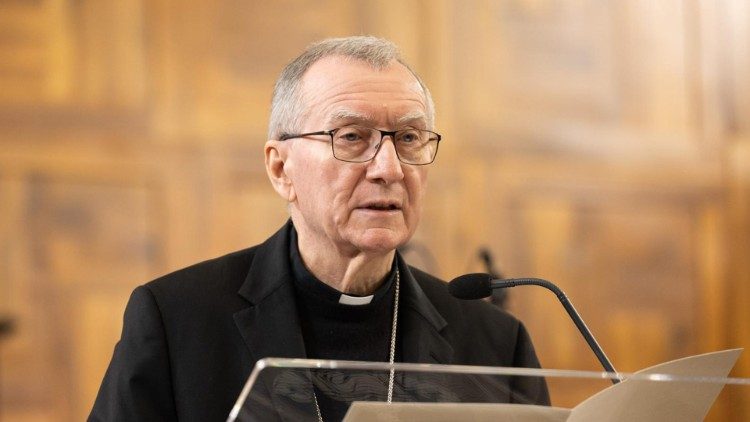
 Cardinal Pietro Parolin speaking at the Università Cattolica del Sacro Cuore in Milan, ItalyCardinal Pietro Parolin speaking at the Università Cattolica del Sacro Cuore in Milan, Italy 

Cardinal Parolin expresses hopes for future of all in Syria

The Cardinal Secretary of State is in Milan, Italy, for an event at the Università Cattolica del Sacro Cuore and the awarding of the Al Issa Research Award for Arab-Islamic Studies. On the sidelines of the event, the Cardinal comments on the situation in Syria following the fall of Bashar al-Assad noting how quickly it happened and the scenarios opening up with hopes for the respect of all, dialogue, and harmony.

By Salvatore Cernuzio

Cardinal Pietro Parolin, Secretary of State, expressed concern over how quickly things unfolded in Syria, where a regime that seemed so solid was "swept away." His hope is that those who take power can create "a system respectful of everyone." He was speaking just days following the fall of President Assad at the hands of rebels, while now in Damascus the nation's government palace hosts meetings to form a new transitional government.

Cardinal Parolin is in Milan, Italy, for a meeting at the Università Cattolica del Sacro Cuore entitled "Studies for Dialogue. Al Issa Research Award for Arab-Islamic Studies," during which a research grant promoted by the Secretary General of the Muslim World League, Muhammad Al-Issa, for young researchers focusing on Arab-Islamic culture will be presented.

Rapid changes

The rapid developments in Syria offer "a good opportunity to continue building bridges" with the Muslim world, Cardinal Parolin commented speaking with journalists who asked for his reaction about the current situation. The most pressing issue is the turmoil of the past 72 hours in Syria. "I believe we are all concerned about what is happening in Syria, particularly because of the speed with which events have unfolded. It's difficult to understand what is going on," the Vatican Secretary of State emphasised. "It is striking to me that a regime that seemed so strong, so solid, has been completely swept away in such a short time."

Hopes for openness

There are cautious hopes a system open and respectful of all. "Let us now see what scenarios unfold... Perhaps it is a little premature to speculate," he says, adding, "We have had some indications about respect for Christian communities, so we really hope that there can be a future of respect for all." The hope "is that those who come to power will try to create a regime that is open to and respectful of everyone." 

The Holy See continues its work of dialogue and diplomacy, though it does not have "formal roles," the Cardinal clarified. In Ukraine, for example, "no formal negotiations have been initiated, but we take respond to all situations to look for conditions that allow dialogue and problem-solving, such as ceasefire agreements, the release of hostages in the Middle East, and humanitarian aid. These are all areas in which we are actively engaged."

The importance of dialogue

As always, dialogue remains a priority. The event at the Università Cattolica del Sacro Cuore marks an opportunity to strengthen the bridges between different religious cultures that share contemporary society. "A timely opportunity," Cardinal Parolin emphasises. "I am very pleased that an institution like the Università Cattolica has taken the lead in this initiative, allowing for mutual understanding, deepening knowledge, and fostering collaboration." "I believe," the Cardinal concluded, "that the challenge today is to collaborate in responding to the many problems and difficulties the world faces. We need to recover synergy and cooperation."

Cardinal Parolin’s engagements

Cardinal Parolin is in Milan participating in the conference at the Università Cattolica del Sacro Cuore alongside University Rector Elena Beccalli, together with Muhammad Al Issa and Wael Farouq, Associate Professor of Arabic Language and Literature. Late on Tuesday 10 December morning, the Cardinal will celebrate the Mass in preparation for Christmas, and in the afternoon, he will attend the 4 p.m. presentation of the book "For a New Economy" by Dr. Beccalli, which explores the limitations of the current economic paradigm and proposes a new model based on ethics, trust, and cooperation. The event will also feature greetings from the Archbishop of Milan, Mario Delpini, and participation from, among others, Alberto Quadrio Curzio, President-emeritus of the Accademia dei Lincei.

Sunday, October 20, 2024

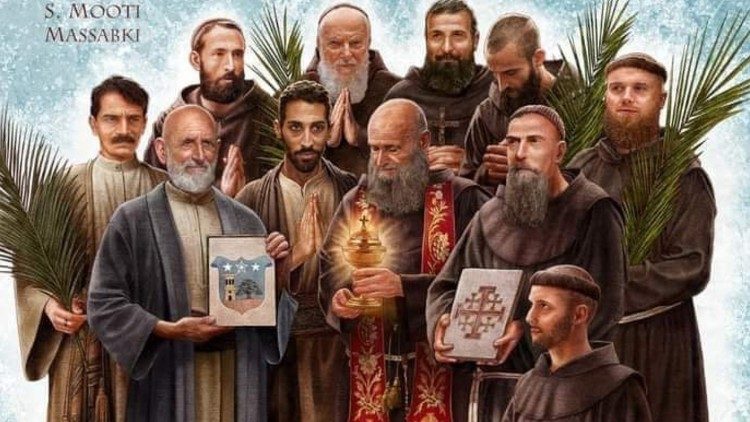
The Martyrs of Damascus


The canonization of the 11 martyrs of Damascus will be a sign of hope and ecumenismThe canonization of the 11 martyrs of Damascus will be a sign of hope and ecumenism 

Martyrs of Damascus canonization a 'sign of hope for Christians'

Ahead of the canonization of the Martyrs of Damascus at Mass celebrated by Pope Francis on October 20, Fr. Luke Gregory of the Custody of the Holy Land says their witness offes a sign of hope and ecumenism for Christians everywhere, especially those in Syria, where Christians make up about 2% of the population.

By Kielce Gussie

On the night of July 9, 1860, eleven men—eight Franciscan friars and three lay Maronites, known collectively as the eleven martyrs of Damascus—were murdered, and, in 1926, Pope Pius XI beatified them.

More than 160 years after their deaths, Pope Francis will canonize these men at Mass in St. Peter's Square on October 20.

In an interview with Vatican News, Fr. Luke Gregory, a Franciscan priest with the Custody of the Holy Land, described their canonization as a sign of hope in the midst of the ongoing conflict in the Middle East.

Martyrdom: a message of ecumenism

The martyrdom they endured is not very different from the situation of many Christians in the Middle East today.

Damascus, located in Syira, is home to one of the oldest Christian communities in the world but only about 2% of the population still identifies with the faith. Over the last decade, Christians have been facing persecution in Syria, following the country’s civil war that began in 2011.

All eleven men will be canonized, even though the group is made up of different Catholic rites. In 2023, Pope Francis established the “Commission of New Martyrs—Witnesses of the Faith” to catalogue Christians who have died for their faith in Christ. Through the Commission, a number of non-Catholic Christians have also been included in the list of martyrs, including the Coptic Christians killed in Libya.

A sign of hope

For Christians in the Middle East, Fr. Gregory said reflecting on the lives of these men “gives a sign of hope because after the bloodshed there is a new spring.”

He explained that the Franciscans of the Custody of the Holy Land hope the intercession of these martyrs will lead to an end to the conflict in Israel, Palestine, and other parts of the Middle East.

Beyond hope, Fr. Gregory said he prays their example and canonization could be a way to open a line of communication between different religious groups and help bring about peace.

“The whole world will be looking,” he said, at the canonization, which he hopes will “lead to dialogue.”

A place of pilgrimage and prayer

There is a shrine at Batumah in honor of the 11 men, Fr. Gregory noted, adding that it is "being renovated and made open to the public."

In July 2024, five large canvases with the images of the martyrs dating back to 1926—when they were beatified—were unveiled.

Fr. Gregory expressed his hope that once the conflict in the Middle East ends, pilgrimages to the Holy Land will be able to resume and more people will be able to visit the place of these martyrs of Damascus.