Showing posts with label Byzantine liturgy. Show all posts

Wednesday, January 10, 2024

Two Eastern Catholic Bishops reject Fiducia Supplicans and confusion concerning same-sex couples


'No' to same-sex blessings, say two Eastern Catholic bishops

Prelates reject Vatican document on pastoral blessings for same-sex and unmarried couples for theological, canonical reasons


Pope Francis receives His Beatitude, Sviatoslav Shevchuk, Major Archbishop of Kyiv-Halych. (Photo: Vatican News)


Two Eastern Catholic bishops have issued statements with in-depth theological and canonical reasons for their rejection of a controversial Vatican document on pastoral blessings for same-sex couples and other unmarried couples.

Major Archbishop Sviatoslav Shevchuk, head of the Ukrainian Greek Catholic Church, and Bishop Kurt E. Burnette of the Byzantine Catholic Eparchy of Passaic, New Jersey, provided detailed responses on behalf of their respective sees to "Fiducia Supplicans" ("Supplicating Trust"), which was released Dec. 18 by the Vatican's Dicastery for the Doctrine of the Faith.

The declaration, subtitled "On the pastoral meaning of blessings," concluded that priests could offer "spontaneous" and "non-liturgical" pastoral blessings upon request to those in same-sex unions or couples in "irregular situations." At the same time, the text -- which was signed by dicastery prefect Cardinal Víctor Manuel Fernández and secretary Msgr. Armando Matteo and approved by Pope Francis -- affirmed the church's teaching on marriage.

The declaration followed up on the pope's response to "dubia," or questions, posed by several cardinals in a letter released in early October.

"Fiducia Supplicans" garnered a range of reactions among Catholic clergy and faithful -- from praise to confusion to anger -- and prompted a Jan. 4 Vatican press release from Cardinal Fernández urging "a full and calm reading" of the text.

In a communiqué released Dec. 22, Major Archbishop Shevchuk -- who leads one of the 23 Eastern Catholic churches that, together with the Latin Church, comprise the universal Catholic Church -- said the declaration "applies solely to the Latin Church, not the Eastern Catholic churches."

He cited as the basis for his decision Canon 1492 of the Code of Canons for the Eastern Churches (abbreviated as CCEO, according to its Latin title), which was promulgated under St. John Paul II in 1990. That code, along with the 1983 Code of Canon Law, form the Catholic Church's primary governing documents.

Canon 1492 of the CCEO specifies that laws enacted by the pope that do not expressly indicate otherwise affect Eastern Catholics only "insofar as they treat matters of faith or morals or declarations of divine law," or if "they grant a favor which contains nothing contrary to the Eastern rites."

"The declaration … interprets the pastoral meaning of blessings in the Latin Church, not the Eastern Catholic churches," said Major Archbishop Shevchuk. "It does not address questions of Catholic faith or morality, refer to any precepts of the Code of Canons for the Eastern Churches … or refer to Eastern Christians."

Stressing that the CCEO safeguards the unique "liturgical, theological, canonical and spiritual heritage" of the Eastern Catholic churches, he noted that "the meaning of 'blessing' in the UGCC (Ukrainian Greek Catholic Church) and the Latin Church is different.”

While "Fiducia Supplicans" allows for a "non-liturgical" variant, in the Ukrainian Greek Catholic Church "the blessing of a priest or bishop is a liturgical gesture that cannot be separated from the rest of the content of the liturgical rites and reduced to the circumstances and needs of private piety," said Major Archbishop Shevchuk, referencing "Christ Our Pascha," the catechism of the Ukrainian Greek Catholic Church.

"Christ Our Pascha" was published in 2011 by Major Archbishop Shevchuk in response to St. John Paul II's call for the development of additional "local catechisms" for the Eastern Catholic churches, following the pope's 1992 publication of the Catechism of the Catholic Church.

Major Archbishop Shevchuk also noted in his statement that "according to the traditions of the Byzantine rite, the concept of 'blessing' means approval, permission, or even an order for a specific type of action, prayer, and ascetic practices, including certain types of fasting and prayer."

Since "the blessing of a priest always has an evangelizing and catechetical dimension," he said, "pastoral discernment urges us to avoid ambiguous gestures, statements, and concepts that would distort or misrepresent God's word and the teachings of the church."

Bishop Burnette, who also is apostolic administrator of the Phoenix and Toronto eparchies, released a four-page message titled "Some Thoughts and Guidance on the Publication of 'Fiducia Supplicans,'" echoing Major Archbishop Shevchuk's point that the declaration, as a liturgical guideline, was not applicable to the Byzantine rite according to canon law.

The bishop also underscored the distinction between the Eastern and Western Catholic understandings of the sacrament of matrimony.

"In the West, couples marry each other by the exchange of consent," said Bishop Burnette. "By ancient tradition and by current laws of the Church, in the East, a couple is married sacramentally by the blessing of a presbyter/priest."

He noted that Eastern Catholic churches of the Constantinopolitan tradition also employ a crowning ceremony to signify the priest's blessing upon the sacrament of matrimony (or at times upon a renewal of vows), and warned that "a crowning ceremony performed for a couple that cannot be married in the Catholic Church is a crime … under canon law," known as "simulating a sacrament."

"All parties are guilty of the crime, but the priest will be hurt the most," said Bishop Burnette. "Please do not be misled. Even without a crowning, one might commit the crime of simulating a sacrament by giving the appearance of blessing an unlawful union."

Bishop Burnette said that "presbyter/priests in recent years in our (Eastern Catholic) Churches in the United States have been excommunicated and involuntarily laicized for attempting to marry two males."

He urged laypeople to "take care not to compromise a priest by encouraging him to do something he is forbidden to do by the Church or by Divine Law or by his conscience."

"God gave us His Law because He loves us and desires to protect us," said Bishop Burnette, adding that he recently saw parents telling their small children to hold their parents' hands while crossing a busy street.

"When God gives us His Law, He is saying, 'Hold my hand. I don't want you to get hurt,'" said the bishop.

Monday, October 9, 2023

Monday's opening Mass ahead of Synod activities for Monday


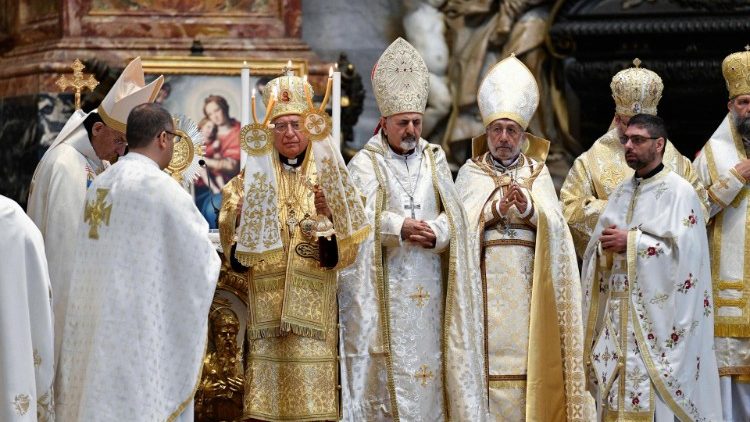
Patriarch Absi (center left) presides over the Byzantine rite MassPatriarch Absi (center left) presides over the Byzantine rite Mass  (Vatican Media)

Cardinal Raï at Mass: Synodal path helps us respond to global crises

Cardinal Béchara Boutros Raï, the Maronite Patriarch of Antioch, delivers the homily at daily Mass for Synod members, and urges Christians to imbibe a synodal way of living to confront the many issues that face our world.

By Devin Watkins

Members of the Synod General Assembly celebrated Mass together in St. Peter’s Basilica on Monday morning, ahead of the presentation of the fourth General Congregation.

Patriarch Youssef Absi, the Greek Melkite Patriarch of Antioch, presided over the Mass celebrated according to the Byzantine rite at the Altar of the Chair.

Cardinal Béchara Boutros Raï, the Maronite Patriarch of Antioch, delivered the homily at the Mass, reflecting on Jesus’ invitation to pray for workers for God’s abundant harvest.

Harvesting situations of suffering

In his homily, the Cardinal Patriarch noted that Jesus felt compassion for the large crowd which was following Him and so told His disciples: “The harvest is abundant but the laborers are few; so ask the master of the harvest to send out laborers for his harvest.”

Cardinal Raï said Jesus’ words offer a starting point to understand the current state of the Church and the challenges facing society.

He reflected first on the abundant harvest as a symbol of various pressing global issues that require attention and action from the Church and all Christians.

These issues, he said, include the pursuit of just peace amid ongoing wars, addressing climate change and protecting the environment, challenging exploitative economic systems, aiding persecuted individuals, and healing the wounds inflicted by various forms of abuse.

Cardinal Raï added that the harvest includes the need to promote human dignity, foster ecumenical and interfaith dialogue, care for the marginalized and vulnerable, and engage with contemporary societal challenges.

Laborers guided by the Spirit

The Maronite Patriarch of Antioch went on to consider the laborers who are called to gather the harvest.

Cardinal Raï said the Synod Instrumentum Laboris (working document) identifies these laborers as every person sent by Christ and guided by the Holy Spirit.

God’s Spirit, said Cardinal Raï, is the true “protagonist of the mission entrusted to the Church and thus of the entire synodal journey.”

Every laborer needs to receive formation and guidance from the Holy Spirit to embrace a synodal way of living.

Such training, he said, “involves formation for a life of communion, mission, and participation, as well as synodal spirituality at the heart of the Church's renewal.”

Our mission to heal wounds of others

In conclusion, Cardinal Raï invited Christians to feel compassion, as Jesus did, for our world’s situations of suffering and the conditions in which people find themselves.

He said the suffering of the poor, discarded, refugees, innocent victims of wars, and the homeless all stir Christ’s compassion and should stir our own.

Christ, concluded Cardinal Raï, “has chosen each one of us to heal these wounds and strive for a better world, where we can inhabit our common home in peace and tranquility.”

Saturday, April 29, 2023

Pope Francis meets with Greek-Catholics in Hungary


Pope Francis blesses Greek Catholic Church in Hungary

Pope Francis pays a visit to the Greek Catholic community in Budapest, as he prays with the Catholics of the Byzantine rite in the Church of the Protection of the Mother of God.

By Francesca Merlo

Pope Francis paid a brief visit to the Greek Catholic community in Budapest on Saturday morning, the second day of his Apostolic Journey to Hungary.

After meeting with migrants and refugees at St. Elizabeth of Hungary Church, the Holy Father travelled to the nearby Protection of the Mother of God Church, located in the 7th Disctrict's Rose Square, which serves the Catholic faithful of the Byzantine rite.

The Pope was welcomed at the entrance by Archbishop Péter Fülöp Kocsis, the Metropolitan Archbishop of Hajdúdorog, and together they walked to the Iconostasis, while the choir sang in the background. 

After a brief greeting with the Archbishop there was a moment of prayer, led by Pope Francis, with the community. The Pope was handed a cross and blessed the Greek Catholic community of Hungary. 


About the church

The one-nave church, built in 1881 to a design by Győző Czigler, in the Neo-Romanesque style, was originally the Roman Catholic parish church in the neighbourhood.

As the number of worshippers grew rapidly, a huge plot of land in the middle of the same square was chosen to build a larger church. Thus was born the neo-Gothic parish church of St. Elisabeth of Hungary to plans by Imre Steindl. In 1904, therefore, the then-empty church building was given to the Greek Catholic parish, which did not yet have its own Church, and had, until then, operated in the university Church.

Greek Catholic Church in Hungary

The Hungarian Greek Catholic Church was reorganised by Pope Francis on 20 March 2015, and elevated to Metropolitan Church sui iuris.

The Greek Catholic Bishops in Hungary are members of the Hungarian Bishops' Conference with deliberative voting rights. The status of Metropolia sui iuris makes the Greek Catholic Church completely independent from the local Latin Church from a legal point of view, without in any way calling into question its full ecclesiological communion with the Pope. In the liturgy, the Hungarian Greek Catholic Church uses the national language.

Monday, February 28, 2022

The Catholic Church in Ukraine


Things to Know About the Catholic Church in Ukraine

Though most of Ukraine‘s population is Eastern Orthodox, Catholics are among those suffering amid Russia’s invasion of the country.


CNA Staff
February 24, 2022

Though most of Ukraine‘s population is Eastern Orthodox, Catholics are among those suffering amid Russia’s invasion of the country. Russian military entered Ukraine at several points on Thursday, and missile strikes on military targets and cities were also reported.

Here is what to know about Ukraine's Catholic population:

Ukrainian Greek Catholic Church

About 9% of Ukrainians are Greek Catholics, meaning they are Catholics who belong to Churches of the Byzantine Rite. Virtually all of these are part of the Ukrainian Greek Catholic Church, which is led by Major Archbishop Sviatoslav Shevchuck of the Ukrainian Archeparchy of Kyiv-Halych. 

The Byzantine Rite celebrates the liturgy in the form used by the Eastern Orthodox Churches, regularly using the Divine Liturgy of St. John Chrysostom.

Ukrainian Greek Catholics are concentrated in the country's western oblasts bordering Poland, particularly Lviv. There are, however, 16 eparchies or exarchates (equivalent to dioceses or vicariates) of the Church throughout the country, including in Crimea, Luhansk and Donetsk.

The Ukrainian Greek Catholic Church is rooted in the 10th-century Christianization of Kievan Rus,' a state whose heritage Ukraine, Russia and Belarus all claim. That event also forms the roots of the Russian Orthodox Church, the Ukrainian Orthodox Church (Moscow Patriarchate) and the Orthodox Church in Ukraine.

This Church also has a diaspora, with a sizable presence in the U.S., Canada, Poland and Brazil and smaller communities elsewhere in Europe and in Argentina and Australia.

Latin Rite Catholics

There is also a Latin, or Roman, Rite hierarchy in Ukraine, to which about 1% of the population belongs. This is also concentrated in the west of the country, with six dioceses being suffragan to the Archdiocese of Lviv, and has cultural ties to Poland and Hungary.

Others

Ukraine is also home to the Ruthenian Catholic Eparchy of Mukachevo and the Armenian Catholic Archeparchy of Lviv.

The Ruthenian Catholic Church also uses the Byzantine Rite, and it is centered in an oblast that borders four of Ukraine's western neighbors. There are nearly 320,000 Catholics in the Mukachevo eparchy, who are served by about 300 priests.

There is an Armenian Catholic Archeparchy in Lviv, though it has been vacant since World War II. Armenian Catholics in Ukraine are few in number and are often entrusted to the pastoral care of priests of other Catholic Churches.

Persecution

Catholic Churches were severely persecuted in Ukraine while the country was part of the Soviet Union, and the renewal of conflict between Russia and Ukraine in the 2010s brought with it fears of ecclesial conflict and persecution.

The Ukrainian Greek Catholic Church was outlawed under Soviet rule, from 1946 to 1989, and the Ruthenian Catholic Church was suppressed in 1949.

In 2014, after the Russian annexation of Crimea and armed conflicts in other border regions between Ukrainian military forces and pro-Russian rebel groups and Russian soldiers, the then-apostolic nuncio to Ukraine warned of a return of persecution because of Russia's expansion into Ukrainian territory.

“The danger of repression of the Greek-Catholic Church exists in whatever part of Ukraine Russia might establish its predominance or continue through acts of terrorism to push forward with its aggression,” Archbishop Thomas Gullickson said Sept. 23, 2014.

Archbishop Gullickson was nuncio to Ukraine from 2011 to 2015, and he retired in 2020, at age 70.

“Any number of statements emanating from the Kremlin of late leave little doubt of Russian Orthodox hostility and intolerance toward Ukrainian Greek-Catholics,” he said in September 2014 to directors of Aid to the Church in Need. 

“There is no reason for excluding the possibility of another wholesale repression of the Ukrainian Greek-Catholic Church as came about in 1946 with the complicity of the Orthodox brethren and the blessing of Moscow,” he stated.

Many Roman Catholic and Greek Catholic clergy were forced to leave Crimea after its annexation. Both Roman and Greek Catholics faced difficulties in properly registering ownership of church property and in ensuring legal residency for their clergy.


Under the Soviet Union, 128 priests, bishops and nuns of the Ruthenian Catholic Church were put in prisons or sent into exile in Siberia. The eparchy of Mukachevo had 36 priests martyred during the persecution.

Blessed Theodore Romzha was Ruthenian bishop of Mukachevo for three years before he was assassinated in 1947 by the NKVD on the orders of Nikita Khrushchev, who was then first secretary of the Communist Party of Ukraine. 

Blessed Romzha was among a group of more than 20 Ukrainian martyrs of the 20th century who were beatified by St. John Paul II during his 2001 visit to Ukraine.

Tuesday, September 14, 2021

Celebrating the Divine Liturgy in the Byzantine Rite in Slovakia


Pope at Divine Liturgy in Slovakia: Let us turn our hearts to the Cross

Pope Francis presides at the celebration of the Divine Liturgy in the Byzantine Rite in Prešov, calling on the faithful of Slovakia to “turn the eyes” of their hearts “to the crucified Jesus.”

By Christopher Wells

On Tuesday in Prešov, Pope Francis presided at the Divine Liturgy for the Feast of the Universal Exaltation of the Precious and Life-Giving Cross.

The liturgy, in the Byzantine Rite, was celebrated by the Metropolitan Archbishop of Prešov, Ján Babjak, and concelebrated by numerous Greek and Latin Catholic prelates.

In his homily, Pope Francis repeated the words of St Paul: “We proclaim Christ crucified… the power of God and the wisdom of God.” The Cross, which on the surface can seem to be a “scandal” and “foolishness,” reveals to us “the beauty of God’s love”: “The Cross was an instrument of death, yet it became the source of life.”

The Pope noted that in Tuesday’s Liturgy, the account of the crucifixion is taken from the Gospel of St John, who was personally present at the foot of the Cross. Saint John, he said, “sees and testifies.”

Seeing

At the foot of the Cross, John sees Jesus, an innocent man, put to death. “In the eyes of the world, the Cross represents failure.” We too, the Pope said, can look on the Cross superficially, failing to see its message. Instead, we long for a triumphalist Christianity, losing sight of the humble love of Jesus. “Christianity without the Cross,” said Pope Francis, “is a worldly” and sterile Christianity.

Instead, St John saw precisely in the Cross the presence and work of God, who chose to enter into the misery of human history in this way. The Cross, said Pope Francis, shows us that no one is in so desperate a situation that they cannot find Christ there, in their suffering.

Pope Francis said that we must learn to see the glory of the Cross by living it, looking on the crucified Jesus, and opening our hearts to Him.

Bearing witness

Contemplating Jesus on the Cross leads to bearing witness, the Pope said. By doing so, the face of Jesus comes to be reflected on our own: “His features become ours, the love of Christ wins us over and transforms us.”

Pope Francis reflected on the martyrs of our own recent history, especially the martyrs of Slovakia. Their witness was “borne out of love of Him Whom they had long contemplated, to the point that they resembled Him even in their death.”

The Pope insisted that our witness must not be worldly or indifferent. “A witness who bears the Cross in his or her heart… views no one as an enemy, but everyone as a sister or brother for whom Jesus gave His life.” The only strategy for witnesses of the Cross is “that of the Master: humble love.”

Pope Francis called on the faithful to “cherish the memory” of the witnesses they themselves have seen. He reminded them, too, that “today, the Lord, from the eloquent silence of the Cross, is also asking each of you: Do you want to be my witness?”

Sunday, October 25, 2015

Byzantine liturgy comes to the campus of Notre Dame University

Notre Dame Looks East: University Begins Regular Byzantine Liturgy

Serving a growing international community in South Bend, a Melkite priest brings ancient traditions


Melkite liturgy
Mazur/catholicchurch.org.uk
 
 
Students and faculty at the University of Notre Dame who go to the university’s chapel on Sundays may be hearing something different from the usual Mass opening of “In the name of the Father and of the Son and of the Holy Spirit.”
“Blessed is the kingdom of the Father and the Son and the Holy Spirit, now and always and forever and ever,” Father Khaled Anatolios recently chanted, as he made the sign of the cross with the book of the Gospels lifted high above the altar.
He faced the altar, away from the congregation, and there were icons on either side. Those in the congregation sang “amen” in response.
The first Byzantine liturgy on Notre Dame’s campus had begun, and once a month, at least in the beginning, those who are from Eastern Christian traditions and those who are just curious will have a chance to participate.
Father Anatolios is a newly ordained priest of the Melkite Greek Catholic Church, one of twenty-two Eastern churches in communion with Rome. When his bishop knew that he was going to be moving to South Bend, Indiana, to teach theology, he asked if there could be “a Byzantine Catholic presence on the campus of the most prominent Catholic university in America,” Father Anatolios told the Notre Dame Observer.
It’s not that the Byzantine liturgy is unknown on college campuses. There are Orthodox campus ministies, and there’s a Byzantine Catholic Mission at Penn State, with a liturgy offered every Sunday. And near the campus of the Catholic University of America in Washington, DC, there is a Ukrainian shrine, with divine liturgy offered on Sundays. But Notre Dame seems to be the first Catholic university in the United States where an Eastern liturgy will be celebrated on campus on a regular basis.
With a growing international student body at Notre Dame, there has been an increasing need to serve Eastern Christians. There is a Melkite church nearby, but lately there has not been a priest there. And there is a Ukrainian Catholic parish in Mishawaka, but for many in the Notre Dame community, the distance makes it somewhat inaccessible.
Mourad Takawi, a doctoral student in theology, is a Coptic Catholic from Egypt. He’s been at Notre Dame for four years and only recently got a car, so he had little choice but to attend the Roman Catholic Mass on campus.
“It’s really a blessing, especially for international students who don’t have cars or other means of transportation,” he said in an interview this week.
The Melkite church—like the Ukrainian and other Catholic churches, as well as several Orthodox churches—uses the Liturgy of St. John Chrysostom, which dates to the fourth century. St. John Chrysostom was archbishop of Constantinople before the Great Schism. Since the city was known previously as Byzantium, the liturgy is called Byzantine.
With its heavy use of icons, singing, incense, and endless beseeching of “Lord have mercy,” the liturgy will a very different atmosphere to the Notre Dame chapel, which is more accustomed to the much simpler Roman Mass. It also exposes students to a different side of the Church, with traditions that are still carried on by many Catholics and Orthodox around the world.
Plus, it helps put American students better in touch with the suffering Church in the Middle East and places like Ukraine, where the Byzantine liturgy and other liturgical forms are more prominent.
Hannah Naguib also has an Egyptian background, but she was born in the states and is Coptic Orthodox. The sophomore chemistry-classics double major said she has “always enjoyed participating in liturgies of many backgrounds [Coptic, Russian, Greek, American, etc.] and have been curious to see how each one incorporates the core essences of the Christian faith.
“Having this monthly liturgy is an amazing opportunity for me,” she said. “Over the past year or so I have loved experiencing Roman Catholic Masses, but after a while I really began to miss the liturgies I have grown up with. Although there are many similarities between the Roman Catholic Masses and the Orthodox liturgies, there is still something about St. Chrysostom’s liturgy that really speaks to me as an Orthodox Christian.”
“It is wonderful how diversity of rites enriches us, just as diversity of cultures expands our thinking and brings surprises to our human experience,” said Christine Cervenak, associate director of the Notre Dame Center for Civil and Human Rights, who was baptized and reared in the Russian Greek Catholic Church. “Encounters with the Eastern Rite Catholic churches help our collective spiritual imagination, as to how much diversity and tolerance is possible within our Church.”
Added Holy Cross Father Pete McCormick, director of campus ministry, “I’m grateful to Father Khaled for his ministry to the Byzantine Catholics at the University of Notre Dame. His witness to the Catholic faith, through the Byzantine Rite, serves as an important reminder to students, staff and faculty of the Catholic Church’s universality.”
John Burger is news editor for Aleteia’s English edition.