Showing posts with label Slovakia. Show all posts

Monday, August 8, 2022

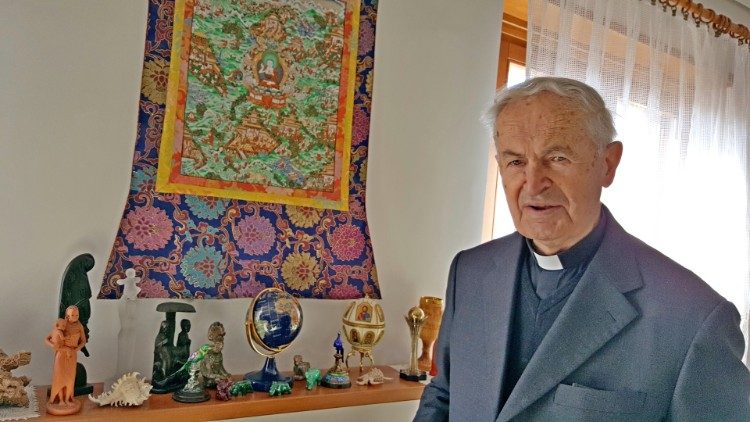
The oldest member of the College of Cardinals has died


Cardinal Jozef Tomko, Prefect emeritus of the Congregation for the Evangelization of Peoples Cardinal Jozef Tomko, Prefect emeritus of the Congregation for the Evangelization of Peoples  

Cardinal Jozef Tomko dies at 98

Slovakian Cardinal Josef Tomko died on Monday morning. He was the Prefect emeritus of the Congregation for the Evangelization of Peoples and the oldest member of the College of Cardinals.

By Vatican News staff writer

Cardinal Jozef Tomko, prefect emeritus of the Congregation for the Evangelization of Peoples, died in Rome at 5 a.m. on Monday, 8 August, aged 98.

The Slovak-born Cardinal was the oldest member of the College of Cardinals. He was created a Cardinal in 1985 by Pope John Paul II.

Cardinal Tomko died in his apartment in Rome, where he was cared for by the Sisters of Charity of St. Vincent de Paul.

He had been admitted to Rome’s Gemelli hospital on June 25 due to an injury to his cervical spine, and he had returned home on Saturday, August 6, to continue his in-home care, with a dedicated nurse.

During his stay in the hospital, he was visited by the Vatican Secretary of State, Cardinal Pietro Parolin.

Upon receiving the news of his death, the Slovak bishops’ Conference invited the faithful to pray for the repose of the soul of the Cardinal. The date of the funeral in Rome and subsequently in Košice will be announced.

An initial message from the Press Office of the Slovak Bishops’ Conference read:

"It is with a heavy heart and at the same time with the hope of resurrection that we announce that His Eminence Cardinal Jozef Tomko rendered his noble soul to the Lord today, August 8, 2022, in the early hours of the morning at his residence in Rome, surrounded by his closest associates.

We invite all to include him in their prayers. More information about the funeral in Rome and the burial at St. Elizabeth's Cathedral in Košice, where he will be buried, will be provided in the near future."

Saturday, April 30, 2022

Peace thru Solidarity


Pope meeting pilgrims from SlovakiaPope meeting pilgrims from Slovakia  (Vatican Media)

Pope encourages Slovakian pilgrims to promote peace through solidarity

Pope Francis encourages pilgrims from Slovakia to cultivate the richness of diversity of Slovakian society and Church and its culture of hospitality, commending Slovakia’s solidarity with Ukrainian refugees

By Lisa Zengarini

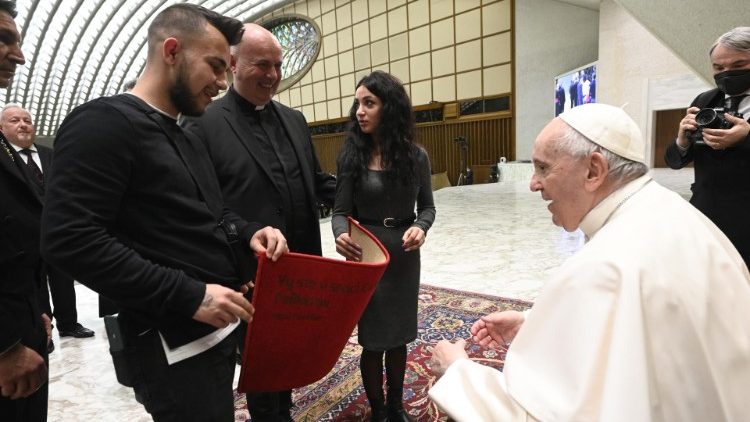
Pope Francis on Saturday  received in audience some 2,500 pilgrims from Slovakia visiting Rome to thank him for his Apostolic journey to the country 12-15 September  2021.

They were accompanied by  Archbishop  Stanislav Zvolenský of Bratislava, President of the Slovakian Bishops’ Conference. Attending the audience were also Cardinal Jozef Tomko, Prefect emeritus of the Congregation for the Evangelization of Peoples and  some representatives of Slovakian authorities, including the President of Parliament and the President of the Constitutional Court. 

The richness of diversity

Greeting the pilgrims in the Paul VI Audience Hall,  the Holy Father spurred them to continue to cultivate the richness of diversity of Slovakian society which can also be found in the local Church, with its different rites and traditions bringing together the  Christian West and East.

Walking the path of encounter

“When I  came to see you, I wanted to encourage you to walk the path of encounter, all together: young people, families, the elderly, the different communities that have historically been part of your society”, the Pope recalled,  reminding that the  culture of encounter is built on “the search of harmony between diversity,  that requires welcome, openness and creativity”, he said.

He also recommended “not to tire of invoking the Holy Spirit”, to heal past wounds in Slovakian society and Church The Holy spirit is the Creator of harmony and the balm of wounds!

Working for peace through charity

Pope Francis went on to commend Slovakian culture of hospitality and solidarity symbolized by the Slavic custom of offering bread and salt to visitors as a sign of welcome, which has proved itself again in the tragic context of the ongoig war in Ukraine.

Indeed, as pointed out in his introductory remarks by Archbishop Zvolenský, many Slovakian families,  parishes and institutions have offered shelter to Ukranian mothers and children forced to flee Ukraine after the Russian invasion.

“Looking at their eyes uou are the witnesses  of how war breaks family ties, deprives children of the presence of their fathers, of school, and leaves grandparents stranded”, Pope Francis noted.

He therefore urged them  “to continue to pray and work for peace, which, he said, “is built in our everyday life, even with these gestures of welcoming charity”.

“Whoever welcomes a needy person performs not only an act of charity, but also of faith, because he recognizes Jesus in his brother and sister.”

The legacy of Saints Cyril and Methodius

Pope Francis further invited Slovakian Catholics to preserve and cultivate the legacy of Saints Cyril and Methodius, so as to build bridges of fraternity together with all the European peoples who have been nourished by the same roots, with both the Christian lungs of Europe – Western and Eastern – mentioned by Pope St. John Paul II

Concluding , the Holy Father thanked Slovakian Catholics for their fidelity to Christ, expressed through their witness of a living faith, their good ecumenical relations, their charitable deeds, respect for human life and  responsible care for the environment.

Wednesday, September 15, 2021

Highlights of the Apostolic visit to Slovakia


Pope Francis departs from Slovakia to RomePope Francis departs from Slovakia to Rome  (AFP or licensors)

Pope in Slovakia: What a difference three days make

During a whirlwind three days in Slovakia, Pope Francis tells the people to persevere in the faith, while seeing for himself a Church of charity, and one which breaths with “two lungs”

By Lydia O’Kane - Bratislava

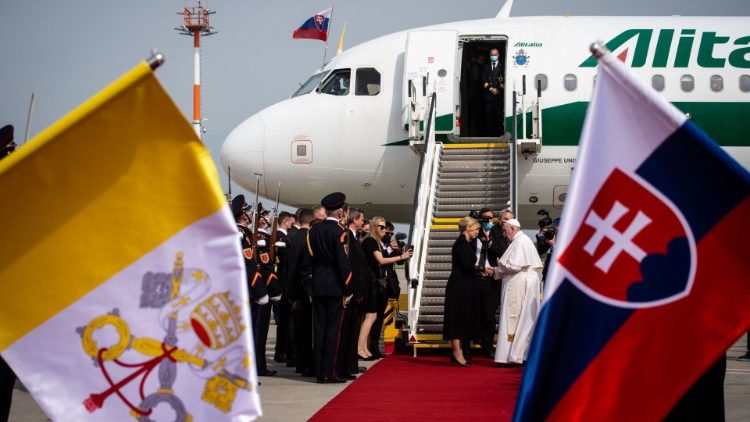
When the Pope arrived for this Apostolic Visit to Slovakia on Sunday, the banners to greet him read “Viva Papa Francesco" or “Long Live Pope Francis.”

As he departed on Wednesday, following the celebration of Holy Mass at the National Shrine at Šaštín, the banners were replaced to read, “Thank you, Holy Father.”

This visit was a tapestry of many significant events: The celebration of the Byzantine Divine Liturgy and the Mass at Šaštín demonstrated the Christian values that have been deeply rooted in society here down through the centuries and continue to be today.

The visit also provided an occasion for Pope Francis to highlight the importance of unity and fraternity during an ecumenical meeting and an encounter with the Jewish community.

Christianity in action

But perhaps the two events that captured the heart of Christianity, and the spirit of charity in action, were the visits to the Bethlehem Centre in Petržalka and to the Roma Community at Lunik IX.

Most of the people who were at Lunik IX on Tuesday witnessed a community that gave their all to welcome the Pope in a joyous atmosphere, guided in prayer by the Salesians of Don Bosco.

As Pope Francis departed from this district of Košice, people were already expressing the hope that this visit would bear real fruit for the community here.

Presevering the faith

Slovakia is a country still imbued by the faith, but like any plant, if it is not nurtured, it dies. The Church in this country is well aware that the secularism that has arrived at the doorstep of many European countries is also knocking here.  Therefore, for the bishops of Slovakia, taking one’s eye off the ball is not an option.

By coming here to Slovakia, the Pope has given a jolt of energy to the faithful; nowhere was that seen more than at the meeting with young people at Lokomotiva Stadium in Košice where Pope Francis told them, “For love to be fruitful, don’t forget your roots.” Those roots, he said, are to be found in the love and heroism of the Lord Jesus

Before the Pope departed on route to Rome on Wednesday, he left the country with a message: He told them that faith is a journey “inspired by a simple and sincere devotion”; and called on them to persevere in it with compassion and gratitude.


Pope Francis celebrates final Mass in Slovakia


Pope at Mass upholds Mary to Slovaks as model of faith

Celebrating his final Mass on Slovak soil near the National Marian Shrine of Šaštín on Wednesday, Pope Francis invites Slovaks to imitate Mary in her journey, her prophecy and her compassion.

By Robin Gomes

In what was the final public event of his 34th Apostolic Journey to Slovakia, Pope Francis Wednesday morning celebrated the feast of Our Lady of Sorrow with an open-air Mass in Šaštín.  The town, some 71 kilometers north of the Slovak capital Bratislava, is home to the National Marian Shrine dedicated to Our Lady of Sorrows, the patroness of Slovakia.  Some 90 bishops and more than 500 priests concelebrated at the Mass, attended by some 60,000 faithful.

Mary’s faith as a journey      

In his homily, the Pope reflected on Mary’s faith as a journey, a prophecy and as compassion.

Firstly, the Pope said, Mary’s faith sets her on a journey.  After hearing the message of the angel, she did not consider it a privilege to be chosen as the Mother of the Saviour; she did not lose the simple joy of her humility; she did not keep thinking about herself within the four walls of her house.  Rather, after experiencing the gift she had received as a mission to be carried out, she went to visit and assist Elizabeth, her cousin.  Completely caught up in God’s own “haste”, she felt urged to open the door and go out to reach all people with God’s saving love. "She chose the unknowns of the journey over the comfort of her daily routines, the weariness of travel over the peace and quiet of home; the risk of a faith that makes our lives a loving gift to others over a placid piety."


The day’s Gospel presents Mary on a journey to Jerusalem with her husband Joseph for the rite of the Presentation of Baby Jesus in the temple.  The Pope said the rest of her life would be a journey in the footsteps of her Son, as the first of his disciples, even to Calvary, to the foot of the cross.

Pope Francis held out the Blessed Virgin to Slovaks as a model of faith that involves journeying, a faith inspired by simple and sincere devotion, a constant pilgrimage to seek the Lord.  It’s a journey that overcomes the temptation to a passive and ritual faith, and makes life a pilgrimage of love towards God and their brothers and sisters.  

He urged Slovakia’s Catholics to persevere on this journey without stopping, adding, when the Church stops moving, she falls sick.  When bishops stop moving, the Church falls sick and when priests stop walking, the people of God fall sick, he said.

Mary’s faith as prophetic

The Pope then focused on Mary’s faith as prophetic.  Her life is a prophetic sign that points to God’s presence in human history, His merciful intervention that confounds the logic of the world lifts up the lowly and casts down the mighty.  As the Immaculate Virgin, she is the icon of our own vocation, called to be holy and blameless in love.

Reflecting on the prophecy of Simeon at the Presentation, that the Child was destined for the fall and rise of many in Israel and a sign of contradiction, the Pope said that faith cannot be "reduced to a sweetener to make life more palatable."  The darkness always fights against Him and He came to bring not peace but a sword, demanding a decision from us.  With Jesus, we cannot remain lukewarm, with a foot in both camps.  “When I accept Him, He reveals my contradictions, my idols, my temptations.  He becomes my resurrection, the one who always lifts me up when I fall, the one who takes me by the hand and lets me start anew.”

The Pope said Slovakia today needs such prophets, Christians who can demonstrate the beauty of the Gospel by the way they live.  Turning to the bishops, he urged them to take up this path.  Slovakia needs Christians, who are "weavers of dialogue where hostility is growing; models of fraternal life where society is experiencing tension and hostility; bringers of the sweet fragrance of hospitality and solidarity where personal and collective selfishness too often prevails, protectors and guardians of life where the culture of death reigns".

Mother of compassion

Finally, contemplating on the Mary, the Mother of compassion, the Holy Father said, she ensured there was sufficient wine at the wedding feast of Cana, she shared in her Son’s mission of salvation, even to the foot of the Cross.  While Jesus suffered in the flesh, disfigured by evil, Mary suffered in spirit, as the compassionate Mother who dries our tears, comforts us, and points to Christ’s definitive victory.

The Mother of Sorrows remains at the foot of the cross, without running away, trying to save herself, or finding ways to alleviate her grief.   She stands there weeping with the faith that knows that, in her Son, God transfigures pain and suffering and triumphs over death.

Pope Francis encouraged Christians to a faith that becomes compassion, identifying themselves with the needy, those who are hurt, suffering and are forced to bear heavy crosses.  It is a faith that does not remain abstract but becomes incarnate in fellowship with those in need.  It is a faith that imitates God’s way of doing things, quietly relieving the suffering of our world and watering the soil of history with salvation.

Tuesday, September 14, 2021

Celebrating the Divine Liturgy in the Byzantine Rite in Slovakia


Pope at Divine Liturgy in Slovakia: Let us turn our hearts to the Cross

Pope Francis presides at the celebration of the Divine Liturgy in the Byzantine Rite in Prešov, calling on the faithful of Slovakia to “turn the eyes” of their hearts “to the crucified Jesus.”

By Christopher Wells

On Tuesday in Prešov, Pope Francis presided at the Divine Liturgy for the Feast of the Universal Exaltation of the Precious and Life-Giving Cross.

The liturgy, in the Byzantine Rite, was celebrated by the Metropolitan Archbishop of Prešov, Ján Babjak, and concelebrated by numerous Greek and Latin Catholic prelates.

In his homily, Pope Francis repeated the words of St Paul: “We proclaim Christ crucified… the power of God and the wisdom of God.” The Cross, which on the surface can seem to be a “scandal” and “foolishness,” reveals to us “the beauty of God’s love”: “The Cross was an instrument of death, yet it became the source of life.”

The Pope noted that in Tuesday’s Liturgy, the account of the crucifixion is taken from the Gospel of St John, who was personally present at the foot of the Cross. Saint John, he said, “sees and testifies.”

Seeing

At the foot of the Cross, John sees Jesus, an innocent man, put to death. “In the eyes of the world, the Cross represents failure.” We too, the Pope said, can look on the Cross superficially, failing to see its message. Instead, we long for a triumphalist Christianity, losing sight of the humble love of Jesus. “Christianity without the Cross,” said Pope Francis, “is a worldly” and sterile Christianity.

Instead, St John saw precisely in the Cross the presence and work of God, who chose to enter into the misery of human history in this way. The Cross, said Pope Francis, shows us that no one is in so desperate a situation that they cannot find Christ there, in their suffering.

Pope Francis said that we must learn to see the glory of the Cross by living it, looking on the crucified Jesus, and opening our hearts to Him.

Bearing witness

Contemplating Jesus on the Cross leads to bearing witness, the Pope said. By doing so, the face of Jesus comes to be reflected on our own: “His features become ours, the love of Christ wins us over and transforms us.”

Pope Francis reflected on the martyrs of our own recent history, especially the martyrs of Slovakia. Their witness was “borne out of love of Him Whom they had long contemplated, to the point that they resembled Him even in their death.”

The Pope insisted that our witness must not be worldly or indifferent. “A witness who bears the Cross in his or her heart… views no one as an enemy, but everyone as a sister or brother for whom Jesus gave His life.” The only strategy for witnesses of the Cross is “that of the Master: humble love.”

Pope Francis called on the faithful to “cherish the memory” of the witnesses they themselves have seen. He reminded them, too, that “today, the Lord, from the eloquent silence of the Cross, is also asking each of you: Do you want to be my witness?”

Pope Francis Tuesday in Slovakia


Pope Francis at the meeting with the Roma people at the Lunik IX neighbourhood of Kosice, Slovakia. Pope Francis at the meeting with the Roma people at the Lunik IX neighbourhood of Kosice, Slovakia.   (Vatican Media)

Pope in Slovakia condemns discrimination, prejudice against Roma people

One highlight of Pope Francis’ visit to Slovakia was Tuesday’s meeting with the Roma community in Kosice during which he called for their integration.

By Robin Gomes

“Judgement and prejudice only increase distances. Hostility and sharp words are not helpful.  Marginalizing others accomplishes nothing.  Segregating ourselves and other people eventually leads to anger.”  Pope Francis used these words to condemn the discrimination that the Roma people face, stressing, “The path to peaceful coexistence is integration.”  

He made the remark during a meeting Tuesday evening with the Roma community of Košice, Slovakia, where he is on the 34th apostolic journey of his pontificate.   The Luník IX neighbourhood where the Pope met them has the highest density of Roma people in Slovakia.  Basic services such as gas, running water, sewage system, electricity and heating are scant in the run-down and overcrowded tenement buildings.

After listening to the testimonies of some of the Roma people, the Pope said it is not easy to leave prejudice behind, even for Christians.  “It is not easy to value others, especially if we see them as problems or enemies; if we pass judgement without making any effort to get to know them and to listen to their stories.”

Stereotyping and prejudice

Pointing to what Jesus said, “Do not judge”, the Holy Father lamented the gossip or rumours we pass or the prejudices, judgements and labels we tag others with, but consider ourselves justified. 

“In this way,” he said, “we disfigure by our words the beauty of the children of God, who are our brothers and sisters.  “We cannot reduce the reality of others to fit our own pre-packaged ideas; people cannot be pigeonholed.”  Our knowledge and appreciation of others must be grounded in our acknowledgement that each of them possesses the inviolable beauty of a son or daughter of God, a reflection of the Creator’s image.

Integration

Recalling the words of Saint Pope Paul VI - “In the Church, you are not on the margins... You are in the heart of the Church”, Pope Francis assured the Roma people, “In the Church, no one ought ever to feel out of place or set aside.” 

He told them that too often they have been the object of prejudice and harsh judgements, discriminatory stereotypes, defamatory words and gestures, which make humanity poorer.  Restoring dignity, he said, means passing from prejudice to dialogue, from introspection to integration. 

He explained that integration through peaceful coexistence as an organic, gradual and vital process starts with coming to know one another, which grows patiently, keeping its gaze fixed on the future, who are the children. 

Children

“Our children,” the Pope pointed out, “want to grow together with others, without encountering obstacles and exclusion.”  “They deserve a well-integrated and free life,” the Pope said, calling for “courageous decisions on behalf of children to promote their dignity, to educate them in such a way that they can grow up solidly grounded in their own identity and be given every opportunity they desire”.

Discovering Christ

The Salesians of Don Bosco, assisted by the Salesian sisters and numerous volunteers have established a pastoral and community centre in Lunik IX, helping the integration of the Roma people.

Pope Francis thanked all who dedicated themselves to the task, particularly priests, religious and the laity.  He encouraged them saying, “Do not be afraid to go out to encounter the marginalized.  You will find that you are going out to meet Jesus.”  He said Jesus awaits them “wherever there is need, not comfort; wherever service rules, not power; wherever incarnation, not self-indulgence, is required.”

Pope Francis also expressed his closeness with refugees and prisoners.  Do not be afraid to go out to encounter the marginalized.  You will find that you are going out to meet Jesus.  He awaits you wherever there is need, not comfort; wherever service rules, not power; wherever incarnation, not self-indulgence, is required.  Those are the places where he will be found.

Monday, September 13, 2021

The Cathedral hosting Pope Francis this morning


The Cathedral of St Martin,  Bratislava.The Cathedral of St Martin, Bratislava. 

Pope in Slovakia: St Martin’s Cathedral, a place of faith and charity

As Pope Francis visits St Martin’s Cathedral in Bratislava on Monday for a meeting with Bishops, priests, religious, consecrated persons, seminarians and catechists, the cathedral’s vicar speaks about this place of charity, and expectations for the encounter.

By Lydia O’Kane – Bratislava

“I hope it will be a great and wonderful surprise what the Pope will say to us,” says Fr Radoslav Šaškovic, as he sits in the majestic surroundings of St Martin's Cathedral in Bratislava.

It is the eve of the Pope’s meeting with priests and religious in this place of worship, and the cathedral’s vicar adds, “I like to be surprised by him; this great Pope, this great Bishop of Rome, so I don’t think I have any special expectation about what he is going to say.”

Preparations are continuing unabated all around Fr Šaškovic, as he describes this cathedral as a place steeped in charity.

“I think this cathedral is one of the best places for the Pope to visit… We are here in St Martin’s Cathedral and you know St Martin is one of the patrons… of charity, of Christian love, service to poor people,” he says.

With the establishment of the Archdiocese of Bratislava in 2008, Metropolitan Archbishop Stanislav Zvolensky established the tradition of an annual collection on St. Martin’s Day just after the Archdiocese was founded, so that all might imitate this great saint with good works.

The proceeds of the first “St. Martin’s collection” were donated to the Cenacolo Center, which offers help to those affected by drug addiction. The cathedral is also involved in care of the needy, and care of victims of human trafficking.

As the faithful await Pope Francis’ visit here on Monday, Fr Šaškovic is hoping that his example of care and support for the poor and vulnerable will be a source of encouragement to people in Slovakia to lend a hand to those who need help and support.

Pope Francis in Slovakia this Monday


Pope encourages Slovakia to fraternity, hospitality, solidarity

Pope Francis addressed government officials, diplomats and civil and religious leaders of Slovakia in the capital, Bratislava. He encouraged Slovaks to fraternity, hospitality and solidarity.

By Robin Gomes

Pope Francis on Monday encouraged Slovakia on the path to peace and integration through fraternity and hospitality, inviting its citizens to share their bread with others and add flavour to life with the salt of solidarity. 

The Pope who is on the 34th foreign Apostolic Journey of his pontificate, made the call at the presidential palace in the Slovak capital, Bratislava, where he addressed government officials, the diplomatic corps, and civil and religious leaders. 

After concluding the 52° International Eucharistic Congress in the Hungarian capital Budapest on Sunday, the 84-year-old Pope, who underwent an intestine surgery in July, flew to Slovakia in the afternoon for a 3-day visit.

Fraternity 

Commending the peaceful splitting of former Czechoslovakia into two nations 28 years ago, Pope Francis said Slovakia is called to be a message of peace in the heart of Europe.  Noting that the blue strip on the Slovak flag symbolizes fraternity with the Slavic peoples, he said such fraternity is necessary for the increasingly pressing process of integration and peace.  He hoped that Europe may bring back solidarity to the centre of history by transcending borders.

He upheld Saints Cyril and Methodious, the apostles of the Slavic peoples and co-patrons of Europe, as models of fraternity, saying they identified with all, and sought communion with all: Slavs, Greeks and Latins alike.

Slovaks, he said, are called to be a sign of unity by preserving this legacy of spontaneous openness to others.

Bread broken and shared

He thus encouraged them to fraternity along with hospitality, which, he said, is symbolized in the Slavic custom of offering bread and salt to visitors as a sign of welcome. 

Noting that God chose bread to make Himself present in our midst, the Holy Father said that Scripture commands us not to hoard our bread, but to share it.  Just as the bread of the Gospel is always broken, he explained, true wealth does not consist simply in multiplying the things we have, but in sharing them fairly with those around us.

“No one should be stigmatized or suffer discrimination,” he stressed adding, the Christian way does not look at others as a burden or a problem, but rather as brothers and sisters to be helped and protected. This call to sharing bread equitably calls for justice and fair laws, and their maintenance by fighting corruption.

The prayer for daily bread, the Pope continued, underscores the right to employment and job, saying without labour there is no dignity. At the basis of a just and fraternal society is the right of each person to receive the bread of employment, so that none will feel marginalized or constrained to leave family and homeland in search of a better life.

Salt of solidarity

Explaining the symbolism of salt, the Pope said just as salt gives flavour to food, so too we need the flavour of solidarity.  Society rediscovers its flavour through the gratuitous generosity of those who spend their lives for others. 

With their dreams and creativity, young people in particular need to be encouraged in this. Often, he lamented, they end up disenchanted by a consumerism that makes life bland and dull. 

Underscoring the concern for others as the missing ingredient, the Pope said, the feeling of responsibility for someone else gives flavour to our lives and enables us to realize that what we give away is really a gift we make to ourselves.

Preserving traditions

Just as salt preserves food, the Pope hoped Slovaks will never allow the rich flavours of their finest traditions to be spoiled by the superficiality of consumerism and material gain or by forms of ideological colonization.

While a single thought-system stifled freedom under decades of Communist rule in Czechoslovakia, the Pope pointed out that today there is another single thought-system which is reducing progress to profit and rights only to individual needs.  In this situation, he said, the salt of the faith acts by quietly and humbly sowing the seeds of God’s kingdom, especially by the witness of charity. 

The Beatitudes, the Pope stressed, are the inspiration for a Christian vision of society. Cyril and Methodius have shown that preserving what is good does not mean repeating the past, but being open to newness without ever losing one’s roots. 

Many illustrious men and women of Slovakia, the Pontiff noted, endured imprisonment, yet remained interiorly free, offering a radiant example of courage, integrity, resistance to injustice, but above all of forgiveness, which is the salt of Slovakia’s earth.

In the current Covid-19 crisis, the Pope urged that instead of withdrawing and thinking only of ourselves we should set out anew, realizing that all of us are frail and in need of others.  None can stand apart, either as individuals or as a nation. 
Sunday, September 12, 2021

Papal trip to Slovakia all about encouragement


Flowers adorn the altar at the National Shrine of ŠaštínFlowers adorn the altar at the National Shrine of Šaštín 

Pope in Slovakia: Encouragement in the faith

As Pope Francis makes an Apostolic Journey to Slovakia from the 12-15 September, his visit is being seen as an encouragement in the faith, and to inspire those whose faith has become lukewarm.

By Lydia O’Kane

Despite being a journey which lasts just four days, Pope Francis’ Apostolic Visit to Slovakia is one that encompasses many elements.

Two of the highlights are the celebration of the Byzantine Divine Liturgy in Prešov and a visit to the National Shrine dedicated to Our Lady of Sorrows at Šaštín.

There is also a visit to a homeless centre, a meeting with young people, and an encounter with priests and religious.

Fr Marek Vanus, SVD, works in the parish of the Exaltation of the Holy Cross in the district of Petržalka in Bratislava. He is also a lecturer in Biblical Theology.

A living faith

Speaking about the anticipation in his parish ahead of the Pope’s visit, Fr Vanus says “the general expectation is joy.” People are “expecting some encouragement in the faith and to show that the faith is one to be lived, not just through the liturgy but also in helping those less fortunate such as the poor and marginalized.”

He explains that the Pope’s encouragement is important because there is a sense that people are becoming more “indifferent” towards the faith.

Fr Vanus is also hoping that the visit will inspire people who have become lukewarm in the faith to draw nearer.

Respecting traditions

During his journey, Pope Francis is expected to preside over the Byzantine Divine Liturgy in Prešov and pay a visit to the National Shrine dedicated to Our Lady of Sorrows at Šaštín.

Fr Vanus points out that the first of these celebrations concerns the Greek Catholic Rite, while the visit to the Shrine is a meeting of the Roman Rite. With both these celebrations, he says, the Pope is showing his “respect to both traditions that are co-existing in Slovakia.”


Dialogue and fraternity

Alluding to the Pope’s most recent encyclical Fratelli tutti, Fr Vanus notes that it is significant that Pope Francis is “presenting this idea of Fraternity of Brotherhood,” adding that it is “important to recognize in the other the brother with whom I can talk and lead a dialogue, and I think it would be important in our country.”

He goes on to say he had the impression that during the last period of COVID both in Slovakia and beyond, “some people became very critical and not satisfied with anything and criticizing everybody, and I think this is not the way. I think we have to recognize the good in the other one and try to find a way of leading a dialogue and not already judging the other one.”

Economy in Slovakia

Asked about the economic challenges people in Slovakia face, especially in light of the current pandemic, Fr Vanus notes that there is not much difference between his country and other European nations as far as economic progression is concerned, but he also notes the continuing distinction between “the eastern and the western parts of Europe.”

The country’s history, he points out, “is signed by Communism,” which restricted economic development. However, in these last 30 years, “Slovakia is doing well and people can travel wherever they want.”

Priests and religious

During his visit to Slovakia, Pope Francis will address priests and religious, which Fr Vanus says is an aspect of the journey he is looking forward to the most in terms of words of encouragement. “We are experiencing diminishing vocations as it is very present in other countries in Europe, and so I am looking forward to this moment to hear from him some words of encouragement.”

Fr Vanus is also hoping this visit will help the Pope learn more about the situation of the Church in Slovakia, and on the other hand, that people will experience the Pope and his words on their native soil.