Showing posts with label Ukrainian Greek Catholics. Show all posts

Monday, August 24, 2026

Meanwhile, the reality for Catholics in Ukraine still suffering from war


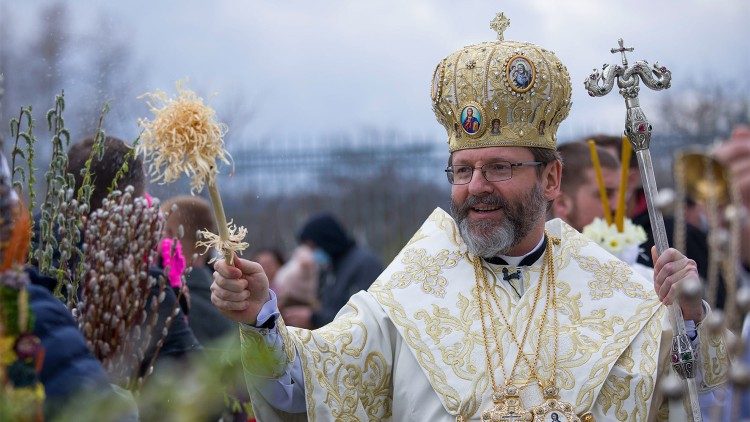
Major Archbishop Sviatoslav ShevchukMajor Archbishop Sviatoslav Shevchuk 

Major Archbishop Shevchuk: Freedom must never be taken for granted

On the day the country celebrates 35 years of independence, the head of the Ukrainian Greek Catholic Church, Major Archbishop Sviatoslav Shevchuk, tells Vatican News about the suffering inflicted on the population by the war and issues a renewed, heartfelt appeal to all the nations of the world for their solidarity.

By Father Taras Kotsur

The Major Archbishop of the Ukrainian Greek Catholic Church, His Beatitude Sviatoslav Shevchuk, lists the figures for July 2026, the “bloodiest month” of four and a half years of war, which has already exacted an unspeakable toll in human lives and destruction.

In the following interview with Vatican News, he condemns the cruelty of the war and the ethical consequences produced by technology, in which the eye of a drone that can precisely see whom it is about to strike makes the notion of “accidental” civilian casualties not only tragic but unacceptable.

He speaks with Vatican Media as Ukraine marks 35 years of independence from Soviet totalitarianism, and emphasizes the value of freedom.

Your Beatitude, it is a great pleasure to hear from you again, especially in this context, when every day we hear of continuing and intense attacks on the Ukrainian capital, including strikes on the part of the city where your cathedral and residence are located. How are you experiencing the current situation?

All of us spent this night in the air-raid shelter, as we have on the nights before, because unfortunately the number of drones and missiles being launched over our heads is increasing. Lately, each month has become bloodier than the one before. For example, according to the United Nations monitoring mission, July was the bloodiest month since March 2022, which was the month with the highest number of casualties during these four and a half years of war. Official statistics say that in July alone, 437 civilians were killed and 2,610 were wounded, with the highest number of children killed and wounded since April 2022.

All the experts who are trying to understand what is happening say that this war is increasingly becoming a high-tech war involving highly sophisticated weapons. Some speak of a “war of the cities.” Why? Because, in practice, the possibility of advancing along the battle line has come to a halt. Advancing along the front has become increasingly impossible and extremely costly for the Russian army. So they are trying to strike civilians, increasing the suffering of people who live especially in the large cities. This is why the capital of Ukraine has become the number-one target. When people try to find historical parallels, many say that what is unfolding in Ukraine is very similar to the Iran-Iraq War of the 1980s, which was truly a war between two peoples who were unable to achieve victory along the front line and therefore sought to increase the suffering of civilians. The other very serious characteristic, from a moral and ethical point of view, is that the high technology being developed uses not only artificial intelligence to determine the point of attack for drones. Today, these deadly drones—and also missiles, which are becoming increasingly sophisticated in targeting civilians—have been equipped with cameras. So an operator guiding a missile or a drone in real time can see the people he is killing.

It is impossible to say that civilian casualties are accidental, unintended victims. For example, the other day a bus was struck in the city of Kherson. Not only the people traveling on that bus were killed, but also people who happened to be nearby. It is obvious that the operator of that drone could see the people he was killing. This is truly a very serious moral problem. It is said that today Russia is seeking to use the suffering of civilians, and even fear itself, as a weapon. What they have been unable to achieve on the battlefield, they are trying to accomplish through this terror inflicted on the major cities. This war is also seeking to turn people's exhaustion, their suffering, including their spiritual suffering, into an instrument of political pressure. Obviously, this is changing the face of the war, which remains, in every respect, a sacrilegious war. Every act of this kind is a crime both against international humanitarian law and against the moral law governing armed conflicts. This is the situation we have been experiencing, especially in the capital, over these past months and days.

In this situation, what does it mean to celebrate 35 years of independence, which coincide precisely with four and a half years since the beginning of this atrocious aggression?

For us, celebrating Ukraine's Independence Day means, first and foremost, thanking the Lord for the gift of freedom, of which the independent Ukrainian state is the guarantor. For Christians, love of one's homeland cannot turn into idolatry of the state. A state governed by the rule of law is an important instrument for protecting human dignity, freedom, the common good, and the people's right to life. Love for one's homeland is not hatred of others; rather, it is the willingness to assume responsibility for one's people and to serve them. Therefore, for us, this day commemorating Ukrainian independence is a day of prayer and reflection on how, today, we must not only defend our freedom but also positively build our future. These days we are also constantly speaking about national unity, because it is a unity around certain fundamental values. The state is an instrument for serving the common good and the dignity of the human person, for ensuring survival, for living freely, and for building our society in peace. Obviously, on this day we will all pray for an end to the war. We know that not only Ukraine's independence is a gift from God, but peace is also a gift from God. We will all be united in prayer, but also in our service to the common good, in our service of saving human lives, especially in the context of the war we are experiencing today

You have spoken about the gift of freedom. In this context, I would like to ask you something personal. You were born during the period of totalitarianism. Your priestly formation began in underground seminaries. What do these 35 years of freedom mean to you personally, especially when you look at young people today, who are already the second generation to have been born during this period of independence?

I had the experience of living through the moment when the totalitarian communist state, which sought to control even people's minds and wills, collapsed into pieces. At that moment, we understood that freedom does not simply mean the possibility of being free externally. We understood that freedom is a spiritual and moral category. I remember that even in the Soviet Union, we Catholic Christians who lived underground were freer than the communist leaders, because we carried this freedom of the children of God in our hearts. And precisely thanks to this ability to be free—to have the courage to think differently from what was imposed by the state communist ideology—the freedom to make decisions, to decide freely, but always according to the criteria of Christian discernment—this, for us, during the Soviet era, was a spiritual school of freedom. Then, when this totalitarian state collapsed, we were able to transmit this inner freedom that we had carried within us into the context of Ukrainian civil society. And so we truly became the leaven of the new society. Our Church truly became an agent of the transformation of Ukrainian society from a post-communist, post-Soviet colonial country into a democratic country. Obviously, this journey will never be something accomplished once and for all. Every day we must demonstrate this Christian freedom and continue on our journey. But here I understood something very profound that belongs to the Byzantine spiritual and theological tradition: freedom is something greater than mere free will. Freedom is the fruit of a good choice, a choice grounded in truth. If I make the right choice, if I choose fundamental values, if I choose what is good, then my free will—which is a potentiality of freedom—is transformed into an experience of freedom. Therefore, helping people make the right choices is a path toward authentic freedom. Not license, not anarchy, but a freedom that is always connected with responsibility and the common good. It is obvious that this understanding of freedom is very much sought after in Ukraine today. It is interesting to note that many of our young men who were prisoners of war, who endured terrible torture while in Russian captivity and were subsequently liberated, said that they felt freer even with their hands bound than those who were torturing them. Why? Because those Russian officers were truly prisoners of their own intellectual frameworks. They were afraid of their superiors. They were afraid of ending up in prison themselves for failing to obey the orders they had received blindly. And our soldiers, at those moments, felt freer even with their hands bound. Why? Because they had made their choice. The right choice. The choice that is always based on truth and on the defense of people's lives. This is our experience from the time of the Soviet Union. It is our experience of a society rebuilding itself after the fall of state totalitarianism. And this is the freedom that the Ukrainian people are seeking to defend and to build ever more deeply in their own free and independent country.

What could be the message of the Ukrainian people to today's world, where we can observe a certain crisis of democracy, with authoritarian tendencies growing in different parts of the world, even in places where one would least expect them?

Do not grow tired of being free! In my view, this crisis of democratic values is connected to a certain crisis of personal responsibility for one's own country. Everyone wants to shift their responsibility onto the shoulders of others. And sometimes people look for a scapegoat, a politician or an autocrat who can take upon themselves the personal duties that each of us has toward our homeland and our country. Sometimes people want to be relieved of the need to think and discern. They want someone else to think, discern, and decide for them. This is a form of infantilism, because that is how children behave when they think that it is always someone else who should build a better future for them. The flight from responsibility, in my view, is one of the great scourges of modern democracies. That is why I am struck by the fact that today the Church is increasingly becoming a guarantor and defender of democratic values, because the Church affirms the dignity of every human person. It is precisely the Church that is protecting human beings, within today's culture, from dehumanization at every level, beginning today with the challenge posed by artificial intelligence. It is precisely the Church that says that no one should have the right to steal other people's dreams and hopes for their future for the sake of their own interests. On the contrary, we ourselves are the builders of our own lives and our own future. Do not be afraid to be free. This is the fundamental message that Ukraine can send to the whole world today. Even if this freedom has to be defended. Because freedom cannot be taken for granted. Those who are unwilling to take the risk of embracing freedom and living as free men and women are not worthy of this gift of freedom.

As a pastor of a portion of the faithful in Ukraine and also in other parts of the world, what appeal would you like to address to the universal Church on the occasion of this anniversary of independence?

The highest expression of freedom is the human being's capacity to love. To love God and to love one's neighbor. Today in Ukraine, we see that the national unity that led us toward national independence can be defended only through mercy: the capacity to empathize with those who suffer, the capacity to show mercy toward those who make mistakes, but also our capacity to do good to our neighbor. Therefore, we must not forget that the greatest experience of freedom comes when we love God and our neighbor. I would like to thank all those who, on Ukraine's Independence Day, August 24, will join us in prayer. I would like to recall that the All-Ukrainian Council of Churches has issued an appeal to the World Council of Churches, and has also written a letter to Pope Leo and to all men and women of good will, asking them to observe August 24 as a day of prayer for peace in Ukraine. All of us in Ukraine will be united in prayer on that day. We, the heads of Churches and religious organizations, will gather in the oldest cathedral in Eastern Europe, Saint Sophia Cathedral in Kyiv. There is an eleventh-century mosaic of the Oranta, the Praying Virgin Mary. Before this mosaic of the Kyiv Oranta, we will pray for peace. We ask for your solidarity and unity in prayer, but also in humanitarian action, which for us today is an excellent way of demonstrating our love for God and for our neighbor. 

Saturday, June 28, 2025

Pope Leo XIV offers prayers, encouragement and support to Ukranian Greek Catholics


Pope Leo XIV meeting with members of the Jubilee Pilgrimage of the Ukrainian Greek-Catholic ChurchPope Leo XIV meeting with members of the Jubilee Pilgrimage of the Ukrainian Greek-Catholic Church  (@Vatican Media)

Pope to Ukrainian Greek Catholics: 'Your faith is being put to the test'

Pope Leo XIV acknowledges that the faith of Ukrainian Greek Catholics is being put to a severe test, "amid this senseless war," but stresses that the Lord will have the final word and life will triumph over death.

By Deborah Castellano Lubov

Even if your faith is being put to the test, trust in God, Pope Leo XIV told Ukrainian Greek Catholics on Saturday in the Vatican.

The Pope began saying he extends a heartfelt greeting to the dear faithful of the Ukrainian Greek-Catholic Church, who have come to the tomb of the Apostle Peter on the occasion of the Jubilee Year, and greeting, in particular, His Beatitude Sviatoslav Shevchuk, Major Archbishop of Kyiv-Halyč, the bishops, priests, consecrated men and women, and lay faithful.

Welcoming the delegation, Pope Leo said, "I wish to express my closeness to the martyred Ukraine—to the children, the youth, the elderly, and especially to the families who mourn their loved ones," adding, "I share in your sorrow for the prisoners and for the victims of this senseless war."

Keep eyes on Christ

The Holy Father also reassured that he entrusts to the Lord their intentions, your daily struggles and tragedies, and above all, their longing for peace and serenity, noting, "I encourage you to walk together—pastors and faithful—keeping your eyes fixed on Jesus, our salvation."

"Your pilgrimage," he said, "is a sign of the desire to renew the faith, to strengthen the bond and communion with the Bishop of Rome, and to bear witness to the hope that does not disappoint, because it is born from the love of Christ poured into our hearts through the Holy Spirit," highlighting, "The Jubilee calls us to become pilgrims of that hope throughout our lives, despite the adversities of the present moment."

Many questions for the Lord

"The faith of your people," Pope Leo recognized, "is now being put to a severe test." "Many of you, since the war began," he acknowledged, "have surely asked yourselves: Lord, why all this? Where are you? What must we do to save our families, our homes, and our homeland?"

Faced with this dramatic scenario, Pope Leo stressed that, "Believing does not mean already having all the answers, but trusting that God is with us and grants us His grace, that He will have the final word, and that life will triumph over death.

Learning from the Virgin Mary

The Pope urged them to draw strength and courage from the Blessed Mother.

"The Virgin Mary, so beloved by the Ukrainian people, who with her humble and courageous 'yes,'” he said, "opened the door to the world’s redemption, assures us that our own “yes,” simple and sincere, can also become an instrument in God’s hands for accomplishing something great."

"Saying “yes” today," he said, "can open new horizons of faith, of hope, and of peace, especially for all those who are suffering."

Hope that the Lord will wipe away every tear

The Pope urged them to share that faith with their loved ones, fellow countrymen and women, and all those the Lord places in your path, reminding that the Jubilee calls all faithful to become pilgrims of hope throughout our lives, despite the adversities of the present moment.

Their journey to Rome, with the passage through the Holy Doors and the stops at the tombs of the Apostles and Martyrs, he also suggested, is a symbol of this daily path, oriented toward eternity, "where the Lord will wipe away every tear, and there will be no more death, nor mourning, nor crying, nor pain."

Pope Leo concluded by praying that the Virgin Mary, Mother of Hope, guide and protect them, and imparting his heartfelt Apostolic Blessing to their families, Church, and people.

The Holy Father also greeted and blessed some mothers of soldiers who had fallen at the front who were participating in the pilgrimage.


Pope Leo XIV blesses mothers of fallen Ukrainian solders.   (@Vatican Media)

Tuesday, March 4, 2025

Metropolitan Gudziak still hopeful after the Trump - Zelenskyy tense meeting

 ‘Unity, rooted in truth’ can stop evil, says Gudziak after Trump-Zelenskyy meeting


A woman speaks with Metropolitan Archbishop A. Gudziak of the Ukrainian Greek Catholic Archeparchy of Philadelphia Sept. 8, 2024, following Divine Liturgy at St. Nicholas the Wonderworker Ukrainian Greek Catholic Church in Kharkiv, Ukraine. (OSV News photo/Gina Christian)


(OSV News) — “Unity rooted in truth has the power to stop evil,” said Metropolitan Archbishop Borys A. Gudziak of the Ukrainian Catholic Archeparchy of Philadelphia and head of the nation’s Ukrainian Catholics, following a tense exchange Feb. 28 on live television at the White House among U.S. President Donald Trump, Vice President JD Vance and Ukrainian President Volodymyr Zelenskyy.

“Ukraine does not seek pity; it asks for support to protect its people, its cities and villages, to defend the truth about humanity, to defend God’s truth,” said Metropolitan Gudziak in a statement issued that day. “Ukraine needs unity of people — of every nation and every citizen — to establish a just peace, a peace Ukrainians long for more than anyone and for which they are making the ultimate sacrifice.”

On the third anniversary of Russia’s Feb. 24, 2022, full-scale invasion of Ukraine, the Ukrainian Greek Catholic bishops, who were meeting at the time in Canada, affirmed Ukrainians’ belief in “the triumph of God’s truth” — and the recognition that “true peace cannot exist without justice.”

Russia’s aggression in Ukraine, which continues attacks launched in 2014, has twice been declared a genocide in two joint reports from the New Lines Institute and the Raoul Wallenberg Centre for Human Rights. 

War’s grievous toll

In his Feb. 28 statement, Metropolitan Gudziak said, “Unity. Dignity. Resilience. Sacrifice. Gratitude. These are the words that are in my heart on this turbulent day.”

Those terms, which “define modern Ukrainian history … have become even more pronounced over the years of Russian aggression against Ukraine,” he said. “Today, their significance is singular. Their embodiment in action will help us persevere — not only now but in the days and weeks ahead.”

Since Russia’s 2022 invasion of Ukraine, at least 174,000 to 420,000 people have been killed, with civilian deaths reported to be severely undercounted, according to research by Sweden’s Uppsala University. Those numbers do not include the 14,200-14,400 slain from 2014-2021, as estimated by the United Nations Office of the High Commissioner for Human Rights.

Currently, 3.7 million people are internally displaced in Ukraine, with 6.9 million seeking refuge abroad, “unable to return to lives and livelihoods that no longer exist,” the U.N. stated in January.

At least 19,546 Ukrainian children have been forcibly deported by Russia — although that number could be more than 700,000, according to Russian child commissioner Maria Lvova-Belova. The Russian official, along with Russian President Vladimir Putin, is the subject of one of six International Criminal Court arrest warrants for war crimes.

Russian forces have also systematically tortured, sexually violated and executed Ukrainian civilians and combatants. 

Gudziak offers thanks for solidarity

Metropolitan Gudziak — who has repeatedly highlighted the generosity of U.S. Catholics and the American people in supporting Ukraine amid Russia’s invasion — said in his statement Feb. 28 that “the Ukrainian people — soldiers and civilians alike, the government, the Church, and civil society — are profoundly grateful to the American people and to all people of goodwill across the world in the hundreds of millions. For every word and every deed, for every prayer.”

Such generosity “empowers Ukrainians to defend their God-given dignity, protect innocent lives, and uphold the values of the democratic world,” he said. “This solidarity has strengthened our resilience, enabling a modern-day David to stand against a ruthless Goliath — against shameless aggression and genocide that seek to obliterate our people and undermine international rule of law.”

He concluded, “God’s truth will prevail.”

Gina Christian is a multimedia reporter for OSV News. Follow her on X @GinaJesseReina.

Wednesday, January 10, 2024

Two Eastern Catholic Bishops reject Fiducia Supplicans and confusion concerning same-sex couples


'No' to same-sex blessings, say two Eastern Catholic bishops

Prelates reject Vatican document on pastoral blessings for same-sex and unmarried couples for theological, canonical reasons


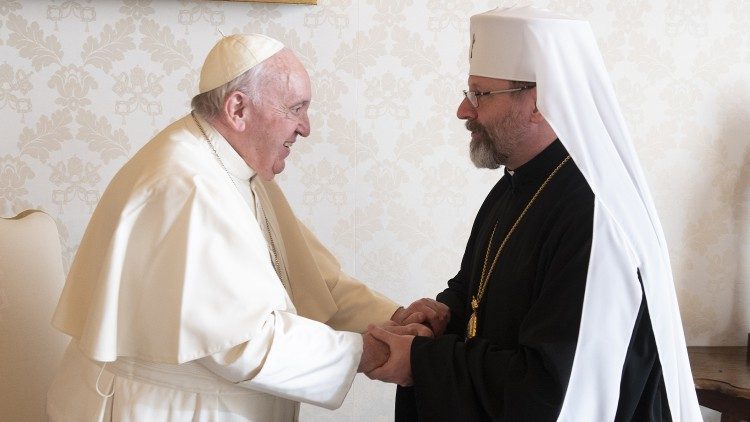
Pope Francis receives His Beatitude, Sviatoslav Shevchuk, Major Archbishop of Kyiv-Halych. (Photo: Vatican News)


Two Eastern Catholic bishops have issued statements with in-depth theological and canonical reasons for their rejection of a controversial Vatican document on pastoral blessings for same-sex couples and other unmarried couples.

Major Archbishop Sviatoslav Shevchuk, head of the Ukrainian Greek Catholic Church, and Bishop Kurt E. Burnette of the Byzantine Catholic Eparchy of Passaic, New Jersey, provided detailed responses on behalf of their respective sees to "Fiducia Supplicans" ("Supplicating Trust"), which was released Dec. 18 by the Vatican's Dicastery for the Doctrine of the Faith.

The declaration, subtitled "On the pastoral meaning of blessings," concluded that priests could offer "spontaneous" and "non-liturgical" pastoral blessings upon request to those in same-sex unions or couples in "irregular situations." At the same time, the text -- which was signed by dicastery prefect Cardinal Víctor Manuel Fernández and secretary Msgr. Armando Matteo and approved by Pope Francis -- affirmed the church's teaching on marriage.

The declaration followed up on the pope's response to "dubia," or questions, posed by several cardinals in a letter released in early October.

"Fiducia Supplicans" garnered a range of reactions among Catholic clergy and faithful -- from praise to confusion to anger -- and prompted a Jan. 4 Vatican press release from Cardinal Fernández urging "a full and calm reading" of the text.

In a communiqué released Dec. 22, Major Archbishop Shevchuk -- who leads one of the 23 Eastern Catholic churches that, together with the Latin Church, comprise the universal Catholic Church -- said the declaration "applies solely to the Latin Church, not the Eastern Catholic churches."

He cited as the basis for his decision Canon 1492 of the Code of Canons for the Eastern Churches (abbreviated as CCEO, according to its Latin title), which was promulgated under St. John Paul II in 1990. That code, along with the 1983 Code of Canon Law, form the Catholic Church's primary governing documents.

Canon 1492 of the CCEO specifies that laws enacted by the pope that do not expressly indicate otherwise affect Eastern Catholics only "insofar as they treat matters of faith or morals or declarations of divine law," or if "they grant a favor which contains nothing contrary to the Eastern rites."

"The declaration … interprets the pastoral meaning of blessings in the Latin Church, not the Eastern Catholic churches," said Major Archbishop Shevchuk. "It does not address questions of Catholic faith or morality, refer to any precepts of the Code of Canons for the Eastern Churches … or refer to Eastern Christians."

Stressing that the CCEO safeguards the unique "liturgical, theological, canonical and spiritual heritage" of the Eastern Catholic churches, he noted that "the meaning of 'blessing' in the UGCC (Ukrainian Greek Catholic Church) and the Latin Church is different.”

While "Fiducia Supplicans" allows for a "non-liturgical" variant, in the Ukrainian Greek Catholic Church "the blessing of a priest or bishop is a liturgical gesture that cannot be separated from the rest of the content of the liturgical rites and reduced to the circumstances and needs of private piety," said Major Archbishop Shevchuk, referencing "Christ Our Pascha," the catechism of the Ukrainian Greek Catholic Church.

"Christ Our Pascha" was published in 2011 by Major Archbishop Shevchuk in response to St. John Paul II's call for the development of additional "local catechisms" for the Eastern Catholic churches, following the pope's 1992 publication of the Catechism of the Catholic Church.

Major Archbishop Shevchuk also noted in his statement that "according to the traditions of the Byzantine rite, the concept of 'blessing' means approval, permission, or even an order for a specific type of action, prayer, and ascetic practices, including certain types of fasting and prayer."

Since "the blessing of a priest always has an evangelizing and catechetical dimension," he said, "pastoral discernment urges us to avoid ambiguous gestures, statements, and concepts that would distort or misrepresent God's word and the teachings of the church."

Bishop Burnette, who also is apostolic administrator of the Phoenix and Toronto eparchies, released a four-page message titled "Some Thoughts and Guidance on the Publication of 'Fiducia Supplicans,'" echoing Major Archbishop Shevchuk's point that the declaration, as a liturgical guideline, was not applicable to the Byzantine rite according to canon law.

The bishop also underscored the distinction between the Eastern and Western Catholic understandings of the sacrament of matrimony.

"In the West, couples marry each other by the exchange of consent," said Bishop Burnette. "By ancient tradition and by current laws of the Church, in the East, a couple is married sacramentally by the blessing of a presbyter/priest."

He noted that Eastern Catholic churches of the Constantinopolitan tradition also employ a crowning ceremony to signify the priest's blessing upon the sacrament of matrimony (or at times upon a renewal of vows), and warned that "a crowning ceremony performed for a couple that cannot be married in the Catholic Church is a crime … under canon law," known as "simulating a sacrament."

"All parties are guilty of the crime, but the priest will be hurt the most," said Bishop Burnette. "Please do not be misled. Even without a crowning, one might commit the crime of simulating a sacrament by giving the appearance of blessing an unlawful union."

Bishop Burnette said that "presbyter/priests in recent years in our (Eastern Catholic) Churches in the United States have been excommunicated and involuntarily laicized for attempting to marry two males."

He urged laypeople to "take care not to compromise a priest by encouraging him to do something he is forbidden to do by the Church or by Divine Law or by his conscience."

"God gave us His Law because He loves us and desires to protect us," said Bishop Burnette, adding that he recently saw parents telling their small children to hold their parents' hands while crossing a busy street.

"When God gives us His Law, He is saying, 'Hold my hand. I don't want you to get hurt,'" said the bishop.

Saturday, April 15, 2023

Leader of Ukranian Greek Catholic Church says Pope Francis is a force for peace


Pope Francis with His Beatitudine Sviatoslav ShevchukPope Francis with His Beatitudine Sviatoslav Shevchuk 

Leader of Ukrainian Greek Catholic Church: Pope Francis offers unique voice for peace

In an interview with Vatican News, Major Archbishop Sviatoslav Shevchuk, the leader of the Ukrainian Greek Catholic Church, says this Easter, Christ gives them hope and certainty of a better future ahead, and expresses gratitude to Pope Francis for being a singular voice in working toward peace.

By Deborah Castellano Lubov

Despite the tragic ongoing war in Ukraine bringing death and destruction, the head of the Ukrainian Greek Catholic Church says that as they celebrate Easter, Christ, as their source of hope and resilience, enables them to keep hope for an end to the war, and that peace, life and resurrection, will have the final word.

In an interview with Vatican Radio - Vatican News, Major Archbishop Sviatoslav Shevchuk of Kyiv-Halyc, expressed this, noting his gratitude to Pope Francis for his constant closeness and appeals, and, in particular, for offering a unique voice on how to find peaceful solutions.

His Beatitude discusses the Ukrainian Greek Catholic Easter amid rubble and war, the timeliness of Pope Francis' warnings throughout his papacy about nuclear arms, and how to work toward peace even as their country has faced war and suffering for more than a year since Russia's invasion.

***

Your Beatitude, in Ukraine at Easter, believers greet each other with the words ‘Christ is risen, truly risen.’ What significance does this greeting have in the context of the war that has been going on for more than a year?

Well, for us, this greeting is not a simple greeting, but is a proclamation of the Christian faith and also of a revelation of the authenticity of our existence as Christians. I remember when back in the Soviet times, when I was a child with these greetings, I greeted a representative of the Communist Party without being aware of that. And I said to him, 'Christ is risen.' And he responded, ‘Yes, thank you. I was already informed.' But to be informed and to have a right to proclaim ‘Indeed risen,’ they are two different perspectives. And today we can share our experience from the tragic situation, tragic moments of the Ukrainian people. Christ is indeed risen. He is with us, and He is a source of our resilience and a source of our hope, hope for the future, hope that one day this war will end, and then, peace, life, and resurrection, will have the last word in our history.


The Holy Father has made countless appeals for Ukraine and to help those suffering. What has this meant to you and what value have those appeals had?

For us, it's very important that we are not abandoned, that in our sufferings, we are not alone. And the Holy Father speaks not only to Ukrainians but also on behalf of Ukrainians to the world. And each time that he is trying to announce to the world the tragedy which is happening in Ukraine, for us, his words are lifegiving. Because of the worldwide solidarity, we were able to withstand with the consequences of this war. Thanks be to God and thanks to the Holy Father, this humanitarian crisis, provoked by the war, the humanitarian tragedy did not deteriorate. Nobody in Ukraine died because of hunger, thirst, or cold. We were able to pay our assistance to those who are victims of this Russian invasion. So each prayer, each appeal of the Holy Father to the world for us, is a lifegiving message.

Pope Francis has encouraged finding peaceful solutions to the war. In your mind, do you envision a possible road to peace with an emphasis on mediation and peace-building efforts rather than arms and violence? And how so?

We pray for peace. We struggle for peace. Of course, this peace right now sounds like a miracle, like something that should be happening, but when, we do not know. There is no human prospective for an immediate cease-fire in this war. But we do believe that miracles happen. Maybe one day, we will enjoy peace in our Ukrainian land.

Throughout Pope Francis's pontificate, he has constantly warned against the dangers of nuclear arms. Why is his message particularly important at this time?

Because right now, the world again is at the edge of a nuclear confrontation. When international law doesn't work anymore, no one in the world feels secure. And which security, which argument, [do] many, many nations have today? Only nuclear weapons, nuclear powers. And that is very sad because we are witnessing how the escalation and militarization of international relationships are happening right now. And Pope Francis almost is a unique voice to the world saying, ‘Please stop. Don't use that argument as an argument in your negotiations.’ We cannot argue, with blackmailing, using nuclear power, because this fact will provoke a disaster for the whole world.

The Risen Christ first manifested Himself to women. What role do Ukrainian women, and, in particular within the Church, play in these difficult times?

Women in Ukraine are a cornerstone stone of our society. Very often, we would say that in Ukrainian culture, we have a matriarchate. So, a mother, a woman, is a person who mostly announced, proclaimed the Christian faith in Ukraine. And the second Sunday after Easter, we have a Sunday dedicated to the Myrrhbearering women.

The role of women in the mission of evangelization today in Ukraine is crucial. Almost 99% of the catechists in our communities are women, but also our clergy is mostly married, so the role of priestly wife is very important in the parish and parish community. Very often people would first approach the priest’s wife, and then him, especially in some delicate issues for women. The mother is an image of Ukraine today. A Church as a mother is something very, very important, I would say, eloquent to Ukrainian people today especially. Mother Church, mother and teacher, mother and protector, is an icon of our Church today.


How difficult is it, Beatitude, to transmit this faith when there is so much pain and so many deaths all around? How do you offer a message of hope and faith in the midst of such sadness at this time?

In those circumstances, we ourselves experience that the Christian message is not an idea, but is a life-giving experience. So sharing our message, we share our experience. We share our own source of hope, our own source of resilience. So people are listening to us, but looking to us: How do we ourselves incarnate this message in our own life? Very often today, we are witnessing an outstanding moment of conversion of so many people in Ukraine because they are looking for a deep meaning of those very difficult circumstances: Why it's happening to us. What should you do? Is it right, that which we are doing? And very often those messages or those questions could be responded to only if we are listening to the Word of God, and only if we are members of a community who lives that message, that good news, which we proclaim each day.

Is there anything else that you would like to add, Your Beatitude?

Well, from the bottom of our heart, from Ukraine, from the capital of Ukraine, Kyiv, we would like to convey the authenticity of that message: ‘Christ is indeed risen. Indeed risen!’  Christ is with us. We do have a hope because we are participating in His Resurrection. This message, ‘Christ is risen’ is not only about Him, but is also about us, and the proclamation of the Christian hope for today.