Friday, June 28, 2024

Minnesota Archdiocese to send visiting Priests to a Minnesota Diocese


U.S. archdiocese sends ‘missionary priests’ to neighboring diocese


Bishop Andrew H. Cozzens of Crookston, Minn., elevates the Eucharist during his installation Mass at the Cathedral of the Immaculate Conception in Crookston Dec. 6, 2021. (Credit: Dave Hrbacek/The Catholic Spirit via CNS.)

NEW YORK – In a unique arrangement that Archbishop Bernard Hebda and Bishop Andrew Cozzens agree would be beneficial to the American church if done more often, the Archdiocese of St. Paul and Minneapolis will loan the Diocese of Crookston three priests for a period of three years.

The priests will begin in the Diocese of Crookston on July 1. Cozzens said the arrangement helps the diocese address its current priest shortage, as well as buy it some time to develop a more long-term plan for how the diocese can continue to care for the faithful with fewer priests.
Looking beyond the Diocese of Crookston, though, Cozzens views the concept of missionary priests within the United States – arrangements where dioceses with more priests are willing to send their priests as missionaries to other American dioceses – as something that could be beneficial nationwide.

“Everybody’s short. Nobody has as many priests as they’d like to have, but there are some dioceses that are doing much better and that kind of mutual missionary spirit to help each other is a great sign of what it means to be the Catholic Church, that we’re all in this together,” Cozzens said.

Hebda told Crux that it’s the first time he’s done an arrangement like this, but noted he often works with other bishops to get priests for seminary work who have an expertise in certain fields, and that when he was the coadjutor bishop of the Archdiocese of Newark from 2013-2016 there were several priests who were involved in mission work outside of the archdiocese.

“We certainly have great needs in the archdiocese so to send three priests to do anything is significant, but more, the request that had come from Bishop Cozzens was very serious,” Hebda explained. “I think each bishop is supposed to care for his individual church but also the universal Church, so when you do see a need somewhere else … you are supposed to be attentive to that and responsive to that.”

Crux reached out to more than a dozen American dioceses in different locations and of different sizes to gauge the commonality of the type of arrangement between the Archdiocese of St. Paul and Minneapolis and the Diocese of Crookston – where multiple priests are loaned to another diocese for parish ministry for a set number of years – and didn’t find anything similar.

The concept of the arrangement between the two Minnesota dioceses dates to 2022.

At that time, Cozzens began discerning with the presbyterate and laity about the needs of the diocese. Cozzens knew that he had some retirements coming up, the next ordination class still a few years out, and that parish mergers wouldn’t work given the land size of the diocese. The Diocese of Crookston has 66 parishes spread out across more than 17,000 square miles.

Then, during the summer of 2023, Cozzens spoke with the diocese’s Priests Personnel Board, and with their encouragement reached out to Hebda to see if he’d consider loaning the diocese a small number of priests from the Companions of Christ – a fraternity of diocesan priests and seminarians of which Cozzens in a founding member.

Hebda said he initially told Cozzens it likely wasn’t feasible, but ultimately agreed.

When Hebda and Cozzens announced the arrangement back in January, Hebda said that he determined because of a strong ordination class and priests willing/able to serve past the age of retirement that the archdiocese could absorb the short-term loss of the priests. He also highlighted the “real” need for assistance in the Diocese of Crookston given its geographical and presbyterate sizes.

Another reason, Hebda later told Crux, was the willingness of the three priests to take on the assignment.

“For me, what was really significant was having three priests stand up and say that they would be willing to do this,” Hebda said. “It would be awfully hard to leave a diocese that’s your home, so that there were three priests who were willing to do this, I thought that was pretty significant and unexpected for me.”

The three priests are Fathers David Blume, Thomas Niehaus, and Josh Salonek.

In Crookston, Blume will become pastor of St. Philip and St. Charles, and superintendent of St. Philip’s School. Niehaus and Salonek, meanwhile, will both become parochial vicars at St. Philip and St. Charles. Niehaus will also be the chaplain for the Newman Ministry at Bemidji State University.

Cozzens said he expects the priests will have a long-term impact in their short time in the diocese.

“I don’t think the future is filled with doom,” Cozzens said. “We have real challenges, but I’m grateful for the help we’ve been able to get from the Companions of Christ, which I think will have a long term impact even if some of those priests are only here for a short time.”

Pope Francis hopes to visit Turkey on the anniversary of Nicea


Pope Francis with the Delegation of the Ecumenical PatriarchatePope Francis with the Delegation of the Ecumenical Patriarchate  (Vatican Media)

Pope hopes to visit Türkiye for anniversary of Council of Nicea

In remarks to a delegation from the Ecumenical Patriarchate of Constantinople, Pope Francis expresses his hopes of travelling to Türkiye in 2025 to celebrate the 1,700th anniversary of the Council of Nicea.

By Christopher Wells

Pope Francis expressed his desire to visit the area of Nicaea in 2025 to mark the 1,700th anniversary of the first Ecumenical Council.

“It is a trip I wholeheartedly desire to make,” the Pope said on Friday morning, as he greeted a delegation from the Ecumenical Patriarchate of Constantinople, which is in Rome for the feast of Sts Peter and Paul, the founders of the Church in Rome.

The customary visit is reciprocated by a delegation from the Catholic Church to Istanbul on the feast of St. Andrew, who tradition holds founded the Church at Constantinople.

The joy of fraternal encounter

In his address to the delegation, the Holy Father welcomed the opportunity “to experience the joy of fraternal encounter” and to bear witness both to the “profound bonds” that unite the two Churches and to the “firm resolve to progress together” towards the restoration of unity between them.

Pope Francis highlighted in particular his numerous meetings with the current Ecumenical Patriarch, Bartholomew I, especially their encounter in Jerusalem in 2014 to mark the 50th anniversary of the historic meeting between Pope St Paul VI and Athenagoras I.

Emphasizing the commitment to “journeying together” towards full unity, the Pope reaffirmed “that dialogue between our Churches poses no risk to the integrity of the faith; rather, it is a necessity arising from our fidelity to the Lord and leading us to the whole truth through an exchange of gifts and under the guidance of the Holy Spirit.”

Prayers for peace

The Pope recalled, too, the peace ceremony in Vatican Gardens, which took place shortly after the meeting in Jerusalem. Together, Pope Francis and Patriarch Bartholomew welcomed representatives of Israel and Palestine “in order to invoke peace in the Holy Land, in the Middle East, and throughout the world.”

“Present events have shown us the necessity and urgency of praying together for peace,” the Pope said, “so that the war may end, the leaders of nations and the parties in conflict may rediscover the path to concord, and all parties come to recognize one another as brothers and sisters.”

He noted that this invocation for peace is extended to all conflicts, especially the ongoing war in Ukraine.

The way of love, reconciliation, and mercy

The need for hope in the world, at “a time when so many men and women are prisoners of fear for the future,” suggested the motto for the upcoming Jubilee Year, “Pilgrims of Hope.”

The Pope invited the Eastern Orthodox Churches to “accompany and support” the upcoming Holy Year with their prayers, “so that abundant spiritual fruits may not be lacking.”

Pope Francis concluded his address with prayer that “the Lord might grant that we may continue to walk on the path that He points out to us, which is always the way of love, reconciliation, and mercy.”

Pope Francis takes a break for the month of July; kind of...


File photo of Pope Francis holding a weekly General Audience in the VaticanFile photo of Pope Francis holding a weekly General Audience in the Vatican 

Pope Francis to take usual July pause from activities

Pope Francis will take his usual break in July from his weekly General Audiences and most activities, with the exception of the Sunday Angelus prayer in St. Peter's Square.

By Deborah Castellano Lubov

Pope Francis will take his usual July break from most of his activities, according to the Prefecture of the Papal Household in a statement released on Friday.

As he has for years, the Holy Father will suspend General Audiences, as well as most activities and other meetings, during July to allow for a period of rest.

However, as he has always done in the past, the Pope will continue to pray the Angelus on Sunday at noon with the faithful in St. Peter’s Square.

The Pope's General Audiences will resume on Wednesday, August 7.

The General Audiences in August are often held in the Vatican's Paul VI Hall due to the intense Roman heat.

The following month, the Holy Father is scheduled to make two Apostolic Journeys, the first being to Asia and Oceania, on September 2-13, and the next being later in the month, to Belgium and Luxembourg, on September 26-29.

Thursday, June 27, 2024

And another Saint for Friday


St. Paul I, Pope


Pope from 757-767. The brother of Pope Stephen 11 and a Roman, he was educated in the Lateran Palace, became a deacon under Pope Zachary, and wielded considerable influence in his brother's administration. Elected to succeed Stephen, he took as his primary concern the threat posed to Rome and the Papal States by the Lombards. Paul secured an alliance with the Frankish king Pepin the Short, thereby cementing the relationship between the Holy See and the Frankish Empire which culminated with the historically significant alliance between Pope Leo III and Charlemagne. Paul also opposed the Iconoclast policies of the Byzantine emperor Constantine V, thereby exacerbating further the deteriorating relationship between the papacy and the Byzantine Empire. He died on June 28 at St. Paul's Outside the Walls, in Rome.

Saint of the Day for Friday


St. Irenaeus


The writings of St. Irenaeus entitle him to a high place among the fathers of the Church, for they not only laid the foundations of Christian theology but, by exposing and refuting the errors of the gnostics, they delivered the Catholic Faith from the real danger of the doctrines of those heretics.

He was probably born about the year 125, in one of those maritime provinces of Asia Minor where the memory of the apostles was still cherished and where Christians were numerous. He was most influenced by St. Polycarp who had known the apostles or their immediate disciples

Many Asian priests and missionaries brought the gospel to the pagan Gauls and founded a local church. To this church of Lyon, Irenaeus came to serve as a priest under its first bishop, St. Pothinus, an oriental like himself. In the year 177, Irenaeus was sent to Rome. This mission explains how it was that he was not called upon to share in the martyrdom of St Pothinus during the terrible persecution in Lyons. When he returned to Lyons it was to occupy the vacant bishopric. By this time, the persecution was over. It was the spread of gnosticism in Gaul, and the ravages it was making among the Christians of his diocese, that inspired him to undertake the task of exposing its errors. He produced a treatise in five books in which he sets forth fully the inner doctrines of the various sects, and afterwards contrasts them with the teaching of the Apostles and the text of the Holy Scripture. His work, written in Greek but quickly translated to Latin, was widely circulated and succeeded in dealing a death-blow to gnosticism. At any rate, from that time onwards, it ceased to offer a serious menace to the Catholic faith.

The date of death of St. Irenaeus is not known, but it is believed to be in the year 202. The bodily remains of St. Irenaeus were buried in a crypt under the altar of what was then called the church of St. John, but was later known by the name of St. Irenaeus himself. This tomb or shrine was destroyed by the Calvinists in 1562, and all trace of his relics seems to have perished.

Pope addresses the Oriental (Eastern) Churches and appeals to end war


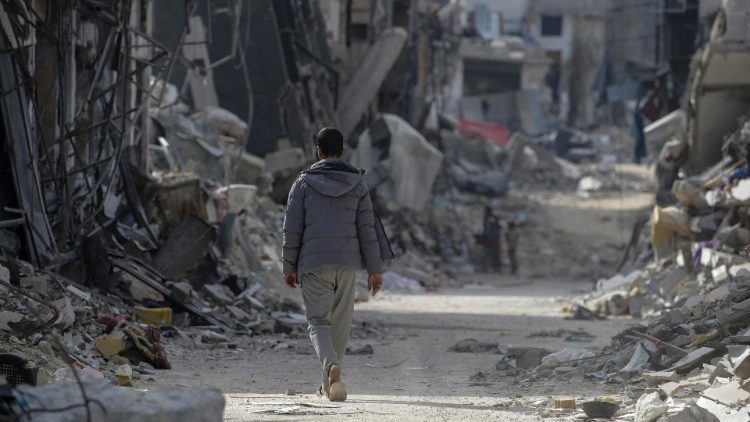
Destruction in Khan Younis, southern Gaza StripDestruction in Khan Younis, southern Gaza Strip  (ANSA)

Pope: ‘Stop spiral of war now! War is always a defeat’

Pope Francis addresses members of ROACO, the Holy See’s humanitarian arm for the Oriental Churches, and renews his plea for peace, calling for solidarity with Eastern Christians fleeing conflicts.

By Lisa Zengarini

Meeting the Reunion of Aid Agencies for the Oriental Churches (ROACO) on Thursday, Pope Francis restated his heartfelt plea for peace in the world, and particularly in the Middle East and Ukraine.

“To those who fuel the spiral of conflicts and reap profit from them, I once again say: Stop! Stop because violence will never bring peace,” the Pope pleaded as he addressed participants in the 97th plenary assembly of the Holy See’s humanitarian arm for the Oriental Churches concluding Thursday.

Focus on Middle East and Ukraine 

The four-day meeting held in the General Curia of the Society of Jesus in Rome included a focus on the dramatic situation in the Holy Land, as well as Ukraine and Ethiopia. Participants also discussed the pastoral care of the many Eastern Catholics outside their territories.


Martyr Churches

In his address, Pope Francis lamented that many Eastern Churches have become “martyr Churches”.

“Just as the Lord’s flesh was pierced by nails and a lance, so many Eastern communities are suffering and bleeding because of the conflicts and violence they endure," he said.

The Pope recalled the Holy Land and Ukraine, but also Syria, Lebanon, the entire Middle East, the Caucasus, and Tigray in Ethiopia. “It is in these very places, where great numbers of Eastern Catholics are found, that the brutality of war is felt most fiercely.”

“Many Eastern Churches are bearing a heavy cross and have become 'martyr Churches'.”

He then renewed his appeal for solidarity. “We cannot remain indifferent," the Pope said.

He encouraged the members of ROACO “to persevere” in their support for the Eastern Catholic Churches, “assisting them, in these dramatic times, to remain firmly rooted in the Gospel.”

The Pope further urged the clergy and religious of Eastern Churches to be ever “attentive” to the cries of their flock, “exemplary” in faith, “putting the Gospel before all forms of dissension or self-interest, and united in service to the common good.”

Pope Francis warmly thanked the representatives of the various agencies of ROACO “for responding to the malign logic of power with the Christian logic of service.” 

"The seeds you plant in fields poisoned by hatred and war,” he noted, “will be a prophecy of a different world, one that does not believe that might makes right, but in the non-violent power of peace.”

“You are sowers of hope, witnesses called to act, as the Gospel tells us, with kindness and discretion.”

Call for a ceasefire in the Holy Land

Referring specifically to the dramatic situation in the Holy Land, Pope Francis reiterated his call on the faithful throughout the world to show their closeness to Christians in the Middle East, encouraging them “to rise above the temptation to abandon their lands torn by conflicts.”

He insisted on the urgent need for a ceasefire in the Holy Land and for dialogue, so as to allow the peaceful coexistence of different peoples in those lands.

“This is the only possible path to a stable future, “he said. “With war, a senseless and inconclusive venture, no one emerges a winner; everyone ends up defeated, because war, right from the beginning, is already a defeat, always.”

“Let us listen to those who suffer its consequences, the victims and those who have lost everything. Let us hear the cry of the young, of ordinary individuals and peoples, who are weary of the rhetoric of war and the empty slogans that constantly put the blame on others, dividing the world into good and evil, weary of leaders who find it difficult to sit at a table, negotiate and find solutions”

Pray for peace in Ukraine and release of prisoners

Pope Francis then turned his thoughts to war-torn Ukraine.

He again called for prayers so that “paths of peace may open for those beloved people, that prisoners of war may be freed, and children repatriated.” 

He also conveyed his “fraternal greetings” to His Holiness Karekin II and to the dear people of Armenia facing conflict

Supporting Eastern Christians living in the diaspora

Bringing his address to a close, Pope Francis referred to the many Eastern Christians fleeing conflicts or migrating in search of work and better living conditions.

He recalled the risk of these diaspora communities “losing their religious identity” and of the precious “spiritual heritage” of the East being "weakened.”

While expressing his gratitude to the Latin dioceses that welcome Eastern Christians, he urged them to show them “particular concern” so that they may keep the Eastern rites alive and flourishing.

He concluded by encouraging the Dicastery for the Eastern Churches to work to this end, “by establishing principles and norms that can help Latin bishops support Eastern Catholics living in the diaspora."

Layoff announcement from USCCB causes concerns

 Bishops' conference layoffs spark wave of concern and speculation


The headquarters of the U.S. Conference of Catholic Bishops in Washington, D.C. (Wikimedia Commons/Farragutful)


The recent announcement of significant layoffs within the U.S. Conference of Catholic Bishops' Department of Justice, Peace and Human Development has sparked a wave of concern and speculation among the Catholic community and the broader public, particularly regarding the implications for the office's ongoing projects and initiatives.

"Needless to say, I am deeply disappointed by this latest development at the conference," said Bishop Joseph Tyson of Yakima, Washington, who sits on the subcommittee of the bishops' Catholic Campaign for Human Development (CCHD). Tyson said he was "saddened" that he heard first about the layoffs only when NCR reached out to him for comments, and not from the U.S. bishops' conference leadership itself.

The Catholic Campaign for Human Development is part of the Department of Justice, Peace and Human Development.

"Selective staff reductions in CCHD may leave the incorrect impression that CCHD staff is at fault. But the CCHD staff is not at fault," Tyson said. "And after our strong backing of CCHD, the optics of a staff reduction seem to contradict our message of strong support."

Bishop Joseph Tyson of Yakima, Washington (CNS/Paul Haring)

Bishop Joseph Tyson of Yakima, Washington (CNS/Paul Haring)

In a June 25 email to NCR, Chieko Noguchi, executive director of the Office of Public Affairs at the bishops' conference, said, "Staff were notified of changes to the structure of the USCCB's Department of Justice, Peace, and Human Development. This reorganization will allow the Conference to align resources more closely with recent funding trends."

Noguchi confirmed this included the loss of jobs, but added, "Since this is a personnel matter, I'm not able to share further information at this time."

Sources close to American Catholic social justice organizations told NCR that the number of laid-off staffers could be as high as 12, about half of the entire department. The U.S. bishops' conference did not respond to questions regarding how many and which staffers have been laid off, and whether their roles will be replaced in the foreseeable future.

NCR also tried to contact some of the staffers in the Department of Justice, Peace and Human Development office directly, but they responded they were not authorized to provide any information on the matter.

Tyson pointed out that questions have persisted over the years regarding the transparency and accuracy of financial reporting, particularly in relation to the Catholic Campaign for Human Development. Tyson suggested that "a 10-year longitudinal study" could provide "valuable insights," allowing for a detailed, frame-by-frame analysis of what transpired and why the bishops' subcommittee remained unaware of certain financial issues.

"I have just finished my 19th year as a bishop and over these many years there have been questions about the quality of financial information shared within the conference and publicly," he said.

Bishop John Stowe of Lexington, Kentucky (CNS/Tyler Orsburn)

Bishop John Stowe of Lexington, Kentucky (CNS/Tyler Orsburn)

According to Bishop John Stowe of Lexington, Kentucky, "The CCHD subcommittee has still not seen a financial report that makes sense."

Stowe, who also sits on the subcommittee, added that he is "sure the approval [regarding the layoffs] was not given at a broader level than the General Secretariat and the Executive Committee," and that it is "absolutely time" for an outside audit of U.S. bishops' conference finances.

The rest of the bishops sitting on the Justice, Peace and Human Development committees and subcommittee did not immediately respond to NCR's requests for comment.

The Justice, Peace and Human Development office encompasses a range of programs dedicated to international and domestic policy; environmental justice; combating racism; and education and outreach, along with overseeing the Catholic Campaign for Human Development. This campaign administers grants to community organizations across the U.S. that aim to address systemic poverty.

As NCR staff reporter Brian Fraga reported earlier in June during the U.S. bishops' spring meeting in Louisville, Kentucky, there were fears of potential cutbacks or elimination of the campaign, raising questions about the bishops' commitment to social justice and anti-poverty initiatives.

However, during a closed-door executive session at the spring meeting in Louisville, the bishops overwhelmingly supported the Catholic Campaign for Human Development, despite financial challenges that may necessitate reduced grant funding. Both lay and religious social justice activists expressed optimism, highlighting the bishops' strong endorsement of the program's anti-poverty mission.

Even though the session's outcome had been seen as a significant victory for social justice advocates within the church, these recent layoffs may constitute a new threat.

Drawing from his experience with PREPARES, a statewide initiative supported by a five-year strategic grant from the Catholic Campaign for Human Development, Tyson emphasized the recurring issue of delayed funding. The program, designed to support mothers and families from conception to a child's fifth birthday, has often faced financial hurdles. Despite the campaign's work in contracting evaluators to monitor progress, there were instances where the local Catholic Charities agencies had to provide cash flow due to delayed grant money, he said.

"From my limited vantage point, the financial side of the USCCB may need to deepen their knowledge and develop better skills in tracking the speed and rate of revenue and expenses — not only for CCHD but other areas of conference work," added Tyson.

Pax Christi USA, the national Catholic peace movement, has expressed disappointment over the decision of the bishops' conference, viewing this move as a severe setback for their collaborative efforts to promote social justice.

Johnny Zokovitch, Pax Christi USA's executive director, emphasized that the U.S. bishops' provision to scale back its social justice initiatives is a "tragedy" that will impact not only domestic partners but also those around the world who rely on these efforts.

"Our faith-filled work for peace, the work to promote Gospel nonviolence and to advocate for those on the margins, those who are impoverished, those who are struggling for justice, is best done together; it is strengthened in community," he said.