Showing posts with label Russia. Show all posts

Monday, August 24, 2026

Meanwhile, the reality for Catholics in Ukraine still suffering from war


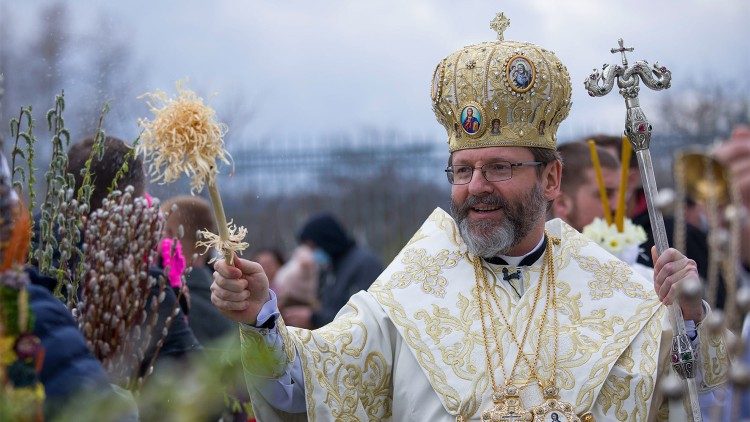
Major Archbishop Sviatoslav ShevchukMajor Archbishop Sviatoslav Shevchuk 

Major Archbishop Shevchuk: Freedom must never be taken for granted

On the day the country celebrates 35 years of independence, the head of the Ukrainian Greek Catholic Church, Major Archbishop Sviatoslav Shevchuk, tells Vatican News about the suffering inflicted on the population by the war and issues a renewed, heartfelt appeal to all the nations of the world for their solidarity.

By Father Taras Kotsur

The Major Archbishop of the Ukrainian Greek Catholic Church, His Beatitude Sviatoslav Shevchuk, lists the figures for July 2026, the “bloodiest month” of four and a half years of war, which has already exacted an unspeakable toll in human lives and destruction.

In the following interview with Vatican News, he condemns the cruelty of the war and the ethical consequences produced by technology, in which the eye of a drone that can precisely see whom it is about to strike makes the notion of “accidental” civilian casualties not only tragic but unacceptable.

He speaks with Vatican Media as Ukraine marks 35 years of independence from Soviet totalitarianism, and emphasizes the value of freedom.

Your Beatitude, it is a great pleasure to hear from you again, especially in this context, when every day we hear of continuing and intense attacks on the Ukrainian capital, including strikes on the part of the city where your cathedral and residence are located. How are you experiencing the current situation?

All of us spent this night in the air-raid shelter, as we have on the nights before, because unfortunately the number of drones and missiles being launched over our heads is increasing. Lately, each month has become bloodier than the one before. For example, according to the United Nations monitoring mission, July was the bloodiest month since March 2022, which was the month with the highest number of casualties during these four and a half years of war. Official statistics say that in July alone, 437 civilians were killed and 2,610 were wounded, with the highest number of children killed and wounded since April 2022.

All the experts who are trying to understand what is happening say that this war is increasingly becoming a high-tech war involving highly sophisticated weapons. Some speak of a “war of the cities.” Why? Because, in practice, the possibility of advancing along the battle line has come to a halt. Advancing along the front has become increasingly impossible and extremely costly for the Russian army. So they are trying to strike civilians, increasing the suffering of people who live especially in the large cities. This is why the capital of Ukraine has become the number-one target. When people try to find historical parallels, many say that what is unfolding in Ukraine is very similar to the Iran-Iraq War of the 1980s, which was truly a war between two peoples who were unable to achieve victory along the front line and therefore sought to increase the suffering of civilians. The other very serious characteristic, from a moral and ethical point of view, is that the high technology being developed uses not only artificial intelligence to determine the point of attack for drones. Today, these deadly drones—and also missiles, which are becoming increasingly sophisticated in targeting civilians—have been equipped with cameras. So an operator guiding a missile or a drone in real time can see the people he is killing.

It is impossible to say that civilian casualties are accidental, unintended victims. For example, the other day a bus was struck in the city of Kherson. Not only the people traveling on that bus were killed, but also people who happened to be nearby. It is obvious that the operator of that drone could see the people he was killing. This is truly a very serious moral problem. It is said that today Russia is seeking to use the suffering of civilians, and even fear itself, as a weapon. What they have been unable to achieve on the battlefield, they are trying to accomplish through this terror inflicted on the major cities. This war is also seeking to turn people's exhaustion, their suffering, including their spiritual suffering, into an instrument of political pressure. Obviously, this is changing the face of the war, which remains, in every respect, a sacrilegious war. Every act of this kind is a crime both against international humanitarian law and against the moral law governing armed conflicts. This is the situation we have been experiencing, especially in the capital, over these past months and days.

In this situation, what does it mean to celebrate 35 years of independence, which coincide precisely with four and a half years since the beginning of this atrocious aggression?

For us, celebrating Ukraine's Independence Day means, first and foremost, thanking the Lord for the gift of freedom, of which the independent Ukrainian state is the guarantor. For Christians, love of one's homeland cannot turn into idolatry of the state. A state governed by the rule of law is an important instrument for protecting human dignity, freedom, the common good, and the people's right to life. Love for one's homeland is not hatred of others; rather, it is the willingness to assume responsibility for one's people and to serve them. Therefore, for us, this day commemorating Ukrainian independence is a day of prayer and reflection on how, today, we must not only defend our freedom but also positively build our future. These days we are also constantly speaking about national unity, because it is a unity around certain fundamental values. The state is an instrument for serving the common good and the dignity of the human person, for ensuring survival, for living freely, and for building our society in peace. Obviously, on this day we will all pray for an end to the war. We know that not only Ukraine's independence is a gift from God, but peace is also a gift from God. We will all be united in prayer, but also in our service to the common good, in our service of saving human lives, especially in the context of the war we are experiencing today

You have spoken about the gift of freedom. In this context, I would like to ask you something personal. You were born during the period of totalitarianism. Your priestly formation began in underground seminaries. What do these 35 years of freedom mean to you personally, especially when you look at young people today, who are already the second generation to have been born during this period of independence?

I had the experience of living through the moment when the totalitarian communist state, which sought to control even people's minds and wills, collapsed into pieces. At that moment, we understood that freedom does not simply mean the possibility of being free externally. We understood that freedom is a spiritual and moral category. I remember that even in the Soviet Union, we Catholic Christians who lived underground were freer than the communist leaders, because we carried this freedom of the children of God in our hearts. And precisely thanks to this ability to be free—to have the courage to think differently from what was imposed by the state communist ideology—the freedom to make decisions, to decide freely, but always according to the criteria of Christian discernment—this, for us, during the Soviet era, was a spiritual school of freedom. Then, when this totalitarian state collapsed, we were able to transmit this inner freedom that we had carried within us into the context of Ukrainian civil society. And so we truly became the leaven of the new society. Our Church truly became an agent of the transformation of Ukrainian society from a post-communist, post-Soviet colonial country into a democratic country. Obviously, this journey will never be something accomplished once and for all. Every day we must demonstrate this Christian freedom and continue on our journey. But here I understood something very profound that belongs to the Byzantine spiritual and theological tradition: freedom is something greater than mere free will. Freedom is the fruit of a good choice, a choice grounded in truth. If I make the right choice, if I choose fundamental values, if I choose what is good, then my free will—which is a potentiality of freedom—is transformed into an experience of freedom. Therefore, helping people make the right choices is a path toward authentic freedom. Not license, not anarchy, but a freedom that is always connected with responsibility and the common good. It is obvious that this understanding of freedom is very much sought after in Ukraine today. It is interesting to note that many of our young men who were prisoners of war, who endured terrible torture while in Russian captivity and were subsequently liberated, said that they felt freer even with their hands bound than those who were torturing them. Why? Because those Russian officers were truly prisoners of their own intellectual frameworks. They were afraid of their superiors. They were afraid of ending up in prison themselves for failing to obey the orders they had received blindly. And our soldiers, at those moments, felt freer even with their hands bound. Why? Because they had made their choice. The right choice. The choice that is always based on truth and on the defense of people's lives. This is our experience from the time of the Soviet Union. It is our experience of a society rebuilding itself after the fall of state totalitarianism. And this is the freedom that the Ukrainian people are seeking to defend and to build ever more deeply in their own free and independent country.

What could be the message of the Ukrainian people to today's world, where we can observe a certain crisis of democracy, with authoritarian tendencies growing in different parts of the world, even in places where one would least expect them?

Do not grow tired of being free! In my view, this crisis of democratic values is connected to a certain crisis of personal responsibility for one's own country. Everyone wants to shift their responsibility onto the shoulders of others. And sometimes people look for a scapegoat, a politician or an autocrat who can take upon themselves the personal duties that each of us has toward our homeland and our country. Sometimes people want to be relieved of the need to think and discern. They want someone else to think, discern, and decide for them. This is a form of infantilism, because that is how children behave when they think that it is always someone else who should build a better future for them. The flight from responsibility, in my view, is one of the great scourges of modern democracies. That is why I am struck by the fact that today the Church is increasingly becoming a guarantor and defender of democratic values, because the Church affirms the dignity of every human person. It is precisely the Church that is protecting human beings, within today's culture, from dehumanization at every level, beginning today with the challenge posed by artificial intelligence. It is precisely the Church that says that no one should have the right to steal other people's dreams and hopes for their future for the sake of their own interests. On the contrary, we ourselves are the builders of our own lives and our own future. Do not be afraid to be free. This is the fundamental message that Ukraine can send to the whole world today. Even if this freedom has to be defended. Because freedom cannot be taken for granted. Those who are unwilling to take the risk of embracing freedom and living as free men and women are not worthy of this gift of freedom.

As a pastor of a portion of the faithful in Ukraine and also in other parts of the world, what appeal would you like to address to the universal Church on the occasion of this anniversary of independence?

The highest expression of freedom is the human being's capacity to love. To love God and to love one's neighbor. Today in Ukraine, we see that the national unity that led us toward national independence can be defended only through mercy: the capacity to empathize with those who suffer, the capacity to show mercy toward those who make mistakes, but also our capacity to do good to our neighbor. Therefore, we must not forget that the greatest experience of freedom comes when we love God and our neighbor. I would like to thank all those who, on Ukraine's Independence Day, August 24, will join us in prayer. I would like to recall that the All-Ukrainian Council of Churches has issued an appeal to the World Council of Churches, and has also written a letter to Pope Leo and to all men and women of good will, asking them to observe August 24 as a day of prayer for peace in Ukraine. All of us in Ukraine will be united in prayer on that day. We, the heads of Churches and religious organizations, will gather in the oldest cathedral in Eastern Europe, Saint Sophia Cathedral in Kyiv. There is an eleventh-century mosaic of the Oranta, the Praying Virgin Mary. Before this mosaic of the Kyiv Oranta, we will pray for peace. We ask for your solidarity and unity in prayer, but also in humanitarian action, which for us today is an excellent way of demonstrating our love for God and for our neighbor. 

While the Roman Catholic Church is very small in Russia, the Vatican continues outreach and dialogue with the Russian people


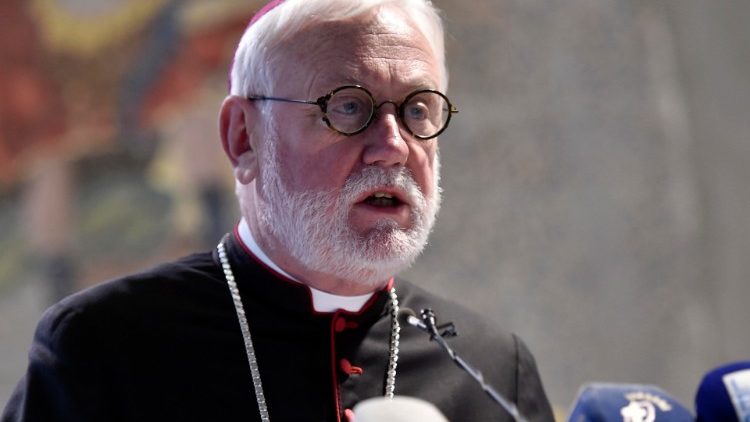
Archbishop Paul RIchard GallagherArchbishop Paul RIchard Gallagher  (ANSA)

Archbishop Gallagher begins visit to Russia

A post on X by the Secretariat of State announces the programme for the Secretary for Relations with States and International Organizations, who arrives in Moscow today for a mission focused on dialogue and peace.

By Vatican News

Busy days lie ahead, with meetings with Russian authorities, representatives of the Moscow Patriarchate and the Catholic community.

This is the program for the visit to the Russian Federation by Archbishop Paul Richard Gallagher, Holy See Secretary for Relations with States and International Organizations, announced in a post on X by Terza Loggia, the account of the Secretariat of State.

The Archbishop arrives in Moscow today and will return to Rome on 28 August.

Tomorrow, Tuesday 25 August, the Archbishop will meet Sergey Lavrov, Minister of Foreign Affairs of the Russian Federation, followed by a meeting with Metropolitan Anthony of Volokolamsk, Chairman of the Department for External Church Relations of the Moscow Patriarchate.

The following day, Wednesday 26 August, Archbishop Gallagher will meet Yuri Ushakov, Aide to the President of the Russian Federation for Foreign Policy.

The schedule confirms the Holy See’s determination to continue along the path of dialogue, even at one of the most difficult moments in international relations at the global level.

Archbishop Gallagher’s visit will also provide an opportunity to meet the Catholic community, whom he will see on Thursday 27 August.

The day will begin with a meeting with the clergy, religious men and women, followed by the celebration of Mass at the Cathedral of the Immaculate Conception of the Blessed Virgin Mary in Moscow.

Afterwards, the Secretary for Relations with States and International Organizations will meet with the Bishops.

The Catholic Church in Russia is a numerically small community and is geographically dispersed across a vast territory. Its territorial organization comprises the Archdiocese of the Mother of God in Moscow and the dioceses of St Clement in Saratov, the Transfiguration in Novosibirsk and St Joseph in Irkutsk.

This is not the first time Archbishop Gallagher has travelled to the Russian capital. His most recent visit took place in November 2021. On that occasion, the Archbishop met Prime Minister Mikhail Mishustin, Foreign Minister Sergey Lavrov and the then head of the Department for External Church Relations of the Moscow Patriarchate, Metropolitan Hilarion.

Sunday, August 9, 2026

After the Angelus Address, Pope Leo XIV prays for an end to violence; particularly in Sudan, Ukraine; and reflects on visit to Assisi


Ukrainian rescuers work at the site of a Russian strike on a residential area in downtown Odesa, Ukraine, August 9, 2026Ukrainian rescuers work at the site of a Russian strike on a residential area in downtown Odesa, Ukraine, August 9, 2026  (ANSA)

Pope: Stop the spiral of violence and make room for diplomacy

Following the recitation of the Angelus, Pope Leo XIV expresses his concern over the ongoing violence in Sudan, Ukraine, and Russia. He calls for the conversion “of those who sow violence” and an end to “an ever-growing number of civilian casualties.”

By Kielce Gussie

Following the recitation of the Angelus prayer on Sunday, Pope Leo XIV expressed his concern over the ongoing situation in Sudan, referring in particular to the city of el-Obeid.

“In expressing my spiritual closeness to all the people of the nation, I renew my appeal to those in authority to guarantee humanitarian corridors for the civilian population,” he stressed. At the same time, the Pope called on the international community “to support efforts aimed at bringing about an immediate ceasefire.”


A damaged interior view of the Agricultural Bank of Sudan after it was reportedly targeted by the Rapid Support Forces in el-Obeid on July 27, 2026 (AFP or licensors)

He urged everyone to pray that the Lord will support and sustain everyone suffering, “convert the hearts of those who sow violence, and grant the long-awaited peace.”

Preventing another humanitarian catastrophe

The United Nations is warning the global community that el-Obeid is in danger of becoming Sudan’s next humanitarian catastrophe. People report running out of food, water, and medical supplies following months of siege as drones continue to strike and sexual violence has become more common.

Sudanese children trying to get leftover food from an empty pot in a camp for displaced people near the city of el-Obeid (AFP or licensors)

Fighting continues in and around the capital city of the North Kordofan state as el-Obeid is situated along a strategic corridor in central Sudan and on the road to the western Darfur region of the country.

More than 14 million people have been displaced across Sudan, and millions live in hunger after three years of conflict.


'War only breeds more war'

Continuing his appeals, Pope Leo drew attention to the many innocent lives lost and people wounded in Ukraine and Russia. He highlighted how “tragic episodes” are not only continuing but are multiplying, leading to an increasing number of civilian casualties.

“I stand with the families of the victims, the wounded, and all those who are suffering as a result of the ongoing conflict,” the Pope said.

In the midst of this ongoing conflict, he renewed his heartfelt appeal for international humanitarian law to be respected and for people on both sides stop attacks that involve civilians as targets.

“War only breeds more war and causes immense suffering,” Pope Leo stressed. “It is time to stop the spiral of violence and make room for diplomacy and dialogue, paving the way for peace.”

Young people: Be inspired by the saints

After greeting groups from around Italy, the Pope highlighted the presence of many youth groups in St. Peter's Square. He noted that they have chosen to "devote some of their vacation days to activities that foster personal growth and friendship as a sign of hope." In particular, he recalled his meeting with young people at the Franciscan meeting in Assisi on August 6.

Pope Leo greeting young people in Assisi during his visit on August 6 (@VATICAN MEDIA)


Pope Leo encouraged the young people to look to the saints on the liturgical calendar these days as examples: Saint Dominic, Saint Teresa Benedicts of the Cross, Saint Lawrence, and Saint Clare of Assisi.

"Dear young people," the Pope said, "let yourselves be inspired and enthused by these exemplary witnesses to the Gospel!"

Sunday, April 19, 2026

Pope Leo XIV asked today for prayers for peace in Lebanon and for the war to stop in Ukraine


Ukrainians in the aftermath of an attack Ukrainians in the aftermath of an attack

Pope Leo appeals for dialogue to end wars in Ukraine and Middle East

Speaking at the Regina Coeli after Mass in Angola, Pope Leo XIV expresses closeness to the people of Ukraine amid intensified attacks and appeals for dialogue and diplomatic efforts in Lebanon.

By Linda Bordoni

Pope Leo XIV on Sunday renewed his appeal for a path of dialogue to be pursued in Ukraine, which is under increased Russian attacks, and in the Middle East, where he said, a ceasefire in Lebanon is "a sign of hope."

He was speaking during the Regina Coeli address after Holy Mass in the Kilamba district of Luanda in Angola on Sunday, on the second day of his visit to the southern African nation.

Appeal for diplomatic solution to Ukraine war

“I deeply regret the recent intensification of attacks against Ukraine, which continue to affect the civilian population,” the Pope said, and he expressed his closeness and prayers to all who are suffering.

“I renew my appeal for the weapons to fall silent,” he added, “and for the path of dialogue to be pursued.”

The past week has seen Russia launch the deadliest attacks in months on Ukraine, with more than 700 drones in multiple waves, killing at least 18 people in Odesa, Dnipro and Kyiv. The intensification of strikes came after a brief ceasefire took place during the Orthodox Easter last weekend, although both sides accused each other of hundreds of violations.

Truce in Lebanon a sign of hope

Pope Leo went on to say that “the announced truce in Lebanon is a sign of hope, offering relief to the Lebanese people and to the wider Levant.”

“I encourage those engaged in seeking a diplomatic solution to continue along the path of peace, so that the end of hostilities throughout the Middle East may become lasting,” he appealed.

A 10-day ceasefire came into effect on Thursday between Israel and Lebanon, announced earlier in the day by the U.S. President. Israeli attacks targeting Hezbollah in Lebanon have killed almost 2,000 people, injured thousands and displaced tens of thousands.

United in prayer

Pope Leo, who is in Angola on the third leg of his four-nation apostolic journey to the African Continent, concluded the celebration of Holy Mass in Luanda’s Kilamba esplanade, inviting the faithful to join him in prayer.

“With this joyful hymn, we do not wish to silence or drown out the cry of those who suffer,” he said, “Rather, we seek to embrace it and join it to our own voices in a new harmony, so that even in pain the light of faith may remain alive, and with it the hope for a better world.”

Noting that Christ conquered death, he said that “united with him and in him as one body”, we must “strive today and every day to foster around us the fruits of Easter: love, true justice, and peace, beyond every obstacle and difficulty."

“May the Mother of Jesus, Mother of the Heart, help us always to feel alive and strong within us, the presence of her risen Son close at hand.”

Sunday, February 22, 2026

Pope Leo XIV renews urgent call for peace in the ongoing war against Ukraine


Aftermath of overnight Russian strikes on Kyiv and surrounding districtsAftermath of overnight Russian strikes on Kyiv and surrounding districts  (ANSA)

Pope Leo: Peace is urgently needed, requiring responsible decisions

After the Angelus prayer, the Pope strongly renewed his appeal for the silencing of arms and the cessation of bombings. "Let an immediate ceasefire be reached and let dialogue be strengthened to pave the way toward peace," said the Pope, marking four years since the start of the war against Ukraine. Peace cannot be postponed, he emphasized: "Every war is truly a wound inflicted upon the entire human family; it leaves in its wake death, devastation and a trail of pain that marks generations."

By Antonella Palermo

"Let the weapons fall silent, let the bombings cease, let an immediate ceasefire be reached, and let dialogue be strengthened to pave the way toward peace."

Four years after the start of the war against Ukraine, the Pope’s heart went out to the people living through such suffering devastation, which Pope Leo recalled following the Angelus prayer from the Apostolic Palace window, a war that is "unfolding before the eyes of the whole world."

“So many victims, so many lives and families shattered, such immense destruction, such unspeakable suffering! Every war is truly a wound inflicted upon the entire human family; it leaves in its wake death, devastation and a trail of pain that marks generations. Peace cannot be postponed. It is an urgent necessity that must find a home in our hearts and be translated into responsible decisions.”

United in prayer

The Pope strongly encouraged everyone to "join in prayer for the embattled people of Ukraine and for all those who suffer due to this war and every conflict in the world, that the long-awaited gift of peace may shine upon our days."

Repeated appeals for peace

Today’s appeal, on the fourth anniversary of the start of Russia's large-scale invasion of Ukraine, carries a bitter aftertaste, but nonetheless continues to keep hope alive. This has been the case since the poignant pleas of Pope Francis for peace in the heart of Europe were consistently raised, accompanied by his great concern for the martyred Ukrainian people. This expression has become familiar to many. The pleas were reiterated by Leone XIV right after his election when he called the war "senseless" and emphasized the urgency of reaching "an authentic, just, and lasting peace as soon as possible."

The release of all prisoners and the return of children to their families have been recurring themes in the Pope’s prayers. Now, the intense cold of winter, which exacerbates the damage caused by the bombings, particularly concerns him. “May the clamor of weapons cease, and may the parties involved, with the support and commitment of the international community, find the courage to engage in sincere, direct and respectful dialogue” he stated in his Christmas Urbi et Orbi message.

Heartfelt solidarity with the victims of war

Continuing the solidarity shown by his predecessor for the Ukrainian population, Pope Leo has sent repeated humanitarian assistance from the Papal Almoner to Ukraine. He also spoke by phone with Russian President Vladimir Putin, received associations working closely with war victims, mothers and wives of Ukrainian soldiers at the front, children and young people deprived of opportunities. He has also met with beneficiaries of emergency refuge, and met with Ukrainian pilgrims, praising the faith of a land rich with "the testimony of many saints" and "the blood of many martyrs."

During an audience with Ukrainian President Zelensky last December, he reiterated the Holy See’s willingness to host negotiations. He has even contemplated a visit to Kyiv, though he acknowledged the necessity of prudent realism. In the face of the escalation of an increasingly hybrid conflict, with significant damage to civilians and infrastructure, upon returning from his first international trip, he emphasized the importance of European and Italian involvement. “Serious commitment to dialogue,” he hoped for at the end of August, while, for the anniversary of Ukraine’s national holiday, he expressed "with a heart wounded by violence" his condolences to the families of the fallen and to the displaced people.

Wednesday, February 4, 2026

Pope Leo XIV expresses concern for the beleaguered people of Ukraine; urges a renewal for the New START treaty


A damaged residential building struck by a Russian attack in Odesa, UkraineA damaged residential building struck by a Russian attack in Odesa, Ukraine  (AFP or licensors)

Pope calls for prayers for Ukraine, renewed commitment to nuclear disarmament

Pope Leo XIV asks for prayers for the people of Ukraine, who continue to suffer the consequences of war exacerbated by freezing temperatures, and appeals for a renewed international commitment against the proliferation of nuclear weapons, as the New START treaty is due to expire.

Vatican News

Pope Leo XIV on Wednesday renewed his appeal for prayer and solidarity with the people of Ukraine, who continue to suffer the consequences of the conflict, and highlighted the need to renew the “New START treaty” against nuclear proliferation that is due to expire.

Speaking during the General Audience, the Pope said, “I urge everyone to support our brothers and sisters in Ukraine with prayer, as they are being severely tested by the consequences of bombardments that have once again begun to strike energy infrastructure as well.”

He went on to express his gratitude for concrete gestures of solidarity and thanked the Catholic dioceses of Poland and other countries “which are working to help the population endure during this time of intense cold.”

Expiration of New START

The Pope then turned his attention to international security, recalling the “New START Treaty,” signed in 2010 by the Presidents of the United States and the Russian Federation, which he said is due to expire on Thursday.

Highlighting that the agreement represents an important step in limiting the proliferation of nuclear weapons, Pope Leo reaffirmed his encouragement for all constructive efforts in support of disarmament and mutual trust.

“I issue an urgent appeal that this instrument not be allowed to lapse without seeking to ensure a concrete and effective follow-up,” he said.

The current situation, he continued, “demands that everything possible be done to avert a new arms race that would further threaten peace among nations.”

The Pope stressed the urgency of moving beyond a logic rooted in fear and mistrust. In its place, he called for a shared ethic capable of guiding decisions toward the common good, “so that peace may become a responsibility and a heritage safeguarded by all.”

What is New START?

The Pope’s appeal to limit nuclear proliferation comes as experts express concern that the end of New START could lead towards a dangerous and costly arms race between the world’s biggest nuclear powers.

New START, (the New Strategic Arms Reduction Treaty), which was initially agreed upon in 2010 and extended for five years in 2021, limited US and Russian deployed strategic nuclear weapon arsenals. The treaty defines strategic nuclear weapons systems as those that are “intercontinental in range.”

The Treaty limited the number of strategic nuclear weapons for the United States and Russia. It also required regular short-notice, on-site inspections and biannual data exchange between the two countries.