Showing posts with label annulments. Show all posts

Friday, January 31, 2025

Pope tells the Roman Tribunal to exercise charity in annulment cases


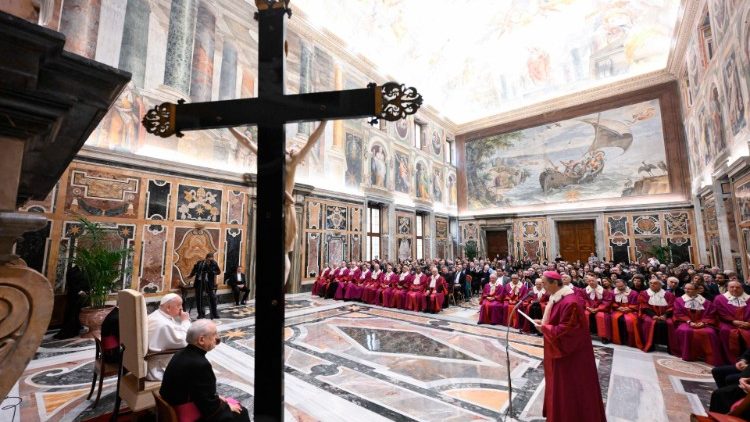
Pope with the officials of the Roman Rota at the inaguration of the Judiciary YearPope with the officials of the Roman Rota at the inaguration of the Judiciary Year  (VATICAN MEDIA Divisione Foto)

Pope to Roman Rota: ‘Discern annulment cases with charity’

In his address to the Roman Rota for the opening of the Judicial Year, Pope Francis says, Pope Francis calls upon judges to exercise prudence, justice, and charity, remarking that every just ruling contributes to strengthening the culture of indissolubility affirmed by the Church’s teaching on marriage.

By Lisa Zengarini

Pope Francis reiterated Friday the critical importance of simplifying processes of annulment of marriages and of making them more accessible while upholding the Church’s teachings on the indissolubility of marriage.

“We are called by the pain and hope of many faithful who seek clarity regarding the truth of their personal condition and, consequently, their possibility of fully participating in sacramental life,” the Pope said as he addressed the officials of the Roman Rota, the Vatican’s highest judicial tribunal, at the beginning of their Judicial Year.

The implementation of the 2015 marriage annulment reform

This year marks the tenth anniversary of his two Moti Propria  ‘Mitis Iudex Dominus Iesus’ and ‘Mitis et Misericors Iesus’, which reformed the process for annulments, empowering diocesan bishops to act as judges to nullify marriages, eliminating the requirement that the Roman Rota sign off with its own sentence. That measure also pushed for making the procedure free.

In his remarks, Pope Francis reminded the audience that his move was inspired by the deliberations of the Synodal Fathers in 2014, who emphasized the urgent need for more accessible and streamlined procedures, moved by a pastoral concern to ensure that Church structures remain close to the faithful and serve their spiritual needs effectively.

An expression of the Church's concern for the salvation of souls

A crucial point of the reform was the central role of the diocesan bishop. Giving the bishop the power to grant annulments through the shorter process (processus brevior) in cases where nullity is manifest, the Pope explained, is an expression of the Church’s concern for the salvation of souls (salus animarum).

Noting that many faithful are often unaware of this possibility, the Pope stressed the need to inform them and reaffirmed that the procedures should be free of charge to reflect the gratuitous love of Christ.

Need for competence

Pope Francis also underscored the importance of ensuring that diocesan tribunals are well-structured, with adequately trained clerics and laypeople so “they can carry out their work with justice and diligence.”

The quality of formation—both intellectual and spiritual—is therefore crucial in guaranteeing that faithful receive a just and careful examination of their cases, he said, reiterating that the reform must continue to be guided by the concern for the salvation of souls as stated in “Mitis Iudex”.

“Investing in the formation of these personnel—scientifically, humanly, and spiritually—always benefits the faithful, who have the right to careful consideration of their requests, even when they receive a negative response.”

Streamlining procedures and making them more accessible

A key theme of the speech was the balance between justice and pastoral sensitivity.

The reform, the Pope explained, was not designed to increase the number of annulments but to prevent prolonged uncertainty that could burden the faithful in line with the previous reform introduced by Pope Saint Paul VI in 1975. By abolishing the requirement for double-conforming sentences,  the 2015 reform aimed to prevent unnecessary legal complexities from obstructing access to truth and justice.

“The reform is not aimed at increasing the nullity of marriages but at expediting processes, ensuring a just simplicity so that, due to delayed rulings, the hearts of the faithful awaiting clarity about their status are not long oppressed by the darkness of doubt”

A pastoral service 

Warning against the danger of an excessively legalistic approach, Pope Francis, therefore, called upon the judges to exercise prudence, justice, and charity, ensuring that their work serves the real needs of the people rather than being an abstract legal exercise. “There is an intimate connection between prudence and justice, as the exercise of prudentia iuris aims at knowing what is just in a concrete case,” he said.

The judges’ work in discerning the validity of marriage, therefore, is not merely a legal duty but a pastoral service to the salvation of souls, “as it enables the faithful to know and accept the truth of their personal reality”, thus contributing to strengthening the culture of indissolubility, affirmed by the Church’s teaching on the sacredness of marriage.

Concluding Pope Francis encouraged the officials of the Roman Rota in their mission, reminding them that their work is ultimately one of hope: “helping individuals to purify and restore interpersonal relationships.”

Thursday, January 25, 2024

Pope discusses annulment cases with the Vatican's appeals court


The Inaugauration of the Judicial Year of the Tribunal of the Roman RotaThe Inaugauration of the Judicial Year of the Tribunal of the Roman Rota  (VATICAN MEDIA Divisione Foto)

Pope to Roman Rota: Discern annulment cases 'with prayer, on your knees'

Pope Francis inaugurates the Vatican's judicial year and urges officials of the Tribunal of the Roman Rota, an appeals court, to pray fervently as they discern cases that hit their docket.

By Joseph Tulloch

On Thursday, Pope Francis addressed officials from the Vatican’s Tribunal of the Roman Rota, an appeals court. 

In a speech delivered to mark the inauguration of the Judicial Year in the Vatican City State, the Pope discussed the process of discernment as it applies to annulment cases.

He discussed the tension between justice and mercy, the importance of prayer for the judges' work, and the close relationship between judicial discernment and synodality.

The centrality of prayer

“Without prayer," Pope Francis stressed, “one cannot be a judge. If any of you are not praying, please resign... That would be better.”

He went on to underline that "discernment is done on one’s knees, imploring the gift of the Holy Spirit; only in this way can decisions be reached that promote the good of individuals and the entire Church community.”

“I ask each one of you," Pope Francis said, "Do you pray? Do you feel with the Church? Are you humble in prayer, asking the Lord for light?”

“I come back to this," the Pope emphasised. "A judge's prayer is essential to his task. If a judge does not pray or cannot pray, he had better go and do another job.”

A great responsibility

The Pope then went on to stress the importance of the responsibility facing the judges of the Rota, who must decide whether to grant annulments when they have been contested in lower courts. 

Achieving the "moral certainty" necessary to make such decisions, the Pope said, is no easy feat. 

Officials of the Tribunal, he noted, have thus been entrusted with a “great responsibility” by the Church, because these decisions “powerfully influence the lives of individuals and families.”

2015 reform of annulments

Pope Francis also commented on his 2015 reform of annulment proceedings, which implemented various measures to speed up the process.

This move, he said, was “inspired by mercy towards the faithful in problematic situations.”

At the same time, however, he said, it ought not to be misunderstood: its aim was to favour “not the annulment of marriages, but the speed of processes.”

Justice and mercy

This led the Pope to discuss the tension between justice and mercy, a theme he has often returned to during his pontificate.  

“Highlighting the importance of mercy in family pastoral work, as I did in particular in the Apostolic Exhortation Amoris Laetitia,” he said, “does not diminish our commitment to seeking justice in annulment cases.”

Rather, he noted, quoting St. Thomas Aquinas: “Mercy does not take away justice, but is the fullness of justice.”

The synodal dimension

Finally, Pope Francis stressed that the process of judicial discernment is “supported and guaranteed” by synodality.

“When the tribunal is collegial,” he said, “or when there is only one judge but he consults with those in authority, discernment takes place in an atmosphere of dialogue or discussion in a common search for truth.”

The Pope brought his address to a close by entrusting the work of the judges to "Most Holy Mary, Virgo prudentissima e Speculum iustitiae," the Most Wise Virgin and Mirror of Justice.

The full text of Pope Francis' address can be accessed here. 

Friday, November 26, 2021

Pope Francis pushes even more annulment reforms


Pope Francis expedites reforms of marriage annulment processes in Italy. Pope Francis expedites reforms of marriage annulment processes in Italy.  

Pope ensures application of marriage annulment reforms in Italy

Pope Francis issues Motu Proprio, setting up a new commission to verify and implement new rules for marriage annulment cases in Italian dioceses.

Vatican News

Six years ago in September 2015, Pope Francis issued the Motu proprio Mitis Iudex Dominus Iesus (The Gentle Judge, our Lord Jesus), introducing new rules to streamline the process for obtaining marriage annulments, addressing complaints that the proceedings in marriage tribunals were too cumbersome, complicated, and expensive.

Motu Proprio

On Friday, the Pontiff made a further move in this area, issuing a motu proprio to establish a commission to verify and help the implementation of the reform in Italy, so as to give "new impetus" to those rules.

The purpose of the commission, which has been set up at the Roman Rota with the participation of a bishop of the Italian Bishops' Conference (CEI), is to "support the Churches in Italy to welcome the reform". The Holy Father recalls that the bishop has received the power to judge marriage cases, and stressed again that "the judicial ministry" of the bishop "by its very nature postulates closeness between the judge and the faithful", thus giving rise to "at least an expectation on the part of the faithful" to be able to turn to their bishop's court "according to the principle of proximity".

Recalling the norms issued in 2015, the Pope in his new Motu Proprio, dated November 17, reiterates that although diocesan bishops are permitted to have access to other tribunals, this faculty should be considered an exception and therefore every bishop "who does not yet have his own ecclesiastical tribunal, must seek to erect it or at least work to ensure that this becomes possible".  He says that the equal distribution of the human and economic resources to the dioceses for the exercise of judicial power, will be a stimulus and help individual bishops to put the reform of the marriage annulment process into practice.

Pope Francis reiterates what he already indicated in his address to the Italian Bishops' Conference in May 2019: "The reform drive of the canonical marriage annulment process - characterized by proximity, speed, and gratuitousness of the procedures - necessarily passes through a conversion of structures and persons".

A new Pontifical Commission

To encourage this "conversion", six years after the new norms came into force, the Pope set up a Pontifical Commission at the Tribunal of the Roman Rota, to verify and help all the particular Churches in Italy. The Commission will be chaired by the Dean of the Rota, Father Alejandro Arellano Cedillo, and will include the two Rota judges, Vito Angelo Todisco and Davide Salvatori, and Bishop Vincenzo Pisanello of Oria.

The Commission's task will be "to ascertain and verify the full and immediate application of the reform" in Italian dioceses. It will “suggest to the same dioceses what is considered appropriate and necessary to support and help the fruitful continuation of the reform, so that the Churches in Italy may show themselves to the faithful as generous mothers, in a matter closely linked to the salvation of souls", which has also been encouraged by the Extraordinary Synod on the Family.

At the end of its work, the Commission will draw up a detailed report on the application of the new rules on marriage annulment cases in Italy.

Sunday, April 8, 2018

The critics gathered and have spoken, sure to be championed by a few, ignored by most; will Pope Francis respond?

‘Amoris’ critics at Rome summit beg pope, bishops, ‘Confirm us in the faith!’

‘Amoris’ critics at Rome summit beg pope, bishops, ‘Confirm us in the faith!’
Participants in an April 7, 2018, summit of opposition to Pope Francis's document "Amoris Laetitia." (Credit: Crux/John Allen.)
Participants in an April 7 summit of opposition figures to Pope Francis's "Amoris Laetitia" finished by asking the "pope and the bishops to confirm us in the faith."
ROME - At a Rome summit on Saturday of the most ardent opposition figures to Amoris Laetitia, Pope Francis’s controversial 2016 document on the family, lay participants issued a final declaration broadly rejecting the teaching that divorced and civilly remarried Catholics may receive Communion and imploring “the pope and the bishops to confirm us in the faith.”
Their final conclusions, issued Saturday towards the end of the summit, which attracted several hundred people to a Rome hotel near the Vatican, were the following:
  1. “We witness and profess in accord with the authentic confession of the faith that a consummated marriage can be dissolved only by death.”
  2. “Christians who unite with another person if their spouse is still living commit a great sin.”
  3. “We are convinced that this is a norm that applies always and  without exception.”
  4. “We are convinced that no subjective judgment of conscience can render an evil action good.”
  5. “Forgiveness is based on an intention to abandon a way of life that is contrary to the divine commandments.”
  6. “The divorced and remarried who live together may not receive Eucharistic Communion.”
There was a strong sense at the summit that although their position may represent a minority, it cannot be ignored.
“Experience through history teaches us that truth is not necessarily with the majority, with big numbers,” German Cardinal Walter Brandmuller said. “Often in the history of the people of God it wasn’t the majority but rather a minority that authentically lived out the faith.”
He cited the case of the Arian heresy, a fourth century movement that believed Christ was not fully divine, which once was upheld by a substantial majority of Christians at the time.
One of four cardinals who asked the pope for clarification two years ago strongly hinted that the time for waiting for an answer is over.
“As history demonstrates, it’s possible that a Roman pontiff exercising his fullness of power can fall into heresy or fail in his first duty of safeguarding and preserving the unity of faith and the discipline of the Church,” said American Cardinal Raymond Burke.
Burke was one of four cardinals who submitted five critical questions to Francis after Amoris appeared, technically known as dubia. One of the other four, Brandmüller, was also on hand, while two others have died - German Cardinal Joachim Meisner and Italian Cardinal Carlo Caffarra.
It was an Italian association known as the “Friend of Cardinal Caffarra” who organized Saturday’s event. There was a strong presence of a major Italian pro-life movement, and one recurrent theme throughout the day was the importance of Humanae Vitae, Blessed Pope Paul VI’s 1968 encyclical upholding the Church’s opposition to artificial birth control, the 50th anniversary of which falls this year.
At one point, a video commentary by Caffara, who died in September 2017, was played, in which he said: “Humanae Vitae remains the light Paul VI turned on forever.”
The name of the event was “Catholic Church, Where are You Going?” It invoked a quote from Caffarra, “Only a blind man could deny there’s great confusion in the Church today.”
Burke insisted on the right to stand up to an erring pope.
“Since the pope can’t be subject to a judicial process, the situation has to be addressed and remedied based on natural law, the gospels, and canonical tradition, and that’s a two-step process,” Burke said, speaking to a crowd of several hundred people gathered at Rome’s Church Village Hotel, located about two miles from the Vatican.
“First, one corrects the presumed error or abandonment of duty directly to the Roman Pontiff,” Burke said. “If he doesn’t respond, then one proceeds to public correction.”
At that point, a contingent in the crowd leapt to their feet and began shouting, “People of God, stand up! We are the ones who have to act!”
“As a matter of duty, the pope can be disobeyed,” Burke said. “There’s an abundant body of literature on the theme.”
“The pope’s authority is not magical,” Burke said. “It derives from his obedience to the Lord,” once again drawing strong applause from the crowd gathered in a hotel ballroom.
Earlier, Brandmüller argued that the teaching of Amoris Laetitia cannot be considered an authentic “development of doctrine,” basing his argument on the theological writings of the 19th century English convert Cardinal John Henry Newman.
The “sense of the faithful,” Brandmüller said, “cannot be understood as a poll or a plebiscite, that’s impossible. The Church is not a democratically constituted society, it’s the corpus misticum (“mystical body”), to which the faithful are united as members of that body.”
“What does it mean when our parish communities today applaud when our priests announce their upcoming wedding?” he asked, to strong applause. “What does it mean when at the 1968 Katholikentag,” referring to a major festival of lay Catholics in German-speaking countries, they reacted with excessive text explosions of hate against Humane Vitae?”
The reference is to landmark 1968 encyclical letter from Blessed Pope Paul VI, affirming the Church’s opposition to artificial birth control.
“In these and analogous cases, it seems evident that the sensus fidelium can’t be compared to the general will of Rousseau,” he said, referring the “sense of the faithful,” the idea that all Catholics participate in both shaping and protecting doctrine. “For instance, there are Catholics who consider it legitimate to remarry after divorce and to use contraception.”
“Among the criteria for distinguishing organic development [of doctrine], Newman included the indispensable absence of contradiction with respect to authentic tradition,” Brandmüller said. “The authentic mode of participating in the sensus fidelium means excluding all those who call themselves Catholic but who can’t claim to have taken seriously what it means.”
Brandmüller suggested the questionnaires distributed prior to two Synods of Bishops called by Francis, in October 2014 and 2015, were not legitimate instances of the sensus fidelium, because they were subject to “manipulation” by “single groups.”
Instead, he pointed to 140,000 Catholics in Poland who signed a petition asking bishops to protect them from “German errors,” such as the teaching in Amoris Laetitia, in which German-speaking prelates are seen as having played a key role.
“These are the forms in which today the sensus fidelium is manifest, it’s the instinct of faith of believing people, and the magisterium should pay attention,” Brandmüller said, once again generating cheers.
Making a case that papal power is not absolute, Burke rejected what he called the “facile response” of many to papal teaching, “as if because the Holy Father says something, one must accept whatever papal teaching comes.”
“It’s always been clear that the Roman pontiff can dispense with the law only for the purpose of preserving its purpose, and never for subverting it,” he said, again eliciting a round of applause.
“It’s axiomatic that any power given by Christ to his Church is for the purpose of realizing the ends for which he founded it, not for contesting them,” Burke said, “It can only be exercised within these terms. It’s not a license for arbitrary government.”
Burke said that at the synod some bishops argued that the pope’s power would allow him to take the step he did in Amoris Laetitia, but he scoffed at the logic.
“As if that power would permit the pope to make a decision in open contrast to Matthew 19,” he said, referring to Christ’s prohibition of divorced in the gospels, “and the constant teaching of the Church in fidelity to those words.”
“Any act of a pope, given that he’s a human being, that’s heretical or sinful, in itself is null,” he said.
Auxiliary Bishop Athanasius Schneider of Kazkhstan, who led his country’s two other Catholic bishops in taking a strong anti-Amoris stand in January, emphasized the duty of popes to be “custodians” of authority.
Schneider then invoked a supposed oath that many traditionalist Catholics believe newly elected popes took for centuries, up to Blessed Pope Paul VI in 1963. In the form in which it’s usually cited, its first article is: “I vow to change nothing of the received Tradition, and nothing thereof I have found before me guarded by my God-pleasing predecessors, to encroach upon, to alter, or to permit any innovation therein.”
Many Church historians, however, regard the oath as myth, saying there’s no evidence it was ever administered or incorporated into papal coronation ceremonies.
Nevertheless, Schneider said, “I think it’s urgent to revive this formula of papal swearing-in in our days,” triggering another round of strong applause and cries of Bravo! Bravo!

Sunday, September 24, 2017

Happy Sunday Morning as select 60 uber conservative Catholics formally accuse the Pope of spreading heresy


Conservative Catholics accuse pope of spreading heresy

Pope Francis talks to an infant during his visit to the Santa Lucia Foundation in Rome, Friday, Sept. 22, 2017. (L'Osservatore Romano/Pool Photo via AP)
Pope Francis talks to an infant during his visit to the Santa Lucia Foundation in Rome Friday  (L'Osservatore Romano/Pool Photo via AP)
More than 60 Roman Catholic theologians, priests and academics have formally accused Pope Francis of spreading heresy after the pontiff opened the door last year to allowing divorced and civilly remarried Catholics receive Communion.
In a 25-page letter delivered to Francis last month and provided Saturday to The Associated Press, the 62 signatories issued a "filial correction" to the pope — a measure they said hadn't been employed since the 14th century.
–– ADVERTISEMENT ––

The letter accused Francis of propagating seven heretical positions concerning marriage, moral life and the sacraments with his 2016 document "The Joy of Love" and subsequent "acts, words and omissions."
The initiative follows another formal act by four tradition-minded cardinals who wrote Francis last year asking him to clarify a series of questions, or "dubbia," they had about his 2016 text.
Francis hasn't responded to either initiative. The Vatican spokesman didn't immediately respond to an email seeking comment late Saturday.
None of the signatories of the new letter is a cardinal, and the highest-ranking churchman listed is actually someone whose organization has no legal standing in the Catholic Church: Bishop Bernard Fellay, superior of the breakaway Society of St. Pius X. Several other signatories are well-known admirers of the old Latin Mass which Fellay's followers celebrate.
But organizers said the initiative was nevertheless significant and a sign of the concern among a certain contingent of academics and pastors over Francis' positions, which they said posed a danger to the faithful.
"There is a role for theologians and philosophers to explain to people the church's teaching, to correct misunderstandings," said Joseph Shaw, a spokesman for the initiative, signatory of the correction and senior research fellow in moral philosophy at Oxford University.
When it was released in April 2016, "The Joy of Love" immediately sparked controversy. Church teaching holds that unless divorced and civilly remarried Catholics obtain an annulment — a church decree that their first marriage was invalid — they cannot receive the sacraments, since they are seen as committing adultery.
"The Joy of Love" didn't create a church-wide pass for these Catholics, but suggested — in vague terms and strategically placed footnotes — that bishops and priests could do so on a case-by-case basis after accompanying them on a spiritual journey of discernment. Subsequent comments and writings have made clear he intended such wiggle room, part of his belief that God's mercy extends in particular to sinners and that the Eucharist isn't a prize for the perfect but nourishment for the weak.
Shaw said none of the four cardinals involved in the initial "dubbia" letter, nor any other cardinal, was involved in the "filial correction."
Organizers said the last time such a correction was issued was to Pope John XXII in 1333 for errors which he later recanted.
The Associated Press contributed to this report.

Tuesday, September 13, 2016

What's up with the Buenos Aires directive?

On the Buenos Aires directive

September 13, 2016

Canon 915, the modern (yet resting on ancient roots) norm that prohibits ministers of holy Communion from giving that sacrament to Catholics who “obstinately persevere in manifest grave sin” does not expressly name divorced Catholics living in their second (or third, or fourth, or fifth…) ‘marriages’ as examples of persons ineligible for holy Communion, but they have long been the ‘go-to’ example of those covered by the canon. Even its harshest critics generally conceded that Canon 915 applies to divorced-and-remarried Catholics—the emotional hardships associated with such cases being, in some critics’ minds, a good argument for abandoning the norm.
Now, in his unequivocal endorsement (“There are no other interpretations possible” [!]) of a leaked draft of some Argentine bishops’ plan for implementing his document Amoris laetitia, Pope Francis has neither ‘abrogated’ Canon 915 nor ‘interpreted’ it out of existence (both being the sort of technical operations the pope shows little interest in). Nevertheless, his action will likely make it harder for Catholic ministers, who remain bound by canon law even in stressful cases, to observe Canon 915 at the practical level.
Basically, the Argentine draft (assuming it is still a ‘draft’) directs ministers of holy Communion (chiefly parish priests) to work through concrete cases impacting access to at least three sacraments (Matrimony, Penance, and the Eucharist), guided not by the Church’s accumulated pastoral wisdom as summed up in norms like Canon 915 (which seem not even not to be mentioned!), but instead by a line of endlessly malleable considerations phrased in verbiage redolent of the 1970s. If some pastors after the publication Amoris were already being told by irate parishioners that ‘Pope Francis says you have to give me Communion’, what might they expect in the wake of his sweeping approval of this Argentine interpretation of Amoris?
Fundamentally the Argentine draft stumbles, I suggest, in the same way as does Amoris, namely, in thinking that an individual’s subjective, albeit sincere, conclusions about his or her eligibility for Communion per Canon 916 trumps the Church’s authority, nay her obligation, to withhold the sacrament in the face of certain objective, externally verifiable conditions per Canon 915. I shall not rehash that argument here, but we should be clear: compromising the well-established interpretation of Canon 915 in the case of divorced-and-remarried Catholics necessarily calls into question the law’s applicability to cases of, say, ‘loving’ couples cohabitating outside of marriage, the ‘compassionate’ promotion of abortion or euthanasia, ‘honest’ persons entering “same-sex marriages”, and so on.
Where from here?
1. It is hard to see how the Argentine bishops can tone-down a document that Francis has already warmly endorsed, but, who knows?, maybe they might “clarify” it in some way that lets Rome in turn “clarify” its endorsement.
2. The Argentine document itself has some supposedly restricting language which might be invoked, but frankly, I don’t think that will be much help to pastors. Consider, for example, the requirement that one must, among other things, be “unable” to obtain a declaration of nullity before being allowed holy Communion. But think about this—what if one is “unable” to obtain an annulment precisely because there is no proof of nullity? Does losing one’s bid for a declaration of nullity suddenly make one eligible for holy Communion despite remarriage? Most of the rest of the allegedly cautionary language, such as that to “avoid understanding this possibility as an unrestricted access to the sacraments”, is platitudinous—no one seriously thinks that the Church approves “unrestricted access to the sacraments” so an admonition against such access is pointless.
3. As hard as it might be to follow, my basic advice to ministers of holy Communion in the context of divorced-and-remarried Catholics is to ignore the coming furor over the pope’s endorsement of an ambiguously worded document from some local bishops, and just follow the law of the Church, which is quite clear, unless and until that law is formally changed, at which point (if it comes to that) we will sit down and figure out what the new law directs.

Monday, August 8, 2016

A Sacramental Marriage thanks to recent reforms in the annulment process(keep in mind this is written in a secular manner by the AP)

Decades-long couple finally married by Catholic Church thanks to reform on divorcees

  • Mexico Old Wedding.jpg
    Francisca Santiago, 65, and Pablo Ibarra, 75, exchange wedding vows on July 23, 2016.
In a small town tucked into a valley, songs from a local band heralded a religious wedding that had remained out of reach for decades.
In 46 years of marriage, Pablo Ibarra and Francisca Santiago have had eight children and several grandchildren. But until Pope Francis' reforms to the church's annulment process went into effect on Dec. 8, 2015, they didn't think they could be married in a religious ceremony – he was divorced.
The reforms streamlined a previously complicated process for divorces.
So last year, with the help of the Rev. Domingo García Martínez, the couple's annulment case was taken to a bishop in Oaxaca. The prelate determined Ibarra's first marriage was null because he had not lived with his former wife for more than 40 years and she didn't present herself to petition the annulment.
On July 23, Garcia performed Ibarra and Santiago's wedding in front of about 250 family members and friends.
After receiving the sacrament, Santiago pulled in the priest for a big hug while a nose-wrinkling smile lit up her face.
"It was beautiful, everything I hoped for," she said. "Now we are together with the blessing of God."
The couple first met in 1967 while tending goats in the fields outside Santa Ana in the southern state of Oaxaca. Soon, Ibarra asked Santiago to marry him, but he wanted her to move with him to Mexico City.
Santiago, who was 16 at the time, turned down his offer because she didn’t want to leave her widowed mother alone.
When Ibarra returned to Santa Ana three years later, Ibarra proposed again and this time it was “yes.” The only issue was that they could only marry in a civil ceremony, not in a Roman Catholic Church as they wished, because Ibarra was divorced.
"It felt like the first time I saw her," Ibarra said after the exchange of vows. "But now it finally feels right. With her, God has blessed my life so much."
Based on reporting by The Associated Press.

Thursday, July 7, 2016

Archbishop Chaput addresses Catholic truths; hard teachings in light of Amoris Laetitia; this is an example of what I mean by loving others with a love that leads all the way to Heaven!

Archbishop Chaput: ‘Remarried’ Catholics must be abstinent to receive Communion
Claire Chretien Claire Chretien                                        

PHILADELPHIA, Pennsylvania, July 5, 2016 (LifeSiteNews) – Divorced and civilly remarried Catholics may not receive Holy Communion unless they “refrain from sexual intimacy,” Philadelphia Archbishop Charles J. Chaput announced in new diocesan guidelines for the implementation of Pope Francis’s exhortation Amoris Laetitia.
“Anything less” than upholding the Catholic Church’s traditional teaching on the indissolubility of marriage and thus the adulterous nature of second unions “misleads people about the nature of the Eucharist and the Church,” Chaput wrote.
Amoris Laetitia seems to contradict longstanding Church teaching on the subject of admitting to the Sacraments the divorced and civilly remarried. The document, which was released after two contentious synods on the family, seemingly opened the door for those living unrepentantly in relationships the Church labels objectively sinful to receive the Sacraments in certain circumstances.
But Chaput, who is part of a committee overseeing the exhortation’s implementation in the United States, wrote that Amoris Laetitia should “be read in continuity with the great treasury of wisdom handed on by the Fathers and Doctors of the Church, the witness of the lives of the Saints, the teachings of Church Councils, and previous magisterial documents.”
“As with all magisterial documents, Amoris Laetitia is best understood when read within the tradition of the Church’s teaching and life,” Chaput’s guidelines declare.
“Catholic belief, rooted in Scripture, reserves all expressions of sexual intimacy to a man and a woman covenanted to each other in a valid marriage,” wrote Chaput. “We hold this teaching to be true and unchangeable, tied as it is to our nature and purpose as children of a loving God who desires our happiness.”
Chaput’s instructions make it clear that individuals living according to the Church’s teachings on human sexuality despite having entered an invalid second “marriage” may receive the Sacraments. In administering the Sacraments to such individuals, Chaput wrote, priests must take care to avoid committing scandal by seemingly indicating approval of behaviors condemned by the Church.
Chaput wrote:
With divorced and civilly-remarried persons, Church teaching requires them to refrain from sexual intimacy. This applies even if they must (for the care of their children) continue to live under one roof. Undertaking to live as brother and sister is necessary for the divorced and civilly-remarried to receive reconciliation in the Sacrament of Penance, which could then open the way to the Eucharist. Such individuals are encouraged to approach the Sacrament of Penance regularly, having recourse to God’s great mercy in that sacrament if they fail in chastity.
Even where, for the sake of their children, they live under one roof in chaste continence and have received absolution (so that they are free from personal sin), the unhappy fact remains that, objectively speaking, their public state and condition of life in the new relationship are contrary to Christ’s teaching against divorce. Concretely speaking, therefore, where pastors give Communion to divorced and remarried persons trying to live chastely, they should do so in a manner that will avoid giving scandal or implying that Christ’s teaching can be set aside. In other contexts, also, care must be taken to avoid the unintended appearance of an endorsement of divorce and civil remarriage; thus, divorced and civilly remarried persons should not hold positions of responsibility in a parish (e.g. on a parish council), nor should they carry out liturgical ministries or functions (e.g., lector, extraordinary minister of Holy Communion).
Chaput’s directives and reasoning are in line with the Church’s historic teaching that Pope St. John Paul II articulated in his exhortation Familiaris Consortio:
…the Church reaffirms her practice, which is based upon Sacred Scripture, of not admitting to Eucharistic Communion divorced persons who have remarried. They are unable to be admitted thereto from the fact that their state and condition of life objectively contradict that union of love between Christ and the Church which is signified and effected by the Eucharist. Besides this, there is another special pastoral reason: if these people were admitted to the Eucharist, the faithful would be led into error and confusion regarding the Church's teaching about the indissolubility of marriage.

Same-sex relationships ‘produce moral confusion’ in Catholic communities

Chaput also wrote that unmarried cohabitating couples must either separate before marriage or cease sexual intimacy until they are married in the Church. If the couple already has children, it may be best for them to remain living together until marriage for the sake of their children, Chaput wrote, but such couples must not be sexually active until they are validly married.
Chaput’s guidelines also addressed the need to provide authentic pastoral care to those with same-sex attraction.
“Those who work in pastoral ministry often encounter persons with diverse forms of same-sex attraction,” Chaput wrote. “Many such persons have found it possible to live out a vocation to Christian marriage with children, notwithstanding experiencing some degree of same-sex attraction.”
Chaput’s new guidelines acknowledge that there may be same-sex couples who “live together in chaste friendship and without sexual intimacy,” and encourages pastors to handle such situations with prudence. The archbishop’s guidelines warned that any seeming acceptance of the homosexual lifestyle undermines the Catholic faith and “can only produce moral confusion in the community.”
“Two persons in an active, public same-sex relationship, no matter how sincere, offer a serious counter-witness to Catholic belief, which can only produce moral confusion in the community,” wrote Chaput. “Such a relationship cannot be accepted into the life of the parish without undermining the faith of the community, most notably the children…those living openly same-sex lifestyles should not hold positions of responsibility in a parish, nor should they carry out any liturgical ministry or function.”
Meanwhile, the German Catholic bishops’ conference allows Church employees to openly defy and act contrary to the teachings and beliefs of the Church. In April, three German bishops claimed that Amoris Laetitia allows for Communion for the divorced and civilly remarried on a case-by-case basis.
And Cardinal Christoph Schönborn, who Pope Francis chose to present Amoris Laetitia at the document’s debut, has said that he allows the divorced and civilly remarried to receive the Sacraments in some circumstances. Schönborn is the Archbishop of Vienna.
Pope Francis recently stirred up a storm by claiming that the “great majority” of Christian marriages are invalid, yet many couples who cohabitate partake in the grace of the sacrament of marriage.

Monday, June 20, 2016

Helpful article: what makes a marriage "null"

What actually makes a marriage ‘null’ in Church law?

What actually makes a marriage ‘null’ in Church law?
(Credit: isak55 via www.shutterstock.com.)
In the wake of a brouhaha over the pope's words on marriage nullity, an expert on Church law says “marriage is, by its very nature, a difficult thing ... and the Church instructs us to presume that God has given us the grace of marriage, and to rely on that grace, and to ask God to strengthen that grace.”
A virtual brouhaha erupted Thursday after Pope Francis said in unscripted remarks that “the great majority” of marriages today are null, due to a “provisional” culture in which people do not understand permanent commitment.
Although his comment was later revised to say that “a portion” of marriages are null, the question remains: What exactly makes a marriage invalid?
“It’s certainly in my experience that the kind of provisional culture, the conditional and temporary way in which we view real permanent institutions, has an impact on marriage, on the way that we live our marriages, on the way that we relate to our spouses, and those kinds of things,” J.D. Flynn, a canon lawyer in Nebraska, told CNA.
Pope Francis, during a Thursday question-and-answer session at the Diocese of Rome’s pastoral congress, decried today’s “culture of the provisional” where people are unwilling to commit to a lifelong vocation.
“It’s provisional, and because of this the great majority of our sacramental marriages are null,” he continued. “Because they [couples] say ‘yes, for the rest of my life!’ but they don’t know what they are saying. Because they have a different culture. They say it, they have good will, but they don’t know.”
The Vatican on Friday revised the remarks in the official transcript, with Pope Francis’ approval. The text was changed to say that “a portion” of marriages today are null, not a “great majority.”
Many couples “don’t know what the sacrament is,” the Pope said on Thursday. “They don’t know that it’s indissoluble, they don’t know that it’s for your entire life. It’s hard.” Pope Francis faulted, in part, lack of good marriage preparation in teaching engaged couples about the truth of marriage.
In his impromptu comments, the Holy Father was not declaring any particular marriages to be invalid, as Church tribunals do when they establish that a marriage never actually existed, Flynn said. He added that “it’s important for people to remember that the Church always presumes the validity of a marriage unless it’s proven otherwise.”
Whether the number of invalid marriages is “a portion” or “the great majority,” such cases do exist, and the Church has very specific processes in place to evaluate them.
Just because a couple encounters difficulties does not mean their marriage is invalid.
“Marriage is, by its very nature, a difficult thing,” Flynn said, “and the Church instructs us to presume that God has given us the grace of marriage, and to rely on that grace, and to ask God to strengthen that grace.”
When a tribunal does examine the validity of a particular marriage, it looks at two primary factors from “the time [the couple] attempted consent,” or the time that they made their wedding vows, Flynn explained.
First is the “object of their consent,” he said. “Did they intend against what marriage really is, or did they intend to marry as the Church understands marriage?”
The second factor is the person’s “capacity for consent,” he added. “Did they have the ability to make a full and free human act of consent?”
There are some key ways that a “provisional culture” can affect people’s marriages, he said. For example, grounds for annulment can include when “a person might directly and principally intend against a permanent marriage.”
“That is to say,” he continued, “‘I marry you but I intend to end this perpetual union when I see fit.’” This can’t just be an admitting that divorce “happens,” he noted, but rather “an intention against the permanence of the marriage” at the time of the wedding vows.
Another nullifying factor is “ignorance” of the nature of marriage as “a permanent union between a man and a woman, that in some way is ordered to the procreation of children through sexual cooperation,” he said.
“We presume that everyone who has achieved puberty is not ignorant of marriage. The law of the Church says we’re supposed to presume that,” he said.
So for ignorance to nullify a marriage, “you have to prove in a definitive way that they really had no knowledge of the concept of marriage as a permanent union.” And this would be ignorance of a “basic human understanding” of marriage, Flynn clarified, not an ignorance of graduate-level theology of marriage.
Also, a person’s “grave” psychological defects or a “grave defect in their will or in their cognition” can be factors mitigating a person’s “ability to choose” to marry someone, he said. And this has a higher risk of happening in today’s culture.
He acknowledged that “it is true that in a breakdown of the family, in a ‘provisional culture,’ in the ‘culture of death’ as John Paul II said, it’s more likely that people’s ability to choose the act of marriage will be mitigated.”
There are other factors that can nullify a marriage as well. One question is if someone is “free to enter into the human relationship of marriage,” Flynn said.
“In other words, are they capable of having a human relationship at all with other people, or do they suffer psychologically in a way that they wouldn’t be able to?”
Another question is, “Does a person reserve to themselves the right to create children in an intentional way?” Flynn asked.
Although the Church teaches that contraception is gravely wrong, using it does not make one’s marriage invalid, he clarified. For that to be the case, someone “has to intend, directly and principally and definitively, not to grant the other person the right to the good of children. Not to be open, in any way, at any point in the marriage, in a definitive sense, to children.”
Furthermore, if a person takes their wedding vows with the definitive intention not to be faithful, the marriage would not be valid. This is different than a case of someone vowing to be faithful and then cheating on their spouse later, he clarified.
The Church’s annulment process is thorough, he said, and for good reason.
“It’s very difficult to kind of mete out what a person had intended on their wedding day, which is why the Church’s process for a declaration of nullity is so exhaustive,” he said, “and why it’s often the case that it’s difficult to come to a conclusion.”
“Because you have to go back to an earlier time and get real testimony about what a person’s capacity was or what their intentions were,” he added.
Other present-day marital problems Pope Francis mentioned are couples who are living together in a sexual union before marriage, and couples who are expecting a child before marriage, and who are rushed into marrying in a “shotgun wedding” rather than “accompanied” by the Church in order to spiritually “mature.”
Mary Rose Verret, who with her husband Ryan runs the “Witness to Love: marriage prep renewal ministry,” emphasized the importance of the Church teaching these couples about Christian marriage, and ensuring they are living in accord with Catholic teaching and are ready to receive the sacrament before they make their vows.
Couples who want to enter the marriage prep program, but who are cohabiting or expecting a child, should not be rushed into marriage at the expense of formation, she insisted. “Don’t push them to get married. Accompany them, wait with them, be a witness to them, but don’t just push them to get married.”
Even married couples who are accompanying engaged couples in their ministry need catechesis, Verret added. These “mentor couples” are picked by the engaged couple to help them prepare for marriage and go through the marriage prep process with them.
“They do the ‘virtue development’ workbook, they’re coached in accompaniment, and they even go to the marriage prep retreat with the engaged couples. They do all of it with the engaged couple,” Verret said.
“And what we hear from them is ‘this is the marriage prep I never received’,” she said.