Showing posts with label Roman Rota. Show all posts

Monday, January 26, 2026

By meeting with the Roman Rota, Pope Leo XIV stresses the important work of the tribunals of the Church


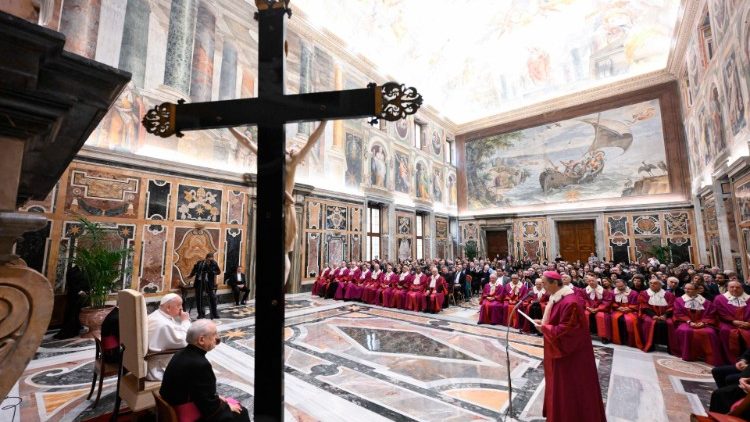
Pope Leo XIV receives officials of the Tribunal of Roman Rota for the inauguration of their judicial yearPope Leo XIV receives officials of the Tribunal of Roman Rota for the inauguration of their judicial year  (@Vatican Media)

Pope to Roman Rota: Justice and charity find harmony in mystery of God

Pope Leo XIV meets officials of the Tribunal of Roman Rota for the inauguration of their judicial year and urges them to safeguard the truth with rigor but without rigidity and to exercise charity without omission.

By Deborah Castellano Lubov

"You are called to safeguard the truth with rigor but without rigidity, and to exercise charity without omission."

Pope Leo XIV made this invitation to the prelate auditors of the Tribunal of Roman Rota in the Vatican on Monday, as he inaugurated its Judicial Year.

The Tribunal of the Roman Rota ordinarily acts as an appellate court of higher instance at the Apostolic See, with the purpose of safeguarding rights within the Church. It fosters unity of jurisprudence and, by virtue of its decisions, provides assistance to lower tribunals.

The Tribunal also includes the Office competent to adjudicate the fact of the non-consummation of marriage and the existence of a just cause for granting dispensations. This Office is also competent to deal with cases of the nullity of sacred ordination, pursuant to the norm of universal and proper law, in accordance with the different cases. It has a collegiate structure and is composed of a certain number of judges of proven doctrine, competence, and experience selected by the Pope from various parts of the world.

Precious service

The Pope began by thanking them for their work, "which is a precious service to the universal judicial function that belongs to the Pope and in which the Lord has called you to share," noting that the expression “Veritatem facientes in caritate” (The truth in love) (Eph 4:15), "can be applied to your daily mission in the administration of justice."

He thanked those present in the audience and everyone working in Church tribunals throughout the world, noting, "The ministry of judge that I have had occasion to exercise enables me to understand your experience more deeply and to appreciate the ecclesial significance of your task."

Pope Leo then returned to a fundamental theme that has been central in the addresses delivered to the Tribunal of the Roman Rota from Pope Pius XII up to Pope Francis, concerning the relationship of their activity "with the truth that is intrinsic to justice."

"On this occasion," the Pope said, "I intend to offer you some reflections on the close bond that exists between the truth of justice and the virtue of charity," clarifying they "are not two opposing principles, nor values to be balanced according to purely pragmatic criteria, but two dimensions intrinsically united, which find their deepest harmony in the very mystery of God, who is Love and Truth."

This correlation, he stated, calls for constant and careful critical discernment, "since, in the exercise of judicial activity, a dialectical tension not infrequently emerges between the demands of objective truth and the concerns of charity."

A delicate balance

"At times," Pope Leo said, "there is the risk that excessive identification with the often-troubled circumstances of the faithful may lead to a dangerous relativization of the truth."

"Indeed, a misguided compassion, even when apparently motivated by pastoral zeal," Pope Leo said, "risks obscuring the necessary dimension of ascertaining the truth that is proper to the judicial office."

"This," he continued, "can occur not only in cases of matrimonial nullity—where it might lead to decisions of a pastoral character lacking a solid objective foundation—but also in any type of proceeding, thereby undermining its rigor and equity."

On the other hand, he cautioned, "there can sometimes be a cold and detached affirmation of the truth that fails to take into account all that love for persons requires, omitting those concerns dictated by respect and mercy, which must be present at every stage of a process."

In considering the relationship between truth and charity, Pope Leo insisted that St. Paul offered "clear guidance" when exhorting in his Letter to the Ephesians that, “Living the truth in love, we should grow in every way into Him who is the head, Christ.” 

"Veritatem facientes in caritate," Pope Leo reiterated, "does not mean merely conforming to a speculative truth, but “doing the truth,” that is, a truth that must illuminate the whole of one’s actions. And this must be done “in charity,” which is the great driving force that leads to the practice of true justice." 

Not a tension between opposing interests, but an instrument for discernment

The process, Pope Leo said, "is not in itself a tension between opposing interests, as is sometimes mistakenly thought, but the indispensable instrument for discerning truth and justice in a given case."

The Pope went on to discuss the adversarial nature of judicial proceedings, and delineated the rigorous elements needed to properly assess these delicate situations and to ascertain appropriately the truth.

"Failure to observe these basic principles of justice—and the fostering of unjustified disparities in the treatment of similar situations—constitutes a serious injury to the juridical dimension of ecclesial communion."

The Pope also addressed the shorter process for the declaration of matrimonial nullity before the diocesan Bishop.

Here, he said, "the apparently manifest nature of the ground of nullity that makes this procedure possible must be assessed with great care, without forgetting that it will be the duly conducted process itself that must confirm the existence of nullity or determine the need to have recourse to the ordinary process."

With all this in mind, the Holy Father underscored, "it therefore proves fundamental that the study and application of canonical matrimonial law continue with scientific seriousness and fidelity to the Magisterium."

Praying that the true wisdom of Christian law must be made manifest, Pope Leo XIV entrusted their work to the intercession of the Blessed Virgin Mary, Speculum iustitiae, "the perfect model of truth in charity."

Friday, January 31, 2025

Pope tells the Roman Tribunal to exercise charity in annulment cases


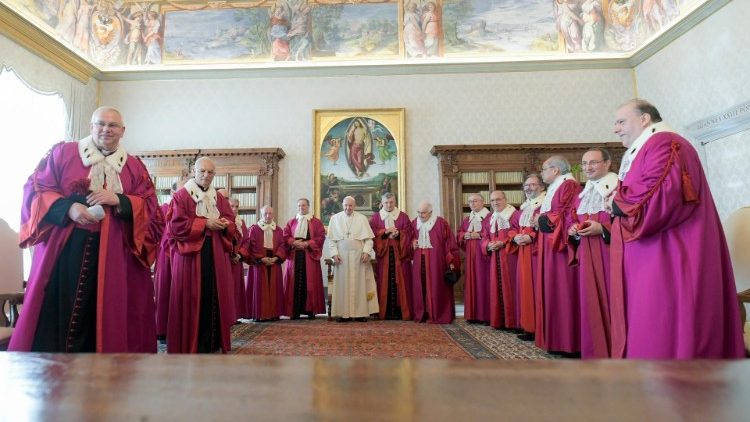
Pope with the officials of the Roman Rota at the inaguration of the Judiciary YearPope with the officials of the Roman Rota at the inaguration of the Judiciary Year  (VATICAN MEDIA Divisione Foto)

Pope to Roman Rota: ‘Discern annulment cases with charity’

In his address to the Roman Rota for the opening of the Judicial Year, Pope Francis says, Pope Francis calls upon judges to exercise prudence, justice, and charity, remarking that every just ruling contributes to strengthening the culture of indissolubility affirmed by the Church’s teaching on marriage.

By Lisa Zengarini

Pope Francis reiterated Friday the critical importance of simplifying processes of annulment of marriages and of making them more accessible while upholding the Church’s teachings on the indissolubility of marriage.

“We are called by the pain and hope of many faithful who seek clarity regarding the truth of their personal condition and, consequently, their possibility of fully participating in sacramental life,” the Pope said as he addressed the officials of the Roman Rota, the Vatican’s highest judicial tribunal, at the beginning of their Judicial Year.

The implementation of the 2015 marriage annulment reform

This year marks the tenth anniversary of his two Moti Propria  ‘Mitis Iudex Dominus Iesus’ and ‘Mitis et Misericors Iesus’, which reformed the process for annulments, empowering diocesan bishops to act as judges to nullify marriages, eliminating the requirement that the Roman Rota sign off with its own sentence. That measure also pushed for making the procedure free.

In his remarks, Pope Francis reminded the audience that his move was inspired by the deliberations of the Synodal Fathers in 2014, who emphasized the urgent need for more accessible and streamlined procedures, moved by a pastoral concern to ensure that Church structures remain close to the faithful and serve their spiritual needs effectively.

An expression of the Church's concern for the salvation of souls

A crucial point of the reform was the central role of the diocesan bishop. Giving the bishop the power to grant annulments through the shorter process (processus brevior) in cases where nullity is manifest, the Pope explained, is an expression of the Church’s concern for the salvation of souls (salus animarum).

Noting that many faithful are often unaware of this possibility, the Pope stressed the need to inform them and reaffirmed that the procedures should be free of charge to reflect the gratuitous love of Christ.

Need for competence

Pope Francis also underscored the importance of ensuring that diocesan tribunals are well-structured, with adequately trained clerics and laypeople so “they can carry out their work with justice and diligence.”

The quality of formation—both intellectual and spiritual—is therefore crucial in guaranteeing that faithful receive a just and careful examination of their cases, he said, reiterating that the reform must continue to be guided by the concern for the salvation of souls as stated in “Mitis Iudex”.

“Investing in the formation of these personnel—scientifically, humanly, and spiritually—always benefits the faithful, who have the right to careful consideration of their requests, even when they receive a negative response.”

Streamlining procedures and making them more accessible

A key theme of the speech was the balance between justice and pastoral sensitivity.

The reform, the Pope explained, was not designed to increase the number of annulments but to prevent prolonged uncertainty that could burden the faithful in line with the previous reform introduced by Pope Saint Paul VI in 1975. By abolishing the requirement for double-conforming sentences,  the 2015 reform aimed to prevent unnecessary legal complexities from obstructing access to truth and justice.

“The reform is not aimed at increasing the nullity of marriages but at expediting processes, ensuring a just simplicity so that, due to delayed rulings, the hearts of the faithful awaiting clarity about their status are not long oppressed by the darkness of doubt”

A pastoral service 

Warning against the danger of an excessively legalistic approach, Pope Francis, therefore, called upon the judges to exercise prudence, justice, and charity, ensuring that their work serves the real needs of the people rather than being an abstract legal exercise. “There is an intimate connection between prudence and justice, as the exercise of prudentia iuris aims at knowing what is just in a concrete case,” he said.

The judges’ work in discerning the validity of marriage, therefore, is not merely a legal duty but a pastoral service to the salvation of souls, “as it enables the faithful to know and accept the truth of their personal reality”, thus contributing to strengthening the culture of indissolubility, affirmed by the Church’s teaching on the sacredness of marriage.

Concluding Pope Francis encouraged the officials of the Roman Rota in their mission, reminding them that their work is ultimately one of hope: “helping individuals to purify and restore interpersonal relationships.”

Saturday, November 23, 2024

Pope Francis to canon lawyers: love justice, charity and truth


Pope Francis meets with participants in the Roman Rota's formation coursePope Francis meets with participants in the Roman Rota's formation course  (Vatican Media)

Pope: Canon lawyers must love justice, charity, truth

Pope Francis greets canon lawyers taking part in a course organized by the Roman Rota, and highlights how charity, justice, and truth are interconnected and at the heart of the 2025 Jubilee of Hope.

By Devin Watkins

“Love—caritas—is an extraordinary force that impels people to courageously and generously engage in the field of justice and peace. It is a force that originates in God, eternal Love, and absolute Truth.”

Pope Francis opened his address to participants in a formation course organized by the Tribunal of the Roman Rota with those words from Caritas in Veritate, Pope Benedict XVI’s 2009 encyclical.

The mission of the Roman Rota, the Church’s highest appellate court, as well as each of the Church’s lower tribunals, can be described as a “ministry of justice and charity in truth,” said the Pope.

Canon lawyers, he added, are called to love justice, charity, and truth, which are so closely intertwined that if one is lacking all three lose authenticity.

“Neither justice without charity nor charity without justice,” he said. “Charity without justice is not true charity.”

Justice involves seeking the good of the entire community and must be tempered by mercy, “for justice can only be understood in the light of love.”

“Never forget,” urged the Pope, “that those who come to you seeking the exercise of your ecclesial office must always encounter the face of our Mother, the Holy Church, who tenderly loves all her children.”

Love, he noted, teaches canon lawyers to cultivate their “legal sensitivity” so that they may recognize “what constitutes a true right of the person within the Church.”

Pope Francis went on to invite everyone to overcome fear of justice, since it can undermine charity due to its root in a mistaken concept of justice as a merely punitive exercise.

Justice, he said, “is a distinctly altruistic virtue that seeks the good of the other,” which links it closely with charity and mercy.

“Charity does not nullify justice, nor does it relativize rights,” he said. “In the name of love, we cannot neglect what is a duty of justice.”

As an example, he noted, the current norms on matrimonial cases cannot be compromised in pursuit of speed, since “mercy does not abolish justice.”

Charity and justice, said the Pope, work harmoniously together when they find their basis in truth.

In conclusion, Pope Francis invited canon lawyers to embrace hope, as the Church looks to the upcoming 2025 Jubilee of Hope, which begins on December 24.

“Let us allow ourselves to be drawn by hope and make it contagious for those who desire it,” he said, citing the Jubilee Bull of Indiction. “May our lives proclaim: ‘Hope in the Lord, be strong, let your heart take courage, and hope in the Lord’.”

Thursday, January 25, 2024

Pope discusses annulment cases with the Vatican's appeals court


The Inaugauration of the Judicial Year of the Tribunal of the Roman RotaThe Inaugauration of the Judicial Year of the Tribunal of the Roman Rota  (VATICAN MEDIA Divisione Foto)

Pope to Roman Rota: Discern annulment cases 'with prayer, on your knees'

Pope Francis inaugurates the Vatican's judicial year and urges officials of the Tribunal of the Roman Rota, an appeals court, to pray fervently as they discern cases that hit their docket.

By Joseph Tulloch

On Thursday, Pope Francis addressed officials from the Vatican’s Tribunal of the Roman Rota, an appeals court. 

In a speech delivered to mark the inauguration of the Judicial Year in the Vatican City State, the Pope discussed the process of discernment as it applies to annulment cases.

He discussed the tension between justice and mercy, the importance of prayer for the judges' work, and the close relationship between judicial discernment and synodality.

The centrality of prayer

“Without prayer," Pope Francis stressed, “one cannot be a judge. If any of you are not praying, please resign... That would be better.”

He went on to underline that "discernment is done on one’s knees, imploring the gift of the Holy Spirit; only in this way can decisions be reached that promote the good of individuals and the entire Church community.”

“I ask each one of you," Pope Francis said, "Do you pray? Do you feel with the Church? Are you humble in prayer, asking the Lord for light?”

“I come back to this," the Pope emphasised. "A judge's prayer is essential to his task. If a judge does not pray or cannot pray, he had better go and do another job.”

A great responsibility

The Pope then went on to stress the importance of the responsibility facing the judges of the Rota, who must decide whether to grant annulments when they have been contested in lower courts. 

Achieving the "moral certainty" necessary to make such decisions, the Pope said, is no easy feat. 

Officials of the Tribunal, he noted, have thus been entrusted with a “great responsibility” by the Church, because these decisions “powerfully influence the lives of individuals and families.”

2015 reform of annulments

Pope Francis also commented on his 2015 reform of annulment proceedings, which implemented various measures to speed up the process.

This move, he said, was “inspired by mercy towards the faithful in problematic situations.”

At the same time, however, he said, it ought not to be misunderstood: its aim was to favour “not the annulment of marriages, but the speed of processes.”

Justice and mercy

This led the Pope to discuss the tension between justice and mercy, a theme he has often returned to during his pontificate.  

“Highlighting the importance of mercy in family pastoral work, as I did in particular in the Apostolic Exhortation Amoris Laetitia,” he said, “does not diminish our commitment to seeking justice in annulment cases.”

Rather, he noted, quoting St. Thomas Aquinas: “Mercy does not take away justice, but is the fullness of justice.”

The synodal dimension

Finally, Pope Francis stressed that the process of judicial discernment is “supported and guaranteed” by synodality.

“When the tribunal is collegial,” he said, “or when there is only one judge but he consults with those in authority, discernment takes place in an atmosphere of dialogue or discussion in a common search for truth.”

The Pope brought his address to a close by entrusting the work of the judges to "Most Holy Mary, Virgo prudentissima e Speculum iustitiae," the Most Wise Virgin and Mirror of Justice.

The full text of Pope Francis' address can be accessed here. 

Friday, January 27, 2023

Addressing the Roman Rota, Pope Francis discusses Marriage and the Gospel of the Family


Pope Francis to Roman Rota: All true marriage is a gift

In his address to the Roman Rota for the opening of the judicial year, Pope Francis says proclaiming the “Gospel of the Family” is one of the essential tasks of the Church.

By Christopher Wells

There is a “strong need,” in the Church and in the world, “to rediscover the meaning and value of the conjugal union between man and woman on which the family is founded," Pope Francis said on Friday.

Addressing the auditors of the Roman Rota at the beginning of the Church’s judicial year, the Holy Father said the Church has the mission to proclaim the Good News, which includes “illuminating and sustaining the ‘great mystery that is conjugal and family love.'”

Marriage is a gift

The Pope explained that, according to Christian revelation, marriage is more than a ceremony or social event; it is not a mere formality or an abstract ideal, but instead “is a reality with its own precise consistency.”

Given that reality, and the fact that marriage takes place between real men and women, with all their limitations and failings, the Pope asked how marriages can be engaging, faithful, and permanent.

The answer, he said, lies in the fact that all true marriages, even non-sacramental marriages, are a gift from God to the spouses.

“Marriage is always a gift! Conjugal fidelity rests on divine fidelity; conjugal fruitfulness rests on divine fruitfulness.”

For this reason, marriage cannot “be reduced to a sentimental plane or to mere selfish satisfactions”; that is, one must reject the idea that a marriage lasts only so long as romantic love does.

Instead, Pope Francis said, “marital love is inseparable from marriage itself, in which fragile and limited human love meets divine love, which is always faithful and merciful.”

We can fulfill Jesus’ command that we “love one another” – which also pertains to marriage – because “it is He Himself who sustains spouses with His grace."

Marriage is good

Having elaborated on marriage as a gift from God, Pope Francis went on to emphasize that marriage is good – and, in fact, “a good of extraordinary value for everyone,” not just spouses and children, but other families, the Church, and the whole world.

He emphasized, too, that “in the Christian economy of salvation, marriage constitutes first and foremost the high road to holiness, a holiness lived out in ordinary life.”

This, the Pope said, “is an essential aspect of the Gospel of the family.”

Turning to the question of marriages in crisis, Pope Francis said the Church must accompany spouses facing difficulties with love and support. The Church’s pastoral response, he said, must involve helping renew the awareness of marriage as an “irrevocable gift.” Without ignoring the contributions of social sciences, this “light on one’s marriage is an essential part of the journey of reconciliation” within marriages.

The Pope recognized that marriage always involves “fragility” – but, he said, “with the help of the Holy Spirit,” difficulties in married life need not lead to a definitive rupture.

Thursday, January 27, 2022

At the Vatican the Roman Rota begins their new judicial year


Pope Francis with members of the Apostolic Tribunal of the Roman Rota on ThursdayPope Francis with members of the Apostolic Tribunal of the Roman Rota on Thursday  (Vatican Media)

Pope to the Roman Rota: Listen with a pastoral heart

Pope Francis received members of the Apostolic Tribunal of the Roman Rota on Thursday at the start of their judicial year. In his speech, he stressed that in the work of this Court there must always be understanding for people who suffer because of the breakdown of their marriage.

By Vatican News staff reporter

Pope Francis on Friday addressed the officials of the Tribunal of the Roman Rota on the occasion of the inauguration of their Judicial Year.

Speaking to those gathered, he reflected on the theme of synodality with regard to annulment cases, reminding them that their mission is to be at the service of families.

Synodal process

The Pope underlined that synodal work should see dialogue placed alongside judicial activity, in order to encourage a more general rethinking of the importance of the canonical process “for those who have experienced a marriage breakdown and, at the same time, for the harmony of relationships within the ecclesial community.”

Synodality, said Pope Francis, “implies walking together.” He went on to say, “we need to rediscover that all the participants in the process are called to contribute to the same objective, that of shining a light on the truth about a concrete union between a man and a woman, and reaching a conclusion as to whether or not there is a true marriage between them.”

Search for the truth

He stressed that even at the preliminary stage, when the faithful seek pastoral help, “there must be an effort to discover the truth about their union, an indispensable prerequisite for the healing of wounds."

The Pope added, “when presenting the possibility of nullity, it is necessary to make the faithful reflect on the reasons that lead them to request the declaration of nullity of matrimonial consent.”

He noted that the same objective of a shared search for the truth “must characterize every stage of the judicial process.”

Any deliberate alteration or manipulation of the facts “in order to achieve a pragmatically desired result is inadmissible,” he said.

"Even lawyers," added Pope Francis, in off-the-cuff remarks, "can do terrible damage." The fact of walking together in judgement "is valid for the parties and their patrons, for the witnesses called to declare according to the truth, for the experts who must put their knowledge at the service of the process, as well as in a particular way for the judges".

Listening and discernment

Synodality with regards to the law, Pope  Francis commented, “implies a constant exercise of listening,” which is not simply hearing.

Another aspect of synodality, remarked the Pope, was the importance of discernment. “This discernment is based on walking together and listening, and allows the concrete matrimonial situation to be read in the light of the Word of God and the Magisterium of the Church,” he said.

“The outcome of this path is the judgment,” Pope Francis noted, “the fruit of careful discernment that leads to an authoritative word of truth on personal experience, thus highlighting the paths that can be opened from there.”

In conclusion, the Pope encouraged members of the Apostolic Tribunal to continue, with fidelity and renewed industriousness, their ecclesial ministry at the service of justice, truth, and ultimately, salus animarum (the salvation of souls).