Showing posts with label Egypt. Show all posts

Saturday, August 2, 2025

Pope Leo XIV shares grief and hope with Egyptian youth after death of 18-year-old pilgrim


Pope Leo prays with young Egyptian pilgrims in remembering Pascale Rafic, their 18 year old companion who died on her way to Rome for the Jubilee of YouthPope Leo prays with young Egyptian pilgrims in remembering Pascale Rafic, their 18 year old companion who died on her way to Rome for the Jubilee of Youth  (@Vatican Media)

Pope expresses condolences on sudden death of Egyptian pilgrim

Pope Leo expresses his deep sorrow upon receiving news of the sudden death of an 18-year old Egyptian youth, Pascale Rafic, who was traveling to Rome to participate in the Jubilee of Youth.

Vatican News

On Saturday morning, 2 August, Pope Leo XIV received a group of Egyptian young people who have arrived in Rome to participate in the Jubilee of Youth. With them leading the delegation was Jean-Marie Chami, Titular Bishop of Tarsus and Auxiliary Bishop of the Patriarchate of Antioch of the Greek Melkites for Egypt, Sudan and South Sudan. Tragically, one of the pilgrimage group members, 18-year old Pascale Rafic, died earlier in the day just after travelling to Rome to participate in the Jubilee together with them.


Pope Leo giving the group of Egyptian pilgrims his blessing   (@Vatican Media)

In welcoming the group, the Pope assured them of his "heartfelt prayers" and invoked "the Lord’s comfort and consolation upon Pascale’s family members, friends and all of those who grieve her loss." While consoling the group, he acknowledged the grief we feel, also so suddenly, but that our hope in the Risen Christ gives us hope in remembering Pascale's new life in Christ.

“So, we thought at least, in the midst of this pain, that you all experience for the loss of your friend, that at least to have this opportunity to come together to pray, to renew our faith, and to ask God both for the eternal rest of our sister but also for strengthening and consolation, strengthening of our faith and to be renewed in hope and as Church, as brothers and sisters, we therefore have gathered together for that reason. So we ask the Lord to be with us, to be with all of you, as you live these days of the pilgrimage of the Jubilee Year of Hope and that you will all also be protected with God‘s love and God‘s grace.”

Addressing the group in English, before imparting his apostolic blessing to them, Pope Leo encouraged them to find consolation in God's boundless love and mercy, and the hope that never disappoints.

“It is our hope in the resurrection, that is the ultimate source of our hope, and we speak about a Jubilee Year of Hope, our hope is in Jesus Christ who is risen. And he calls all of us to renew our faith, calls all of us to be friends, brothers and sisters to one another, to support one another, and he says you too must be witnesses to that Gospel message.”

Wednesday, May 10, 2023

The religious and cultural significance of the Coptic Orthodox Church


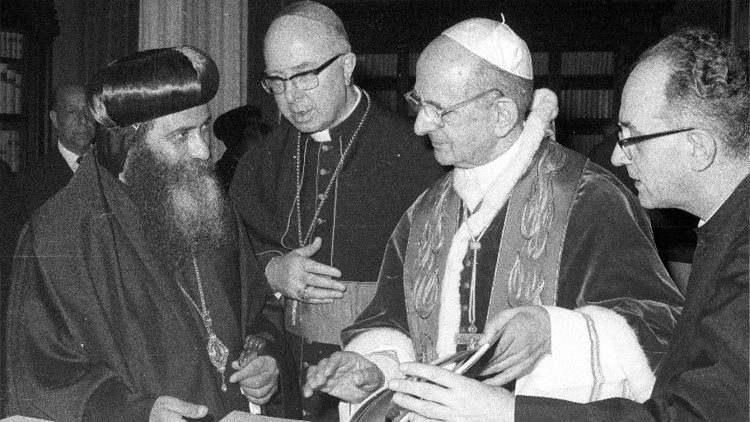
Pope St Paul VI with Pope Shenouda III, Patriarch of the Coptic Orthodox Church (May 1973)Pope St Paul VI with Pope Shenouda III, Patriarch of the Coptic Orthodox Church (May 1973) 

Coptic Christians preserve 'an immeasurable treasure'

Alberto Alfredo Winterberg, a PhD student at the University of Groningen, Netherlands, at the Faculty of Theology and Religious Studies, explores the ancient Coptic Christian tradition.

By Christopher Wells

“The Coptic Orthodox Church guards an immeasurable treasure trove of religious, cultural, and historical significance,” says Alberto Alfredo Winterberg, a Ph.D. student in the Faculty of Theology and Religious Studies at the University of Groningen in the Netherlands.

Ahead of the visit by Coptic Orthodox Patriarch Tawadros II to the Vatican, Mr. Winterberg spoke to Tomasz Matyka, SJ of Vatican News about the ancient Christian tradition in Egypt.

“The Copts are the indigenous Egyptian Christian minority population,” he explains, “whose roots extend as far back as the pharaonic Egyptians from antiquity.”

Founded by St Mark

The Coptic Christian minority amounts to approximately eight to ten percent of the total population of Egypt, with most belonging to the Coptic Orthodox Church. According to tradition, it traces its origins to the foundation of the See of Alexandria by St Mark the Evangelist, the disciple of St Peter.

The formation of a distinctive Coptic Orthodox Church, Mr. Winterberg explains, “was a long process which took place in the aftermath of the Council of Chalcedon in 451.” Although Christological questions were at the forefront of disputes over the Council, Mr. Winterberg notes that political and economic issues played a significant role in divisions between the Church in Alexandria and the Roman Church.

When Egypt was conquered by Islamic forces two centuries later, Egyptian Christians were forced either to convert to Islam or pay a heavy tax. “Within a long process of economic restrictions, civil humiliations and, at times, violent persecutions against the Copts by the foreign rulers, the former Christian majority population turned into a minority. However, they survived until the present day.”

A Church of martyrs

Elaborating on the contributions of Coptic Christianity to the wider Church, Mr. Winterberg points first to the institution of monasticism, which is also connected to ancient Syria. He notes the importance of Coptic saints among the desert fathers, especially Saint Anthony the Great and Saint Pachomius, who were important influences on St Benedict, the founder of Western monasticism.

Mr. Winterberg notes, too, the history of persecution of Egyptian Christians in the early Church. “Apart from the great tradition of Coptic monks and ascetics, the Roman province of Egypt was one of the most affected by the persecution of Christians under the Emperor Diocletian,” he says. “As such, the Coptic Church particularly identifies itself as a martyr Church whose very own calendar begins in the year of 284 AD, the year on which Emperor Diocletian began his reign.”

Ecumenical and theological dialogue

The Coptic Orthodox Church is currently headed by Pope Tawadros II, the Patriarch of Alexandria, and numbers about ten million adherents. Outside of Egypt and the Middle East, significant numbers of Orthodox Copts are found in the US, Canada, Australia, France, and Germany.

Fifty years ago, on 10 May 1973, Pope Saint Paul VI and Pope Shenouda III met in the Vatican, during which they signed an historic “Joint Christological Declaration.” The Declaration followed on years of ecumenical and theological dialogue between the Catholic Church and the Coptic Orthodox Churches in the wake of the Second Vatican Council.

Monday, August 15, 2022

Devastating fire at Coptic Church kills at least 40


Reports of at least 40 people killed in church fire in Egypt


AC Wimmer

At least 40 people — most of them children — have died in a fire in a Coptic Orthodox church in Giza Governorate, Egypt, on Sunday, according to government and church officials.

Thirty-five children between two and six years of age were among the victims of the blaze that ripped through the Church of Saint Mercurius (known in Arabic as Abu Sefein), reported ACI MENA, CNA's partner agency for the Middle East and Northern Africa.

The cause of the blaze has so far not been established. Reuters reported that an electrical fire broke out at the church where people gathered during the Divine Liturgy celebration. The blaze reportedly blocked the exit from the church and caused a stampede. 

The parish priest, Fr. Abdul Masih Bakhit, also died during the fire.

The injured were transferred to Imbaba General Hospital and Agouza General Hospital after 30 ambulances attended the scene. 

The Patriarch of the Coptic Orthodox Church, Pope Tawadros II, offered condolences to the families of the victims, according to a media statement, saying: "We are following with sorrow the tragic incident that occurred this morning in the Church of the Great Martyr Mercurius Abo Sefein in the Imbabah Airport area, north of Giza."

"As we offer our condolences to the victims' families, we pray for the injured and wounded, trusting that the hand of God will have mercy on us all."

Offering his condolences to the head of the Coptic Church in Egypt, President Abdel Fattah el-Sissi said his thoughts were with "the families of the innocent victims that have passed on to be with their Lord in one of his houses of worship."

Saturday, December 30, 2017

The Holy Family in Egypt

Where did the Holy Family live in Egypt?


Jesus likely took his first steps not in Bethlehem or Nazareth, but in Egypt.

It is easy to forget that part of Jesus’ early childhood was spent outside of Bethlehem and the Holy Land. Forced into exile by King Herod, the Holy Family fled to Egypt and lived there for several years. It is fascinating to think about this time in Jesus life. Did Jesus see the ancient pyramids? What about the great Nile river?
Before we look at the possible locations of Jesus’ exile in Egypt, let’s first look at the narrative from Matthew.
[B]ehold, an angel of the Lord appeared to Joseph in a dream and said, “Rise, take the child and his mother, and flee to Egypt, and remain there till I tell you; for Herod is about to search for the child, to destroy him.” And he rose and took the child and his mother by night, and departed to Egypt, and remained there until the death of Herod. (Matthew 2:13-15)
Historians tend to disagree when it comes to the date of King Herod’s death. Most scholars point to 4 BC, while some claim that he died as late as 1 AD. Whatever the actual dates may be, local tradition claims that the Holy Family lived in Egypt for as long as four years.
It is intriguing to picture Jesus taking his first steps and saying his first words not in Bethlehem or Nazareth, but in Egypt!
According to local traditions, the first stop for the Holy Family was Farma, east of the Nile river. Then they continued traveling to Mostorod, a city north of Cairo. There is a spring near the city that reportedly sprung up after they arrived.
After that they stopped at Sakha, and is the site of a rock that has an impression of the baby Jesus’ foot.
Moving along they progressed to Wadi El Natroun before stopping just outside of Cairo. At this site there is a place where a tree provided shade to the Holy Family.
They most certainly saw the ancient pyramids of Egypt as they continued on their journey, possibly stopping to see such an amazing sight.
The family in exile then continued on to Old Cairo and up to Maadi, where they took a boat to Deir El Garnous and then Gabal Al-Teir.
The main stopping point for the Holy Family was Gebel Qussqam. It is believed that they stayed here for about six months. Before returning home they stopped in Assiut and then back to the Holy Land.
The Coptic people take great pride in this special chapter in the life of Jesus and feel particularly close to the Holy Family, who walked and lived among them during Jesus’ early years as a child.

Saturday, April 29, 2017

Pope Francis wraps up 2nd and final day of his missionary trip to Egypt

Pope Francis Wraps Up Short, But Significant Visit to Egypt
A Wrap Up of Pontiff’s 2nd Day in Cairo
PHOTO.VA - L'OSSERVATORE ROMANO
Pope Francis has wrapped up the second and final day of his visit to Egypt this weekend, April 28-29. This marked his 18th apostolic journey out of Italy and 27th country visited. It also marked the second time that a Pope goes to the north African nation, after the visit of St. Pope John Paul II in 2000.
The Pope was invited to the country by President Abdel-Fattah al Sisi, the Grand Imam of al-Azhar University, Sheikh Ahmed Mohamed al-Tayeb, Coptic Orthodox Pope Tawadros II, and by the Catholic bishops.
As opposed to his first intense day which involved three discourses, including to authorities, an international peace conference at Al Azhar and to Coptic Orthodox Pope Tawadros II, along with a common declaration and moments of prayer with the Coptic Pope, Francis’ second day was a bit lighter. It started out with a Mass, for the country’s Catholics who don’t even constitute one percent of the population, followed by lunch, and concluded with addressing clergy and religious.
In his homily at the Mass for Egyptian Catholics in the “Air Defense Stadium,” he recalled that today’s Gospel of the third Sunday of Easter speaks of the journey to Emmaus of the two disciples who set out from Jerusalem. The Jesuit Pope explained the account can be summed up in three words: death, resurrection and life.
He also reminded all those present what ‘true faith’ has the power to do and that nothing is impossible to God.
“God,” he also pointed out, “is pleased only by a faith that is proclaimed by our lives, for the only fanaticism believers can have is that of charity! Any other fanaticism does not come from God and is not pleasing to him!”
After Mass, Pope Francis had lunch with Egyptian bishops and the Papal entourage. He was served by a young Italian chef who had a moment to greet him after the lunch.
During his prayer meeting with clergy, religious, and seminarians at 3:15 p.m., Francis warned them of seven temptations:
1. The temptation to let ourselves be led, rather than to lead.
2. The temptation to complain constantly.
3. The temptation to gossip and envy.
4. The temptation to compare ourselves to others.
5. The temptation to become like Pharaoh, that is to harden our hearts and close them off to the Lord and our brothers and sisters.
6 The temptation to individualism.
7. The temptation to keep walking without direction or destination:
Resisting these temptations, Francis insisted, is not easy, but it is possible if we are grafted on to Jesus.
“The more we are rooted in Christ, the more we are alive and fruitful!” he said, noting the quality of one’s consecration depends on the quality of one’s spiritual life. “You too can be salt and light, and thus an occasion of salvation for yourselves and for all others, believers and non-believers alike, and especially for those who are poor, those in need, the abandoned and discarded,” he said.
Preceded by a farewell ceremony, at 5 p.m. the flight of Pope Francis and his entourage departed from Cairo International Airport, and the flight is expected to land in Rome’s Ciampino Airport at about 8:30 p.m. Pope Francis as usual will respond to journalists’ questions on his return flight to Rome, which remain for some time under embargo. Therefore, Zenit will inform our readers of the in-flight press conference’s contents on Monday.
During the two-day journey, the Pope was accompanied by Cardinal Pietro Parolin, Secretary of State, Cardinals Leonardo Sandri, Prefect of the Congregation for Eastern Churches and Kurt Koch, President of the Pontifical Council for Unity, and Apostolic Nuncio in Egypt, Bishop Bruno Musaró. The interpreter of the Pope will be his private secretary, official of the secretariat of state, Msgr. Yoannis Lahzi Gaid, a Catholic Coptic priest of the Patriarchate of Alexandria.
Egypt has some 90 million inhabitants, a majority of whom, at least 85%, are Muslims. About 10% of the population are Orthodox Coptic Christians, and the Catholics, who are broken up between Coptic Catholics and different rites: Coptic, Latin, Armenian , Melkite, Maronite, Syro-Catholic, etc., make up less than 1% of the population.Their bishops are gathered in the Assembly of the Catholic Hierarchy presided over by the Coptic Catholic Patriarch of Alexandria, Ibrahim Isaac Sidrak.
***
On ZENIT’s Web page:
Pope’s Homily at Mass: https://zenit.org/articles/popes-homily-at-air-defense-stadium-in-cairo-egypt-full-text/
Pope to Clergy, Religious, and Consecrated: https://zenit.org/articles/pope-warns-religious-in-egypt-of-7-temptations/
Pope’s Full Program: https://zenit.org/articles/popes-program-for-egypt-visit-today/
Italian Cuisine Is Also Appreciated Along the Nile: https://zenit.org/articles/popeinegypt-italian-cuisine-is-also-appreciated-in-egypt/
Pope’s In Flight Press Conference: to be made available to our readers by Monday

Friday, April 28, 2017

Pope Francis 1st Day in Egypt

Pope Francis Wraps Up 1st Day in Egypt
Today, Pope Visited Authorities, Grand Imam of Al-Azhar, Coptic Orthodox Pope Tawadros II
Logo of the Visit of the Pope to Egypt, 2017 - © Http://Catholic-Eg.Com/

Pope Francis has wrapped up the first day of his visit to Egypt this weekend, April 28-29. This marks his 18th apostolic journey out of Italy and 27th country visited. It also marks the second time that a Pope goes to the north African nation, after the visit of St. Pope John Paul II in 2000.
The Pope was invited to the country by President Abdel-Fattah al Sisi, the Grand Imam of al-Azhar University, Sheikh Ahmed Mohamed al-Tayeb, Coptic Orthodox Pope Tawadros II, and by the Catholic bishops.
During the press conference before arriving, Francis thanked the journalists for their work and warned them of the intense days ahead.
The Pope gave three speeches during his first day: the first at an international conference on peace in Al-Azhar; the second, before the authorities of the nation; and the third to Coptic Orthodox Patriarch, Pope Tawadros II.
During his journey, the Pope was accompanied by Cardinal Pietro Parolin, Secretary of State, Cardinals Leonardo Sandri, Prefect of the Congregation for Eastern Churches and Kurt Koch, President of the Pontifical Council for Unity, and Apostolic Nuncio in Egypt, Bishop Bruno Musaró. The interpreter of the Pope will be his private secretary, official of the secretariat of state, Msgr. Yoannis Lahzi Gaid, a Catholic Coptic priest of the Patriarchate of Alexandria.
Egypt has some 90 million inhabitants, a majority of whom, at least 85%, are Muslims. About 10% of the population are Orthodox Coptic Christians, and the Catholics, who are broken up between Coptic Catholics and different rites: Coptic, Latin, Armenian , Melkite, Maronite, Syro-Catholic, etc., make up less than 1% of the population.Their bishops are gathered in the Assembly of the Catholic Hierarchy presided over by the Coptic Catholic Patriarch of Alexandria, Ibrahim Isaac Sidrak.
Pope Francis arrived in Cairo. The welcome ceremony took place at the presidential palace of Heliopolis, where he had a courtesy visit to the President of the Republic. Then he visited the Great Imam of Al-Azhar, and they exchanged gifts.
Within the walls of Al-Azhar University, the Pope participated in an international conference on peace. The speech of the Grand Imam was followed by that of the Pope.
The Pope called on all religious leaders to reject radicalism and said “violence is a negation of every authentic religious experience.” He thanked them for various contributions and reminded them that Muslims and Christians “are under the sun of the same God.”
During his later meeting with authorities, Francis underscored: “Egypt has a unique role to play in the Middle East and among those countries seeking solutions to pressing and complex problems that need to be faced now in order to avoid the spread of worse violence.”
Pope Francis then met with the Coptic Orthodox Patriarch Tawadros II. In his address to Tawadros, he recalled how all Christians are united by the ‘ecumenism of blood.’ After the discourses, they prayed together in the Church of St. Peter for the victims of recent anti-Christian attacks. They also signed a common declaration divided into 12 points.
Pope Francis went to the nunciature for the night, and before dinner, he greeted children and a group of young people from all over the country.
Moving around the city, Pope Francis used a “normal” car, as he wished.
***
On ZENIT’s Web page:
Pope’s Words to Journalists on Flight to Egypt: https://zenit.org/articles/popes-words-to-journalists-during-flight-to-egypt/
Francis to Authorities: https://zenit.org/articles/pope-remind-authorities-of-egypts-role-to-avoid-spread-of-worse-violence/
Pope at Peace Conference: https://zenit.org/articles/pope-to-al-azhar-violence-is-negation-of-every-authentic-religious-expression/
Pope’s Address to Pope Tawadros II: https://zenit.org/articles/pope-francis-address-to-coptic-orthodox-patriarch-pope-tawadros-ii/
Common Declaration of Pope Francis & Pope Tawadros II: https://zenit.org/articles/common-declaration-of-pope-francis-coptic-orthodox-patriarch-s-s-tawadros-ii/
Pope’s Full Program: https://zenit.org/articles/popes-program-for-egypt-visit-today

Tuesday, April 11, 2017

Pope still going to Egypt despite the recent terror attack

Egypt’s attacks won’t stop pope’s visit for peace, says Vatican official


Security personnel investigate the scene of a bomb explosion April 9 inside the Orthodox Church of St. George in Tanta, Egypt. That same day an explosion went off outside the Cathedral of St. Mark in Alexandria where Coptic Orthodox Pope Tawadros II was presiding over the Palm Sunday service. (CNS/EPA)
By Carol Glatz
Catholic News Service
VATICAN CITY (CNS) — Despite recent and repeated terrorist attacks against Egypt’s minority Christian communities, Pope Francis will not cancel his visit to Egypt.
“The pope’s trip to Egypt proceeds as scheduled,” Greg Burke, Vatican spokesman, told Catholic News Service by email April 10. The pope is scheduled to meet governmental and interfaith leaders during an April 28-29 visit to Cairo.
“Egyptians are looking forward to Pope Francis’ visit, although the atmosphere at present is heavy,” Father Rafic Grieche, spokesman for the Egyptian bishops, told CNS April 10, the day after the attacks.
“The pope’s mission is to be beside his brothers at the time of difficulty. Now is the real time that he can bring peace and hope to the Egyptian people as a whole and to the Christians of the East, in particular,” Father Grieche added.
He said people were uneasy entering churches with metal detectors and other security measures.
“It’s not like going to a normal church. But we need these measures to keep people safe,” he said.
He said after the attack, he celebrated a Mass with 2,000 people.
“The people knew already about the attack in Tanta, but they did not want to be afraid. In the evening, they also came for the prayers of the Holy Week,” Father Grieche said.
Coptic Orthodox Pope Tawadros II was in the Cathedral of St. Mark in Alexandria April 9 for the Palm Sunday service, when an explosion went off outside the church. Security footage appeared to show a security officer direct a man who was seeking entry into the cathedral to go through a metal detector. The man took a step under the detector then backed up a step, followed by a huge explosion that cut off the camera feed.
Earlier, a bomb exploded 70 miles away inside the Church of St. George in Tanta, 50 miles north of Cairo, during its Palm Sunday service. Estimates say at least 44 people were killed and more than 100 injured in the two attacks, making it one of the deadliest against the nation’s Christians in decades.
It was the single deadliest day for Christians in decades and the worst since a bombing at a Cairo church in December killed 30 people.

Pope Tawadros told the Italian national network Rai News April 9 the attacks would “not damage the unity and cohesiveness” of the Egyptian people.
“Egyptians are united before this terrorism,” he said, adding that “these vile attacks that hit people of peace in places of prayer demonstrate that terrorism lacks any religion.”
Sheik Ahmad el-Tayeb, grand imam of al-Azhar University, also condemned the attacks, calling them a “despicable terrorist bombing that targeted the lives of innocents.”
Retired Coptic Catholic Bishop Antonios Mina of Giza, Egypt, said the incidents were an attack against the nation’s unity, its Coptic Christians, “to remind them that they have no rights, and against all Christian minorities of the country that anxiously await Pope Francis.”
“Despite it all, we will never lose hope. These atrocious gestures make us firmer in the faith and stronger,” he said. “Egypt’s Christians are warriors of hope.”
One Catholic leader highlighted his country’s failure to address the real causes behind the Palm Sunday massacres.
Speaking to “the officials and the wise of this country,” Coptic Catholic Bishop Botros Fahim Awad Hanna of Minya said that “you don’t fight terrorism with words or slogans, nor with security or armies alone.”
“What have you done for social, economic, health, political and human justice? What have you done for the poor and downtrodden? What have you done to reform thought, expression and religious discourse?”
In a posting on his Facebook page, Bishop Fahim said that when Pope Francis goes to Cairo, he “will come to say no to terrorism and evil, and yes to goodness and fraternity. Love will never fail.”
Around the world, religious leaders offered prayers.
Cardinal Daniel N. DiNardo, president of the U.S. Conference of Catholic Bishops, said the attacks on the churches were “unspeakable persecution.”
“In the midst of what should be peace, horrible violence yet again,” he said. On behalf of all U.S. bishops, the cardinal expressed “our deepest sadness” for all those killed and injured, and their loved ones.
“I also express our solidarity with the Coptic church in Egypt, an ancient Christian community that faces mounting persecution in its historic home from violent extremism. I also pray for the nation of Egypt, that it may seek justice, find healing, and strengthen protection for Coptic Christians and other religious minorities who wish only to live in peace.”
Egypt is 90 percent Sunni Muslim; Christians make up the remaining 10 percent, with that majority being the Coptic Orthodox church. The Catholic community in Egypt numbers about 272,000, less than 0.5 percent of the population.

Sunday, April 9, 2017

Horror, terror and death visited these Christians at Palm Sunday Mass, if they have persecuted me, they will persecute you

Two Explosions Kill at Least 31 at Egyptian Coptic Churches on Palm Sunday


Photo

Inside St. George’s Church after the deadly explosion on Palm Sunday in Tanta, Egypt. Credit Khaled Elfiqi/European Pressphoto Agency
CAIRO — Two explosions at Coptic churches in Egypt on Palm Sunday left at least 31 people dead and injured dozens of others as a day of worship in the besieged Christian community turned to destruction and carnage.
The first blast ripped through St. George’s Church in northern Egypt in the Nile Delta city of Tanta, 50 miles north of Cairo, during a Mass about 9:30 a.m., according to an official from the Health Ministry.
The deputy minister of health put the preliminary death toll at 25, but some local television reports said at least 25 people had died.

Photo

Egyptians sit in shock at the scene of a bomb explosion inside St. George’s Church. Credit Khaled Elfiqi/European Pressphoto Agency

Hours later, a suicide bomber set off an explosion outside the main Coptic church in Alexandria, St. Mark’s Cathedral, killing at least six — three police officers — and injuring 21 others, the Health Ministry said.
There was no immediate claim of responsibility for the blasts, but the bombings followed a number of attacks by Islamic State militants targeting Egypt’s minority Christians.
They happened weeks before Pope Francis is to visit Egypt, and a week before Easter.
The second attack took place while worshipers at St. Mark’s were leaving at the end of Palm Sunday Mass. The service had been led by the Coptic pope, Tawadros II. Mr. Sawiras said that the pope had already left when the explosion happened.

Photo

Inside St. George’s Church after the deadly explosion on Palm Sunday in Tanta, Egypt. Credit Khaled Elfiqi/European Pressphoto Agency

Photos from the scene circulating on social media showed scenes of blood and devastation inside the Tanta church. Initial reports said that the explosion occurred in the pews near the front of the church, and that many of the dead were children.
A security official told the state news agency they believed the blast had been caused by an explosive device planted inside the church.
After the first blast, President Abdel-Fattah el-Sisi ordered military hospitals to treat the injured, Sky News Arabia reported.

Photo

Coptic priests sit among the damage after a bomb on Palm Sunday at St. George’s Church in Tanta, Egypt, on April 9, 2017. Credit Khaled Elfiqi/European Pressphoto Agency

Eyewitnesses said that an angry crowd outside the church in Tanta attacked a young man they accused of being involved in the attack.
After that explosion, the provincial governor, Ahmad Deif, told the state-run Nile News channel: “Either a bomb was planted or someone blew himself up.”
In December, the Islamic State claimed responsibility for a suicide attack on a chapel in the grounds of St. Mark’s Cathedral, the main Coptic Church in Cairo, killing at least 28 people.

Photo

The scene inside St. George’s Church in Tanta, northern Egypt, after a bomb exploded on Palm Sunday. Credit Khaled Elfiqi/European Pressphoto Agency

In February, hundreds of Christians fled northern Sinai, where the Egyptian Army is fighting a local Islamic State affiliate, following a targeted campaign of violence and intimidation.
Christians, mostly Orthodox Copts, account for about 10 percent of Egypt’s population, which is predominantly Sunni Muslim.
Francis’ planned trip to the country is seen as an opportunity to improve ties between Christians and Muslims. The pontiff is to visit with Mr. Sisi; the leader of the Coptic Orthodox Church; and the grand imam of Al Azhar, a 1,000-year-old mosque and university that is revered by Sunni Muslims.

Photo

A relative of one of the victims in Tanta, Egypt. Credit Mohamed Abd El Ghany/Reuters

In a news conference to provide details about the trip on Friday, the Catholic archbishop of Egypt, Bishop Emmanuel, said that the pope’s pending journey was a signal that Egypt is safe for visitors.
In 2011, a suicide bombing ripped through a throng of worshipers outside a Coptic Christian church in the port city of Alexandria, killing at least 21 people in one of the worst attacks against Egypt’s Christian minority.
Earlier this month, an explosion near a police training center in the Nile Delta city injured 13 officers.
On Sunday, Francis said in response to the first bombing: “We pray for the victims of the attack carried out today, this morning, in Cairo, in a Coptic church.”
He called the leader of the Coptic Christians his “brother” and expressed his “deep condolences” to the church and the Egyptian nation.
The archbishop of Canterbury, Justin Welby, also responded in a post on Twitter: “As we come to Easter, pray for victims, the justice of the cross, hope & healing of resurrection.”
In a Twitter post, a spokesman for the Egyptian Foreign Affairs Ministry, Ahmed Abu Zeid, said, “Terrorism hits Egypt again.”