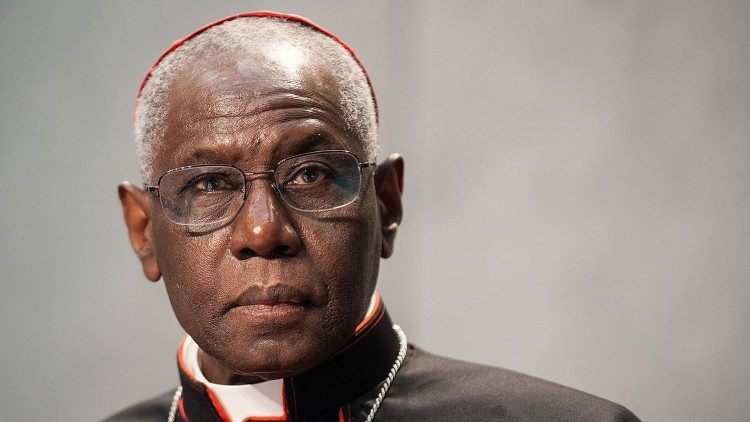
Showing posts with label Cardinal Robert Sarah. Show all posts

Sunday, January 25, 2026

Today was Word of God Sunday. What is and who started it?


What is Sunday of the Word of God? 5 Things to KNOW and SHARE - Sunday of the Word of God Explained


The Sunday of the Word of God of the Catholic Church takes place on the third Sunday in Ordinary Time, in January. Pope Francis’ Apostolic Letter, issued as a motu proprio, Aperuit illis, was published on the 30th September 2019. It established, "the Third Sunday in Ordinary Time is to be devoted to the celebration, study and dissemination of the Word of God". It occurs on January 26st in 2025 and Jan. 25th in 2026.

1.  The 1st Sunday of the Word of God took place on January 26th in 2020.
Pope Francis invites Catholics across the world to deepen their appreciation, love and faithful witness to God and his Word.
That’s why, as established by a papal decree - the third Sunday in Ordinary Time, is to be observed as a special day devoted to “the celebration, study and dissemination of the Word of God”. 
2. A note released by the Congregation for Divine Worship and the Discipline of the Sacraments, and signed by the prefect, Cardinal Robert Sarah, explains that The Sunday of the Word of God is a means to help people “reawaken an awareness of the importance of Sacred Scripture for our lives as believers, beginning with its resonance in the liturgy which places us in living and permanent dialogue with God.” 
 3. As Archbishop Salvatore Fisichella, President of the Pontifical Council for Promoting New Evangelization explained during a press conference, that it is an initiative that the Pope has entrusted to the whole Church so that "the Christian community may concentrate on the great value that the Word of God occupies in its daily existence" (Aperuit illis 2).“This Sunday, he wants to stimulate all Christians not just to place the Bible on the shelf as one of many books, perhaps filled with dust, but as an instrument that awakens our faith.”
4. The Sunday of the Word of God, instituted by Pope Francis and to be held every year on the third Sunday of Ordinary Time,[1] reminds us, pastors and faithful alike, of the importance and value of Sacred Scripture for the Christian life, as well as the relationship between the word of God and the liturgy: “As Christians, we are one people, making our pilgrim way through history, sustained by the Lord, present in our midst, who speaks to us and nourishes us. A day devoted to the Bible should not be seen as a yearly event but rather a year-long event, for we urgently need to grow in our knowledge and love of the Scriptures and of the Risen Lord, who continues to speak his word and to break bread in the community of believers. For this reason, we need to develop a closer relationship with Sacred Scripture; otherwise, our hearts will remain cold and our eyes shut, inflicted as we are by so many forms of blindness”.[2]

5. This Sunday, therefore, presents an ideal opportunity to reread some of the Church’s documents[3] and especially the Praenotanda of the Ordo Lectionum Missae, which present a synthesis of the theological, ritual and pastoral principles surrounding the word of God proclaimed at Mass, but which is also valid in every other liturgical celebration (Sacraments, Sacramentals, Liturgy of the Hours).

Monday, April 15, 2024

Cardinal Sarah warns of practical atheism; Bishops desiring to be loved by the world


Cardinal Sarah denounces ‘atheistic’ Western bishops who prefer the world to the cross


The Catholic Herald


YAOUNDÉ, Cameroon – Guinean Cardinal Robert Sarah has accused Western bishops of worldliness and of succumbing to the temptation of “practical atheism” as they lose faith in the teachings of the Catholic Church.

The former prefect of the Vatican’s Congregation for Divine Worship and the Sacraments said that so many bishops desired to be “loved by the world” that they have forgotten that Christianity calls them to be “signs of contradiction”.

The 78-year-old cardinal also repeated his criticism of Fiducia Supplicans, the Vatican document that provides for the blessings of couples involved in same-sex unions, insisting that it’s not just traditional African culture but Catholic teaching itself which makes the document unacceptable.

Speaking to the episcopal conference of Cameroon, Cardinal Sarah accused many bishops of “a failure of nerve” when confronted by the successive cultural revolutions convulsing the West.

“Many Western prelates are tetanised [paralysed] by the idea of opposing the world,” the cardinal said. “They dream of being loved by the world; they’ve lost the desire to be a sign of contradiction.”

Cardinal Sarah told the Cameroonian bishops he believes “the Church of our time is experiencing the temptation of atheism”.

“Not intellectual atheism,” he explained, “but that subtle and dangerous state of mind [of] fluid and practical atheism.”

“The latter is a dangerous disease, even if its initial symptoms seem benign,” he said.

According to Cardinal Sarah, practical atheism is more insidious than its intellectual counterpart because it does not declare itself openly but seeps into every aspect of contemporary culture, including ecclesiastical discourse.

He asserted that the church and its leadership has been guilty of “accommodating, of complicity with this major lie that is fluid and practical atheism”.

“We pretend to be Christian believers and men of faith. We celebrate religious rites, but in fact we live as pagans and unbelievers,” said Cardinal Sarah.

He described “fluid and practical atheism” as a treacherous and elusive force. He compared it to being caught in a spider’s web, where efforts to escape only tighten its grip. This brand of atheism, he argues, is a masterful trap set by Satan himself.

He emphasised that this form of atheism preys on human frailties and on man’s tendencies to give in to its deceptions.

He urged that within the Church, there should be no factions or self-proclaimed saviours, as such divisions play into the adversary’s hands.

“We don’t have to create parties in the Church; we don’t have to proclaim ourselves the saviours of this or that institution,” he said.

“But each of us can decide today: the lie of atheism will no longer pass through me; I no longer wish to renounce the light of faith; I no longer wish, out of convenience, laziness or conformism, to allow light and darkness to cohabit within me.”

He continued: “To maintain the spirit of faith is to reject anything that undermines it and to view the world solely through the lens of faith, holding steadfastly to God’s hand.”

Cardinal Sarah condemned the “bitterness and partisanship” that have plagued the Church, suggesting that these issues are symptomatic of a deeper spiritual crisis.

He stressed that only a spirit of faith can foster genuine brotherly love and bring peace to a world ravaged by deceit and conflict.

He also exhorted the episcopate in Africa to defend what he called the “unity of faith” in the face of Western distortions.

Referring to the October 2024 session of the ongoing Synod of Bishops on Synodality, Cardinal Sarah praised the spirited defence African Church leaders have mounted of traditional doctrine and values.

“At the last Synod, the church in Africa forcefully defended the dignity of the man and woman created by God. Her voice was ignored and scorned by those whose sole obsession is to please Western lobbies,” he said.

“The Church in Africa will soon have to defend the truth of the priesthood and the unity of the faith. The church in Africa is the voice of the poor, the simple and the small.”

The cardinal noted that while the African Church today plays a critical role in upholding the word of God, Western Christians seem to be misled by their wealth into a false sense of enlightenment and modernity.

Cardinal Sarah highlighted the unique position of African bishops as guardians of the faith’s universality, standing against those, he said, who fragment the truth and promote a culture of relativism. He praised their role as messengers of divine truth, suggesting that God often chooses the seemingly weak and unpopular to confound the strong and well-regarded.

He also commended the bishops of Cameroon for their opposition to Fiducia Supplicans, saying their decision was a “bold and prophetic move” which upholds the unity of the Church and the truth of its teachings.

The cardinal rejected the notion – advanced by the Vatican – that the resistance of the African bishops to Fiducia Supplicans is rooted in traditional African culture, dismissing such claims as a form of intellectual neo-colonialism.

Instead, Sarah pointed to the Symposium of Episcopal Conference of Africa and Madagascar’s statement, which outlined theological and doctrinal reasons for not adopting such blessings in Africa, including previous declarations on homosexuality, the Catechism of the Catholic Church, Sacred Scriptures, and concerns about the language used in the Vatican document.

(CNS photo/Paul Haring)


Monday, October 2, 2023

Cardinals submit dubia; the Pope responds; confusion ensues


Pope suggests blessings for same-sex unions possible in response to 5 conservative cardinals


BY NICOLE WINFIELD
Updated 1:22 PM CDT, October 2, 2023

VATICAN CITY (AP) — Pope Francis has suggested there could be ways to bless same-sex unions, responding to five conservative cardinals who challenged him to affirm church teaching on homosexuality ahead of a big meeting where LGBTQ+ Catholics are on the agenda.

The Vatican on Monday published a letter Francis wrote to the cardinals on July 11 after receiving a list of five questions, or “dubia,” from them a day earlier. In it, Francis suggests that such blessings could be studied if they didn’t confuse the blessing with sacramental marriage.

New Ways Ministry, which advocates for LGBTQ+ Catholics, said the letter “significantly advances” efforts to make LGBTQ+ Catholics welcomed in the church and “one big straw towards breaking the camel’s back” in their marginalization.

The Vatican holds that marriage is an indissoluble union between man and woman. As a result, it has long opposed gay marriage. But even Francis has voiced support for civil laws extending legal benefits to same-sex spouses, and Catholic priests in parts of Europe have been blessing same-sex unions without Vatican censure.

Francis’ response to the cardinals, however, marks a reversal from the Vatican’s current official position. In an explanatory note in 2021, the Congregation for the Doctrine of the Faith said flat-out that the church couldn’t bless gay unions because “God cannot bless sin.”

In his new letter, Francis reiterated that matrimony is a union between a man and a woman. But responding to the cardinals’ question about homosexual unions and blessings, he said “pastoral charity” requires patience and understanding and that regardless, priests cannot become judges “who only deny, reject and exclude.”

“For this reason, pastoral prudence must adequately discern whether there are forms of benediction, requested by one or more persons, that do not transmit a mistaken conception of marriage,” he wrote. “Because when a benediction is requested, it is expressing a request for help from God, a plea to be able to live better, a trust in a father who can help us to live better.”

He noted that there are situations that are objectively “not morally acceptable.” But he said the same “pastoral charity” requires that people be treated as sinners who might not be fully at fault for their situations.

Francis added that there is no need for dioceses or bishops conferences to turn such pastoral charity into fixed norms or protocols, saying the issue could be dealt with on a case-by-case basis “because the life of the church runs on channels beyond norms.”

Francis DeBernardo, executive director of New Ways Ministry, welcomed the pope’s openness.

""The allowance for pastoral ministers to bless same-gender couples implies that the church does indeed recognize that holy love can exist between same-gender couples, and the love of these couples mirrors the love of God,” he said in a statement. “Those recognitions, while not completely what LGBTQ+ Catholics would want, are an enormous advance towards fuller and more comprehensive equality.”

The five cardinals, all of them conservative prelates from Europe, Asia, Africa and the Americas, had challenged Francis to affirm church teaching on gays, women’s ordination, the authority of the pope and other issues in their letter.

They published the material two days before the start of a major three-week synod, or meeting, at the Vatican at which LGBTQ+ Catholics and their place in the church are on the agenda.

The signatories were some of Francis’ most vocal critics, all of them retired and of the more doctrinaire generation of cardinals appointed by St. John Paul II or Pope Benedict XVI.

They were Cardinals Walter Brandmueller of Germany, a former Vatican historian; Raymond Burke of the United States, whom Francis axed as head of the Vatican supreme court; Juan Sandoval of Mexico, the retired archbishop of Guadalajara; Robert Sarah of Guinea, the retired head of the Vatican’s liturgy office; and Joseph Zen, the retired archbishop of Hong Kong.

Brandmueller and Burke were among four signatories of a previous round of “dubia” to Francis in 2016 following his controversial opening to letting divorced and civilly remarried couples receive Communion. Then, the cardinals were concerned that Francis’ position violated church teaching on the indissolubility of marriage. Francis never responded to their questions, and two of their co-signatories subsequently died.

Francis did respond this time around. The cardinals didn’t publish his reply, but they apparently found it so unsatisfactory that they reformulated their five questions, submitted them to him again and asked him to simply respond with a yes or no. When he didn’t, the cardinals decided to make the texts public and issue a “notification” warning to the faithful.

The Vatican’s doctrine office published his reply to them a few hours later, though it did so without his introduction in which he urged the cardinals to not be afraid of the synod.

Thursday, July 6, 2023

Cardinal Sarah: You can't invent a female priesthood


Cardinal Sarah: No synod can invent a 'female priesthood'


Cardinal Robert Sarah, prefect emeritus of the Dicastery for Divine Worship and the Discipline of the Sacraments, stressed that "the priesthood is unique" and warned that "no council, no synod" can "invent a female priesthood."

In his conference on the priesthood, entitled "Joyful Servants of the Gospel" given July 3 at the Conciliar Seminary in Mexico City, the cardinal assured that no one "has the power to transform this divine gift to adapt it and reduce its transcendent value to the cultural and environmental field.”

"No council, no synod, no ecclesiastical authority has the power to invent a female priesthood ... without seriously damaging the perennial physiognomy of the priest, his sacramental identity, within the renewed ecclesiological vision of the Church, mystery, communion, and mission," he emphasized.

Sarah stressed that “the Catholic faith professes that the sacrament of Holy Orders, instituted by Christ the Lord, is one, it is identical for the universal Church. For Jesus, there is no African, German, Amazonia, or European priesthood. The priesthood is unique, it is identical for the universal Church.”

Priesthood ‘a gift’

In his conference, the prefect emeritus also reflected on "being a priest" and stressed that "the priesthood is a great, great mystery, so great a gift that it would be a sin to waste it." 

“It’s a divine gift that must be received, understood, and lived, and the Church has always sought to understand and enter deeper into the real and proper being of the priest, as a baptized man, called to be an alter Christus, another Christ, even more so an ipse Christus, Christ himself, to represent Him, to conform to Him, to be configured and mediated in Christ with priestly ordination,” he explained.

For the Guinean prelate, “the priest is a man of God who is day and night in the presence of God to glorify him, to adore him. The priest is a man immolated in sacrifice to prolong the sacrifice of Christ for the salvation of the world.”

The cardinal said that the "first task" of priests "is to pray, because the priest is a man of prayer: He begins his day with the Office of Readings and ends his day with the Office."

“A priest who does not pray is about to die. A Church that does not pray is a dead Church,” he warned.

Regarding the lack of priestly vocations, he encouraged the faithful to pray because “it’s not that we are few."

"Christ ordained 12 for the whole world. How many of us are priests today? There are close to 400,000 of us priests in the world. There are too many of us,” he said, citing the same observation made by Pope Gregory the Great in the 7th century.

"Many have accepted the priesthood, but they’re not doing the work of the priest," Sarah explained.

"So in response, we must pray. Ask him to send workers to his harvest, pray. And show that we priests are happy, because if young men see that we are sad, we won’t attract anyone.” he urged. “We have to be happy, even if we’re suffering.”

Thursday, May 27, 2021

Replacement for Cardinal Sarah at the top liturgy office at the Vatican


Francis selects low-profile Roche to replace Cardinal Sarah at Vatican liturgy office


20200401T1510-VATICAN-MASS-PANDEMIC-604277.JPG

Cardinal Robert Sarah, then prefect of the Congregation for Divine Worship and the Sacraments, and Archbishop Arthur Roche, then secretary of the congregation, pray with U.S. bishops at the start of a meeting at the congregation at the Vatican Jan. 14, 2020. (CNS photo/Paul Haring)

ROME — Pope Francis on May 27 named a relatively low-profile British prelate to replace Cardinal Robert Sarah as the leader of the Vatican office charged with overseeing most of the global Catholic Church's liturgical rites.

Archbishop Arthur Roche, who had served as the No. 2 official at the Congregation for Divine Worship and the Discipline of the Sacraments since 2012, is now the office's prefect.

A former head of the Diocese of Leeds, England, Roche is known in Rome as something of a quiet voice, not often stepping into the limelight except for official press conferences or announcements. 

Unlike his predecessor Sarah, who was often seen as an opponent of Francis' vision for the global church, Roche is not known to maintain a Twitter account, nor to often given interviews.

Roche, 71, had been leading the Vatican office on an interim basis since February, when the pope accepted Sarah's resignation. Sarah had turned 75, the traditional retirement age for bishops, in June 2020.

Beyond Roche, Francis also appointed new No. 2 and No. 3 officials for the congregation. Bishop Vittorio Viola, until now the head of the Italian Diocese of Tortona, north of Genoa, will serve as secretary. Msgr. Aurelio Marcias, formerly a department head at the office, will now serve as its under-secretary.

After Sarah's resignation, Francis had taken the unusual step of asking that an outside expert consult with the Vatican office's staff to review its procedures and consider what might be needed in a new prefect. In a March interview with Catholic News Service, Roche compared the consultation process to how a bishop might consult with a parish before appointing a new pastor.

Roche was brought to Rome from Leeds in 2012 by retired Pope Benedict XVI. He has previously been an auxiliary bishop of Westminster, the Catholic Church's archdiocese in London, and a general secretary of the bishops' conference of England and Wales.

Sarah had led the Vatican congregation since 2014 and was known as a vocal proponent of more traditional styles of Catholic liturgy.

Sarah came under scrutiny earlier in Francis' papacy when it became apparent the cardinal had waited years to implement a papal instruction to change church law to allow for women to be among those who have their feet washed at Holy Thursday services.


While in Leeds, Roche had also served as the chairman of the International Commission on English in the Liturgy (ICEL), set up by bishops' conferences across the English-speaking world after the 1962-65 Second Vatican Council to help in providing translations for Latin-language liturgical texts.

During Roche's tenure at the commission much of its authority had been assumed by a Vatican committee, known as Vox Clara, which had been created by Pope John Paul II in 2001 to specifically evaluate English-language liturgical translations.

Francis decentralized authority over how the texts used in the Catholic Church's liturgies are translated from Latin into local languages in 2017, moving most responsibility for the matter from the Vatican to national bishops' conferences.

Unusually, the official commentary from the Vatican worship office at the time of that change came not from Sarah, then the office's leader, but Roche. The archbishop said then that the pope's changes reflected a hope that the Vatican and bishops' conferences could work "in a spirit of dialogue" about liturgical translations.

Tuesday, March 16, 2021

Looks like hard work ahead to replace Cardinal Sarah


Pope requests study of worship congregation before naming new prefect

Pope requests study of worship congregation before naming new prefect

Pope Francis uses incense as he celebrates a Mass marking the 500th anniversary of Christianity in the Philippines, in St. Peter's Basilica at the Vatican, March 14, 2021. (Credit: Cristian Gennari/ Pool via CNS.)

ROME — Before Pope Francis names a new prefect for the Congregation for Divine Worship and the Sacraments, he has asked that an outside expert consult with the office’s staff and review its procedures.

The pope in late February accepted the resignation of Guinean Cardinal Robert Sarah, who had reached the normal retirement age of 75 last June. The cardinal had been prefect since 2014.

A French website reported March 12 that it would be a “canonical visitation” carried out by Bishop Claudio Maniago of Castellaneta, president of the Italian bishops’ conference’s liturgical commission and a member of the Congregation for Divine Worship and the Sacraments.


In response to questions from Catholic News Service, Archbishop Arthur Roche, who has served as secretary of the congregation since 2012, had an assistant reply that “this is not a canonical visitation. Rather it is more in the nature of the consultations a diocesan bishop would have with his vicar general and others when he is appointing a new parish priest. In such an instance, the idea is to get to know the needs of the parish, the actual situation, as well as having an eye to its future direction.”

The congregation is charged with promoting the celebration of the Mass and the sacraments and fostering their correct celebration, including by overseeing the approval of the translations of liturgical books and texts.

In the draft of the new constitution for the Roman Curia, sent to bishops for comment in 2019, that task remains, but is introduced by a sentence saying, “The dicastery is dedicated in the first place to promoting the sacred liturgy according to the renewal desired by the Second Vatican Council.”

Saturday, February 20, 2021

A big resignation at the Vatican; hate to see him go


Cardinal Robert SarahCardinal Robert Sarah 

Pope accepts resignation of Cardinal Robert Sarah

Pope Francis accepts the resignation of Cardinal Robert Sarah as Prefect of the Congregation for Divine Worship and the Discipline of the Sacraments.

Pope Francis on Saturday accepted the resignation of Cardinal Robert Sarah from the post of prefect of the Congregation for Divine Worship and the Discipline of the Sacraments.

Born in Guinea in 1945, Cardinal Sarah Guinea, turned 75 on 15 June last year. He was ordained a priest on 20 July 1969, and was appointed Archbishop of Conakry by John Paul II in 1979, at the age of 34. In 2001 he was named secretary of the Congregation for the Evangelization of Peoples, and in 2010 Benedict XVI appointed him president of the Pontifical Council "Cor Unum". The same year he was created Cardinal with the title of the Diaconia of St. John Bosco in Via Tuscolana, Rome. On 23 November 2014, Pope Francis appointed him Prefect of the Congregation for Divine Worship and the Discipline of the Sacraments. He participated in the March 2013 conclave that elected Pope Francis

Monday, September 14, 2020

Cardinal Sarah says time to return to the Eucharist with joy

With pope’s okay, cardinal says return to public Mass ‘necessary and urgent’

With pope’s okay, cardinal says return to public Mass ‘necessary and urgent’
Cardinal Robert Sarah, prefect of the Congregation for Divine Worship and the Discipline of the Sacraments, arrives for the presentation of Cardinal Raymond Leo Burke's book Divine Love Made Flesh, in Rome, Wednesday, Oct. 14, 2015. The Vatican said Saturday it was “necessary and urgent” to return to in-person Masses as soon as coronavirus lockdowns permit. (Credit: AP Photo/Andrew Medichini.)
ARGENTINA – Calling it “necessary and urgent” to return to public Masses as soon as anti-COVID 19 measures permit, the Vatican’s top official for liturgy has urged Catholic bishops around the world not to let religious worship be relegated to a priority level below “recreational activities” or treated as just another public gathering.
Signed by Cardinal Robert Sarah of Guinea, Prefect of the Vatican’s Congregation for Divine Worship, the letter came with the approval of Pope Francis.
Sarah argues that although the Catholic Church should cooperate with civil authorities and adopt protocols to protect the safety of the faithful, “liturgical norms are not matters on which civil authorities can legislate, but only the competent ecclesiastical authorities.”
Sarah also insisted that broadcast and livestreamed Masses are useful, but they’re no replacement for being physically present.
“No broadcast is equivalent to personal participation, nor can it substitute for that participation,” Sarah wrote.
Since the coronavirus pandemic broke out in March, most bishops’ conferences, following Pope Francis’s lead, closed the liturgy and other sacraments to the faithful, asking for them to be made available online and via TV and radio. Leading by example, Francis livestreamed his daily Masses from his residence at the Vatican’s Casa Santa Marta, drawing sizeable audiences on Youtube and Italian TV.
In Italy, the government of Prime Minister Giuseppe Conte greenlighted the resumption of public Masses in late May, on the advice of a technical-scientific committee that’s been overseeing the country’s response to the COVID crisis, and Francis ended his daily livestream.
In other parts of the world, including the pontiff’s former archdiocese in Buenos Aires, Masses are still being celebrated without faithful or with extreme restrictions, which have led some critics to claim a double standard when 15 people are allowed into a grocery store but only 10 in a church.
Sarah wrote the letter on Aug. 15, it was approved by Francis on Sept. 3, and then sent to bishops’s conferences worldwide last week. The Vatican released the text of the letter Saturday.
The 72-year-old Guinean cardinal, often seen as a conservative stalwart in the Church, praised bishops and episcopal conferences for “listening to, and collaborating with, civil authorities and experts,” saying bishops have been “prompt to make difficult and painful decisions, even to the point of suspending the participation of the faithful in the celebration of the Eucharist for a long period.”
“This congregation is deeply grateful to the bishops for their commitment and effort in trying to respond in the best possible way to an unforeseen and complex situation,” he wrote.
Sarah, named by Pope Francis to his present post in 2014, titled the letter, “Let us return to the Eucharist with Joy.”
Sarah insists that when circumstances allow, it’s “necessary and urgent to return to the normality of Christian life, which has the church building as its home and the celebration of the liturgy, especially the Eucharist, as the summit toward which the activity of the Church is directed; and at the same time it is the font from which all her power flows.”
“As soon as is possible,” Sarah wrote, “we must return to the Eucharist with a purified heart, with a renewed amazement, with an increased desire to meet the Lord, to be with Him, to receive Him and to bring Him to our brothers and sisters with the witness of a life full of faith, love and hope.”
We “cannot be without the Christian community,” Sarah added, “cannot be without the house of the Lord,” “cannot be without the Lord’s Day.”
When the only Masses available are through broadcast technologies, Sarah says, “these transmissions … risk moving us away from a personal and intimate encounter with the incarnate God who gave himself to us not in a virtual way, but in a real way.”
“This physical contact with the Lord is vital, indispensable, irreplaceable,” Sarah said.
For the most part, Francis has supported the restrictive measures imposed in Italy and other parts of the world. He halted all public Masses and other events in the Vatican during the Italian lockdown, used one of his daily Masses to urge “obedience” to anti-COVID measures, and at one point even said priests who defied the restrictions were engaged in “adolescent resistance.”
In his letter, Sarah said that bishops’ conferences should give “due attention” to “hygiene and safety regulations” while avoiding the “sterilization of gestures and rites” or “instilling, even unconsciously, fear and insecurity.”
The prelate also asked the faithful to be obedient to the norms of the Church and to the bishops, arguing that this is a “sure principle in order not to err.”
“In times of difficulty (e.g. wars, pandemics), bishops and episcopal conferences can give provisional norms which must be obeyed,” Sarah wrote. “Obedience safeguards the treasure entrusted to the Church. These measures given by the bishops and episcopal conferences expire when the situation returns to normal.”
In May, Sarah was initially presented as a signatory of a letter penned by Italian Archbishop Carlo Maria Viganò, the former papal ambassador in the US who’s accused Pope Francis both of doctrinal error and of covering up sex abuse charges against former Cardinal Theodore McCarrick. Viganò’s letter argued that the pandemic is being exploited in order to pave the way for a one-world government.
Sarah quickly asked that his name be removed from the list of signatories, tweeting that while “I may share some questions or preoccupations raised regarding restrictions on fundamental freedom, I didn’t sign that petition.”