reflections, updates and homilies from Deacon Mike Talbot inspired by the following words from my ordination: Receive the Gospel of Christ whose herald you have become. Believe what you read, teach what you believe and practice what you teach...
Showing posts with label Archbishop Arthur Roche. Show all posts
Showing posts with label Archbishop Arthur Roche. Show all posts
St. John Henry Newman inscribed in the General Roman Calendar with memorial on October 9
The Dicastery of Divine Worship and the Discipline of the Sacraments releases a decree on Tuesday, February 3, in which Pope Leo XIV inscribes the Doctor of the Church, St. John Henry Newman, in the General Roman Calendar.
By Isabella H. de Carvalho
Pope Leo XIV inscribes St. John Henry Newman, Doctor of the Church, in the General Roman Calendar, with his optional memorial being on October 9, the Dicastery of Divine Worship and the Discipline of the Sacraments announced in a decree released on Tuesday, February 3, 2026.
The 19th century English Anglican priest, who converted to Catholicism and then became a cardinal, was beatified by Pope Benedict XVI in 2010 and canonized by Pope Francis in 2019. On November 1, 2025, Pope Leo proclaimed him co-Patron of the Church’s educational mission, along with St. Thomas Aquinas, and a Doctor of the Church.
Considering this recent recognition, “conferred upon a saintly pastor of such outstanding significance for the entire community of the faithful,” the decree states that his optional memorial can now be celebrated on October 9 - the day in which, in 1845, he converted to Catholicism.
The decree explains that the new memorial will in fact “be inserted into all Calendars and Liturgical Books for the celebration of Mass and the Liturgy of the Hours, adopting the liturgical texts attached to the present decree, which are to be translated, approved, and—after confirmation by this Dicastery—published by the Conferences of Bishops.”
The Dicastery’s decree was released on Tuesday, February 3, but was signed by the Prefect of the body, Cardinal Arthur Roche, and the Secretary, Archbishop Vittorio Francesco Viola, on November 9, 2025, Feast of the Dedication of the Lateran Basilica.
A radiant light for the Church
“The kindly light of God’s grace, which came into this world to enlighten the gentiles, led John Henry Newman to find peace in the Catholic Church and gave him such strength that he was able to say ‘God has created me to do Him some definite service … I have a part in this great work; I am a link in a chain, a bond of connection between persons. He has not created me for naught’,” the decree highlights.
The text emphasizes how, throughout his long life, Cardinal Newman continuously and tirelessly served the poor, preached and taught and engaged in “intellectual enquiry”. The decree defines him as “a radiant light for the Church on pilgrimage through history.”
“His lively mind has left us enduring monuments of great importance in the fields of theology and ecclesiology, as well as poetic and devotional compositions,” the decree continues.
“His constant search to be led out of shadows and images into the fullness of the truth has become an example for every disciple of the Risen One.”
Divine Worship indicates readings for Mass "ad postulandam continentiam"
The Dicastery for Divine Worship and the Discipline of the Sacraments specifies the Biblical readings for use at Mass celebrated for the intention "ad postulandam continentiam”, or to pray for self-restraint.
By Vatican News
The Dicastery for Divine Worship and the Discipline of the Sacraments has issued a Decree indicating the Biblical Readings for the Mass "ad postulandam continentiam," which is found among the formularies of Eucharistic celebrations for various needs in the Roman Missal.
The Decree containing the list of readings was signed by Cardinal Arthur Roche, Prefect of the Dicastery, and Archbishop Vittorio Francesco Viola, Secretary of the same Dicastery. It was sent out to the various national Bishops' Conferences around the world.
The Dicastery for Divine Worship also released a communiqué to explain the Decree, dated 22 June.
“In the Roman Missal,” reads the communiqué, “the term ‘continentia’ is used in a general way to indicate all those things which every baptized person is called to do in order to put on Christ (cf. Gal. 3:27), fighting against every form of evil, aware that one’s body is the temple of the Holy Spirit, a means to glorify God (cf. 1 Cor 6:19), following life’s path, in step with the Holy Spirit (cf. Gal 5:25), in observance of the Divine commandments (cf. Sir 2:20, 21 and Ez 36:27), and not a means to offend Him by clinging to the desires and works of the flesh (cf. Gal 5:19).”
The communiqué emphasizes that this endeavor is not solely reliant on human effort, since Christians must “ask for and abtain the grace to live by the Holy Spirit (cf. Gal 5:25), to receive a new heart and a new spirit (cf. Ez 36:26)”.
“With these biblical readings,” the communiqué states, “the intention is to offer a complete celebration in order to ask for the grace of a chaste heart, free from the desire to dominate, to possess, to conquer, to peruse one’s ambitions in an unbridled manner and to satisfy one’s desires, often at the expense of the weakest.”
Therefore, the Mass "ad postulandam continentiam” can be celebrated for the intentions of every baptized person, regardless of their condition or status.
Biblical Readings
The indicated Readings include a Gospel passage from Matthew ("You are the salt of the earth," Mt 5:13-16) and one from John ("This is my commandment: that you love one another, as I have loved you," Jn 15:12-17).
The Old Testament readings are taken from the Book of the Prophet Ezekiel ("I will give you a new heart, I will put a new spirit within you, I will remove from you the heart of stone and give you a heart of flesh," Ez 36:24-29a) and from Sirach ("Those who fear the Lord prepare their hearts," 2:18-23).
The New Testament readings are derived from St. Paul's Epistles to the Romans ("Let charity have no pretenses," Rom 12:1-2, 9-18), to the Corinthians ("All things are lawful to me! But not all things profit," 1 Cor 6:12-15a, 17-20), and to the Galatians ("The fruit of the Spirit, on the other hand, is love, joy, peace, patience, kindness, goodness, faithfulness, meekness, self-control; against these things there is no law," Gal 5:16-25).
The responsorial psalm is taken from Psalms 86 and 112.
The Diocese of Albany, New York, has at least temporarily banned the Traditional Latin Mass at two parishes to comply with an order issued by the Vatican last week.
Effective immediately, parish churches in the diocese are prohibited from celebrating the Latin Mass in accordance with the “Missale Romanum” of 1962, according to a statement from the diocese.
“In light of the rescript, which the Vatican sent last week, the celebration of the Usus Antiquior [Traditional Latin Mass] is currently on hold in parish churches in the Albany Diocese,” the diocese noted in a statement provided to CNA. “As we explore various possibilities, the Usus Antiquior can continue at Our Lady of Martyrs Shrine in Auriesville, which is not a parish church in the diocese.”
Holy Family Parish in Little Falls, which offered the Latin Mass at noon on Sundays and at 8 a.m. on Wednesdays, cannot celebrate the ancient form of the Mass for the time being. St. Ann’s Church in Fort Ann, which offered the Latin Mass on certain weekdays, was also informed it can no longer celebrate this form of the Mass.
At this time, the only church within the diocese that can offer the Latin Mass in accordance with the Missale Romanum of 1962 is the Our Lady of Martyrs Shrine in Auriesville. The shrine is currently closed until May. The diocese is also home to a Carmelite rite church: St. Joseph Church in Troy. The Carmelite rite has a unique liturgical tradition that celebrates an older form of the Mass in Latin, which is distinct from the “Missale Romanum” of 1962. According to the diocese, the Carmelite rite’s liturgy is not subject to the Vatican’s restrictions. The church offers a Latin Mass at noon on Sundays, Mondays, Wednesdays, and Fridays.
On July 16, 2021, Pope Francis issued a motu proprio titled Traditionis custodes, which directed bishops to designate locations for the celebration of the Latin Mass but added that those locations not be within parish churches. Many bishops offered dispensations for parishes that already had thriving Latin Mass communities. On Feb. 21, Cardinal Arthur Roche, who serves as the prefect for the Dicastery for Divine Worship and the Discipline of the Sacraments, issued a clarification, known as a rescript. The rescript clarified that all dispensations must be approved by the Vatican and ordered any bishop who had already issued dispensations to inform the dicastery, which will evaluate individual cases.
CNA reached out to Holy Family Parish and St. Ann’s Church but did not receive a response by the time of publication. However, one Holy Family parishioner, Fred Simon, told CNA that he is requesting prayers.
“We are living through historic and unprecedented times and the best thing we can do — and I’m asking everyone to do so — is pray for our bishops and priests,” Simon said.
The effect of Cardinal Roche’s rescript is still unclear, as many bishops have yet to clearly indicate what they will do next. However, some bishops have already sought and received Vatican approval for dispensations. These dispensations, however, are not permanent but instead only granted for a limited period of time. For example, the Diocese of Arlington, Virginia, was approved for two-year dispensations for three parishes that offer the Traditional Latin Mass: St. Anthony Mission in King George County, St. Rita in Alexandria, and St. John the Beloved in McLean. When that time is up, the dispensations will expire and will need the Vatican’s approval to be extended.
Some bishops have sought to accommodate Latin Mass goers in other ways. For example, Bishop Thomas Paprocki of the Diocese of Springfield, Illinois, redesignated a parish church that offers the Latin Mass, Sacred Heart, as a non-parish church to skirt the restrictions. Bishop Robert Barron of the Diocese of Winona-Rochester, Minnesota, designated a new chapel for the celebration of the Traditional Latin Mass that was not inside a parish church.
The late Queen Elizabeth II at Balmoral Castle on 6 September 2022 (PA
File photo of Cardinal Arthur Roche
English Cardinal Roche praises late Queen Elizabeth’s ‘love for her people’
Cardinal Arthur Roche expresses his immense sadness upon the death of Britain’s Queen Elizabeth II, and praises her lifetime of dedication to serving her people.
By Devin Watkins
As the world learned of the death of Queen Elizabeth II on Thursday, English-born Cardinal Arthur Roche released a statement to express the “immense sadness” of all those who work in the Holy See but hail from Great Britain, Northern Ireland, and the countries of the Commonwealth.
The Prefect of the Vatican’s Dicastery for Divine Worship and the Discipline of the Sacraments was born in Batley Carr, West Riding of Yorkshire, England.
In his statement, the Cardinal said the late Queen dedicated herself “unstintingly to serve her people, but also entrusted this to God’s protection.”
“Her Christian faith, expressed so often in her annual Christmas messages and elsewhere, were moments of outstanding witness to her faith, the Gospel and the values of the common good, family life, peace and concord among peoples.”
Life dedicated to others
Cardinal Roche recalled that, in her first radio broadcast at the age of 21 in 1947, Queen Elizabeth promised to dedicate her entire life to the service of her people.
He prayed that God might rest her "great soul" in peace.
“Her graciousness and common touch, her statesmanship and love for her people in the many countries, cultures and religions of the Commonwealth have witnessed an unbroken and unique bond of dedication to the service of others. She has been greatly loved by all.”
Below please find Cardinal Roche’s full statement:
It is with immense sadness that those of us who work in the Holy See from Great Britain, Northern Ireland and the countries of the Commonwealth, received news of the death of Her Majesty Queen Elizabeth II.
From the moment of her accession to the throne in 1952, following the death of her father King George VI, she not only dedicated herself unstintingly to serve her people, but also entrusted this to God’s protection.
Her Christian faith, expressed so often in her annual Christmas messages and elsewhere, were moments of outstanding witness to her faith, the Gospel and the values of the common good, family life, peace and concord among peoples.
Her graciousness and common touch, her statesmanship and love for her people in the many countries, cultures and religions of the Commonwealth have witnessed an unbroken and unique bond of dedication to the service of others. She has been greatly loved by all.
Following the promise she made in her famous broadcast at the age of 21 in 1947, she remained steadfast to the moment of her dying in fulfilling her own words then: “I declare before you all that my whole life whether it be long or short shall be devoted to your service.”
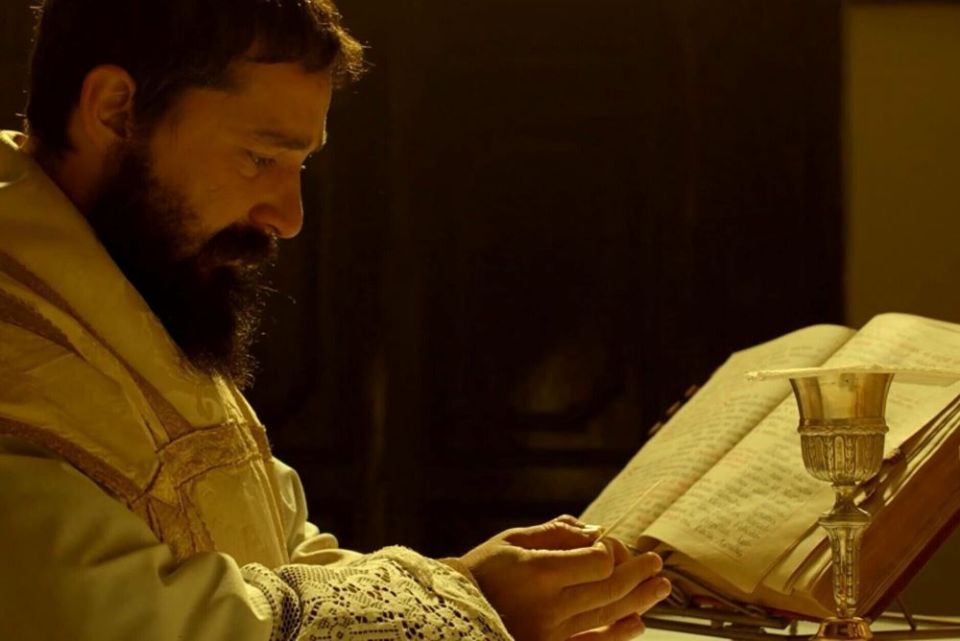
Shia LaBeouf stars as the Italian monk Padre Pio in a film that will screen Sept. 2 at the Venice Film Festival's independently run Giornate Degli Autori. The American actor credits practicing Latin scenes for the film to his conversion to Catholicism. (Giornate Degli Autori/Christian-Mantuan)
ROME — The head of the Vatican's liturgy office says he would welcome a conversation with Hollywood actor Shia LaBeouf, who recently cited the traditional Latin Mass as motivation for his conversion to Catholicism.
"I'd like to know why he thinks that, what is his experience of the celebration of the Mass," said English Cardinal Arthur Roche. "That's what priests do; we try to talk to people."
Roche is one of 20 new prelates elevated to the College of Cardinals by Pope Francis on Aug. 27. He has spearheaded the pope's liturgical reforms, which have included restricting the traditional Latin Mass to limited times, places and celebrants in an effort to facilitate a more unified form of church worship.
New English Cardinal Arthur Roche, prefect of the Dicastery for Divine Worship and the Sacraments, is pictured at a reception after a consistory for the creation of 20 new cardinals at the Vatican Aug. 27. (CNS/Paul Haring)
LaBeouf is currently playing the titular role in the new film "Padre Pio," which chronicles the life of the popular mystic Capuchin monk, who was canonized by Pope John Paul II in 2002. In the press promotion for the film, LaBeouf, 36, who has a history of domestic violence allegations, says he experienced "genuine emotional experiences" while practicing the Latin scenes for the film, ultimately leading him to seek conversion to Catholicism.
"The Latin Mass affects me deeply," the actor said in a recent interview. "Because it doesn’t feel like they're trying to sell me a car."
In a joint interview with NCR and the UK's The Tablet magazine on Aug. 27, Roche said he was unfamiliar with LaBeouf and the news of his conversion, but said that when it comes to high-profile Latin Mass supporters who publicly extol it as a superior form of liturgy, he hopes they will encounter the same reverence in the liturgy's ordinary form (or Novus Ordo), which has been continually updated since the Second Vatican Council, which took place 1962-1965.
"The Mass should be celebrated with great dignity," Roche said. "It isn't just something, a trait that belongs to the missal of 1962. It belongs to the reform."
During the interview, Roche also said that he believes much of the resistance to Francis, as has been expressed by a number of Latin Mass adherents, is rooted in opposition to the reforms of the Council.
Vatican II reforms included the approval of the translation of the liturgy into the vernacular, in an effort to make the Mass more accessible and involve greater participation of the laity.
"Reform of the liturgy was an enormous, long preparation prior to the council and the council is the highest legislation that exists in the church," he said. "Once that legislation comes into effect, it's a very serious matter."
"You disregard that and you're really putting yourself sideways towards the edges of the church," he added.
Roche warned against those reluctant to embrace the reforms of Vatican II, describing them as "not only dragging their feet but stubbornly opposing what the church has decreed."
"And that's a very serious matter," he continued. "In the end, people have to ask themselves, 'Am I really a Catholic or am I more of a Protestant?' "
A conversation with future Cardinal Roche, Prefect of Divine Liturgy, Sacraments
In a wide-ranging interview with Vatican News, Cardinal-elect Arthur Roche, Prefect of the Vatican’s Dicastery for Divine Worship and Discipline of the Sacraments, reflects on his nomination, and various matters related to liturgy, sacraments and evangelization.
By Deborah Castellano Lubov
Future Cardinal Arthur Roche, Prefect of the Vatican's Dicastery for Divine Worship and the Discipline of the Sacraments, suggests we must rediscover the sacred sense of Sundays, and as worshipers, when celebrating the liturgy, worshiping and praising God.
In a wide-ranging interview at the Dicastery, that we bring to you on the Solemnity of Corpus Christi, the English Cardinal-designate stressed this when reflecting on Pope Francis naming him cardinal and how he expects to assist the Holy Father.
In this conversation, the Prefect also reflects on recent debates about the liturgy and the Eucharist, noting “it’s a tragedy” because “the Eucharist is, by its nature, the sacrament that unites the entire Church.”
The Prefect laments the decline of religiosity, particularly in the West on Sundays, greatly due to secularization, and calls for a rediscovering the beauty of the liturgy and sacraments.
Cardinal-elect Roche also speaks about Pope Francis’ changes regarding the Latin Mass, clarifies what has been misreported, and reflects on the situation of the missionary Churches in the Amazon. He also addresses the universal sacramental identity of permanent deacons, but warns that they cannot be the answer to dwindling vocations in various regions of the world, because we would risk following into a “diaconal” Church, rather than a “priestly” one.
He highlights how ordained priesthood is key to the heart of the Church.
Reflecting on evangelization and worship, Cardinal-elect Roche recalls that “the strength for evangelization comes from the celebration of the Eucharist.” He also calls for rediscovering and recapturing the holy and sacred sense of Sundays.
Q: Where were you and what were you doing when you learned Pope Francis had appointed you cardinal?
Well, actually, I was fixing a fuse in the cellar just before the Angelus, which I normally listen to on a Sunday; I had a problem. So, I knew that something had gone wrong and I went into the cellar to fix it. When I came back, both the house phone and my mobile phone, were going berserk. And the first call I picked up was from the Secretary of the Congregation [Dicastery], Archbishop [Vittorio Francesco] Viola. And he said to me, ‘Oh, Tanti auguri,’ you know, ‘many congratulations.’ And I thought he was talking about the Feast of the Ascension, which was being celebrated in Italy on that Sunday. So, I said to him, ‘Yes, buona festa (Happy Feast Day) to you also.” And he said, “No, no, you have been made a Cardinal.” “What?” [smiling]
Q: As Prefect of the Dicastery for Divine Worship and the Discipline of the Sacraments, and as an English future Cardinal, in what way do you expect to counsel the Holy Father?
Well, I would think that obviously the responsibility that I have as Prefect of this Dicastery, which oversees the liturgy in general, and also the matters of discipline pertaining to the sacraments that he would seek my advice about those things. But Pope Francis, you know, whenever we meet him, which happens not infrequently, he's also very interested in your opinion about other things. So, we'll see what happens because as a cardinal, you're at his disposition and you're there in order to help him and not to increase the weight that is upon him. So, we'll see what happens.
Q: Turning to liturgy and reform. There have been many debates recently about liturgy, particularly the Eucharist. Why, in your view, does something that should unite us continue to be so contentious?
There have been opinions expressed about particular concerns. For example, very shortly after the chalice was withdrawn from Holy Communion for everybody who attended Mass, there was a controversy over that, but there's never been a controversy about the liturgy in the way that we're experiencing it today, partly because there has never before been two versions of the Roman Missal –the Roman Missal from 1962, and then the Roman Missal from 1970, which was produced with the full force of the Second Vatican Council behind it and promulgated by Pope Saint Paul VI.
It's a tragedy that there is this controversy today, the so-called ‘battles’ over liturgy, because the Eucharist is, by its nature, the sacrament that unites the entire Church.
And as the Holy Father has pointed out in his Traditionis custodes, there is one liturgical law which assists us in our belief in transmitting the Church's doctrine. So, the reform of the liturgy is really a very important matter today and also not something to be taken as an option.
But one of the problems, challenges, of our age is the growth in individualism and in relativism, that ‘I prefer this.’ Well, the celebration of the Mass is not something to be a matter of personal choice. We celebrate as a community, as the entire Church and the Church throughout the centuries, has always regulated the form of liturgy that it has come to believe is more pertinent for a particular age.
Father [Jozef Andreas] Jungmann, an Austrian Jesuit who only died at the beginning of this century, was someone who, in his studies, showed how over the centuries the Mass has been changed in this way in order to fit the needs of the day. And the resistance to this is quite a serious matter, which the Pope has pointed out in his document on the liturgy, Traditionis custodes.
So, all that is taking place is the regulation of the former liturgy of 1962 Missal by stopping the promotion of that, because it was clear that the Council, the Bishops of the Council, under the inspiration of the Holy Spirit, were putting forward a new liturgy for the vital life of the Church, for its vitality. And that's really very important. And to resist that is, is something that is really quite serious, too.
Q: Let's turn for a moment to access to the sacraments following the Synod on the Amazon. Some expressed disappointment, suggested that it failed to resolve what had been termed as the sacramental crisis for missionary churches with vast territories and with few priests. Is this still a concern?
Well, there are two aspects there. One is the question of the shortage of priests. And I think that's always been a reality, actually, throughout the history of the Church, that even in the Gospel, our Lord Himself foresaw that the harvest is great, but the workers are few. And the second question is with regard to the Amazonian usage of the Roman rite. In other words, the inculturation of the Roman Missal into the Amazonian culture. Well, that is something that is being worked on. But first of all, it has to be worked on by the so-called Amazonian Bishops in Brazil and in Peru, etc... So, they have established a Commission which is beginning to think about that. And that work will take some time, I think.
The other matter regarding vocations is something that always needs to be foremost in the mind of people, because the father of any community is the one who is responsible for bringing bread home to the children.
And so, the Eucharist is very much part and parcel of that. So that is another consideration that has to be looked at by the Bishops and indeed by the Holy Father himself.
But I think that where it does exist, it should really be well known. There are some pushes for deacons to be able to undertake other sacraments, for example, the Anointing of the Sick.
But that isn't possible because with the anointing of the sick also comes the forgiveness of sins, which is personally the priest's responsibility. So, it's not very long since we had the Council, and a lot of these things take time to settle down. And I think that, in general, the role of the deacon is well understood. It is well accepted. It is a blessing for very many parts of the world, in which we're living.
Q: And do you see it as a remedy to dwindling priestly vocations?
No, I don't because if we were to replace the priest with the deacon, we become a diaconal Church instead of a priestly Church. But our baptismal identity is a priestly identity.
And the ordained priesthood is key to the confection of what is at the heart of the Church, which is the Eucharist. So I don't see that as being the case, but I do see deacons as being of enormous pastoral significance and assistance to both priests and bishops in in many, many parts of the world.
Q: In your experience over the past few decades, what have been the greatest changes in religious practices?
Well, I think the fall of religious practice on a Sunday, but that's mainly in the West, and I think that's mainly also because of secularization and because of the change of the status of Sunday.
When I was young, shops were never open on Sunday. And you very rarely played football, except perhaps in the afternoon. But the morning was sacrosanct because it was a general practice that everybody went to church and the ‘Domenica [Sunday in Italian],’ Sunday, for us is named after the Lord, the Lord's Day.
And it's something that we really somehow need to recapture. I think we could do that by increased catechesis and closeness to people. When I was a young priest, my bishop used to say that a people-going priest makes a Mass-going people. So, I think the closeness of the priest to his community is vital in this regard.
Q: Looking at secularization and liturgy, is there any connection between the two?
Well, secularization tries to diminish the importance of the divine, and we must be very careful about that, because when we go to church, when we celebrate the liturgy, we're there to worship God. We're not there to entertain ourselves or to entertain the community.
It's the community who's there to give praise to God for the gifts that He's given to us, especially through His Son Who died for us and Who is made present in the bread and the wine, where, as fully-present body, blood, soul and divinity, He is in the Eucharist. So, we've got to be very careful, but we are living in a in a secular world.
And so, we have to be evangelists. And the strength for evangelization comes from the celebration of the Eucharist. So, at the end of the Mass, when the deacon says, ‘go in the peace of Christ,’ or the Masses end, and [says] ‘go in peace,’ or ‘let us now go to give praise to Christ by our way of life,’ in the world in which we live, he is sending us out to be evangelizers, to be catechizers in the world in which we live in. So that's a very strong link with the two cultures, if you like, and one that can bring great wholeness to a secular society.
Q: What role can worship, play in the re-evangelization of de-Christianized countries?
Well, the Eucharist itself brings with it the doctrine of the Church. All the prayers that constitute the celebration of the liturgy on Sunday are mainly from the Sacred Scripture. Nearly always, nearly every word, nearly every nuance, is coming from Scripture or from the Teaching of the Fathers of the Church. So that itself, when you go to Mass, you're receiving the doctrine of the Church. They used to say that Saint Bernard of Clairvaux in the 12th Century knew the Scriptures so well that he spoke ‘scripturally.’ I suppose our young people today would say he spoke ‘Bible’ [smiling]. Well, he received that because he was imbibing it.
When we imbibe all the liturgy of the of the Church, we are receiving the doctrine. We are receiving how to pray, scripturally. We are receiving what the Word of God in its revealed form brings to us the life of the Church. So, if you attend Mass and if you attend the liturgy and really pray all the content that is in the liturgy, you're being prepared to be a very important evangelizer.
New moves by Pope Francis mean changes for Catholics dedicated to the Traditional Latin Mass —and for the priests and bishops responsible for these communities.
Even though these Catholics represent a relative small minority of believers, the changes have ramifications for the entire Church. Here's what you need to know about the rules the pope set forth in a document called Traditionis custodes.
What is Traditionis custodes?
Traditionis custodes is a July 16 instruction called a motu proprio. In this document, Pope Francis made major changes to the place of Traditional Latin Mass in the life of the Church.
His predecessor Benedict XVI had issued a 2007 apostolic letter, Summorum Pontificum, which acknowledged the right of all priests to say Mass using the Roman Missal of 1962.
The Mass said using the 1962 Roman Missal is known variously as the extraordinary form of the Roman Rite, the Tridentine Mass, the usus antiquior, and the Traditional Latin Mass. It was the form of the Mass used for centuries. This form of the Mass has ancient roots, being substantially the same as that found in sacramentaries of the eighth century, but it was especially codified following the Council of Trent in the 16th century.
After the Second Vatican Council of the 1960s, St. Paul VI released a form of the Mass that could be used in vernacular languages.
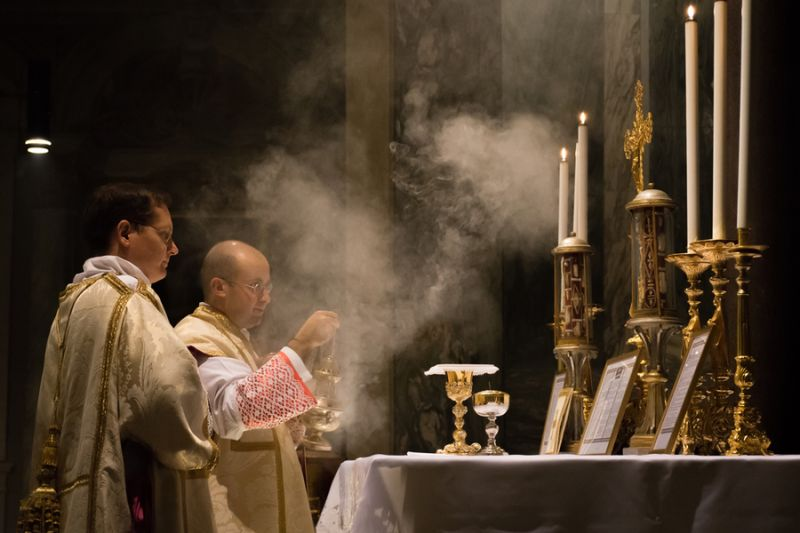
In the Traditional Latin Mass, the priest faces the altar. Some prayers are different, some prayers are expanded, and some prayers and responses are limited to the priest or those serving at the altar. Traditional Latin Mass communities follow a different liturgical calendar, too.
Why did Pope Francis say Traditionis custodes was necessary?
Pope Francis said he acted “in defense of the unity of the Body of Christ,” on the grounds that there was “distorted use” of the ability for priests to say Mass according to the 1962 missal. The opportunities provided by St. John Paul II and Benedict XVI were “exploited to widen the gaps, reinforce the divergences, and encourage disagreements that injure the Church, block her path, and expose her to the peril of division.”
The pope said he was saddened that the celebration of the extraordinary form was now characterized by a rejection of the Second Vatican Council and its liturgical reforms. To doubt the Council, he said, is “to doubt the Holy Spirit himself who guides the Church.”
He criticized what he said was a growing attitude of “rejection of the Church and her institutions in the name of what is called the ‘true Church’.”
In March 2020, the Congregation for the Doctrine of the Faith’s prefect Cardinal Luis Ladaria wrote to the presidents of bishops’ conferences, asking them to distribute a questionnaire about how Benedict XVI’s Latin Mass rules affected bishops’ dioceses.
Pope Francis said the responses to the survey “reveal a situation that preoccupies and saddens me, and persuades me of the need to intervene.”
What changes are we talking about?
Pope Francis said that the liturgical books issued by St. Paul VI and St. John Paul II are “the unique expression” of the Roman rite. While priests used to have broad rights to decide to celebrate the Traditional Latin Mass, the pope has now established a bishop’s “exclusive competence” to authorize the use of the 1962 Roman Missal in his diocese.
Bishops must determine that existing Traditional Latin Mass groups in their diocese do not deny the validity of the Second Vatican Council and the teachings of the Catholic Church. Also, bishops must designate non-parish churches where these groups may gather to celebrate Mass and establish the days on which they may celebrate. These Masses are to use scriptural readings “in the vernacular language” in translations approved by the relevant episcopal conferences.
Bishops also need to name a diocesan delegate to oversee pastoral care for Traditional Latin Mass groups, and should verify that these communities are effective for spiritual growth.
Newly ordained priests who want to offer the extraordinary form of the Mass now need to make a formal request to their bishop. The bishop must then consult with the Vatican before granting permission. Priests who already offered the Mass in the extraordinary form needed to request authorization from their bishop.
How many people attend the Traditional Latin Mass?
There are perhaps as few as 150,000 U.S. Catholics who regularly attend the Traditional Latin Mass, at about 700 venues. They make up less than 1% of some 21 million regularly Mass-going Catholics.
At the same time, you might find Traditional Latin Mass Catholics in plenty of places. Political and cultural commentators show particular sympathy for this form of the liturgy, and aren’t shy about saying so.
On social media, traditional Catholics can be quite vocal — and even eccentric and abusive. Some devotees of the traditional Latin Mass adhere to the Society of St. Pius X or have unusual beliefs about the papacy and the Second Vatican Council.
In France, there are perhaps 60,000 traditionalist Catholics. They make up perhaps 4% to 7% of practicing Catholics in the country, and a sizable number are with breakaway groups. These communities show slow but steady growth each year and their members tend to be much younger than average churchgoers.
Critics of the Traditional Latin Mass hope that the Pope’s actions will rein in some Catholic traditionalists who they say have gone too far in their attitude towards the papacy or the Second Vatican Council.
The prefect of the Congregation for Divine Worship, Archbishop Arthur Roche, told a Swiss television station that Pope Francis issued Traditionis custodes because the effort to reconcile the breakaway traditionalist Society of St. Pius X “has not entirely been successful” and because it is necessary to “go back” to what the Second Vatican Council required of the Church.
The pope’s action appears to have re-opened long-time debates about the Catholic liturgy that some observers thought had settled into a period of quiet co-existence, despite some polemics on the internet.
Those who still admire Pope Benedict’s broad permission for the Traditional Latin Mass like to cite the previous pope’s own words — and the words of previous Vatican leaders in liturgy.
Before Pope Francis announced his changes, Cardinal Robert Sarah, former head of the Congregation for Divine Worship, took to Twitter July 8 to defend Benedict XVI’s rules on the Traditional Latin Mass: “despite difficulties and resistance, the Church embarked on a path of liturgical and spiritual reform, which, though slow, is irreversible.”
“Despite intransigent clerical attitudes in opposition to the venerable Latin-Gregorian liturgy, attitudes typical of the clericalism that Pope Francis has repeatedly denounced, a new generation of young people has emerged in the heart of the Church,” Sarah said. “This generation is one of young families, who demonstrate that this liturgy has a future because it has a past, a history of holiness and beauty that cannot be erased or abolished overnight.”
Has there been any further directives issued by the Vatican?
Yes. The Congregation for Divine Worship and the Discipline of the Sacraments, the Vatican office responsible for matters related to the sacred liturgy, said it had received “several requests for clarification” on the correct application of Traditionis custodes. For this reason, the congregation on Dec. 18, 2021 published an explanatory document, called a “responsa ad dubia”(“answers to doubts”), with one-word replies — either “negative” or “afffirmative” — to 11 specific questions, followed by brief explanations.
Among other directives, the document bans confirmations and ordinations according to pre-Vatican II Roman Missals.
The intent of the new restrictions is “to re-establish in the whole Church of the Roman Rite a single and identical prayer expressing its unity,” the liturgy office said.
“In implementing these provisions, care should be taken to accompany all those rooted in the previous form of celebration towards a full understanding of the value of the celebration in the ritual form given to us by the reform of the Second Vatican Council,” the document said.
“This should take place through an appropriate formation that makes it possible to discover how the reformed liturgy is the witness to an unchanged faith, the expression of a renewed ecclesiology, and the primary source of spirituality for Christian life.”