Showing posts with label Bishop Kevin Rhoades. Show all posts

Thursday, February 12, 2026

Indiana Bishop speaks out against Notre Dame's appointment of abortion advocate


Bishop Rhoades calls on Notre Dame to reverse new director’s appointment over abortion advocacy


(OSV News) — An Indiana bishop is urging the University of Notre Dame to halt the appointment of a faculty member, who advocates openly for abortion, as head of one of the school’s research centers.

The matter highlights the role of Catholic universities in the life of the Church, as delineated in St. John Paul II’s 1990 apostolic constitution, “Ex Corde Ecclesiae,” for which the U.S. Conference of Catholic Bishops approved a particular application in 1999.

Bishop Kevin C. Rhoades of Fort Wayne-South Bend, Indiana, issued a Feb. 11 statement expressing “dismay” and “strong opposition” to the university’s appointment of associate professor Susan Ostermann as director of the Liu Institute for Asia and Asian Studies, effective July 1. Notre Dame is located adjacent to South Bend, Indiana, the state’s fourth largest city.


The institute is part of the university’s Keough School of Global Affairs, of which Ostermann — who specializes in the study of regulatory compliance, comparative politics and environmental regulation, with a focus on South Asia — is a faculty member. The appointment, announced on Jan. 8, has drawn fire from Notre Dame faculty and staff due to Ostermann’s robust public endorsement of legal abortion, and her work as a consultant for the Population Council, an international research and policy firm that works to advance “sexual and reproductive health, rights and choices” as a key aim. At least two Notre Dame faculty members, professor Diane Desierto and emeritus professor Robert Gimello, resigned their roles at the Liu Institute in protest, according to The Observer, Notre Dame’s student-run newspaper.


The University of Notre Dame announced Jan. 8, 2026, that Susan Ostermann, who supports keeping abortion legal, has been appointed as director of the university’s Liu Institute for Asia and Asian Studies. Ostermann is pictured in a Sept. 16, 2021, photo. (OSV News photo/Matt Cashore, University of Notre Dame)

Ostermann’s abortion advocacy

In his statement, Bishop Rhoades said Ostermann’s “extensive public advocacy of abortion rights and her disparaging and inflammatory remarks about those who uphold the dignity of human life from the moment of conception to natural death go against a core principle of justice that is central to Notre Dame’s Catholic identity and mission.”

Bishop Rhoades — noting he had read “many of the op-ed pieces co-authored by Professor Ostermann — said the appointment was “causing scandal to the faithful of our diocese and beyond.”

In one such piece, published by the Chicago Tribune in December 2022, Ostermann and former faculty colleague Tamara Kay (who left Notre Dame for the University of Pittsburgh, following outcry over her endorsement of legalized abortion) surveyed “lies about abortion” that have “dictated public policy.”

Among those lies, wrote Ostermann and Kay, was that “abortion kills babies.”

“Almost 90% of abortions occur during the first 10 weeks of pregnancy when there are no babies or fetuses. There are only blastocysts or embryos so tiny they are too small to be seen on an abdominal ultrasound,” wrote Ostermann and Kay.

‘Outrageous claims’ about the pro-life position cited

The same article also described crisis pregnancy centers as “anti-abortion rights propaganda sites” that “operate and provide false information to women who are lured to them believing they will receive legitimate medical care.” 

Ostermann and Kay further asserted that “women who are denied an abortion experience a panoply of negative outcomes physically, mentally and occupationally.”

Bishop Rhoades quoted additional writings by Ostermann in his statement, noting she had claimed the pro-life position has “its roots in white supremacy and racism,” with misogyny “embedded” in the movement.”

“She also argued that the Catholic social doctrine of ‘integral human development’ supports abortion because it enhances freedom and flourishing for women,” said Bishop Rhoades.

“These are all outrageous claims that should disqualify her from an administrative and leadership role at a Catholic university,” he said. “I hope that Professor Ostermann will explicitly retract these claims, and I pray that she will have a change of mind and heart that will lead her to affirm the innate dignity of unborn babies as well as that of their mothers.”

In a statement provided to OSV News, Ostermann said that her “primary focus is to serve as a steward for the Liu Institute mission in the context of the University’s larger mission, and a facilitator for our world-class faculty. 

“I am fully committed to maintaining an environment of academic freedom where a plurality of voices can flourish,” she said. “I have long worked with scholars who hold diverse views on a multitude of issues, and I welcome the opportunity to continue doing so. While I hold my own convictions on complex social and legal issues, I want to be clear: my role is to support the diverse research of our scholars and students, not to advance a personal political agenda.”

“This commitment to academic inquiry and mutual respect is deeply rooted in my appreciation for Notre Dame’s identity as a global Catholic research university,” Ostermann continued. “I am inspired by the University’s focus on Integral Human Development, which calls us to promote the dignity and flourishing of every person. I respect Notre Dame’s institutional position on the sanctity of life at every stage. By fostering a collaborative space that values rigorous inquiry, we contribute in important ways to global development and human well-being. As Liu Director, I look forward to working closely with my colleagues to ensure the Liu Institute remains a place where truth is pursued with both excellence and integrity.”

Bishop Rhoades reminds Notre Dame about papal witness to life

In his statement, Bishop Rhoades cited a Nov. 15, 2014, address by Pope Francis in which the late pontiff denounced “false compassion which holds that it is a benefit to women to promote abortion.”

“The Church here in our diocese and around the world serves mothers before and after birth, providing spiritual, emotional, and material care to moms in need,” said Bishop Rhoades. “The Church stands for the inalienable right to life of mothers and their unborn children.”

Bishop Rhoades said that “Notre Dame has publicly committed as a Catholic institution to the life and dignity of the human person,” affirming the Church’s teaching that “human life must be respected and protected absolutely from the moment of conception,” as the Catechism of the Catholic Church states.

“I am proud of Notre Dame’s pro-life commitment, manifest in the large number of students and faculty who promote a culture of life through many campus organizations, programs, and activities,” Bishop Rhoades said. “They witness to the sanctity of life at every stage, with special attention to the lives of the vulnerable, including the unborn, the poor, immigrants, the elderly, and the infirm.”

He stressed that “the Catholic Church upholds a consistent ethic of life,” pointing to Pope Leo XIV’s recent citation of St. Teresa of Calcutta’s address at the National Prayer Breakfast in February 1994, in which she said “the greatest destroyer of peace today is abortion.”

Bishop Rhoades also quoted Pope Leo, who in a Jan. 31 address observed that “no policy can genuinely serve the people if it denies the unborn the gift of life, or if it neglects to support those in need whether in their material circumstances or in their spiritual distress.”

Bishop Rhoades said that “this pro-life principle is not merely affirmed by Catholics; it is embraced by many people of good will of diverse backgrounds and commitments around the world.”

Catholic social teaching does not support abortion

With the Keough Institute endorsing integral human development as the primary Catholic social teaching principle for its work, said Bishop Rhoades, “Professor Ostermann has written — ludicrously — that this Catholic principle actually supports abortion on demand.”

Yet the Holy See has repeatedly affirmed to the United Nations that the inherent right to life is central to integral human development, said the bishop.

“Professor Ostermann’s opposite view thus clearly should disqualify her from holding a position of leadership within the Keough School,” he said.

He added that Ostermann’s consultancy for the Population Council was another disqualifier for the Liu Institute appointment, since the council is “dedicated to the promotion of abortion around the world, “linked to China’s population control policies that have resulted in hundreds of millions of abortions of baby girls,” and “instrumental in securing approval of the abortion pill by the FDA, which is responsible for the majority of abortions in the United States.”

“Some may claim that this appointment should be protected by academic freedom,” said Bishop Rhoades noted.

However, he said, “Academic freedom concerns the liberty of faculty to conduct research according to their own professional judgment and interests. 

“This appointment, by contrast, concerns the official administrative appointment to lead an academic unit,” he said. “Such appointments have profound impact on the integrity of Notre Dame’s public witness as a Catholic university.”

‘Still time to make things right’ at Notre Dame

Ostermann’s appointment as the head of the Liu Institute “understandably creates confusion in the public mind as to Notre Dame’s fidelity to its Catholic mission,” said Bishop Rhoades, adding that “many faculty, students, alumni, and benefactors of Notre Dame have reached out to me to express their shock, sadness, confusion, and disappointment” over the move.

Bishop Rhoades urged prayer, particularly to the Virgin Mary under her title Our Lady of Lourdes, asking her to intercede so that “Notre Dame will always stand firm in her commitment to the Gospel of her Son, the Gospel of Life.”

 He cited “Ex Corde Ecclesiae,” which names the local bishop as having particular responsibility to promote and assist in preserving the Catholic identity of Catholic universities within a given diocese.

“I call upon the leadership of Notre Dame to rectify this situation,” said Bishop Rhoades. “The appointment of Professor Ostermann is not scheduled to go into effect until July 1, 2026. There is still time to make things right.”


Gina Christian is a multimedia reporter for OSV News. Follow her on X @GinaJesseReina.

Wednesday, November 12, 2025

USCCB approves the Consecration of the USA to the Sacred Heart of Jesus in 2026

 U.S. bishops to consecrate nation to Sacred Heart of Jesus

The Sacred Heart of Jesus. | Credit: Unidentified painter, Public domain, via Wikimedia Commons

Tessa Gervasini

The United States Conference of Catholic Bishops (USCCB) approved the consecration of the nation to the Sacred Heart of Jesus in 2026 to accompany the country’s 250th anniversary.

At the USCCB Fall Plenary Assembly in Baltimore, bishops voted “to entrust our nation to the love and care of the Sacred Heart of Jesus.” Devoting the nation is an opportunity “to remind everyone of our task to serve our nation by perfecting the temporal order with the spirit of the Gospel as taught by the Second Vatican Council,” Bishop Kevin Rhoades of Fort Wayne-South Bend, Indiana, said.

“One hundred years ago, in 1925, in his encyclical instituting the feast of Christ the King, Pope Pius XI, drawing on the teaching of Pope Leo XIII, referred to the pious custom of consecrating oneself, families, and even nations to the Sacred Heart of Jesus as a way to recognize the kinship of Christ,” said Rhoades, who serves on an advisory board for President Donald Trump’s Religious Liberty Commission.

To help Catholics prepare for the consecration, Rhoades said the bishops will develop prayer resources, including a novena. He said they are already putting together other resources for use by dioceses, parishes, and other groups to engage Catholics.

“In his fourth and last encyclical, Dilexit Nos, Pope Francis brought devotion to the Sacred Heart to the forefront of Catholic life as the ultimate symbol of both human and divine love, calling it a wellspring of peace and unity,” said Rhoades, who has served as chair of the USCCB Committee on Religious Liberty. 

Francis “wrote of how the Sacred Heart teaches us to build up in this world God’s kingdom of love and justice. Then in his first apostolic exhortation, Dilexi Te, Pope Leo XIV, following upon Pope Francis’ teaching, invites us to contemplate Christ’s love, the love that moves us to mission in our suffering world today,” Rhoades said.

Before bishops voted to consecrate the U.S. to the Sacred Heart of Jesus, Archbishop Paul Etienne of Seattle asked if the bishops will include catechetical materials to guide Catholics, as the devotion “is ultimately inviting people into a deeper relationship with the very person of Jesus himself.”

Etienne said the “devotion to the Sacred Heart is such a rich devotion and almost complex.” 

Rhoades responded they “do intend to have catechetical materials,” because “there is such an abundance of beautiful teaching.” 

At the request of Bishop Arturo Cepeda of San Antonio, Rhoades said the bishops can provide the materials in various languages “to have as many of our people involved as possible.” He said the resources will also allow individuals and families to make their own consecration, as the consecration simultaneously happens across the nation.

Miami Archbishop Thomas Wenski proposed a celebration during the bishops’ spring meeting in Orlando, Florida, in June at the solemnity of the Sacred Heart of Jesus and suggested inviting Trump, Vice President JD Vance, and other officials to attend.

History of the devotion

The story behind the devotion to the Sacred Heart of Jesus dates back to 1673. At a monastery belonging to the Order of the Visitation of Holy Mary in eastern France, Sister Margaret Mary Alacoque began experiencing visions of the Sacred Heart that continued for 18 months.

Sister Margaret Mary learned ways to venerate the Sacred Heart of Christ during her visions. These devotions included a Holy Hour on Thursdays, the creation of the feast of the Sacred Heart after Corpus Christi, and the reception of the Eucharist on the first Friday of every month.

On June 16, 1675, Jesus told Sister Margaret Mary to promote a feast that honored his Sacred Heart. He also gave Sister Margaret Mary 12 promises to all who venerated and promoted the devotion of the Sacred Heart.

The Vatican was first hesitant to declare a feast of the Sacred Heart. But as the devotion spread throughout France, the Vatican granted the feast of the Sacred Heart of Jesus to France in 1765. In 1856, Blessed Pius IX designated the Friday after the octave of Corpus Christi as the feast of the Sacred Heart for the universal Church.

Monday, June 23, 2025

The focus for the 2025 Religious Freedom Week


The logo for Religious Freedom Week The logo for Religious Freedom Week  

Bishop Rhoades highlights religious freedom concerns

Bishop Kevin Rhoades, chairman of the USCCB’s Committee on Religious Liberty, highlights the domestic and international issues the Church in the United States is focusing on during Religious Freedom Week 2025.

By Christopher Wells and Kielce Gussie

Religious Freedom Week in the United States commenced on Sunday with a focus on political polarization, which can lead to “abandoning the search for truth and fidelity to the Church in order to support one or another political party or ideology.”

Polarization is an issue of special concern for the US Bishops, and for the Church, said Bishop Kevin Rhoades, especially when “people are more influenced by their political ideology than their faith.”

Challenges from across the ideological spectrum

Speaking with Vatican News ahead of Religious Freedom Week, Bishop Rhoades, the chairman of the USCCB’s Committee on Religious Liberty, noted that threats to religious freedom can come from various points of the political spectrum, with political parties on both the right and the left attempting to limit the religious freedom of their ideological opponents.

Each day of the week is dedicated to a different issue related to religious liberty, Bishop Rhoades said, noting that although the focus is largely on issues facing the United States, the week also has an international dimension—this year focusing on challenges to religious freedom in Nigeria and Nicaragua.

'We don't look at immigration status'

Among the domestic issues raised by the US Bishops is the Catholic Church’s services to migrants and refugees. “This doesn’t mean that we’re getting involved in the immigration debate itself,” said Bishop Rhoades. Instead, “it has to do with our ability, our freedom, to provide food or to provide housing, to provide assistance to those who are in our county. We don’t look to see what their immigration status is.”

Attacks on the Church’s ability to provide aid to those in need, the Bishop said, are a “serious violation” of religious liberty.

Parents' rights in educating their children

Bishop Rhoades explained that the choice of issues to emphasize during Religious Freedom Week is largely based on the USCCB’s annual report on the state of religious liberty in the United States. Among the other challenges addressed this year are government funding for in vitro fertilization and other procedures that fail to uphold the dignity of human life and parental choice in the education of their children.

The latter “is another area that we have worked very hard on,” Bishop Rhoades said, “because of the Church’s teaching and our belief that education is primarily the responsibility of the parents.”

Parents, he said, “should have the freedom to educate their children in schools that they choose, including religious schools, but sometimes we’re discriminated against because of that.” He described discrimination against religious schools as “unjust.”

Inspired by the Saints

In concluding remarks, Bishop Rhoades noted that Religious Freedom Week begins each year on the feast of Sts. Thomas More and John Fisher, who both suffered for their liberty and were martyred for their refusal to recognize the king of England as the supreme head of the Church in England. Although they truly loved their country, he said, “their ultimate loyalty was to Christ and His Kingdom.”

Similarly, Sts. Peter and Paul, whose feast marks the end of Religious Freedom Week, were “persecuted, imprisoned, and martyred in Rome” when they refused to deny their faith. So, Bishop Rhoades said, “I think the bookends for Religious Freedom Week, these two feasts, are also very significant for us” and an inspiration for those working to defend religious liberty.

Wednesday, January 17, 2024

USCCB identifies 5 areas of concern as threats to religious liberty


New US Bishops’ Report Identifies 5 Top Areas Of Religious Liberty Concerns


WASHINGTON (OSV News) — A new annual report by the U.S. bishops’ conference identifies five top threats to religious liberty in the United States, including a federal regulation it says could impose mandates on doctors to perform objectionable procedures and threats to the church’s service to people who are migrants.

The U.S. Conference of Catholic Bishops’ first annual “State of Religious Liberty in the United States,” published Jan. 16, said potential threats to religious liberty in the United States largely come in the form of federal regulations or cultural trends.

Five key areas of concern, the 48-page report said, include attacks against houses of worship, especially in the aftermath of the Israel-Hamas conflict; the Section 1557 regulation from the U.S. Department of Health and Human Services, which the report said “will likely impose a mandate on doctors to perform gender transition procedures and possibly abortions”; threats to religious charities serving migrants and refugees, “which will likely increase as the issue of immigration gains prominence in the election”; suppression of religious speech “on marriage and sexual difference”; and the Equal Employment Opportunity Commission’s Pregnant Workers Fairness Act regulations, which the report said “aim to require religious employers to be complicit in abortion in an unprecedented way.”

The report’s introduction said that due to a divided federal government, “most introduced bills that threatened religious liberty languished,” resulting in threats in the form of “proposed regulations by federal agencies,” or cultural trends such as growing partisanship over migration.

The report noted the U.S. Supreme Court only heard two cases implicating religious liberty in 2023, “but in each case the Supreme Court ruled for broader protections — for religious exercise in the workplace, in Groff v. DeJoy, and for free speech based on religious beliefs, in 303 Creative LLC v. Elenis.”

Other areas of concern identified in the report include some state bills making clergy mandatory reporters for abuse without an exception for the seal of the confessional. As the report notes, “For Catholic priests, breaking the confidentiality of statements made during the Sacrament of Reconciliation — that is, breaking the seal of the confessional — is a grave offense, resulting in automatic excommunication from the Church.”

The report also identified partisanship within the church as an area of concern.

“This dynamic is not new, is not unique to Catholics, nor will it disappear anytime soon,” it said. “But it will be especially salient in 2024, and the long-term standing of the Church in the public square requires a conscious and sustained turn — away from partisanship and toward the Gospel.”

Bishop Kevin C. Rhoades of Fort Wayne-South Bend, Indiana, chair of the USCCB’s Committee for Religious Liberty, who oversaw the report, told OSV News that the committee began this annual report in order to “educate the faithful” and “motivate people to get involved in promoting and protecting religious liberty.”

Bishop Rhoades noted that threats to houses of worship remain a significant cultural concern, as Catholic churches and organizations saw vandalism and other crimes in the wake of the U.S. Supreme Court’s Dobbs v. Jackson Women’s Health Organization decision in 2022 that overturned prior rulings by the high court making abortion access a constitutional right; other faith traditions have seen more violence occur at their places of worship, such as the 2018 mass shooting at a Pittsburgh synagogue.

Dan Balserak, the USCCB’s religious liberty director and assistant general counsel, told OSV News the committee’s work has historically centered on “legal problems.”

“Things are such now these days that we are actually having to worry about the physical health and safety of people in their place of worship,” Balserak said. “Which is pretty disturbing.”

Both Bishop Rhoades and Balserak said that a growing cultural divide on the issue of migration also threatens to imperil the church’s service to people who are migrants and refugees.

“The church’s mission, you know, is we’re to serve, serve the poor and the needy. That’s part of our mission to the corporal works of mercy, so welcoming the stranger,” Bishop Rhoades said, an act of mercy demanded by Jesus Christ in Matthew 25 when he renders justice at the final judgment. “And we’re talking here about basic needs: sometimes food, sometimes shelter, clothing and other kinds of assistance. The church has always done this and it’s just part of our Christian responsibilities.”

Bishop Rhoades said some have suggested that “somehow the church is contributing to illegal immigration” through such service.

“Comprehensive immigration reform is something that the Catholic Church in the United States has been advocating for for decades,” he added. He said “our provision of humanitarian aid to human beings who are in need” is needed regardless of whether and how Congress would act.

Balserak said, “It seems that the role that religious charities play in the immigration system as service providers — helping immigrants get a place to sleep, get a meal, understand their legal obligations, the role that religious charities play in that regard — has been essentially scapegoated.”

The real burden of responsibility is with Congress which has failed to address “the immigration problem that the immigration crisis has created.”

Charities that ensure “newcomers who arrive in America deserve to have their basic human needs met” are sometimes then accused of “conspiratorial, outlandish stuff — like you know, facilitating ‘the great replacement.'”

The so-called “great replacement” theory is a conspiracy theory advanced by white supremacists in which they claim people of other races plot to eliminate the white race. The racist theory was amplified recently by Vivek Ramaswamy at a GOP presidential primary debate prior to dropping out of the race after a distant fourth-place finish in the Jan. 15 Iowa caucuses.

Erroneous claims about the church’s service to migrants, Balserak said, could imperil their ability to partner with the federal government on services to migrants and on other projects.

“At the end of the day … what’s being proposed is basically if you exercise your religious beliefs in this particular way or area, we’re going to penalize you,” he said, calling those claims “a classic religious liberty threat.”

Both Bishop Rhoades and Balserak said the USCCB annual report concerns the landscape for domestic religious liberty, but the issue of religious liberty in the U.S. has echoes around the globe.

Bishop Rhoades said an erosion of that liberty would not only be “harmful to our country, and the principles on which our nation was founded, but also I think affects others around the world.”

“If you’ve been paying attention to the international religious liberty front recently, we are incredibly blessed,” Balserak said. “For all the problems that we are talking about in this report, we are incredibly blessed to live in the United States.”

Balserak said the best way for Catholics to respond to religious liberty threats is to “go out and do the things that we are fighting for your right to do.”

“So what’s under threat right now?” he said. “Our service to immigrants? Go volunteer at a shelter for immigrants. We see arsons pregnancy resource centers — there’s a threat to the continued operation of ministries meant to help pregnant mothers in need — go volunteer at a pregnancy resource center.”

That “ground up approach,” Balserak said, “is the most viable long-term solution to current threats that we face to religious liberty.”


Kate Scanlon is a national reporter for OSV News covering Washington. Follow her on X (formerly Twitter) @kgscanlon.

Sunday, April 9, 2023

Meet the U.S. Deacon chosen to chant the Exsultet at St. Peter's Basilica in front of Pope Francis


‘You sing, and the Holy Spirit does the rest’: US deacon to chant Easter proclamation at St. Peter’s Basilica

 
Deacon Exsultet Rome
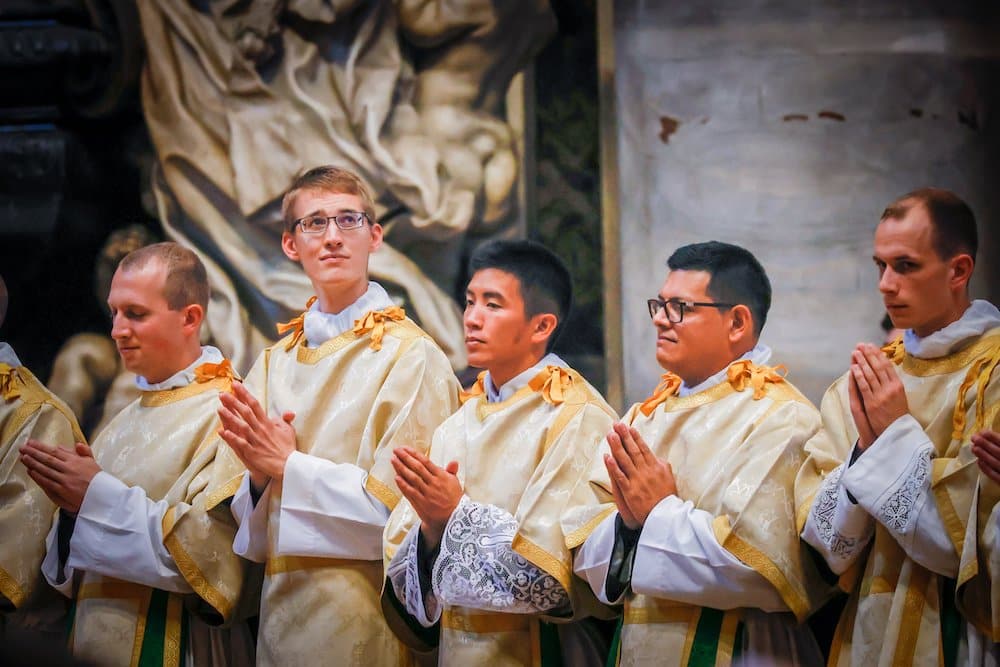
Deacon Zane Langenbrunner, second from left, at his Sept. 29, 2022, ordination as a transitional deacon in St. Peter's Basilica at the Vatican. Deacon Langenbrunner, an Indiana native, was selected to chant the Exsultet at the April 8, 2023, Easter Vigil with Pope Francis in St. Peter's Basilica. (OSV News photo/Jennifer Barton, Today's Catholic)

(OSV News) — As a kid, 29-year-old Deacon Zane Langenbrunner loved to sing in church.

“The people in the pew in front of us would turn around and say to my parents, ‘He sings so loud, and we love that,'” Deacon Langenbrunner, a Mishawaka, Indiana, native studying at the Pontifical North American College (PNAC) in Rome, told OSV News.

Now, the deacon — a high school marching band alumnus who will be ordained to the sacred priesthood in June — is set to sing the Easter proclamation, or Exsultet, at the Easter Vigil Mass Pope Francis celebrates April 8 at St. Peter’s Basilica.

“Every year, one of the deacons in the PNAC choir gets to help in singing it. It’s kind of a little tradition that one of (our) guys gets to do it, and this year, I was fortunate enough to be asked,” said Deacon Langenbrunner. “I said yes.”

Bishop Kevin C. Rhoades of the Diocese of Fort Wayne-South Bend, Indiana, Deacon Langenbrunner’s home diocese, told OSV News he was “thrilled” at the prospect.

“Deacon Zane is a humble young man and exemplary seminarian,” said the bishop, adding “the privilege of chanting the Exsultet” was “not an easy musical task.”

In the Latin Church led by the pope, the bishop of Rome, the ancient text of the Exsultet — named for its first word, Latin for “exult” — is normally sung by a deacon (or a priest, or lay cantor if necessary) as the Paschal candle is blessed during the Easter Vigil.

The solo piece, which on average takes from 10 – 13 minutes to sing, lauds Jesus Christ’s triumph over sin and death, narrating the sweep of salvation history as the triumph of light over darkness. The text in its present form is largely identical with that used since the ninth century.

“It’s amazing how it speaks to earthly, created things, and … how they are united forever now in Christ with the things of heaven,” Deacon Langenbrunner said. “This is a victorious prayer about proclaiming this reality right now: the Son of God, taking flesh for our salvation, (coming) to unite earth and heaven.”

Deacon Langenbrunner said he only learned of his selection “about two or three weeks ago,” and his practice time was curtailed by a five-day silent retreat.

But the tenor said any twinges of anxiety he might have about singing the Exsultet, especially with Pope Francis as the principal celebrant, are offset by his excitement over “using the gift of music to glorify God.”

Thanks to his experience as percussionist — he played drums in high school, and has been doing the same for his seminarian rock band, “PNAC at the Disco” — Deacon Langenbrunner plans to bring a gentle cadence to chanting the Exsultet.

“Chant notation doesn’t have a specific rhythm lined out, but it does have some kind of movement,” he said.

Although he has sung with fellow seminarian choir members in St. Peter’s Basilica, singing solo in the world’s “most enormous church” will take an act of faith, he admitted.

“You sing, your voice goes out, and you don’t hear it come back,” he said. “You have to trust that the sound will get to the place where it needs to be projected. You sing, and the Holy Spirit does the rest.”

Deacon Langenbrunner likens the process to that of his own vocational journey.

“It’s amazing what Lord has had in store for me,” he said. “It’s beyond what I ever would have imagined.”