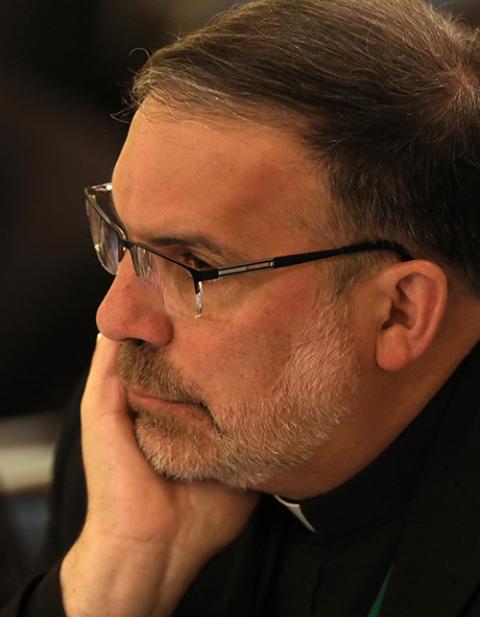
Showing posts with label Bishop John Stowe. Show all posts

Monday, December 16, 2024

One U.S. Bishop/Diocese began installing women acolytes


Bishop Stowe blesses 3 women in ceremony recognizing lay ministry roles


Bishop John Stowe of Lexington, Kentucky, blesses three women acolytes during Mass Nov. 24 at the Cathedral of Christ the King in Lexington. (Courtesy of Maureen C Guarnieri Yeager)


Brian Fraga

Nearly four years since Pope Francis changed canon law to allow women to be installed as lectors and acolytes, some dioceses are now moving ahead with ceremonies to formally recognize women in those instituted lay ministries.

"I waited long enough to get any direction from the USCCB," Bishop John Stowe said, referring to the U.S. Conference of Catholic Bishops, which has yet to promulgate new guidelines and norms on the expanded lay ministries.

Stowe installed three women as acolytes during Mass on Nov. 24 at the Cathedral of Christ the King in his Diocese of Lexington, Kentucky. Following his homily, Stowe imparted a blessing onto the acolytes, who typically assist priests in distributing Communion and preparing the altar during Mass.

"It was a nice day to recognize the ministry that these women have already accomplished," Stowe told National Catholic Reporter. "I would have liked to have done it sooner."

Diane Zekind, one of the acolytes blessed by the bishop, said it was fulfilling to be recognized for a ministry that she has been performing at her parish, St. Clare Church in Berea, Kentucky, for 14 years.

"It was an awesome moment," Zekind told NCR. "I think it was a great way to set an example for others to be involved with liturgical ministries, that women can serve in a number of areas, and how others should be involved with it."

At least one other diocese has installed women as lectors and acolytes in the absence of guidance from the U.S. bishops.

On Aug. 27, the San Antonio Archdiocese held a special Mass at Our Lady's Chapel in Assumption Seminary to install five women in those ministries. The women had completed formation training through the archdiocese's Lay Ministry Institute.

"Your role is crucial in helping the community encounter Christ," San Antonio Archbishop Gustavo García-Siller said during his homily in which he emphasized the importance of those ministerial roles in the life of the local church.

"Through your proclamation of the Scriptures and your service at the altar, you will make the presence of Christ known, inviting the faithful to a deeper communion with Him," the archbishop said.

Though the pope allowed for women to be formally installed as acolytes and lectors with his motu proprio letter Spiritus Domini in January 2021, most dioceses have been waiting for the U.S. bishops' conference to update its norms to reflect the changes in canon law.

At their plenary meeting in June, the U.S. Catholic bishops voted to establish a task force that will create a new national directory of instituted ministry that would encompass norms, guidelines and best practices for the expanded ministries of lector, acolyte and catechist. Francis, in a separate document issued motu proprio (meaning on his own initiative) in 2021, also established catechist as a new lay ministry.

Military Services Archbishop Timothy Broglio, president of the U.S. bishops' conference, said at the June plenary that the bishops' task force would consider "practical" matters, such as qualities that instituted lay ministers should possess and whether those ministries require a set minimum age or duration, as well as how those ministries would relate to the roles that pastors serve in a parish, among other considerations.

In addition, Broglio and other prelates said the national directory will need to reflect the updated or expanded theological vision of lay instituted ministry, which Francis said in his 2021 apostolic letter had undergone a "doctrinal development" in recent years.

Opening up the ministries of lector and acolyte to women, Francis wrote in Spiritu Domini, reflected a reality that "certain ministries instituted by the Church are based on the common condition of being baptized and the royal priesthood received in the Sacrament of Baptism."

That development, the pope wrote, followed recommendations from several assemblies of the Synod of Bishops to deepen the subject of lay ministry doctrinally, "so that it may respond to the nature of the aforementioned charisms and the needs of the times."

In a letter accompanying Spiritu Domini that he wrote to the then-prefect of the Vatican's Congregation for the Doctrine of the Faith, Francis said it would be the role of national bishop's conferences to consider criteria for who in their communities could serve as lectors and acolytes.

The U.S. bishops' task force on creating the new national directory of instituted ministries will be led by Auxiliary Bishop Michael Woost of Cleveland, Broglio announced at the bishops' November plenary meeting in Baltimore. Broglio did not articulate a timeline for when he expects the directory to be complete.

Stowe, a former member of the bishops' conference Administrative Committee, said he asked "on multiple occasions" in recent years why the conference had not yet adopted new norms for the instituted lay ministries. Stowe told NCR he "never got an answer to that question."

"It just seemed to me that we were waiting too long, and there were people here who I felt were already qualified for this role," Stowe said. "I thought it was time to have women installed in some kind of a ministry that would be visible in the sanctuary."

The women who were installed as acolytes in the Lexington Diocese completed a new diocesan training program that Stowe said was made available to people who had already been serving their parishes in various liturgical ministries.

"This is to give some sense of permanence to the ministries that they're doing, which they do officially in the name of the church," he said.

Zekind, who has served as an acolyte in various liturgical ceremonies — including weddings, funerals, confirmation and installation Masses — said she not only enjoys serving in her ministry but added that it has enriched her own personal faith.

"You're involved in the Mass, you're interacting with the priest, and I think it just brings a little bit more involvement with receiving the Eucharist," she said.

Friday, August 30, 2024

Let's speculate...who could be the next American Cardinal?


America’s Next Cardinal: 6 Bishops Who Could Soon Receive a Red Hat


Pope Francis celebrates Mass with cardinals for the opening of the Synod of Bishops for the Amazon region in St. Peter's Basilica in 2019. (photo: Riccardo De Luca / Shutterstock)


If 2024 turns out like most years of Pope Francis’ decade-long reign, the Catholic Church will soon be getting a new slate of cardinals. 

And if Pope Francis does call his 10th consistory before 2024 ends, it’s reasonable to think that an American could be among those to receive a “red hat.” 

Since becoming pontiff in March 2013, Francis has created new cardinals in every full calendar year of his pontificate except 2021. And with the backstretch of 2024 already upon us, the Vatican rumor mill is already turning about a forthcoming consistory.  

The Italian traditionalist blog Messa in Latino cites “plausible rumors” that Pope Francis will soon announce a consistory set for October’s synod, while ecclesial insiders like Ed Condon are speculating about which Church leaders from around the world could be in line to become cardinals.  

Will a U.S. prelate be among them? With Boston’s Cardinal Seán O’Malley no longer eligible to vote in a papal conclave after turning 80 this past June, the Pope could be looking to add another American cardinal-elector. 

Additionally, at 87 years old, Francis could view a 2024 consistory as one of his last remaining chances to leave his mark on the American episcopacy, a group that is both hugely influential in the universal Church but also seen as somewhat unenthused about some of Francis’ priorities. 

Currently, there are 10 American cardinals among the 124 eligible to vote in a conclave. Pope Francis has created six of them: Cardinals Blase Cupich of Chicago; Joseph Tobin of Newark, New Jersey; Wilton Gregory of Washington, D.C.; Robert McElroy of San Diego; Kevin Farrell, prefect of the Dicastery for Laity, Family, and Life; and Robert Prevost, prefect of the Dicastery for Bishops. 

Of course, given Pope Francis’ documented preference for expanding the geographic makeup of the College of Cardinals, it wouldn’t be surprising if he didn’t add another American. While representation from the Global South has gone up during Francis’ pontificate, the percentage of cardinals from North America has fallen, from 12% in 2013 to 10% as of last September’s conclave.  

But if Pope Francis does add another American, a small batch of U.S. prelates exhibit some of the qualities he typically looks for when he creates cardinals, such as shared ecclesial priorities, collaboration on a papal project of importance, and affiliation with the peripheries. 

Here are six prelates who Pope Francis could pick to become America’s next cardinal. 


Archbishop Jóse Gomez

Archdiocese of Los Angeles 

72 years old 

By conventional standards, no American prelate is more qualified to wear the red than Archbishop Gomez. The Los Angeles prelate leads an archdiocese with more than 5 million Catholics, the largest in the U.S. and one of the largest in the world. His three immediate predecessors in Los Angeles were all named cardinals, and the Mexican native’s personal experience of immigration and leadership on the issue squares nicely with a Francis priority. 

But all of these things have been true of Archbishop Gomez throughout the present pontificate — and yet he has been passed over in all nine consistories convened by Pope Francis.  

The conspicuous fact is part of a broader pattern of the Pope skipping over prelates from traditional “cardinalatial” sees, like Paris and Milan. But in Archbishop Gomez’s case, it’s especially glaring: Pope Francis has not only not made the Los Angeles archbishop a cardinal, but he gave the red hat to the ordinary of one of Archbishop Gomez’s suffragan dioceses, Cardinal McElroy, in 2022. Some have surmised that Archbishop Gomez’s previous leadership of the U.S. Conference of Catholic Bishops (USCCB), or even his ties to Opus Dei, could be behind the papal pass-over. 

But perhaps a consistory at the twilight of Pope Francis’ pontificate will change all of that. While some have speculated that the Pope is using consistories to “stack the conclave,” ensuring that a successor who continues with his reform agenda is elected, it’s also true that Francis has recently made the effort to define himself and his legacy as less disruptive than the common narrative suggests. Perhaps offering the red hat to an American prelate as well-respected as Archbishop Gomez could be one way to do that. 


Archbishop Paul Etienne

Archdiocese of Seattle 

65 years old 

Last summer, Pope Francis tapped Archbishop Etienne as one of his personally nominated delegates to the Synod on Synodality. The only other American prelates to receive that designation, other than Cardinal O’Malley? Cardinals Cupich, Gregory and McElroy — each given the red hat by Francis.  

The Seattle shepherd’s inclusion among the Francis-made American cardinals suggests that he may be in next in line to become one. 

Like Francis’ U.S. cardinal picks, the pastorally minded Archbishop Etienne has emphasized Pope Francis’ priorities in his ministry, speaking out on issues like care for creation and nuclear disarmament

Widely regarded as the “progressive bloc’s” candidate in the 2022 elections for USCCB president, Archbishop Etienne only mustered 37 of 242 votes (15%). Of course, being somewhat of a stand-apart from the U.S. episcopacy is arguably what Pope Francis has typically looked for when picking American cardinals. 

There are certainly other American archbishops who have been elevated by Pope Francis and seem to share his pastoral priorities, such as Archbishops Mitchell Rozanski (St. Louis), Christopher Coyne (Hartford, Connecticut) and Gregory Hartmayer (Atlanta). But the fact that Archbishop Etienne is already thought of in Rome as a peer to Cardinals Cupich, Gregory and McElroy suggests that he may be the most likely candidate to join them in the College of Cardinals.  

And if the next consistory is really set to take place amidst October’s synod session, he’d already be there. 

Bishop Daniel Flores

Diocese of Brownsville, Texas 

62 years old 

Pope Francis has given red hats to prelates who have played a pivotal role in executing initiatives important to the Holy Father, such as Portuguese Cardinal Américo Aguiar, who led World Youth Day 2023 in Lisbon as a then-auxiliary bishop. 

If Francis hews to that criterion again, consider Bishop Flores to be a strong candidate for a red hat. 

As the USCCB’s doctrine head, Bishop Flores has adeptly led the U.S. bishops’ implementation of the various stages of the Synod on Synodality — no easy task, given heightened concerns about the initiative. The Pope already expressed his esteem for Bishop Flores by making him one of only nine “presidential delegates” from across the world at the Rome synod sessions. Who’s to say Francis doesn’t go a step further by naming Bishop Flores to the College of Cardinals? 

But whereas Francis’ other U.S. cardinal picks have been divisive among the local episcopacy, Bishop Flores’ selection would be something of an olive branch between Rome and America. The Texas native is widely respected throughout the U.S. ecclesial landscape and across typical partisan divides.  

And while there are other moderate, Latino prelates who are well-regarded across the U.S. Church (Philadelphia’s Archbishop Nelson Pérez comes to mind), the symbolism of having a “prince of the Church” in the lowly border diocese of Brownsville may be too much for Pope Francis to pass up on. 


Bishop John Stowe, OFM, Conv.,

Diocese of Lexington, Kentucky 

58 years old 

If giving a red hat to someone like Bishop Flores or Archbishop Gomez would be a reconciling move between Rome and the U.S., tapping Bishop Stowe would be the polar opposite: It would be seen as nothing short of a parting shot from Francis to the majority of U.S. bishops and active Catholics.  

It’s hard to think of an American prelate who has been more divisive than Bishop Stowe. He has criticized the National Eucharistic Revival as opposed to synodality and defied his brother bishops by publicly endorsing the Equality Act, pro-LGBTQ legislation that the USCCB opposed due to religious-liberty concerns.  

Bishop Stowe’s critics have been quick to point out ways in which his stances appear to diverge from Pope Francis’ such as his recent approval of a transgender hermit’s vows, which seems to run afoul of recent Vatican guidance critical of gender theory.   

But Pope Francis clearly has a pattern of using his U.S. cardinal picks as a way to chastise the USCCB status quo. And if this is his primary consideration when selecting the next American red hat, as opposed to picking a unifying figure, it’s hard to think of a more fitting candidate than the contentious Bishop Stowe. 


Bishop Mark Seitz

Diocese of El Paso, Texas 

Age 70 

Pope Francis likes to give the red hat to prelates embroiled in conflict as a pledge of papal backing. 

El Paso is certainly not a war zone, but it is in the epicenter of the southern border’s migration crisis. And giving the red hat to Bishop Seitz, a strong voice for justice to migrants, would certainly send a powerful message. Most recently, the El Paso bishop has gone toe-to-toe with the Texas state government over its targeting of Catholic charities ministering to migrants. Perhaps the Pope will conclude that Bishop Seitz will be even more effective with “cardinal” in front of his name. 

What’s more, the Pope is already clearly familiar with Bishop Seitz’s ministry. He gave the Texan blessed rosaries for victims of the 2019 Walmart shooting and their families, called Bishop Seitz after he took part in a prayer vigil against racism in 2020, and praised the El Paso prelate in a May 2024 interview with CBS News, calling him “a great bishop” who “does the impossible to help migrants.” 

Pope Francis clearly thinks highly of Bishop Seitz’s ministry. Giving him the red hat would be the ultimate seal of papal approval. 


Archbishop-Elect Richard Henning

Archdiocese of Boston 

59 years old 

If Pope Francis is looking for a successor to Cardinal O’Malley in a future conclave, why not pick the prelate he already tapped to follow Cardinal O’Malley in Boston?  

Archbishop-elect Henning is intelligent, forward-thinking and mission-driven — all qualities that led Pope Francis to install him as the head of one of the country’s most prominent sees at only 59 years old. Presumably, these same qualities would make the Long Island native and outgoing bishop of Providence, Rhode Island, a valuable cardinal as well.  

And while picking a recently elevated 50-something-year-old with minimal episcopal experience to join the exclusive College of Cardinals may seem dramatic, there’s Pope Francis precedent for it. The Pope gave 58-year-old Spanish Cardinal José Cobo Cano the red hat last September, just months after he had made the former auxiliary bishop the archbishop of Madrid. 

At the same time, Francis moved three other prelates under 60 into major archdioceses last year, including Archbishop Francis Leo of Toronto, and none of them received a red hat at last September’s consistory. So there’s no guarantee that one is coming to Archbishop-elect Henning in Boston. As with so many other things with this pontificate, we’ll just have to wait and see. 

Monday, June 17, 2024

Bishops seek guidance after revelation that a diocesan hermit is transgendered

 US Bishops’ Canonical Committee To Offer Clear Analysis’ Of Transgenderism  And Consecrated Life


LOUISVILLE, Ky. (OSV News) — A number of the nation’s Catholic bishops have asked for guidance from their episcopal conference following the public disclosure of transgenderism by a Lexington diocesan hermit.

“This issue is now on our agenda,” Bishop Thomas J. Paprocki of Springfield, Illinois, chair of the U.S. Conference of Catholic Bishops’ Committee on Canonical Affairs and Church Governance, told OSV News. “Other bishops may be looking at this, and they’ve asked about this. And so we will try to give a clear analysis that will give the doctrinal and canonical guidelines that hopefully will be helpful to any bishop.”

Bishop Paprocki spoke to OSV News June 14 after the final public session of the USCCB’s 2024 Spring Plenary Assembly in Louisville.

Less than 100 miles from where the U.S. bishops convened, 39-year-old Brother Christian Matson, hermit for the Diocese of Lexington, Kentucky, came out as transgender on Pentecost Sunday (May 19, 2024), having been received as such when professing vows of poverty, chastity and obedience to Bishop John E. Stowe a year prior.

Bishop Stowe, who declined OSV News’ request for comment, told Religion News Service in a May 19 article that he regarded Matson as “a sincere person seeking a way to serve the church.”

The bishop also told the outlet that “hermits are a rarely used form of religious life … but they can be either male or female. Because there’s no pursuit of priesthood or engagement in sacramental ministry, and because the hermit is a relatively quiet and secluded type of vocation, I didn’t see any harm in letting him live this vocation.”

But Bishop Paprocki indicated to OSV News that following a “preliminary discussion” by the canonical affairs and governance committee, “the initial consensus … was that it’s not really possible for a (transgender) person to be admitted to the role of a hermit or consecrated life if they are not repentant of what they’ve done.”

Bishop Paprocki told OSV News that the issue “was not presented to us with a question of addressing any one particular bishop.”

“Consecrated life is vowing yourself to God, and the church’s teaching on transgender ideology is very clear,” Bishop Paprocki told OSV News. “Pope Francis has been very clear about that. And the Bible is also very clear. God made us male and female. And so someone who is claiming to be a transgender person is basically denying a biblical and a doctrinal teaching of the church, and so I would say it would be very difficult for a person like that to authentically enter consecrated life unless that person’s repented.”

However, he added, “at least as far as being a hermit is concerned, if that person has repented and somehow tries to take steps to reverse the decision they made, well, maybe there’s a possibility for a person in that situation. But that’s not the scenario that’s been presented to us.”

As a result, the case “also raises other questions in terms of Catholic teaching about mutilation of the body, which is also part of the church’s moral objection to transgender surgeries, unless it’s in those very rare cases of ambiguous sexuality that a baby may be born with. But that’s very rare.”

Bishop Paprocki also noted an apparent incongruence between Matson’s public disclosure and the hermit vocation, which — although tracing its roots to the third century — was only formally recognized by the universal church’s canon law in 1983.

“You also have a question of why is a hermit going public with making statements, when you can see the very nature of eremitical life is to withdraw and to dedicate yourself to a life of private prayer with God,” he said. “And so it seems that someone who is claiming to be a hermit and then is giving public interviews — it really raises some serious questions about the seriousness of that person’s commitment to this way of life.”

At a June 13 press briefing during the bishops’ spring assembly, the USCCB president, Archbishop Timothy P. Broglio of the U.S. Archdiocese for the Military Services, in response to a question from a member of the media, also noted concerns about the impact of the disclosure on the integrity of the eremitic vocation under canon law.

Asked by OSV News if the USCCB committee will consult with the Vatican regarding the issue, Bishop Paprocki said, “I think we can handle it here.

“Pope Francis has made some very clear statements,” he said, pointing as well to the declaration “Dignitas Infinita” released in April by the Vatican’s Dicastery for the Doctrine of the Faith.

“‘Dignitas Infinita’ has some very clear sections on gender ideology. So I think we have guidance already from the Holy See,” said Bishop Paprocki. “So … I would say this is within our competence. If in the course of our study we have any questions that seem not clear, I suppose we could bring those (to the dicastery). But for now, I think there’s some very clear guidance from the Holy See on this.”

Gina Christian is a multimedia reporter for OSV News. Follow her on X (formerly Twitter) at @GinaJesseReina. Contributing to this story was Gretchen R. Crowe, editor-in-chief of OSV News.

Monday, May 6, 2024

Catholic Bishop joins public protest backing a cease-fire in Gaza and an end to weapons sent to Israel


Catholic Bishop joins cease-fire prayer vigil protesting weapons for Israel

Asked about student protests on college campuses, Bishop John Stowe said he appreciated their 'interest in the situation and their solidarity with the Palestinians' but stressed the need to act peacefully.


May 3, 2024

WASHINGTON (RNS) — Calling the White House “a symbol of ongoing support for destruction of human lives,” Catholic Bishop John Stowe appeared at a prayer vigil outside the presidential mansion on Friday (May 3), joining a group of religious demonstrators as they urged President Joe Biden to back a permanent cease-fire in Gaza and halt offensive weapons shipments to Israel.

Stowe said the protesters hoped to appeal to Biden’s Catholicism, saying the group intended to deliver a new letter signed by more than 200 U.S. Catholic leaders, including a cardinal, an archbishop and several nuns, to the president, urging him to do more to stop the violence. Activists read the letter aloud during the demonstration.

It is rare in recent years for an active American Catholic bishop to participate in a political demonstration. The Catholic hierarchy more commonly expresses its views as a group as the U.S. Conference of Catholic Bishops, most often in written statements. Stowe, who heads the Catholic diocese of Lexington, Kentucky, is president of Pax Christi USA, a Catholic anti-war advocacy group that helped organize the vigil as part of Christians for Ceasefire.

But Stowe has become known for his willingness to speak out on a range of issues. In 2019, he publicly criticized former President Donald Trump for what the prelate characterized as a narrow pro-life agenda, pursuing an end to Roe v. Wade while failing to show concern for human lives when it came to immigration and the environment.

On Friday the bishop addressed the crowd of a few dozen demonstrators after several minutes of ecumenical prayer, music and speeches from other demonstrators. “We stand outside this symbol of power, this symbol of authority and, right now, a symbol of ongoing support for the destruction of human lives,” Stowe said, referring to the White House.

The demonstration expressed solidarity with the ongoing student protests on college campuses across the country. Asked about the protests the day after encampments at Notre Dame and Fordham universities, both Catholic schools, were cleared, Stowe told Religion News Service he appreciated the students’ “interest in the situation and their solidarity with the Palestinians,” but stressed the need for protests to be “measured in a peaceful way that is going to make a positive impact.”


In his remarks to the protesters, Stowe lamented the plight of Palestinians in the Gaza Strip, where Israel continues to wage a military campaign that has claimed the lives of more than 34,000 people, according to local authorities, and pushed a displaced population to the brink of famine. The ground assault came in the wake of an attack in southern Israel launched by Hamas militants that killed 1,200 people and took hundreds more hostage.

“When food cannot get in, when medical help is limited or inaccessible to the people in Gaza, when innocents are being killed day in and day out, when people are trapped and being forced into even smaller confinement — we have to raise the voice, a voice that is not supportive of Hamas or terrorism, but a voice that calls for peace,” Stowe said.

The bishop noted that Friday was the 41st anniversary of a statement by the U.S. Catholic bishops calling on the church to promote peace and non-violence. “It’s a requirement of our faith that we are called to be peacemakers, not by some movement of the moment, but by the Lord Jesus Himself,” he said.


Stowe expressed hope his fellow bishops would join him in speaking out about the Israel-Hamas war, but acknowledged the topic has proven controversial in conservative and liberal circles alike.

Even so, the bishop stressed the need to take a stand, recalling that when Pope Francis visited the Holy Land in 2015, he prayed both at the Wailing Wall of Jerusalem as well as the concrete walls that separate Israel and the occupied West Bank.

“It’s easy to think that you have to fall into one side or the other, but we’re asking for peace for everybody,” he said. “We can’t be antisemitic, but we can’t support what (Israeli Prime Minister Benjamin) Netanyahu, Israel and the Israeli government at this time is doing to Palestinians.”

Stowe later added: “We have to realize the injustice with which the Palestinians have lived for decades.”

As the protest concluded with the Lord’s prayer, several attendees began to gather for another protest at the White House nearby, where they intended to risk arrest while praying and singing along the fence.

The prayer vigil is one of several protests convened by Pax Christi and a range of other religious groups in Washington, D.C., and elsewhere calling for a cease-fire since the outbreak of the Israel-Hamas war on Oct. 7. In addition to sprawling protests organized by Jewish groups such as Jewish Voice for Peace and If Not Now, a number of Christian and Muslim groups have protested, prayed and issued statements condemning the ongoing Israeli assault into Gaza and demanding an end to hostilities in the region.

Francis has also called for a cease-fire in Gaza on multiple occasions, including during his recent Easter message.

Monday, March 4, 2024

A group of U.S. Catholic Bishops meet with trans people and their families


US Catholic bishops listen to transgender people in closed-door meeting


As the number of state-based bills and Catholic diocesan policies that impact — and critics say harm — transgender individuals mount, a group of more than a dozen U.S. bishops gathered for a private meeting at St. Louis University in January to listen to trans people and their families, as well as to theologians, medical professionals and those in church ministry.

The day-and-a-half-long event was organized by New Ways Ministry, a Catholic LGBTQ advocacy group, and closed to the public and press. Participants told NCR the intent of the meeting was to help bishops better understand the experience of trans people and inform the pastoral care in their respective dioceses.

How trans people are viewed and welcomed varies widely across dioceses and parishes, with some offering robust LGBTQ outreach and others adhering to policies that circumscribe LGBTQ participation in church life.  

Bishop John Stowe of Lexington, Kentucky, was among the approximately 40 total attendees in St. Louis.

The bishop, a member of Order of Friars Minor Conventual and longtime advocate for the LGBTQ community, said he felt there was a consensus after hearing from medical experts and from transgender people "that we are not talking about something that is fabricated, that people have a right to be called as they wish to be called."

Bishop John Stowe of Lexington, Kentucky, in a 2019 file photo (CNS/Bob Roller)

Bishop John Stowe of Lexington, Kentucky, in a 2019 file photo (CNS/Bob Roller)

"And if we would all stop and hear the struggles that individuals went through," said Stowe, "we'd realize this is not just an issue of gender theory; it's people's lived experience."

The bishops present were eager to attend, according to Stowe, though not all invited prelates could make the trip. "We've all encountered pastoral situations related to transgender persons and for the most part felt inadequately prepared to deal with them," he said.

This is the second such meeting for bishops organized by New Ways Ministry, a nonprofit co-founded in 1977 by Loretto Sr. Jeannine Gramick. The religious sister was barred from ministering to LGBTQ Catholics in 1999 by then-Cardinal Joseph Ratzinger, the future Benedict XVI, but in recent years has been praised and befriended by Pope Francis.

Francis has called "gender ideology" dangerous because it "blurs the differences and the value of men and women." But he has met repeatedly with transgender people, and late last year approved a document saying trans individuals may be baptized or be godparents as long as the "danger of scandal" is avoided.

The first News Ways Ministry event for bishops was held in January 2023 at Georgetown University in Washington, D.C., and focused more broadly on LGBTQ individuals "in light of Pope Francis' continued call for church leaders to reach out pastorally to LGBTQ people," read a statement from the organization given to NCR last year.

New Ways Ministry chose not to comment on this year's gathering, which took place under the "Chatham House Rule" — meaning attendees can recount publicly what was discussed, but not identify who made any given comment. The goal of that agreement was to allow participants to speak more feely, attendees told NCR.

Dominican Fr. Charles Bouchard is the retired senior director of theology and sponsorship for the Catholic Health Association of the United States. He attended the event in D.C. and said the meetings have provided bishops "a safe space to really talk about what they want to talk about, to hear things and speak candidly without any pressure."

Stowe said listening to transgender individuals in St. Louis share about their faith journeys, their struggles and their transitions "was powerful and moving."

The New Ways Ministry statement said in 2023 that the impetus for the first meeting grew out of prior conversations and questions among bishops "and others concerned about ministry to LGBTQ people."

"The focus of the discussions was how to respond pastorally to LGBTQ people and their family members, in order to show the welcoming invitation of the Catholic Church," said New Ways Ministry. 

The organization added that the event was not designed to produce any unified statement or agreement among the participants, and no overarching pastoral or theological plan was formed.

In the United States, more than 25% of dioceses now have documents focused on LGBTQ people, primarily students in Catholic schools, with the bulk saying names and pronouns, bathroom use, and attire must correspond to students' assigned sex at birth.

The U.S. Conference of Catholic Bishops currently is revising its official ethical directives for American Catholic health care institutions. It is expected to align the directives with a doctrinal note issued last March by the U.S. bishops' doctrine committee that says gender-affirming medical treatments must not be performed by Catholic providers.