Showing posts with label Bishop Paprocki. Show all posts

Thursday, July 30, 2026

The funeral reforms implemented by Bishop Paprocki; putting the focus where the focus needs to be


Illinois bishop bars family eulogies, same-day vigils under new funeral policies

by Brian Fraga

A mourner touches a casket in this file photo. (OSV News)

People in the Diocese of Springfield, Illinois, are no longer able to eulogize or speak about their deceased loved ones during Catholic funeral rites after a series of new diocesan policies took effect earlier this month.

The new policies allow a reference during the rites to "how the deceased person put his or her Christian faith into practice," but any words of remembrance have to be submitted for approval three days prior to the funeral Mass and they can only be read by a priest or deacon.

Springfield Bishop Thomas Paprocki announced the changes in a six-minute YouTube video and in a statement posted on the diocesan website where he said that he and diocesan officials were looking to "address some irregular practices that have crept into local funeral services."

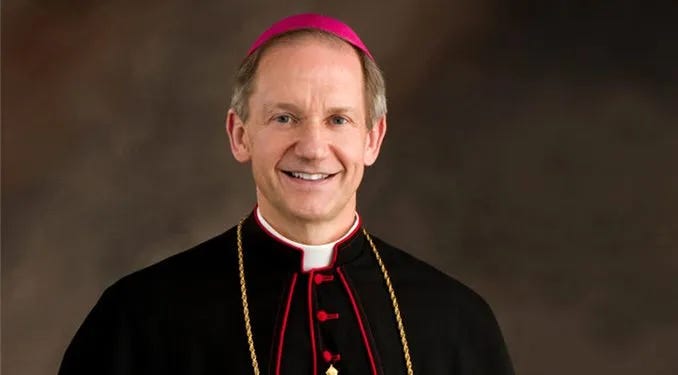
Bishop Thomas J. Paprocki of Springfield, Illinois, is pictured in a July 11, 2018, photo. (OSV News/Courtesy of Diocese of Springfield in Illinois)


Those practices, Paprocki said, include having a visitation immediately preceding the funeral Mass, as well as friends and loved ones delivering eulogies during the rites, which Paprocki said the Order of Christian Funerals does not permit.

"Unfortunately, too often people speaking at the end of a Funeral Mass say things that are very inappropriate," Paprocki said. "Even if the remarks are suitable words of remembrance, family members are often overcome with grief and have a hard time getting through their remarks."

The policies took effect, July 1, and they are intended to "ensure that Catholic funerals in our diocese will conform to the norms of the Catholic Church," said Paprocki, who is one of several bishops in recent years who have tightened diocesan policies pertaining to funerals and burials to emphasize stricter adherence to church norms.

In May, Bishop Robert McManus of Worcester, Massachusetts, issued a decree that emphasizes the church's preference for bodies to be buried instead of cremated. In October 2025, Youngstown, Ohio, Bishop David Bonnar ended funeral visitations in church buildings. In January 2025, the Archdiocese of Los Angeles updated its funeral guidelines that emphasize the sequence of funeral rites and that state delaying burial for convenience is inappropriate.

In addition to regulating how the deceased is remembered during the liturgy, the new policies in the Diocese of Springfield, Illinois, now prohibit a visitation in the church immediately preceding the funeral Mass.

According to Connecting Directors, a publication for the funeral home industry, practicalities such as convenience, cost-savings and scheduling constraints have condensed memorial observances into one-day events, with visitations often held immediately before the funeral services.

Paprocki refers to that trend as one of several "liturgical anomalies."

"The vigil, by definition, is the night before, so the vigil prayers will be prayed then by the priest or deacon even if there is no public visitation," Paprocki said. "In such cases, it would be fitting at least for the immediate family members to join the priest or deacon in the vigil prayers."

Mourners can gather at the funeral home prior to the funeral, where a priest or deacon may preside over a brief prayer service called Transfer of the Body to the Church or to the Place of Committal. If no priest or deacon is available, a funeral director, a member of the parish staff, or a relative or friend of the deceased can offer the prayers.

"Another problematic area that has crept into recent practice," according to Paprocki, had been the practice of eulogizing the deceased. The Order of Christian Funerals permits, in certain circumstances, "speaking in remembrance of the one who died," but does not permit a eulogy.

"To speak in remembrance of the deceased is to speak about the faith-life of the one who died and to give praise to God. A eulogy makes the person being praised the main focus of attention. The homily and the words of remembrance have God as the primary focus," Paprocki said.

"In this regard, reference may be made to how the deceased person put his or her Christian faith into practice, which provides a good example for others to follow and gives hope for an eternal reward in Heaven," Paprocki added.

Any words of remembrance that the family would like to be spoken by a priest or deacon have to be submitted three days before the funeral. Only the priest or deacon will then read those words during the vigil, funeral Mass or liturgy, or during the Rite of Committal at the cemetery.

"If deemed appropriate by the family, words of remembrance or even a eulogy may be given by someone other than the priest or deacon in other gatherings, such as at the meal following the committal service," Paprocki said. "This should not, however, immediately precede or follow any of the Christian funeral rites."

The new policies in the Springfield Diocese also stipulate that the Catholic Church "still earnestly recommends that the pious custom of burying the bodies of the deceased be observed," even if the church does not prohibit cremation unless chosen for reasons contrary to Christian doctrine, such as denial of the resurrection of the body.

The diocesan policy requires that interment of cremated remains take place within 30 days following the funeral rites. 

When cremation takes place, Paprocki said, "all of the cremated remains of the deceased person's body must be interred following the Rite of Committal. At no time and in no way shall the cremated remains be divided, separated, or interred in more than one place."

Saturday, May 9, 2026

Springfield Illinois diocese to build shrine to Venerable Augustine Tolton

Father Augustine Tolton (Courtesy of the Diocese of Springfield, Illinois)Father Augustine Tolton (Courtesy of the Diocese of Springfield, Illinois)

US diocese to build shrine for Venerable Fr. Tolton, first US Black priest

The Diocese of Springfield, Illinois, in the United States, announces plans to build a shrine to Venerable Father Augustine Tolton, whose story of overcoming racial discrimination and divisions in his time continues to be a source of inspiration to promote peace and unity.

By Isabella H. de Carvalho

Venerable Father Augustine Tolton—the first publicly recognized Black priest in the United States—surmounted racial tensions and divisions that marked the country in the 19th century and lived a full life serving the Church and its faithful, while being loved by many. 

Now his life story and witness are set to reach many more people as the Diocese of Springfield, Illinois, where he grew up and ministered, announced on April 29 that they plan to build a shrine in his honor at St. Boniface Church, in the city of Quincy.

Father Augustine Tolton “overcame all the divisions of his time and he did so with peace, hope and love,” said Father Steven Arisman, Chairman of the Committee for The Shrine for Father Augustine Tolton and pastor of St. Francis Solanus Parish in Quincy, in an interview with Vatican News.


 “His story teaches us how to do the same in our own time, with the divisions we see in our world today.”

Fr. Tolton’s cause for canonization was formally opened in 2010, and in 2019 he was recognized as a Venerable—the second of the four steps towards sainthood—by Pope Francis. If a miracle is attributed to his intercession, he can then be recognized as Blessed, and if then a second miracle is confirmed then he can be declared a Saint. 

An example of perseverance in the face of adversity

Fr. Tolton was born into slavery in 1854 in Missouri. When he was still a child he escaped with his mother and siblings to Illinois and settled in Quincy. Although slavery was officially abolished in 1865, African Americans continued facing a lot of discrimination and even in Quincy Fr. Tolton had to change schools twice to be able to pursue an education.

He was also confronted with religious divisions, as when he was 24 years old he opened the first school for Black children in Quincy but was met with opposition from African American Protestants who refused to send their children there as he was Catholic.

Bishop Jospeh Perry, diocesan postulator of Father Tolton's cause, near his portrait (©Courtesy of the Diocese of Springfield, Illinois)

Fr. Arisman highlighted how Venerable Tolton didn’t let this be a source of tension or “something that brought him down,” but rather he used it “as an opportunity to continue to reach across and welcome all peoples to show them the gift of education in the life of the faith.”

As he grew older, Fr. Tolton discerned a call to the priesthood, but no American seminary would accept him as a Black man. He was thus admitted in 1880 to the Pontifical Urban University in Rome as a seminarian for the Congregation for the Evangelization of Peoples (Propaganda Fidei), the entity of the Roman Curia responsible for missionary work and which today has become the Dicastery for Evangelization.

He was ordained on April 24, 1886, in the Basilica of St. John Lateran in Rome and sent back to his home diocese to serve the faithful there. He became known for his zealous preaching, his humility and his attention to the poorest and marginalized.

For Fr. Arisman, what we can learn from Fr. Tolton’s story today is his “perseverance in the face of great trial, perseverance in great difficulty, and perseverance in that hope that Jesus is the one who saves us.”

His is a story of “unity with Christ, who is our Salvation, but also of how to live in harmony with one another, how to find a way to overcome divisions and tensions so that we can find a common ground.”

Bishop Paprocki speaks at the shrine announcement event (©Courtesy of the Diocese of Springfield, Illinois)

Overcoming difficulties with peace

Additionally, Venerable Tolton “not only experienced a great difficulty with racial division, but also with priestly jealousy,” Fr. Arisman explained.

“He was so loved as a preacher and pastor in this area. There were many priests that did not particularly like the fact that he was loved above them.”

In this regard, Fr. Tolton faced harassment and discrimination from a German priest from a nearby parish. This situation led to Tolton being moved to Chicago, where he served the city’s Black Catholics until his death from a heat stroke in 1897. He was then buried in Quincy.

“He dealt with every kind of division and every kind of difficulty in his life with such peace, tranquility, and perseverance. That really teaches us how to look to Christ as the foundation of what we're doing and who we are,” Fr. Arisman said.

A Shrine that brings people together

Today, Fr. Tolton's story and witness continue to bring people together. At the launch event for the shrine in Quincy there were people from all walks of life, including local politicians and Protestant and Catholic representatives.

Bishop Thomas John Paprocki of the Diocese of Springfield in Illinois blessed a commemorative plaque during the event. Bishop Joseph Perry, retired auxiliary bishop of Chicago, and diocesan postulator of Fr. Tolton's cause, was also present. 

Fr. Arisman underlined how Fr. Tolton “really teaches us to come together” and noted that even the committee to build the shrine is very diverse. “We have people of other faith backgrounds. We have some people who are not of any faith at all, but they love Tolton’s story.”


The outside of St. Boniface Church   (©Courtesy of the Diocese of Springfield, Illinois)


“Throughout the world, but also in the United States, to have a story like Tolton’s that can unite us in speaking of Christ, really helps reach out to people who I think would otherwise not be involved,” he emphasized.

“The most important thing is to tell the story of Jesus Christ, because Tolton lived his entire life for Him.”

The Shrine will be located at the site where Fr. Tolton offered his first public Mass in Quincy and where later St. Boniface Church was built. The church was closed in 2020 and has since fallen into disrepair. The launch event was also to begin raising funds, as it is estimated that the cost to renovate the space will be over $5 million.

Fr. Arisman also pointed out the importance of having the Shrine in Quincy, which is where he says Venerable Tolton’s heart was, as it represented for him a “place of freedom” and “of welcome and hospitality.”

Get to know Father “Gus”

For Fr. Arisman the construction of the Shrine is an opportunity for Venerable Tolton’s story to go beyond Quincy and the United States and encourage more people to get to know him and turn to him in prayer.

“One thing I tell people all the time is, get to know good Father “Gus”, as he was called. You will have a good friend for the rest of your life,” he said.

“He's such a wonderful friend and confidant, somebody you can turn to for intercession, guidance and inspiration in his story.”

Tuesday, September 23, 2025

Bishop Paprocki speaks up as Cardinal Cupich plans to honor a very pro-abort U.S. Senator


Paprocki: On Durbin award, ‘I had to say something’

“I'm hoping and praying for some reconsideration.“

The Archdiocese of Chicago announced recently its plans to honor Senator Dick Durbin with a “lifetime achievement award” from the archdiocesan office of human dignity and solidarity.

Durbin, who is Catholic, is scheduled to receive the award “for his work with immigrants” at a Nov. 3 fundraiser in the Chicago archdiocese.

Bishop Thomas Paprocki. File photo.

But late last week, Bishop Thomas Paprocki of Springfield, Illinois expressed “shock” over the decision, explaining that Durbin is prohibited from receiving the Eucharist in the Springfield diocese, where he resides, because of his advocacy for legal protection for abortion.

Paprocki talked with The Pillar Sept. 22 about the award, and his decision to speak out.

This interview has been edited for length and clarity.

Bishop Paprocki, it is not common for a diocesan bishop to comment on decisions made in another diocese.

Why did you feel it important to say something about this award?

The main issue for me is the fact that Senator Durbin has his home here in Springfield, and in that regard, I'm still his bishop.

I know that he has a residence also in Chicago, and since he was told back in 2004 not to go to communion here in Springfield, he has started, for some time now, apparently going to Mass in Chicago.

But the fact is that he still has a domicile here, and that still gives me jurisdiction over him.

If he lived somewhere else — in another diocese — and I didn't have a direct connection I might not have said anything publicly about this. But in this case, because my predecessor was so strong in dealing with this matter and I've continued that here, I felt that I had to say something.

I think some people reading your comments might conclude that this is a partisan issue, that your intervention came because Sen. Durbin is a Democrat. Is this about a partisan position?

No, it’s not.

I would have done the same thing if Senator Durbin were a Republican.

For me, it's a pro-life matter, an abortion issue.

We have a politician here, who is a Catholic politician, and who has very publicly promoted a [policy of] abortion license, and has opposed any attempt to restrict abortion rights, and so that's what it comes down to.

I think it's also a question of the consistent ethic of life promoted by Cardinal Joseph Bernardin, the late archbishop of Chicago, who I worked very closely with over the years … I served as his chancellor until he died.

So I think his emphasis on the “consistent ethic” was precisely what the phrase implies — we have to be consistent, and that you can't say, ‘well, I'm pro-life on 9 out of 10 issues, I just disagree with the Church on the abortion issue, but I'm still pro-life, I'm still consistent.’

I think Cardinal Bernardin’s answer to that would have been: ‘No, you can’t say that you’re pro-life if you’re not consistent across the board.’

Cardinal Berndardin didn't like it when people would use the consistent ethic to try to argue that you can downplay the abortion issue as long as you're promoting other social justice issues.

And I know that from his own words.

In 1998, he told the National Catholic Register: ‘I know that some people on the left, if I may use that label, have used the consistent ethic to give the impression that the abortion issue is not all that important anymore, that you should just be against abortion in a general way but there are more important issues, so don’t hold anybody’s feet to the fire just on abortion. That’s a misuse of the consistent ethic, and I deplore it.’

I think in this case, Cardinal Bernardin would deplore any attempt to say: ‘Well, we're just using a consistent ethic of life to honor Senator Durbin, even though he happens to be pro-abortion.’

I would say that's comparable to saying that someone is a good Catholic who follows 9 out of the 10 Commandments except for the one that says ‘Thou shalt not kill.’

Do you anticipate any reconsideration from the Chicago archdiocese?

Well, I’m hoping and praying for some reconsideration. I mean, I think that it would be important.

I've heard from a number of pro-life people who are very upset that the Archdiocese of Chicago is doing this.

And I think it would be important for people to speak out about this so that I’m not the only one speaking on it. If there is a general outcry from the Catholic community, saying that this really shouldn't be done and that the honor should be revoked, I would hope that the Archdiocese of Chicago and Cardinal Cupich would reconsider.

Archbishop Salvatore Cordileone has already expressed some solidarity with your position. Do you anticipate other bishops might say something?

Yes, I do. And this is even something that I hope the USCCB would weigh in upon, because it is contrary to the statement the USCCB issued back in 2004 on Catholics and political life.

That statement is very clear as well, it says that the Catholic community and Catholic institutions should not honor those who act in defiance of our fundamental moral principles. They should not be given awards, honors, or platforms which would suggest support for their actions. So when you have an archdiocese basically acting contrary to this guidance from the USCCB, I don't know what the consequences are of that.

I would hope at least for some kind of a statement from the USCCB that this is contrary to our statement on Catholics and political life.

Would you feel compelled to speak out in the same way in a similar situation, if the person advocated for other things contrary to the faith — the unfettered use of the death penalty, for example…

Yes.

And again, this [Durbin] situation is connected to my own diocese.

But if there was a case in another diocese, and that bishop were to speak concern about the policies of the national bishops’ conference being flouted here, yes, I would've said something in support of that as well.

And I appreciate the Archdiocese of San Francisco and Archbishop Cordileone and their words of support, and I do anticipate that more [bishops] will be supportive as well.

There has been a great deal of emphasis placed at the USCCB in the past few years on unity, and the appearance of unity among bishops. And it seems that Pope Leo really wants to emphasize episcopal unity.

Have you violated that unity by speaking about a brother bishop the way that you have?

Well, I think the question is: Who initiated that? Who is violating the unity here?

I don’t think I'm violating unity by pointing out a violation of our USCCB statement and policy. It’s the violation of the USCCB statement that is acting contrary to our unity.

I think what we have to do is speak the truth, and when we see something that is wrong taking place, I don’t think that we should be silent or say, ‘Well, I don't want to say anything because that will violate unity.’

What’s violating unity is not speaking out, it’s that something has been done contrary to Church teaching.

I’m reminded that French bishops spoke out this summer, when the archbishop of Toulouse made a controversial appointment to the office of chancellor

Yes.

Unity does not mean that you stay silent because you don't want to ruffle anybody's feathers. It certainly is desirable that we all speak with one voice and that we work together as Christ entrusted his mission to us. But when someone steps outside of what the Church teaches, well I think we have to call that out.