Showing posts with label Archbishop Richard Henning. Show all posts

Friday, November 1, 2024

The new Archbishop of Boston is installed


New Boston archbishop challenges flock to develop ‘deeply personal’ relationship with God


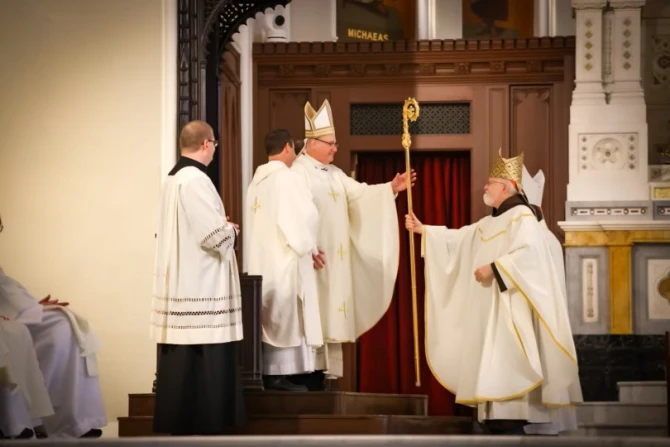
New Boston Archbishop Richard Henning and outgoing archbishop Cardinal Cardinal Seán O’Malley during a packed two-hour-plus installation Mass at Boston’s Cathedral of the Holy Cross on Oct. 31, 2024. | Credit: Andrzej Skonieczny

Newly installed Boston Archbishop Richard Henning challenged people of the archdiocese Thursday to commit to a relationship with God even when it hurts, saying that’s what God does for them.

“He gives us the precious gift, the gift of his own heart: his Son,” Henning said Oct. 31 during a packed two-hour-plus installation Mass at Boston’s Cathedral of the Holy Cross.

Henning, 60, originally from Long Island, New York, and most recently bishop of Providence, Rhode Island, replaced Cardinal Seán O’Malley, who had led the Archdiocese of Boston since 2003.

As the 10th bishop and sixth archbishop of Boston, he is the first head of the diocese to come from New York, which he noted often leads to a question.

Ever since he was announced as Boston’s next archbishop in August, Henning said, “people have been asking me about me — all kinds of questions, about my opinions, my personality traits, and history. The most common question I’ve received in the last few months boils down to something like this: ‘Have you ever been, and are you now, or will you ever be, a Red Sox fan?’”

The congregants laughed. Then Henning added: “Now, while that may be a very important question here in Boston, along with all those other ones, it seems to me that the most important thing that you, the people of this archdiocese, need to know about me is that I believe.”

Earlier, Cardinal Christophe Pierre, the apostolic nuncio to the United States, presented Henning with his letter of appointment from Pope Francis, and, following tradition, Henning walked around the cathedral displaying it to the congregants.

After that, O’Malley and Pierre escorted Henning to the bishop’s chair to the left of the altar, which he sat in, thus taking formal possession of the archdiocese, which is one of four created in 1808.

O’Malley, who widely steadied the archdiocese after the disastrous departure of Cardinal Bernard Law, received a standing ovation at the beginning of the Mass after being praised by Pierre. He got another one near the end of Mass, when Henning told O’Malley he detected “mixed feelings” among Catholics in Boston at the changing of the guard “because of the magnitude of your ministry.”

New spiritual father

The procession of several hundred priests into the cathedral was more joyful than solemn. Outside, to the right of the main entrance, musicians from the Neocatechumenal Way sang rousing songs of praise, backed by eight guitars, a ukulele, two bongos, and a shofar, the ram’s horn used in Jewish religious ceremonies. As priests neared the music, many smiled and some sang along as they made their way up the steps into the building.

Sean Gibney, 47, of Burlington, Massachusetts, who coordinated the group, acknowledged that it’s an unusual way to welcome a new archbishop.

“Now it is. But it wasn’t always. It was always the people who welcomed their shepherd,” Gibney told CNA, noting that in the early Church people chose bishops by acclamation.

“So we find it a totally normal thing. He’s a shepherd, because we’re sheep,” Gibney said, referring to Henning. “We feel in a way that the faith demands that we have to go and welcome. He’s sent in the name of the Lord Jesus Christ.”

David Enrique, 24, of East Boston, who sang and played guitar, was asked what the installation of Henning means to him and why he came.

“For me, we have a new father,” Enrique said. “Cardinal Seán has been our father for the last 21 years, and I came to welcome my new father — my new spiritual father and our shepherd.”

God is love

Acknowledging the presence of many cultures within the archdiocese, the first reading was in Spanish, with the second reading in Haitian Creole. Prayers of the Faithful were in English, Spanish, Haitian Creole, and Vietnamese.

About half the cathedral was occupied by priests in white vestments, a turnout that Henning said “overwhelmed” him. Some, he noted, were from his home diocese of Rockville Centre on Long Island, with many from the Archdiocese of Boston.


Archbishop Richard Henning by the altar during his Oct. 31, 2024, installation Mass at Boston’s Cathedral of the Holy Cross. Credit: Andrzej Skonieczny


After the chanting of the Gospel reading from John 17, Henning spoke for 21 minutes, with no notes.

He challenged listeners to develop a “deeply personal” relationship with God, a relationship, he noted, that comes with demands on both sides.

“God is love, and God summons us to love. And not in a ’70s love song kind of love,” Henning said. “This is a love that sweats and bleeds and dies.”

Using Pope Francis’ image of the Catholic Church as a “field hospital,” Henning expanded on the visual, saying: “But there’s only one doctor in the field hospital, and that is Jesus Christ. The rest of us are patients in need of healing.”

Right ordering is necessary for a fruitful relationship with God, he said.

“Whenever human beings think they are gods, everyone else has to be slaves,” Henning said. “This God makes us free.”

He quoted Dietrich Bonhoeffer, the German Lutheran pastor and anti-Nazi dissident, about what Bonhoeffer called “the cost of discipleship.”

“Faith is not just a list of beliefs. It’s not just a feeling. It’s a whole life,” Henning said.

When O’Malley took over the archdiocese in 2003, the see was vacant, because Law had resigned in disgrace in December 2002, 11 months after the archdiocese’s priest sex abuse scandal exploded.

About a dozen protesters held signs outside the cathedral before Thursday’s Mass, criticizing both archbishops and the Church over priest sex abuse.

Henning acknowledged continuing pain.

“This Church of Boston, it is in a very real sense a wounded Church, because of a failure to act compassionately — the sins against the innocent,” Henning said.

He noted that the Church has made efforts “to protect the vulnerable” in recent decades.

“But still we feel the weight of those wounds,” Henning said. “And we owe a debt of gratitude to victim-survivors who tell their stories, for they help to protect new generations by their courage.”

Friday, August 30, 2024

Let's speculate...who could be the next American Cardinal?


America’s Next Cardinal: 6 Bishops Who Could Soon Receive a Red Hat


Pope Francis celebrates Mass with cardinals for the opening of the Synod of Bishops for the Amazon region in St. Peter's Basilica in 2019. (photo: Riccardo De Luca / Shutterstock)


If 2024 turns out like most years of Pope Francis’ decade-long reign, the Catholic Church will soon be getting a new slate of cardinals. 

And if Pope Francis does call his 10th consistory before 2024 ends, it’s reasonable to think that an American could be among those to receive a “red hat.” 

Since becoming pontiff in March 2013, Francis has created new cardinals in every full calendar year of his pontificate except 2021. And with the backstretch of 2024 already upon us, the Vatican rumor mill is already turning about a forthcoming consistory.  

The Italian traditionalist blog Messa in Latino cites “plausible rumors” that Pope Francis will soon announce a consistory set for October’s synod, while ecclesial insiders like Ed Condon are speculating about which Church leaders from around the world could be in line to become cardinals.  

Will a U.S. prelate be among them? With Boston’s Cardinal Seán O’Malley no longer eligible to vote in a papal conclave after turning 80 this past June, the Pope could be looking to add another American cardinal-elector. 

Additionally, at 87 years old, Francis could view a 2024 consistory as one of his last remaining chances to leave his mark on the American episcopacy, a group that is both hugely influential in the universal Church but also seen as somewhat unenthused about some of Francis’ priorities. 

Currently, there are 10 American cardinals among the 124 eligible to vote in a conclave. Pope Francis has created six of them: Cardinals Blase Cupich of Chicago; Joseph Tobin of Newark, New Jersey; Wilton Gregory of Washington, D.C.; Robert McElroy of San Diego; Kevin Farrell, prefect of the Dicastery for Laity, Family, and Life; and Robert Prevost, prefect of the Dicastery for Bishops. 

Of course, given Pope Francis’ documented preference for expanding the geographic makeup of the College of Cardinals, it wouldn’t be surprising if he didn’t add another American. While representation from the Global South has gone up during Francis’ pontificate, the percentage of cardinals from North America has fallen, from 12% in 2013 to 10% as of last September’s conclave.  

But if Pope Francis does add another American, a small batch of U.S. prelates exhibit some of the qualities he typically looks for when he creates cardinals, such as shared ecclesial priorities, collaboration on a papal project of importance, and affiliation with the peripheries. 

Here are six prelates who Pope Francis could pick to become America’s next cardinal. 


Archbishop Jóse Gomez

Archdiocese of Los Angeles 

72 years old 

By conventional standards, no American prelate is more qualified to wear the red than Archbishop Gomez. The Los Angeles prelate leads an archdiocese with more than 5 million Catholics, the largest in the U.S. and one of the largest in the world. His three immediate predecessors in Los Angeles were all named cardinals, and the Mexican native’s personal experience of immigration and leadership on the issue squares nicely with a Francis priority. 

But all of these things have been true of Archbishop Gomez throughout the present pontificate — and yet he has been passed over in all nine consistories convened by Pope Francis.  

The conspicuous fact is part of a broader pattern of the Pope skipping over prelates from traditional “cardinalatial” sees, like Paris and Milan. But in Archbishop Gomez’s case, it’s especially glaring: Pope Francis has not only not made the Los Angeles archbishop a cardinal, but he gave the red hat to the ordinary of one of Archbishop Gomez’s suffragan dioceses, Cardinal McElroy, in 2022. Some have surmised that Archbishop Gomez’s previous leadership of the U.S. Conference of Catholic Bishops (USCCB), or even his ties to Opus Dei, could be behind the papal pass-over. 

But perhaps a consistory at the twilight of Pope Francis’ pontificate will change all of that. While some have speculated that the Pope is using consistories to “stack the conclave,” ensuring that a successor who continues with his reform agenda is elected, it’s also true that Francis has recently made the effort to define himself and his legacy as less disruptive than the common narrative suggests. Perhaps offering the red hat to an American prelate as well-respected as Archbishop Gomez could be one way to do that. 


Archbishop Paul Etienne

Archdiocese of Seattle 

65 years old 

Last summer, Pope Francis tapped Archbishop Etienne as one of his personally nominated delegates to the Synod on Synodality. The only other American prelates to receive that designation, other than Cardinal O’Malley? Cardinals Cupich, Gregory and McElroy — each given the red hat by Francis.  

The Seattle shepherd’s inclusion among the Francis-made American cardinals suggests that he may be in next in line to become one. 

Like Francis’ U.S. cardinal picks, the pastorally minded Archbishop Etienne has emphasized Pope Francis’ priorities in his ministry, speaking out on issues like care for creation and nuclear disarmament

Widely regarded as the “progressive bloc’s” candidate in the 2022 elections for USCCB president, Archbishop Etienne only mustered 37 of 242 votes (15%). Of course, being somewhat of a stand-apart from the U.S. episcopacy is arguably what Pope Francis has typically looked for when picking American cardinals. 

There are certainly other American archbishops who have been elevated by Pope Francis and seem to share his pastoral priorities, such as Archbishops Mitchell Rozanski (St. Louis), Christopher Coyne (Hartford, Connecticut) and Gregory Hartmayer (Atlanta). But the fact that Archbishop Etienne is already thought of in Rome as a peer to Cardinals Cupich, Gregory and McElroy suggests that he may be the most likely candidate to join them in the College of Cardinals.  

And if the next consistory is really set to take place amidst October’s synod session, he’d already be there. 

Bishop Daniel Flores

Diocese of Brownsville, Texas 

62 years old 

Pope Francis has given red hats to prelates who have played a pivotal role in executing initiatives important to the Holy Father, such as Portuguese Cardinal Américo Aguiar, who led World Youth Day 2023 in Lisbon as a then-auxiliary bishop. 

If Francis hews to that criterion again, consider Bishop Flores to be a strong candidate for a red hat. 

As the USCCB’s doctrine head, Bishop Flores has adeptly led the U.S. bishops’ implementation of the various stages of the Synod on Synodality — no easy task, given heightened concerns about the initiative. The Pope already expressed his esteem for Bishop Flores by making him one of only nine “presidential delegates” from across the world at the Rome synod sessions. Who’s to say Francis doesn’t go a step further by naming Bishop Flores to the College of Cardinals? 

But whereas Francis’ other U.S. cardinal picks have been divisive among the local episcopacy, Bishop Flores’ selection would be something of an olive branch between Rome and America. The Texas native is widely respected throughout the U.S. ecclesial landscape and across typical partisan divides.  

And while there are other moderate, Latino prelates who are well-regarded across the U.S. Church (Philadelphia’s Archbishop Nelson Pérez comes to mind), the symbolism of having a “prince of the Church” in the lowly border diocese of Brownsville may be too much for Pope Francis to pass up on. 


Bishop John Stowe, OFM, Conv.,

Diocese of Lexington, Kentucky 

58 years old 

If giving a red hat to someone like Bishop Flores or Archbishop Gomez would be a reconciling move between Rome and the U.S., tapping Bishop Stowe would be the polar opposite: It would be seen as nothing short of a parting shot from Francis to the majority of U.S. bishops and active Catholics.  

It’s hard to think of an American prelate who has been more divisive than Bishop Stowe. He has criticized the National Eucharistic Revival as opposed to synodality and defied his brother bishops by publicly endorsing the Equality Act, pro-LGBTQ legislation that the USCCB opposed due to religious-liberty concerns.  

Bishop Stowe’s critics have been quick to point out ways in which his stances appear to diverge from Pope Francis’ such as his recent approval of a transgender hermit’s vows, which seems to run afoul of recent Vatican guidance critical of gender theory.   

But Pope Francis clearly has a pattern of using his U.S. cardinal picks as a way to chastise the USCCB status quo. And if this is his primary consideration when selecting the next American red hat, as opposed to picking a unifying figure, it’s hard to think of a more fitting candidate than the contentious Bishop Stowe. 


Bishop Mark Seitz

Diocese of El Paso, Texas 

Age 70 

Pope Francis likes to give the red hat to prelates embroiled in conflict as a pledge of papal backing. 

El Paso is certainly not a war zone, but it is in the epicenter of the southern border’s migration crisis. And giving the red hat to Bishop Seitz, a strong voice for justice to migrants, would certainly send a powerful message. Most recently, the El Paso bishop has gone toe-to-toe with the Texas state government over its targeting of Catholic charities ministering to migrants. Perhaps the Pope will conclude that Bishop Seitz will be even more effective with “cardinal” in front of his name. 

What’s more, the Pope is already clearly familiar with Bishop Seitz’s ministry. He gave the Texan blessed rosaries for victims of the 2019 Walmart shooting and their families, called Bishop Seitz after he took part in a prayer vigil against racism in 2020, and praised the El Paso prelate in a May 2024 interview with CBS News, calling him “a great bishop” who “does the impossible to help migrants.” 

Pope Francis clearly thinks highly of Bishop Seitz’s ministry. Giving him the red hat would be the ultimate seal of papal approval. 


Archbishop-Elect Richard Henning

Archdiocese of Boston 

59 years old 

If Pope Francis is looking for a successor to Cardinal O’Malley in a future conclave, why not pick the prelate he already tapped to follow Cardinal O’Malley in Boston?  

Archbishop-elect Henning is intelligent, forward-thinking and mission-driven — all qualities that led Pope Francis to install him as the head of one of the country’s most prominent sees at only 59 years old. Presumably, these same qualities would make the Long Island native and outgoing bishop of Providence, Rhode Island, a valuable cardinal as well.  

And while picking a recently elevated 50-something-year-old with minimal episcopal experience to join the exclusive College of Cardinals may seem dramatic, there’s Pope Francis precedent for it. The Pope gave 58-year-old Spanish Cardinal José Cobo Cano the red hat last September, just months after he had made the former auxiliary bishop the archbishop of Madrid. 

At the same time, Francis moved three other prelates under 60 into major archdioceses last year, including Archbishop Francis Leo of Toronto, and none of them received a red hat at last September’s consistory. So there’s no guarantee that one is coming to Archbishop-elect Henning in Boston. As with so many other things with this pontificate, we’ll just have to wait and see. 

Saturday, August 24, 2024

Getting to know the soon-to-be Archbishop of Boston


Boston’s new archbishop leans into transparency, trust in God’s grace to face challenges ahead


By


Archbishop Richard G. Henning speaks at press conference in the Archdiocese of Boston's Pastoral Center in Braintree, Mass., with Boston Cardinal Seán P. O'Malley Aug. 5, 2024, after Pope Francis accepted Cardinal O'Malley's resignation and named then-Bishop Henning of Providence, R.I., as his successor. The Boston Archdiocese announced Archbishop Henning will be installed Oct. 31. (OSV News photo/Gregory L. Tracy, The Pilot)


(OSV News) — It was during a session for priests at the 10th National Eucharistic Congress in Indianapolis in July when Archbishop Richard G. Henning, who will be installed as archbishop of Boston Oct. 31, made peace with what was to come.

“God finally broke me, in the best of ways,” he shared with OSV News a couple of weeks later during a lengthy and refreshingly candid Zoom conversation.

It was two talks that stopped him cold: one by Daniel Cellucci of the Catholic Leadership Institute, who shared a moving testimony of his child’s cancer diagnosis and how he hadn’t “signed up for” that as a father — and relating it to the many struggles facing priests that they, too, might not have expected when they first “signed up for” seminary. And the second by Bishop Daniel E. Flores of Brownsville, Texas, who articulated the poverty of priesthood — how Jesus Christ embodied a poverty “of not being able, in the end, to control everything,” as Bishop Flores put it.

“It was then that I finally came to peace with things internally,” Archbishop Henning said in the OSV News interview.

What he was coming to peace with was a fact that no one else in the room knew: that not long before, he had been told that he would soon be leaving the Providence, Rhode Island, Diocese he had been leading for just 15 months and then heading an hour north-northeast to a city with more than three times the Catholic population.

While he is looking forward to getting to know his new home and flock, the appointment to Boston came as “a shock,” Archbishop Henning said — a fact that he shared with almost remarkable honesty and candor. Those characteristics were present throughout our recent wide-ranging conversation, indicating an authenticity that many have described as a trademark characteristic.

Particularly concerned about leaving his Providence flock so soon, Archbishop Henning pointed to his episcopal ring and spoke of the nuptial imagery between a bishop and the local church entrusted to him. “This symbolism means a great deal to me,” he said — and it was borne out over the past years in Providence where he was busy “throwing myself into the work.”

“But I’m a man under authority,” he added, and, understanding this, it didn’t take him long to accept his new appointment.

After the formal announcement was made on Aug. 5, Archbishop Henning has been the subject to a great deal of scrutiny from secular and religious media sources, and he seems to relish that pundits can’t figure out what to make of his appointment to such a significant see. Neither outwardly liberal or conservative, he appears to embrace what the late Cardinal Francis E. George of Chicago famously described as living “simply Catholicism” — which the late cardinal articulated as the Catholic faith “in all its fullness and depth, a faith able to distinguish itself from any cultures and yet able to engage and transform them all, a faith joyful in all the gifts Christ wants to give us and open to the whole world he died to save.”

In fact, Archbishop Henning is almost allergic to making any kind of foray into political activism, describing himself not as a politician but a pastor in the first interview he gave representing his new role. Nor is he eager to fire up the social channels and weigh in at a moment’s notice on the latest cultural brouhaha, though he admires many who do.

Rather, the Long Island native moves to another new city in another new state ready to give his all. “I realize my life is not my own now,” he said. “I’ll be completely theirs.”


Much of Archbishop Henning’s short tenure in Providence was spent in parishes, and The Boston Globe reported that he put 30,000 miles on his car during his short tenure. As he traveled, he listened and learned, or was simply present. He also was on the cusp of undertaking a pastoral plan to help the local church navigate the ramifications of shrinking resources and the need to downsize its institutional footprint — as have many dioceses in the U.S. — a task now awaiting his unnamed successor.

Archbishop Henning is not getting a pass, though; he will face similar challenges regarding governance and reform on a greater scale in Boston. And he brings to those challenges a unique background — both as a Scripture scholar and as a former seminary professor and administrator — that could serve him well, in addition to the perspective of his own life experience.

The now-archbishop was ordained an auxiliary bishop of his home Diocese of Rockville Centre, New York, in the summer of 2018, about a month after revelations that former Cardinal Theodore E. McCarrick had lived a double life as a notorious sexual predator and a couple of weeks before the release of the damning Pennsylvania grand jury report that chronicled decades of sexual abuse and coverup in most of that state’s dioceses. Within his first month as a bishop — as if a whole bushel of apples is made rotten by a few — then-Bishop Henning had requests for his own resignation.

Archbishop Henning acknowledged that “it was very difficult” to become a bishop amid those scandals. But he learned some important things. One was the need for bishops “to be willing to take criticism” when it’s warranted and even when it’s not. Even when someone “is irrationally critical or angry and hostile and maybe wrong … I still have to love that person. I still have to find a response that does not dismiss them or give up on them,” he said.

He also learned, during that difficult time in the church, the importance of being straight with the people of God. “One of the high values of the people of God and the clergy is transparency, you know, of being just honest with people,” he said.

The 2018 experience also taught Archbishop Henning the importance of being “direct” in leadership. “I don’t want to make the mistake of trying to manipulate people, nor, in some sense, waste time,” he said. “So when I meet with a priest and there’s something, some difficulty, I will tend to be, I try to be compassionate, but I’m direct.”

That summer of 2018 — which Cardinal Timothy M. Dolan of New York referred to as the “summer of hell” — was “a wake-up call” for bishops, Archbishop Henning said — “that we really have to be authentic.”

“That’s a struggle of every day, every month, every year,” he said. “I don’t live in abject poverty, but I try to live, you know, simply and oriented toward mission.”

With the Archdiocese of Boston having been ground zero for the clergy sexual abuse crisis in the United States, following The Boston Globe’s revelatory “Spotlight” reporting in 2002 that sent shockwaves through the church, it follows that Archbishop Henning will be scrutinized in his approach to clergy abuse and to victims. Critics are increasingly vocal that bishops should continue to improve upon both abuse prevention and on the handling of allegations — including those of adult misconduct, as boldly stated by outgoing National Review Board chair Suzanne Healy at the U.S. bishops’ June general assembly in Louisville, Kentucky.

Archbishop Henning, who said he has taken a special interest in abuse prevention work long before he was a bishop, said that in Providence he was “already thinking about those things,” and having conversations with the diocese’s priests both “to make sure the people entrusted to our care are physically, spiritually, emotionally safe” and to emphasize that “clear and conscious boundaries are just good order” for priestly ministry.

“The challenge for us as ministers is that we do have to interact with people often on a very emotional level and frequently at moments in their lives when they are vulnerable, right?” he said. “So if we stop doing that, you know, what’s the point?”

One concrete insight offered by Archbishop Henning relates to confession. “The reconciliation room is a problem,” he said, suggesting a return to old-style confessionals where a screen separates priest and penitent. The “reconciliation rooms” and their face-to-face style introduces a vulnerable situation, Archbishop Henning explained, “and it certainly is a risk that a predator could exploit that, right?”

Acutely aware of the many issues facing priests today, the archbishop also said that another key question in preventing abuse by priests is how to keep priests “from going off the rails.”

“Our authenticity, you know, is our best prevention,” Archbishop Henning said, “because we are human.”

“If you raise a child in a polluted city, that child’s gonna end up with asthma, right?” he reasoned. “We are all affected by the environment in which we live, and it’s an environment that is hedonistic, it is hyper-sexualized, it’s constantly telling us to do what feels good and to avoid anything that challenges us or is difficult.”

“This is not a healthy environment for priests,” he added. “And then throw on top of that all the challenges of ministry in our own age, and the fewer numbers of priests, and that they are living mostly by themselves — it’s a perfect storm of difficulties that requires, I think, a return to the most basic foundations of the faith, of spiritual direction, of daily prayer, of good, solid friendships (with each other), of good, solid friendships with lay faithful that don’t have an agenda.”

Archbishop Henning has certainly made that a priority.

“One of my most important strengths are some really fine married couples that have been a part of my life for decades and whose own kind of faithful witness strengthens me in my chastity, you know, to see them kind of being with one another and being faithful to that whatever comes, that’s an inspiration for me,” he said.

As more cases revealing adult vulnerability to abuse continue to come to light, Archbishop Henning acknowledged that it’s difficult to handle adult misconduct or abuse cases in the same fashion as the abuse of minors, particularly since law enforcement often will not get involved. As of 2024, only 13 states and the District of Columbia have laws criminalizing clergy sexual misconduct perpetrated on adults under their pastoral or spiritual care. Massachusetts is not among them.

“When you have individuals that engage in what at least appears to be a consensual sexual relationship, there isn’t a crime that’s committed,” he said. “I know that’s not a good enough answer because that was the kind of answer people might have given in the 1970s. But I think it is a little bit more complex.

“It’s not like you can just simply say, ‘We report everything to the police,'” he continued. “I don’t know that the response in those circumstances can or should be the same. But I understand that that also brings with it a risk that, as the goalposts move, in 10 years, someone’s gonna look back and say, ‘That was a cover-up.'”

These more complex cases, he said, should be addressed on an individual basis — with the “key element” being whether or not “coercion or undue influence” in the form of “abuse of authority” took place, he said. And who, he wondered, should address them?

“We haven’t done this in Providence, but I know a number of dioceses have introduced some version of a review board — again, distinct from the child review board,” he said. “I think that’s a helpful development, and one that I will be kind of observing others do. Because I think that gives us at least some way to do a more objective, transparent examination, even if names are not revealed, and we don’t humiliate people in public.”

Another challenge for bishops today is a growing number of priests leaving ministry within the first few years of ordained ministry. Archbishop Henning is a former seminary formator and administrator at the Immaculate Conception Seminary — which served the Brooklyn, New York, and Rockville Centre dioceses for 80 years — and oversaw its transformation to a retreat and conference center, after a merger with the New York Archdiocese’s St. Joseph’s Seminary.

Priests are burning out very fast with increasing obligations being placed on them, many for which they are not necessarily prepared. Coming changes in formation might be necessary to respond to the challenges for priests today, especially as more institutional decline looms for the Catholic Church in the U.S. — something Archbishop Henning admits is a sort of “apocalypse,” for which he tried to prepare his former seminary students as far back as 2011.

In regard to this, Archbishop Henning — ordained in 1992 and reticent to claim any particular expertise — regarded seminary formation as having improved from his own time as a seminarian, crediting Pope St. John Paul II’s apostolic exhortation “Pastores Dabo Vobis” (“I Will Give You Shepherds”).

“The seminary formation I experienced, I would say, was too shallow, and it was insufficiently kind of faithful to the church’s own teaching at times,” Archbishop Henning said. Recent changes made following the 2002 and 2018 priestly scandals have put a greater emphasis on spiritual formation, which the archbishop called “a good thing.”

“I think that getting men to develop a robust interior life and prayer life in the seminary is a really important thing,” he said. “I think right now, in light of the Holy Father’s kind of influence in this, there is a tremendous focus on human formation, responding, I think, to the reality that so many of our men in formation are coming from unhealthy family environments or experiences that really need a lot of healing. Sometimes they just need help to kind of function.”

Archbishop Henning believes we will see “happier priests and bishops” when greater communion is facilitated with laity. “In the life of the Catholic Church, if you look at where some of the most vibrant faith life and leadership is occurring, it’s coming from the laity,” he said.

“For me, the thing that has made me happiest as a priest has been that connection to people,” he said. “I certainly have good relationships with peers in priesthood and in episcopacy, and those are very important relationships, but it’s that real connection with regular folks in the parish, I think, that also brings another element.”

While recognizing the increased number of priests living alone due to necessities of ministry today and a greater awareness of boundaries can be a catch-22 in this regard, Archbishop Henning also underscored the importance of seeing the cleric’s connection with his people as something of a nuptial bond.

“Obviously there’s differences, but the Eucharist itself is the icon of what it means to be a priest. It’s also the icon of what it means to be married. This is my body, blood given for you, right? So I think maybe that’s an area that could help men cope better with the challenges and demands they’re gonna face when they get out of the seminary,” he said.

Archbishop Henning also said he knows that bishops cannot maintain a status quo with a business-as-usual approach to pastoring.

“We have parish after parish that has a plan that was created for mission in a different age. And that now becomes a burden rather than a tool of mission,” he said. “But, of course, a burden that is emotionally fraught and so very difficult to change, right?”

As Archbishop Henning tackles those challenges, working in the self-described academic’s favor is that he is unafraid to theorize and ask questions — and that he also “tries to figure out how to get from the theory to some kind of expression of reality.

“So how do we figure out how to come alive with discipleship and mission and a true sense of community in kind of the ruins of that prior age?” he said. “How do we take that plant (of the past) and bring it alive? I don’t have these answers. These are questions that I can’t answer.”

And he will bring these questions with him to Massachusetts.

“I’m not gonna go (to Boston) and tell them what to do or even necessarily start this conversation, but I think this is the conversation of the next decade or two for the church,” he said.

But he stressed that, despite that decline, despite the challenges with governance, despite the abuse that the church continues to wrestle with, hope remains.

“I think that’s, again, why Indianapolis is important because I think that’s pointing us to this truth: The church is still alive,” he said. “There may be institutional decline, but it is not a decline in the Gospel or in the Eucharist or the Lord himself, right? That is all well and good and alive, and will be as long as there are people who will surrender themselves and trust in his grace.”


Which brings us back to Archbishop Henning’s Saturday morning at the National Eucharistic Congress — the one that “broke” him. That experience gave him an opportunity to truly practice — and model — what he preaches.

That’s especially evident when the Scripture scholar identified the 13th chapter of St. Paul’s First Letter to the Corinthians as his favorite Pauline passage — what is called St. Paul’s ode to love.

Archbishop Henning might not have wanted to leave his Rhode Island flock after investing himself so much in such a short amount of time. He might not have relished the idea of the burdens of office awaiting him in Boston. But it’s clear that he has surrendered himself to God and trusts in his grace. And because of this, as he comes to know and love his new flock, there’s a good chance the feeling will be mutual.

Michael R. Heinlein writes for OSV News from Indiana.
Tuesday, August 6, 2024

The new Archbishop for Boston; plans to do lots of listening


Newly appointed archbishop of Boston says first job is to 'be a listener'


Then-Auxiliary Bishop Richard Henning of Rockville Centre, New York, speaks during Mass at St. Agnes Cathedral Jan. 1, 2021, in Rockville Centre, New York. On Aug. 5, the apostolic nunciature in Washington announced that Pope Francis had accepted Cardinal Sean O'Malley's resignation and appointed Henning to be Boston's 10th bishop and seventh archbishop. (CNS/Gregory A. Shemitz)


BY BRIAN FRAGA

Staff Reporter


When he was told this past weekend that Cardinal Christophe Pierre was on the phone, Bishop Richard Henning of Providence, Rhode Island, did not expect the Vatican's ambassador to the United States to tell him he would be Boston's next archbishop.

"I was deeply shocked and surprised by this call," Henning said during an Aug. 5 press conference in Boston, where he sat next to the man he will succeed, Cardinal Sean O'Malley.

On Aug. 5, the apostolic nunciature in Washington, D.C., announced that Pope Francis had accepted O'Malley's resignation and appointed Henning to be Boston's 10th bishop and seventh archbishop.

Henning said he had to sit down after Pierre broke the news to him, and that it took him three minutes before he could respond. Installed a little more than a year ago in Providence, Henning said his first thoughts were for "the people in Rhode Island."

"That was the hardest part of it for me," said Henning.

O'Malley, a Capuchin Franciscan friar who became Boston's archbishop in July 2003 when the archdiocese was still reeling from the clergy sex abuse scandals revealed by the Boston Globe in 2002, turned 80 on June 29.

Henning will be installed as Boston's archbishop on Oct. 31, the eve of the upcoming jubilee year. O'Malley will continue to serve as Boston's archbishop until then.

The episcopal transition in Boston marks a momentous moment for the U.S. Catholic church. O'Malley, who was seen as an early voice in the hierarchy who recognized the gravity of the clergy abuse crisis, has gained national and global attention, especially during Francis' pontificate.

O'Malley has been a member of the pope's Council of Cardinals, also known as the C-9, since it was formed in 2013 to advise the pope on matters of church governance. He has also served as president of the Pontifical Commission for the Protection of Minors since that entity's creation in 2014.

He told reporters that he will probably divide his time between Boston and Washington, where he founded an organization in the early 1970s that assists Hispanic immigrants, adding that Francis has also asked him to continue serving in his role as president of the Pontifical Commission for the Protection of Minors.

"I don't think I'll be bored. I'm not going to take up golf," O'Malley said. "But I will try to stay out of the new archbishop's way and to be available to him if he needs anything."

Several leading bishops responded to the news of O'Malley's upcoming departure from Boston. New York Archbishop Cardinal Timothy Dolan issued a statement expressing gratitude for O'Malley as "he begins his well-earned retirement."

"For decades he has been a leader for the Church in the United States, and I know that we can look forward to his continued presence with us, as he continues his loving service to Jesus and His Church," Dolan said.

Writing on X, the social media platform previously known as Twitter, Washington Cardinal Wilton Gregory commended O'Malley for his "incredible pastoral service to our Church in many locations."

He also said he is "certain that Archbishop Richard Henning will build upon the solid pastoral foundation that he inherits today."

Speaking with reporters Aug. 5 in the archdiocese's headquarters in Braintree, Massachusetts, O'Malley said he had not given much thought to his legacy, though he did reflect on the challenges that he faced upon arriving in Boston in 2003.

"My 20 years in Boston have been challenging and wonderful years in many respects," O'Malley said. "But when I arrived it was a time of great crisis and great pain because of the terrible scourge of sexual abuse. But despite all of the challenges we have faced, I am filled with hope as I see people who have come forward to be a part of the mission of the church, and have stayed with the church through very, very difficult times."

Though O'Malley struck a hopeful note, he at times received criticism from victim abuse survivors and advocates who saw him as not doing enough to root out the clericalist culture that they said exacerbated the coverup of sex abuse.

Mike McDonnell, communications director for the Survivors Network of Those Abused by Priests, told National Catholic Reporter that "just because a new bishop [is installed], that doesn't mean any child or adult is safer from harm by those employed by those who minister."

"We can't forget the past or present," McDonnell said. "We especially can never forget victims who have yet to step forward."

Adding that the arrival of a new bishop is "always a time of renewal and hope" for the church, O'Malley said that Henning brings "the heart of a pastor" to his new role in Boston.

Ordained a priest in 1992 for the Diocese of Rockville Centre, New York, and consecrated an auxiliary bishop for that diocese in July 2018, Henning struck a pastoral note during his introductory press conference. He referred to himself as primarily "a sinner in need of grace."

"I think my first job really is to be a listener, and begin to understand," Henning said of what his first priority will be in Boston. Later asked about his thoughts on how he sees the role of bishop in political controversies, Henning stressed that he does not see himself as an activist.

"I'm not that exciting," he said. "My stance in Providence has been that I am a pastor, not a politician."

Describing politics as the proper arena for the laity, Henning said he sees his role as helping to form consciences while not commenting on political candidates or telling Catholics who they should support. He added that he would keep his voting preferences to himself.

"That's not my job, to advocate for either side," said Henning, who added that he is pro-life. He acknowledged that "there are people of goodwill who disagree with that," but said he believes "there's room for us to talk to one another."

Regarding the clergy sex abuse crisis, Henning said his message to survivors is that he will always "listen to their pain and their woundedness."

"Those survivors," Henning said, "they deserve a listening heart. In some ways, they have as much to proclaim about the Gospel as we do to them."

Praise keeps pouring in for retiring Cardinal Sean O'Malley


Catholic leaders praise Cardinal O’Malley on his retirement


Cardinal Seán P. O’Malley answers a reporter’s question at a joint press conference with Archbishop Richard G. Henning held Aug. 5 at the Archdiocese of Boston’s Pastoral Center to announce Archbishop Henning’s appointment as the next Archbishop of Boston. (Credit: Steven Senne/AP.)


NEW YORK – When asked by a reporter to consider his legacy in the Archdiocese of Boston, Cardinal Seán O’Malley gave a slight smile and said he hasn’t thought about it, before crediting any legacy of his to those who have supported him and the Church’s mission for the last 20-plus years.

Nationally, however, after the Vatican publicized that Bishop Richard Henning of Providence will succeed O’Malley, tributes poured in from secular and Catholic leaders commending O’Malley for his work to advance the mission of the local, national, and global Church.

Church leaders also commended Pope Francis’s decision to name Henning as his successor.

Cardinal Timothy Dolan of New York, who serves as a cardinal alongside O’Malley and knows Henning from his time as an auxiliary bishop in the Diocese of Rockville Centre, said Pope Francis made a wise choice in Henning, and thanked O’Malley for his decades of leadership.

“The Holy Father has chosen well in appointing Long Island native, Bishop Richard Henning, an outstanding priest and bishop, as the next Archbishop of Boston!” Dolan said in a statement, adding that the New York bishops relied on Henning’s “wise counsel and pastoral insights.”

“I must share a word of gratitude to my brother, Cardinal Sean O’Malley, as he begins his well-earned retirement from his role as Archbishop of Boston,” Dolan continued. “For decades he has been a leader for the Church in the United States, and I know that we can look forward to his continued presence with us, as he continues his loving service to Jesus and His Church.”

Massachusetts Governor Maura Healey extended gratitude to O’Malley and said she knows that “he will continue to be a guide and an inspiration for us all.” She also congratulated Henning and said she looks forward to working with him.

“I greatly admire [O’Malley’s] deep faith and his empathy and compassion for all,” Healey said in a statement. “He will be remembered for his lifesaving support for families experiencing homelessness, his advocacy for more affordable housing, his support for victims of human trafficking and his global leadership in the fight against climate change. I was humbled and privileged to seek and receive his advice many times during my time as Attorney General and Governor.”

Catholic University of America President Peter Kilpatrick called O’Malley one of the university’s “most distinguished alumni” following the announcement. O’Malley earned a master’s degree from the university in the 1960s, served as a professor there from 1969-1973, and as chairman of the University’s Board of Trustees in 2016-2017. He remains on the Board of Trustees.

“On behalf of Catholic University, I would like to thank Cardinal O’Malley for his leadership, which has been marked by profound commitment to the Church and her mission,” Kilpatrick said in a statement. “His efforts in addressing critical issues, such as the global immigration crisis and the clergy sexual abuse crisis, reflect his deep sense of responsibility and compassion.”

Auxiliary Bishop Robert Reed of Boston in a statement said the archdiocese is “blessed” by Henning’s appointment as the next archbishop, adding that “there are not enough words to express our tremendous gratitude to Cardinal Seán O’Malley.”

Hosffman Ospino, chair of the Department of Religious Education and Pastoral Ministry at Boston College, and a leading voice on Hispanic ministry, told Crux that O’Malley’s commitment to affirming the importance of underrepresented communities should serve as a model for future church leaders. Particularly, he highlighted O’Malley’s work with Hispanic Catholics, and his mindfulness that “investment in this community, particularly young Hispanics, is crucial to secure the vibrancy of Catholic communities in the country.”

“Personally, I say goodbye to a pastor, supporter and role model,” Ospino said. “I look forward to working with Archbishop-elect Richard G. Henning, who I know, has a strong pastoral heart, a passion for ministerial formation, and many years of experience serving Hispanic Catholics.”

Henning was introduced as archbishop-elect at an August 5 news conference, where the parallels between O’Malley’s appointment 21-years-ago and Henning’s were clear. O’Malley, 58 at the time, noted that he had only been in the Diocese of Palm Beach for nine months before he came to Boston. Henning, 58, has led the Diocese of Providence for barely a year.

Henning will be installed on October 31.

In opening remarks, O’Malley touted the arrival of a new archbishop as “a time of renewal and hope,” and his successor as someone who “brings the heart of a pastor in his new role.”

“Pope Francis has said a priest is someone who transmits hope to restless hearts,” O’Malley said. “In Archbishop-elect Henning, I believe this to be a true virtue and example of his priestly care for the people of God. Archbishop Henning is a joyful pastor who seeks to serve Christ and his people.”

Henning, meanwhile, noted the shock and surprise of his appointment. He thanked Pope Francis and O’Malley, and acknowledged the “special tug” in his heart for Rhode Islanders after what he described as a joyful and intense tenure had come to an end. To Bostonians, he said he comes ready to listen.

“As I look forward to this new ministry in the Bay State, I would like to offer my greetings to the clergy, religious and faithful of Boston, and to all men and women of goodwill,” Henning said. “I’m humbled by the size and the history of this archdiocese, and I am very well aware that I have a lot to learn and so I’ll be eager for your witness of faith and to learn your wisdom.”

“I think my first job really is just to be listener and to begin to understand,” Henning added.

Henning, born and raised in Rockville Centre, New York, was ordained an auxiliary bishop of his home diocese in 2018, where he served until he became bishop of Providence, Rhode Island, last year. His ministry as a priest began at a New York parish in the 1990s, before becoming a teacher at and ultimately head of the Seminary of the Immaculate Conception in Huntington, New York.

Henning was at the Diocese of Rockville Centre when it filed for bankruptcy in 2020 – a move that has been criticized by clergy sex abuse survivor advocates as unjust and lacking transparency. Jeff Anderson & Associates PA, a firm that represents clergy sex abuse survivors, called Henning’s appointment a “concerning and foreboding move” for that reason. At the news conference, Henning highlighted that as an auxiliary bishop he had little to do with the bankruptcy decision. He did, however, defend it.

“Bishop [John] Barres argued at the time, and it makes sense to me, I agree with it, that it really was the only decision that would have allowed the diocese to meet the obligations of survivors, as well as continue the mission of the church,” Henning said.

Like Dolan, others who know Henning commended Pope Francis’s decision.

The Diocese of Rockville Centre, in a statement, said Henning is “a creative and pastoral evangelizer, a biblical theologian and teacher, and a seminary formator with great pastoral experience and a deep love for the Hispanic community in the United States.”

“As a son of Long Island and the Diocese of Rockville Centre, we take a humble pride in Bishop Henning’s … mission spirit, love for the poor and all those who carry the Cross of Christ,” the diocese said. “Bishop Henning’s commitment to global evangelization illustrates how a care for the global mission of the Church makes us more effective evangelizers in our local parishes and dioceses. Bishop Henning is a fine pastor and biblical theologian.”

Bishop Robert Brennan of Brooklyn, who has known Henning since they were students at St. John’s University together, said Henning will be an important voice for the national church in his new role.

“While I am sure the Catholic community of Rhode Island will miss him, he will be a blessing to the Church in Boston, building on the great work of Cardinal O’Malley. At the same time, he will be an important voice for the Church in the United States,” Brennan said.