reflections, updates and homilies from Deacon Mike Talbot inspired by the following words from my ordination: Receive the Gospel of Christ whose herald you have become. Believe what you read, teach what you believe and practice what you teach...
Showing posts with label Archdiocese of Edmonton. Show all posts
Showing posts with label Archdiocese of Edmonton. Show all posts
On the third day of his Apostolic Journey, Pope Francis departs Edmonton for Quebec, for the second leg of his Penitential Pilgrimage to Canada.
By Benedict Mayaki, SJ
Pope Francis is set to arrive in Quebec city on Wednesday, the third full day of his ongoing 5 -day “Penitential Pilgrimage” to Canada.
Earlier on Wednesday morning, the Holy Father bade farewell to the staff of St. Joseph Seminary in Edmonton where he had been staying in the first days of his Apostolic Journey. He then headed to the Edmonton International Airport where his flight to Quebec leaves at 9:00 am local time.
The Pope will be in the Quebec City area until Friday before making the final stretch of his Apostolic visit to Iqaluit.
Preview of activities
Pope Francis is scheduled to arrive at the Jean Lesage International Airport in Quebec around 15:05 local time, after a just-over 4-hour flight from Edmonton.
From the airport, he will travel to the Citadelle of Quebec where he will meet with Governor General Mary May Simon, Prime Minister Justin Trudeau, as well as Indigenous leaders and other civil authorities.
On Thursday, the Pope will celebrate Mass at the National Shrine of Saint Anne de Beaupré, located on the shores of the St. Lawrence River, about 30 kilometers from Québec city. Later that day, he will preside at Vespers with the Bishops, clergy, consecrated persons, seminarians and pastoral workers at the Notre Dame de Quebec Cathedrale.
The Pope's activities on Friday will see him meet with members of the Society of Jesus (Jesuits) and a delegation representing the Indigenous people from Quebec at the residence of the Archbishop of Quebec before flying to Iqaluit.
He will then start his tour of Iqaluit with a meeting with residential school survivors and a meeting with the youths and elderly outside an elementary school.
The Pope is billed to fly back to Rome later on Friday evenin
Visit to the Lac Ste Anne pilgrimage site near Edmonton, Canada
Pope: Indigenous Peoples and grandmothers are a precious treasure of the Church
Following the Mass in the Commonwealth Stadium of Edmonton, on Tuesday, Pope Francis celebrates a Liturgy of the Word at Lac Ste. Anne, one of the most sacred sites for Indigenous peoples of North America, long known as a place of healing. In his homily he says that Indigenous Peoples and grandparents are a precious treasure of the Church.
By Lisa Zengarini
Thousands of pilgrims welcomed Pope Francis as he joined their annual pilgrimage to the sacred shores of Lac Ste. Anne, on Tuesday afternoon, local time. The lake called Wakamne (“Lake of God”) by the Nakota Sioux and “Lake of the Spirit” by the Cree people, is renowned for its healing waters and for its spiritual significance both to Catholics and Indigenous Peoples in Canada and Northwestern United States.
It was named after St. Anne, the mother of Mary and grandmother of Jesus, by a Quebecois Catholic missionary, who launched the pilgrimage in the late 19th century, celebrating the week of her Feast Day, on 26 July.
Returning to the sources of our faith
After blessing the water of the lake and the faithful present with it, Pope Francis presided over a Liturgy of the Word. The Holy Father started his homily, noting that the beating of drums introducing the celebration “seems to echo the beating of the hearts” of the many pilgrims who for generations have walked together to reach this “lake of God”, seeking healing from its waters.
The Pope further remarked that silently contemplating these waters where “the maternal heartbeat of the earth” can be sensed, inspires us to return to the sources of life and of our faith. “Indeed - he said - it allows us, in spirit, to visit the holy places, to imagine Jesus, who carried out much of his ministry on the shores of a lake: the Sea of Galilee”.
Fraternity in diversity
God chose the richly diverse context of this peripheral area where various peoples converged, to announce to the world his “revolutionary”message of fraternity. That message, the Pope said, resounds today in the sound of drums spanning the centuries and uniting different peoples. “It reminds us that fraternity is genuine if it unites those who are far apart, that the message of unity that heaven sends down to earth does not fear differences, but invites us to fellowship, in order to start afresh together, because we are all pilgrims on a journey.”
Water gives life
Focusing on the readings of the Liturgy drawn from the Book of Ezechiel (Ez 47, 1-2. 8-9. 12), Pope Francis reiterated the crucial role of grandmothers, specifically in indigenous communities, in transmitting the “living water of faith”. “Faith rarely comes from reading a book alone in a corner”, said the Pope, “instead, it spreads within families, transmitted in the language of mothers, in the sweetly lyrical accents of grandmothers”. While thanking them for their precious role, he reiterated his call on families to cherish and take care of their elders.
“I would like to say to all those families with elderly people at home: you possess a treasure! Guard this source of life within your homes: take care of it, as a precious legacy to be loved and cherished.”
Water heals
Pope Francis then focused on the healing power of water in the context of the injuries suffered by the Indigenous Peoples of Canada after the European colonization. Recalling Jesus’ ministry on the shores the Sea of Galilee, he implored the Lord, through the intercession of Mary and of Saint Anne, to help heal those deep wounds.
“ [In this blessed place, where harmony and peace reign, we present to you the disharmony of our experiences, the terrible effects of colonization, the indelible pain of so many families, grandparents and children. ]”
The role of grandmothers in the healing process
Pope Francis, again, emphasized the role of mothers and grandmothers in the Indigenous communities also in helping to heal those wounds, referring specifically to the figure of the grandmother of God, who was introduced to the Indigenous Peoples in Canada by the missionaries through an effective process of inculturation.
He recalled that part of the “painful legacy” of European colonization “stems from the fact that indigenous grandmothers were prevented from passing on the faith in their own language and culture”. “That loss – the Pope said - was certainly tragic, but your presence here is a testimony of resilience and a fresh start, of pilgrimage towards healing, of a heart open to God who heals the life of communities”.
All the Church needs healing
Pope Francis then remarked that, today, “all the Church needs healing”, inviting the pilgrims to contribute to the building up of a “a Mother Church” capable of “embracing each of her sons and daughters”, that “is open to all and speaks to everyone”, and “encounters everyone”. He further emphasized that “if we want to care for and heal the life of our communities, we need to start with the poor and most marginalized”, including the elderly who risk dying alone, but also young people “who are more interrogated than listened to”.
Pointing out that Jesus calls us to “to go out, to give, to love”, he invited all the faithful to ask themselves what they can do for those in need, and specifically for the Indigenous Peoples who have endured so much suffering.
“[Sometimes, a good way to help others is not immediately to give them what they ask for, but to accompany them, inviting them to love, and to give of themselves. In this way, through the good they can do for others, they will discover their own streams of living water, and the unique and precious treasure that they truly are. ]”
Indigenous Peoples a treasure for the Church
In his final words the Pope expressed hope that the Church may advance helping the healing process of the Indigenous Peoples of Canada, reiterating how precious they are to him and the Church.
“[May the Lord help us to move forward in the healing process, towards an ever more healthy and renewed future. I believe that this is also the wish of your grandmothers and your grandfathers. May the grandparents of Jesus, Saints Joachim and Anne, bless us on our journey.”
Pope in Canada: Preserve your history to protect your future
During Mass celebrated at the Commonwealth Stadium in Edmonton on Tuesday - the feast day of Sts Joachim and Anne - Pope Francis reflects on the important role of grandparents in passing down the faith, and highlights the need to preserve the memory of those who preceded us.
By Benedict Mayaki, SJ
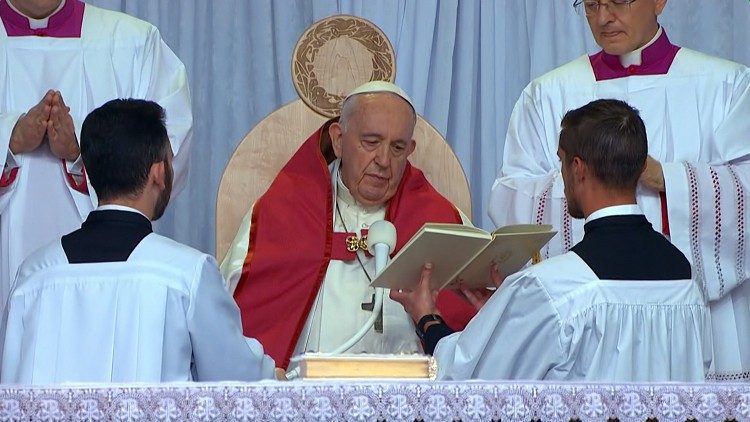
On the second day of his 5-day “Penitential Pilgrimage” to Canada, Pope Francis presided at the Holy Mass at the Commonwealth Stadium in Edmonton, with the presence of the faithful.
In the homily, the Holy Father invited everyone to think about their own grandparents, as the Church celebrates the feast day of Saints Joachim and Anne, in whose home the child Jesus came to know his relatives and “experienced the closeness, tender love and wisdom of His grandparents.”
Children of a history to be preserved
Pope Francis highlighted that we are children of a history that needs to be preserved – not isolated individuals - as no one comes into the world detached from others. Thus, our roots and families in which we grew up are part of a unique history that preceded us and gave us life.
In this light, “we did not choose that history” but “received it as a gift”, one we are to cherish. We are “descendants” of those who went before us and their “inheritance” which is “centered on righteousness, fidelity to God and His will.”
“We are here thanks to our parents, but also thanks to our grandparents, who helped us feel welcome in the world," the Pope said, adding they are the ones who love us unconditionally, without expecting anything back. Thanks to them, he continued, “we received a caress from the history that preceded us: we learned that goodness, tender love and wisdom are the solid roots of humanity.”
Further appreciating grandparents, the Pope said it is in their homes that many of us “breathed in the fragrance of the Gospel,” and discovered a “familiar” faith, through affection, encouragement, care and closeness.
He pointed out that it is in this way that Joachim and Anne loved Mary, and how Mary, in turn, loved Jesus, with a love that “never smothered Him or held Him back,” and the Pope invited everyone to learn not to pressure the consciences of others, or fail to love and respect those who preceded us or are entrusted to our care.
Preserving memory
Pope Francis enjoined everyone, on this note, to set aside a worthy space for preserving memory, and to remember those who went before us, insisting that we should “cultivate our roots to pray for and with our forebears, to dedicate time to remember and guard their legacy.”
He encouraged us not to lose their memory, nor forget the history that gave birth to our own lives. Rather, we should remember those whose hands caressed us and who held us in their arms; “for in this history we can find consolation in moments of discouragement, a light to guide us, and courage to face the challenges of life.”
“Let us ask ourselves: are we children and grandchildren capable of safeguarding this treasure that we have inherited? Do we remember the good teachings we have received? Do we talk to our elders, and take time to listen to them?”
Authors of a history yet unwritten
In addition to being children of a history that needs to be preserved, we are authors of a history yet to be written, the Pope said, noting that we are marked by both light and shadows, and by the love we did or did not receive.
He added that this is the mystery of human life: we are someone’s children but we too are called to give life, as fathers, mothers and grandparents to someone else. We should, therefore, ask ourselves what kind of society we want to build and bequeath to those who come after us, in light of the much we have received from those who preceded us.
Using the image of the life-giving sap that travels from roots, to branches, leaves, flowers and to the fruit of a tree, Pope Francis said that authentic tradition is expressed in this vertical dimension – from the bottom up. He, thus, warned against falling into a “caricature of tradition” which is not vertical – from roots to fruits, but horizontal – forwards and backwards, saying that this only leads to a backwards culture, trapped in the mentality that says “we have always done it this way.”
What are we passing on to those after us?
Reflecting on the day’s Gospel reading, Pope Francis noted that Jesus tells his disciples that they are blessed because they can see and hear what prophets and righteous people could only long for – the Messiah that those who can see and hear are called to welcome and proclaim. Similarly, those before us passed on a passion, strength and flame that is up to us to reignite.
Likewise, our grandparents and elders “wanted to see a more just, fraternal and solidary world, and they fought to give us a future” and it is up to us not to let them down and to bear fruit, because “we are the branches that must blossom and spread new seeds of history.”
Highlighting the “unique and irreplaceable” role we all have in history, Pope Francis asked everyone to question what we are passing on to those who come after us and what kind of mark we will be leaving behind.
He added that the Lord does not want us to be mere critics of our system, closed and backwards looking, but rather “artisans of a new history, weavers of hope, builders of the future, peacemakers.”
“The real question is: am I giving life? Am I ushering into history a new and renewed love that was not there before? Am I proclaiming the Gospel in my neighbourhood? Am I freely serving others, the way those who preceded me did for me? What am I doing for our Church, our city, our society?”
A future where the elderly are not cast aside
Concluding, the Holy Father invoked the intercession of Saints Joachim to help us cherish the history that gave us life and “remind us of our spiritual duty to honour our grandparents and our elders, to treasure their presence among us in order to create a better future.”
The Pope prayed, in this light, for a future where the elderly are not cast aside because they are no longer useful and cannot produce, or one that is indifferent to the need of the aged to be cared for and listened.
He further prayed for a future in which “the history of violence and marginalization suffered by our indigenous brothers and sisters is never repeated.”
“That future is possible if, with God’s help, we do not sever the bond that joins us with those who have gone before us, and if we foster dialogue with those who will come after us,” the Pope said. “Young and old, grandparents and grandchildren, all together. Let us move forward together, and together; let us dream.”
Pope Francis at Sacred Heart Church in Edmonton, Canada
Pope: ‘Christ, crucified in Canada's residential school students, reconciles us'
Pope Francis meets with members of the Sacred Heart Church of the First Peoples in Edmonton, and says reconciliation is a gift of Christ to move forward in the wake of the pain caused by the Church’s role in the Canadian residential school system.
By Devin Watkins
“This is the way forward: to look together to Christ, to love betrayed and crucified for our sake; to look to Christ, crucified in the many students of the residential schools.”
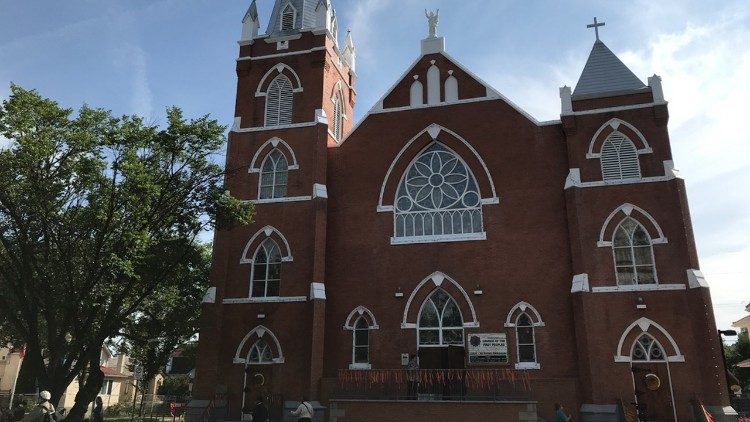
Pope Francis set out that path for the Catholic Church in Canada on Monday, as he met with members of the country’s only designated Indigenous parish church.
The Pope held the encounter in the western city of Edmonton with parishioners of the Sacred Heart Church of the First Peoples, which came on the heels of his public apology for the Church’s role in running residential schools.
Church as ‘a house for all’
In his address, Pope Francis expressed his joy for the opportunity to come “as a friend and pilgrim in your land”, adding that his Apostolic Journey to Canada is meant as a concrete sign of his desire to support the process of healing.
The Sacred Heart Church welcomes people from the First Nations, Métis, and Inuit communities, as well as immigrants from other countries.
The Pope said the parish offers an example of how the Church should be “a house for all… a home where everyone should feel welcome, regardless of past experiences and personal life stories.”
Pain for Church’s past
Pope Francis recalled the reason for his “penitential pilgrimage” to Canada.
“It pains me to think that Catholics contributed to policies of assimilation and disenfranchisement that inculcated a sense of inferiority, robbing communities and individuals of their cultural and spiritual identity, severing their roots and fostering prejudicial and discriminatory attitudes; and that this was also done in the name of an educational system that was supposedly Christian.”
Education, added the Pope, should be based on respect and never imposed in a pre-packaged format, but rather undertaken as an adventure to “discover together the mystery of life.”
Reconciliation on ‘tree of life’
The Pope then focused on the theme of reconciliation, saying Christ brought a form of reconciliation which goes beyond outward appearances.
“Jesus reconciles us with one another on the cross, on the ‘tree of life’, as the ancient Christians loved to call it.”
That tree of life, said Pope Francis, joins heaven and earth and embraces all Creation, even things that seemed “unthinkable and unforgiveable.”
He said indigenous peoples attribute “powerful cosmic significance” to the cardinal points, noting how Sacred Heart Church appropriates that symbolism and gives it a Christological meaning.
“Jesus, through the four extremities of His cross, has embraced the four cardinal points and has brought together the most distant peoples; He has brought healing and peace to all things,” he said.
‘Scandalous love’ and peace
Recognizing the pain endured by many indigenous peoples and families at the hands of Canada’s residential schools, Pope Francis said he can “only imagine the effort it must take, for those who have suffered so greatly because of men and women who should have set an example of Christian living, even to think about reconciliation.”
“Nothing can ever take away the violation of dignity, the experience of evil, the betrayal of trust. Or take away our own shame, as believers. Yet we need to set out anew, and Jesus does not offer us nice words and good intentions, but the cross: the scandalous love that allows his hands and feet to be pierced by nails, and his head to be crowned with thorns.”
The path forward, said the Pope, is to look together to Christ and to embrace Christ’s gift of reconciliation, “a peace that radiates from the heart of Jesus, a grace which must be sought.”
“If we want to be reconciled with one another and with ourselves, to be reconciled with the past, with wrongs endured and memories wounded, with traumatic experiences that no human consolation can ever heal,” he said, “our eyes must be lifted to the crucified Jesus; peace must be attained at the altar of his cross.”
‘Living body of reconciliation’
Pope Francis went on to say that the Church is the “living body of reconciliation”, since she is the one body in which Christ has reconciled us.
He said the Church can never lead people to Christ by imposing Him through proselytism. Rather, Jesus must be “preached as He desires, in freedom and charity.”
The Church, he added, must be a place of welcome in which the Holy Spirit fosters the healing of wounded memories, which he said should be carried out at the local level in praying and sharing life with one another.
Teepee: Sign of God’s closeness
The Pope concluded his address to members of the Sacred Heart Church of the First Peoples with the image of the teepee.
He noted that above the altar and tabernacle are four poles representing the typical indigenous tent, saying it recalls the Tent of Meeting where God dwelt as the people of Israel journeyed in the desert for forty years.
“The teepee reminds us that God accompanies us on our journey and loves to meet us together,” said Pope Francis. “God is a God of closeness, and in Jesus He teaches us the language of compassion and tender love.”
May God, he concluded, “take us by the hand, and even through the deserts of history, and continue to guide our steps on the way of reconciliation.”
Canada's only designated Indigenous Church welcomes Pope
Fr. Susai Jesu, OMI, parish priest of Sacred Heart Church of the First Peoples in Edmonton which will host the Pope on the first day of his Apostolic Journey to Canada, reflects on the significance of the Pope’s visit to the community of the only designated Indigenous Church in Canada.
By Vatican News staff reporter
Pope Francis arrived in Canada on Sunday to begin his 37th Apostolic Journey abroad - a “penitential pilgrimage” as he describes it - with an emphasis on the Indigenous peoples of the country who await his message of repentance and reconciliation.
On the lineup of the Holy Father’s activities on Monday is a visit to Sacred Heart Church of the First Peoples in Edmonton, which will see him meet with members of the Parish community and the Indigenous peoples, including those who may not have a particular connection to an Indigenous organization or group.
Sacred Heart is Edmonton’s First Nations, Métis and Inuit parish and is the only designated Indigenous Church in all of Canada.
The Pope’s visit
Fr. Susai Jesu, OMI, a missionary from India and the Pastor at Sacred Heart, spoke to Vatican News’ Christopher Wells about the parish's unique characteristics, his ministry among the indigenous peoples in Edmonton and preparations for the Pope’s visit among his parishioners.
Ahead of the Pope’s visit, together with the group of volunteers helping him, the priest says that they have also put a lot of work into listening to the Indigenous community – an activity that he says, is what they need most.
He shares in the excitement of the people who await the Pope, while not downplaying that it a visit of “healing and reconciliation.” Fr. Jesu notes that even though there may be some tensions, the parish community is focusing on the “positive spirit that is coming in.”
A parish for everyone
Sacred Heart parish is known for its ministry of receiving strangers and caring for them. The church serves 230 – 240 lunches to people in need daily, and provides clothing and other basic necessities to them, through the help of volunteers.
And even if preparations for the Pope’s visit may cause interruptions in this important service, the parish has made other plans to temporarily send those in need to nearby churches and outreach ministries so that “the people that we serve every day on are not overlooked, not left behind.”
“We want to maintain that inclusiveness and welcoming spirit. This is a national indigenous parish,” which welcomes both Indigenous and non-Indigenous people, affirms Fr. Jesu, who insists that this character is maintained by not only “who we are” but also “what we do.”
For the 5 years he has been at Sacred Heart parish, Fr. Jesu has worked among the Indigenous peoples, trying, in his words, to “keep the shining light that they have” and “help them see their own light.”
His ministry in this field began in 2008 after arriving in Canada the year before. He even went on to take up a master's degree in counselling, in order to be of better service to the Indigenous people
Sacred Heart Parish
Sacred Heart grew out of Immaculate Conception parish which was created in 1906 to accommodate immigrants to Edmonton.
The construction of the building was completed in 1913 and it provided a base for several ethnic groups who wanted to set up parishes that would reflect their origins, as they gathered their resources to build their churches. Over the years, several churches got their start at Sacred Heart.
Much of the church was destroyed in a fire in 1966, but the Second Vatican Council, which ended in 1965, required churches to remodel to accommodate the new style of communal worship, thus presenting an opportunity to remodel.
The Parish became Sacred Heart Church of the First Peoples on 27 October 1991, when Archbishop Joseph MacNeil designated it Edmonton’s First Nations, Métis and Inuit parish.
Receiving Pope Francis
Fr. Jesu recounts that the parish suffered another fire incident on 30 August 2020, but nonetheless, has not missed a single Mass even if it did not have a Church. Weekday Masses have been held at the boardroom, which is now a chapel, and Sunday Masses are held at a Gymnasium at the Sacred Heart Learning Center.
The reconstruction work on the parish was finished just in time for the Pope’s visit, and Fr. Jesu expresses gratitude at being able to welcome the people and the Pope into the building.
As the parish prepares to host the Holy Father on Monday evening, Fr. Jesu prays that the event may “bring more healing and reconciliation, and together we walk forward.”
Bishop of Edmonton looks ahead to Pope's penitential pilgrimage
Ahead of Pope Francis penitential pilgrimage to Canada, the Archbishop of Edmonton, Richard Smith, shares his hopes and expectations for the papal visit. The Holy Father’s journey of healing and reconciliation with indigenous peoples will begin in Edmonton on Sunday, and continue with stops in Quebec City and Iqaluit.
By Christopher Wells
Archbishop Richard Smith is convinced Pope Francis’s penitential pilgrimage to Canada’s indigenous peoples will reveal the Holy Father once again as “a man of profound compassion,” who will demonstrate the Church’s commitment to hearing the pain of the aboriginal peoples and responding to it with reconciliation and healing.
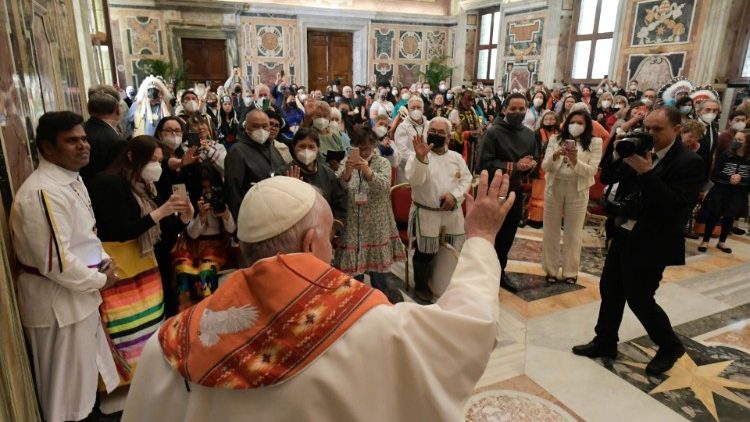
The Archbishop of the western city of Edmonton – the first stop on the upcoming papal journey – recalled the Pope’s meeting with representatives of Canada’s indigenous populations during a visit to Rome this spring. “What happened in Rome is that the delegation of indigenous peoples encountered in the Holy Father a man of profound compassion,” the Archbishop said. “They spoke what was in their hearts and in their minds, and they could see that he was listening very deeply, very attentively, not only with his mind, but also, and more importantly, I would suggest with his heart.”
“The Church stands with you”
At that meeting, Archbishop Smith noted, Pope Francis “spoke with profound compassion” making his own stance, and the Church’s stance, “very, very clear.”
“That is a stance that hears the pain and wants to respond to it with healing, a stance that acknowledges the rights of indigenous peoples and wants to uphold them with them. A stance that acknowledges the giftedness and the beauty of indigenous culture and the great wisdom that lies therein.”
Archbishop Smith said the Pope’s message could be summed up with the words, “The Church stands with you… Don’t forget that, the Church stands with you!”
A sense of hope and healing
He also emphasized the significance of the Pope’s personal presence in Canada. In the first place, he said, there is the personality of Pope Francis himself “which does touch people right away.” He noted the “wonderful, wonderful sense of healing and hope” that many people experience on meeting the Holy Father.
“But more profoundly,” Archbishop Smith continued, Catholics understand the Pope as the successor of Saint Peter. And when he comes to any area, he brings with him the shadow of Saint Peter. We know that from the Acts of the Apostles, but that in itself brought healing and hope to people who were touched simply by the shadow of Peter as he walked by. When Pope Francis comes to this country, he's bringing that shadow with him wherever he goes.”
Drawing close to the indigenous peoples
Archbishop Smith said that Catholics in Canada want to ensure indigenous peoples of their solidarity and support, adding, “there is no one better placed to speak on behalf of us all than the Holy Father.”
The Bishops of Canada in particular, he said, have tried to express the desire “to draw close, to work together with the indigenous peoples, to discern together with them how we can face the various challenges that they are encountering, how we can together learn from them, from their wisdom, and how we can learn from that as a country.” The Holy Father, he continued, “given his office and given the particular personality of Pope Francis, has unique ability to make that message heard more clearly than anybody else could.”
The Archbishop said the Church in Canada sees the Holy Father “very much as a spokesman,” who will be able to express their own “sentiments and hopes” to the aboriginal peoples of Canada.
A broader need for healing and reconciliation
At the same time, he said, “the need for healing and reconciliation exists everywhere, far beyond this particular relationship.” He gave the examples of societal divisions revealed and exacerbated by the pandemic, the need for healing in families and in individual hearts, and, on a global level, the war in Ukraine and other instances of terrible aggression,” all instances of situations in need of healing and reconciliation.
He said he hoped and prayed “that what unfolds here in Canada, as as we grapple with the issue and face it, together with the pope, together with our indigenous peoples, look at the issues and move forward. But that by God's grace, obviously, we become a beacon of hope for our world.”
A legacy in need of healing
Acknowledging the pain and suffering that have long marked the Church’s relationship with indigenous people, Archbishop Smith insisted on the need to hear the stories of people’s “pain and heartache, the legacy that continues to impact them and their families in a number of different ways.”
Catholics today, even though they may not be personally guilty of the sins and errors of the past, have inherited that legacy of past guilt, and must ask themselves, “How do we together receive the legacy and then help in healing?”
That, he said, “is the responsibility that falls on the shoulders of us today.”
Archbishop Smith tied that insight to the theme of “Walking Together,” the theme of the Pope’s Visit. “This is what we understand we need to do right now: Walk together, find pathways to mutual understanding, to mutual respect, mutual help healing,” he said.
An impetus to move forward
He added, “The need for healing exists across the board, but the sense of wanting to take this issue on fully and move forward in a way that will bring healing to everybody that needs it is something that really does see us right now as a nation, it seems to me. And this is going to be a great opportunity to receive from the Pope a real impetus forward.”