reflections, updates and homilies from Deacon Mike Talbot inspired by the following words from my ordination: Receive the Gospel of Christ whose herald you have become. Believe what you read, teach what you believe and practice what you teach...
Canadian Cardinal Marc Ouellet, former prefect of the Dicastery for Bishops, speaks to reporters at the Vatican Feb. 20, 2023. A Canadian Superior Court judge ruled Aug. 31, 2026, that sexual misconduct accusations against Cardinal Ouellet, retired archbishop of Quebec, were unfounded and ordered his accuser to pay him $100,000 in damages. (CNS photo/Justin McLellan)
(OSV News) — A judge in Montreal has found sexual misconduct accusations against Quebec’s Cardinal Marc Ouellet to be unfounded and ordered his accuser to pay him $100,000.
The cardinal, retired since April 2024, had been under a cloud of suspicion since Paméla Groleau had accused him of touching her without consent on three occasions between 2008 and 2010 while she was training or working as a lay pastoral agent. She also told the court she felt “hunted” at another event, saying Cardinal Ouellet came from across the room to sit next to her.
“The court finds that the allegations describing the four events cited by Ms. Groleau in the context of the class action are false,” Superior Court Justice Martin Castonguay wrote in a decision released Aug. 31.
Castonguay concluded that Groleau’s testimony against the now 82-year-old Cardinal Ouellet “was neither credible nor reliable,” noting in his judgment that she had changed her story several times.
Judge rules other women’s testimony not pertinent
Two other women testified against Cardinal Ouellet at the trial, but the judge ruled their testimony was not pertinent to the question of whether Groleau defamed the cardinal. He also concluded Cardinal Ouellet was “not the author of the gestures” brought into evidence by one of the women.
The allegations against the cardinal surfaced in 2022 as part of a class-action lawsuit launched against the Archdiocese of Quebec and dozens of clergy and lay members. In response, Cardinal Ouellet publicly denied any wrongdoing and countered with a $100,000 (US $72,230) defamation countersuit against his accuser, claiming she had damaged his reputation, honor and dignity.
After the lawsuit was filed, the Vatican chose not to launch its own investigation into the cardinal. In a statement issued Aug. 18, 2022, by Matteo Bruni, then director of the Press Office of the Holy See, the Vatican found there were “insufficient elements to open a canonical investigation for sexual assault by Cardinal Ouellet against person F,” as Groleau was identified at the time.
Damage to cardinal ‘amplified’ by class-action suit
In his ruling, Castonguay said the damage to Cardinal Ouellet — former archbishop of Quebec who would serve as prefect of the Dicastery for Bishops under Pope Benedict XVI and Pope Francis — and his reputation was “amplified by the chosen vehicle, meaning that of a class action aimed principally at religious pedophiles, thereby equating Cardinal Ouellet, in the eyes of the ‘ordinary citizen,’ with that group of individuals.”
He said it “is difficult to quantify” the true impact of the allegations against Cardinal Ouellet and awarded him the $100,000 he sought.
The class action against the Archdiocese of Quebec was ratified Aug. 12, with the Quebec Superior Court approving a $31.5 million (U.S. $22.66 million) out-of-court settlement for people who say they were sexually abused by members of the church dating back to 1940.
In a statement about the ruling in favor of their client, Cardinal Ouellet’s lawyers were pleased the court recognized the injustice suffered by the cardinal.
‘Judgment reaffirms a fundamental principle’
“This judgment reaffirms a fundamental principle: even in the context of judicial proceedings, serious allegations must be based on accurate and relevant facts and advanced with the rigor required by their gravity,” said Dominique Ménard in the statement.
The cardinal has promised to donate the damages he was awarded to organizations fighting against sexual abuse experienced by Indigenous Canadians.
The class action also accused Quebec’s current archbishop, Cardinal Gérald Lacroix, of sexual misconduct. After stepping aside for six months in early 2024, Cardinal Lacroix resumed his role after a Vatican-mandated investigation found no evidence to support the accusations.
Soldiers in Revolutionary War uniforms participate in a military parade to commemorate the U.S. Army's 250th Birthday in Washington June 14, 2025. Credit: OSV News photo/Carlos Barria, Reuters.
What provoked the American Revolution?
Economic conflict, Enlightenment ideologies and historical trends aside, among the leading proximate causes were the Coercive Acts of 1774, a number of British parliamentary decrees that came to be known on this side of the pond as the “Intolerable Acts.” The first four might fairly be considered revenge for the Boston Tea Party. First, the Boston Port Act authorized a blockade of Boston’s harbor until the locals paid up for the losses incurred by the British East India Company; next, the Massachusetts Government Act and the Administration of Justice Act both severely curtailed the authority of local government in the colonies (including over trials); and then the Quartering Act required locals to pay for the lodging of British soldiers in the colonies.
A fifth act had little to do with Boston, at least as the British saw it: the Quebec Act of 1774. Concerned with the governance of New France after French territories in Canada were formally ceded to Great Britain in 1763, it established, among other concessions, the right of Catholics in British-occupied Canada to celebrate the sacraments and practice their faith freely.
This, in the eyes of the would-be revolutionaries to the south, was the most intolerable act of them all.
Looking to Canada
In October of that year—two years before the Declaration of Independence—the First Continental Congress endorsed what are known as the “Suffolk Resolves,” one of which stated the case against the papists and their unlikely British enablers:
That the late act of Parliament for establishing the Roman Catholic Religion and the French Laws in that extensive country now called Canada, is dangerous in an extreme degree to the Protestant religion and to the civil rights and liberties of all Americans; and, therefore, as men and Protestant Christians, we are indispensably obliged to take all proper measures for our security.
Those “proper measures” included an invasion of New France, which the colonials—led by Benedict Arnold, among others—attempted immediately.
The congressional delegates, meanwhile, expressed their dismay that the British should be so blind to the Romish enemy in their midst: “Nor can we suppress our astonishment that a British parliament should ever consent to establish in that country a religion that has deluged your island with blood, and dispersed impiety, bigotry, persecution, murder and rebellion through every part of the world,” they declared in late 1774.
Though the would-be conquerors captured Montreal in late 1775, they were defeated at Quebec City soon after, and the arrival of British reinforcements in 1776 dashed any real hopes of a revolutionary military victory in Canada. In the spring of that year, Benjamin Franklin tried diplomacy instead, leading a delegation to Canada to coax the locals to join the American cause. He was joined by Charles Carroll, the prominent Maryland landowner and Catholic (the only one to sign the Declaration of Independence a few months later) and Samuel Chase. Franklin then invited Carroll’s cousin, the Jesuit priest John Carroll, along as well.
John Carroll spoke French. More important, as a Jesuit (though the Society had been suppressed just three years before) and a prominent priest, he could appeal to Quebec’s Catholic citizenry in a way that Franklin and his Protestant confreres obviously could not. Allies against the British were needed; suddenly the colonial concerns about a Romish faith known for its “impiety, bigotry, persecution, murder and rebellion” were no longer such an issue.
There is something quintessentially American about Franklin’s embrace of realpolitik even as anti-Catholic sentiment still found a home among the revolutionary ranks. Is it just as American that as we celebrate the nation’s semiquincentennial this summer, we barely remember the tumult noted above? A number of speakers at the “Rededicate 250” prayer service held on the National Mall in Washington, D.C., on May 17, for example, noted that a key principle of the revolutionary movement was freedom of religion.
No, it wasn’t. Not for Catholics, anyway.
Comparisons and Contrasts
That forgotten history can feel all the more dissonant in the United States 250 years later because Catholicism has become so integral a part of our national life. Six of the nine Supreme Court justices in 2026 are Catholic; so too is the vice president, as was the previous president; the secretary of state is also a Catholic, as is around a third of President Donald Trump’s cabinet. A former altar boy from Chicago’s South Side is the pope. Catholics are the largest religious denomination in the United States, making up 22 percent of the population. (If counted as a denomination, the second-largest is former Catholics, at around 13 percent of the population.) It is a far different world from 1776.
According to the historian James T. Fisher, the population of the 13 colonies at the time of the Declaration of Independence was around 2.5 million, including half a million who were enslaved people. The vast majority of colonials were Protestant, though rather less churched than their descendants would prove to be; most historians estimate that around 15 to 17 percent of the population attended religious services regularly in the colonial era.
As for the Catholics, they were so few that they should have been all but invisible. Numbering around 25,000, they made up less than 1 percent of the population and were almost all in Pennsylvania and Maryland. Cities like Boston had almost no Catholics at all when battles like Bunker Hill were fought; the first public Mass was not celebrated there until 1788. The priest-historian Anthony Andreassi, C.O., noted recently in a series for OSV News that “the story of New England begins in a region that was, from the start, among the least welcoming places in early America for Catholics.”
Charles Carroll’s signature on the Declaration of Independence, four below John Hancock. (Wikimedia Commons)
In the religious imagination of the 18th century, however, numbers could be trumped by reputation and rumor: Catholics occupied a space in the American Protestant imagination far in excess of their physical presence or access to avenues of authority. This was true in part because the original 13 colonies had neighbors on three sides where Catholics dominated the European-descended population, including Spanish Florida, the aforementioned Canada, French (then Spanish, then French) Louisiana and, more remotely, the Spanish Southwest. All had histories of Christian conquest and evangelization far more ancient than any tale of pilgrims building a city upon a hill; for example, Dominican friars were celebrating Mass in 1526 in a short-lived colony in what would become South Carolina—almost a century before the Mayflower landed at Plymouth Rock.
Even the American Indian populations bordering the colonies to the west and northwest were associated in the American Protestant imagination with Jesuit and Franciscan missionary efforts that began more than a century before. Jesuits like Jacques Marquette were traversing the Mississippi River in 1673, and Isaac Jogues died in what is now upstate New York in 1644.
Though the French Revolution—and all the tumult it brought to notions of government and right relationship with authority—was still more than a decade away at the time of the American Revolution, Catholics also already had the reputation of being hostile to Enlightenment notions of liberty current among the intelligentsia on both sides of the Atlantic. What use to the colonials were compatriots who, if successful in throwing off the yoke of a king, were probably plotting to bring the nation under the yoke of a pope?
This sentiment ran counter to the actual ideals of some well-known American Catholics, including the aforementioned Charles Carroll, who favored the separation of church and state from an early hour. Decades after the war was over, he wrote the following to John Stanford, a prominent Baptist preacher:
To obtain religious as well as civil liberty I entered jealously into the Revolution, and observing the Christian religion divided into many sects, I founded the hope that no one would be so predominant as to become the religion of the State. That hope was thus early entertained because all of them joined in the same cause, with few exceptions of individuals.
Even moments later celebrated as examples of religious harmony between Catholics and Protestants could include harsh notes of contempt. When John Adams joined George Washington in visiting some Catholic churches in Philadelphia in 1774, he found places like St. Mary’s Church (which still has a plaque noting the occasion) beautiful—but the practices within appalling.
“The afternoon’s entertainment was to me most awful and affecting; the poor Wretches fingering their beads, chanting Latin, not a Word of it they understood,” Adams wrote to his wife, Abigail. The Mass included everything, he added, that “can charm and bewitch the simple and ignorant. I wonder how Luther ever broke the spell.”
Adams was even more leery of the Jesuits, writing years later to Thomas Jefferson of his concerns after the Society of Jesus was officially restored. “Shall we not have swarms of them here, in as many shapes and disguises as ever a king of the gypsies,” he wrote, “hiding in plain sight as printers, editors, writers and schoolmasters?”
“If ever any congregation of men could merit eternal perdition on earth and in hell,” he added, “it is this company of Loyola.”
Boots on the Ground
But what was the reality for Catholics themselves in the colonies in 1776? It varied from place to place, though most historians today would note that even in locales that cherish their long traditions of religious freedom—Pennsylvania, Maryland and Rhode Island chief among them—anti-Catholicism was an accepted part of the culture, part and parcel of what it meant to be an American. The great mid-century American Catholic historian Msgr. John Tracy Ellis noted that anti-Catholicism even served a unifying purpose among the Protestant denominations predominant in the colonies; nothing could unite an Anglican and a Puritan more. In his words, a “universal anti-Catholic bias was brought to Jamestown in 1607 and vigorously cultivated in all the thirteen colonies from Massachusetts to Georgia.”
Catholics in Pennsylvania, where the religious toleration established by the Quaker William Penn in 1682 still had some traction into the 18th century, fared the best. In fact, the Jesuit church and parish established in 1733 near Independence Hall in Philadelphia, St. Joseph’s, was for many years the only place in the English-speaking world where Mass could be celebrated publicly. The first Catholic parochial school in the United States was also founded at nearby St. Mary’s in 1782.
Maryland—founded by a Catholic, Cecil Calvert, who had been granted the territory by the king of England—was another early haven for Catholics, and also benefited somewhat from being the locus of activity for English-speaking Jesuits in North America during the 17th and 18th centuries. (The shameful history of the Jesuit treatment of enslaved people on their Maryland plantations was explored in depth in 2023 by Rachel Swarns in her book The 272: The Families Who Were Enslaved and Sold to Build the American Catholic Church.) The Maryland Toleration Act of 1649 even guaranteed religious freedom to “Trinitarian Christians” in the territory. As Father Andreassi has noted in OSV News, however, the English Civil War and the Glorious Revolution of 1689 in England hardened hearts against Catholics in British territories, and by the 18th century most Catholics were excluded from the colony’s public life and restricted to worshiping in private.
Elsewhere in the colonies, Catholics were vastly outnumbered and usually politically marginalized. Laws in New England actually barred Catholics from settling in the colonies, and any priest in Massachusetts could technically be executed as “an enemy of the true Christian religion.” In New York, where the massive influx of Catholic immigrants from Ireland, Germany and elsewhere that would remake New York City was still decades away, the public practice of the sacraments had been illegal for almost a century at the time of the Revolution. While these draconian restrictions were likely more honored in the breach in many places, their continued presence on the books is still notable.
Further south, Catholics in Virginia had experienced occasional moments of toleration in the 18th century, but there were few Catholic communities of note in 1776. Their numbers were even fewer in Georgia and the Carolinas—not more than several hundred—though the latter territories actually had a long history of Catholic presence far predating the establishment of the 13 colonies.
In addition to small numbers and political and economic marginalization, the Catholic Church throughout the colonies also suffered from a drastic shortage of clergy—and thus of access to the sacraments when they could be celebrated. When John Carroll was made bishop of the newly established Diocese of Baltimore (and thus of essentially the entire United States), he estimated in a letter to Rome that there were probably no more than 50 priests in the entire nation.
A statue of Bishop John Carroll at Georgetown University. (CNS photo/Elizabeth Bachmann)
Lessons Learned
When we explore that history in the light of 250 years of history since, what reconsiderations might benefit our celebrations of 1776 throughout this year?
First, we might recognize that when we talk about American history being driven by the quest for religious freedom, we often are at best misremembering a nuanced past and at worst telling a lie. Freedom for me but not for thee, perhaps. While the Catholic Church gets a bum rap for refusing to accept religious freedom until the Second Vatican Council, its Protestant brethren—at least in the colonies—were no better, be they Puritan or Anglican or Presbyterian or otherwise. And one might ask: If Catholic colonists had been able to keep control of Maryland, would they have extended to their Protestant peers the religious freedom so cherished today? If anything, early American history is primarily marked by religious exclusion and intolerance in every corner of the colonies.
Second, while a number of Catholics played prominent roles in the Revolutionary War, including Charles, John and Daniel Carroll, Thomas Fitzsimons and Mary Waters of Philadelphia, and a number of important military commanders like Commodore John Barry and Stephen Moylan, it is also true that numerically, Catholics were a small part of the war effort. Some of the most comprehensive histories of the Catholic Church in the United States can tend toward a “Catholic contributions to the cause should not be underestimated” sentiment, but the names and places tend to repeat themselves. The postwar praises from figures like George Washington certainly do mention the valor and dedication of American Catholics, but they are also quick to note that the primary Catholic contribution to the war was, after all, the French Navy.
Third, the historical context of the war—and of those who waged it—deserves more consideration than we give it today. The revolutionary fervor of the colonials did not come out of nowhere; nor did it always survive past a generation. When the French Revolution began in 1789, it frightened the new American political class as much as it did their European peers—and perhaps more so the American Catholics, given that revolution’s antipathy for the Catholic Church along with its other bêtes noires.
The historian Jay P. Dolan noted in The American Catholic Experience that after the French Revolution, Charles Carroll became “a classic example of a revolutionary gentleman who turned into a federalist aristocrat.” The “anarchy and insurrection” of the French Revolution and its bloody aftermath also frightened his cousin John Carroll, the newly appointed first bishop of the United States. Federalism and respect for institutions became primary concerns for all of the new nation’s powerbrokers, Catholics included, not necessarily the liberties held up in our celebrations and remembrances.
The Birth of the American Catholic
On the other hand, one element our celebrations probably have gotten correct is that the Revolutionary War did offer up a rationale for citizens of the new nation to find common cause with one another. The old adage that bonds are formed easier “shoulder to shoulder than face to face” fits American Catholicism in the post-Revolutionary period. The Catholic Church that emerged in the United States after the war was certainly far more independent of Europe than its pre-war version and more closely tied to American ideas of governance. Catholics largely accepted the American notion of separation of church and state (a concept condemned by popes for more than another century) and some congregationalist models of church governance like the election of bishops and priests’ councils. Not all of that survived the next century, of course, but the church in the states after 1776 was certainly American as well as Catholic.
So too did Catholics in the new nation gain notice across the Atlantic for being, well, too American: 19th-century prelates like Cardinal James Gibbons and Archbishop John Ireland were not afraid to assert their authority in struggles with Rome, and American intellectuals like Orestes Brownson and Isaac Hecker were so well known in Europe by the end of the 19th century that entire encyclicals were devoted to criticizing their thought under the rubric of “Americanism.” (Not every nation has a heresy all its own!)
The participation of Catholics in the war effort also contributed to a sense that Catholics need not exist as a world apart from American society, and that it did not have to be the case that a secular democracy had to be opposed to the church. The experiment in, to quote Benjamin Franklin, “a republic, if you can keep it,” would henceforth be both Protestant and Catholic. That would also prove important as the nation expanded rapidly in the 19th and 20th centuries and absorbed territories where Catholics outnumbered Protestants. As Archbishop William Lori of Baltimore once noted in America (January 2026), “faith can engage democracy—not by retreating from it, but by entering into it as leaven, conscience and companion.”
Perhaps another prelate from Baltimore, the aforementioned John Carroll, should have the last word. The United States, he wrote after the war, had “banished intolerance from their systems of government” in part by giving everyone, regardless of creed, an equal right of participation in civic life. The war for independence played no small part in the creation of that shared ideal—if not always respected—of equal participation in the life of the nation. In Carroll’s words: “Freedom and independence, acquired by the united efforts, and cemented with the mingled blood of protestant and catholic fellow-citizens, should be equally enjoyed by all.”
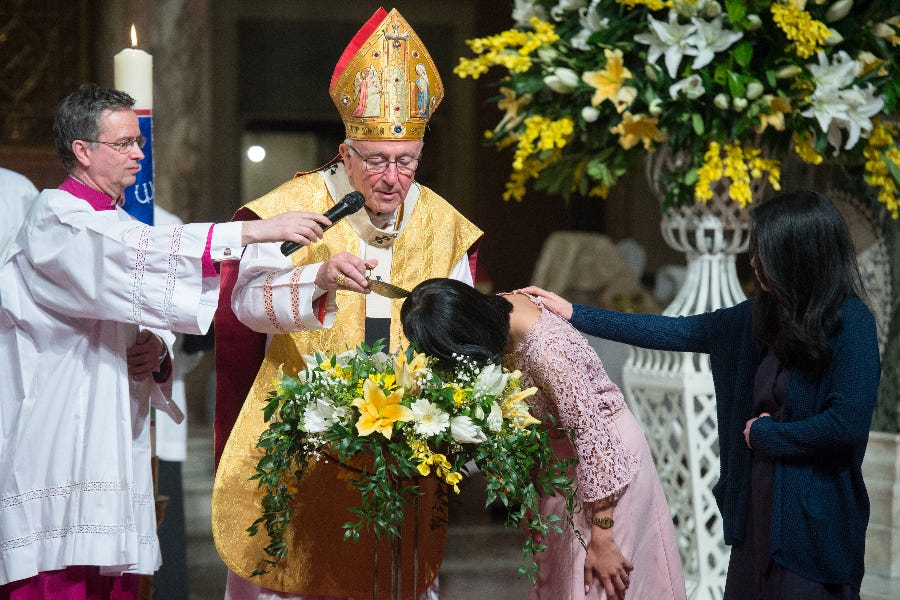
What kind of figures are dioceses seeing? And what are the baptismal candidates, known as catechumens, saying about their journeys to the Catholic Church?
Around 240 adults are preparing to be baptized in Austria’s dioceses this Easter, up from roughly 130 people in 2024, an 85% year-on-year increase. In the Austrian Church, an adult is defined as anyone over the age of 14.
In the Vienna archdiocese, which has reported rising adult baptisms for almost a decade amid an influx of refugees, 118 adults will be baptized at the Easter Vigil, 50 more than in 2024. A third of the catechumens are under the age of 20.
There were approximately 5 million Catholics in Austria in 2021, slightly more than half the country’s population. In that year, there were more than 3,000 parishes in 11 dioceses.
Daniel Vychityl, who oversees the catechumenate for the archdiocese and the Austrian bishops’ conference, said: “In the past, we primarily had baptism candidates between the ages of 20 and 40, but now the adolescent age group represents the largest group, with the majority of them being Austrian citizens.”
What are catechumens saying?
Bettina Farasin decided to be baptized in 2018, at the age of 44 in the city of Linz. She was scheduled to be baptized as a baby but the ceremony was canceled after the sudden death of her godmother, she told the Austrian Church magazine Grüß Gott.
Throughout her adult life, she intended to be baptized but repeatedly postponed the thought. She became involved in her local church and even put her name forward for a seat on the parish council in 2017, but withdrew it because of her unbaptized status.
She began a year-long preparation for the sacrament with her pastor. “That’s when I got to know my faith in a completely new way. I began to understand the Bible in a new way, but also to see prayers like the Creed with different eyes,” she said.
🇦🇺 Australia
What’s happening?
More than 200 catechumens are preparing to be baptized in the Archdiocese of Melbourne. They were joined in March by 150 candidates — who are already baptized but seeking to become Catholics — at what Archbishop Peter Comensoli described as one of the biggest Rite of Election groups at St. Patrick’s Cathedral.
There were 7 million Catholics in Australia in 2021, more than one quarter of the population. The country had that year 1,353 parishes, in 30 Latin Catholic dioceses, and five Eastern Catholic eparchies.
What are catechumens saying?
This year’s catechumens include a father named Jason, who said that his eight-year-old daughter Ivy asked one day if she could start going to church.
Neither he nor Ivy’s mother came from religious families. But Jason wanted to support his daughter, so they began attending the local Catholic church, where a parishioner suggested he join the RCIA class.
“I feel weird when we miss Mass. We try to go a few times a week,” he said in a report on the Melbourne archdiocese website. “I enjoy going, but I also get enjoyment from seeing my daughter happy.”
🇧🇪 Belgium
What’s happening?
The number of adult baptisms in Belgium is expected to rise to 536 this year, an almost 50% increase from 2024, when there were 362.
Ten years ago, in 2015, there were 180 adult baptisms, meaning the number has almost tripled over the past decade.
The figures suggest more adult baptisms may be occurring in French-speaking parts of the country than in Flemish-speaking regions. But the main source of the baptisms is in the bilingual capital region around Brussels.
In total, there were 8.3 million Catholics in Belgium in 2021, 72% of the national population, in 3,681 parishes in nine dioceses.
What are catechumens saying?
Maëlle Montoisy, a 22-year-old literature student, did not grow up in a church-going family. But she attended a Catholic school and was influenced by her grandfather, a Mass-goer who offered her words of encouragement, she told the website CathoBel.
After her grandfather died in 2021, she entered a dark period, which ended when she spontaneously decided to attend Mass. At the church, she met a woman called Georgette, who will be her godmother.
“She welcomed me with such kindness. She spoke to me about baptism, as if it were obvious. And little by little, I began this journey,” Montoisy said.
🇨🇦 Canada
What’s happening?
More than 600 catechumens are preparing for baptism in the Archdiocese of Vancouver, as a record number of people prepare to become Catholics.
In all of Canada, there were almost 17 million Catholics in 2021, 44% of the national population, spread across almost 4,000 parishes in 60 Latin Catholic dioceses and 15 Eastern Catholic eparchies.
What are catechumens saying?
Sarah Hurley, a catechumen in the Vancouver archdiocese, said the Rite of Election in March was profoundly moving.
“Stepping into Holy Rosary Cathedral for the Rite of Election felt like entering a sacred embrace, its majestic stained-glass windows glowing with divine light,” she said in a report on the archdiocese’s website.
🇫🇷 France
What’s happening?
A record 17,800 catechumens will be baptized at this year’s Easter Vigil in France, including more than 7,400 young people aged 11 to 17.
France is arguably the country that is driving the growing discussion about a Catholic adult baptism “boom.”
In total, there are 49 million Catholics in 2021, 75% of the national population, in more than 13,000 parishes across almost 100 Latin Catholic dioceses and three Eastern Catholic eparchies.
What are catechumens saying?
Sébastien, 51, grew up in an anti-clerical family, but felt a strong sense of a “benevolent presence” in his youth. At the age of 48, the father of three was out walking when he decided to enter a small church near his house.
“That day, I made the decision to open the door, take the plunge and get baptized,” he told Aleteia.
His parents were unhappy at the decision, but he committed himself to learning about and living out the faith, becoming a volunteer at Secours Catholique – Caritas France.
In 2024, his youngest daughter was baptized. He said: “We talked about it together. It’s a coincidence, but in the end not so much…”
🇲🇳 Mongolia
What’s happening?
When Pope Francis visited Mongolia in 2023, the Vatican estimated there were only 1,394 Catholics in the country that is roughly the size of Alaska. While the numbers are small, the Church is on an upward trajectory, thanks in part to adult baptisms.
What are catechumens saying?
Two of Tserenchimed Chuluunbaatar’s daughters were baptized Catholics at the Easter Vigil in 2023. Each week, they would bring home the Sunday Mass booklet containing the Gospel readings, which Chuluunbaatar, a Buddhist, would examine closely.
“I became interested in the Bible, the Church, and the Christian faith,” the retired finance ministry worker said in an interview with UCA News.
When the family attended the papal Mass in Ulaanbaatar, Chuluunbaatar decided he wanted to be a Catholic. He is due to be baptized April 19, alongside his wife and third daughter.
🇳🇱 Netherlands
What’s happening?
It’s hard to find overall figures for adult baptisms in the Netherlands. But in the Diocese of ’s-Hertogenbosch, 42 catechumens are preparing to be baptized.
There were 4.8 million Catholics in the Netherlands in 2021, less than 30% of the population, in 615 parishes across eight Latin Catholic dioceses and one Eastern Catholic diocese.
What are catechumens saying?
Guusje Peters, 26, did not grow up in a religious family, but she felt there was a higher power and wrestled with spiritual questions. Around a year ago, she entered a “dark time,” she told the Katholiek Nieuwsblad.
“I wondered why this was part of his plan, but decided to surrender completely and made a kind of cry for help in prayer,” said Peters, who lives in a village in the Limburg province.
“It was a dark moment, but I will never forget how a ray of sunlight began to light up the room. A certain warmth and peace came over me, and I knew in that moment that I was being called. That longing only grew stronger as time went by.”