Showing posts with label Archbishop Richard Smith. Show all posts

Tuesday, July 26, 2022

The poignant and sincere message of Pope Francis during a beautiful Mass celebrated in Edmonton, Canada today


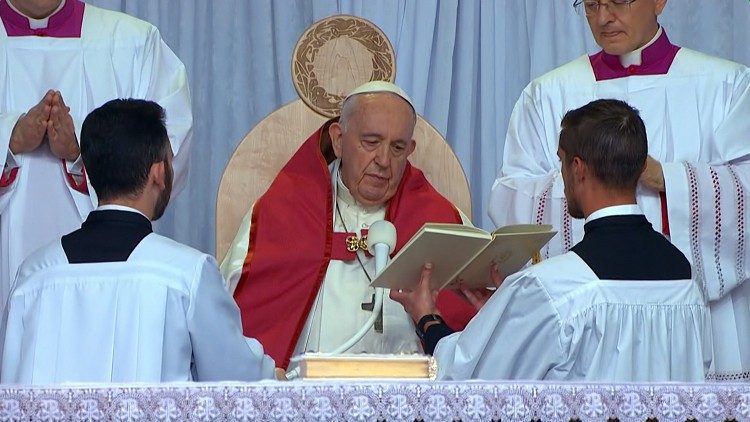
Pope Francis presides at Holy Mass at the Edmonton Stadium in CanadaPope Francis presides at Holy Mass at the Edmonton Stadium in Canada 

Pope in Canada: Preserve your history to protect your future

During Mass celebrated at the Commonwealth Stadium in Edmonton on Tuesday - the feast day of Sts Joachim and Anne - Pope Francis reflects on the important role of grandparents in passing down the faith, and highlights the need to preserve the memory of those who preceded us.

By Benedict Mayaki, SJ

On the second day of his 5-day “Penitential Pilgrimage” to Canada, Pope Francis presided at the Holy Mass at the Commonwealth Stadium in Edmonton, with the presence of the faithful.

In the homily, the Holy Father invited everyone to think about their own grandparents, as the Church celebrates the feast day of Saints Joachim and Anne, in whose home the child Jesus came to know his relatives and “experienced the closeness, tender love and wisdom of His grandparents.”

Children of a history to be preserved

Pope Francis highlighted that we are children of a history that needs to be preserved – not isolated individuals - as no one comes into the world detached from others. Thus, our roots and families in which we grew up are part of a unique history that preceded us and gave us life.

In this light, “we did not choose that history” but “received it as a gift”, one we are to cherish. We are “descendants” of those who went before us and their “inheritance” which is “centered on righteousness, fidelity to God and His will.”

“We are here thanks to our parents, but also thanks to our grandparents, who helped us feel welcome in the world," the Pope said, adding they are the ones who love us unconditionally, without expecting anything back. Thanks to them, he continued, “we received a caress from the history that preceded us: we learned that goodness, tender love and wisdom are the solid roots of humanity.”

Further appreciating grandparents, the Pope said it is in their homes that many of us “breathed in the fragrance of the Gospel,” and discovered a “familiar” faith, through affection, encouragement, care and closeness.

He pointed out that it is in this way that Joachim and Anne loved Mary, and how Mary, in turn, loved Jesus, with a love that “never smothered Him or held Him back,” and the Pope invited everyone to learn not to pressure the consciences of others, or fail to love and respect those who preceded us or are entrusted to our care.

Preserving memory

Pope Francis enjoined everyone, on this note, to set aside a worthy space for preserving memory, and to remember those who went before us, insisting that we should “cultivate our roots to pray for and with our forebears, to dedicate time to remember and guard their legacy.” 

He encouraged us not to lose their memory, nor forget the history that gave birth to our own lives. Rather, we should remember those whose hands caressed us and who held us in their arms; “for in this history we can find consolation in moments of discouragement, a light to guide us, and courage to face the challenges of life.”

“Let us ask ourselves: are we children and grandchildren capable of safeguarding this treasure that we have inherited? Do we remember the good teachings we have received? Do we talk to our elders, and take time to listen to them?”

Authors of a history yet unwritten

In addition to being children of a history that needs to be preserved, we are authors of a history yet to be written, the Pope said, noting that we are marked by both light and shadows, and by the love we did or did not receive.

He added that this is the mystery of human life: we are someone’s children but we too are called to give life, as fathers, mothers and grandparents to someone else. We should, therefore, ask ourselves what kind of society we want to build and bequeath to those who come after us, in light of the much we have received from those who preceded us.

Using the image of the life-giving sap that travels from roots, to branches, leaves, flowers and to the fruit of a tree, Pope Francis said that authentic tradition is expressed in this vertical dimension – from the bottom up. He, thus, warned against falling into a “caricature of tradition” which is not vertical – from roots to fruits, but horizontal – forwards and backwards, saying that this only leads to a backwards culture, trapped in the mentality that says “we have always done it this way.”

What are we passing on to those after us?

Reflecting on the day’s Gospel reading, Pope Francis noted that Jesus tells his disciples that they are blessed because they can see and hear what prophets and righteous people could only long for – the Messiah that those who can see and hear are called to welcome and proclaim. Similarly, those before us passed on a passion, strength and flame that is up to us to reignite.

Likewise, our grandparents and elders “wanted to see a more just, fraternal and solidary world, and they fought to give us a future” and it is up to us not to let them down and to bear fruit, because “we are the branches that must blossom and spread new seeds of history.”

Highlighting the “unique and irreplaceable” role we all have in history, Pope Francis asked everyone to question what we are passing on to those who come after us and what kind of mark we will be leaving behind.

He added that the Lord does not want us to be mere critics of our system, closed and backwards looking, but rather “artisans of a new history, weavers of hope, builders of the future, peacemakers.”

“The real question is: am I giving life? Am I ushering into history a new and renewed love that was not there before? Am I proclaiming the Gospel in my neighbourhood? Am I freely serving others, the way those who preceded me did for me? What am I doing for our Church, our city, our society?”

A future where the elderly are not cast aside

Concluding, the Holy Father invoked the intercession of Saints Joachim to help us cherish the history that gave us life and “remind us of our spiritual duty to honour our grandparents and our elders, to treasure their presence among us in order to create a better future.”

The Pope prayed, in this light, for a future where the elderly are not cast aside because they are no longer useful and cannot produce, or one that is indifferent to the need of the aged to be cared for and listened.

He further prayed for a future in which “the history of violence and marginalization suffered by our indigenous brothers and sisters is never repeated.”

“That future is possible if, with God’s help, we do not sever the bond that joins us with those who have gone before us, and if we foster dialogue with those who will come after us,” the Pope said. “Young and old, grandparents and grandchildren, all together. Let us move forward together, and together; let us dream.”

Saturday, July 23, 2022

First Canadian stop for Pope Francis is Edmonton


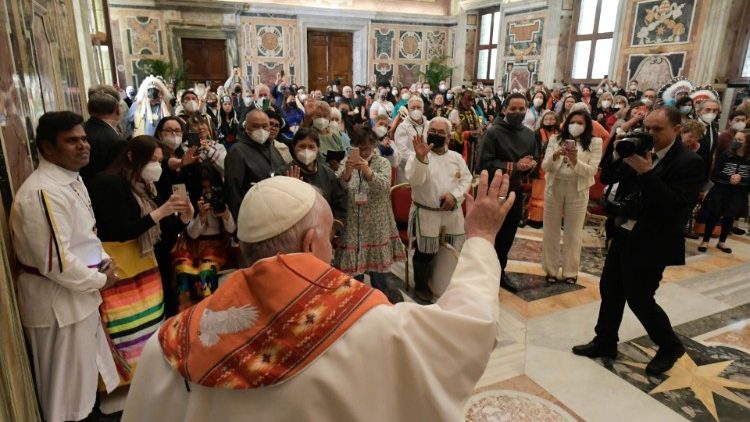
A delegation of Canada's Indigenous peoples meets with Pope Francis in the Vatican (April 2022)A delegation of Canada's Indigenous peoples meets with Pope Francis in the Vatican (April 2022)  (Vatican Media)

Bishop of Edmonton looks ahead to Pope's penitential pilgrimage

Ahead of Pope Francis penitential pilgrimage to Canada, the Archbishop of Edmonton, Richard Smith, shares his hopes and expectations for the papal visit. The Holy Father’s journey of healing and reconciliation with indigenous peoples will begin in Edmonton on Sunday, and continue with stops in Quebec City and Iqaluit.

By Christopher Wells

Archbishop Richard Smith is convinced Pope Francis’s penitential pilgrimage to Canada’s indigenous peoples will reveal the Holy Father once again as “a man of profound compassion,” who will demonstrate the Church’s commitment to hearing the pain of the aboriginal peoples and responding to it with reconciliation and healing.

The Archbishop of the western city of Edmonton – the first stop on the upcoming papal journey – recalled the Pope’s meeting with representatives of Canada’s indigenous populations during a visit to Rome this spring. “What happened in Rome is that the delegation of indigenous peoples encountered in the Holy Father a man of profound compassion,” the Archbishop said. “They spoke what was in their hearts and in their minds, and they could see that he was listening very deeply, very attentively, not only with his mind, but also, and more importantly, I would suggest with his heart.”

“The Church stands with you”

At that meeting, Archbishop Smith noted, Pope Francis “spoke with profound compassion” making his own stance, and the Church’s stance, “very, very clear.”

“That is a stance that hears the pain and wants to respond to it with healing, a stance that acknowledges the rights of indigenous peoples and wants to uphold them with them. A stance that acknowledges the giftedness and the beauty of indigenous culture and the great wisdom that lies therein.”

Archbishop Smith said the Pope’s message could be summed up with the words, “The Church stands with you… Don’t forget that, the Church stands with you!”

A sense of hope and healing

He also emphasized the significance of the Pope’s personal presence in Canada. In the first place, he said, there is the personality of Pope Francis himself “which does touch people right away.” He noted the “wonderful, wonderful sense of healing and hope” that many people experience on meeting the Holy Father.

“But more profoundly,” Archbishop Smith continued, Catholics understand the Pope as the successor of Saint Peter. And when he comes to any area, he brings with him the shadow of Saint Peter. We know that from the Acts of the Apostles, but that in itself brought healing and hope to people who were touched simply by the shadow of Peter as he walked by. When Pope Francis comes to this country, he's bringing that shadow with him wherever he goes.”

Drawing close to the indigenous peoples

Archbishop Smith said that Catholics in Canada want to ensure indigenous peoples of their solidarity and support, adding, “there is no one better placed to speak on behalf of us all than the Holy Father.”

The Bishops of Canada in particular, he said, have tried to express the desire “to draw close, to work together with the indigenous peoples, to discern together with them how we can face the various challenges that they are encountering, how we can together learn from them, from their wisdom, and how we can learn from that as a country.” The Holy Father, he continued, “given his office and given the particular personality of Pope Francis, has unique ability to make that message heard more clearly than anybody else could.”

The Archbishop said the Church in Canada sees the Holy Father “very much as a spokesman,” who will be able to express their own “sentiments and hopes” to the aboriginal peoples of Canada.

A broader need for healing and reconciliation

At the same time, he said, “the need for healing and reconciliation exists everywhere, far beyond this particular relationship.” He gave the examples of societal divisions revealed and exacerbated by the pandemic, the need for healing in families and in individual hearts, and, on a global level, the war in Ukraine and other instances of terrible aggression,” all instances of situations in need of healing and reconciliation.

He said he hoped and prayed “that what unfolds here in Canada, as as we grapple with the issue and face it, together with the pope, together with our indigenous peoples, look at the issues and move forward. But that by God's grace, obviously, we become a beacon of hope for our world.”

A legacy in need of healing

Acknowledging the pain and suffering that have long marked the Church’s relationship with indigenous people, Archbishop Smith insisted on the need to hear the stories of people’s “pain and heartache, the legacy that continues to impact them and their families in a number of different ways.”

Catholics today, even though they may not be personally guilty of the sins and errors of the past, have inherited that legacy of past guilt, and must ask themselves, “How do we together receive the legacy and then help in healing?”

That, he said, “is the responsibility that falls on the shoulders of us today.”

Archbishop Smith tied that insight to the theme of “Walking Together,” the theme of the Pope’s Visit. “This is what we understand we need to do right now: Walk together, find pathways to mutual understanding, to mutual respect, mutual help healing,” he said.

An impetus to move forward

He added, “The need for healing exists across the board, but the sense of wanting to take this issue on fully and move forward in a way that will bring healing to everybody that needs it is something that really does see us right now as a nation, it seems to me. And this is going to be a great opportunity to receive from the Pope a real impetus forward.”