You know the old saying, all good things must come to an end. So this morning, a cool, dreary Sunday, in a fairly quiet house with the dog curled up in my lap, I'm reflecting on my time off over these past many days and dealing with the fact that in a few days, this will indeed come to an end. But, I'm pretty stoked this morning to realize that even after this Sunday I get to sleep in or do whatever I want to do for two more mornings before heading back to work. And let me be clear, heading back to work ain't all bad, I've just thoroughly enjoyed this past week and a half.
Wendy and I originally planned this week off from work in order to be able to travel to North Carolina and see the kids for Christmas. My work requires us to select these days about a year in advance so little did we know what 2018 would have in store for us. We began the New Year with Wendy's mom so very sick and needed some extra care to recover from that illness. Just a few weeks later Wendy came down with severe pain which was diagnosed as 12 bleeding ulcers. Her hospitalization and subsequent recovery dominated January and part of February too. Then March brought the awesome birth of grandbaby #3 in the person of our Brennan Leigh. A now fully recovered Wendy spent numerous days helping Elizabeth with her first baby. We did have a really nice May visit with Calvin and Katelyn but our return began months of extreme challenge.
On June 2nd Wendy's mom took a terrible fall at her apartment and we began getting alerts from her medical alert necklace. By the time we met up with her in the ER of the closest hospital, we thought we would just be dealing with a very sore person who luckily did not break anything. But something wasn't right and she would never go back to that apartment again. From June 2nd until her death on November 19th Wendy was at her side 90% of the time, often for periods of 12 hours or more, even spending nights in the hospital. By the end of September she was very ill and fell victim to pneumonia and sepsis. She was very ill but thankfully recovered. She was strong enough to finally get her mom permanently settled in to a very nice nursing home and we prepared for a more peaceful end of the year. It was not to be; her mom was back in the hospital and soon would be critical, excessive complications with her heart and lungs and her journey here with us came to an end on a quiet Monday morning.
So as you can see, we had plenty to deal with and Wendy and I simply decided to stay home during this final vacation I had for 2018. I also thought it important to spend some time with Wendy and hopefully plan some things that she would enjoy. So that's what we did. Our past week plus has been dominated by family and holiday fun and just great time spent together. Between my very demanding job and my ministry schedule that goes far beyond Sunday's only, Wendy and I often see each other coming and going, especially this past year.
We had one day devoted to spending time and sharing a meal with her family, now just her sister and brother-in-law and niece, one day we traveled to Hammond to see my nephew and niece who live out of state, the children of my youngest sister, on Christmas Eve we spent the whole day with my daughter and son-in-law so we could play with Brennan and watch her open Christmas presents. Christmas Day brought my family to town to eat Christmas dinner and enjoy the day. The next day, which I blogged about earlier, is Wendy's birthday and the deacon celebration for St. Stephen's Feast Day. Wendy and I had a delicious lunch at Pascals Manale in New Orleans and we attended the St. Stephen's Day mass and celebration that evening. On the following day I took her to whatever movie she wanted to see; my goodness that choice was Mary Poppins. Yes, I endured it even though Wendy says she had to wake me up twice.
Friday was a very special day as we drove to Thibodaux, about a 2-hour drive, and spent the whole day with two special people we became fast friends with back in the Jaycees days of the 1980's. Blair and Sher went through so much with us in those heady years but as our Jaycees time ended, so did opportunities to visit. Events of recent months made this possible again and we agreed to visit them at their home, it would be the first time in almost 20 years that we would visit in Thibodaux. The day was about good food, great conversation and good friendship. I know that this may have been one of Wendy's favorite events in week long whirlwind of activity. So by now we had done so many wonderful and busy things that I asked Wendy for one favor; could Saturday-Tuesday be more laid back and relaxing before I return to work on Wednesday. And that's where I find myself on this Sunday morning.
I blogged earlier that perhaps my mother-in-law's final gift to us in her passing may have been the heartfelt desire this Christmas to focus more on the family, to truly be attentive to one another, to measure our words more carefully and just be thankful for what we do have, for one another and for our many blessings. In her passing, we should see gift, the gift of her life, the gift of memories that we have forever and the gift to move forward.
With everything going on in 2018 and the fact I always tend to over book myself I can tell you honestly that I have loved everything about this past week and a half. I don't think Wendy and I have been in each other's presence this much in like, well, I'm not sure. We've had fun, laughed, smiled and shared and that has been very good, very special. Today we have nothing planned except time at home together, a game to watch and Mass tonight. New Year's Eve, we sincerely hope, will be nothing but laid back time. And New Year's Day will bring Wendy's traditional meal of pork, cabbage and black eyed peas; and yes LSU football. And I will retire that evening with the realization that January 2, 2019 brings me back to the bank for the first time since December 21, 2018(when honestly I only worked for 2 hours). As said at the beginning, all good things!
I will probably post something tomorrow or Tuesday reflecting forward about some of our 2019 plans and how we will try to ease back into routines well known to us. I will say here that January will be kind of special as Wendy and I embark on our first ever cruise. My goodness, married 41 years and I'm finally taking her on a cruise!
One final word. My plans this last week of 2018 as well as the cruise are all things I hoped to do with Wendy in mind. She deserves any and all goodness that can come her way. The way she "served" her mom in the these most precious and special last months of her life has been inspiring to me. She really deserves some good days, some nice days and I hope I helped her experience that recently and now as we move forward in 2019. So even though this good thing(my time off) is coming to an end, the really good things that endure need never come to an end.
Merry Christmas everyone and prayerful best wishes for 2019.
Sunday, December 30, 2018

Saturday, December 29, 2018
The Feast of the Holy Family
Christmas: December 30th
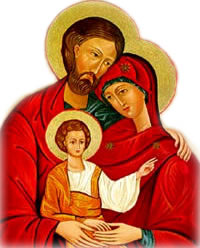
Feast of the Holy Family
MASS READINGS
December 31, 2017
(Readings on USCCB website)
COLLECT PRAYER
O God, who were pleased to give us the shining example of the Holy Family, graciously grant that we may imitate them in practicing the virtues of family life and in the bonds of charity, and so, in the joy of your house, delight one day in eternal rewards. Through our Lord Jesus Christ, your Son, who lives and reigns with you in the unity of the Holy Spirit, one God, for ever and ever.
show
Recipes (1)
show
Activities (7)
show
Prayers (14)
show
Library (4)
Scripture tells us practically nothing about the first years and the boyhood of the Child Jesus. All we know are the facts of the sojourn in Egypt, the return to Nazareth, and the incidents that occurred when the twelve-year-old boy accompanied his parents to Jerusalem. In her liturgy the Church hurries over this period of Christ's life with equal brevity. The general breakdown of the family, however, at the end of the past century and at the beginning of our own, prompted the popes, especially the far-sighted Leo XIII, to promote the observance of this feast with the hope that it might instill into Christian families something of the faithful love and the devoted attachment that characterize the family of Nazareth. The primary purpose of the Church in instituting and promoting this feast is to present the Holy Family as the model and exemplar of all Christian families.
— Excerpted from With Christ Through the Year, Rev. Bernard Strasser, O.S.B.
The feast of St. Sylvester I, which is ordinarily celebrated today, is superseded by the Sunday liturgy.

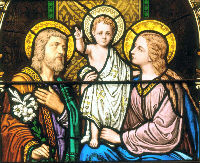
The Holy Family
 Marriage is too often conceived as the sacrament which unites a man and a woman to form a couple. In reality, marriage establishes a family, and its purpose is to increase the number of the elect, through the bodily and spiritual fecundity of the Christian spouses.
Marriage is too often conceived as the sacrament which unites a man and a woman to form a couple. In reality, marriage establishes a family, and its purpose is to increase the number of the elect, through the bodily and spiritual fecundity of the Christian spouses.
1. Every marriage intends children. Although Mary and Joseph were not united in a carnal way, their marriage is a true marriage: an indissoluble, exclusive union, wholly subordinated to the child. Mary and Joseph are united only in order to bring Jesus into the world, to protect and raise him. They have only one child, but he contains the whole of mankind, even as Isaac, an only child, fulfilled the promise made to Abraham of a countless progeny.
2. The purpose of every marriage is to establish a Christian family. The Holy Family observed the religious laws of Israel; it went in pilgrimage to Jerusalem every year with other Jewish families (Lk. 2:41). Jesus saddens and amazes his father and his mother because to their will and company he prefers "to be in his Father's house". Thus it may happen that God's will obliges the family to make disconcerting sacrifices. Yet every Christian family must live in harmony and in prayer, which are the pledges of joy and union.
3. "He remained obedient to them." Jesus was God. And through the fullness of grace Mary stood above Joseph. Nevertheless — if we except the event in the Temple — Joseph remained the head of the family; he took the initiative (as when the Holy Family fled to Egypt), and in Nazareth Jesus obeyed his parents.
Excerpted from Bread and the Word, A.M. Roguet
The Holy Family: Jesus, Mary and Joseph
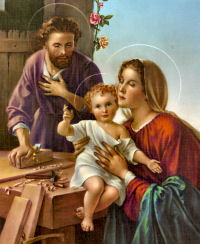 The devotion to the Holy Family was born in Bethlehem, together with the Baby Jesus. The shepherds went to adore the Child and, at the same time, they gave honor to His family. Later, in a similar way, the three wise men came from the East to adore and give honor to the newborn King with gifts of gold, frankincense, and myrrh that would be safeguarded by His family.
The devotion to the Holy Family was born in Bethlehem, together with the Baby Jesus. The shepherds went to adore the Child and, at the same time, they gave honor to His family. Later, in a similar way, the three wise men came from the East to adore and give honor to the newborn King with gifts of gold, frankincense, and myrrh that would be safeguarded by His family.
We can go further to affirm that in a certain sense Christ, Himself, was the first devotee of His family. He showed His devotion to His mother and foster father by submitting Himself, with infinite humility, to the duty of filial obedience towards them. This is what St Bernard of Clairvaux said in this regard, ‘God, to whom angels submit themselves and who principalities and powers obey, was subject to Mary; and not only to Mary but Joseph also for Mary’s sake [….]. God obeyed a human creature; this is humility without precedent. A human creature commands God; it is sublime beyond measure.’ (First Homily on the ‘Missus Est’).
Today’s celebration demonstrates Christ’s humility and obedience with respect to the fourth commandment, whilst also highlighting the loving care that His parents exercised in His keeping. The servant of God, Pope John Paul II, in 1989, entitled his Apostolic Exhortation, ‘Redemptoris Custos’ (Guardian of the Redeemer) which was dedicated to the person and the mission of Saint Joseph in the life of Christ and of the Church. After exactly a century, he resumed the teaching of Pope Leo XIII, for who Saint Joseph ‘.. shines among all mankind by the most august dignity, since by divine will, he was the guardian of the Son of God and reputed as His father among men’ (Encyclical Quamquam Pluries [1889] n. 3). Pope Leo XIII continued, ‘.. Joseph became the guardian, the administrator, and the legal defender of the divine house whose chief he was.[…] It is, then, natural and worthy that as the Blessed Joseph ministered to all the needs of the family at Nazareth and girt it about with his protection, he should now cover with the cloak of his heavenly patronage and defend the Church of Jesus Christ.’ Not many years before, blessed Pope Pius IX had proclaimed Saint Joseph, ‘Patron of the Catholic Church’ (1870)
Almost intuitively, one can recognize that the mysterious, exemplary, guardianship enacted by Joseph was conducted firstly, in a yet more intimate way, by Mary. Consequently, the liturgical feast of the Holy Family speaks to us of the fond and loving care that we must render to the Body of Christ. We can understand this in a mystical sense, as guardians of the Church, and also in the Eucharistic sense. Mary and Joseph took great care of Jesus’ physical body. Following their example, we can and must take great care of His Mystical Body, the Church, and the Eucharist which He has entrusted to us. If Mary was, in some way, ‘the first tabernacle in history’ (John Paul II Ecclesia de Eucharistia, n. 55) then we the Tabernacle in which Our Lord chose to reside in person, in His Real Presence, was also entrusted to us. We can learn from Mary and Joseph! What would they ever have overlooked in the care of Jesus’ physical body? Is there something, therefore, that we can withhold for the right and adoring care of His Eucharistic Body? No amount of attention, no sane act of love and adoring respect will ever be too much! On the contrary, our adoration and respect will always be inferior to the great gift that comes to us in the Holy Eucharist.
Looking at the Holy Family, we see the love, the protection, and the diligent care that they gave to the Redeemer. We can not fail to feel uneasiness, perhaps a shameful thought, for the times in which we have not rendered the appropriate care and attention to the Blessed Eucharist. We can only ask for forgiveness and do penance for all the sacrilegious acts and the lack of respect that are committed in front of the Blessed Eucharist. We can only ask the Lord, through the intersession of the Holy Family of Nazareth, for a greater love for their Son Incarnate, who has decided to remain here on earth with us every day until the end of time.
Is it good or bad that a Pontifical Commission is about to be suppressed

Archbishop Guido Pozzo, president of the Pontifical Commission Ecclesia Dei, looks set to lose his position if rumors of the commission's suppression are true. (Edward Pentin photo)
Blogs | Dec. 27, 2018
Farewell Pontifical Commission ‘Ecclesia Dei’?
The Vatican body aimed at keeping traditional Catholics united with the Successor of Peter looks likely to be suppressed, but sources suggest it could actually be a positive development.
Pope Francis is expected to issue a papal decree in the coming weeks that will effectively dissolve the pontifical commission charged with bringing separated traditionalist Catholics back into full communion.
Various reliable sources have confirmed to the Register that the Pontifical Commission ‘Ecclesia Dei’ is to be abolished and its work absorbed into the Congregation for the Doctrine of the Faith, of which the commission is already a part.
The Pope’s “motu proprio” authorizing the change is allegedly still in its drafting stages, but is expected to be published in January. Others say it has already been written and signed.
Although some have voiced concern about the move, first made public in the Italian blog Messa in Latino, sources within the Vatican and elsewhere sympathetic to the commission are more sanguine, telling the Register that the structural change could be positive and actually facilitate regularization of the breakaway Society of St. Pius X.
Archbishop Marcel Lefebvre founded the SSPX in 1970 in response to errors he believed had entered into the Church following the Second Vatican Council. Pope St. John Paul II set up the Pontifical Commission in 1988 in response to Archbishop Lefebvre’s decision that year to consecrate four bishops without papal permission, a schismatic decision according to the Vatican which led to Archbishop Lefebvre’s excommunication along with those of the four bishops. Benedict XVI lifted the four bishops' excommunications in 2009.
The commission’s role was primarily to care for Archbishop Lefebvre’s followers who wished to remain united with the successor of Peter, serving as the chief Vatican body in overseeing efforts to regularize the SSPX and bringing them back into full communion with Rome.
The commission has also had the task of regularizing canonical situations of other religious communities of a traditionalist nature, giving them a canonical form corresponding to their charism.
Added to this, the commission has had the responsibility of working with local bishops to facilitate Mass in the Extraordinary Form of the Roman Rite (according to the 1962 Missal) for those faithful who request it, especially after Pope Benedict XVI’s 2007 motu proprio Summorum Pontificum which fully liberalized celebration of the Traditional Latin Mass if a “stable group” of faithful asks for it.
But according to the French traditionalist website L’Homme Nouveau, the SSPX has viewed the Pontifical Commission as an obstacle to its negotiations with the Vatican and would prefer to deal directly with the prefect of the CDF, currently Cardinal Luis Ladaria Ferrer, rather than having to go through the current president of the Pontifical Commission ‘Ecclesia Dei’, Archbishop Guido Pozzo. After years of talks between Archbishop Pozzo and the Society, few if any achievements have been made, the article says.
The rumored restructuring may therefore serve to address these concerns which the newly elected superior general of the SSPX, Father Davide Pagliarini, discussed with Cardinal Ladaria at a Nov. 22 meeting at the Vatican.
In a statement issued after those talks, Father Pagliarini stressed that for the SSPX the “fundamental problem is actually doctrinal” which “remains absolutely essential,” and that similarly for the Holy See, no canonical status can be established for the Society “until after the signing of a doctrinal document.”
“This restructuring is more likely a concession to the SSPX who aren’t interested in dealing with a structure like Ecclesia Dei,” said an informed Church source, adding that “what is central at the moment is discussion of doctrine rather than practical aspects.”
Part of Curial Reform?
Another possible reason for the suppression of the Pontifical Commission could be to do with the reforms of the Roman Curia. A new apostolic constitution, Predicate Evangelium (Preach the Gospel), is expected to be published in the first of months of the new year, and much of it is about streamlining curial offices and making them more cost-efficient. At the moment, Ecclesia Dei has a separate budget, so ending the structure and having its staff absorbed into the CDF could help achieve that as part of the curia-wide restructuring.
It could also ensure that various aspects of the commission’s work related to liturgy and religious life are kept within the arguably more sympathetic confines of the CDF rather than delegated to the Congregation for Divine Worship and the Congregation for Institutes of Consecrated Life and Societies of Apostolic Life, where the interests of the SSPX and traditional Catholics in general are likely to receive a less favorable hearing among officials in both of those dicasteries (CDW prefect Cardinal Robert Sarah notwithstanding).
Much of the alarm about the rumored changes stems from recent reports of some opposition to Summorum Pontificum within the Italian bishops’ conference, and a general belief — yet to be concretely proven — that Pope Francis wishes to repeal it and is opposed to the SSPX. Francis, however, has previously made a number of conciliatory gestures toward the Society, most notably granting all of its priests faculties to hear valid confessions during and after the Jubilee Year of Mercy.
Benedict XVI was the first to integrate the commission into the CDF when in 2009 he made the Congregation’s prefect the ex officio head of Ecclesia Dei rather than a cardinal president, which was the case until then.
For all these reasons, the general approach among sources both within the Vatican and among traditional Catholics is to “keep calm” and to wait and see what the final motu proprio communicates.
I was Catholic once, I never heard the Gospel at Mass; then someone tells you the TRUTH!
I was a Catholic once....
"I was a Catholic once,” said the lady a few yards from me in the parking lot. “Now I’m a Christian and you can be one as well.” She preceded to hand a tract to a gentleman standing next to the opened trunk of his car. I couldn’t help it.
“Excuse me,” I said to the lady “but could I too have a tract?” The lady's face beamed. “Are you saved?,” she asked. “Of course I am; I’m a believing Catholic,” I retorted. She looked at me as if I had bad breath or something.
She continued, “I was just telling this gentleman that I too was a Catholic - a Catholic for thirty-some years in fact. Now I've found Christ and I’m trying to tell everyone I know about salvation through Christ.”
“Wow, that’s really something! May I ask why you left the Church?” I could tell that, by asking this question, my new acquaintance was getting excited. After all, she had probably been snubbed by dozens of people and now she has someone that she can “witness” to Christ. I didn’t mind much either, but I tried not to show it.
She continued, “I was just telling this gentleman that I too was a Catholic - a Catholic for thirty-some years in fact. Now I've found Christ and I’m trying to tell everyone I know about salvation through Christ.”
“Wow, that’s really something! May I ask why you left the Church?” I could tell that, by asking this question, my new acquaintance was getting excited. After all, she had probably been snubbed by dozens of people and now she has someone that she can “witness” to Christ. I didn’t mind much either, but I tried not to show it.
"You see,” she said, “I was born Catholic. I attended Mass every week, received the Sacraments and graduated from a Catholic school. Not once did I ever hear the gospel proclaimed. Not once! It was after the birth of my first child that a good friend of mine shared ‘the gospel’ with me and I accepted Jesus as my personal Lord and Savior and became a Christian. Now I belong to a ‘Bible-believing’ church and I’m sharing the gospel with whomever will listen.”
This shocked me. “You mean you belonged to the Catholic Church for over forty years and you never heard the gospel?,” I said. She was getting more excited. “Yes, I never once heard the gospel of salvation preached or taught or even mentioned in the Church. If you don’t preach the gospel, excuse my bluntness, but you're simply not Christian.” I scratched my head and said, “that’s strange. I’ve been a Catholic all my life and I bet I hear the gospel ever week at Church.” Her smile quickly faded into a look of curiosity. “Maybe, I’m missing something,” I continued. “Tell me what you mean by ‘the gospel?’”
The lady reached back into her purse to pull out a little tract and said, “This tracts explains the simple gospel of salvation. It can be broken down into four easy steps.
“First, we acknowledge that we are all sinners in need of God’s forgiveness.
Secondly, we recognize that only God can save us.
The third step is that Jesus Christ died on the Cross for our sins and to bring us to God.
And the fourth and final step is that each individual accepts Jesus Christ as their personal Lord and Savior to be saved.”
I thought for a couple of seconds and said, “If I could demonstrate to you that Catholics hear “the gospel” every Sunday, would you agree to take a closer look at the Catholic Church?” Now, she knew she had me over a barrel. “Prove it,” she said. I excused myself for a second and ran to my car to grab a Missal.
“Since you have attended Mass nearly all your life, you probably remember these prayers.” I flipped open to the beginning prayers of the Mass and proceeded to show her how Catholics hear, pray and live the gospel message every Sunday.
“First, we acknowledge that we are all sinners in need of God’s forgiveness.
Secondly, we recognize that only God can save us.
The third step is that Jesus Christ died on the Cross for our sins and to bring us to God.
And the fourth and final step is that each individual accepts Jesus Christ as their personal Lord and Savior to be saved.”
I thought for a couple of seconds and said, “If I could demonstrate to you that Catholics hear “the gospel” every Sunday, would you agree to take a closer look at the Catholic Church?” Now, she knew she had me over a barrel. “Prove it,” she said. I excused myself for a second and ran to my car to grab a Missal.
“Since you have attended Mass nearly all your life, you probably remember these prayers.” I flipped open to the beginning prayers of the Mass and proceeded to show her how Catholics hear, pray and live the gospel message every Sunday.
The first step in my new found friend’s tract stated that we are all sinners in need of God’s forgiveness. After the Greeting, the Mass continues to what is known as the Penitential Rite. I read loud the text to her while she followed reading silently.
“I confess to almighty God, and to you, my brothers and sisters, that I have sinned through my own fault. In my thoughts and in my words, in what I have done, and in what I have failed to do.”
I mentioned that it is here in this section that each Catholic states publicly that he or she is individually a sinner - not merely in a general sense - but specifically in thoughts, words and deeds. You can’t get much more complete than that. I continued reading,
“and I ask Blessed Mary, ever virgin, all the angels and saints, and to you, my brothers and sisters, to pray for me to the Lord our God.”
The priest reaffirms this confession of sin by praying,
“May almighty God have mercy on us, forgive us our sins, and bring us to everlasting life.”
And the whole congregation says “Amen,” that is, “I believe.” The priest continues.
“Lord have mercy, Christ have mercy, Lord have mercy,”
and finishes by saying;
"Lord show us your mercy and love. And grant us your salvation.”
“I confess to almighty God, and to you, my brothers and sisters, that I have sinned through my own fault. In my thoughts and in my words, in what I have done, and in what I have failed to do.”
I mentioned that it is here in this section that each Catholic states publicly that he or she is individually a sinner - not merely in a general sense - but specifically in thoughts, words and deeds. You can’t get much more complete than that. I continued reading,
“and I ask Blessed Mary, ever virgin, all the angels and saints, and to you, my brothers and sisters, to pray for me to the Lord our God.”
The priest reaffirms this confession of sin by praying,
“May almighty God have mercy on us, forgive us our sins, and bring us to everlasting life.”
And the whole congregation says “Amen,” that is, “I believe.” The priest continues.
“Lord have mercy, Christ have mercy, Lord have mercy,”
and finishes by saying;
"Lord show us your mercy and love. And grant us your salvation.”
I looked at her and said, “You see, we Catholics start every Mass with a public declaration of our own personal sinfulness and look to God for forgiveness.” She responded, “But Catholics don’t believe that God alone can save them. They believe Mary and the saints will save them.” I shook my head in disagreement. “No, we don’t. Remember what we had just read in the Mass. Catholic ask Mary, the angels, the saints and the whole congregation to pray to God for mercy on their behalf - just like I would ask you to pray for me to God. Does that mean that I look to you to ‘save’ me? No, of course I don’t believe that. I’m just asking for your help. Besides the ‘Gloria’ of the Mass proves that Catholics look to God alone to save us.”
I began reading the Missal emphasizing certain words to prove my point:
“Glory to God in the highest, and peace to his people on earth. Lord God, heavenly King, almighty God and Father, we worship you, we give you thanks, we praise you for your glory. Lord Jesus Christ, only Son of the Father, Lord God, Lamb of God, you take away the sin of the world, have mercy on us, you are seated at the right hand of the Father, receive our prayer. For you alone are the Holy One, you alone are the Lord, you alone are the Most High, Jesus Christ, with the Holy Spirit, in the glory of God the Father."
“Glory to God in the highest, and peace to his people on earth. Lord God, heavenly King, almighty God and Father, we worship you, we give you thanks, we praise you for your glory. Lord Jesus Christ, only Son of the Father, Lord God, Lamb of God, you take away the sin of the world, have mercy on us, you are seated at the right hand of the Father, receive our prayer. For you alone are the Holy One, you alone are the Lord, you alone are the Most High, Jesus Christ, with the Holy Spirit, in the glory of God the Father."
Likewise, the doxology spoken just prior to communion reads,
“Through him, with him, in him; in the unity of the Holy Spirit, all glory and honor is your, almighty Father, for ever and ever.”
“Through him, with him, in him; in the unity of the Holy Spirit, all glory and honor is your, almighty Father, for ever and ever.”
As I looked up, I could see the lady intently reading the page. She couldn’t believe that she had prayed these prayers for years and never noticed what it was saying. Yet, there it was in black and white. I continued with the third step - the acknowledgment that Jesus Christ died on the cross for our sins and to bring us to God.
The Profession of Faith reads,
“For us men and for our salvation he came down from heaven: by the power of the Holy Spirit he was born of the Virgin Mary, and became man. For our sake he was crucified under Pontius Pilate.”
The Profession of Faith reads,
“For us men and for our salvation he came down from heaven: by the power of the Holy Spirit he was born of the Virgin Mary, and became man. For our sake he was crucified under Pontius Pilate.”
In the Eucharistic Prayer 1, the priest prays:
“Remember [Lord] all of us gather here before you. You know how firmly we believe in you and dedicate ourselves to you. . . We pray to you, our living and true God, for our well-being and redemption . . . Grant us your peace in this life, save us from final damnation, and count us among those you have chosen.”
The prayer ends with an appeal to God for salvation through Jesus Christ:
“May, these and all who sleep in Christ, find in your presence light, happiness and peace. For ourselves, too, we ask some share in the fellowship of your apostles and martyrs . . . Though we are sinners, we trust in your mercy and love. Do not consider what we truly deserve, but grant us your forgiveness. Through Christ our Lord you give us all these gifts. You fill them with life and goodness, you bless them and make them holy.”
“Remember [Lord] all of us gather here before you. You know how firmly we believe in you and dedicate ourselves to you. . . We pray to you, our living and true God, for our well-being and redemption . . . Grant us your peace in this life, save us from final damnation, and count us among those you have chosen.”
The prayer ends with an appeal to God for salvation through Jesus Christ:
“May, these and all who sleep in Christ, find in your presence light, happiness and peace. For ourselves, too, we ask some share in the fellowship of your apostles and martyrs . . . Though we are sinners, we trust in your mercy and love. Do not consider what we truly deserve, but grant us your forgiveness. Through Christ our Lord you give us all these gifts. You fill them with life and goodness, you bless them and make them holy.”
Similarly the second Eucharistic Prayer proclaims,
“Dying you [Jesus] destroyed our death, rising you restored our life. Lord Jesus, come in glory. . . Have mercy on us all; make us worthy to share eternal life with Mary, the virgin Mother of God, with the apostles and with all the saints who have done your will throughout the ages.”
“Dying you [Jesus] destroyed our death, rising you restored our life. Lord Jesus, come in glory. . . Have mercy on us all; make us worthy to share eternal life with Mary, the virgin Mother of God, with the apostles and with all the saints who have done your will throughout the ages.”
Likewise, Eucharistic Prayer 3 reads,
“All life, all holiness comes from you through your Son, Jesus Christ our Lord, by the working of the Holy Spirit . . .
Father, calling to mind the death your Son endured for our salvation, his glorious resurrection and ascension into heaven, and ready to greet him when he comes again, we offer you in thanksgiving this holy and living sacrifice. Look with favour on our your Church’s offering, and see the Victim [Christ] whose death has reconciled us to yourself . . .
May he make us an everlasting gift for you and enable us to share in the inheritance of your saints . . . “
“All life, all holiness comes from you through your Son, Jesus Christ our Lord, by the working of the Holy Spirit . . .
Father, calling to mind the death your Son endured for our salvation, his glorious resurrection and ascension into heaven, and ready to greet him when he comes again, we offer you in thanksgiving this holy and living sacrifice. Look with favour on our your Church’s offering, and see the Victim [Christ] whose death has reconciled us to yourself . . .
May he make us an everlasting gift for you and enable us to share in the inheritance of your saints . . . “
Lastly, the fourth Eucharistic Prayer reads,
“Father, you so loved the world that in the fullness of time you sent your only Son to be our Savior . . .
In fulfillment of your will he gave himself up to death; but by rising from the dead, he destroyed death and restored life.”
“Father, you so loved the world that in the fullness of time you sent your only Son to be our Savior . . .
In fulfillment of your will he gave himself up to death; but by rising from the dead, he destroyed death and restored life.”
In this prayer, the congregation proclaims the mystery of faith:
“Lord, by your cross and resurrection, you have set us free. You are the Savior of the world.”
“You see, every week Catholics proclaim that Jesus died for them,” I said to the lady who was now searching for something to say. After a brief moment of silence, she shot a response back at me.
“What about accepting Jesus Christ and their personal Lord and Savior?” She retorted. “They may be saying all this stuff, but they don’t make a personal act of acceptance.” What she didn’t know was that I deliberately didn’t mention the last “step” of her “gospel.”
“Lord, by your cross and resurrection, you have set us free. You are the Savior of the world.”
“You see, every week Catholics proclaim that Jesus died for them,” I said to the lady who was now searching for something to say. After a brief moment of silence, she shot a response back at me.
“What about accepting Jesus Christ and their personal Lord and Savior?” She retorted. “They may be saying all this stuff, but they don’t make a personal act of acceptance.” What she didn’t know was that I deliberately didn’t mention the last “step” of her “gospel.”
I explained that if Catholics don’t believe what they are praying, they ought not to be publicly proclaiming it. Since we can’t read the dispositions of other people’s hearts, we ought not to judge whether they truly believe what they are saying. Next, I pointed out the last step - where Catholics are accepting Jesus into their hearts. Right before communion the priest holds up the host (which is now the body, blood, soul and divinity of Our Lord under the appearances of bread and wine) and prays.
“This is the Lamb of God who takes away the sins of the world. Happy are those who are called to his supper.”
And the congregation responds,
“Lord, I am not worthy to receive you, but only say the word and I shall be healed.”
I looked straight into the lady’s eyes and said, “It is here that all those who are prepared to receive Jesus Christ walk up to the front of the church but they don’t just believing in Christ or merely asking Jesus into their hearts.” “They don’t?” She asked. “No,” I answered, “they receive that same Christ who died on the cross on Calvary into their mouth and into their stomachs - body, blood, soul and divinity - and become one with him in an unspeakable way. Now that's accepting Christ!” She didn’t have a response. I’m not sure that she had ever really thought about the Mass and Christ’s real presence in the Eucharist because she appeared to be both surprised and intrigued.
“This is the Lamb of God who takes away the sins of the world. Happy are those who are called to his supper.”
And the congregation responds,
“Lord, I am not worthy to receive you, but only say the word and I shall be healed.”
I looked straight into the lady’s eyes and said, “It is here that all those who are prepared to receive Jesus Christ walk up to the front of the church but they don’t just believing in Christ or merely asking Jesus into their hearts.” “They don’t?” She asked. “No,” I answered, “they receive that same Christ who died on the cross on Calvary into their mouth and into their stomachs - body, blood, soul and divinity - and become one with him in an unspeakable way. Now that's accepting Christ!” She didn’t have a response. I’m not sure that she had ever really thought about the Mass and Christ’s real presence in the Eucharist because she appeared to be both surprised and intrigued.
I gave her my phone number and invited her to a study group I was heading in the neighborhood which examined the Biblical foundation for Catholic doctrine. As we departed, I couldn’t help but wonder how many other people, like my new friend, left the Church thinking that it had nothing to say about salvation. Yet the richness of the liturgy of the Mass and even more so Christ’s real substantial presence in the Eucharist so outshines our separated brethren’s “low church” prayer services that there is no comparison!
Indeed, the mystery of the Mass goes far beyond the simple “sinner’s prayer.” What I wanted to demonstrate is that all the elements of what Protestants consider the “essentials” of human salvation are presented, in Technicolor, in the liturgy of the Mass and that to deny the charge that the Church is somehow neglecting to present “the gospel".
Friday, December 28, 2018
This Episcopal Priest embraces the fullness of truth and comes home to the Catholic Church
Andrew Petiprin is the canon to the ordinary in the Episcopal Diocese of Tennessee. He announced that he is leaving his denomination and joining the Catholic Church.
Nashville Tennessean
A conservative Episcopal priest, who is a top administrator in the Tennessee diocese, is leaving the church to become a Roman Catholic.
Andrew Petiprin recently announced his plans to change his religious tradition and resign his post as the Episcopal diocese's canon to the ordinary. He wraps up his job on New Year's Eve, and Petiprin and his family will start 2019 in the Catholic Church.
"I’m not really running away from the Episcopal Church, but running toward the Catholic Church," Petiprin said in an interview.
Since June 2017, Petiprin has worked alongside Bishop John Bauerschmidt, helping him with the administration of the Episcopal Diocese of Tennessee, which covers much of Middle Tennessee.
Petriprin said he started the job excited about the chance to influence the future of the Episcopal Church, but it became clear several months ago that God was calling him to Catholicism.
Petiprin says there is still room for conservatives in the Episcopal Church
"There are many reasons, but no one of them is definitive," Petiprin said. "One of the great things that has happened to me over the last few months is, although I remain conservative on many of the questions that the Episcopal Church is facing, I have far less anger or bitterness about any of that than I used to have."
Petiprin, who has been an Episcopal priest for eight years, is a conservative in a denomination that has made progressive shifts in recent decades. Like Bauerschmidt, he does not support the Episcopal Church's decision to allow same-sex couples to marry in the church. That change came in 2015 and was broadened this summer.
Middle Tennessee views: Episcopal couples, advocates hope the church removes gay marriage restrictions
While he says it is hard to be a conservative in the denomination, Petiprin thinks there is still room in the Episcopal Church for those who share his views and that his own experience is proof that conservatives who want to stay do not have to leave.
"Ultimately, I’ve just found that the Lord has called me into the Catholic Church and away from that project of being a conservative Episcopalian," said Petiprin, who announced last week his decision to leave.
Bauerschmidt also sent out a letter to the Episcopal diocese about Petiprin's upcoming departure, explaining that he plans to appoint a new canon to the ordinary in early January. In the letter, the bishop said he was grateful for Petiprin's friendship and work in the diocese.
"This is, of course, a major transition for Canon Andrew and his family. This development in their lives was not foreseen by him at the time of their arrival in Tennessee," Bauerschmidt said in the letter. "Decisions like this are not made lightly or easily. He will be charting a new course for his ministry in the future. Please keep all of them in your prayers."
Writing a book and local Catholics moved Petiprin toward the church
Petiprin, raised Methodist and then nondenominational Christian, has a long-held affinity for the Catholic Church. Although he became an Anglican while in England in 2002, he contemplated Catholicism after being affected by the 2005 death of Pope John Paul II. But he prayed about it and still felt he was on the right path.
Petiprin became an Episcopal priest and served in Orlando, Florida, before moving to Nashville. In Tennessee, Petiprin said he met interesting local Catholics, came across influential reading materials, and the strife he felt regarding the Episcopal Church dissipated.
"I’ve experienced a great healing about that," Petiprin said.
He also spent the last couple of years writing an apologetics book called "Truth Matters: Knowing God and Yourself," which came out earlier this year.
"I’m writing a book about truth, and I sort of come deeper and deeper into the realization that the Catholic Church has been the guardian of truth for many centuries, and despite its flaws, it really presents the best case for the gospel to the world," Petiprin said.
He said the Episcopal Church pointed him in the direction of that truth, too. And Petiprin is grateful for all he has learned and the relationships he has built through the denomination.
But he decided to make the leap and leave the Episcopal Church as well as the job that helps him provide financially for his wife and two children for the Catholic Church.
He is excited to join a church that believes marriage is between a man and a woman and takes a strong anti-abortion stance.
But Petiprin also is delighted about the devotion to Mary, Jesus' mother, among Catholics as well as their strong reliance on the saints. He has found the rosary and the prayers to the saints to be a powerful practice in his life.
On Tuesday, Petiprin and his family will be received and confirmed at St. Patrick's Catholic Church in Nashville.
Petiprin still needs to figure out his next career move. He is considering teaching, writing and administrative work, but has not ruled out the priesthood in his new church. A path exists within the Catholic Church that allows married Episcopal priests to become Catholic priests.
"I’m open to discernment on that question, but for the present I am seeking other employment hopefully within the church somehow," Petiprin said. "I’m keen to just be a Catholic in the pews and to discern how I can best serve the church."
Reach Holly Meyer at hmeyer@tennessean.com or 615-259-8241 and on Twitter @HollyAMeyer.
Subscribe to:
Posts (Atom)