Showing posts with label Octave. Show all posts

Saturday, April 11, 2026

April 12th: The 2nd Sunday of Easter IS Divine Mercy Sunday


Easter: April 12th

Second Sunday of Easter (or Sunday of Divine Mercy)


"I shall sing forever the Lord's mercy" (Ps 89 [88]).

Today is the Sunday of Divine Mercy, the Octave Day of Easter.

From Creation, God has revealed his nature as love itself, in Sacred Scripture and most perfectly in the life, Passion, death and Resurrection of his Son, Jesus. In his second encyclical, Dives In Misericordia (Rich in Mercy), Pope Saint John Paul II offers an extended meditation on the mystery of God’s mercy, which he calls “the greatest of the attributes and perfections of God” (Dives in misericordia, 13). He returned to this theme throughout his pontificate:

As a gift to humanity, which sometimes seems bewildered and overwhelmed by the power of evil, selfishness, and fear, the Risen Lord offers His love that pardons, reconciles, and reopens hearts to love. It is a love that converts hearts and gives peace. How much the world needs to understand and accept Divine Mercy!

Lord, who reveals the Father’s love by Your death and Resurrection, we believe in You and confidently repeat to You today: Jesus, I trust in You, have mercy upon us and upon the whole world.
—Pope John Paul II, Regina caeli message for Divine Mercy Sunday, April 3, 2005

The Divine Mercy Sunday origin is from a revelation to Saint Faustina, a Sister of Mercy in Poland who initiated the Divine Mercy devotion. Between 1930 and 1938 Jesus requested numerous times a Feast of Divine Mercy. On May 5, 2000, five days after the canonization of Saint Faustina, the Vatican decreed that the Second Sunday of Easter would henceforth be known as Divine Mercy Sunday.


Commentary on the Divine Mercy Sunday Mass Readings, Cycle A
The First Reading is taken from Acts 2:42-47. On Pentecost Sunday the Holy Spirit, as promised by Christ, descended on the Apostles with external signs which brought the people of Jerusalem in their hundreds to the Upper Room where the Apostles with external signs which brought the people of Jerusalem in their hundreds to the Upper Room where the Apostles lived. St. Peter addressed them and explained what had happened, with the result that “about three thousand souls were baptized and added that day” (Acts 2:41) to the Apostles and disciples, who formed the nucleus of the Christian Church.

In these six short verses of the second chapter of the Acts we are given a picture of the fervent religious life of the first Christian community. As would be expected, these Jerusalem Christians, having the Apostles still among them, and the memory of the resurrection and the descent of the Holy Spirit still fresh in their memories, were animated and moved by a deep religious fervor.

The Second Reading is from the First Letter of St. Peter 1:3-9. This first epistle of St. Peter has always been accepted as authentic, that is, it was written by St. Peter and most probably from Rome which he called “Babylon.” Tradition says he died a martyr there in 64 or 67. The letter, therefore, was written before 67 at the latest. It is in the form of an encyclical letter to the numerous churches of Asia Minor. Its purpose was to recall to the minds of these converts to the Church the basic doctrines of Christianity and to encourage them to endure any persecution that the faithful observance of their new religion might bring on them from their pagan or Jewish neighbors.
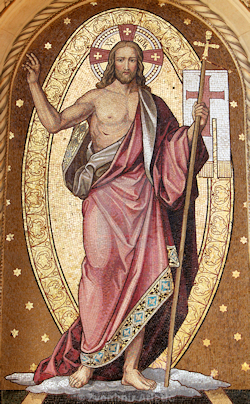
We have just celebrated the feast of the resurrection, and St. Peter’s words today are intended to remind us again of what that unique event means to us and to the Christian faith which we profess. It is the final and convincing proof of the Incarnation. The Christ who had been born as a baby of the Virgin Mary, had lived in Nazareth, had preached the message of salvation, had died on the cross, was none other than what he had said he was, the divine Son of God. He had come to give mankind life and “abundant” life—an eternal life hereafter in the kingdom of his Father.

The first converts to Christianity had grasped this truth, this consoling knowledge, and they rejoiced in it “with unutterable and exalted joy.” We, too, have grasped this truth; we, too, know that through the Incarnation, death and resurrection of Christ, we have been made heirs to an “inheritance which is imperishable, undefiled and unfading.” But do we always let this consoling knowledge, this Christian conviction, govern and regulate our daily lives and actions?

The things of this world are very close to us and hard to ignore. Heaven seems very far away, and may seem to be something we can worry about later. The joys and pleasures of this passing life are very attractive because they surround us so closely now—the thought of the true, unending pleasure and happiness, much as it satisfies and answers to our innate human, intellectual desires and ambitions, can easily be pushed into the background by the hustling and bustling of the present, temporary attractions.

Let us remember that “our faith is more precious than gold”: let us never forget these words of St. Peter.

The Gospel is read for all years (Cycles A, B and C) and is taken from John 20:19-31. Last Sunday’s gospel, also taken from St. John, described the first hint at the resurrection which the Apostles received. Peter and John, convinced that the body had not been taken away, because the winding sheets were left behind, were beginning to believe. But the others were skeptical, the two disciples on the way to Emmaus paid no heed to the women’s story, and Thomas refused to believe the testimony of the other ten, even when this present appearance of our Lord had convinced them.

It may surprise and amaze us that the Apostles were so reluctant to believe that Christ had risen from the dead, to live forever in glory with his Father in heaven. But we must remember that during their two or three years with him they saw nothing in him but a mere man, one with divine powers, but yet a man; certain prophets of the old covenant had some such powers also. Christ had “emptied himself” of his divine nature, and he had foretold his resurrection many times. But that he could be really God, as well as man, was something they could not then grasp, and if he was a mere man death had to be the end.

Their slowness of faith had its value for the future Church and for all of us. If they had been expecting the resurrection, and anxiously looking forward to it, people could say that they imagined it, that they persuaded themselves it had happened. Indeed, there have been men proud of their acuteness of judgment, who have said that the story of the resurrection is a story of mass hallucination, although all the evidence proves the opposite. Their conviction that it could not happen, could not be removed from their minds except by impressive evidence that it had. Hallucination is born in a mind already excepting and hoping for the imagined fact.

We can thank the Apostles and especially Thomas, the last to give in, that our faith in the resurrection and divine glorification of Christ is that much the stronger. Our Christianity which would have ended before the first Easter week had passed, if Christ had not risen in glory, spread rapidly to the then known world and is still spreading because its author was none other than Christ “our Lord and our God.” How prophetic were the words of the Gamaliel at the meeting of the Sanhedrin which tried to prevent the Apostles from preaching the new Christian faith: “if this plan or work is of men, it will overthrown; but if it is of God, you will not be able to overthrow it” (Acts 5:38-39).
—Excerpted from The Sunday Readings , Cycle A, by Fr. Kevin O'Sullivan, O.F.M.


Second Sunday of Easter or Divine Mercy Sunday
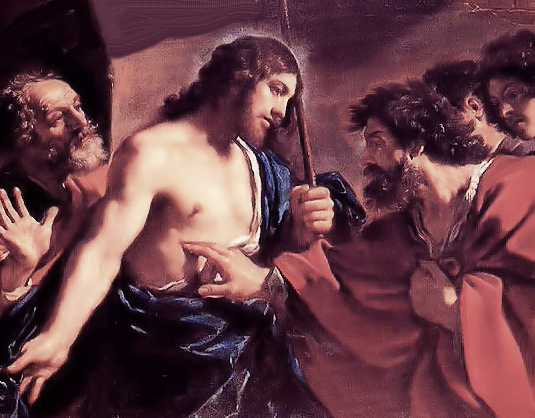
The Holy Gospel that the Liturgy presents to us on this second Sunday of Easter, is one of the most well known, discussed, and appreciated—the meeting of the Risen Lord with St Thomas. The Fathers of the Church have given us numerous insights into this Gospel text. Likewise, it is has proven the inspiration to the numerous artists who have physically represented the events of this Gospel in order to give us a clear idea of what happened, ‘eight days after’ the first apparition of the Risen One, to the disciples congregated in the cenacle.

Jesus’ response to Thomas, after he recognized Him as ‘My Lord and my God’, has a mysterious fascination that must relate not so much to the disciples—those who ‘have seen’—but rather to those, like us, who were added to their number afterwards. ‘You have come to believe because you have seen me. Blessed are those who have not seen and have believed.’ (Jn 20:29)

The attention that these words evoke seems yet more paradoxical if we remember that the Lord had proposed, to the same author of the Gospel, what can be justly referred to as the Christian method, ‘come and see’ (Jn 1:39). How can we possibly reconcile these two phrases by Jesus that form the ideal setting for the whole of the fourth Gospel? Perhaps, in the end, the Lord decided to change His method? What do the words ‘have not seen’ really mean?

The timely recollection of the ‘eight days after,’ which is the Sunday after the Resurrection, permits us to tie our reflection to one of the most significant Eucharistic hymns composed by another Thomas, St Thomas Aquinas. In the Adore Te Devote, which refers to the Eucharist, we read: ‘Sight, touch, taste are all deceived in their judgement of you. But hearing suffices firmly to believe’. Combining these words with today’s Gospel we can justly affirm that the experience ‘to see’ was not denied to us, but it is in contrast with the Apostle Thomas’ physical experience, who was able to put his own finger into the holes in Christ’s hands and side, whilst we can only comprehend it in the faith which is guarded and transmitted by the Church, our Mother and Teacher.

That which we ‘have not seen’ is therefore the glorious Body of the Risen One. However, today we have the ability to ‘listen’ to the Word of God and the Magisterium of the Church and so we can ‘see’ the real Body of Christ which is the Eucharist. We can ‘see’ His Mystical Body which is the Church. We can ‘see’ Him in our lives and in the lives of our many brothers who, after meeting the Lord in a real but mysterious way, are united to Him in His Spirit!

Like Thomas, Christ calls us to fill the holes left by the instruments of the passion in His Body with our own hands so that our lives and the verbal witness that we give proclaim His Resurrection. Our senses could betray us, but we know that we have met the Risen One and we have recognized Him!

The certain hope that Peter, who betrayed the Lord three times for fear of death, proclaims to us with the words, ‘rejoice with an indescribable and glorious joy’ (1 Peter 1:8), become fully comprehensible because blessed are they that ‘have not seen’ the Risen Lord, but seeing the joy of His disciples ‘have believed’ in Him!
—From the Congregation for the Clergy


Jesus to Sr. Faustina
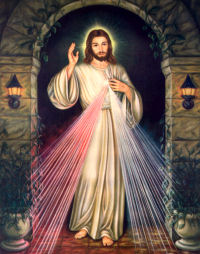
On one occasion, I heard these words: "My daughter, tell the whole world about My inconceivable mercy. I desire that the Feast of Mercy be a refuge and shelter for all souls, and especially for poor sinners. On that day the very depths of My tender mercy are open. I pour out a whole ocean of graces upon those souls who approach the fount of My mercy. The soul that will go to Confession and receive Holy Communion shall obtain complete forgiveness of sins and punishment. On that day all the divine floodgates through which graces flow are opened. Let no soul fear to draw near to Me, even though its sins be as scarlet. My mercy is so great that no mind, be it of man or of angel, will be able to fathom it throughout all eternity. Everything that exists has come forth from the very depths of My most tender mercy. Every soul in its relation to Me will contemplate My love and mercy throughout eternity. The Feast of Mercy emerged from My very depths of tenderness. It is My desire that it be solemnly celebrated on the first Sunday after Easter. Mankind will not have peace until it turns to the Fount of My Mercy.

"[Let] the greatest sinners place their trust in My mercy. They have the right before others to trust in the abyss of My mercy. My daughter, write about My mercy towards tormented souls. Souls that make an appeal to My mercy delight Me. To such souls I grant even more graces than they ask. I cannot punish even the greatest sinner if he makes an appeal to My compassion, but on the contrary, I justify him in My unfathomable and inscrutable mercy. Write: before I come as a just Judge, I first open wide the door of My mercy. He who refuses to pass through the door of My mercy must pass through the door of My justice.

"From all My wounds, like from streams, mercy flows for souls, but the wound in My Heart is the fountain of unfathomable mercy. From this fountain spring all graces for souls. The flames of compassion burn Me. I desire greatly to pour them out upon souls. Speak to the whole world about My mercy."
—Excerpted from Diary of Sr. M. Faustina Kowalska

Thursday, January 1, 2026

Pope Leo XIV presides at January 1st Mass for the Solemnity of Mary Mother of God


Pope: The new year is ‘a journey to be discovered’

Pope Leo XIV celebrates his first public Mass of 2026 on the Solemnity of Mary, Mother of God, telling believers that Mary has revealed the ‘unarmed and disarming’ face of God.

By Joseph Tulloch

“May the Lord bless you and keep you.  May the Lord let his face shine on you and be gracious to you.  May the Lord uncover his face to you and bring you peace”.

Pope Leo opened the homily at his first Mass of 2026 by reflecting on this blessing from the Book of Numbers, taken from the day’s first reading.

The blessing, he said, was addressed to the people of Israel, who had just been liberated from slavery in Egypt, and had been offered a “rebirth”, an “open road toward the future”.

In this way, the Pope noted, the day’s liturgy reminds us that “every day can be the beginning of a new life, thanks to God’s generous love, his mercy and the response of our freedom.”

We should thus view the coming year, the Pope urged the roughly 5,500 faithful in attendance, as “an open journey to be discovered”.

READ THE FULL TEXT OF POPE LEO'S HOMILY HERE

Pope Leo prays in front of a statue of the Virgin Mary (@VATICAN MEDIA)

Mary and an 'unarmed' God

The day’s liturgy marked both the Solemnity of Mary, Mother of God and the World Day of Peace.

In his homily, the Pope explored the tight relationship between the two celebrations. With Mary’s co-operation, he said, God arrived amongst us “naked and defenceless”, a “newborn in a cradle.”

“He does this”, the Pope explained, to teach us that the world is not saved by violence but by “tirelessly striving to understand, forgive, liberate and welcome everyone, without calculation and without fear.”

“In Mary’s divine motherhood”, the Pope emphasized, two ‘unarmed realities’ come together: “that of God, who renounces every privilege of his divinity to be born in the flesh, and that of a human person who, trustingly and fully, embraces God’s

 will.”

2025 Jubilee: 'Forgiveness received and given'

The Pope brought his homily to a close by reflecting on the 2025 Jubilee Year, which will come to an end on the 6th of January.

He did so by citing the words of his predecessor Pope St John Paul II, at the closure of the 2000 Jubilee:

“How many extraordinary occasions the Great Jubilee has offered to believers! In the experience of forgiveness received and given, in the commemoration of the martyrs, in listening to the cry of the world’s poor… we too have glimpsed the saving presence of God in history. We have, as it were, physically felt his love which renews the face of the earth.”

Wednesday, December 31, 2025

January 1st: The Solemnity of Mary, Mother of God and the Octave Day of Christmas


Christmas: January 1st

Solemnity of the Blessed Virgin Mary, the Mother of God, The Octave Day of the Nativity of the Lord (Christmas)


The Church celebrates the Solemnity of Mary, the Holy Mother of God, our Lady's greatest title. This feast is the Octave Day of Christmas. In the current liturgical Calendar only Christmas and Easter enjoy the privilege of an octave.

It is also the World Day of Peace.

"Mary, the all-holy ever-virgin Mother of God, is the masterwork of the mission of the Son and the Spirit in the fullness of time. For the first time in the plan of salvation and because his Spirit had prepared her, the Father found the dwelling place where his Son and his Spirit could dwell among men. In this sense the Church's Tradition has often read the most beautiful texts on wisdom in relation to Mary. Mary is acclaimed and represented in the liturgy as the "Seat of Wisdom."
Catechism of the Catholic Church 721

The Word Took Our Nature from Mary
The Apostle tells us: The Word took to himself the sons of Abraham and so had to be like his brothers in all things. He had then to take a body like ours. This explains the fact of Mary’s presence: she is to provide him with a body of his own, to be offered for our sake. Scripture records her giving birth and says: She wrapped him in swaddling clothes. Her breasts, which fed him, were called blessed. Sacrifice was offered because the child was her firstborn. Gabriel used careful and prudent language when he announced his birth. He did not speak of “what will be born in you” to avoid the impression that a body would be introduced into her womb from outside; he spoke of “what will be born from you” so that we might know by faith that her child originated within her and from her.

By taking our nature and offering it in sacrifice, the Word was to destroy it completely and then invest it with his own nature and so prompt the Apostle to say: This corruptible body must put on incorruption; this mortal body must put on immortality.

This was not done in outward show only, as some have imagined. This is not so. Our Savior truly became man, and from this has followed the salvation of man as a whole. Our salvation is in no way fictitious, nor does it apply only to the body. The salvation of the whole man, that is, of soul and body, has really been achieved in the Word himself.

What was born of Mary was therefore human by nature, in accordance with the inspired Scriptures, and the body of the Lord was a true body: It was a true body because it was the same as ours. Mary, you see, is our sister, for we are all born from Adam.

The words of Saint John: The Word was made flesh, bear the same meaning, as we may see from a similar turn of phrase in Saint Paul: Christ was made a curse for our sake. Man’s body has acquired something great through its communion and union with the Word. From being mortal, it has been made immortal; though it was a living body it has become a spiritual one; though it was made from the earth it has passed through the gates of heaven.

Even when the Word takes a body from Mary, the Trinity remains a Trinity, with neither increase nor decrease. It is forever perfect. In the Trinity we acknowledge one Godhead, and thus one God, the Father of the Word, is proclaimed in the Church.
—Excerpted from a letter by St. Athanasius

Solemnity of Mary, the Holy Mother of God, Octave Day of Christmas—Day Eight
Although New Year's Day is not celebrated by the Church, this day has been observed as a Holy Day of Obligation since early times for this feast. Each family and country has different traditional foods to eat on New Year's Day, with lentils being the main superstition: ill luck befalling those who do not eat lentils at the beginning of the year.

New Year's is a day of traditional hospitality, visiting and good cheer, mostly with a secular view, but there is no reason that this day, too, could not be sanctified in Christ.

Solemnity of the BVM, Mother of God: O God, who through the fruitful virginity of Blessed Mary bestowed on the human race the grace of eternal salvation, grant, we pray, that we may experience the intercession of her, through whom we were found worthy to receive the author of life, our Lord Jesus Christ, your Son. Who lives and reigns with you in the unity of the Holy Spirit, God, for ever and ever.


Sunday, December 28, 2025

Pope Leo XIV delivers Sunday Angelus on Holy Family Sunday 12.28.2025


Pope Leo XIV during the AngelusPope Leo XIV during the Angelus  (@Vatican Media)

Pope Leo at Angelus: Pray for peace and for families suffering due to war

During the Angelus on the Feast of the Holy Family of Jesus, Mary, and Joseph, Pope Leo reflects on how families can be a light in a society often marked by loneliness, despair, divisions, and conflicts.

By Isabella H. de Carvalho

On Sunday, December 28, the Feast of the Holy Family of Jesus, Mary, and Joseph, Pope Leo XIV called on the faithful to continue to pray for peace in the world, and especially for families that are suffering at the hands of violent conflicts.  

“In the light of the Lord's Christmas, let us continue to pray for peace. Today, in particular, let us pray for families suffering because of war, for children, the elderly, and the most vulnerable. Let us entrust ourselves together to the intercession of the Holy Family of Nazareth,” said Pope Leo XIV during the Angelus prayer in St. Peter’s Square.

Don't let success and power take out love 

In his reflection, the Pope highlighted how Christian families can be a light in the society in which we live — which is not only marked by conflitcs but also by isolation and discord — by reflecting on the Holy Family’s flight into Egypt shortly after Jesus’ birth to escape King Herod’s persecution.

“Unfortunately, the world always has its 'Herods,' its myths of success at any cost, of unscrupulous power, of empty and superficial well-being, and it often pays the price in the form of loneliness, despair, divisions and conflicts,” Pope Leo said.

“Let us not allow these mirages to suffocate the flame of love in Christian families.”

He instead invited families to cherish the values of the Gospel by praying, receiving the sacraments — especially Confession and Communion — and promoting “healthy affections, sincere dialogue, fidelity, and the simple and beautiful concreteness of everyday words and gestures.”

He called them to become a “light of hope” and “a school of love and an instrument of salvation in God’s hands.”

The presence and mission of the Holy Family

Pope Leo’s reflection was based on the Gospel of the day, taken from Matthew, in which the evangelist describes how an angel appeared to Joseph and told him to flee to Egypt, as King Herod was trying to find Baby Jesus and kill Him.

The Pope described Herod as “a cruel and bloodthirsty man” who is deeply lonely and lives in fear of being deposed.

“In his kingdom, God is performing the greatest miracle in history, in which all the ancient promises of salvation are fulfilled, but he cannot see this because he is blinded by the fear of losing his throne, riches, and privileges,” the Pope explains.

He emphasized, however, that “it is precisely this hardness of heart" that further "highlights the value of the presence and mission of the Holy Family.”

“In the despotic and greedy world represented by the tyrant, it is the birthplace and cradle of the only possible answer of salvation, that of God who, in total gratuitousness, gives Himself to men without reserve and without pretension," he said. 

The Pope also underlined how Joseph is obedient to God’s plan and in Egypt “the flame of domestic love, to which the Lord has entrusted His presence in the world, grows and gains strength in order to bring light to the whole world.”

At the end of his message Pope Leo asked the Lord, through Mary and Joseph’s intercession, to bless all the families throughout the world, so that by following Christ’s example “they may be for all an efficacious sign of His presence and His endless charity.”

Saturday, December 27, 2025

Celebrating the Feast of the Holy Family


Christmas: December 28th

Feast of the Holy Family


Today is the Fourth Day within the Octave of Christmas. The Feast of the Holy Family is a movable feast, assigned to the Sunday within the Octave of Christmas.

Scripture tells us practically nothing about the first years and the boyhood of the Child Jesus. All we know are the facts of the sojourn in Egypt, the return to Nazareth, and the incidents that occurred when the twelve-year-old boy accompanied his parents to Jerusalem. In her liturgy the Church hurries over this period of Christ's life with equal brevity. The general breakdown of the family, however, at the end of the past century and at the beginning of our own, prompted the popes, especially the far-sighted Leo XIII, to promote the observance of this feast with the hope that it might instill into Christian families something of the faithful love and the devoted attachment that characterize the family of Nazareth. The primary purpose of the Church in instituting and promoting this feast is to present the Holy Family as the model and exemplar of all Christian families.
—Excerpted from With Christ Through the Year, Rev. Bernard Strasser, O.S.B.

Feast of the Holy Family—Day Four
Today is the feast day of the Holy Family, but also every family's feast day, since the Holy Family is the patron and model of all Christian families. Today should be a huge family feast, since it is devoted entirely to the Holy Family as a model for the Christian family life. As Rev. Edward Sutfin states:

"The children must learn to see in their father the foster-father St. Joseph, and the Blessed Mother as the perfect model for their own mother. The lesson to be learned is both practical and theoretical, in that the children must learn how to obey and to love their parents in thought, word and action, just as Christ was obedient to Mary and Joseph. Helping mother in the kitchen and in the house work, and helping father in his odd jobs about the home thus take on a new significance by being performed in a Christ-like spirit." (True Christmas Spirit, ©1955, St. Meinrad Archabbey, Inc.)

The Holy Family
Marriage is too often conceived as the sacrament which unites a man and a woman to form a couple. In reality, marriage establishes a family, and its purpose is to increase the number of the elect, through the bodily and spiritual fecundity of the Christian spouses.
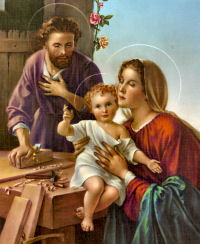
1. Every marriage intends children. Although Mary and Joseph were not united in a carnal way, their marriage is a true marriage: an indissoluble, exclusive union, wholly subordinated to the child. Mary and Joseph are united only in order to bring Jesus into the world, to protect and raise him. They have only one child, but he contains the whole of mankind, even as Isaac, an only child, fulfilled the promise made to Abraham of a countless progeny.

2. The purpose of every marriage is to establish a Christian family. The Holy Family observed the religious laws of Israel; it went in pilgrimage to Jerusalem every year with other Jewish families (Lk. 2:41). Jesus saddens and amazes his father and his mother because to their will and company he prefers "to be in his Father's house". Thus it may happen that God's will obliges the family to make disconcerting sacrifices. Yet every Christian family must live in harmony and in prayer, which are the pledges of joy and union.

3. "He remained obedient to them." Jesus was God. And through the fullness of grace Mary stood above Joseph. Nevertheless — if we except the event in the Temple — Joseph remained the head of the family; he took the initiative (as when the Holy Family fled to Egypt), and in Nazareth Jesus obeyed his parents.
—Excerpted from Bread and the Word, A.M. Roguet

Commentary on the Mass Readings for the Feast of the Holy Family, Cycle A:
The First Reading is from the Book of Sirach 3:2-6, 12-14. Although all the emphasis in these verse seems to be on the obligation of children to their parents, there is a profound lesson here for parents, too. "Like father like son" is an old and a true saying very often. If the parents fail to do what is right and just in the sight of God they can hardly complain if their children turn out disobedient to God and to them. The young learn more from example than from precept. Today, on this feast day, I would ask all parents to examine themselves and see how how they are fulfilling this grave responsibility—which God has placed on them. Are they preparing their children by word and example, especially by example, to be worthy citizens of heaven where they will be their parents' crown and glory?

The Second Reading is from the Letter of St. Paul to the Colossians 3:12-21. Ninety per cent of the first readers of St. Paul's Letter to the Colossians were pagans before their conversion. To practice the new Christian virtues was no easy task for people reared in the laxity and license of the paganism of their day. Yet they did practice these virtues and produced many saints and martyrs. Let us being in our own family circle to bring sanity back to our world. Let us have the true peace of Christ in our hearts and in our home, each one carrying out the task God has allotted to him. We shall not convert the world immediately but we shall have made a start. The world is the sum-total of its individual families.

The Gospel is from Matthew 2:13-15; 19-23. During this holy season of Christmas, Jesus Mary and Joseph should be remembered frequently by every Christian. To help us to remember them and above all to strive to imitate them, the Church has dedicated this Sunday to the memory of the Holy Family. Although they were God's closest friends, and although they were the holiest family that ever lived, or ever will live, on earth, they had more than their share of this world's troubles and cares. Today's Gospel story tells us of some of these earthly woes and sufferings. They had just settled in Bethlehem, and the Baby Jesus was only a few months old when, to avoid his murder at the hands of the murderous and jealous Herod, they had to flee from Bethlehem and become displaced persons in a foreign and pagan land.

The message of today's Gospel story is a message of encouragement and consolation for every one of us. If the Holy Family suffered such trials and hardships, surely we should be ready and willing to suffer and bear with the trials that God sends us for our own eternal welfare.
—Adapted from The Sunday Readings, by Fr. Kevin O'Sullivan, O.F.M.

Christmas Reflection: Children of God
1. In the middle of the night the Word of God descended into the homes of the Egyptians and slew every first-born among them. Israel was then freed from the Egyptian captivity. The Book of Wisdom reminds us of this marvelous delivery. "While all things were in quiet silence and the night was in the midst of her course, Thy almighty Word leapt down from heaven from the royal throne" (Wisd. 18:14 f.) and released Israel from the chains of the Egyptians from which they yearned so long to be freed. This descent of the angel among the people of Israel is a foreshadowing of the descent of the Son of God to free mankind when He comes to us at Christmas.

2. "God sent His Son, made of woman, made under the law, that He might redeem them who were under the law; that we might receive the adoption of sons" (Epistle). This is the mystery of Christmas, the mystery of the love, wisdom, justice, and mercy of God. We were slaves to the Egyptians; we served the severe taskmasters of this life: the world, the flesh, and the devil. God, looking upon our misery, sends His Son to become a slave, to assume our bondage, to purchase our freedom. Christ becomes subject to all the ills to which the human race is subject; He must be born as men are born, He must grow to manhood, He must suffer, He must die. He must be like to us in all things except sin. He is subject even to the law of Moses, since He is a Hebrew. He faithfully observes this law, which was fashioned for a sinful and stiff-necked people, and which had become for them an insufferable burden.

On this Sunday we find the Son of God, the almighty Word, with His mother and His foster father in the Temple, humbly submitting to the prescriptions of the law of Moses, as if He had been conceived in sin like His fellow men. From His submission to the law one might suppose that He, too, had been conceived in a natural way, by the desires of man and by a human father, not by the will and power of God. For Him the law was not necessary, but He submits to it joyfully and willingly. He has become a slave for us in order to free us from our bondage. Surely there has never been a more sublime example of perfect love and condescension. The Son of God descends from His royal throne and exchanges divine freedom for the chains of men in order that all men may be free. Such an act of divine condescension demands our careful contemplation.

"God sent His Son" to redeem us "that we might receive the adoption of sons." This is freedom, indeed. Not only are we freed from the bondage of sin, but we are made sons of God and share the majesty of the Son of God. "And because you are sons, God hath sent the Spirit of His Son into your hearts, crying: Abba, Father. Therefore now he is not a servant, but a son; and if a son, an heir also through God" (Epistle). But this redemption which the Son of God has wrought in us is not merely a liberation from the slavery of the world, the flesh, and the devil; it elevates us to a higher sphere and introduces us to a new life. "But as many as received Him, He gave them power to be made the sons of God, to them that believe in His name; who are born, not of blood, nor of the will of the flesh, nor of the will of man, but of God" (John 1:12 f.).

We are, then, the children of God. born to Him through the virginal birth of baptism, and are filled with the spirit of His life, by which we are entitled to cry out to God and call Him our Father. "Hallowed be Thy name; Thy kingdom come; Thy will be done." Thy will be done in us and through us. A redemption such as this could have been conceived only by the infinite wisdom of God and executed only through His almighty power. A new race comes into being at Christmas, a race born of the strength of the incarnate Word of God. The child who is born to us at Christmas is born under the law, but holds the scepter of omnipotence in His tiny hands.

The Gospel of the day describes the members of the family who surround the throne of the newborn King. Grouped about His throne we find the Virgin Mother and her virginal spouse, St. Joseph. There, too, is the aged Simeon, now filled with the Spirit of God and uttering his great prophecy: "Behold, this child is set for the fall and for the resurrection of many in Israel, and for a sign which shall be contradicted. And thy own soul a sword shall pierce." Nearby lingers the chaste widow, Anna, the prophetess, whose days and nights were spent in prayer and the service of God. These are the first members of the new race raised to a new life by the Spirit of God. Theirs is the new age, the age in which men will live by the Spirit of God, abounding in all good works.

3. The Incarnate Word of God became subject to the law in order to free us from the servitude of the law and to establish His sovereignty over us. Though subject to the law, He is above the law and confers upon our fallen nature a royal freedom that makes us the children of God.

With profound gratitude we cry out to Him, "The Lord hath reigned; He is clothed with beauty; the Lord is clothed with strength and hath girded Himself" (Introit). "Thou art beautiful above the sons of men; grace is poured abroad in Thy lips" (Gradual). The glory of the divine King, of the Word of God, the reflected splendor of the Father, shines in the eyes and upon the lips of the child in the manger at Bethlehem. He is our brother and our Savior, who for our sake was subject to the law of childhood and childhood's weaknesses. Yet He is the only-begotten of the Father.

The Church, the bride of the divine King, presents herself to Him as a victim. In the celebration of the Holy Eucharist, the almighty Word of God descends upon the altar (into the womb of His bride), and in Holy Communion takes up His abode in the hearts (His crib) of her children, to fulfill what was announced. He becomes subject to the law, as our sacrifice and sacrificial meal, "that He might redeem them who were under the law, that we might receive the adoption of sons." As children of His love we are privileged to address Him as our father, heart to heart. What a tremendous privilege!
—Excerpted from The Light of the World, Volume One by Benedict Baur, O.S.B.

The Holy Family: Jesus, Mary and Joseph
The devotion to the Holy Family was born in Bethlehem, together with the Baby Jesus. The shepherds went to adore the Child and, at the same time, they gave honor to His family. Later, in a similar way, the three wise men came from the East to adore and give honor to the newborn King with gifts of gold, frankincense, and myrrh that would be safeguarded by His family.

We can go further to affirm that in a certain sense Christ, Himself, was the first devotee of His family. He showed His devotion to His mother and foster father by submitting Himself, with infinite humility, to the duty of filial obedience towards them. This is what St Bernard of Clairvaux said in this regard, ‘God, to whom angels submit themselves and who principalities and powers obey, was subject to Mary; and not only to Mary but Joseph also for Mary’s sake [….]. God obeyed a human creature; this is humility without precedent. A human creature commands God; it is sublime beyond measure.’ (First Homily on the ‘Missus Est’).

Today’s celebration demonstrates Christ’s humility and obedience with respect to the fourth commandment, whilst also highlighting the loving care that His parents exercised in His keeping. The servant of God, Pope John Paul II, in 1989, entitled his Apostolic Exhortation, ‘Redemptoris Custos’ (Guardian of the Redeemer) which was dedicated to the person and the mission of Saint Joseph in the life of Christ and of the Church. After exactly a century, he resumed the teaching of Pope Leo XIII, for who Saint Joseph ‘ shines among all mankind by the most august dignity, since by divine will, he was the guardian of the Son of God and reputed as His father among men’ (Encyclical Quamquam Pluries [1889] n. 3). Pope Leo XIII continued, ‘...Joseph became the guardian, the administrator, and the legal defender of the divine house whose chief he was.[…] It is, then, natural and worthy that as the Blessed Joseph ministered to all the needs of the family at Nazareth and girt it about with his protection, he should now cover with the cloak of his heavenly patronage and defend the Church of Jesus Christ.’ Not many years before, blessed Pope Pius IX had proclaimed Saint Joseph, ‘Patron of the Catholic Church’ (1870).

Almost intuitively, one can recognize that the mysterious, exemplary, guardianship enacted by Joseph was conducted firstly, in a yet more intimate way, by Mary. Consequently, the liturgical feast of the Holy Family speaks to us of the fond and loving care that we must render to the Body of Christ. We can understand this in a mystical sense, as guardians of the Church, and also in the Eucharistic sense. Mary and Joseph took great care of Jesus’ physical body. Following their example, we can and must take great care of His Mystical Body, the Church, and the Eucharist which He has entrusted to us. If Mary was, in some way, ‘the first tabernacle in history’ (John Paul II Ecclesia de Eucharistia, n. 55) then we the Tabernacle in which Our Lord chose to reside in person, in His Real Presence, was also entrusted to us. We can learn from Mary and Joseph! What would they ever have overlooked in the care of Jesus’ physical body? Is there something, therefore, that we can withhold for the right and adoring care of His Eucharistic Body? No amount of attention, no sane act of love and adoring respect will ever be too much! On the contrary, our adoration and respect will always be inferior to the great gift that comes to us in the Holy Eucharist.

Looking at the Holy Family, we see the love, the protection, and the diligent care that they gave to the Redeemer. We can not fail to feel uneasiness, perhaps a shameful thought, for the times in which we have not rendered the appropriate care and attention to the Blessed Eucharist. We can only ask for forgiveness and do penance for all the sacrilegious acts and the lack of respect that are committed in front of the Blessed Eucharist. We can only ask the Lord, through the intersession of the Holy Family of Nazareth, for a greater love for their Son Incarnate, who has decided to remain here on earth with us every day until the end of time.
—From the Congregation for the Clergy

Friday, December 26, 2025

Pope Leo XIV delivers Angelus Address on the Feast of Stephen


Pope at Angelus: Saint Stephen teaches us that martyrdom is a birth into the light

On the feast of the Church’s first martyr, Saint Stephen, Pope Leo XIV reflects on martyrdom as a “birth into heaven” and on Christmas joy as the choice to live fraternity, forgiveness and peace in a world marked by fear and conflict.

By Vatican News

On the feast of Saint Stephen, the first martyr of the Church, Pope Leo XIV invited the faithful to contemplate martyrdom not as an end, but as a beginning: a “birth into heaven” that reveals what it truly means to come into the light.

Greeting pilgrims gathered in Saint Peter’s Square for the Angelus, on the day traditionally known by early Christians as Saint Stephen’s “birthday”, the Pope recalled the ancient certainty that “we are not born just once”. With the eyes of faith, he said, even death is no longer darkness. “Martyrdom is a birth into heaven,” he continued, describing it as a passage illuminated by love rather than obscured by fear.

Reflecting on the account from the Acts of the Apostles, Pope Leo XIV pointed out the striking image of Stephen before the council: “All who sat in the council looked intently at him, and they saw that his face was like the face of an angel” (Acts 6:15). This, the Pope explained, is “the face of one who does not leave history indifferently, but responds to it with love”. Stephen’s life and death, he said, mirror “the divine love that appeared in Jesus, the Light that shines in our darkness”.

From Bethlehem to martyrdom, the Holy Father traced a single thread: the call to live as children of God. The birth of the Son of God, he said, draws humanity, as it did Mary, Joseph and the shepherds with their humility. Yet, he acknowledged, the beauty of such a life is also rejected. From the very beginning, “his magnetic force has provoked the reaction of those who struggle for power”, of those unsettled by a goodness that exposes injustice and reveals “the intentions of their hearts” (cf. Lk 2:35).

Still, Pope Leo XIV insisted, no power can prevail over God’s work. Even today, across the world, there are those who “choose justice even at great cost”, who place peace before fear and service of the poor before self-interest. From these choices, he said, “hope then sprouts”, making celebration possible even amid suffering.

The Pope did not shy away from the realism of the present moment. In a world marked by uncertainty and pain, joy can seem unattainable. Those who believe in peace and follow “the unarmed path of Jesus and the martyrs”, he noted, are often ridiculed or excluded, sometimes even accused of siding with enemies. Yet, he said, “Christians have no enemies, but brothers and sisters”, whose dignity remains intact even when understanding fails.

At the heart of the Christmas mystery, Pope Leo XIV continued, is a joy sustained by those who already live fraternity, who recognise in every person, even in adversaries, “the indelible dignity of the daughters and sons of God”. Like Jesus, Stephen died forgiving, sustained by “a force more real than that of weapons”: a gratuitous force already present in every heart, reawakened when we learn to look upon one another with attention and recognition.

“Yes, this is what it means to be reborn, to come once more into the light,” the Pope said. “This is our ‘Christmas’.”

Bringing his address to a close, Pope Leo XIV entrusted the faithful to Mary, “blessed among all women who give life and counter arrogance with care, and distrust with faith”. And finally, inviting all to contemplate her, he prayed that she might lead the world into her own joy – “a joy that dissolves all fear and all threats, just as snow melts before the sun”.

“I renew my heartfelt good wishes for peace and serenity in the light of our Lord’s birth...As we remember Saint Stephen, the first Martyr, we seek his intercession for strengthening our faith and supporting the communities that suffer most for their Christian witness. May his example of humility, courage and forgiveness accompany those who, in situations of conflict, are committed to promoting dialogue, reconciliation and peace.”


Pope Leo during his Angelus on the Feast of Saint Stephen

Wednesday, January 1, 2025

Papal Mass for the Solemnity of Mary Mother of God; entrust 2025 to Mary


Pope Francis invites us to cherish life and entrust 2025 to Mary

Mary “immerses us once more in the mystery of Christmas” and leads us to Jesus, says Pope Francis, as he celebrates Mass for the Solemnity of the Most Holy Mother of God.

By Christopher Wells

Pope Francis marked the beginning of 2025 with the celebration of Mass for the Solemnity of Mary, the Most Holy Mother of God.

In his homily, the Holy Father said that “like a Mother,” Mary points us to her Son and leads us to Jesus.

The mystery of Christmas

Today’s feast, he said, “immerses us once more in the mystery of Christmas” – a mystery summed up in the Second Reading, where St Paul tells us that “God sent forth His Son, born of a woman.” These words “echo in our hearts today” and “remind us that Jesus, our Saviour, became flesh and is revealed in the frailty of the flesh.”

That Jesus was born of a woman reminds us “that God became truly man through a human womb” – showing us that God is not simply “some vague religious feeling or fleeting emotion,” but “has a face and a Name, and calls us to have a relationship with Him.”

Jesus, the Pope said, “is one of us, and thus is able to save us.”


Jesus shows us the face of God

St Paul’s words also “speak to us about the humanity of Christ” who is “revealed in the frailty of flesh.” Jesus’ coming as a tiny baby, through the Virgin Mary, reveals how God chooses to act: “through littleness and hiddenness.” Jesus, the Pope said, “revealed God’s love in the beauty of His humanity, dwelling in our midst, sharing our daily life… by the frailty of His humanity and His concern for the weak and vulnerable, Jesus shows us the face of God.”

Pope Francis invited us to “entrust this new year to Mary, the Mother of God,” with the hope that we might learn, “like her” to protect “the precious gift of life.”

Cherishing all human life

Today, the Pope continued, on this World Day of Peace, “all of us are invited to take up the summons that flow from the maternal heart of Mary: to cherish life, to care for life, to restore dignity to the lives of everyone ‘born of woman,’ for this is the basis for building a culture of peace.”

This, he said, is the reason for his appeal “for a firm commitment to respect the dignity of human life from conception to natural death.”

“Let us entrust to Mary this new Jubilee Year,” the Holy Father concluded. “Let us entrust to her our questions, our worries, our sufferings, our joys and all the concerns that we bear in our hearts. Let us entrust to her the whole world, so that hope may be reborn and peace may finally spring up for all the peoples of the earth.”