Showing posts with label social media. Show all posts

Tuesday, July 29, 2025

Mass celebrated at Vatican to encourage Digital Missionaries and Catholic Influencers


Pope at Mass: Creators should promote encounters between hearts

At the close of Mass for digital missionaries and Catholic influencers, presided over by Cardinal Tagle, Pope Leo challenges everyone to use social media to promote a human culture.

By Kielce Gussie

St. Peter’s Basilica was filled with young people coming from across the globe to partake in the Mass as part of the Jubilee for Digital Missionaries and Catholic Influencers. Cardinal Luis Antonio Tagle, Pro-Prefect of the Section for the First Evangelization and New Particular Churches of the Dicastery for Evangelization, presided over the Eucharistic celebration.

In his homily, the Cardinal reflected on the word “influence” and what exactly it means for Catholics and digital missionaries.

What is influence today?

Cardinal Tagle emphasized that the everyone is an influencer, and at the same time, everyone is influenced. “Daily life is a tapestry of crisscrossing influences”, the Cardinal shared, pointing out that we are constantly being influenced by our families, neighborhoods, schools, and other social settings.

When these aspects of life are corrupted, they, in turn, impact who we are and what type of society we create. Moreover, the Pro-Prefect continued, “as the earth and the environment affect us, our activity affects the planet as well.”


Some 1400 pilgrims participated in the Mass for the Jubilee of Digital Missionaries and Catholic Influencers (@Vatican Media)


He insisted that this Jubilee event is an invitation to “scrutinize the intention that fuels the influence our contemporary world wants to effect.” The change we wish to see in the world is directly connected to how we choose to influence others and our motivations behind it.

Some use false advertising to sway people; others use blackmail or bribery. Still others resort to war, bombings, forced starvation as a means of influencing those around them.

God is our influencer

Cardinal Tagle turned to the day’s readings to answer the question: what is influence? Rather than sending us a text or email with an attachment, he pointed out that God sent us His Son.

The Gospel message encourages us to allow Jesus to influence us with His love, through which we can influence others for good. The Cardinal challenged the pilgrims present to “let the love of God in Jesus and the Holy Spirit prevent various poisonous influences from flowing into human hearts and societies.”

Pope Leo’s call for peace

At the end of the Mass, Pope Leo XIV addressed the young people present in the Basilica in three languages: Spanish, English, and Italian. In his message, he began by once again calling for an end to violence, emphasizing “how much we need peace in these times torn apart by enmity and war”.

He reiterated that proclaiming peace is the mission of both the Church and all those who have gathered in Rome for the Jubilee. “Peace needs to be sought, proclaimed, and shared everywhere; both in the tragic places of war and in the empty hearts of those who have lost the meaning of existence and the taste for interiority, for spiritual life.”

Therefore, today, more than ever, Pope Leo stressed, digital missionaries are essential to spreading this message to the ends of the earth.

Let our culture remain human

A particular challenge facing those who embark on this mission is to always look for the “suffering flesh of Christ” in every person they meet online. As we find ourselves in a technological society and culture, the Pope challenged the influencers: “It is up to us – to each one of you – to ensure that this culture remains human.”


Even though science and technology play an essential role in our daily lives, nothing man-made “should be used to undermine the dignity of others.” Being Catholics and influencers and digital missionaries, our mission is to promote “Christian humanism” in our culture.

Go mend the nets of friendship

Throughout history, there have been many moments of change and, the Pope stressed, the Church has never remained passive. In today’s culture so saturated with technology, the challenge is to “work together to develop a way of thinking and a language of our time, that gives voice to love.”

More than simply creating content, Pope Leo urged these digital missionaries to create encounters among hearts. This, he continued, leads to another call—to mend nets. Nets of relationships, of love, of free exchange, where friendships run deep.

The Pope argued we are called to mend the nets that “open space for others more than ourselves, where no ‘filter bubble’ can silence the voice of the weakest.” Through this, we can create a single network of God.

Closing, Pope Leo thanked the young people present for all their work and encouraged them on their path to reaching the ends of the earth through digital means.

Tuesday, May 13, 2025

Pope Leo XIV makes first papal social media post


A camera records Pope Leo XIV as he appears on the central balcony of St. Peter's Basilica on May 8, 2025A camera records Pope Leo XIV as he appears on the central balcony of St. Peter's Basilica on May 8, 2025  (Vatican Media)

Pope Leo XIV publishes first post on papal social media accounts

Pope Leo XIV has published his first post on the papal social media accounts, which were employed to great effect by his predecessors, Pope Francis and Pope Benedict XVI.

By Devin Watkins

Pope Leo XIV has chosen “to maintain an active social media presence through the official papal accounts on X and Instagram," according to a press release from the Dicastery for Communication on Tuesday.

The Pope’s first post on Instagram was taken from his first public address at the Urbi et Orbi just after his election on May 8, and included several iconic photos from the first days of his pontificate.

“Peace be with you all! This is the first greeting spoken by the Risen Christ, the Good Shepherd. I would like this greeting of peace to resound in your hearts, in your families, and among all people, wherever they may be, in every nation and throughout the world.”

In the press release, the Dicastery for Communication (our parent organization) noted that the official @Pontifex account on X counts a total of 52 million followers across nine languages.

The content posted by the late Pope Francis will be archived in a special section of the Holy See’s institutional website (vatican.va).

On Instagram, the Pope’s new account will bear the name @Pontifex – Pope Leo XIV, which will be the only official papal account on the platform owned by Meta.

Pope Francis’ @Franciscus account will remain accessible as a commemorative archive, noted the press release.

The late Pope Francis maintained an active presence on both social media platforms, publishing around 50,000 posts, mostly posting excerpts from his speeches on X and images from his public events on Instagram.

These posts, said the press release, offered “near-daily accompaniment throughout Pope Francis' pontificate with short messages of an evangelical nature and exhortations in favor of peace, social justice, and care for creation.”

In 2020 alone, the late Pope’s social media content was viewed over 27 billion times.


A screenshot of Pope Leo XIV's first post on Instagram

Papal social media

Pope Benedict XVI was the first Pope to open a social media account, sending the first papal tweet when he was 84-years-old, on what was then Twitter, on December 12, 2012.

"Dear friends, I am pleased to get in touch with you through Twitter. Thank you for your generous response. I bless all of you from my heart,” wrote the German-born Pope.

His 140-character tweet opened the door for the Holy See to embrace the contemporary form of social communication.

Upon his election as the 266th pontiff, Pope Francis used the same Twitter account, sending his first tweet: “Dear friends, I thank you from my heart and ask you to continue to pray for me.”

On March 19, 2016, the Solemnity of St. Joseph, Pope Francis expanded the papal social presence by opening his Instagram account, @franciscus. His first post was a photo of himself kneeling in prayer with the caption “Pray for me” in several languages.

As Pope Leo XIV employs modern means of social communication, the Church’s institutions and all Catholics can look to his guidance and inspiration for how to conduct themselves online.

Thursday, February 13, 2025

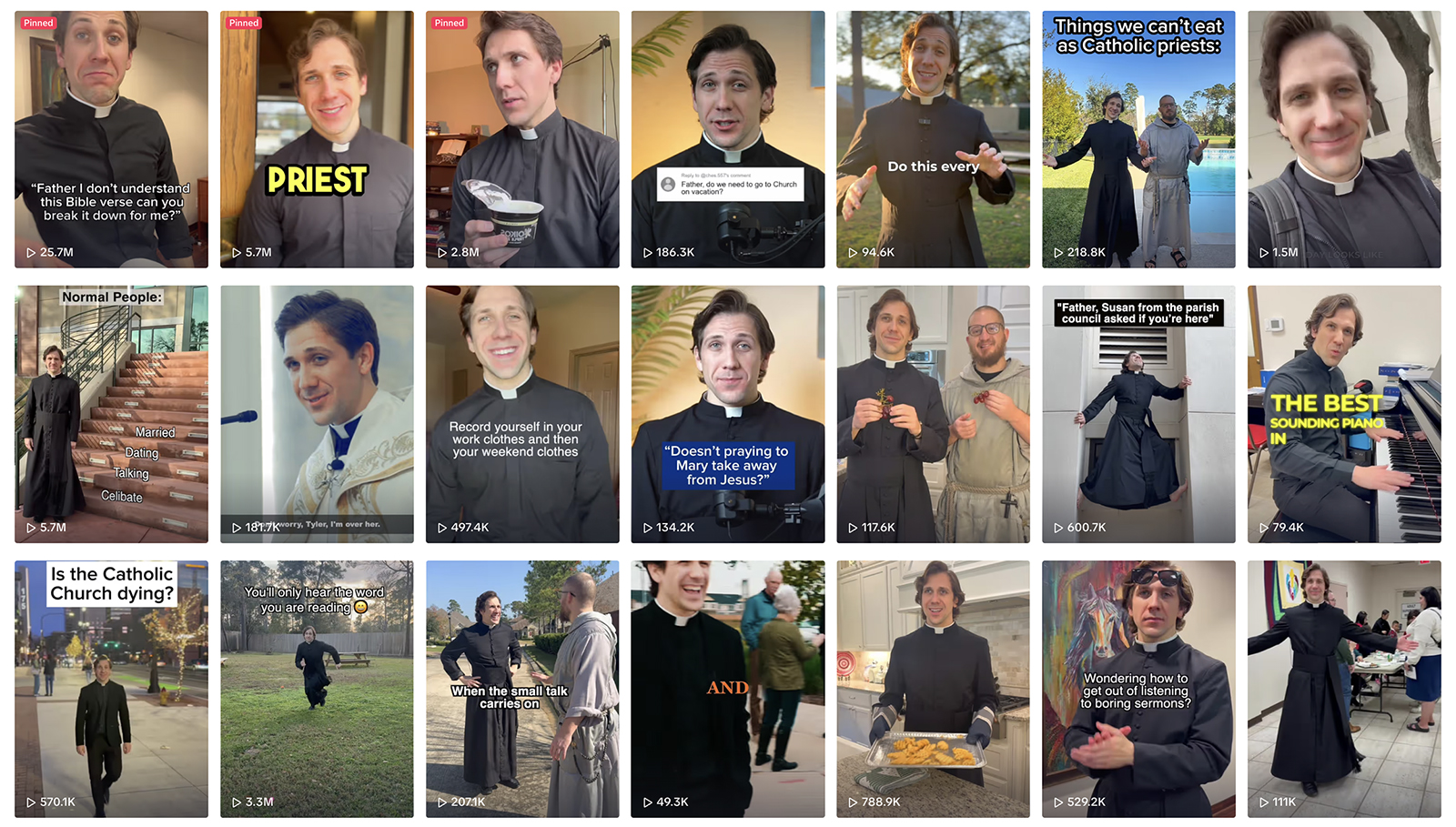
Meet Fr. David Michael Moses; young Priest; social media influencer

 He's a young millennial Catholic priest; of course he's a social media influencer

(RNS) — For Fr. David Michael Moses, whose humorous and heartfelt videos have tens of millions of views, social media isn’t a tool — it’s a mission field.


Fiona Murphy

February 12, 2025


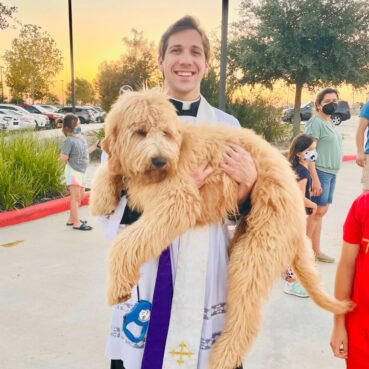
(RNS) — Clad in a black clerical shirt and collar, Fr. David Michael Moses steps out of a black Jeep, a small smile plays on his lips and his bright green eyes catch the camera. The video, with more than 8 million views, is one of many that have earned him nearly 1 million followers on Instagram. “I’m a Catholic priest,” he quips. “Of course I always ask if it comes in black.”

At 31, Moses has become a familiar face to hundreds of thousands across Instagram, TikTok and YouTube. In the next shot of the video, Moses is seated. “I am a Catholic priest,” he continues in the style of the popular TikTok trend. “Of course I tell the story about dating my high school girlfriend and somehow connect it to the readings.” 

Ordained a diocesan priest in 2019, Moses is currently the parochial vicar of Christ the Good Shepherd Church in Spring, Texas, but most people know him online for his short, humorous videos, some of which have garnered over 50 million views.

For Moses, social media isn’t a tool — it’s a mission field. While the parishioners he serves in Spring show up to church each Sunday, he said he sees his online presence as a way to reach those who wouldn’t normally step through the doors of a parish. As one friend put it to him, “People won’t let you into their homes, but they let you into their phones.” 

“ The reason I use social media is because I’m going after the lost sheep,” Moses said. “I’ve found along the way that humor is such a universal language.” 

Inspired by Christ’s parable of the Good Shepherd, who leaves the 99 to seek the one lost sheep, Moses says he believes he is called to a digital evangelization, which requires meeting people where they are. 

While attending a Seek Catholic youth conference in January, where approximately 20,000 young Catholics gathered to worship and socialize, Moses said he met numerous people who had seen his videos. “The most common thing I got was: My atheist friends send me your videos,” Moses said. “I was really pumped to hear that.” 

On Instagram, where he has the largest following, users flood his comment section with laughter, heart-eye emojis and praying hands, thanking him for his uplifting content. One account wrote: “I’m not religious, but this is funny.” 

(Photo courtesy David Michael Moses)

After using humor to draw in his audience, Moses says he hopes they’ll stay for his more serious videos on prayer and Catholic teachings — and many do. Nearly 60,000 people have viewed his YouTube video titled Pray With Me, in which Moses sits in front of the camera and leads a 16-minute recitation of the rosary. 

Since he began posting regularly on Instagram in 2021, he has become a prominent voice in the growing community of priests leveraging digital platforms for evangelization.

“Some of the earliest YouTube videos I remember watching in high school were Fr. Mike videos,” Moses said. “I have pretty vivid memories of seeing Ascension Presents.” 

Fr. Mike Schmitz is a Catholic priest and popular social media personality who built a sizable following (more than 1 million subscribers) through preaching, teaching and engaging in online evangelization via Ascension Presents, a media platform where he creates videos and podcasts aimed at young people.

In a recent post, Moses collaborated with Fr. Mark-Mary Ames, a Franciscan friar and host of a video series on Ascension Presents. The video features the two playfully listing “things Catholic priests can’t eat,” leading to the unexpected punchline — outdoor furniture. The video has 1.2 million views.  

With the rising popularity of Catholic clergy online — Moses is gaining thousands of followers every week — questions are emerging within the Church about how priests should navigate digital spaces. “A change in media technology imposes itself on all of our social and cultural institutions,” said Brett Robinson, who is a media theorist and associate director of the Notre Dame Office of Church Communications. 

At a recent media summit, where hundreds of priests, theologians and prominent Catholic voices gathered in Rome to discuss the evolving intersection of faith and digital media, Robinson said he observed widespread conversation about the emerging role of the priest influencer.

“We’re hearing from the priests themselves who fall into the trap of thinking, ‘I have a bigger audience online than I do in my local parish,'” Robinson said. At a time when weekly Mass attendance is declining and Catholic churches feel increasingly empty, social media offers the chance for a much larger platform. “That’s the new challenge — this was not an option even 20 years ago.”

While he acknowledges the temptation to prioritize his growing online audience over parish ministry, Moses said he views his digital presence as an extension of his pastoral work — and he sees influencing others as an inherent part of that vocation. 

“The loaded term ‘influencer,’ I’d be hesitant about labeling myself that,” Moses said. “But to actually be someone who influences, I’m all for that. That’s why I became a priest.”

Fr. Victor Perez, a longtime friend, fellow priest in Houston and Moses’ spiritual guide, recalls starting to post videos on a dedicated Facebook page during the COVID-19 pandemic, which gained some attention at the time, but he has since deleted it. 

“I just didn’t really like it that much,” Perez said. Perez, who is 45 years old, said the influx of notifications and messages was overwhelming, and the amount of time he spent maintaining the page was difficult to manage. “God has a different path for every person, you know, people have different gifts,” he said.

Perez first met Moses when he was a seminarian and Moses was a young altar server at St. Paul’s the Apostle Church in Nassau Bay, Texas. “I think he’s being creative with his content. I think he’s also always been obedient to the bishop and putting his parish first.”

Fr. David Michael Moses. (Photo courtesy David Michael Moses)

At his parish in Spring, Moses hears daily confessions and leads Mass. He is on call to anoint the sick and dying, writes homilies, visits local elementary schools and regularly performs weddings and baptisms for the community.

Time management is Moses’ biggest challenge as he balances his in-person duties with posting online. To help manage, he relies on two friends who assist with shooting, editing, scheduling and posting his content, which he says gets scheduled weeks in advance.

Moses has also stopped using direct messaging on Instagram.

“I get online just to check,” Moses said. “My name is on everything, so I want to be very careful. It can be such an addictive and dangerous thing, so I think it’s good to have a little bit of separation.”

Despite Moses’ frequent use of platforms like Instagram, Facebook and TikTok, he uses the analogy of social media as a “bad neighborhood.” 


“I wouldn’t recommend my family live in a bad neighborhood,” Moses said. “But I do believe there should be a priest in every bad neighborhood — someone who understands the culture, speaks the language and is able to minister to the people there.”

This article was produced as part of the RNS/Interfaith America Religion Journalism Fellowship.

Wednesday, January 24, 2024

Pope releases Communication Day message and confronts AI


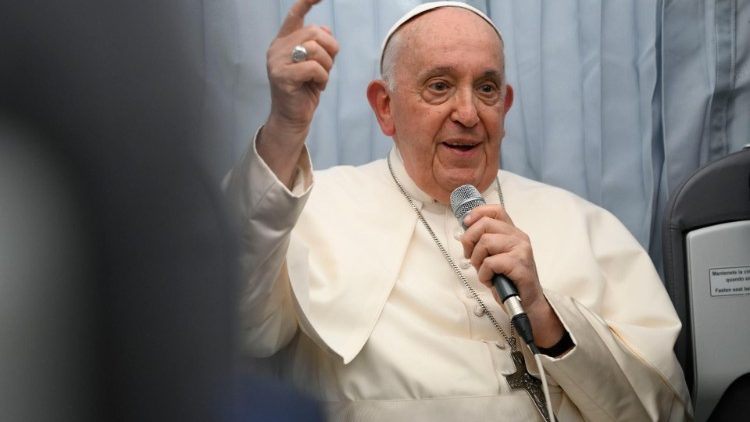
Pope Francis holds a microphone on the flight back from MarseillePope Francis holds a microphone on the flight back from Marseille  (VATICAN MEDIA Divisione Foto)

Pope's Communications Day message: AI can never replace wisdom of human heart

In his message for the 58th World Day of Social Communications, Pope Francis urges humanity to cultivate wisdom of the heart in the age of artificial intelligence.

By Francesca Merlo

Pope Francis has released his message for the 2024 World Day of Social Communications, focusing on the theme: Artificial Intelligence and the Wisdom of the Heart: Towards a Fully Human Communication.

Celebrated on 12 May, this year's theme is closely linked to the Pope’s message for the World Day of Peace, which was devoted to the development of systems of artificial intelligence (AI).

AI is “radically affecting the world of information and communication, and through it, certain foundations of life in society,” says the Pope in his Communications Day message, adding that “these changes affect everyone.”

So, the Pope asks, “how can we remain fully human and guide this cultural transformation to serve a good purpose?”

Starting with the heart

In answering this question, the Holy Father notes that “at this time in history, which risks becoming rich in technology and poor in humanity, our reflections must begin with the human heart.”

He recalls that, in the Bible, the heart is seen as the place of freedom and decision-making, "symbolising integrity and unity, while also engaging our emotions, desires, and dreams."

But, he continues, the heart is, above all, “the inward place of our encounter with God."

“Wisdom of the heart, then, is the virtue that enables us to integrate the whole and its parts, our decisions and their consequences, our nobility and our vulnerability, our past and our future, our individuality and our membership within a larger community," says the Pope.

Opportunity and danger

The Holy Father goes on to stress that such wisdom cannot be sought from machines.

Although the term "artificial intelligence" has replaced the term "machine learning," he said, “the very use of the word 'intelligence' can prove misleading."

The Pope explained that it is not enough to be able to store data, like machines do, but that this data must be made sense of, and “human beings alone” are capable of this.

“Depending on the inclination of the heart, everything within our reach becomes either an opportunity or a threat,” warns the Pope.

He notes that the technology of simulation behind AI algorithms can be useful in certain specific fields.

However, he adds, the use of AI becomes “perverse when it distorts our relationship with others and with reality.”

In fact, it is extremely important to know that in the wrong hands, such tools could lead to “disturbing scenarios.”

Artificial Intelligence must be regulated, asserts Pope Francis, acknowledging that, as in every human context, “regulation is, of itself, not sufficient.”

Growth in humanity

Pope Francis then invites everyone to grow together, “in humanity and as humanity,” recalling that we are all challenged to make a qualitative leap in order to become “a complex, multiethnic, pluralistic, multireligious, and multicultural society.”

Speaking of information, the Holy Father warns that “information cannot be separated from living relationships.”

He explains that relationships involve the body and an immersion into the real world, but that they also involve human experiences, "compassion, and sharing.”

With this in mind, Pope Francis refers to the many reporters who have been injured or killed in the line of duty as they attempted to show the world what they themselves had seen.

“For only by such direct contact with the suffering of children, women, and men can we come to appreciate the absurdity of war," says the Pope.

Questions for today and for the future

Bringing his message for World Communications Day to a close, Pope Francis recalls that “it is up to us to decide whether we will become fodder for algorithms or will nourish our hearts with that freedom without which we cannot grow in wisdom.”

Only together, he concludes, can we increase our capacity for discernment and vigilance and for seeing things in the light of their fulfilment.

Pope Francis then prays that humanity may never lose its bearings, and that the wisdom that was present before all modern technology may return to us.

Wisdom, says the Pope, can help us “to put systems of artificial intelligence at the service of a fully human communication.”

Tuesday, May 30, 2023

Vatican urges reflective approach to social media, especially for Bishops


Vatican singles out bishops in urging reflective not reactive social media use


VATICAN CITY (AP) — The Vatican on Monday urged the Catholic faithful, and especially bishops, to be “reflective, not reactive” on social media, issuing guidelines to try to tame the toxicity on Catholic Twitter and other social media platforms and encourage users to instead be “loving neighbors.”

The Vatican’s communications office issued a “pastoral reflection” to respond to questions it has fielded for years about a more responsible, Christian use of social media and the risks online that accompany the rise of fake news and artificial intelligence.

For decades the Holy See has offered such thoughts on different aspects of communications technologies, welcoming the chances for encounter they offer but warning of the pitfalls. Pope Francis of late has warned repeatedly about the risk of young people being so attached to their cell phones that they stop face-to-face friendships.

The new document highlights the divisions that can be sown on social media, and the risk of users remaining in their “silos” of like-minded thinkers and rejecting those who hold different opinions. Such tendencies can result in exchanges that “can cause misunderstanding, exacerbate division, incite conflict, and deepen prejudices,” the document said.

It warned that such problematic exchanges are particularly worrisome “when it comes from church leadership: bishops, pastors, and prominent lay leaders. These not only cause division in the community but also give permission and legitimacy for others likewise to promote similar type of communication,” the message said.

The message could be directed at the English-speaking Catholic Twittersphere, where some prominent Catholic figures, including bishops, frequently engage in heated debates or polemical arguments that criticize Francis and his teachings.

The prefect of the communications office, Paolo Ruffini, said it wasn’t for him to rein in divisive bishops and it was up to their own discernment. But he said the general message is one of not feeding the trolls or taking on “behavior that divides rather than unites.”

Tuesday, May 9, 2023

Jubilee Year app and website launched by the Vatican


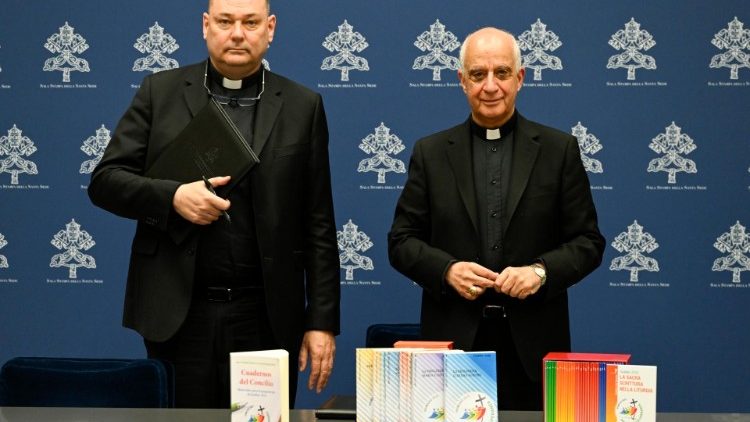
Archbishop Rino Fisichella and Monsignor Graham Bell at the press conference on the Jubilee initiativesArchbishop Rino Fisichella and Monsignor Graham Bell at the press conference on the Jubilee initiatives  (VATICAN MEDIA Divisione Foto)

Vatican launches Jubilee Calendar website and app

As preparations are underway for the Holy Year, the Dicastery for Evangelization presents the official Jubilee Calendar, website and app and announces the winner of the Competition for the official Jubilee Hymn.

By Lisa Zengarini

The Holy Year 2025 is approaching and preparations are well underway.

At a press conference held on Tuesday in the Holy See Press Office, the heads of the Section for Fundamental Questions regarding Evangelization in the World of the Dicastery for Evangelization detailed the several projects envisioned and the preparatory work achieved so far.

Speaking at the conference, Archbishop Rino Fisichella, the pro-prefect of the Dicastery’s Section in charge of coordinating the Vatican’s efforts for  the event, said  that preparations are proceeding at full pace and are progressing significantly.   

Besides starting a series of operational meetings with the Italian government and authorities of the Lazio Region, and the City of Rome to discuss the realization of the infrastructure needed to facilitate the reception of the millions of pilgrims expected to visit the Eternal City in 2025, over the past year the Vatican Dicastery has set up four Commissions and a Technical Committee to support it in outlining the general programme.

Four Commissions

These include a Pastoral Commission, a working group composed of representatives of each Dicastery of the Roman Curia and pastoral contact persons of some ecclesial entities, and whose purpose is to promote preparatory initiatives particularly in the local Churches.

Also, a Cultural Commission has been established to help promote and coordinate cultural activities including exhibitions, concerts and performances, which will accompany and enrich the pilgrims’ spiritual experience.

El Greco exhibition in the Vatican

These activities will kick off in September with an exhibition in the Vatican of three masterpieces of Spanish Renaissance artist El Greco:  The Baptism of Christ, Christ Carrying the Cross, and Christ Blessing.  This first "symbolic event" , said Archbishop Fisichella, will help visitors reflect on the of "Hope in Christ," which is the theme underlining 2025 Jubilee, whose motto is “Pilgrims of hope”.

Also included in the Jubilee preparatory initiatives is the traditional exhibition "100 Nativity Scenes in the Vatican", a popular annual event held in Rome during the Christmas season in which creches from across the globe are displayed.

The information and communication  work of the Dicastery will be supported by a  Communications Commission bringing together journalists from various newspapers, academics, and new media experts, while an Ecumenical Commission  will provide, not only support for inter-religious dialogue on the central theme of Hope, but will also contribute with the Dicastery to the organization of the celebrations for the 17th centenary anniversary of the historic Council of Nicaea, the first Christological Council in Church history, which also falls in 2025.

One further goal achieved over the past months has been the involvement in the Vatican’s Jubilee preparation projects of Dioceses from all around the world. The Dicastery, said Archbishop Fisichella, has already met with the 212 delegates of the Italian dioceses and the 90 representatives of all the Bishops' Conferences.

Publication and translation of  "Council Notebooks”

Following a  request by Pope Francis that 2023 be dedicated to the “rediscovery” of the four Constitutions of the Second Vatican Council on the occasion of the celebration of the 60th anniversary of its opening, the Dicastery has published the "Council Notebooks”, a series of 35 small volumes, on the contents of the Dogmatic Constitutions Dei Verbum, Sacrosanctum Concilium, Lumen Gentium, Gaudium et Spes.

The "Notebooks" have already been translated into Spanish by the Bishops' Conference of Spain under the title "Cuadernos del Concilio," and are also being translated by the Mexican, Brazilian, Czech Bishops’ Conferences and in India in English.

In view of 2024, which Pope Francis has asked to dedicate to prayer, the Dicastery is also studying the possibility of setting up a "School of Prayer," and plans to publish a series of resources titled "Notes on Prayer," aimed at encouraging  the faithful to rediscover the value of prayer  sustained by the great Christian tradition.

Winner of the Competition for the official Jubilee Hymn

During the press conference, the Vatican Pro-Prefect also announced that the Dicastery has selected the winner of the Competition for the official Jubilee Hymn. His name  is Maestro Francesco Meneghello, from Mantua, Italy, who is to set to music the text by Italian theologian and musicologist Pierangelo Sequeri.

The Calendar of the Holy Year and Jubilee website

One of the highlights of the conference was the presentation  of the Calendar of the Holy Year, though for the moment it only covers major jubilee events (Jubilee of young people, movements, confraternities, catechists, the world of work, schools). It will be gradually as the Jubilee year approaches.

Visitors will be able to ask information on the Jubilee Year, at a  Pilgrims Center - Info Point to be inaugurated on June 1  in the premises of Via della Conciliazion, 7 in front of st.Peters’ Basilica .

As from 10 May information can also be found on the Jubilee website www.iubilaeum2025.va.  

The new portal, explained Monsignor Graham Bell, the Dicastery’s Section  undersecretar is available in 9 languages and already presents some of the most important content for learning about the Jubilee event, including  information on the Holy Door of St. Peter's and the other Roman Basilicas. News will be updated daily and starting in September this year pilgrims will be able to register for the Jubilee events and the pilgrimage to the Holy Door.

The  “Pilgrim Card"

From that date the Pilgrim's Zone, the personal page accessed after registering, will be active. Upon registration,  after entering the required data, pilgrims will receive the “Pilgrim Card" in digital version, with a personal Qr code needed to access Jubilee events and to organize the pilgrimage to the Holy Door. The use will be intended not only for individuals, but also for groups.

The Jubilee App

Also  from September social media pages and the new Jubilee App, iubilaeum2025, be officially active and accessible. The app, which will be downloadable for iOs and Android, will allow users to access all the news already on the website, but also make it easier and faster to register for Jubilee events, with the option of receiving personalized information.