Showing posts with label relics. Show all posts

Monday, June 29, 2026

The Relics of St. Margaret Mary Alacoque in United States thanks to Knights of Columbus


Sacred Heart visionary’s relics travel US amid nation’s 250th anniversary


People venerate the major relics of St. Margaret Mary Alacoque at St. James Cathedral in Orlando, Fla., June 12, 2026. The Knights of Columbus brought the relics of the French Visitation nun and mystic to the United States for a multi-city tour. The saint experienced visions of Jesus revealing his Sacred Heart. (OSV News photo/Paul Haring, Knights of Columbus)

The relics of the French nun to whom Christ revealed his Sacred Heart will be available for public veneration in the U.S. at a number of locations, as the nation – newly consecrated to the Sacred Heart – marks its 250th anniversary.

The Knights of Columbus announced June 23 that major relics of St. Margaret Mary Alacoque will travel to Washington and Baltimore from June 29 through July 5.

The relics – which include the saint’s clavicles, two of her ribs and a small piece of her brain – arrived in the U.S. in early June, ahead of the U.S. Conference of Catholic Bishops’ formal consecration of the nation to the Sacred Heart during their annual spring plenary assembly in Orlando, Florida.

The lay leader of the Knights of Columbus in France, Arnaud Bouthéon, personally supervised the relics’ transatlantic transfer from the Chapel of the Apparitions at the Monastery of the Visitation in Parais-le-Monial, where they are housed along with a wax effigy of the 17th-century saint’s body.

Between 1673 and 1675, the Visitation nun experienced visions of Christ showing his Sacred Heart and calling on humanity to experience his love, mercy and tenderness.

The devotion – with roots in Scripture and patristic writings, and widely extolled by a number of popes – spread through the efforts of St. Claude La Colombière, the Jesuit confessor of St. Margaret Mary Alacoque, and the Society of Jesus.

The saint’s relics were on display from June 24-27 at the Blessed Michael McGivney Pilgrimage Center in New Haven, Connecticut.

From June 29 through July 4, the relics will be available for public veneration at the St. John Paul II National Shrine in Washington. Access hours vary slightly during that time, with the relics on public display from 10:30 a.m. to 3:30 p.m. June 29-July 1, and from 10 a.m. to 5 p.m. July 2-4.

From July 5-6, the relics will be available at Baltimore’s Basilica of the National Shrine of the Assumption of the Blessed Virgin Mary. Public veneration will begin with a 10:30 a.m. Mass on July 5 celebrated by Archbishop William E. Lori of Baltimore, and will last until 7 p.m. that day. On July 6, the relics will be available from 7 a.m. to 1 p.m. at the basilica.

Following public veneration in Baltimore, the relics will return to the Blessed Michael McGivney Center for viewing July 8-11 and July 15-18 from 10 a.m. to 4 p.m.

The relics are scheduled to be transported to Denver Aug. 1-6 for the Knights of Columbus’ annual convention, after which they will return to the center in New Haven for public veneration Sept. 25-27.

Monday, March 23, 2026

Public veneration of the relics of Francis of Assisi comes to an end


Pilgrims in line to see the relics of St. FrancisPilgrims in line to see the relics of St. Francis  (ANSA)

Public veneration of St. Francis of Assisi’s relics ends

After welcoming more than 370,000 visitors since its opening on February 22, the public veneration of St. Francis of Assisi’s mortal remains came to a close on March 22.

Vatican News

Sunday, March 22, marked the end of the public veneration of St. Francis' remains, exposed for a month in the Lower Church of the Basilica of St. Francis in Assisi.

This was the first time his relics were displayed and more than 370,000 pilgrims from all over the world came to see them. The public veneration was part of several events scheduled this year to commemorate the 800th anniversary of the Saint’s death.


Cardinal Zuppi: let us listen to message of peace

To conclude the month, Cardinal Matteo Zuppi, Archbishop of Bologna and President of the Italian Bishops’ Conference, celebrated Mass in the Upper Church of the Basilica.

In his homily, he highlighted this current time period marked by individualism and conflict, in which “the tragic illusion is to fight evil with evil.” He said Christians are called to an “unarmed strength” born of the Resurrection, which opposes death and everything that leads to it.

“In this season that exalts force,” the Cardinal urged, “let us listen to the message of peace. How much fear and violence would already be disarmed if we simply said, with our faces and our words, ‘peace be with you.’”

Building the true path to peace

Cardinal Zuppi then highlighted the heart of the Christian message. “It is not force that rules the world,” he said, “because love is the only one that can change it.”

Referring to St. Francis, Cardinal Zuppi emphasized his universal relevance. “He does not belong to one people but to everyone” and he teaches “a love capable of recognizing every person as a brother.”

“It is a humble love,” he continued, “that does not give up and brings the world back to life, to the point of disarming death.”

In a world “afflicted by conflicts and divisions,” he invited everyone to become “builders of peace, disarmed and disarming witnesses,” “building bridges where walls are raised and rediscovering in the Gospel the path of dialogue as the only true defense of peace.”


St. Francis’ relics: a great consolation

The experience of the public veneration itself was “a great consolation” for the thousands of pilgrims who came to Assisi, the Cardinal emphasized.

Before St. Francis’ remains many rediscovered “strengths” and a concrete sense of God’s presence in daily life,” he added. Holiness “is not perfection but the reflection of God’s love in the poverty of our lives.”

We have become “a fraternity gathered around Francis,” said Fr. Marco Moroni, Custos of the Sacred Convent, referring to the flow of faithful who came to venerate the remains.

“A fraternity of 370,000 people gathered here and many others throughout the world. A composed and prayerful fraternity that sought to encounter, in the sign of poor and fragile bones, the full power of a life animated by the Spirit, which continues to bear fruit.”

Fr. Moroni thanked all those who collaborated, organized and participated in this event, which he said exceeded his expectations.

St. Francis called us to him

Fr. Giulio Cesareo, Director of Communications of the Sacred Convent, added: “Many asked me whether I expected such a large turnout, and I must say yes: I had no doubt that so many would come to encounter Francis.”

“What I did not expect was the collected and joyful way the pilgrimage unfolded: silence, patience, phones put away… and yet there are the remains of Francis and Giotto’s frescoes,” he continued. “The only explanation is that none of us came to see Francis—rather, he, alive, called us to speak to our hearts and minds.”

Fr. Cesareo also thanked all the journalists and communications workers who collaborated with the Sacred Convent and contributed to sharing information on this event.

A breath of newness

This month of veneration was a time of renewal and meaningful encounters centered on the figure of St. Francis. The community of friars, for example, welcomed brothers from Italy and from countries such as Brazil, the United States, Tanzania, India, Korea, and the Middle East.

The event also led to the creation of a music video to accompany the hymn of the public veneration, “Su questo colle” (“On this hill”).

Additionally, significant renovations were carried out in the Sacred Convent complex in order to remove architectural barriers and make the visit to the relics fully accessible to everyone.

This focus on inclusivity reflects St. Francis’ spirit, as he began his journey of conversion by reaching out to the most vulnerable and marginalized.

A journey that continues

In the evening, after the last pilgrims had passed through, the Saint’s remains were placed back in the crypt of the Basilica in a private event only attended by the friars and which marked the end of the public veneration.

Nonetheless, the theme “St. Francis Lives” will continue throughout 2026. It will accompany all the initiatives marking the 800th anniversary of the Saint’s death, highlighting the enduring vitality of his message and his ability to speak to all.

Tuesday, February 24, 2026

Venerating the relics of St. Francis of Assisi for 1st time in 800 years


St. Francis’ relics open to public for first extended veneration in 800 years

5:06 PM February 22, 2026

Monks from the local Franciscan community venerate the relics of St. Francis, which were exhumed from their shrine in the Basilica of St. Francis in Assisi, Italy, the morning of February 21, 2026. The remains were exhumed in the presence of the friars and placed on a specially prepared table in the crypt, before being displayed for public veneration Feb. 22. (OSV News photo/courtesy Sala Stampa Sacro Convento Assisi)

ASSISI, Italy (OSV News) — For the first time in eight centuries, the mortal remains of St. Francis of Assisi are being exposed for an extended period of public veneration, drawing hundreds of thousands of pilgrims from around the world to pray before “the Little Poor Man of Assisi.”

The bones of the beloved saint were unveiled for public display Feb. 22 in the Lower Church of the Basilica of St. Francis of Assisi. Pilgrims waited in line outside of the Assisi Basilica, taking in the panoramic views of the Umbrian countryside from the medieval hilltop town, for their chance to pray before the relics. 

The veneration runs through March 22 as part of the Catholic Church’s yearlong celebration of the 800th anniversary of St. Francis’ death in 1226.

Among the first to venerate relics

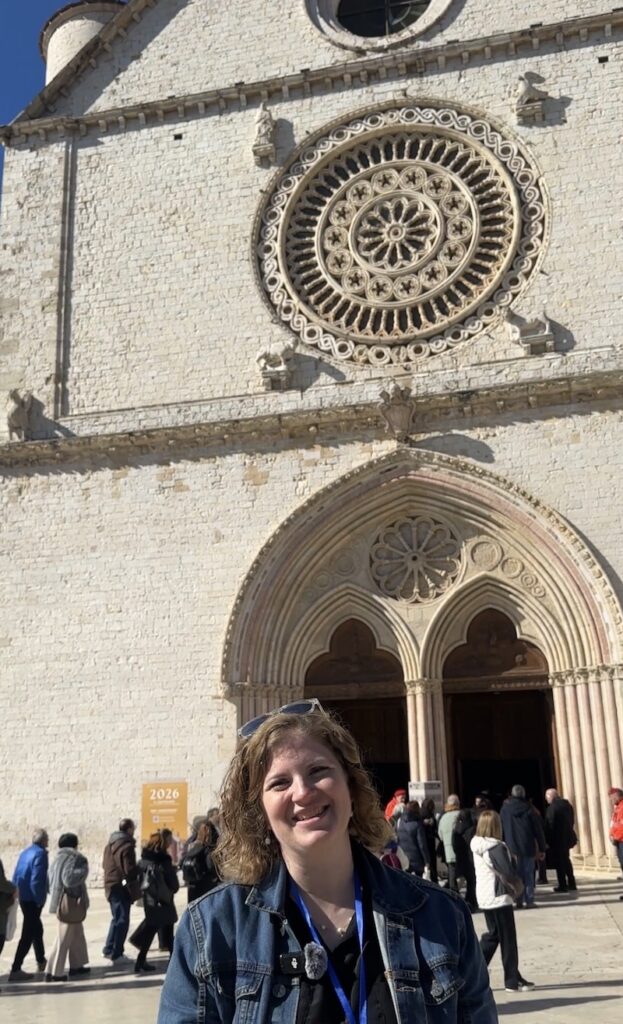
Heather Martin, an American mother who has lived in Assisi for five years with her family, was among the first pilgrims to venerate the relics of St. Francis on display Feb. 22, 2026, in Assisi, Italy. (OSV News photo/Courtney Mares)

Heather Martin, an American mother who has lived in Assisi for five years with her family, was among the first pilgrims to venerate the relics. 

“St. Francis is by far the most important saint in my life. He’s shown up for me in so many ways and so many dark moments,” she told OSV News. 

“This experience to be able to go and physically see his physical form has been utterly life changing.”

Martin recalled a conversation she had with one of the Franciscan friars about the experience. “He felt like he was finally meeting a long-lost relative for the first time,” she said. “And I can’t agree with that more.”

Fabrizio Ballanti traveled from Ancona, Italy, as part of a care home run by the Focolare movement.

‘Came together to live this experience’

“We are a community for people with HIV and AIDS, and we all came together to live this experience,” Ballanti said. 

Standing before the relics of St. Francis, he said, “I felt the presence of the Lord very strongly,” calling it “a truly powerful experience.”

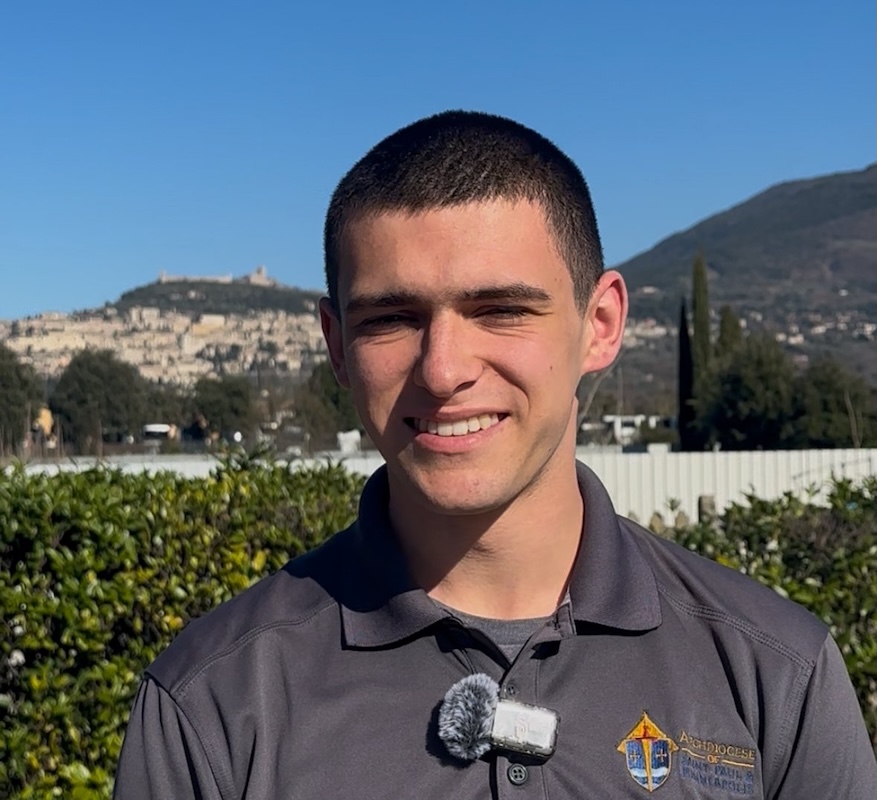
Gregory Maloney from the Archdiocese of St. Paul and Minneapolis is pictured Feb. 22, 2026, in Assisi, Italy. The 21-year-old seminarian said that visiting the relics of St. Francis was an opportunity for him to ask for the gift of a deeper conversion “to grow in the virtue of poverty.” (OSV News photo/Courtney Mares)

For 21-year-old seminarian Gregory Maloney from the Archdiocese of St. Paul and Minneapolis, the moment was an opportunity to ask St. Francis for the gift of a deeper conversion “to grow in the virtue of poverty.” 

He said that the long wait in line to view the relics gave him an opportunity to reflect on the life of St. Francis in prayer. “Here is the man who wanted to live poverty as Christ really said it in the Gospel,” Maloney said. “He wanted to give up his whole life, to give up all the things of the world to focus on the pearl of great price … the treasure of heaven.”

“And so that was a great encouragement for me then to say, ‘OK, what are the areas in my life I need to give to the Lord? I need to focus more on the things of heaven,” the seminarian added.

Opening of the sarcophagus

Monks prepare the relics of St. Francis of Assisi in the crypt of the basilica in Assisi, Italy, Feb. 21, 2026, for public veneration, which began Feb. 22 and runs through March 22. (OSV News photo/courtesy Sala Stampa Sacro Convento Assisi)

Franciscan friars opened the sarcophagus to exhume St. Francis’ remains Feb. 21, placing his bones on a specially prepared table in the crypt before carrying them in procession through the Lower Church while praying the Litany of the Saints. 

Franciscans from across the world participated in a solemn vespers with the exposed relics beneath the basilica’s frescoed ceiling on the evening before the relics opened to the public.

Friar Ignacio Ceja Jimenez, a Franciscan friar from Mexico, called it a historic moment of fraternity for all branches of the Franciscan family “because we all recognize ourselves as children of St. Francis, heirs to his charism.”

“Seeing and praying before the body of St. Francis also means that we must commit ourselves to living what he lived,” he said.

Gospel’s transformative power

“St. Francis reminds us that the Gospel can not only transform human beings, hearts, but that the Gospel can also transform the structures of our world and help us build a fraternal, peaceful world.”

Cardinal Ángel Fernández Artime, the pontifical delegate for the Papal Basilicas of Assisi, presided over both the vespers and the inaugural Mass Feb. 22. 

The cardinal recalled St. Francis’ final hours on Oct. 3, 1226, in his homily for the Feb. 21 vespers.

“When St. Francis felt his death approaching, he asked a friar to read the Gospel to him. Not just any passage, but chapter 13 of John: ‘Before the feast of the Passover, Jesus, knowing that his hour had come … having loved his own who were in the world, he loved them to the end,'” Cardinal Artime said.

“His life had been this: a constant listening to the Word, a burning desire to conform himself to the poor and crucified Christ. Service and self-sacrificing love are the heart of Francis’s spirituality.”

Advice for those unable to get to Assisi

Brother Jimmy Zammit of Toronto, now based in Rome as general definitor for the Franciscan order, shared his advice for Catholics unable to make the trip to Assisi who want to live out the special Jubilee Year of St. Francis in a particular way.

“If our heart becomes more Franciscan, we become makers of peace,” Brother Zammit said. “We seek out to help those who are less fortunate than we are to help the poor, but also to help those who are suffering because they’re feeling isolated and maybe even shunned in some way.”

Approximately 370,000 people from five continents have registered to venerate the relics, with Italians making up 80% of registrants. International registrations include 5,000 from the United States, 3,100 from Croatia, 2,000 from Slovakia and 1,500 each from Brazil and France. Some 400 volunteers from dozens of countries are giving of their time to make the monthlong historic event possible. 

Free to viewing relics but registration needed

Entry to view St. Francis’ relics is free, but it requires advance registration at saintfrancisliveson.org. The exposition will close with Mass on March 22 in the Upper Church, to be presided over by Cardinal Matteo Maria Zuppi, archbishop of Bologna and president of the Italian Episcopal Conference.


A banner noting the 800th anniversary of the death of St. Francis occurring in 2026 hangs outside the Basilica of St. Francis in Assisi, Italy, Feb. 22, 2026. (OSV News photo/Courtney Mares)


“We are experiencing an event of extraordinary grace: For an entire month, in this holy land where St. Francis of Assisi lived and was buried, the exposition of his body is offered for the veneration of the faithful, on the eighth centenary of his death,” Cardinal Artime said.

“This body, fragile and poor, reminds us that the Gospel is also lived with the body, with real choices, with daily gestures. Francis did not love an idea of Christ: He loved Christ, poor and crucified, to the point of bearing his marks in his flesh.”

Courtney Mares is Vatican editor for OSV News. Follow her on X @catholicourtney.

Tuesday, February 17, 2026

Veneration of relics of St. Francis of Assisi begins this week; marking 800th anniversary of his death


The chapel that hosts the relics of St. Francis in AssisiThe chapel that hosts the relics of St. Francis in Assisi 

Remains of St. Francis to be visible for veneration in Assisi

Fr. Giulio Cesareo, director of the Communications Office of the Sacred Convent of Assisi, speaks to Vatican News about the significance of exposing the relics of St. Francis of Assisi and the message he still bears for today’s world.

By Francesco Ricupero

From Sunday, February 22, until March 22, in the lower church of the Basilica of St. Francis of Assisi, pilgrims will be able—for the first time—to pray before the Saint's remains, as 2026 marks the 800th anniversary of his death.

In a time marked by uncertainty, social tensions, and a search for meaning, the display of St. Francis’ relics is an event that goes beyond simple devotion.

For the Catholic Church, it represents a powerful spiritual call and for the faithful it can be an opportunity for a tangible encounter with the living memory of one of the most beloved and universal saints.

In the city of Assisi, the display of the relics renews a profound bond between history, faith, and community, relaunching St. Francis’ message of peace, fraternity, and simplicity that continues to speak to today’s world. Around 15,000 to 18,000 people are expected daily to come see the remains, meaning around 370,000 visitors in total.

In the following interview with Vatican News, Fr. Giulio Cesareo, director of the Communications Office of the Sacred Convent of Assisi, reflects on what this ancient gesture means for society today. 

Q: What is the spiritual and pastoral significance of the display of St. Francis’ relics for the Catholic Church today?

Christians have always venerated relics, because the saints—especially the martyrs—are those who testified with their lives that the love of God fully embraced them, and God’s love is not something abstract; it involves the flesh.

These people served the poor, prayed, fasted, loved others, and allowed themselves to be consumed by love for Christ. Christians have always venerated the lives of the saints because, in them, they saw the action of the Holy Spirit filling their flesh with this love.

This is the context for venerating St. Francis’ relics. We have chosen the Gospel of John, Chapter 12, verse 24, as our interpretative key. In it Jesus, speaking of Himself, says that unless a grain of wheat falls into the earth and dies, it remains alone; but if it dies, it bears much fruit

St. Francis is truly this seed who, in the manner of Jesus, of the saints, of the martyrs—and perhaps of all people of good will—gives himself in daily life. Whoever gives himself is consumed; there is no way around it, but he then bears fruit!

Q: In what way does the exposition of the relics strengthen the sense of belonging and communion among the faithful, both locally and universally?

It strengthens faith. Our faith is not a pre-existing belief, but a relationship with the Lord, who is love. Having faith is inseparable from the experience of being one, united in love.

In this sense, venerating St. Francis’ relics means being strengthened. It means receiving the grace to be reaffirmed in this certainty: that whoever loves, while spending and consuming himself, is in fact nourishing the bonds of unity—those of the Church, those of charity.

The more we live in love and self-giving, the more our humanity becomes our very essence as human beings. What unites us to others is not ideas, but the love we give in our relationships.

Venerating St. Francis is an opportunity to consider how love given authentically bears so much fruit—so much so that 800 years later, he is still spoken of.

Q: What impact does this event have on the local community and on pilgrimages to the basilica?

Certainly, in this month, Assisi and the surrounding area live through this event. Accommodations have been practically sold out for months: hotels, restaurants—everything is booked.

We hope this can be an opportunity of grace, because our society constantly tells us: “Think of yourself. Don’t give yourself. Don’t worry about others. Take care of yourself first.” St. Francis says exactly the opposite, and his bones testify to this.

They are the bones of someone who gave himself, who consumed himself, by walking, kneeling, and living in caves. He tells us in our hearts: do not be afraid to give yourself, because in doing so you bear fruit. I think this is beautiful and deeply beneficial for all of us.

Q: Why does the figure of St. Francis continue to speak to young people and non-believers through concrete signs such as relics?

I believe it is St. Francis himself who speaks. The relics are part of his biological matter. Just as you can hear me because I speak and therefore have a body—if I did not have a body, I would not have a voice.

Our body is the place where relationships happen. In the same way, St. Francis' relics are also the shell of this seed of Francis that has sprouted, and it is a shell that tells us about him.

Why do people seek him? I am convinced that people seek St. Francis because he is truly the Gospel. In him we see that when the Gospel is welcomed, it is good news for the world, for individuals, and for the community. That is what attracts people.

From the beginning, Francis was called alter Christus—not in the sense of another Christ, but as an icon of Christ, an image resembling Christ.

Q: Is the exposition merely a moment of popular devotion, or does it also represent an ecclesial act with strong theological and cultural significance?

We have provided much information on the website sanfrancescovive.org and on the basilica’s social media pages on Facebook and Instagram. We want to nourish devotion—our love—through an ecclesial experience that is theologically grounded, but not necessarily difficult. Theology was not born to be difficult. It was born to express in words the life that dwells within us.

In this sense, we see in St. Francis the shell of a seed that has germinated in charity, crossing time and space. This is an encouragement for all of us to live our daily lives with love. That is what St. Francis invites us to do.

Q: In a time marked by social crises and conflicts, what universal message can St. Francis of Assisi convey to the faithful?

St. Francis did not live in a time much better than ours. There were religious wars, internal city conflicts, great disputes, family feuds, and much injustice. He did not live in an ideal historical moment. Yet his message is beautiful: if a person truly embraces the Gospel, he creates a different story around himself; he creates new relationships.

We often hear a voice in the background saying: “You can’t do anything. You are alone. You are useless. The powerful rule. We can do nothing.” Yet Francis testifies that it is a lie, because if one person embraces the Gospel, he may not change the whole world, but he may change things around him.

For 800 years St. Francis has continued to touch people’s hearts. I believe the beautiful message is this: we cannot solve every problem, but if each of us takes one step, that step leaves an impact—it has an effect. And it is a lie to say that we can’t do anything.

Friday, May 30, 2025

A habit and other relics of Padre Pio are coming to America


Padre Pio’s habit, rare relics coming to US — along with his fellow Capuchins


St. Pio of Pietrelcina, known as Padre Pio, is seen in this undated photo that was part of a Vatican-hosted presentation of 10 new photos of the Capuchin saint on April 29, 2024. (CNS photo/Courtesy Saint Pio Foundation)


(OSV News) — A habit worn by St. Pio of Pietrelcina and other rare relics are coming to the U.S., brought by Capuchin friars from the very monastery that was home to the beloved saint known as Padre Pio.

The National Center for Padre Pio in Barto, Pennsylvania, and the Padre Pio Foundation of America in Cromwell, Connecticut, announced the visit in a May 19 joint press release.

Capuchin Father Francesco Dileo, provincial minister of the Capuchin Friars Minor of San Giovanni Rotondo, Italy — the monastery at which the saint served — will lead the relics tour, which will take place Oct. 11-14 at the Barto center and Oct. 15-18 at St. Pius X Church in Middletown, Connecticut.

Full-Size Habit Worn by Saint

The friars will bring with them a full-size habit worn by the saint, one that has previously never left Italy, along with a second relic.

Padre Pio’s habit is “far more than a simple garment,” and is rather “a sacred symbol of his vocation, humility, and total devotion to Christ,” said Christina Calandra Rocus, whose late mother, Vera Calandra, founded the National Center for Padre Pio after a profound encounter with the saint during his earthly life.

With her husband’s encouragement, Calandra traveled to visit Padre Pio two years after the birth of their fifth child, Vera Marie, who suffered from congenital and life-threatening defects to her urinary tract. During two audiences, the priest blessed Vera and her daughter, as well as Christina and her brother Michael, who had accompanied their mother. Upon their return to the U.S., doctors discovered a bladder growing in place of the one they had removed from Vera Marie, and her health steadily improved. The family founded the center in 1971 in gratitude for Padre Pio’s intercession.

‘Deep Spiritual Reflection and Prayer’

Vera Marie Calandra, now the center’s vice president, said the “unprecedented visit” of the “rare and intimate relic” marked “an occasion of deep spiritual reflection and prayer” — both of which were hallmarks of Padre Pio’s life.

Born Francesco Forgione in 1887 in Pietrelcina, Italy, the future saint entered the Capuchin order at age 15 and was ordained in 1910. Between 1915 and 1918, he served intermittently in the Italian Army’s medical corps during World War I but was ultimately discharged due to poor health. He returned to his monastery at San Giovanni Rotondo, and in 1918 received the stigmata (the wounds of Christ), the first priest to receive such marks in the history of the Catholic Church.

Physical and Spiritual Suffering

Amid sustained physical and spiritual suffering — compounded by austerity and long hours of prayer — he established Casa Sollievo della Sofferenza, now a renowned national research hospital located in San Giovanni Rotondo. The Capuchin also devoted himself to the healing of souls, often spending more than 15 hours a day hearing confessions. Padre Pio died in 1968 and was canonized in 2002 by Pope John Paul II, with whom he had been friends since 1947.

A detailed schedule of the relics tour is available on the websites of both of the centers, which are the only two organizations in North American officially recognized by the Capuchins of Our Lady of Grace Friary.

Julie Fitts Ritter, executive director of the Padre Pio Foundation of America, said the visit of the friars and the relics tour — which she described as a “tremendous privilege” — promise “to deepen the devotion of all who love Padre Pio and carry on his legacy of faith, healing, and compassion.”

Gina Christian is a multimedia reporter for OSV News. Follow her on X @GinaJesseReina.