Showing posts with label funerals. Show all posts

Thursday, July 30, 2026

The funeral reforms implemented by Bishop Paprocki; putting the focus where the focus needs to be


Illinois bishop bars family eulogies, same-day vigils under new funeral policies
by Brian Fraga

A mourner touches a casket in this file photo. (OSV News)

People in the Diocese of Springfield, Illinois, are no longer able to eulogize or speak about their deceased loved ones during Catholic funeral rites after a series of new diocesan policies took effect earlier this month.

The new policies allow a reference during the rites to "how the deceased person put his or her Christian faith into practice," but any words of remembrance have to be submitted for approval three days prior to the funeral Mass and they can only be read by a priest or deacon.

Springfield Bishop Thomas Paprocki announced the changes in a six-minute YouTube video and in a statement posted on the diocesan website where he said that he and diocesan officials were looking to "address some irregular practices that have crept into local funeral services."

Bishop Thomas J. Paprocki of Springfield, Illinois, is pictured in a July 11, 2018, photo. (OSV News/Courtesy of Diocese of Springfield in Illinois)


Those practices, Paprocki said, include having a visitation immediately preceding the funeral Mass, as well as friends and loved ones delivering eulogies during the rites, which Paprocki said the Order of Christian Funerals does not permit.

"Unfortunately, too often people speaking at the end of a Funeral Mass say things that are very inappropriate," Paprocki said. "Even if the remarks are suitable words of remembrance, family members are often overcome with grief and have a hard time getting through their remarks."

The policies took effect, July 1, and they are intended to "ensure that Catholic funerals in our diocese will conform to the norms of the Catholic Church," said Paprocki, who is one of several bishops in recent years who have tightened diocesan policies pertaining to funerals and burials to emphasize stricter adherence to church norms.

In May, Bishop Robert McManus of Worcester, Massachusetts, issued a decree that emphasizes the church's preference for bodies to be buried instead of cremated. In October 2025, Youngstown, Ohio, Bishop David Bonnar ended funeral visitations in church buildings. In January 2025, the Archdiocese of Los Angeles updated its funeral guidelines that emphasize the sequence of funeral rites and that state delaying burial for convenience is inappropriate.

In addition to regulating how the deceased is remembered during the liturgy, the new policies in the Diocese of Springfield, Illinois, now prohibit a visitation in the church immediately preceding the funeral Mass.

According to Connecting Directors, a publication for the funeral home industry, practicalities such as convenience, cost-savings and scheduling constraints have condensed memorial observances into one-day events, with visitations often held immediately before the funeral services.

Paprocki refers to that trend as one of several "liturgical anomalies."

"The vigil, by definition, is the night before, so the vigil prayers will be prayed then by the priest or deacon even if there is no public visitation," Paprocki said. "In such cases, it would be fitting at least for the immediate family members to join the priest or deacon in the vigil prayers."

Mourners can gather at the funeral home prior to the funeral, where a priest or deacon may preside over a brief prayer service called Transfer of the Body to the Church or to the Place of Committal. If no priest or deacon is available, a funeral director, a member of the parish staff, or a relative or friend of the deceased can offer the prayers.

"Another problematic area that has crept into recent practice," according to Paprocki, had been the practice of eulogizing the deceased. The Order of Christian Funerals permits, in certain circumstances, "speaking in remembrance of the one who died," but does not permit a eulogy.

"To speak in remembrance of the deceased is to speak about the faith-life of the one who died and to give praise to God. A eulogy makes the person being praised the main focus of attention. The homily and the words of remembrance have God as the primary focus," Paprocki said.

"In this regard, reference may be made to how the deceased person put his or her Christian faith into practice, which provides a good example for others to follow and gives hope for an eternal reward in Heaven," Paprocki added.

Any words of remembrance that the family would like to be spoken by a priest or deacon have to be submitted three days before the funeral. Only the priest or deacon will then read those words during the vigil, funeral Mass or liturgy, or during the Rite of Committal at the cemetery.

"If deemed appropriate by the family, words of remembrance or even a eulogy may be given by someone other than the priest or deacon in other gatherings, such as at the meal following the committal service," Paprocki said. "This should not, however, immediately precede or follow any of the Christian funeral rites."

The new policies in the Springfield Diocese also stipulate that the Catholic Church "still earnestly recommends that the pious custom of burying the bodies of the deceased be observed," even if the church does not prohibit cremation unless chosen for reasons contrary to Christian doctrine, such as denial of the resurrection of the body.

The diocesan policy requires that interment of cremated remains take place within 30 days following the funeral rites. 

When cremation takes place, Paprocki said, "all of the cremated remains of the deceased person's body must be interred following the Rite of Committal. At no time and in no way shall the cremated remains be divided, separated, or interred in more than one place."

Friday, November 7, 2025

Why are Catholic funerals way down when Catholic population is up


Why Are Fewer Catholics Having Church Funerals?

Despite its enormous significance, skipping a funeral Mass and instead opting for a graveside service or ‘celebration of life’ for a loved one has become increasingly common among U.S. Catholics.


Funeral Masses commit loved ones to God in prayer. (photo: Josh Applegate/Unsplash)

Death awaits at the end of every human life, and this profound event is also the entry point to the final judgment by Jesus that will determine the permanent destination of every human soul: heaven or hell.

The Catholic Church consequently has always emphasized the crucial importance of celebrating a funeral Mass, since it is the instrument through which recently departed souls can be commended to the care of God — and assisted by the prayers of their families and friends — on their final journey.

Yet despite its enormous significance, skipping a funeral Mass and instead opting for a graveside service or “celebration of life” for a loved one has become increasingly common among U.S. Catholics.

“There has been an overall steady decline in the number of Catholic funerals reported annually by dioceses in The Official Catholic Directory (OCD),” Father Thomas Gaunt, executive director of the Center for Applied Research in the Apostolate (CARA), told the Register.

From 2001 to 2024, while the total Catholic population rose 9.3%, from 60.6 million to 66.3 million, the reported number of Catholic funerals (funeral Masses, funeral services and burials combined) fell 30.3%, from 503,733 to 350,755. 

Graphic shows the decline in Catholic funerals (funeral Masses, funeral services and burials combined).(Photo: Jonah McKeown/National Catholic Register)

There has been a similar drop among baptisms, first Communions and weekly Mass attendance during the same period. 

Why the drop? “There are various theories proposed to explain this decline but no hard data,” Father Gaunt replied, adding that “CARA has been interested in researching this for a number of years.”

But anecdotal evidence points to a significant contributor to this trend: Children of devout Catholics are not having Catholic funeral rites for their parents.

Those ministering to grieving families have taken note of this trend.

Certified funeral service practitioner Michael Johnston of Divine Mercy Funeral Home in Fort Wayne, Indiana, which consists of two funeral homes and a Catholic cemetery, certainly has. 

While the trend is less pronounced at his funeral home, which is owned by the Diocese of Fort Wayne-South Bend, “our area, in general, is seeing more and more people going toward a service outside the church and more of a ‘celebration of life,’ which I find interesting because I consider a funeral Mass to be a celebration of life. When I write an obituary, I say ‘a funeral Mass will be celebrated.’”

Added Johnson, “It does seem that more and more people are trending toward a funeral home service or more of a secular service than the traditional religious service that’s been practiced over the years.”

He posits the change might have to do with cremation. “Cremation affords people the opportunity of convenience,” he said, as families can wait weeks or even months and have something informal to mark a loved one’s passing.

Denver’s Response

In Denver, Oblate Father Paul Nguyen, pastor of Holy Ghost Church, finds people opting out of having funeral Masses, but “it’s not an overwhelming trend,” he said. “We still see a fair amount of funeral Masses requested here in Denver.” Some also opt for a graveside service at a Catholic cemetery.

“But the problem that we run into, and more of a change, is the vigil service. A lot of people are not doing the wake. They’ll come an hour early for the funeral Mass, and it’s [wake and funeral] in one shot. We’re also seeing a lot higher incidence of cremations and a fairly low rate of a plan for burying or placing those remains in a columbarium or mausoleum. People are keeping the ashes at home or family members are taking turns.” 

This practice is against Catholic teaching, which communicates that all remains should be buried.

The pastor, who resides in a state that has seen an uptick in human composting and scattering of ashes in the mountains or lakes, explained these are undignified practices that do not honor the deceased. “We counsel against that if we hear about it and encourage them to bury those remains in a sacred place,” he said. 

To counter this trend, a Catholic cemetery in Denver offers an annual free burial of cremated remains in the Crypt of All Souls, including a memorial Mass. Courtesy of this service, Father Nguyen said, people are “able to have a little more closure and finality of the grieving process.” 

Father Kevin Bowman, pastor of St. Joseph Catholic Church in Fort Wayne, Indiana, finds fewer funeral Masses “is definitely the case.” 

“It’s a huge shift from what it used to be in Catholic culture,” he told the Register. “The norm was always the funeral Mass and then the burial.”

He believes COVID was the starting point for when “people have been opting out of Masses.” But he emphasized there are many different reasons why.

“I would say the top reasons are adult children no longer embrace the Catholic faith that they were raised in, either because of marriage situations or they just decide to step away from organized religion,” Father Bowman said. 

He described one situation with the family requesting “an expedited service” and asking him to “abbreviate” the Mass. That shifted the service to a funeral home, to which he agreed. That then changed to a graveside service. “They gave me about five minutes at the graveside. That’s what we ended up with.” 

Father Bowman observed, “It’s not so much Dad’s or Mother’s or grandparents’ wishes, but what the survivors are willing to do.”

The pastor also mentioned another longtime tradition that some families insist on while others sidestep — mourners praying the Rosary at the funeral parlor. He attributes a decline in the prayerful custom to the mixed marriages with non-Catholics. He said while some families have maintained their Catholic identity that way, many have had to accommodate or feel that they must accommodate non-Catholic partners, children and relatives.

“To have a family that has remained very strong and Catholic, rooted in Catholic tradition is rare today, I would dare say,” he told the Register.

Education Is Key

In Arizona, Harry Antram oversees the Diocese of Phoenix Catholic Cemeteries and Funeral Homes, operating six cemeteries and two funeral homes in central and northern Arizona. There, 65% of Catholic burials are preceded by a funeral Mass. 

The diocese established the Catholic funeral homes to ensure the proper handling of Catholic services for the deceased. Antram, who is the organization’s president and CEO, believes many of the problems stem from Catholics today not being catechized about how to handle death, about the sanctity of the body and why the remains should be treated with respect even when considering cremation. 

“That’s why we take time to try to educate families that the greatest gift that you can give your loved one is the funeral Mass,” he told the Register. 

“We have found, contrary to what society is telling us, that Catholics want to know what they don’t know. Many Catholics come in and say, ‘Well, this is what we want,’ and we explain what the Church’s desire is, and they say, ‘Yes, we want to follow.’ Catholic families are yearning to be educated.”

This is evident when Antram works with families who do not want to honor the prearrangements for a funeral Mass. Antram has shown families what their mother or father planned in writing, how they took precious time to go through readings and music that they wanted at the Mass. “Oftentimes, that changes them,” Antram explained. “They say, ‘I didn’t realize they really wanted it that badly.’”

His detailing of Church teaching has even prompted sacramental moments: Children who had not been in church in years requested confession before Mass so they could receive the Eucharist at their parent’s funeral.

The mission of the diocesan funeral homes is “really to educate Catholic families,” he underscored. “That is why it’s so important for Catholic dioceses to look into funeral homes. So many of them have cemeteries, but not many of them have funeral homes. We, as Catholics, have an excellent format to basically create this mission within the Church to really educate Catholic families.”

Looking at the current trend, Michael Johnston also sees hopeful signs. At a recent conference with the National Funeral Directors Association, one item discussed was generational trends for funeral arrangements. “We’re starting to see millennials make funeral arrangements now, and we seem to be trending back more conservative,” he said. “I think we’re going to see this revert again.”

That’s welcome news to Antram. “That’s our faith. You’re offering that Mass as a final send-off for your loved one in prayer that hopefully they’re on their journey to the heavenly Kingdom.”

Tuesday, April 22, 2025

Pope Francis will lie in state now until the funeral this coming Saturday


The late Pope Francis' body lies in the chapel of the Casa Santa MartaThe late Pope Francis' body lies in the chapel of the Casa Santa Marta  (VATICAN MEDIA Divisione Foto)

Pope Francis’ body to lie in state until funeral on Saturday morning

The body of the late Pope Francis will be transferred to St. Peter’s Basilica on Wednesday to lie in state until his funeral on Saturday morning.

By Devin Watkins

The Holy See Press Office announced on Tuesday that Pope Francis’ funeral Mass will take place on Saturday, April 26, 2025, at 10:00 AM in St. Peter’s Square.

Cardinal Giovanni Battista Re, Dean of the College of Cardinals, will preside at the Mass, which will be concelebrated by Patriarchs, Cardinals, Archbishops, Bishops, and priests from across the globe.

The Eucharistic celebration will conclude with the Ultima commendatio and the Valedictio, marking the beginning of the Novemdiales, or nine days of mourning and Masses for the repose of Pope Francis' soul.

The late Pope's body will then be taken into St. Peter’s Basilica and then to the Basilica of St. Mary Major for entombment.

Earlier, on Wednesday, the coffin containing the Pope’s body will be carried from the chapel of the Casa Santa Marta to St. Peter’s Basilica, so that the faithful may pay their respects.

Cardinal Kevin Farrell, Camerlengo of the Holy Roman Church, will preside over the rite of translation on April 23, which will begin at 9:00 AM with a moment of prayer..

The procession will pass through Santa Marta Square and the Square of the Roman Protomartyrs, according to the Holy See Press Office.

The procession will then exit through the Arch of the Bells into St. Peter’s Square and enter the Vatican Basilica through the central door.

At the Altar of the Confession, the Cardinal Camerlengo will preside over the Liturgy of the Word, at the conclusion of which the visits to the body of the Roman Pontiff will commence.

St Peter's Basilica will remain open for the faithful who wish to pay their respects to the late Pope on Wednesday from 11: AM to midnight; on Thursday from 7:00 AM to midnight; and on Friday from 7:00 AM to 7:00 PM.

Wednesday, November 20, 2024

New funeral rites for the Pope


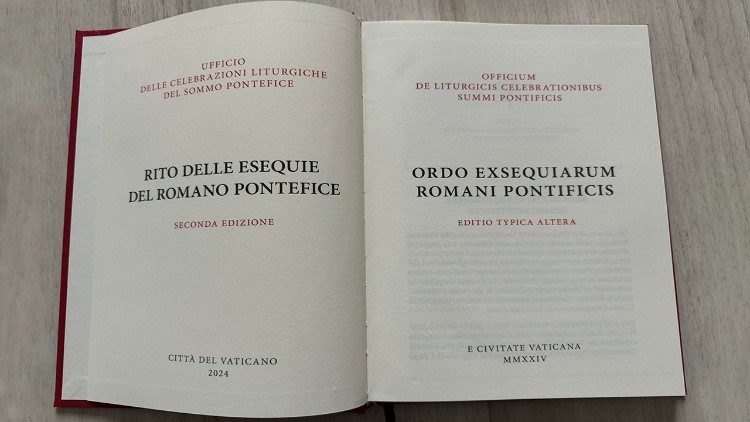
The new edition of the Funeral Rite of the Roman PontiffThe new edition of the Funeral Rite of the Roman Pontiff 

Vatican publishes new edition of funeral rites for Roman Pontiff

Pope Francis has approved the updated edition of the liturgical book for papal funeral rites in April, which was written by the Office for the Liturgical Celebrations of the Supreme Pontiff.

By Vatican News

The Office for the Liturgical Celebrations of the Supreme Pontiff has produced and realeased the second edition of the Ordo Exsequiarum Romani Pontificis, approved on 29 April 2024 by Pope Francis, who received the first copy of the printed volume on 4 November.

A number of new elements for papal funerals have been introduced. The ascertainment of death will no longer take place in the room of the deceased but in the chapel, and his mortal remains will be placed immediately inside the coffin.

The faithful will be able to venerate the Pope's body inside the open coffin, and the tradition of having three coffins of cypress, lead, and oak has been eliminated. 

The liturgical book was presented as a new edition following its predecessor, the editio typica of the Ordo Exsequiarum Romani Pontificis approved in 1998 by Saint John Paul II and published in 2000, which was used in the funeral of the same Pontiff in 2005 and, with adaptations, in those of Pope Benedict XVI in 2023. 

"A second edition became necessary," explained Archbishop Diego Ravelli, Master of Apostolic Ceremonies, "first of all because Pope Francis has requested it, as he himself has stated on several occasions of the need to simplify and adapt certain rites so that the celebration of the funeral of the Bishop of Rome may better expresses the faith of the Church in the Risen Christ."

Archbishop Ravelli also noted that "the renewed rite also needed to emphasise even more that the funeral of the Roman Pontiff is that of a pastor and disciple of Christ and not of a powerful person of this world."

Thursday, September 5, 2024

Catholic "natural burials" now offered in Chicago


Chicago opens Catholic “natural burial” cemetery


J-P Mauro - published on 09/05/24

While it is not the only cemetery in Illinois that offers natural burials, it is the first one offered by the Catholic Church.

The Catholic Archdiocese of Chicago has become the first in Illinois to make available cemetery plots for “natural burials.” While alternative methods of burial that have become popular in recent years have been controversial, the archdiocese has assured the faithful that the cemetery’s offerings are completely in line with Church teaching. 

According to the archdiocese, the plots reserved for natural burials will be located in St. Michael the Archangel Cemetery in Palatine, where a small one-acre area will be dedicated as “Meadows of St. Kateri” in September. The archdiocese website describes the site as including a meadow with long grass and a winding path to walk and reflect and “connect with nature.” 


The Archdiocese of Chicago goes on to explain that natural burial is not a new form of burial, but a return to the traditional ways that people buried the dead for the majority of the last 2,000 years. It wrote of the process: 

“Natural burials forgo harsh embalming fluids, traditional caskets, and outer burial containers in favor of biodegradable materials, organic fibers, and eco-friendly embalming techniques. This minimizes environmental impact while honoring the natural cycle of life and death.”

The announcement came with a brief video tour of the Meadows of St. Kateri. The tour begins at a small pavilion area at the entrance and follows the winding path made from gravel and white marble blocks. The environment is very “natural” with the plants left to grow unpruned and flowers popping up unplanned. 

While it is not the only cemetery in Illinois that offers natural burials, it is the first one offered by the Catholic Church. The Archdiocese of Chicago has assured that the offerings at the Meadows of St. Kateri “aligns with Catholic teachings on the sanctity of life and respect for the environment and honors the Catholic faith in the Resurrection — the cycle of death and rebirth.

Ted Ratajczyk, executive director of Catholic Cemeteries in the archdiocese, said in a statement:

“We are honored to offer a new natural burial option that not only respects the environment but also aligns with Catholic teachings for treating the human body with dignity. This initiative reflects our commitment to providing choices that honor the dignity of life, the needs of our community and the values of our faith.” Ratajczyk said in a statement.

Learn more about Catholic natural burials at the Archdiocese of Chicago.

Thursday, February 22, 2024

Cardinal Dolan reacts to transgender funeral fiasco in St. Patrick's Cathedral


Cardinal Dolan on St. Patrick’s funeral: ‘We don’t do FBI checks on people who want to be buried’


Priests at St. Patrick’s Cathedral in New York City were surprised by the “irreverence and disrespect” that occurred during a funeral for a transgender activist last week, Cardinal Timothy Dolan said in his first public comments on it. 

“We didn’t know the background. We don’t do FBI checks on people who want to be buried,” Dolan, the archbishop of New York, said during his podcast Tuesday. 

He said cathedral staff try to be welcoming when someone requests a funeral.

“All they know is somebody called and said, ‘Our dear friend died. We’d love to have the funeral at St. Patrick’s Cathedral. It would be a great source of consolation. She’s a Catholic. It would be a great source of consolation for us, her family and friends.’ And of course, the priest at the cathedral said, ‘Come on in. You’re more than welcome,’” Dolan said. 

The priests at St. Patrick’s made a decision at the beginning of the service not to celebrate a funeral Mass but to conduct a funeral service with no Mass instead. 

It was the right thing to do given the situation, the cardinal said. 

“I applaud our priests who made a quick decision that, ‘Uh-oh, with behavior like this, we can’t do a Mass. We’ll do the Liturgy of the Word, which is the readings, and the sermon, and the prayers of petition, and the Our Father, and then we’ll stop it. The Mass is not going to go on,’” Dolan said. “Bravo for our cathedral people, who knew nothing about this that was coming up.” 

Meanwhile, though, supporters of the deceased are demanding an apology from the Archdiocese of New York for what they described as “cutting short” the Feb. 15 funeral service of Cecilia Gentili, 52, a male who identified as a woman who died Feb. 6. Supporters of Gentili also want an apology for what they called “the painfully dismissive and exclusionary language” used in a statement released by the pastor of the cathedral after the funeral. 

“The current narrative from St. Patrick’s Cathedral leadership that they were manipulated by funeral organizers of the identity of Ms. Gentili is simply not true,” an organization called Gays and Lesbians Living in a Transgender Society said in a written statement. “Funeral organizers advised cathedral staff to look up Cecilia Gentili, her work, and the community she served. To now place responsibility on the funeral organizers to have affirmatively disclosed the gender identity of their loved one is imposing a burden upon the mourners that would not be expected of a non-transgender person.”

However, the New York Times reported that the funeral’s organizer did not disclose to the cathedral that Gentili, who died Feb. 6 at age 52, was a biological man who identified as a woman.

“I kept it under wraps,” Ceyeye Doroshow, the service’s organizer, told the outlet.

The organization also suggested that cathedral staff violated the Catholic Church’s law. 

“Still reeling from the pain of Cecilia’s loss, community members are asking for an explanation for this decision which seemingly violated Catholic Canon Law governing the denial of funeral [M]asses,” the organization said. “… Ms. Gentili’s service ended an hour earlier than had been scheduled, thus denying her the full funeral Mass that was agreed upon.” 

Joseph Zwilling, a spokesman for the Archdiocese of New York, contacted by CNA on Wednesday said the archdiocese had no immediate comment on the Gentili supporters’ statement. 

Asked by email who decided to replace the funeral Mass with the shorter funeral service, Zwilling said the decision “was made by the priests at the cathedral after witnessing what was taking place.” 

A video of the service posted online last week shows that shortly after the procession down the aisle, the presider, Father Edward Dougherty, looking out into the crowd, said with a laugh: “Well, welcome to St. Patrick’s Cathedral. Except on Easter Sunday, we don’t really have a crowd that is this well turned out, you know?” 

After a short delay, the crowd responded with more than 40 seconds of clapping, standing, and cheering, with occasional chants of “Cecilia.” 

During the ovation, the video shows, a priest dressed in black approached Dougherty and told him, “No Eucharist,” eventually followed with the words “a funeral service, no Mass.” 

Outburst at funeral

As CNA reported last week, the prayers of the faithful during the service included a call for “Cecilia’s community” to “have access to life-affirming health care” — an apparent reference to gender transitioning — to raucous applause. 

Two of the three eulogies were critical of Catholic teaching on human sexuality. The organizer of the funeral, Doroshow, a male who identifies as a woman, who wore a purple dress, said Gentili “worked so hard to make sure girls like me, boys like you are safe, are grounded, got health care, that sex workers are free.” A standing ovation followed the “sex workers” reference. 

A man who delivered a third eulogy used a Spanish word for “whore” several times. Another man lauded the deceased as “This whore, this great whore, St. Cecilia, mother of all whores.” Raucous applause and a standing ovation followed. 

On Tuesday, Cardinal Dolan addressed the Gentili funeral about five minutes into his podcast after discussing a few other topics, including the recent shooting at the Super Bowl parade in Kansas City. Dolan mentioned that he had received “a note of solidarity” from Harrison Butker, the Kansas Chiefs kicker, about what Dolan described as “the irreverence and disrespect” of the crowd at the funeral, and the “very irreverent and disrespectful” eulogies. 

The cardinal asked the cathedral staff to celebrate a Mass of reparation after the funeral service, which the pastor, Father Enrique Salvo, said last week was done. 

“In a way, it’s redundant,” Dolan said Tuesday. “Because every Mass, every Mass is the renewal of the infinitely powerful act of reparation that Jesus did on the cross, correct? He’s the one that made reparation. We can’t do much. All we can do is unite with him on his cross in his sacred act of reparation. There is a bit of an arrow in the quiver of the Church’s treasury of prayer that if a particularly sacrilegious or scandalous act has occurred in a church, it would be good to offer a Mass in particular reparation for that act of irreverence. So we did that.” 

Salvo released a written statement Feb. 17, two days after the funeral, acknowledging what he called “outrage over the scandalous behavior” during Gentili’s funeral. 

“The cathedral only knew that family and friends were requesting a funeral Mass for a Catholic, and had no idea our welcome and prayer would be degraded in such a sacrilegious and deceptive way,” Salvo said in the statement. 

Some mainstream media news stories last week hailed the funeral as a shift in the Catholic Church’s approach to gender identity. Dolan expressed frustration Tuesday with criticism by some Catholics of the cathedral staff and his archdiocese. 

“We have a lot of misunderstanding. Why in the world our people out there still believe what the secular press reports is beyond me,” Dolan said. 

Later, he added: “Our policy at the cathedral is to be as open and welcoming of anybody who wants to be buried from here. And we had absolutely no idea about this. But why people still think the cathedral purposely did that? Well, a lot of people always want to believe the worst. And they don’t like us any more than the protesters did, in the cathedral. But who knows.”