Showing posts with label catholic vote. Show all posts

Monday, December 30, 2024

The Catholic vote, Latinos included, shifted to Trump


Catholic voters' shift toward GOP includes Latinos, new study shows


Supporters hold a sign before Republican presidential nominee former President Donald Trump arrives to speak during a campaign event Sept.12, 2024, in Tucson, Ariz. (AP/Alex Brandon, File)


Hispanic Catholics are moving away from the Democratic party, even as a majority of them still voted for Kamala Harris in 2024, a new post-election analysis reveals. The shift among Hispanic Catholics is even larger than that of white Catholics, or Hispanic voters overall.

But the much-trumpeted shift of Catholic voters overall toward Donald Trump may have been greatly overstated in exit polls as Trump's 53% of the vote was a mere 3 percentage points higher than 2020 and one point higher than 2016.

These are some of the findings of a new study by the Public Religion Research Institute.

"I'd be really cautious about making sweeping generalizations about massive realignment, but it's clear that Trump made inroads with many groups," said Melissa Deckman, chief executive of the research institute.

The data offer fresh insights into a much-discussed phenomenon of the Catholic voter in the 2024 election. Despite their sometimes exaggerated role, Catholics' influence remains a matter of interest and continues to dominate political discussion of electoral politics in America. Because of the importance of the issue in public debate, the National Catholic Reporter has named the Catholic voter its Newsmaker of the Year.

Some of the largest Hispanic Catholic gains for Trump came from counties on the southern border, such as Maverick County, Texas. Voters there chose a Republican for president for the first time in 50 years. The county is 95% Hispanic and predominantly Catholic, with three parishes in its boundaries. It is home to Eagle Pass, a small border town where deaths of migrants trying to make their way to the United States by crossing the nearby Rio Grande River have been concentrated.


Such towns are full of working-class Hispanics, who may have been convinced by Trump's economic populist messaging, analysts said.

"We can't underestimate the economy as a factor in shaping the outcome of the election," said Dylan Corbett, executive director of HOPE Border Institute, a Catholic group that serves refugees and migrants. "They've borne the brunt of the COVID-19 pandemic, the housing affordability crisis, rising food prices and the overall economic inequality we can't seem to kick as a country."

In this year's presidential election, 55% of Hispanic Catholics voted for Harris, according to the study by the Public Religion Research Institute. By comparison, an earlier Pew Research Center study showed 66% support among Hispanic Catholics for the Democratic candidate, Joe Biden, in 2020 — a double-digit shift in four years.

Overall, the presidential race was still very close, and while Trump won the popular vote, he did not break the halfway mark. But small changes in voter turnout can have major consequences — and the shifts among religious Hispanic voters were more than small.

The Public Religion Research Institute's survey primarily confirmed previous patterns, said Deckman, chief executive of the institute. Ultimately, white religious voters — including white Catholics — were a deciding factor for Trump.
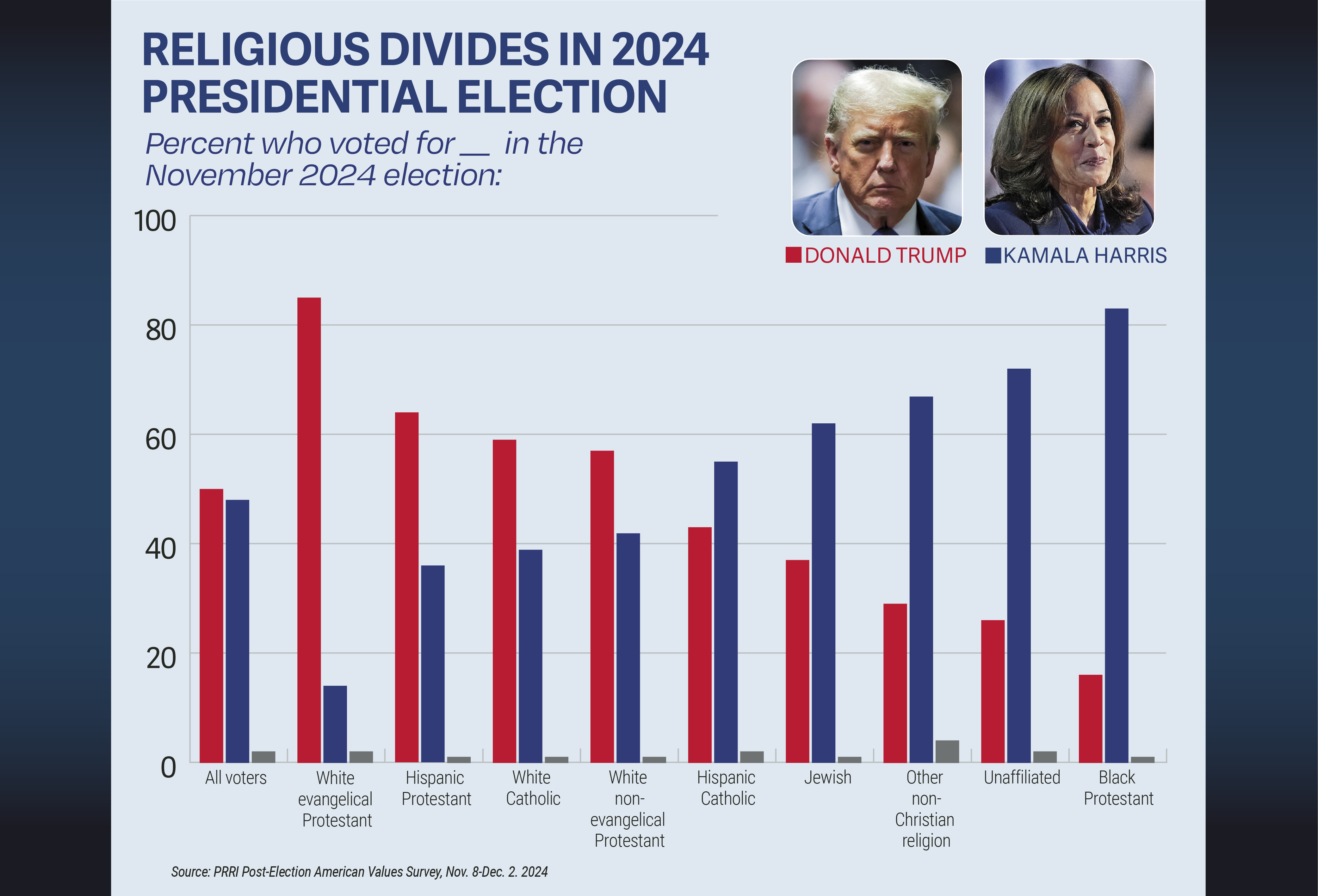
"Religious lines are pretty clearly drawn when it comes to voting behavior," Deckman said. "White people of faith tended to back Trump overall, while religious people of color tended to support Kamala Harris."

The only exception is Hispanic evangelicals — two-thirds of whom supported Trump in 2024.

The numbers for white Catholic voters are far from the 85% of white evangelicals who supported Trump, but the trend over decades continues to show growing support among white Catholics for the Republican Party.

Yet a shift among Catholic voters overall toward Trump may have been overstated in exit polls. The research institute's data for Catholics overall — with 53% of Catholics saying they voted for Trump — is only 3 points higher than 2020 and 1 point higher than 2016. Additional "verified voter" data available in the spring tends to be more accurate, analysts say.

Still, white Catholics "are slowly but surely becoming a clear base of support for Republicans," Ryan Burge, an expert on data about religion and politics, noted even before the election.

Burge has analyzed the counties where Trump made the largest gains since 2020 — and found a correlation between counties with a higher concentration of religious people and bigger gains for Trump. (The full analysis will be published on his Substack in January.)

A list of top counties where Trump improved by 10 points or more is particularly interesting: Every single one is in an area that is predominantly Catholic, and all are in counties where eight in 10 residents are Hispanic. Six of the nine counties are in Texas, along the Mexican border.

The largest gain was in Maverick County, where Trump received nearly 60% of the vote. This is not only a significant increase from 2020, it represents a 36-point shift in the last two election cycles, a swing Burge calls "unbelievable in the modern landscape."

Shifts among Hispanics, many of them Catholic, in those border counties must be about immigration — not abortion — Burge concludes. By comparison, he said, there weren't comparably sized swings in non-border cities such as Houston or Dallas.

"The most logical, simplest explanation is that this is about immigration," said Burge, an associate professor of political science at Eastern Illinois University.

While it might seem obvious to assume that immigrants would support immigration, voting patterns suggest that is not always true. Some researchers have found that established, successful immigrants oppose immigration because of fears that newly arrived migrants will contribute to negative stereotypes about all immigrants.

The Catholic Church supports immigration reform and opposes mass deportations, the opposite of Trump's positions. Pope Francis has been especially vocal about the plight of migrants. However, the U.S. bishops have been significantly more outspoken about "culture war" issues such as abortion or transgender rights — the latter a theme that Trump picked up on in his campaign.

Other surveys of Hispanic Catholics indicate only a slight increase in affiliation with the Republican Party over the past decade, while also seeing a corresponding increase in affiliation with the Democrats (offset by a decline in those identifying as independent). Hispanic Catholics are also less likely to identify as conservative today as they were a decade ago.

That, combined with data showing Hispanic Catholics do not support many GOP policies, leads Deckman to suspect they moved toward Trump in 2024 because of concerns about inflation and the economy. In counties like Maverick in Texas, more than one in five lives below the poverty line, according to the U.S. Census.

"The economy is the most important issue for most Americans, but it is disproportionately important for Hispanic Americans," Deckman said.

Harris also failed to draw a strong contrast on the issue of immigration, running on a platform that included getting tough on the border, Corbett said.

"This should be a wake-up call that we need urgently a politics that addresses the needs of working class families, puts effective policies in place to manage migration at the border, and offers a legalization program for the millions of undocumented essential workers keeping our economy going," he said.

How else to explain the paradoxical results of Hispanic voters moving toward Trump? Some clues may be in the contrast between Hispanic Catholics and Hispanic evangelicals — a 21-point difference in support for Trump, according to the research institute study.

Polarization has led to political parties differentiating themselves based on religious identities, so that to be evangelical is to be Republican, according to Efrén Pérez, who studies race, ethnicity and politics at the University of California at Los Angeles, where he is a professor of political science and psychology.

"That convergence between partisan identity and religious identity is part of what's happening with this change in the patterns of the Latino vote," Pérez said during a webinar about the PRRI data. "They're sort of just picking the right team, so to speak."

It's possible that as Catholic identity is also increasingly associated with Republicanism, the same pattern may happen with Hispanic Catholics.

Yet Pérez wonders how durable the 2024 results may be, given Trump's uniqueness as a candidate. Latinos also tend to be low-propensity voters who don't pay significant attention to politics, he said.

"It could be that we are talking about voters who are kites in the air, where they are highly responsive to the messaging that comes their way during campaigns, because they're still trying to get their political moorings."

Tuesday, November 12, 2024

Donald Trump and the Catholic vote; this time


Trump boosted support among Catholic voters


Republican President-elect Donald Trump addresses supporters during his rally at the Palm Beach County Convention Center in West Palm Beach, Fla., Nov. 6, after being elected the 47th president of the United States. (OSV News/Reuters/Brian Snyder)


Donald Trump performed better among Catholic voters in his election victory this year than he did four years ago in his loss to Joe Biden, according to the AP VoteCast survey of American voters.

Trump captured 54% of Catholic voters compared to 44% for Vice President Kamala Harris — an increase over 2020 that was notable in North Carolina, Florida and Texas, according to VoteCast.

In 2020, the Catholic electorate — one the biggest religious blocs in the nation — was almost evenly split, with 50% backing Trump and 49% favoring Biden, a practicing Catholic.

VoteCast, an exit survey of more than 120,000 voters, documented a racial divide among Catholic voters, similar to what was seen in the NCR Poll of Catholics in battleground states. About six in 10 white Catholics supported Trump, and about four in 10 supported Harris. By contrast, about six in 10 Latino Catholics supported Harris, and about four in 10 supported Trump.

Among religions, VoteCast found that Trump fared about the same against Harris as he did against Biden, winning the support of about 8 in 10 white evangelical Christians. Some of the other VoteCast findings:

  • About eight in 10 Black Protestants supported Harris; 15% supported Trump.
  • About 69% of Jewish voters supported Harris; about 30% supported Trump.
  • About two-thirds of Muslim voters supported Harris; about one-third supported Trump.
  • About six in 10 Mormons supported Trump; about one-third supported Harris.
  • About seven in 10 nonreligious voters supported Harris; about three in 10 supported Trump.

In 2024, Catholic voters were sharply divided over volatile social issues, VoteCast and the NCR poll found. Some conservative Catholics said the Democratic Party's staunch support for abortion rights was reason enough to oppose Harris; more liberal Catholics said Trump's demonization of migrants and disinterest in social justice issues made him unworthy of support.

This story appears in the Election 2024 feature series. View the full series.

Thursday, November 7, 2024

A GOP leaning white Catholic voting bloc emerges from the 2024 election


Expert says Trump victory confirms white Catholics as GOP voting bloc


Republican presidential nominee former President Donald Trump, left, with Republican vice presidential nominee Sen. JD Vance, R-Ohio, right, at an election night watch party at the Palm Beach Convention Center, Wednesday, Nov. 6, 2024, in West Palm Beach, Fla. (Credit: Evan Vucci/AP.)


NEW YORK – While the exact breakdown of the Catholic vote in the 2024 election remains unclear, one expert notes that exit polling data that is available suggests that in future elections, white Catholics can be penciled in as a significant GOP voting bloc.

“White Catholics in every election cycle are becoming an increasingly stronger GOP voting bloc,” Ryan Burge, an associate professor of political science at Eastern Illinois University, told Crux. “I think now we can just assume that the Catholic vote is going to be 60-40, Republican vs. Democrat, and it might even go up from there as things change.”

Burge, who describes himself as a mainline Protestant, spoke with Crux on Nov. 6 after it became clear that former President Donald Trump had secured enough electoral college votes to win the election. So far, multiple exit polls show a significant advantage for Trump with the Catholic vote. NBC gives Trump a 60-37 advantage over Vice President Kamala Harris on that front, and CNN gives him a 56-41 advantage.

In addition to white Catholics, Burge highlighted the apparent shift among Hispanic voters. Nationwide, Trump performed better with Hispanic voters than he did in either 2020 or 2016, and Burge expects that trend to hold for Catholic Hispanic voters, as well.

“One of the things that we’re seeing is the Hispanic vote mattered a whole lot,” Burge said. “I think that they have always been seen as a moderate voting bloc, but voted for Democrats on election day, and I think we saw in 2024 that they’re still a moderate voting bloc, but they’re not necessarily Democratic all of the time.”

Another way to assess the conservative nature of the overall Catholic vote is to analyze the shift in the political leanings of priests over time. Burge said that if you look at survey data of Catholic priests who were ordained in the 1960s and 1970s, you’ll notice that they were evenly split between left, right, and center. That is no longer the case. He said survey data on priests who were ordained in the last ten years shows that they’re 80 percent conservative.

“It’s a purification thing that goes on, where we’re being politically purified by what’s coming from the pulpits and the pews in Protestant and Catholic Churches. To stick around means that you’re at least willing to listen to talking points from the other side of the aisle, which we know that people are less and less likely to do now,” Burge said.

“It’s hard to be challenged from the pulpit on the left or the right, and it looks like the Catholic Church is going to be almost exceedingly from the right in the decades to come,” added Burge, who is also the founder of Graphs about religion, a website that analyzes data regarding religion and politics.

The election also showed, he said, that abortion isn’t necessarily a top priority for Catholic voters. That reality is despite the fact that the United States Conference of Catholic Bishops – both in their voting guide and bishops in individual statements – held it as the “pre-eminent priority” of the election.

“To me, that might be the long, lasting legacy of this 2024 election from a religion/politics standpoint,” Burge said. “There were a whole lot of people who walked in the ballot box in places like Florida, like Missouri, who voted for Donald Trump but then voted to enshrine abortion access in the constitution in their state, and so I think for a lot of people that is not a deal breaker.”

“I’ve been saying that over and over and over again with polling data,” he said. “If you look at white evangelicals, none of them say it’s a deal breaker, the issue of abortion.”

Burge said the simple fact of the election, and Trump’s victory when it comes to the Catholic vote, is that Catholics are all over the country and embrace every economic class. Therefore, he said, like non-Catholics, the economy was clearly a top priority for Catholic voters, and that was going to be the case regardless of statements from any local, national or even global Catholic leader, including Pope Francis.

“I think we realize we all live in bubbles, and I think the average Catholic does not hear [Pope Francis] speak on almost anything in an average year. … I think the average Catholic is not taking their guidance from their priest or their pastor, or their bishop, or a cardinal or the pope,” Burge said.

“I think at the end of the day, they vote based on their pocketbook and decide if they’re doing better or worse than they were doing four years ago, and I think a lot of them think they’re doing worse financially,” he said.

Tuesday, November 5, 2024

Abortion is a big issue in this 2024 election


Candidates’ stance on abortion,

ballot measures on issue play major role 

for Catholics in election


A Minnesota voter wears his "I Voted" sticker after casting an early ballot in St. Paul Nov. 1, 2024. (OSV News/Maria Wiering)


(OSV News) — “Abortion has overtaken immigration to become the second most important issue for voters heading into the 2024 election,” Newsweek, the global media organization, reported Oct. 21 on what its polling has found.

Four years ago — just two weeks prior to the last U.S. presidential election — a Pew Research poll indicated more than half of American Catholics (56%) said abortion should be legal in all or most cases.

Whether or not those attitudes have shifted during the intervening Biden administration could have a profound impact on the Nov. 5 electoral hopes of both the Republican nominee, former President Donald J. Trump, or the Democratic nominee, Vice President Kamala Harris.

“Abortion is arguably the most contentious topic facing Americans today,” Natalie Dodson, policy analyst at the Ethics & Public Policy Center in Washington, told OSV News in an email. “If public opinion has changed, it’s not that Americans are radically pro-abortion, but instead, that the public has been sold a lie about how the abortion industry functions,” she added.

“The average American,” Dodson noted, “does not support abortion up to birth, but they also do not support a complete ban, which poses a challenge for pro-life advocates who must take an incremental approach to abortion.”

Despite Trump having nominated the U.S. Supreme Court justices who overturned Roe v. Wade in June 2022, his campaign website makes no specific mention of abortion among its “20 Core Promises” platform.

Nor does the campaign’s Catholics for Trump webpage — which declares “President Trump did more for Catholics than any administration in history!” — mention the defeat of Roe v. Wade. Instead, it notes, “In 2018, Trump became the first president to address the March for Life rally and declared January 20, 2019 the National Sanctity of Human Life Day.”

Early in his drive to return to the White House, Trump frequently took credit for the downfall of Roe. In a May 2023 tweet representative of that, he asserted, “After 50 years of failure … I was able to kill Roe v. Wade. … Without me the pro Life movement would have just kept losing.”

However, as the nation’s mood indicated the unpopularity of abortion bans among many — according to a May 2024 Pew Research Center poll, 63% of Americans say abortion should be legal in all or most cases — Trump has been less vocal about what he earlier regarded as an accomplishment.

During an Oct. 16 Fox News town hall, Trump also suggested some abortion laws are too strict.

“It’s going to be redone,” he said. “They’re going to …you end up with a vote of the people. They’re too tough, too tough. And those are going to be redone because already there’s a movement in those states.”

In the midst of the same town hall, Trump declared himself “the father of IVF” — in vitro fertilization.

IVF treatments, which fertilize an egg outside the body in a laboratory dish, are opposed by the Catholic Church because, in addition to other ethical and moral issues, they frequently involve the destruction of human embryos.

On Aug. 29, Trump announced that if he’s elected, “your government will pay for — or your insurance company will be mandated to pay for — all costs associated with IVF treatment.”

“It is not uncommon to see politicians shift at the whim of public opinion,” observed Dodson, “and this is a unique election as it is the first since the overturning of Roe. But pro-lifers have faced an uphill climb since 1973. While overturning Roe was a critical step toward forming a society that better protects life at all stages, there is still much work to be done.”

“To move the needle on abortion,” suggested Dodson, “there must be a concerted effort to share with the public the moral concerns of abortion and its harms.”

Harris’ campaign website — and the Democratic Party platform — highlight abortion, primarily contrasting her support for access to it with the restrictions her campaign predicts Trump will enact if elected.

However, the vice president has been clear that it is a priority should she be elected.

On Oct. 26, Harris promised a Michigan campaign rally audience, “I pledge to you, when Congress passes a bill to restore reproductive freedom nationwide, as president of the United States, I will proudly sign it into law.”

Interviewed the same day by “CBS Evening News” anchor Norah O’Donnell, Harris reflected that prior to Roe’s demise, “women, in consultation, if they chose, with their priest, their pastor, their rabbi, their imam were able to make those (decisions).”

When O’Donnell asked Harris if she also supported abortion restrictions after viability, Harris replied, “I support Roe v. Wade being put back into law by Congress, and to restore the fundamental right of women to make decisions about their own body. It is that basic.”

In her Aug. 22 Democratic National Convention nomination acceptance speech, Harris declared Republicans to be “out of their minds” on pro-life issues — warning that, if elected, Trump would restrict access to birth control, ban medication abortion (at least 63% of all 2023 U.S. abortions were medication abortions), and enact a nationwide abortion ban.

Trump responded he’d leave the abortion issue to the states, a position reflected by the Republican Party platform.

This November, abortion-related questions will appear on the ballot in 10 states this November. Initiatives in Arizona, Florida, Missouri, Montana, Nevada, South Dakota, Maryland and Colorado are intended to enshrine a right to abortion in the state constitution. One in Nebraska aims to prohibit it, and one in New York to expand anti-discrimination laws to include reproductive health.

Harris repeated her August claims at an Oct. 30 rally in Raleigh, North Carolina, as well as later in the day in Harrisburg, Pennsylvania.

“He would ban abortion nationwide. He would restrict access to birth control, put IVF treatments at risk and force states to monitor women’s pregnancies,” she told the crowd.

Trump has said he opposes restrictions on birth control and hasn’t suggested the government should monitor pregnancies.

Father Shenan Boquet, president of Human Life International, urged Catholic voters to engage in the challenging work of a fully formed conscience.

“Though we are dealing, obviously, with two imperfect platforms — and imperfect candidates that represent those platforms — there are distinguishable differences between them,” said Father Boquet, a priest of the Houma-Thibodaux Diocese in Louisiana.

“From the Catholic perspective, obviously we’re looking at the human dignity; we’re making sure that as we’re looking at candidates and platforms, that we are seeking a candidate that’s going to advance the principle for voting and defending and serving human dignity, and protecting the vulnerable and the weak,” Father Boquet advised. “And as any voter should be — whether they’re Catholic or not — to look at, how does this affect the common good? How does this affect society?”

“As a Catholic,” he continued, “I have a right — through voting — to express those principles, and to advance those principles, and obviously to express my religious beliefs for the good of my own society and the good of my own country.”

Father Boquet further clarified those principles.

“There are what the church defines as intrinsic evils, which we can never advocate for, and we can never advance. And at the same time, there are some moral issues that are not equal to those, but still are part of our prudential judgment,” he added, citing immigration, human trafficking, and health care.

“That’s why the bishops have been very clear in their teaching to us — to make sure that we are not equating them, and that we are looking at those core issues that we can never advance or participate in, and,” Father Boquet asked, “what can we do to mitigate them, what we can do to lessen the harm, and how can we advance the good?”

“Forming Consciences for Faithful Citizenship,” a document published by the U.S. Conference of Catholic Bishops, states, “Issues that directly affect human lives — such as abortion and euthanasia — are fundamental and demand serious consideration.”

For Helen Alvaré — a professor in Law and Liberty at George Mason University’s Antonin Scalia Law School in Arlington, Virginia, who cooperates with the Permanent Observer Mission of the Holy See to the United Nations as a speaker and delegate to U.N. conferences on women and the family — America’s abortion dialogue talks about everything except the reality of the procedure itself.

“I don’t think there’s reflection about this promotion of abortion — particularly in the Harris campaign — and what it actually says about the country, because of what abortion actually is,” she said.

“Nobody put it better than John Paul II in ‘Evangelium Vitae’ — which is that the next generation can be killed precisely by the people most responsible and capable of protecting them, when they are at their most vulnerable. And this,” she declared, “is really the fact of each and every abortion procedure. The idea of allowing that, first of all — let alone celebrating it as some kind of victory for women — is really grotesque. It’s grotesque and brutal.”

Alvaré didn’t hesitate to say so in an Oct. 11 Newsweek opinion piece.

“I wanted people to reflect on that,” she told OSV News. “And I have no idea if people will. But I’m very sad that it is not being spoken more specifically in this way by pro-life interest groups and candidates.”

Refusing to engage the violence of abortion, Alvaré suggested, is a telling indicator of American optimism — or the lack of it.

“I’d love both sides of the political aisle to think about what abortion is,” said Alvaré, “and what it says about some kind of despair regarding the future that we seem to be experiencing right now as Americans.”

Thursday, October 31, 2024

Continuing Respect Life after the Novena and ahead of the November 5th election


FROM THE CHAIRMAN OF THE BISHOPS' PRO-LIFE COMMITTEE

Thank you for praying for the protection of human life!


Going forward, you'll automatically get monthly prayers, along with other pro-life updates. In the meantime, I invite you to pray the following prayer for a very special intention.


On November 5, people across the country in ten states – Arizona, Colorado, Florida, Maryland, Missouri, Montana, Nebraska, Nevada, New York and South Dakota – will vote on proposed amendments to their state constitutions that would establish powerful and devastating new rights to abortion, in most cases at any stage of pregnancy.


If you are eligible to vote in these states, please take time to learn about the threats of these often-deceptive proposals, such as by visiting the website of your state Catholic conference, and vote to protect life. And regardless of where you live, please keep this in your prayers. I am very grateful for your commitment to protecting God's precious gift of human life.


Sincerely,


Most Reverend Michael F. Burbidge

Bishop of Arlington

Chairman, USCCB Committee on Pro-Life Activities

PRAYER FOR STATES FACING PRO-ABORTION BALLOT INITIATIVES

Ever-living God, you give life and desire a future for all your children. Take hold of our nation, state, and community and awaken in every heart awe for the gift of life. Send your Spirit to strengthen us with wisdom and fortitude as we defend mothers and children from laws that disregard their health and safety.


Mary and Joseph trusted in you and welcomed Jesus into our broken world. Father, we ask their intercession to protect the preborn and their mothers, and to guide all parents in raising their children. May they help us build a civilization of love by upholding the sacredness of life, preserving parental rights, and accompanying pregnant women in need. We ask this through

Christ, our Lord. Amen.


Our Lady, Mother of the Family, pray for us!


St. Joseph, Protector of the Unborn, pray for us!

DON'T MISS THIS!

In his Respect Life Month statement, Bishop Burbidge encourages Catholics to participate in a "revival of prayer and action" for the protection of human life.

When it's all over next week, how will the Catholic vote shake-out?


Another poll of Catholic voters in seven battleground states — Arizona, Georgia, Michigan, Nevada, North Carolina, Pennsylvania and Wisconsin — by the National Catholic Reporter found these voters favored Trump over Harris 50 percent to 45 percent, with a margin of error of plus or minus 2.86 percent.

But most of those same polls also found partisan gaps widened when divided by demographics such as race and gender. While majorities of white Catholics favored Trump, majorities of Black and Hispanic Catholics said they would support Harris.

Thompson said that the Catholic vote in recent decades has grown less distinct from that of the general electorate, and “Catholics are very representative of the American population these days.”

“I think a lot of Catholics are going to vote for Harris, a lot of Catholics are going to vote for Trump,” she said. “And I don’t know how many of them are going to vote for Harris or Trump because they are Catholic.”

Catholic experts who have spoken with OSV News have alternately drawn points of agreement and tension between the platforms of Harris and Trump with respect to Catholic social teaching, on issues ranging from abortion and in vitro fertilization to immigration to climate and labor.

Pope Francis in September cast the upcoming U.S. election as a choice between the “lesser of two evils,” citing tension with the candidates’ platforms on immigration and abortion as “against life.”

But despite this tension, both campaigns have courted Catholic voters and launched Catholic coalitions. The Trump campaign has on social media made some cultural signals to Catholics, for instance, tweeting the St. Michael prayer. His running mate, Sen. JD Vance, R-Ohio, is also a convert to Catholicism. Trump and his surrogates have also labeled Harris as anti-Catholic, pointing to her work as a member of the Senate Judiciary Committee in 2018, when she scrutinized the nominations of some potential judges over whether their membership in the “all-male” Knights of Columbus, a Catholic charitable organization, could impact their ability to hear cases “fairly and impartially,” citing the organization’s opposition to abortion.

The Harris campaign, Thompson said, has been less overt in targeting specifically Catholic voters, but is trying “to retain the votes that President Biden received” in 2020. Biden, whom Harris serves under, is the country’s second Catholic president.

“I do think one area where the Catholic Church position may — and I really emphasize ‘may’ not ‘will’ — help the Democrats is on immigration,” she said, arguing that the U.S. bishops have long advocated for humane immigration policy and treatment of migrants, even those bishops who sometimes otherwise appear “generally pretty conservative.”

“And of course, so has the Holy Father,” she added, referring to Pope Francis.

Courting Catholic voters was also on display Oct. 17 at the annual Al Smith Memorial Foundation Dinner, a long-standing white-tie fundraiser benefiting Catholic charities. The dinner has a long tradition of welcoming both major party presidential candidates in election years, where the rivals typically exchange lighthearted jabs at one another. But this year, Harris declined to attend the event, sending a video message in which she praised “the tremendous charitable work of the Catholic Church.”

Thompson said that although Trump was in attendance at the event, his remarks included vulgarities and differed from the traditional format of light humor about the other candidate. For example, in 2008, then Sens. Barack Obama and John McCain teased one another but also offered remarks noting their respect for their rival, with Obama praising the “honor and distinction” of McCain’s military service, and McCain praising the historic nature of Obama’s candidacy and his “skill, energy and determination” to achieve it.

Harris instead spent that evening campaigning in Wisconsin, one of the three Rust Belt states along with Michigan and Pennsylvania that are seen as key battlegrounds in 2024.

Of those states, Pennsylvania, nicknamed the Keystone State, might live up to its nickname as the key contest in determining whether Trump or Harris secures the 270 Electoral College votes necessary to be elected president. A significant share of that state’s electorate is Catholic.

Micheal Allison, professor and chair of the Department of Political Science at the University of Scranton, said the area has a sizable Catholic population. It includes descendants of “particularly European Catholics who came over 100 years ago, 130 years ago,” and then those whose more recent relatives, or they themselves, immigrated to the area, he said, including “a lot from Latin America.”

Asked about how Biden carried both Catholic voters and Pennsylvania in 2020, Allison told OSV News that Biden was arguably “the right person at the right time,” someone who was seen as “a safe, moderate to conservative Democrat, up against someone who had overseen a pretty rough to worse time, particularly under COVID.”

Exit polling from 2020 found that 30 percent of Pennsylvania voters that year said they were Catholic. Allison said that shows “Catholic voters are going to show up.”

“I think they’re committed to voting,” he said. But he added that “the Catholic population is dwindling.”

“A lot of Catholics — people (who) are baptized and raised Catholic — don’t attend Mass,” he said. “There’s been some alienation from the Catholic Church. So, it’s not entirely always clear what people mean (in polling) when they say they’re Catholic, and they’re filling out exit polling, versus how regularly they attend church.”

Pennsylvania, he said, also has strong union ties, which can impact the voting habits of some who might otherwise be more socially conservative.

Thompson added that Catholics, like many voters, likely “have their positions pretty well solidified by now,” but pointed to controversial remarks at an Oct. 27 Trump rally at Madison Square Garden that generated headlines after a comedian who spoke there called Puerto Rico a “floating island of garbage,” among other controversial remarks about Latinos and other groups, as something that could affect how the remaining undecided Catholics ultimately vote.

Noting that “a sizable proportion of that population is Catholic,” Thompson said, “Is that going to persuade an undecided Catholic voter to say, ‘Well, having heard that, I’m definitely going to vote for the Republicans?’ Frankly, I don’t think so.”

Election Day is Nov. 5.