Showing posts with label Kamala Harris. Show all posts

Tuesday, November 12, 2024

Donald Trump and the Catholic vote; this time


Trump boosted support among Catholic voters


Republican President-elect Donald Trump addresses supporters during his rally at the Palm Beach County Convention Center in West Palm Beach, Fla., Nov. 6, after being elected the 47th president of the United States. (OSV News/Reuters/Brian Snyder)


Donald Trump performed better among Catholic voters in his election victory this year than he did four years ago in his loss to Joe Biden, according to the AP VoteCast survey of American voters.

Trump captured 54% of Catholic voters compared to 44% for Vice President Kamala Harris — an increase over 2020 that was notable in North Carolina, Florida and Texas, according to VoteCast.

In 2020, the Catholic electorate — one the biggest religious blocs in the nation — was almost evenly split, with 50% backing Trump and 49% favoring Biden, a practicing Catholic.

VoteCast, an exit survey of more than 120,000 voters, documented a racial divide among Catholic voters, similar to what was seen in the NCR Poll of Catholics in battleground states. About six in 10 white Catholics supported Trump, and about four in 10 supported Harris. By contrast, about six in 10 Latino Catholics supported Harris, and about four in 10 supported Trump.

Among religions, VoteCast found that Trump fared about the same against Harris as he did against Biden, winning the support of about 8 in 10 white evangelical Christians. Some of the other VoteCast findings:

  • About eight in 10 Black Protestants supported Harris; 15% supported Trump.
  • About 69% of Jewish voters supported Harris; about 30% supported Trump.
  • About two-thirds of Muslim voters supported Harris; about one-third supported Trump.
  • About six in 10 Mormons supported Trump; about one-third supported Harris.
  • About seven in 10 nonreligious voters supported Harris; about three in 10 supported Trump.

In 2024, Catholic voters were sharply divided over volatile social issues, VoteCast and the NCR poll found. Some conservative Catholics said the Democratic Party's staunch support for abortion rights was reason enough to oppose Harris; more liberal Catholics said Trump's demonization of migrants and disinterest in social justice issues made him unworthy of support.

This story appears in the Election 2024 feature series. View the full series.

Thursday, October 31, 2024

When it's all over next week, how will the Catholic vote shake-out?


Another poll of Catholic voters in seven battleground states — Arizona, Georgia, Michigan, Nevada, North Carolina, Pennsylvania and Wisconsin — by the National Catholic Reporter found these voters favored Trump over Harris 50 percent to 45 percent, with a margin of error of plus or minus 2.86 percent.

But most of those same polls also found partisan gaps widened when divided by demographics such as race and gender. While majorities of white Catholics favored Trump, majorities of Black and Hispanic Catholics said they would support Harris.

Thompson said that the Catholic vote in recent decades has grown less distinct from that of the general electorate, and “Catholics are very representative of the American population these days.”

“I think a lot of Catholics are going to vote for Harris, a lot of Catholics are going to vote for Trump,” she said. “And I don’t know how many of them are going to vote for Harris or Trump because they are Catholic.”

Catholic experts who have spoken with OSV News have alternately drawn points of agreement and tension between the platforms of Harris and Trump with respect to Catholic social teaching, on issues ranging from abortion and in vitro fertilization to immigration to climate and labor.

Pope Francis in September cast the upcoming U.S. election as a choice between the “lesser of two evils,” citing tension with the candidates’ platforms on immigration and abortion as “against life.”

But despite this tension, both campaigns have courted Catholic voters and launched Catholic coalitions. The Trump campaign has on social media made some cultural signals to Catholics, for instance, tweeting the St. Michael prayer. His running mate, Sen. JD Vance, R-Ohio, is also a convert to Catholicism. Trump and his surrogates have also labeled Harris as anti-Catholic, pointing to her work as a member of the Senate Judiciary Committee in 2018, when she scrutinized the nominations of some potential judges over whether their membership in the “all-male” Knights of Columbus, a Catholic charitable organization, could impact their ability to hear cases “fairly and impartially,” citing the organization’s opposition to abortion.

The Harris campaign, Thompson said, has been less overt in targeting specifically Catholic voters, but is trying “to retain the votes that President Biden received” in 2020. Biden, whom Harris serves under, is the country’s second Catholic president.

“I do think one area where the Catholic Church position may — and I really emphasize ‘may’ not ‘will’ — help the Democrats is on immigration,” she said, arguing that the U.S. bishops have long advocated for humane immigration policy and treatment of migrants, even those bishops who sometimes otherwise appear “generally pretty conservative.”

“And of course, so has the Holy Father,” she added, referring to Pope Francis.

Courting Catholic voters was also on display Oct. 17 at the annual Al Smith Memorial Foundation Dinner, a long-standing white-tie fundraiser benefiting Catholic charities. The dinner has a long tradition of welcoming both major party presidential candidates in election years, where the rivals typically exchange lighthearted jabs at one another. But this year, Harris declined to attend the event, sending a video message in which she praised “the tremendous charitable work of the Catholic Church.”

Thompson said that although Trump was in attendance at the event, his remarks included vulgarities and differed from the traditional format of light humor about the other candidate. For example, in 2008, then Sens. Barack Obama and John McCain teased one another but also offered remarks noting their respect for their rival, with Obama praising the “honor and distinction” of McCain’s military service, and McCain praising the historic nature of Obama’s candidacy and his “skill, energy and determination” to achieve it.

Harris instead spent that evening campaigning in Wisconsin, one of the three Rust Belt states along with Michigan and Pennsylvania that are seen as key battlegrounds in 2024.

Of those states, Pennsylvania, nicknamed the Keystone State, might live up to its nickname as the key contest in determining whether Trump or Harris secures the 270 Electoral College votes necessary to be elected president. A significant share of that state’s electorate is Catholic.

Micheal Allison, professor and chair of the Department of Political Science at the University of Scranton, said the area has a sizable Catholic population. It includes descendants of “particularly European Catholics who came over 100 years ago, 130 years ago,” and then those whose more recent relatives, or they themselves, immigrated to the area, he said, including “a lot from Latin America.”

Asked about how Biden carried both Catholic voters and Pennsylvania in 2020, Allison told OSV News that Biden was arguably “the right person at the right time,” someone who was seen as “a safe, moderate to conservative Democrat, up against someone who had overseen a pretty rough to worse time, particularly under COVID.”

Exit polling from 2020 found that 30 percent of Pennsylvania voters that year said they were Catholic. Allison said that shows “Catholic voters are going to show up.”

“I think they’re committed to voting,” he said. But he added that “the Catholic population is dwindling.”

“A lot of Catholics — people (who) are baptized and raised Catholic — don’t attend Mass,” he said. “There’s been some alienation from the Catholic Church. So, it’s not entirely always clear what people mean (in polling) when they say they’re Catholic, and they’re filling out exit polling, versus how regularly they attend church.”

Pennsylvania, he said, also has strong union ties, which can impact the voting habits of some who might otherwise be more socially conservative.

Thompson added that Catholics, like many voters, likely “have their positions pretty well solidified by now,” but pointed to controversial remarks at an Oct. 27 Trump rally at Madison Square Garden that generated headlines after a comedian who spoke there called Puerto Rico a “floating island of garbage,” among other controversial remarks about Latinos and other groups, as something that could affect how the remaining undecided Catholics ultimately vote.

Noting that “a sizable proportion of that population is Catholic,” Thompson said, “Is that going to persuade an undecided Catholic voter to say, ‘Well, having heard that, I’m definitely going to vote for the Republicans?’ Frankly, I don’t think so.”

Election Day is Nov. 5.

Thursday, October 24, 2024

Kamala Harris doubles down: abortion is paramount; no religious exemptions, no concessions; enshrining a legal right to abortion is her commitment


Kamala Harris rejects religious exemptions for abortion laws: ‘That cannot be negotiable’


Vice President Kamala Harris confirmed that she would oppose religious exemptions in abortion laws if elected president and emphasized that she would not make concessions to Republicans on the issue.

The Democratic nominee made the comments in a Tuesday interview when NBC News’ Hallie Jackson asked Harris “what concessions would be on the table” when considering federal laws on abortion and specifically whether she would consider “religious exemptions.”

“I don’t think we should be making concessions when we’re talking about a fundamental freedom to make decisions about your own body,” Harris responded.

Jackson followed up on the question, asking whether the vice president would extend “an olive branch” to moderate Republicans who support legal abortion but do not support all of Harris’ abortion policies. But the Democratic nominee also rejected this, saying abortion “cannot be negotiable.”

“I’m not gonna engage in hypotheticals because we could go on a variety of scenarios,” Harris said. “Let’s just start with a fundamental fact, a basic freedom has been taken from the women of America: the freedom to make decisions about their own body. And that cannot be negotiable, which is that we need to put back in the protections of Roe v. Wade.”

Harris continued, adding that former president Donald Trump “allowed Roe v. Wade to be overturned” and said: “So that’s my point about what is nonnegotiable — it has to be that we agree that it is so fundamental that we allow women the ability with their doctor, with, if they choose, talking with their faith leader, to be able to make these decisions and not have the government tell her what to do.”

The vice president’s opposition to religious freedom exemptions regarding abortion laws is consistent with her record as a senator. In 2019, Harris introduced the Do No Harm Act, which would have scaled back religious liberty exemptions to government mandates that exist in the Religious Freedom Restoration Act.

Under the proposed law, which failed to make it out of the Senate Judiciary Committee, religious employers would not be exempt from covering “any health care item or service” that is required under federal law. This would have eliminated religious exemptions to any coverage related to abortion, contraception, transgender surgeries, or any other health care issue.

Harris introduced the proposal when the Catholic Little Sisters of the Poor sought a religious exemption to an Affordable Care Act rule that mandated coverage of drugs that could induce abortions. Although the sisters were initially denied, they obtained their religious exemption with a victory in the United States Supreme Court thanks to the exemptions that Harris was trying to remove from federal law.

Opposition to religious liberty exemptions for abortion is also consistent with the Biden-Harris administration’s policies over the last four years.

The Biden-Harris Department of Health and Human Services promulgated a rule in 2022 that sought to force all hospitals, including Catholic hospitals, to provide abortions if it constituted a “stabilizing treatment” under the Emergency Medical Treatment and Labor Act (EMTALA). This rule was blocked by the U.S. Court of Appeals for the 5th Circuit and the United States Supreme Court declined to hear the administration’s appeal.

According to the United States Conference of Catholic Bishops, “direct abortion is never permissible.” 

Grazie Pozo Christie, a senior fellow at The Catholic Association, said in a statement that Harris “should clarify, and quickly, whether given the chance she would force Americans who object on religious or conscience grounds to participate in abortion.”

“Sadly, it would not be the first time Harris has used her political power to trample the rights of religious Americans,” Christie said.

Harris has committed to enshrining a legal right to abortion into federal law at least until the point of viability by codifying the abortion standards set in the now-defunct Roe v. Wade ruling. During her candidacy for president, she has also refused to disavow late-term abortion, which is legal in several states.

Wednesday, October 23, 2024

Candidate Trump calls Candidate Harris destructive to Christianity and worse for Catholics


Trump: Harris ‘destructive to Christianity,’ Catholics ‘treated worse than anybody’


Former president and Republican presidential candidate Donald Trump prays during a roundtable discussion with Latino community leaders at Trump National Doral Miami resort in Miami on Oct. 22, 2024. | Credit: CHANDAN KHANNA/AFP via Getty Images


Tyler Arnold

Former president Donald Trump continued courting Catholic and other Christian voters at a campaign rally in Charlotte, North Carolina, accusing Vice President Kamala Harris of being “destructive to Christianity” and alleging Catholics are “treated worse than anybody.”

The Monday evening “11th Hour Faith Leaders Meeting” rally came 15 days before Election Day in the important battleground state that Trump won in 2016 and 2020. Polls show Trump with a slight edge in the Tar Heel State, with Harris polling just one-half of a percentage point behind the former president — well within the margin of error.

“[Harris is] very destructive to Christianity and very destructive to evangelicals and to the Catholic Church,” Trump told rally-goers. “… She is your worst nightmare. Much worse, much worse than [President Joe] Biden, and he wasn’t so hot.”

Trump referenced a leaked Richmond FBI memo, which outlined plans to investigate a supposed link between so-called “radical traditionalist Catholics” and “the far-right white nationalist movement.” The document, which was later retracted, suggested developing sources within Catholic churches that offer the Traditional Latin Mass and within traditionalist Catholic online communities.

“The FBI would send spies into Catholic churches [if Harris wins],” Trump asserted. “I don’t know how many Catholics are here, but if you’re Catholic, there is no way you can be voting for these people. These people are a nightmare. I don’t know what they have against Catholics, but Catholics are treated worse than anybody.”

After the memo was leaked to the public and retracted, the FBI asserted that it was the product of “one FBI field office” and “did not meet the exacting standards of the FBI.” A House Judiciary Committee investigation, however, claimed that multiple FBI field offices collaborated to facilitate an investigation of Catholics. An internal review by the FBI and a report from the Biden-Harris Department of Justice claimed there was “no malicious intent” on the part of FBI officials.

Trump also criticized Harris for an incident that occurred at one of her campaign rallies in which two college students said they were asked to leave after shouting “Jesus is Lord.” A video shows that other protesters also yelled “Lies!” and “Liar!” at Harris before she responded by saying, “You guys are at the wrong rally.”

“She heard shouting from the background: Jesus is Lord; Jesus is Lord,” Trump said. “Kamala Harris ridiculed them, mocked them, and told them they were … at the wrong rally. She basically said ‘get out.’”

At the rally, Trump promised to sign an executive order to ban “transgender insanity” in public schools and to impose a national ban on transgender surgeries on minors, which he called “child sexual mutilation.” He also said he would “keep men out of women’s sports.” 

“I will take historic action to defeat the toxic poison of gender ideology and reaffirm that God created two genders, male and female,” Trump said. 

Trump also said he would prevent the IRS from using the Johnson Amendment to punish churches and pastors who speak out on political issues. He said during his first term he protected “the religious freedom of doctors, nurses, teachers, and faith groups like the Little Sisters of the Poor.” 

“On Nov. 5, Christian voters need to turn out in the largest numbers ever,” Trump said at the rally. “... I hope that we’re going to get numbers like we haven’t seen.”

In the final stretch of the campaign, Trump has also pursued Latino Christians in his home state of Florida. On Tuesday, he attended an event with Latinos for Trump in Miami. Among the attendees were Goya Foods CEO Bob Unanue and Catholic actor Eduardo Verástegui.

At the end of the meeting, a group of Christians, including several Catholics, prayed over Trump, asking God to strengthen the former president and help him “make America godly again.”

Harris also sought to court Christian voters as the election nears by speaking at two Protestant churches in the Atlanta area with predominantly Black congregations last weekend. Trump holds a narrow lead on Harris in Georgia, according to recent polls, but that lead is within the margin of error. 

report from Arizona Christian University earlier this month found that more than 100 million Americans who identify with a religious faith do not plan to vote. This includes 46 million people who attend Protestant church services and 19 million Catholics who attend Mass.

Monday, October 14, 2024

Trump has a polling lead over Harris among Catholics


Catholic voters favor Trump in most battleground states, according to new NCR poll

But Harris has overwhelming support from Hispanic and Black Catholics


by Heidi Schlumpf


This combination of photos shows Republican presidential nominee former President Donald Trump, left, and Democratic presidential nominee Vice President Kamala Harris during an ABC News presidential debate at the National Constitution Center, Sept. 10 in Philadelphia. (AP photo/Alex Brandon, File)

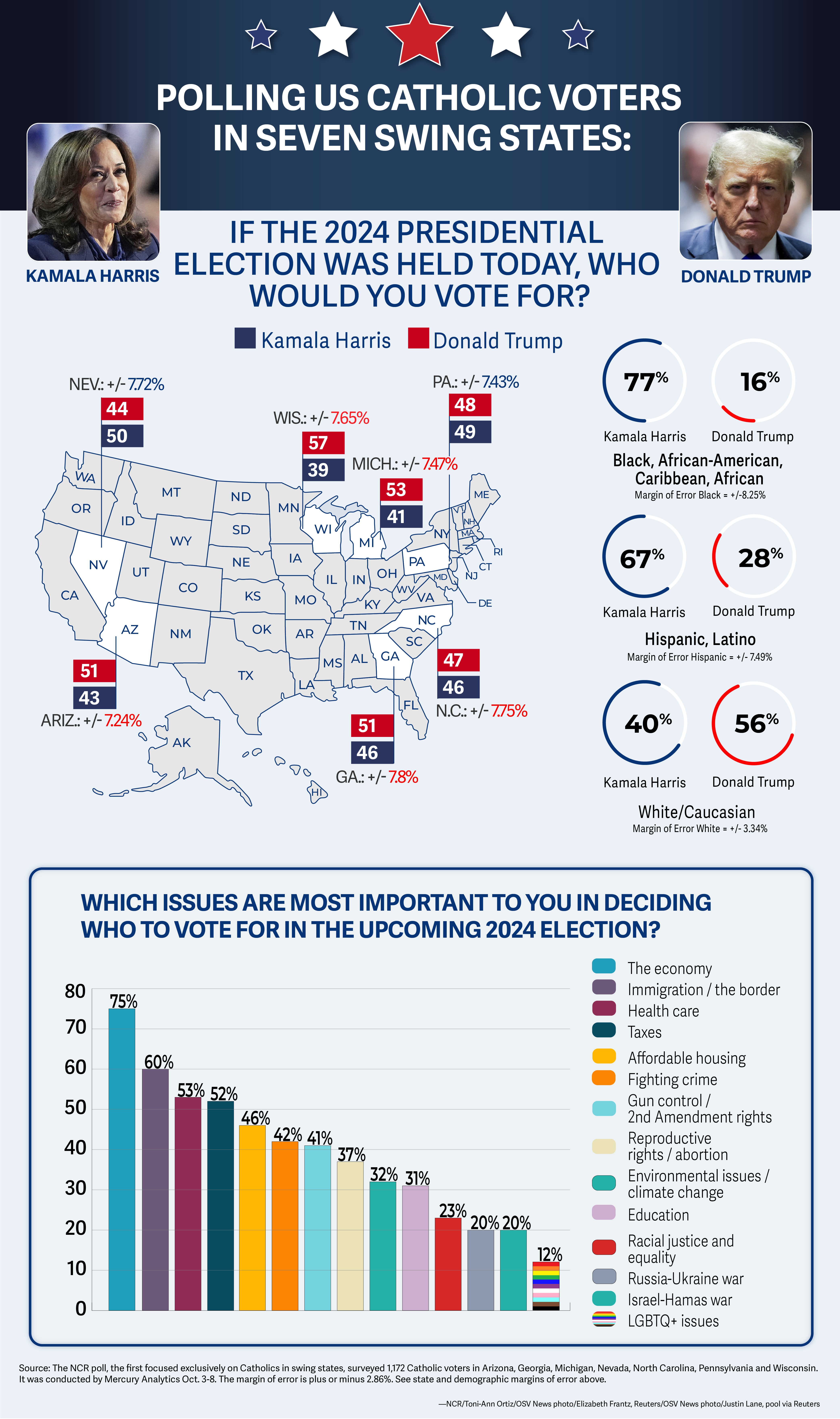
Catholic voters in seven battleground states favor Donald Trump over Kamala Harris by 5 percentage points, but the vice president leads the Republican nominee overwhelmingly among Hispanic and Black Catholics in those swing states, according to a new poll conducted by the National Catholic Reporter.

With just more than three weeks to the election, Trump leads Harris 50% to 45% in the closely watched battleground states, a margin that could be an important factor given the closeness of the contest. Most polls say the race is too close to predict, and margins are extremely narrow in the decisive states of Arizona, Georgia, Michigan, Nevada, North Carolina, Pennsylvania and Wisconsin.

Among Hispanic and Black Catholics in the battlegrounds, Harris has an advantage over Trump with nearly seven out of 10 Hispanics and more than three-quarters of Blacks favoring the sitting vice president. The lead among Blacks and Hispanics stems from a strong aversion to Trump as well as an alignment with the vice president on values and key social issues, the poll shows.

Swing-state Catholic voters were more likely to say they support their preferred candidate for reasons that go against church teaching, with Trump supporters favoring his anti-immigration policies and Harris voters backing her views on reproductive rights. Catholic teaching generally favors immigrant rights and opposes abortion.

In the battleground states, Catholic populations are sizable and are seen as so important to the Trump and Harris campaigns that both have launched efforts to woo the so-called Catholic vote. In Wisconsin and Pennsylvania, for example, approximately one-quarter of adults identify as Catholic.

Among white Catholic voters, Trump's overall lead widens to 16 percentage points.

The Republican nominee also leads overall among Catholic voters in five of the seven individual states, although some are within the margin of error. The former president does have larger leads in Wisconsin, where he is up by 18 percentage points, and in Michigan, where he leads by 12 points among Catholic voters.

One Wisconsin voter, Jason O'Connell, an insurance worker, said he considers himself a moderate who plans to vote for Trump. "I prefer less government intervention and more of a capitalist economy," O'Connell said. "I don't think the government should have their hand in the pot."

The NCR poll, the first focused exclusively on Catholics in swing states, surveyed 1,172 Catholic voters in Arizona, Georgia, Michigan, Nevada, North Carolina, Pennsylvania and Wisconsin. It was conducted by Mercury Analytics Oct. 3-8. The margin of error is plus or minus 2.86%.

Trump did better among older voters in the NCR poll. Those ages 45 and older opted for Trump over Harris by eight percentage points, while those 44 and younger were tied at 47% for each candidate. Voters ages 18-24 gave Harris a seven-point advantage.

Trump also leads among Catholics of all income levels, although some results were within the margin of error. He outperformed among upper-class voters with incomes of over $150,000 annually by 14 points, as compared to middle-class voters with whom he had a three-point lead. The lead was five points among working-class Catholic voters in battleground states.

There was a slight, two-point gender gap among Catholic women, although the findings were within the margin of error for women. Catholic men favored Trump over Harris by eight points.

The poll reveals how complicated capturing the so-called Catholic vote can be. Among Trump supporters, about three-quarters say they are choosing him because of his anti-immigrant positions, which Pope Francis has called "against life." Similarly, about half of Harris voters say they plan to vote for her because of her support for legal abortion.

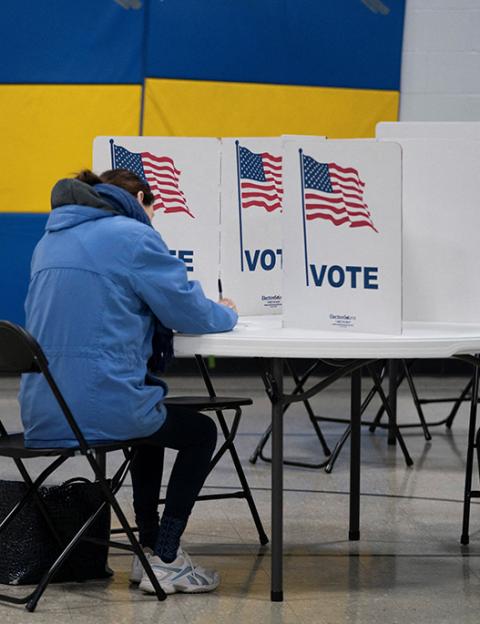
A woman prepares to vote in the presidential primary election at a polling place April 2 in Superior, Wisconsin. (OSV News/Reuters/Erica Dischino)

A woman prepares to vote in the presidential primary election at a polling place April 2 in Superior, Wisconsin. (OSV News/Reuters/Erica Dischino)

Overall, Catholic voters in battleground states are motivated by pocketbook issues, with three of every four respondents saying the economy was the most important issue to them in this election. Other top issues were immigration/the border (60%), health care (53%), taxes (52%), affordable housing (46%), fighting crime (42%), gun control/Second Amendment rights (41%) and abortion/reproductive rights (37%).

Catholic voters in battleground states said the one overriding issue most important to them was the economy, with just over a quarter citing it as a deal-breaker. One in five said immigration/the border was their nonnegotiable issue and 13% cited abortion/reproductive rights as their top nonnegotiable issue. Fifteen percent said there was no one issue for them that was nonnegotiable.

When asked which values undergirded their voting decisions, honesty (77%), concern to protect America's way of life (67%) and concern for human dignity and the common good (64%) were the most frequently named by respondents. Hispanic Catholic voters and those ages 18-29 were more likely to indicate that equality was an important value.

The Catholic clergy's influence on voters in their flock appears to be extremely limited. While two-thirds of poll respondents said church teaching influences how they think about social and political issues, a minority named priests, bishops, Pope Francis, encyclicals and religious women as major influences. Instead, about six in 10 named Jesus or family and friends as what most influences their decisions, while about half cited the Bible.

The poll also indicated mixed results from questions about abortion and reproductive rights, raising questions about the influence of religion on voters' views about the subject. A slight majority, 51%, described themselves as "pro-life," while 28% did not. Twenty-one percent were unsure. Catholics' definitions of "pro-life" are primarily associated with abortion, which was selected by about eight in 10 of respondents from among a list of life issues.

Yet 58% percent of Catholic voters thought abortion should be legal in all or most cases, reflecting other surveys with similar findings. In open-ended responses, some expressed concerns about government infringement on bodily autonomy and lack of support for children after birth from "pro-life" policies and politicians.

The NCR survey also indicated high levels of religious belief and practice among Catholics, with 87% saying their Catholic identity and beliefs are important to them and 94% saying they believe in the existence of God. One half pray daily, while one quarter attend Mass weekly.

When asked about Pope Francis, 62% had a "somewhat" or "very" favorable view of him. By comparison, a Pew survey in April found 75% of Catholics viewed Francis favorably, which was down 8 percentage points from 2021 and 15 points from 2015.

The NCR poll reflects results from a national poll of more than 7,000 registered voters conducted by the Pew Research Center in April, which found Catholic voters favoring Trump 55% to 43% (against then-Democratic nominee President Joe Biden). The Pew poll, however, showed Hispanic Catholics more closely divided, 49% for Biden and 47% for Trump.

"Catholics reflect the diversity of America," said Ryan Burge, an expert on data about religion and politics and associate professor of political science at Eastern Illinois University. "The average Catholic looks like the average American."

Although white Catholics lean Republican, and Latino and Black Catholics tend to be Democrats, the aggregate Catholic vote is pretty evenly divided, said Burge, who reviewed the NCR survey data. "And the U.S. electorate as a whole looks like the Catholic vote. We are incredibly divided."

Burge said he was struck by how little the Catholic vote seems to have changed since 2020. Some polls have indicated that some Latinos are moving toward the Republican Party, but NCR's poll does not show evidence of that, he said.

"If [Catholics] did shift, it could be enough to swing the whole outcome of a swing state and of the election," he said.

Friday, September 6, 2024

Among those identifying as Catholic, Harris leads Trump, but there is more to the story


Harris leads Trump among Catholic voters, per EWTN News/RealClear poll


Democratic presidential candidate Vice President Kamala Harris and Republican presidential nominee Donald Trump. | Credit: MANDEL NGAN/AFP via Getty Images; KAMIL KRZACZYNSKI/AFP via Getty Images

Vice President Kamala Harris leads among Catholic voters over former president Donald Trump, according to the findings of a new EWTN News/RealClear Opinion Research survey two months away from the presidential election.

The poll, conducted from Aug. 28-30, surveyed 1,000 Catholics and has a margin of error of +/- 3 percentage points. 

Catholic voters, like most of the electorate, consider the economy by far the most pressing issue facing the country and oppose transgender surgeries for minors and transgender males competing in women’s sports. They are divided on the question of who should set policy on abortion, U.S. support for Ukraine, and Israel’s war against Hamas in Gaza. The findings also reveal a significant gender gap among Catholic voters, while Trump is currently receiving support from 30% of Catholic Latinos.

According to the findings, 50% of Catholic voters currently support Harris for president while 43% support Trump and 6% are undecided. Harris is also ahead of Trump among Catholic Latino voters, leading the former president 60% to 30% overall but with 9% still undecided. This is important given the growing size and influence of Latinos in American Catholicism.

The vice president also leads Trump among Catholic African American voters 82% to 12% and Catholic Asian voters 58% to 35%. Trump carries non-Hispanic white Catholic voters by a margin of 52% to 42%. 

Similarly, Harris leads the former president in every age group, with her biggest leads among Catholic voters aged 30-39 and 40-49. Interestingly, her smallest margin is among the 18- to 29-year-olds, Gen-Z Catholic voters (many of whom will be voting for the first time in 2024), where she holds a statistically insignificant lead of 44% to 43%.

Among Catholic voters, she has also managed so far to avoid damage from President Joe Biden’s low job approval rating, currently at 49% disapproval with 41% approval, while 10% are neutral.

Especially notable is the gender gap that has emerged among Catholic voters. Female Catholic voters support Harris over Trump 56% to 37%, while male Catholic voters favor Trump 49% to 43%.

Similarly, on the generic ballot for control of Congress, 49% of Catholics support the Democrat candidate while 41% support the Republican candidate. Female Catholic voters, meanwhile, favor the Democrat candidate 54% to 35% while male Catholic voters support the generic Republican 48% to 43%. 

The gender gap exists across many other issues. The economy is considered by far the most pressing issue of the election by both men and women — 51% overall, 54% female and 48% male. But the second most important issue for Catholic women voters is abortion at almost 13% (compared with 6% for Catholic male voters). Catholic male voters rank border security and immigration as second most important at 17% (compared with 9.5% for Catholic female voters). Among all Catholic voters, after the economy, the next most important issues are border security and immigration at 13% and abortion at 10%.

When asked who should be responsible for setting abortion policy: state legislatures, the federal government, or neither, 45% of female Catholic voters say neither, compared with 28% of male Catholics. Overall, Catholics in the era after the fall of Roe v. Wade are divided on the question — a plurality of voters (38%) think neither the state legislature nor the federal government should be responsible for setting abortion policy, 34% think state legislatures should be responsible, and 29% say the federal government should be responsible.

Divided on key issues

Similar divides among Catholic voters are visible when it comes to some of the most important foreign policy questions. When asked how Israel is carrying out its response to Hamas’ savage Oct. 7, 2023, attack, 41% consider it somewhat or completely acceptable, while 39% consider it somewhat or completely unacceptable. Twenty percent are not sure. 

As for the ongoing Russian invasion of Ukraine, 37% of Catholic voters think the U.S. is providing too much support to Ukraine, 36% think it is giving about the right amount of support to Ukraine, and 28% say the U.S. is not providing enough support to Ukraine, a plurality of over two-thirds of Catholic voters favoring U.S. support for Ukraine. 

Moving on to China, only 6% think China poses no threat, and close to half would call China a significant or severe threat. 

Areas of broader agreement do extend to some of the most controversial cultural issues. Half (50%) of Catholic voters oppose puberty blockers/cross-sex hormone treatment or surgical procedures for minors, while 14% support both procedures, 7% support surgical procedures, and 7% support puberty blockers. 

A majority of Catholic voters (67%) also think athletes who were born male but now identify as girls or women should not be able to compete in women’s sports and athletics, while 18% say they should; 15% are unsure. Fifty-six percent of Catholic voters favor the death penalty for a person convicted of murder, while 23% oppose it, and 21% are unsure.

Mass attendance and Catholic voters

The poll also found that when it comes to Mass attendance, 12% of American Catholics attend Mass daily or more than once a week, 31% once a week, 16% once or twice a month, 32% a few times a year, and 9% once a year. Harris leads among every category of Mass-attending Catholics save for daily Mass attendees who support Trump 55% to 30%. 

Unlike the findings in previous polling of Catholics, in this unusual election at least, regular Mass attendance or adherence to Church teaching may no longer be an indication that the voters will vote for the Republican presidential candidate.

In addition, this is the most volatile presidential election in modern American political history, and this first poll was conducted in the immediate aftermath of the Democratic National Convention. It also comes well before the scheduled first presidential debate on Sept. 10, and other events between now and Nov. 5 may have a substantial impact on the race, such as another international crisis or the felony sentencing hearing for Trump in a New York courtroom on Sept. 18. 

National polls are finding the race extraordinarily tight with the candidates effectively tied both nationally and in every battleground state. In that environment, each vote is needed, and Catholic voters will have a key role to play in deciding the next occupant of the White House. EWTN News and RealClear Opinion Research will continue to track Catholic voter attitudes all the way to Election Day. 

Thursday, September 5, 2024

Catholics for Trump organization formed


Trump-Vance campaign launches Catholics for Trump coalition


Former President Donald Trump’s 2024 campaign on Sept. 4, 2024, launched the Catholics for Trump coalition, which emphasizes the defense of religious liberty, traditional values, and the sanctity of human life as priorities of the Republican nominee’s agenda. | Credit: Emily Elconin/Getty Images


Former President Donald Trump’s 2024 campaign on Sept. 4 launched the Catholics for Trump coalition, which emphasizes the defense of religious liberty, traditional values, and the sanctity of human life as priorities of the Republican nominee’s agenda.

The coalition, which intends to rally Catholic support behind the former president, seeks to show a contrast between Trump and his opponent, Vice President Kamala Harris, on key issues that are important to Catholics.

According to the coalition’s mission statement, Catholics for Trump commits “to safeguarding the vital principles of religious liberty and the sanctity of life that President Donald J. Trump has ardently championed.”

“Under President Trump’s leadership, our nation witnessed unprecedented support for religious freedoms, with significant victories both domestically and globally,” the mission statement read. “President Trump restored protections for faith-based organizations and bolstered the rights of religious institutions against governmental overreach.”

The mission statement added that Trump “has stood unwaveringly in defense of traditional values and the sanctity of human life” and that the coalition “stands with President Trump to continue building a nation where the rights of every individual to practice their faith freely is protected.”

Matt Schlapp, the president of The American Conservative Union, and his wife, Mercedes Schlapp, who served in the Trump administration, said in a joint statement that Trump “will continue to defend our religious freedoms and our values enshrined in faith and family.”

“We have watched Kamala Harris attack President Trump’s Catholic judicial nominees who had to face her hostile and unfair questions when she was a member of the Senate Judiciary Committee,” the statement read. “She was especially bigoted to anyone associated with the Knights of Columbus. Harris also was complicit in the FBI’s fascist infiltration of Catholic parishes that say Latin Mass.”

Matt and Mercedes Schlapp, who are both Catholic, were also involved in the 2020 Catholics for Trump coalition.

During his 2024 presidential campaign, Trump has been trying to appeal to Catholic and other Christian voters. In July, the former president accused Harris and the Democratic Party of being “after Catholics,” adding “somebody doesn’t like Catholics in that administration.”

Trump nominated three of the six Supreme Court justices who overturned Roe v. Wade, which had prevented states from imposing restrictions on abortion for nearly 50 years. Following the Supreme Court’s decision, about two dozen states imposed restrictions on abortion.

Since then, Trump has moderated his stance on abortion, announcing that he opposes federal restrictions and supports states adopting their own rules. In contrast, Harris has campaigned on codifying the abortion standards previously held in Roe v. Wade, which would override pro-life laws in more than 20 states.

Last week, Trump announced he would vote against a proposed constitutional amendment in Florida that would enshrine a right to abortion in the state’s constitution. The former president had previously signaled support for the amendment.

Harris has also launched a Catholics for Harris-Walz coalition to rally Catholic support behind her campaign. The campaign scheduled a virtual event for the coalition three weeks ago, but it was abruptly canceled.

Friday, August 30, 2024

Pro-Life leader says we now have two pro-abortion Presidential tickets


Live Action president Lila Rose: ‘Trump is losing pro-life votes’


Live Action president Lila Rose is increasing her criticism of 2024 Republican presidential nominee Donald Trump — arguing that his recent statements are alienating pro-life voters such as herself.

“Given the current situation, we have two pro-abortion tickets,” Rose said in a post on X on Thursday, Aug. 29.

“A Trump win is not a pro-life win right now,” she continued. “Pro-lifers will need to challenge both leaders either way. We only help Trump by sounding the alarm — Trump is losing pro-life votes regardless of what I say — because of his own actions.”

Rose, who is Catholic, argued that “expressions of disappointment are not enough” and that “the currency and the language in this season is votes.” She added that “it is wrong for Trump supporters to demand that pro-life activists be endlessly loyal to Trump in response to repeated betrayal.”

“We will continue to speak the truth and demand better from the Trump campaign for the sake of innocent babies who cannot speak for themselves,” Rose said. “Fear cannot keep us from doing and saying what is right. We are two months out from the election. It’s not too late for Trump to change course.”

Rose added: “I hope and pray that President Trump will change his course and stop supporting the legalization of the killing of babies.”

During his campaign, Trump has repeatedly taken credit for nominating three Supreme Court justices who voted to overturn Roe v. Wade, which ended the country’s recognition of abortion as a constitutional right. For decades, this has been the biggest goal of the pro-life movement. 

Trump further used his executive power to restrict foreign aid funding of abortion and to prevent Title X funding from going to the abortion industry. As president, Trump also signed an executive order to protect infants who were born alive after a failed abortion.

In June, Trump said in a speech to the Faith and Freedom Coalition that, if elected, he would “rapidly review the cases” of pro-life activists and “every political prisoner” who has been jailed under President Joe Biden’s administration and get them “back to their families where they belong.”

Despite this, Trump’s rhetoric on abortion has frustrated some pro-life activists over the past few months.

In April, the former president said abortion policy is “up to the states to do the right thing” and shied away from federal restrictions. He said in a post on Truth Social last week that if he is elected, his administration will be “great for women and their reproductive rights” without expanding on what that meant. He also told CBS in an interview last week that he would not use the Comstock Act to restrict mail-in chemical abortion drugs and that such drugs would remain available.

Trump’s running mate, J.D. Vance, also said in an interview with NBC last weekend that Trump would not sign a national abortion ban if elected.

An abortion ban at the federal level would be unlikely to reach any president’s desk because it would need 60 votes in the Senate to overcome the filibuster. Republicans have 49 votes in the Senate, although some of them oppose a federal ban on abortion.

The 2024 Democratic presidential nominee, Vice President Kamala Harris, has vowed to codify Roe v. Wade into federal law, which would undo pro-life gains at the Supreme Court and prohibit states from passing laws that protect unborn life. This, too, is unlikely to reach any president’s desk because of Senate filibuster rules.

As a senator, Harris backed a bill to prevent states from passing abortion restrictions and voted against a bill that would have required doctors to provide medical care for a child who is born after a failed abortion attempt. As attorney general of California, Harris also backed a law that forced pro-life pregnancy centers to provide advertisements for abortion and oversaw a raid on the home of pro-life journalist David Daleiden, whom she claimed broke laws when obtaining undercover videos of Planned Parenthood officials.

In an interview with Politico published on Thursday, Rose said she “would not vote for Harris or Trump” if the election were held today and said there are “other candidates” and even “write-in candidates.”

“I think that it’s the job of the pro-life movement to demand protection for preborn lives,” Rose said. “It is not the job of the pro-life movement to vote for President Trump.”

Rose said she hopes Trump “embraces the pro-life movement again” and that he would make a better case for pro-life voters if he promises “we will do everything in our power through the executive branch to protect the lives of innocent children.”

Many other pro-life activists have taken a different approach to the 2024 election than Rose, such as Marjorie Dannenfelser, the president of Susan B. Anthony Pro-Life America. Although she has criticized some of Trump’s rhetoric, Dannenfelser has urged pro-life voters to focus on the “short-term urgent threat” that Harris poses to the pro-life movement. 

“The [pro-life] cause is way bigger and younger than Donald Trump. …” Dannenfelser said last week. “The short-term urgent threat? Harris-Walz and all Senate candidates promising unlimited six-, seven-, eight-, nine-month abortion as the only option for women.”