Showing posts with label Year of St. Joseph. Show all posts

Wednesday, November 17, 2021

Wednesday General Audience with Pope Francis and teaching on St. Joseph


Pope Francis: St Joseph, an example and a witness for our times

Following his catechesis on St Paul’s Letter to the Galatians at the Wednesday General Audience, Pope Francis begins a new series of reflections on St Joseph as an example and a witness for our times.

By Christopher Wells

Pope Francis began a new cycle of catecheses on St Joseph at his weekly Audience on Wednesday, explaining that “today, as never before, in this time marked by a global crisis,” St Joseph can offer us “support, consolation, and guidance.” As the year of St Joseph draws to a close, the Pope said he hoped his reflections might “further help us to allow ourselves to be enlightened by his example and by his witness.”

A man full of faith

The Holy Father set the stage for his teaching with a reflection on the biblical context of the life of St Joseph. Recalling the figure of Joseph, the son of Jacob, in the Old Testament, Pope Francis noted that the name “Joseph” – Hebrew for “may God increase, may God give growth” – is “a wish, a blessing based on trust in God’s providence and referring especially to fertility and raising children.” This, he said, “reveals an essential aspect of Joseph of Nazareth’s personality. He is a man full of faith in God, in His providence.”

Pope Francis went on to consider the places associated with St Joseph, especially Bethlehem and Nazareth, which “assume an important role in our understanding” of the saint.

Bethlehem, he said, means “house of bread” or, in Arabic, “house of meat,” both expressions that are full of significances in light of the Incarnation and the Eucharist. Bethlehem also recalls the story of Ruth, the great grandmother of David the king, from whom Joseph traces his descent; as well as the prophecy of Micah, who foretold the coming of the Messiah from Bethlehem.

While Jerusalem was “the city loved by the Lord, the ‘holy city’,” it was Bethlehem and Nazareth, both outlying villages, “far from the clamour of the news and the powers of the time” that are most associated with Saint Joseph. “The choice of Bethlehem and Nazareth tells us that the periphery and marginality are preferred by God,” Pope Francis said. “Failure to take this fact seriously is equivalent to not taking seriously the Gospel and the work of God.”

Going to the peripheries

Jesus, the Pope emphasized, goes out especially in search of those on the peripheries, not only sinners, but also “those who have done no evil but have suffered it: the sick, the hungry, the poor, the least.”

Now, as then, the Pope said, “there is a centre and a periphery” in society; and, as in the time of Jesus, “the Church knows that she is called to proclaim the good news from the periphery.” Here St Joseph can be an example, reminding each of us to accord special importance “to what others cast aside.” In this sense, the Pope said, St Joseph “is truly a master of the essential: he reminds us that what truly matters does not attract our attention, but requires patient discernment to be discovered and appreciated.”

Pope Francis asked us to pray for Joseph’s intercession, “that the whole Church might recover this insight,” adding, “Let us start again from Bethlehem, let us start again from Nazareth.”

And to all those living on the geographical or existential peripheries, the Pope had this message: “May you find in Saint Joseph the witness and protector to whom you can look.”

Prayer to St Joseph

Concluding his catechesis, Pope Francis offered the following prayer to St Joseph:

Saint Joseph,
you who always trusted God,
and made your choices
guided by His providence
teach us not to count so much on our own plans
but on His plan of love.

You who come from the peripheries
help us to convert our gaze
and to prefer what the world discards and marginalises.

Comfort those who feel alone
and support those who work silently
to defend life and human dignity. Amen.

Tuesday, October 12, 2021

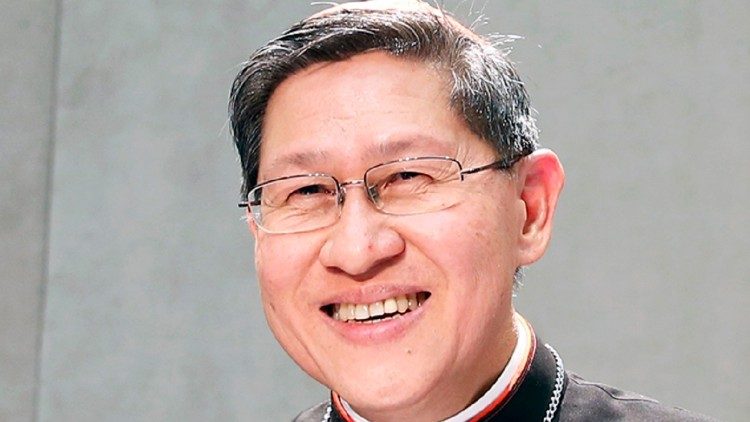
As the synod begins a prominent Cardinal says let St. Joseph be our inspiration


Cardinal Antonio Louis TagleCardinal Antonio Louis Tagle 

Let us be inspired by St. Joseph in the synodal process

In an interview with Vatican media, Cardinal Luis Antonio Tagle, Prefect of the Congregation for the Evangelization of People, talks about his devotion to St. Joseph in this Special Year dedicated to the holy figure, and says we can all find inspiration in his virtues.

By Alessandro Gisotti

St. Joseph is a timely and fruitful figure not only for all fathers, but for all the baptized. This is emphasized by Cardinal Luis Antonio Tagle in an interview with Vatican media on the Special Year desired by Pope Francis on the occasion of the 150th anniversary of the declaration of St. Joseph as Patron of the Universal Church. The Prefect of Propaganda Fide also dwells on the Letter Patris Corde and indicates in St. Joseph - in his choice to be the guardian of Jesus and Mary, even if this requires "changing paths" - a figure that can inspire the Church in the synodal process initiated by Pope Francis.

Cardinal Tagle, we are living the Special Year that Pope Francis has called for St. Joseph. What are the fruits that, in your opinion, all the baptized – all of us – can receive from this Special Year?

The figure of St. Joseph is rightly connected to fathers. I think you pointed out correctly that all of us baptized can benefit from this year. Especially in the following areas: like St. Joseph, I hope that every baptized person will be attentive to God’s voice and leading. Especially in the confusing moments of life. Also, that all the baptized will have the trust in God to pursue God’s project even when things are not always clear. Also, to be a good steward, a guardian, a custodian of the people that God entrusts to us.


Pope Francis in his letter Patris Corde emphasizes the relevance of St. Joseph for today’s fathers. What do you most appreciate about this document?

There are many, many things this document presents to us, especially to fathers. But one of the things that I really appreciate is, first, that he presents St. Joseph as someone who accepts reality. Accepting reality does not mean being passive or just being tolerant of something. He accepts reality as it is, he lives by that reality and as he accepts it. He sees what God wants him to do to transform that reality. Sometimes the temptation for us is that we do not accept reality. We are living in a past that we have idealized, or we are living in a utopia that does not yet exist. And so, we don’t know how to transform the present. But St. Joseph, according to the document, accepted reality and in that acceptance, heard the Word of God and courageously acted to transform that reality.

Regarding reality, today we are used to the fact that we are only right if we speak, if we have the last word in the conversation. But St. Joseph shows his strength, remaining in silence - in the shadows. What does this attitude teach us?

That’s true. When I was a seminarian, the name of our seminary was San José Seminary – St. Joseph seminary. This is one of the virtues of St. Joseph that was stressed to us. The Gospels do not record any of his words but he preserved the Word of God in his silence. It is Jesus, who is able to speak in his silence, He preserved the Word of God from those who wanted to kill him and to silence the Word of God. And so, this teaches us a lesson. First: our desire to speak, speak, speak. “Is it for myself or is it for the Word of God?” Secondly: sometimes silence is the most powerful speech. Jesus himself, when he was being tried by Pilate, at a certain point, he kept quiet. But in his silence, who was being judged? The corrupt system was exposed in the silence of Jesus. So, I think Jesus learned silence from St. Joseph.

St. Joseph is also the father who goes forth, goes out of his way to protect his family. What does his faith say to the Church, now engaged in the synodal process?

The synodal process is an invitation for us to walk together, to journey together. There is a walking that St. Joseph shows us. He walked dangerous paths with Mary and Jesus, guided by the direction of the angel of God. It is a walking that means protection, that means caring. We hope that during the synodal process, we may develop this capacity to love Jesus, to love the Church. And even if we have some observations that are not always positive, we must do so out of caring, out of loving, so that the name of Jesus will be proclaimed and preserved.

A final question, more personal for you. You are very devoted to St. Joseph. You have also declared this devotion on several occasions. What impresses you the most about this saint?

This devotion allows me to turn to him in different situations. Especially when there are difficult moments and I feel threatened and I say “I don’t know what to do”. Then, [I ask for] protection from St. Joseph. But most especially, the courage to be in the shadows. It requires courage, especially when you feel you have the right idea and you want to propose it. You think you have the right solution but then you purify your intentions and you say “wait a minute, am I promoting myself or am I seeking good?”. If it is not so much for the good of others, then it’s good to be in the shadows and let God and God’s angel work his wonders.

Wednesday, June 16, 2021

Wednesday after the Solemnity of the Sacred Heart of Jesus; a devotion to the Most Chaste Heart of St. Joseph


Devotion to the Most Chaste Heart of Saint Joseph

on Saturday, 01 October 2016. Posted in Saint Joseph

Hail Joseph

Hail Joseph, Son of David, the just and the chaste,
Wisdom is with you;
Blessed are you among all men, and blessed is Jesus,
the fruit of Mary, your faithful spouse.
Holy Joseph, worthy foster-father and
guardian of Jesus Christ and of the holy Church,
pray for us sinners and obtain divine wisdom for us from God,
now and at the hour of our death. Amen.

(Private revelation to Edson Glauber de Souza Coutinho)

In the morning, while I was praying, St. Joseph appeared. He was very handsome and he showed me his Most Chaste Heart. He appeared while I was praying the [above] prayer (Hail Joseph), which I had been praying in his honor for some time. Looking at me with a warm smile, he gave me the following Message:

“Spread this prayer to the whole world. Through  this prayer God wishes my name to be more known and loved. He also wants to bestow a lot of graces  through it upon those who will honor me by praying it. Those who will pray this prayer will be given many graces from Heaven. Through it, I will be often invoked by the whole world, and I will be able, by my loved and honorable heart, to grant a lot of graces to  sinners who are in need of divine help. It is important that this prayer be made known to everyone. May it reach everywhere, so all people can enjoy the goodness of God through it. This is His Most Holy Will that I am revealing to you right now” (March 29, 2002).

I felt overwhelmed by God’s presence, and I understood many things which were revealed to my heart about this devotion and about my future life and my mission. I am not worthy to receive such wonderful graces, and I deeply thanked God to have been chosen to present the Most Chaste Heart of Saint Joseph to the entire world. Who am I for this mission? Nothing, but I want to continue to be nothing so that God can do everything. Therefore, I understood that there are six different ways to honor the Heart of St. Joseph:

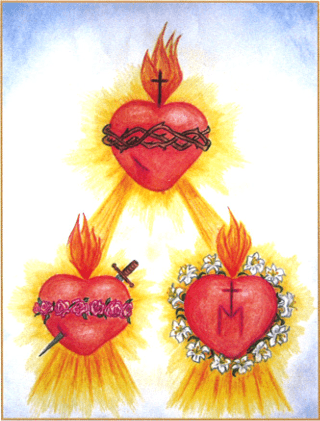
Image of the Most Chaste Heart of Saint Joseph1. The image of the Most Chaste Heart of St. Joseph, presented during the Apparition of 12/25/1996, in which Jesus and Our Lady revealed the Heart of Saint Joseph to the world.
2. The Feast of the Most Chaste Heart of St. Joseph, as requested by Jesus during the Apparition of 6/6/1997: “I wish the first Wednesday after the Feast of My Sacred Heart and the Immaculate Heart of Mary be the Feast of the Most Chaste Heart of Saint Joseph.”

3. The Chaplet of the Seven Sorrows and Seven Joys of St. Joseph, which now should be prayed with the prayer that St. Joseph gave during the Apparition  of  3/29/2002 , so that we are able to enjoy his intercession, begging his Most Holy and Mighty Name that makes all of hell tremble and disperses the demons, as Jesus revealed in an Apparition.

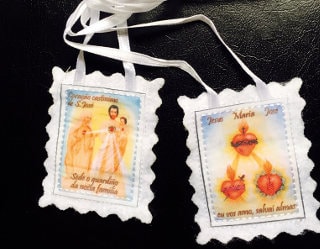
4. The  scapular of St. Joseph was revealed to Edson during two apparitions: on  7/14/2000, in the Sanctuary of Our Lady of Mount Carmel in Aylesfort (England), in the  same  place where the Most Holy Virgin had appeared to St. Simon Stock showing him the Scapular; the second apparition took place on 7/16/2001, on the Feast of Our Lady of Mount Cannel, in Sciacca (AG, Sicily), Italy, on the 750th Anniversary of the delivery of the Scapular to St. Simon by Our Lady.

Scapular of Saint JosephThe Scapular is a sign of protection and devotion to the Heart of St. Joseph, who wants to lead us to God and to holiness, emphasizing his virtues of purity, obedience, silence and humility, and igniting the flame of faith and love for Jesus and for the Holy Virgin Mary. St. Joseph will protect those wearing the Scapular as his property and will bestow innumerable graces through his Chaste Heart upon those who will be tempted against purity, and will protect them against the attacks by the Devil and each evil spirit. Especially young people should wear this Scapular, as they are most attacked by the Devil. Parents should recommend it to their children, since St. Joseph offers his help and protection, as he guided and protected Jesus on earth.
5. The spreading of devotion to the Heart of St. Joseph, associated with good deeds of charity in favor of the most needy, especially of the sick and dying, as St. Joseph requested in his promises in March 1998.

6. First Wednesdays should be remembered as days of special graces where St. Joseph pours out torrents  of extraordinary graces upon all those who appeal to his intercession, honoring his Most Chaste Heart. Jesus himself promised that these faithful servants will enjoy great glory in Heaven which, on the other hand, will not be given to those who will  not honor  him  as He asked.

“God  be always glorified, worshipped  and loved”

Consecration Prayer to the Three Sacred Hearts

Sacred Heart of Jesus,The Three Sacred Hearts
Immaculate Heart of Mary
and Chaste Heart of St. Joseph,
I consecrate to you this day
my mind +, my words +,
my body +, my heart + and soul +,
so that your will be done
through me this day.
Amen.

+Make the Sign of the Cross on the part of the body indicated

Tuesday, March 30, 2021

In the year dedicated to St. Joseph the church built over the house of St. Joseph and childhood home to Jesus


A journey to Jesus’ childhood home, the House of St. Joseph

Nazareth

Berthold Werner | Public Domain

Bret Thoman, OFS - published on 03/18/21

An important stop on a pilgrimage to the Holy Land is this church in Nazareth, which ancient tradition tells us was built over Joseph's home.

When they had fulfilled all the prescriptions of the law of the Lord, they returned to Galilee, to their own town of Nazareth. The child grew and became strong, filled with wisdom; and the favor of God was upon him. (Luke 2: 39-40)

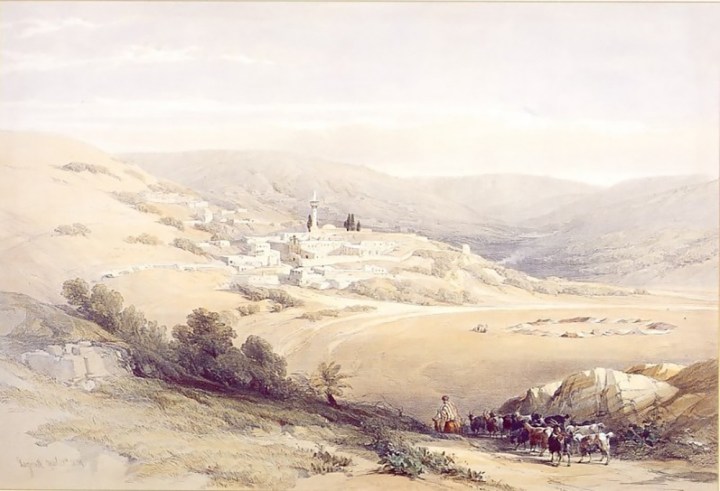
The city of Nazareth, located in Israel’s upper Galilee region, is an important destination for pilgrimages to the Holy Land.

The most important church in Nazareth is without a doubt the Basilica of the Annunciation. The modern church – the largest in the Middle East – sits atop four previous ruined churches, all built over a grotto believed to be the home of Mary’s parents. It is the site where she was visited by the angel Gabriel and given her fiat.

A church built over Jesus’ boyhood home

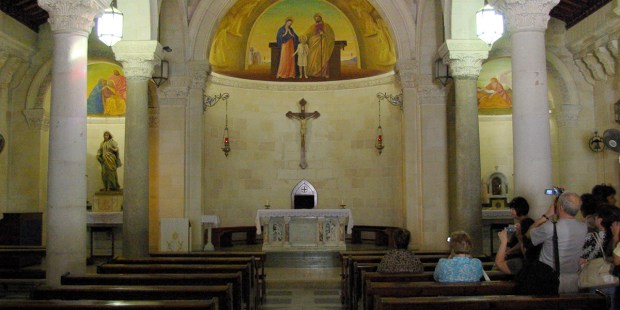
A short distance away – on the other side of the Franciscans’ sprawling complex – is another church of importance to the Christian pilgrim: St Joseph’s Church. According to an ancient tradition, it is believed this church was built over the house and workshop of St. Joseph. This would have been the home of Mary and Joseph following their marriage. The church also goes by the names Church of Nutrition and the Church of Joseph’s Carpentry.

Today’s modern Church of St. Joseph was also built over earlier ruined churches – a decorated 5th-century Byzantine church and a later Crusader-era church.

Though obviously of lesser import than the site where the “Word became flesh” (see John 1:14), the place where the Holy Family lived together for 30 years, and Jesus grew to adulthood is significant. In fact, the Byzantine church built over St. Joseph’s home was larger than the one nearby built over the grotto of the Annunciation.

The Franciscan era of the Church of St. Joseph

After the Arabic occupation in the 13th century, the Crusader church of St. Joseph was left in ruins for centuries. In 1754, the Franciscans purchased the site and rebuilt a chapel in honor of St. Joseph.

In the 1880s, nuns of the Sisters of Nazareth convent rediscovered the ancient 1st-century house beneath their convent. Led by the superior of the convent, Mère Giraud, the project was initiated and directed by the nuns themselves.

The Franciscan friars then rebuilt the present church in 1914 on what remained of the Crusader Church.

Later, in 1936, a Jesuit priest named Henri Senès, who had a background in architecture, visited the site beneath the nuns’ convent and detailed the structures. His work went was largely unknown beyond the local Franciscans.

Archaeologists discover 1st-century house under church

However, in 2006, the nuns granted access to the site to archaeologists led by Professor Ken Dark. He spent 14 years studying the site, including Senès’s drawings and notes. The archaeologists discovered items from a 1st-century house, including broken cooking pots, a spindle for spinning thread, and limestone vessels. These artifacts suggested a family lived there.

Dark believes the site to be the home of St. Joseph and, consequentially, the childhood home of Jesus.

Today, a stairway descends from the church to a crypt where caves can be seen through a grille in the floor.

A few more steps descend to an ancient pool or basin with a black-and-white mosaic floor. This is believed to have been a pre-Constantinian Christian baptistery, perhaps used as early as the 1st century. The mosaic depicts what appears to be a ladder, perhaps symbolizing the spiritual elevation of new converts to Christianity. This indicates that Christians gathered here in biblical times long before the first official churches were built.

There are further steps still, which appear to be older; they reach a narrow passage that eventually opens up into a room. In this room are caves that have been carved into the limestone to be used for storage of grain and as water cisterns.

While it is impossible to know that this was St. Joseph’s house and the site where Jesus grew up, the ancient traditions combined with archaeological evidence make it a strong possibility.

St. Joseph, pray for us.

Tuesday, January 5, 2021

Opportunities for plenary indulgences during the Year of St. Joseph


The Holy Family - Jesus, Our Lady and St. JosephThe Holy Family - Jesus, Our Lady and St. Joseph 

Church grants plenary indulgence for year of St. Joseph

The Apostolic Penitentiary issues a Decree granting plenary indulgences for the year of St. Joseph proclaimed by Pope Francis on Tuesday. The special year will last from 8 December 2020 to 8 December 2021.

By Vatican News staff writer

Pope Francis on Tuesday announced a special year dedicated to St. Joseph starting from 8 December 2020 until 8 December 2021, on the occasion of the 150th anniversary of the proclamation of St. Joseph as the Patron of the Universal Church, as well as the Solemnity of the Immaculate Conception of Our Lady.

The Apostolic Penitentiary also issued a decree granting special indulgences for the duration of the special year to celebrate the anniversary and “to perpetuate the entrustment of the whole Church to the powerful patronage of the Custodian of Jesus.”
 

During this period, the faithful will have the opportunity to commit themselves “with prayer and good works, to obtain, with the help of St. Joseph, head of the heavenly Family of Nazareth, comfort and relief from the serious human and social tribulations that besiege the contemporary world today.”

Devotion to St. Joseph

The decree signed by Cardinal Mauro Piacenza, the Major Penitentiary of the Apostolic Penitentiary, and the Regent, Fr. Krzysztof Nykiel, notes that devotion to St. Joseph has grown extensively throughout the history of the Church, “which not only attributes to him high reverence after that of the Mother of God his spouse but has also given him multiple patronages.”

At the same time, the Magisterium of the Church continues to discover “old and new greatness in this treasure which is St. Joseph, like the master in the Gospel of Matthew who brings from his storeroom both the new and the old.”

Therefore, the gift of indulgences granted through a decree of the Apostolic Penitentiary by mandate of the Holy Father “will be of great benefit to the perfect attainment of the appointed purpose.”

Conditions for the plenary indulgence

The plenary indulgence is granted to the faithful under the usual conditions (sacramental confession, Eucharistic Communion, and prayer for the Pope’s intentions) to Christians who, with a spirit detached from any sin, participate in the Year of St. Joseph on these occasions and manners indicated by the Apostolic Penitentiary:

-       The plenary indulgence is granted to those who will meditate for at least 30 minutes on the Lord’s Prayer, or take part in a Spiritual Retreat of at least one day that includes a meditation on St. Joseph. “St. Joseph, an authentic man of faith, invites us”, the decree reads, “to rediscover our filial relationship with the Father, to renew fidelity to prayer, to listen and correspond with profound discernment to God’s will.”

-       The indulgence can also be obtained by those who, following St. Joseph’s example, will perform a spiritual or corporal work of mercy. St. Joseph “encourages us to rediscover the value of silence, prudence and loyalty in carrying out our duties,” the decree notes.

-       The recitation of the Holy Rosary in families and among engaged couples is another way of obtaining indulgences, in order that “all Christian families may be stimulated to recreate the same atmosphere of intimate communion, love and prayer that was in the Holy Family.”

-       Everyone who entrusts their daily activity to the protection of St. Joseph, and every faithful who invokes the intercession of St. Joseph so that those seeking work can find dignifying work can also obtain the plenary indulgence. On 1 May 1955, Pope Pius XII instituted the feast of St. Joseph “with the intent that the dignity of work be recognized by all, and that it inspires social life and laws, based on the fair distribution of rights and duties.”

-       The plenary indulgence is also granted to the faithful who will recite the Litany to St. Joseph (for the Latin tradition), or the Akathistos to St. Joseph (for the Byzantine tradition), or any other prayer to St. Joseph proper to the other liturgical traditions, for the persecuted Church ad intra and ad extra, and for the relief of all Christians suffering all forms of persecution. Because, the decree notes, “the flight of the Holy Family to Egypt shows us that God is there where man is in danger, where man suffers, where he runs away, where he experiences rejection and abandonment.”

A universal saint

In addition to these, the Apostolic Penitentiary grants a plenary indulgence to the faithful who will recite any legitimately approved prayer or act of piety in honor of St. Joseph, for example, “To you, O blessed Joseph” especially on “19 March, on 1 May, the Feast of the Holy Family of Jesus, Mary and Joseph, on St. Joseph’s Sunday (according to the Byzantine tradition) on the 19th of each month and every Wednesday, a day dedicated to the memory of the saint according to the Latin tradition.”

The decree recalls the universality of St. Joseph’s patronage of the Church, noting that St. Teresa of Ávila recognized him as "a protector for all the circumstances of life". Pope St. John Paul II also said that St. Joseph has “a renewed relevance for the Church of our time, in relation to the new Christian millennium.”

For the sick

Amid the ongoing Covid-19 health crisis, the gift of the plenary indulgence is also extended to the sick, the elderly, the dying and all those who for legitimate reasons are unable to leave their homes.

They too can obtain the plenary indulgences if they are detached from any sin and have the intention of fulfilling, as soon as possible, the three usual conditions and recite an act of piety in honor of St. Joseph, offering to God the pains and hardships of their lives.

The role of priests

The Apostolic Penitentiary encourages priests to pastorally facilitate the celebration of the Sacrament of Penance and the administration of Holy Communion to the sick with a willing and generous spirit.