Showing posts with label Pope Pius XII. Show all posts

Wednesday, July 22, 2026

The evolution of Just War Doctrine from Pius XII to Leo XIV

 THE JUST WAR AND THE RECENT POPES


The Catholic Church now completely rejects “just war” theory, declaring all armed conflict outdated in favor of disarmed diplomacy.


AI-generated illustration depicting six recent popes above St. Peter’s Basilica in Vatican City.

The category of the “just war”—born with Augustine, systematized by Aquinas—was, for centuries, the Christian conscience’s attempt to subject violence to moral criteria.

The magisterium of the recent popes has progressively eroded its ground, down to Leo XIV’s explicit move beyond it.

The turn begins in the atomic era. Pius XII restricted the licit recourse to arms to defense alone. As early as 1944, in his Christmas radio message, in fact, he had declared “now out of date” the theory of war as “an apt and proportionate means of solving international conflicts.” It was “out of date” in Pius XII and “outdated” in Leo XIV: the same word nearly eighty years apart.

John XXIII, in “Pacem in Terris” (1963), declared it alienum a ratione—foreign to reason—to imagine that, in the nuclear age, war could serve as an instrument of justice.

The Council, in “Gaudium et Spes,” called for war to be evaluated “with an entirely new attitude” and condemned total war as a crime against God and against man himself.

John Paul II carried this line down into history: his “never again war” rang out against the Gulf War and, later, against the intervention in Iraq, while “Centesimus Annus” had already called war a “self-destruction of mankind.”

Benedict XVI, more sober in tone, had staked out the position while still a cardinal: asked about the war in Iraq (in an interview with Zenit, on May 2, 2003), he observed that modern weapons strike far beyond combatants, and that therefore “today we should be asking ourselves if it is still licit to admit the very existence of a ‘just war.”

With Francis, the doubt becomes a verdict. In “Fratelli Tutti” (No. 258), he writes that it is “very difficult” to invoke rational criteria elaborated in other centuries to speak of a possible “just war,” and he closes with an imperative: “Never again war!”

From “Pacem in Terris” to “Magnifica Humanitas,” the Church has never ceased to recognize the right to self-defense; it has ceased to lend war the comfort of an adjective.

In a footnote, he adds that Augustine “forged a concept of ‘just war’ that we no longer uphold.”

This is not merely the diagnosis of a “world war fought piecemeal”; it is doctrinal development: at Hiroshima, in 2019, he declared immoral not only the use but the very possession of nuclear weapons.

And to Patriarch Kirill, in March of 2022, with Ukraine under invasion, he said that one can no longer speak, as was once done, of “holy war” or “just war.”

Leo XIV takes a further step. In the encyclical “Magnifica Humanitas,” he denounces a “paradigm shift”: the rehabilitation of war as an ordinary instrument of international politics, even as the ethical principles that once limited its use erode.

In this context, he writes, “without prejudice to the right to legitimate defense in the strictest sense,” that the theory of the just war, “too often used to justify any kind of war,” is “now outdated.”  Humanity has more effective instruments at its disposal: dialogue, diplomacy, forgiveness.

And he extends the argument to the newest frontier—artificial intelligence applied to weapons, which removes the lethal decision from the reach of conscience. His programmatic formula, proclaimed from the loggia on the day of his election, is a peace that is “disarmed and disarming.”

Not a rupture but maturation: Tradition deepening its self-understanding. From “Pacem in Terris” to “Magnifica Humanitas,” the Church has never ceased to recognize the right to self-defense; it has ceased to lend war the comfort of an adjective.

Friday, August 15, 2025

The Church and the History the Solemnity of the Assumption of the Blessed Virgin Mary

 The Fascinating History of the Feast of Mary’s Assumption

Assumption of the Virgin Mary fresco painting in San Petronio Basilica in Bologna, Italy.

On August 15, Catholics around the world mark the solemnity of the Assumption of Mary, commemorating the end of her earthly life and assumption into heaven.

But while the feast day is a relatively new one, the history of the holiday — and the mystery behind it — has its roots in the earliest centuries of Christian belief.

The Catholic Church teaches that when Mary’s earthly life ended, God assumed her, body and soul, into heaven.

The dogma of the Assumption of Mary — also called the “Dormition of Mary” in the Eastern Churches — has its roots in the early centuries of the Church.

While a site outside of Jerusalem was recognized as the tomb of Mary, the earliest Christians maintained that “no one was there,” theologian and EWTN News Vice President and Editorial Director Matthew Bunson explained.

According to St. John of Damascus, the Roman emperor Marcian requested the body of Mary, mother of God, at the Council of Chalcedon in 451.

St. Juvenal, who was bishop of Jerusalem, told the emperor that “Mary died in the presence of all the Apostles but that her tomb, when opened upon the request of St. Thomas, was found empty; wherefrom the Apostles concluded that the body was taken up to heaven,” the saint recorded.

By the eighth century, around the time of Pope Adrian, the Church began to change its terminology, renaming the feast day of the Memorial of Mary to the Assumption of Mary, Bunson noted.

The belief in the assumption of Mary was a widely-held tradition and a frequent meditation in the writings of saints throughout the centuries. However, it was not defined officially until the past century.

In 1950, Pope Pius XII made an infallible, “ex cathedra” statement in the apostolic constitution Munificentissimus Deus officially defining the dogma of the Assumption.

“By the authority of Our Lord Jesus Christ, of the Blessed Apostles Peter and Paul, and by our own authority, we pronounce, declare, and define it to be a divinely revealed dogma: that the Immaculate Mother of God, the ever Virgin Mary, having completed the course of her earthly life, was assumed body and soul into heavenly glory,” the pope wrote.

The decree was seen as the formalizing of long-held Christian teaching.

“We have throughout the history of the Church an almost universal attestation of this,” Bunson said of the Assumption.

“We have this thread that runs throughout the whole of the history of the Church in support of the dogma. That’s significant because it supports the tradition of the Church, but it also supports a coming to a deeper understanding of the teachings of the Church of how we rely upon the reflections of some of the greatest minds of our Church.”

What’s also notable about the dogma, he added, is that it “uses the passive tense,” emphasizing that Mary did not ascend into heaven on her own power, as Christ did, but was raised into heaven by God’s grace.

Today, the solemnity of the Assumption is marked as a major feast day and a public holiday in many countries. In most countries, including the United States, it is a holy day of obligation.

Bunson explained that on major feast days, it’s fitting to mark the significance of the feast as especially vital by emphasizing the necessity of celebrating the Eucharist that day.

“What is more fitting than on the Assumption of the Blessed Mother to, once again, focus on her Son, on the Eucharist?” he asked.

(Photo by Zvonimir Atletic/Shutterstock.)

The official promulgation of the Assumption in 1950 by Pope Pius XII:

Munificentissimus Deus (November 1, 1950)


Wednesday, June 18, 2025

After General Audience, Pope Leo XIV called for peace echoing words of Pope Francis and Pope Pius XII


Russian drone and misille strike in KyivRussian drone and misille strike in Kyiv 

Pope Leo XIV echoes the cry of Francis: War is always a defeat!

Warning that the “atrocity” of modern scientific weapons risks leading combatants “to barbarism far greater than in the past,” Pope Leo XIV reminds world leaders that “war is always a defeat” and “nothing is lost with peace; everything can be lost with war.”

By Christopher Wells 

“The heart of the Church is rent asunder,” Pope Leo lamented on Wednesday, “by the cries rising up from places of war,” especially Ukraine, Iran, Israel, and Gaza.

Speaking at the weekly General Audience, the Holy Father insisted, “We must never become accustomed to war” but instead “reject as a temptation the allure of powerful and sophisticated weapons.”

He warned that the use of “scientific weapons of all kinds” in modern warfare risks “leading combatants to a barbarism far greater than that of times past.”

Appealing directly to world leaders, Pope Leo echoed his predecessor, Pope Francis, who had so often declared, “War is always a defeat!” 

He also recalled the words of Pope Pius XII, who led the Church during the Second World War: “Nothing is lost with peace. Everything can be lost with war.”

Therefore, in the name of human dignity and international law, I repeat to those responsible what Pope Francis used to say: “War is always a defeat!” And with Pius XII, “Nothing is lost with peace. Everything can be lost with war.


Russian air strikes on Ukraine continue

Russian airstrikes on civilian targets in Ukraine have intensified in recent weeks, with at least 18 people killed and 151 wounded in overnight drone and missile strikes. Ukrainian President Volodymyr Zelensky said the attacks were among the most horrific since the full-scale invasion of his country by Russia in February 2022.

Noting that the attack on Kyiv was the deadliest so far this year, the United Nations Human Rights Monitoring Mission in Ukraine warned of the dangers of using such weapons in major cities.

“Last night's attack exemplifies the grave threat posed by the tactic of deploying missiles and large numbers of drones simultaneously into populated areas, which leads to civilian casualties, and profound suffering," Danielle Bell, Head of HRMMU, said in a statement.

Conflict between Israel and Iran

Thousands of people are fleeing the Iranian capital, Tehran, as Israel continues to carry out strikes aimed at eliminating Iran’s nuclear program.

More than 220 people were reportedly killed in the initial round of Israeli strikes, including military leaders and nuclear scientists. Israeli military sources said their air force had struck 20 targets in Tehran overnight.

In response, Iran has launched some 400 missiles at Israel, with approximately 40 making it through Israeli air defences. Authorities in Israel claim 24 people have been killed by the strikes.

Israeli tanks fire on civilians seeking aid

In Gaza, Israeli forces are continuing military operations, ostensibly seeking to destroy the Hamas political and military organization. Israel launched an offensive into Gaza following armed incursions by Hamas militants into Israel in October 2023 that resulted in approximately 1200 Israeli deaths. Additionally, Hamas took approximately 250 hostages during the raids, more than 50 of whom are still being held in captivity.

On Tuesday, Israeli tanks reportedly fired on crowds awaiting trucks carrying humanitarian aid. Medics present at the scene said almost sixty people were killed and more than 220 wounded, including about 20 in critical condition. Israel admitted firing in the area and said it was looking into the incident. 

According to Gaza's health ministry, almost 400 Palestinians have been killed and more than 3,000 have been wounded since the end of May, with numerous casualties occurring among civilians waiting to receive aid. The ministry claims more than 55,000 Palestinians have been killed since the beginning of Israel's invasion of Gaza, while almost the entire population of Gaza has been displaced by the violence.

Wednesday, June 5, 2024

Pope Francis marks anniversary of End of Nazi occupation of Rome


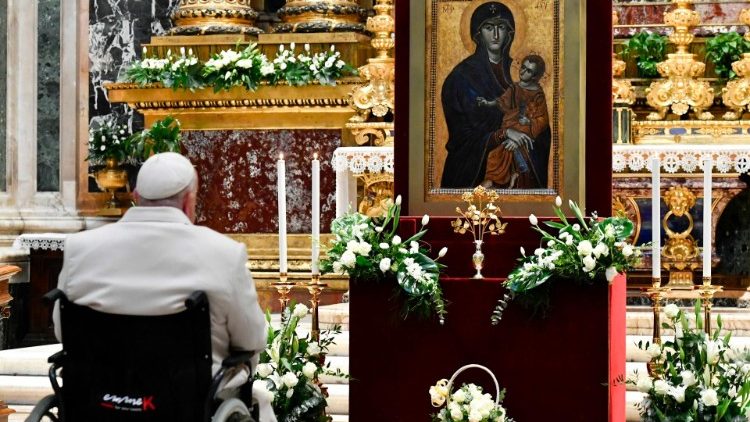
The Pope prays in front of the Salus Populi Romani in the Basilica of Santa Maria MaggioreThe Pope prays in front of the Salus Populi Romani in the Basilica of Santa Maria Maggiore  (Vatican Media)

Pope recalls end of Nazi occupation of Rome

Pope Francis writes a letter to mark the 80th anniversary of the vow made in Rome in front of the Marian icon ‘Salus Populi Romani’ after the city was liberated from the Nazis.

By Vatican News

This is the first time the event has been commemorated in this way, writes the Pope in his letter to the Viceregent of Rome, Auxiliary Bishop Baldassare Reina, which was published on Tuesday evening. 

On 4 June 1944, the people of Rome, together with their bishop, Pope Pius XII, implored Our Lady to save the city when a direct clash between the German army and the Anglo-American Allies was imminent and the city was facing "the nightmare of Nazi devastation".

Eighty years later, this is an occasion, the Pope said, “to pray for the victims of the Second World War and to reflect anew on the terrible scourge of war.”

“We cannot and must not give in to the logic of weapons!”

The innocent victims of wars in Ukraine, Palestine and Israel, Sudan, Myanmar and elsewhere challenge “the conscience of all”, the Pope wrote: “We cannot and must not give in to the logic of weapons!”

Everyday peacemakers

Peace is a gift from God, but it needs people who are willing to accept it “and commit themselves to being builders of reconciliation and witnesses of hope”, Pope Francis wrote.

He expressed his hope that the commemoration of the vow he made to Our Lady 80 years ago would inspire Romans “to be architects of true peace everywhere and to revive fraternity as an essential condition for the resolution of conflicts and hostilities”.

The Pope urged for a peaceful attitude in everyday life: it is a matter, he said, of advocating good relations between people “with courage and gentleness” and “reconciling tensions in the family, at work, at school and among friends”.

The Pope’s devotion to the Salus Populi Romani

In the eleven years of his pontificate, Francis has done much to revitalise devotion to the Marian icon Salus Populi Romani (‘Salvation of the Roman People’).

He regularly visits the image, which is kept in the Basilica of Santa Maria Maggiore, before and after journeys abroad, as well as on the Feast of the Conception on 8 December.

He often has it brought to the Vatican for his liturgies.

Most recently, this Roman icon of the Virgin Mary could be seen behind the Pope on Corpus Christi, when he gave the Eucharistic blessing at the end of the procession in front of Santa Maria Maggiore.

“The most important events in the religious and civil life of Rome found their echo in front of this image”

For centuries, the Pope writes in his letter, the image of the Virgin Mary has been “alive in the hearts of Romans”, who invoked her in prayer during epidemics, natural disasters and wars. “The most important events in the religious and civil life of Rome found their echo in front of this image,” said the Pope.

Thus, Romans also entrusted themselves to Maria Salus Populi Romani as they feared the destruction of their city by the Nazi occupiers in 1944.

4 June 1944: The peaceful liberation of Rome

On 4 June 1944, Rome was the first capital to be freed from Nazi occupation, and, contrary to fears, this was done without fighting.

Some contemporary witnesses considered it a miracle that the city was not devastated, especially as the Americans had bombed and completely destroyed Montecassino on 15 February.

The Vatican and Pope Pius XII (1939-1958) persuaded Field Marshal Albert Kesselring to declare Rome an ‘Open City’, a place that is not defended and therefore may not be attacked.

Sunday, April 30, 2023

How the feast of St. Joseph the Worker came about


ST JOSEPH THE WORKER, SPOUSE OF THE BLESSED VIRGIN MARY, PATRON OF WORKERS


Joseph, the “Just Man”

The Gospel of St Matthew describes Joseph as a “just man”, which in the language of the Bible means one who loves and respects the law as the expression of the will of God. Like Mary, Joseph too was visited by an angel, who appeared to him in a dream. And, again like Mary, her spouse, Joseph said “Yes”, when the angel revealed that the Child she bore was conceived of the Holy Spirit.

The special characteristic of Joseph is hiddenness, remaining in the background. No word of his is recorded in the Gospels. He is not mentioned after the finding of Christ in the Temple. Probably by the time Jesus began his public life, at the wedding in Cana, Joseph had already passed to the next life, although we don’t know exactly when or where he died. And the place of his burial remains a mystery.

Work: Participation in the Divine Plan

As is true of many fathers, Joseph raised Jesus to follow in his own profession as a craftsman; in the Gospels, Jesus is called “the son of the carpenter”.

The life of St Joseph shows us the dignity of human work, which is the duty and the perfection of human beings, who in this way exercise dominion over creation, share in the work of the Creator, offer their service to the community, and participate in God’s plan of salvation. Joseph loved his work. He never complained of weariness, but as a man of faith elevated it to the exercise of virtue. He found contentment in his work, because he did not aspire to wealth and did not envy the rich; for Joseph, work was not a means to satisfy his own greed, but an instrument to support his family.
And, following God’s commandment, on the Sabbath St Joseph observed the weekly rest and took part in the celebrations. We should not wonder at this noble conception of the humble work of manual labour: already in the Old Testament, in fact, God was seen symbolically as a winegrower, a sower, a shepherd.

The feast of Saint Joseph the Worker

This feast was officially instituted by Pope Pius XII on 1 May 1955, in order to ensure that workers not lose this Christian understanding of work; but earlier Popes had already prepared the ground. Blessed Pius IX in a certain way had recognized the importance of Saint Joseph as a labourer, when he proclaimed him Patron of the Universal Church. The principle of work as a means to eternal salvation would be taken up again by St John Paul II in his encyclical Laborem exercens, where he refers to “the Gospel of Work”. And Cardinal Angelo Roncalli – who became Pope St John XXIII – when he was elected to the Throne of Peter had thought of taking the name Joseph, so devoted was he to the saint who was the foster-father of Jesus. Many other saints, especially St Teresa of Avila, had a particular devotion to Saint Joseph.

Friday, September 9, 2022

Queen Elizabeth met with 5 Popes in her lifetime (how did she miss Paul XI?)


A look back at Queen Elizabeth II’s encounters with five popes


With the Royal Family gathering in Balmoral Castle Thursday amid concerns for Queen Elizabeth II’s health, Catholic bishops in England and Wales have offered their prayers for her and her family. 

Queen Elizabeth, who turned 96 in April, is England’s longest-serving monarch, having acceded to the throne in 1952 at age 25 after the death of her father, King George VI. In June, the United Kingdom celebrated Elizabeth’s Platinum Jubilee, marking 70 years as monarch.

Here is a look back at the five popes whom she met in her lifetime: 

Pope Francis in 2014

When Queen Elizabeth II met with Pope Francis at the Vatican in April 2014, she gave the pope a food hamper filled with local delicacies and a bottle of Balmoral whiskey. The meeting marked the 100th anniversary of the re-establishment of diplomatic relations between the United Kingdom and the Holy See.

Pope Benedict XVI in 2010

Pope Benedict XVI’s first meeting during his four-day visit to the United Kingdom in September 2010 was with Queen Elizabeth II in Edinburgh, Scotland. Benedict said it was a “very cordial meeting, characterized by the sharing of several profound concerns for the well-being of the world’s peoples and for the role of the Christian values in society.”


Pope John Paul II in 1980, 1982, and 2000

Queen Elizabeth II first met Pope John Paul II at the Vatican together with her late husband, Prince Philip, for an official state visit on Oct. 13, 1980. 

In a historic trip marking the first time a pope set foot in Britain, Pope John Paul II visited the queen at Buckingham Palace in May 1982. Nearly 20 years later, the queen traveled to the Vatican for a private meeting with the Polish pope on Oct. 17, 2000.


Pope John XXIII in 1961

Queen Elizabeth II and Prince Philip had an audience with Pope John XXIII at the Apostolic Palace on May 5, 1961. The pope expressed his “deepest personal esteem” for the queen for bearing “the weight of such vast responsibilities with so much simplicity and dignity.”

Pope Pius XII in 1951

One year before Queen Elizabeth II acceded to the throne, she met Pope Pius XII as a princess in 1951. You can watch a video of her visit to Rome below.

Tuesday, February 1, 2022

The truth about Pope Pius XII and the Holocaust


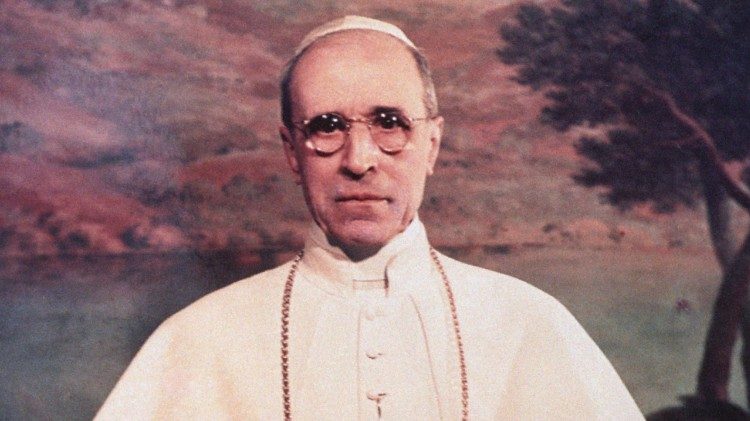
File photo of Pope Pius XIIFile photo of Pope Pius XII  (Vatican Media)

Feldkamp: Pope Pius XII knew early about Holocaust and saved many Jews

Pope Pius XII (1939-1958) personally saved at least 15,000 Jews, and knew early about the Holocaust, says German historian Michael Feldkamp, who offers proof from his findings in the Vatican archives. He says Pius XII sent a report on the Holocaust to the American government shortly after the Wannsee Conference, but they did not believe him.

By Mario Galgano

The chief archivist of the Bundestag (German parliament), Michael Feldkamp, has been involved in historical research on Pope Pius XII for several years.

Feldkamp has published on topics such as the Cologne nunciature and papal diplomacy, as well as articles on the relationship between the Catholic Church and National Socialism.

His book "Pius XII and Germany", published in the year 2000, aimed to bring his complex research to a wider audience, and was also intended as a response to John Cornwell's book “Pius XII - The Pope Who Remained Silent". Feldkamp collaborates with Vatican Archivist Johannes Icks.

Q: Dr. Feldkamp, you have been in the Vatican archives in the last few days and have seen some hitherto unknown documents on Pius XII and Eugenio Pacelli. What do you think is new in the research on Pius XII that the general public does not know yet?

Feldkamp: First of all, we in Germany are not the only ones doing research on Pius XII. There are not only historians in this field, but also journalists - whom we also need as propagators. What is new now, and what we have always known so far, is that Eugenio Pacelli, i.e. Pius XII, knew about the Holocaust very early on.

Regarding the systematic extermination of European Jews, Pius XII sent a message to US President Roosevelt in March 1942 - two months after the Wannsee Conference. In it, he warned him that something was happening in Europe in the war zones. These messages were not considered credible by the Americans. Today we know (...) that Pius XII was confronted with the persecution of the Jews almost on a daily basis. He had been presented with all the reports, and had created his own office within the Second Section of the Secretariat of State, where the staff had to deal exclusively with such matters. There was Cardinal Domenico Tardini - who later became an important cardinal at the Second Vatican Council - and there was Dell'Acqua, also later a cardinal. He is also considered one of the principal authors of the Second Vatican Council's Constitution on Reconciliation with the Jews (Nostra aetate).

During World War II, these leaders were in very close contact with Pius XII, reporting to him daily on persecution and mass deportations, as well as on the individual fates of the people who came to them. And the exciting thing now is that we can estimate that Pius XII personally saved about 15,000 Jews through his own personal efforts: opening monasteries, raising cloisters so that people could be hidden there, and so on. All of this is a huge sensation! The archival findings I have found now in the Vatican show me how accurately Pacelli was informed.


Q: You said that what Pius XII told them about the fate of the Jews but was not considered credible by the American side, so to speak. How did the Holy See and Pope Pius XII react?

Feldkamp: This is diplomatic correspondence, only letters that they had received were confirmed. It is interesting, however, that the president of the United States, or his associates in the State Department, repeatedly contacted Pius XII for information on individual cases...

Pope Pacelli's support for the Jews went so far that the Papal Palatine Guard, a kind of bodyguard for the Pope - like today's Swiss Guard - was involved in fights with the Waffen-SS, with Wehrmacht soldiers, to hide Jews in the Roman Basilica of Santa Maria Maggiore. Now we can see and prove all of this. I am grateful that we have opened these archives in the Vatican. In this way, we can now correct many of these vague assumptions or even accusations.

Above all, there is the accusation that Pius XII did nothing and remained silent. The problem of silence is still there, of course. But now it can be considered reasonable, considering that here he led people into hiding in covert operations. He could not then draw further public attention to himself by organizing protests or writing protest letters, but to divert attention, he conducted negotiations with the German embassy and the Italian police force, even with Mussolini and the Italian foreign minister and so on. He always tried to get as much as possible through negotiations.

Q: How do you see today's historiography and its re-evaluation of the Pius XII files? Are the results presented correctly and honestly, or do you fear that there are some reservations?

Feldkamp: Today's reappraisal can help clarify that. But I am also afraid that certain circles will still try to portray him negatively. I think that will happen. But it is certainly difficult to accuse or want to accuse anyone of this in detail. I also see in my research and in publications here in Germany how difficult it is to convey these new findings as credible. So, there are still people who say that they cannot imagine that, for 70 years we have believed what was wrong, and now it is supposed to be different. I encounter this skepticism often, both inside and outside the Church.

What we must and should pay attention to, and what I have always done, is to keep in mind that the results and the dossiers are all written in French and especially in Italian.

And that most of my colleagues, who are historians and who also know a lot about World War II, often do not understand Italian. This means that they now depend on their colleagues to translate it, or they depend on what I then present and translate. Of course, I try to translate very precisely, and then I bring in the Italian quotes so that people can understand it again, if necessary. I think there is a lot that can be done in this area.... We've already had stories where people have simply mistranslated or gone from one translation to another incorrectly.