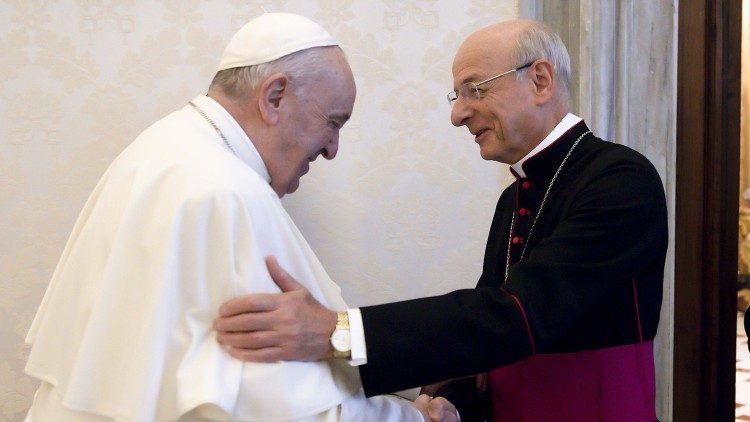
Motu Proprio on Opus Dei to protect charism and promote evangelization
By Alessandro De Carolis
Forty years after the Apostolic Constitution Ut sit, with which Pope St. John Paul II erected Opus Dei as a Personal Prelature, Pope Francis modifies some of its structures on the basis of Praedicate Evangelium, with the aim of "protecting the charism" and "promoting the evangelizing action that its members carry out in the world" by spreading "the call to holiness in the world, through the sanctification of work and family and social commitments."
The Motu Proprio Ad charisma tuendum , promulgated today, establishes new orientations that see the amendment of some Ut sit's articles, harmonizing them with what has been established by the recent Apostolic Constitution.
Charism rather than hierarchical authority
First of all, based on Article 117 of Praedicate Evangelium, the Vatican Dicastery of reference for Opus Dei will no longer be the one for Bishops but the one for the Clergy, to which the Prelate, the highest Opus Dei authority, will submit an annual report on the state of the Prelature. The Prelate himself, contrary to the past, will no longer be able to be appointed a bishop, and this, the Motu Proprio explains in Article 4, is to "reinforce the conviction that, for the protection of the peculiar gift of the Spirit, a form of government based more on charism than on hierarchical authority is needed." So, the title the Prelate of Opus Dei will take on, will be that of Apostolic Protonotary Supernumerary with the title of Reverend Monsignor.
In tune with the founder
Recalling the "very great hope" with which the Church directed "her maternal care and attention toward Opus Dei" at the time of its establishment as a Prelature, according to Pope John Paul II’s description on that occasion, this Motu proprio adds to the text of the papal document: "it is intended to confirm the Prelature of Opus Dei in the authentically charismatic sphere of the Church, specifying its organization in keeping with the witness of the Founder, St. Josemaría Escrivá de Balaguer, and with the teachings of conciliar ecclesiology regarding Personal Prelatures." These provisions will go into effect starting next August 4.
Monsignor Ocáriz: new Prelate "guide, but, first and foremost, father"
In a letter sent to the members of the Prelature, Opus Dei Prelate, Monsignor Fernando Ocáriz, says he "filially" accepts what Pope Francis has ordered, and expresses his hope that the Pope's invitation "will resonate powerfully with each and everyone" as an "opportunity to understand, in depth, the spirit that the Lord instilled in our founder”, and he asks them to share it with family, friends and professional contacts.
Regarding the figure of the Prelate, while expressing thanks "for the fruits of ecclesial communion that the episcopate of Blessed Álvaro and Fr. Javier represented," Monsignor Ocáriz acknowledges that "the episcopal ordination of the prelate was not and is not necessary to lead Opus Dei. The Pope's will to emphasize the charismatic dimension of Opus Dei invites us to strengthen an environment of familial affection and trust: “the Prelate must be a guide, but, first and foremost, a father."
Questions and answers to understand the change
The Prelate's letter is accompanied by a series of eight questions and related answers on the meaning of the Motu Proprio and its most direct implications on the lives of Prelature members. Specifically, on the relationship between charism and hierarchy, it is stressed that in the Motu proprio "it is recalled that the government of Opus Dei must be at the service of the charism - of which we are stewards, and not owners - so that it may grow and bear fruit, with the faith that it is God who works in all."


 Eleven thousand people from over 60 countries joined in the celebrations on Saturday the 18th estimates the Prelature of the Opus Dei. It was a Beatification in consonance with the modern profile of this woman, digital and relocated and re-transmitted by streaming. It has an app, several electronic books, multimedia, and a geocaching itinerary.
 Guadalupe is at once the first woman and the first lay faithful of the Opus Dei to be beatified (Saint Josemaria was a priest and Blessed Alvaro was a Bishop). Guadalupe was a numerary. Numeraries are faithful of the Opus Dei — men and women — who live celibacy as a gift of God and for apostolic reasons. This enables them to have greater dedication to formative tasks, without modifying anything of their lay condition, their professional situation, their position in the Church and in society.
 A Model for the 21st Century Woman
 Harsh trials in her life
 Antonio Jesus Sedano Madrid, 76, a widower since 1991, was suffering from this cancer in his right eye. He prayed intensely to Guadalupe with faith before going to bed that night and on getting up the following day he realized he was cured. The lesion had disappeared completely, leaving no trace. The Congregation’s medical experts concluded that the cure had no scientific explanation. The Theologian Consultors and, later, the Cardinals and Bishops, said it could be attributed to Guadalupe’s intercession before God.
 When the plastic surgeon examined the patient, he confirmed the absolute disappearance of the cancer for unknown reasons. His first impression was one of fright, and his first question was: “Where were you operated on?” Then Antonio recounted the details of his cure and Guadalupe’s intercession. Stated in the clinical history of the date the miracle occurred is that: “The lesion disappeared after praying to the Servant of God Guadalupe Ortiz de Landazuri.”