Showing posts with label Nicaragua. Show all posts

Monday, December 2, 2024

Pope Francis reaches out to Nicaraguan Catholics in times of persecution


Nicaraguan Catholics celebrate the Feast of the Immaculate ConceptionNicaraguan Catholics celebrate the Feast of the Immaculate Conception  (AFP or licensors)

Pope to Nicaraguan faithful: Trust in God even in darkest times

Pope Francis writes a pastoral letter to the faithful in Nicaragua who are celebrating the Novena of the Immaculate Conception, encouraging them to remain firm in their trust in God despite the challenges they face.

By Linda Bordoni

In a letter dated 2 December 2024, Pope Francis expressed closeness and solidarity with the people of Nicaragua, urging them never to lose faith in God despite the many challenges the nation faces.

 “Do not forget the Lord's loving Providence, which accompanies us and is our only sure guide,” he wrote, appealing to the Nicaraguan faithful to hold fast to their "filial trust" in God and their "faithfulness to the Church," which he described as "the two great beacons that illuminate your existence."

The Pope’s letter comes at a time when many in Nicaragua have experienced uncertainty and hardship and a socio-political crisis that has struck the Church, leading to the closing of many faith-based organizations and associations and to the expulsion and arrest of a number of priests and bishops.

Marian devotion

Upholding the spiritual strength of Nicaraguan Catholics, rooted in their devotion to Mary, the Pope noted the celebration in these days of the Novena of the Immaculate Conception, that he said, holds a special place in Nicaraguan culture and faith.

And referring to the gratitude and love Nicaraguans feel for the Virgin Mary, who has been their constant source of maternal protection he said: “You have always experienced her maternal protection in all your needs and have shown your gratitude with a spirituality that is very beautiful and rich.”

As the Church prepares for the Jubilee Year of 2025, Pope Francis encouraged the faithful to let their celebration of the Immaculate Conception serve as a source of strength and renewal.

“I hope that this celebration (...) grants you the strength you need in difficulties, uncertainties, and hardships,” he wrote.

The Rosary: A Connection with God

The Pope called on them to continue their tradition of surrendering to God with the prayer “God first,” and he reminded them of the power of prayer, particularly the Rosary, as a tool for spiritual reflection and connection with God.

“How many graces we receive through the Rosary; it is a powerful prayer,” he said, inviting the faithful to meditate on the mysteries of Jesus and Mary while entrusting their joys and struggles to God.

Jubilee prayer

In closing, Pope Francis invoked the intercession of the Virgin Mary and offered a message of hope.

“The Mother of God does not cease interceding for you, and we do not stop asking Jesus to always hold you in His hands,” he wrote.

The Pope’s letter also included a prayer he has written for the Jubilee of 2025 in which he asks the Lord for peace and to "rekindle in us, Pilgrims of Hope, the longing for heavenly graces."

Monday, January 15, 2024

2 Bishops and 15 Priests released from custody in Nicaragua and shipped them to Rome


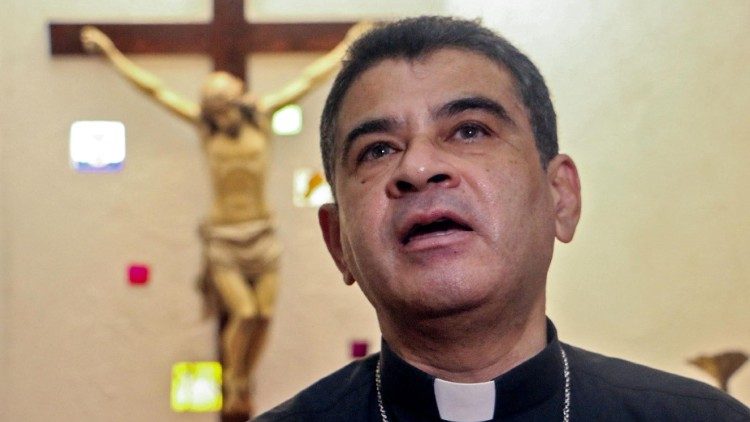
Bishop Rolando Álvarez of Matagalpa, NicaraguaBishop Rolando Álvarez of Matagalpa, Nicaragua  (AFP or licensors)

Holy See receives Bishops Álvarez, Mora, 15 priests after Nicaragua frees them

The Nicaraguan government has confirmed the release of the Bishop of Matagalpa, detained since 2022, together with the Bishop of Siuna, two seminarians, and 15 other priests.

By Salvatore Cernuzio

Bishop Rolando Álvarez, who had been detained for over a year, Bishop Isidoro del Carmen Mora Ortega, two seminarians, and 15 priests have been released.

A total of 19 representatives of the Catholic Church have been freed by the Nicaraguan government.

Government officials in Managua confirmed the news, first reported by local media. All arrived in Rome on Sunday afternoon, with the exception of one who remained in Venezuela. They are now guests of the Holy See.

Bishop Álvarez of Matagalpa and the Apostolic Administrator of the Diocese of Estelí, was sentenced to 26 years in prison where he had been since February last year following house arrest since August 2022. Bishop Mora was arrested in December.

During the Angelus at the beginning of the year, Pope Francis spoke of about the situation of bishops and priests "deprived of their freedom" in the Central American nation. He assured everyone of his "closeness in prayer" and invited God's people to pray for Nicaragua, expressing his hopes "that the path of dialogue will always be sought to overcome difficulties."

Already in October, 12 Nicaraguan priests were released from prison. The Holy See accepted the request to receive them, welcoming them to Rome and providing housing.

Sunday, January 7, 2024

Despite governmental persecution, Catholic Church in Nicaragua ordains 9new Priests


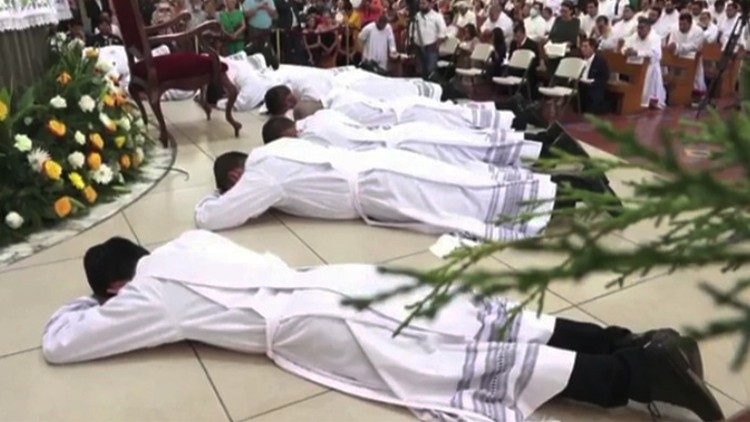
Ordination of nine priests in Managua, NicaraguaOrdination of nine priests in Managua, Nicaragua 

Nicaragua: new priests ordained as UN appeals for missing religious

Cardinal Brenes ordains nine priests in Managua, while the United Nations High Commissioner for Human Rights calls on the Nicaraguan government to disclose the whereabouts of the Bishop of Siuna, Isidoro Mora.

Vatican News

The archdiocese of Managua has ordained nine new priests. Many faithful participated in the rite in Managua Cathedral on Saturady 6 January, on the Solemnity of the Epiphany, presided over by Cardinal Archbishop Leopoldo José Brenes Solórzano. 

Priests, witnesses of fraternity

In his homily, the cardinal thanked God for the "wonderful gift" of the new priests, stating that priesthood "is not a power", but "a mission and a service". Priests, he stressed, are "servants" and "witnesses", called to "live communion and fraternity".

Wave of arrests

The new priests were ordained at a difficult time for the Church in Nicaragua. Since 20 December, at least 14 priests, two seminarians and the Bishop of Siuna, Isidoro del Carmen Mora Ortega, have been arrested. Bishop Mora was kidnapped after praying for Bishop Rolando José Álvarez Lagos, Bishop of Matagalpa and Apostolic Administrator of the Diocese of Estelí, who has been in prison since last February, after having been sentenced to 26 years, without a proper trial. 

Concern for sick priests

Concern is high in the Church community, in particular, for the kidnapped priests who have health problems, including Fr Ismael Serrano, parish priest of Saint Michael the Archangel, and Fr Gerardo Rodrígues, priest of the Church of the Most Holy Conception, both from the archdiocese of Managua. Both are ill and in need of medical care.

UN appeal to the Nicaraguan government

The Office of the United Nations High Commissioner for Human Rights for Central America (OACNUDH) has launched a new appeal to the Nicaraguan government to urgently disclose where Bishop Mora, "a victim of enforced disappearance for 16 days", is being held. "Hiding this information", reads a post on X, "puts his life at risk".

The OACNUDH had previously, on 28 December, condemned "the enforced disappearance of Bishop Isidoro Mora" and "the new wave of arrests of religious" in violation of the "right to religious freedom, the pillar of every democratic State". According to the UN High Commissioner for Human Rights, Nicaragua is moving "ever further" away from the rule of law and "fundamental freedoms" by persecuting "political and indigenous leaders, members of the Catholic Church, activists and journalists" with "repeated cases of arbitrary detention".

Pope Francis' prayer

Pope Francis prayed for Nicaragua during his Angelus on 1 January:

I have been following with deep concern what is happening in Nicaragua, where Bishops and priests have been deprived of their freedom. I express to them, to their families and to the entire Church in the country my closeness in prayer. I also invite all of you present here, and all the People of God, to pray insistently; meanwhile I hope that we will always seek the path of dialogue to overcome difficulties. Let us pray for Nicaragua today.

So far, the Nicaraguan authorities have neither confirmed nor denied the detention of the clergymen reported missing.

Friday, December 29, 2023

Catholic persecution continues in Nicaragua


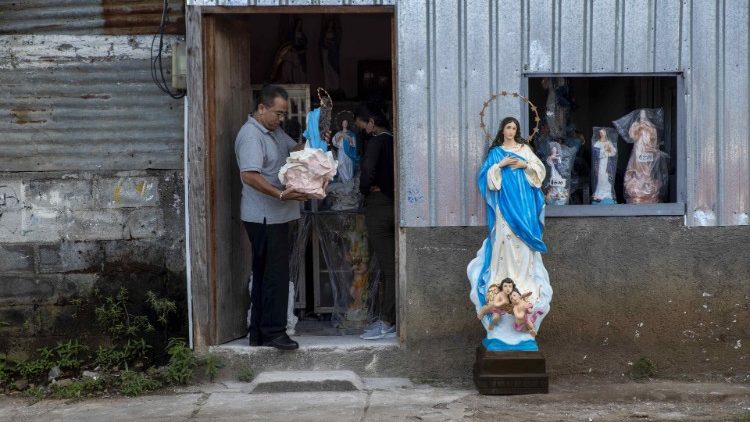
A man sells images of the Blessed Virgin Mary in ManaguaA man sells images of the Blessed Virgin Mary in Managua  (ANSA)

Nicaragua: Two more priests arrested

Police in Nicaragua have reportedly arrested two more Catholic priests, a total of six over the past week, following a public prayer for detained Bishop Rolando Álvarez of Matagalpa.

By Vatican News

Monsignor Carlos Avilés, the vicar general of the Diocese of Managua, and Father Héctor Treminio, the diocesan treasurer, were recently detained by Nicaraguan police.

Local sources suggest the arrests came after they had prayed for Bishop Rolando José Álvarez Lagos, the Bishop of Matagalpa and Apostolic Administrator of the Diocese of Estelí.

The Bishop was sentenced to 26 years in prison without a proper trial on charges of conspiracy, spreading false news, obstructing justice, and insulting authorities.

Bishop Álvarez has been in jail since February 2023 after being under house arrest since August 2022.

With the arrest of Monsignor Avilés and Father Treminio, the total number of priests arrested in Nicaragua in the last week has risen to six.

On December 20, Bishop Isidoro del Carmen Mora Ortega, of the Diocese of Siuna, was arrested.

According to local media, he too was detained for publicly praying for Bishop Álvarez during a homily.

Along with Bishop Mora, two seminarians—Alester Sáenz and Tony Palacio—were also arrested.

Thursday, October 19, 2023

Recently freed Nicaraguan Priests to live at the Vatican (Holy See)


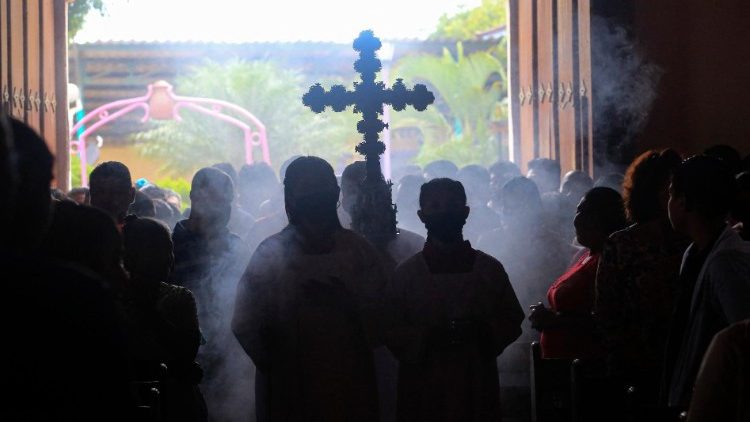
Catholics attend Mass in San Juan de Oriente in Nicaragua on 24 June 2023Catholics attend Mass in San Juan de Oriente in Nicaragua on 24 June 2023  (AFP or licensors)

Holy See welcomes 12 priests released from prison in Nicaragua

The director of the Holy See Press Office confirms that the Holy See has been asked to take in 12 recently released priests from Nicaragua, who will reside in facilities of the Diocese of Rome.

By Vatican News

"I can confirm that the Holy See has been asked to receive 12 priests from Nicaragua who were recently released from prison. The Holy See has accepted."

The director of the Holy See Press Office, Matteo Bruni, offered that response to questions put to him by journalists.

"They will be welcomed by an official of the Secretariat of State in the afternoon," continued Mr. Bruni, "and lodged in several facilities of the Diocese of Rome."

Friday, August 18, 2023

U.S. Government condemns continued Catholic persecution by Nicaragua


U.S. State Department spokesman condemns seizure of Jesuit university in Nicaragua


At the U.S. State Department on Thursday, Principal Deputy Spokesperson Vedant Patel condemned the recent seizure of a Jesuit-run university in Nicaragua and called for the release of political prisoners there, including Bishop Rolando Álvarez.

“The Ortega-Murillo seizure of the Jesuit-run Universidad Central Americana represents the further erosion of democratic norms and a stifling civic space,” Patel said in response to a question about the situation from “EWTN News Nightly” correspondent Owen Jensen. “This is a premier center of academic excellence, independent inquiry, and a hope for [the] future in Nicaragua.”

“The U.S. condemns the regime’s ongoing repression of religious figures and institutions and we call for the immediate unconditional release of individuals of conscience imprisoned in Nicaragua, including Bishop Álvarez,” Patel continued.

“The decision is a further sign that Ortega and Murillo continue to embrace authoritarianism and undermine all independent institutions in Nicaragua. Despite their efforts, they cannot extinguish freedom of thought and we’re going to continue to use diplomatic and economic tools to promote accountability for such acts.”

The dictatorship of President Daniel Ortega in Nicaragua on Tuesday confiscated all the assets and bank accounts of the Central American University (UCA), run by the Society of Jesus (Jesuits), accusing the school of “terrorism.”

The university confirmed the government action in an email Wednesday shared on X by Arturo McFields Yescas, former Nicaraguan ambassador to the Organization of American States (OAS).

In its message, the UCA informed the university community that on Aug. 15 the Tenth Criminal District Court of Managua announced “the seizure of real estate, furnishings, money in national or foreign currency from frozen bank accounts, financial products in national or foreign currency owned by the UCA.”

The court also ruled that from now on the regime will be in charge of “all educational programs.”

In its email, the UCA said the measures were taken based on “unfounded allegations” that it “functioned as a center of terrorism, organizing criminal groups.”

“Given all this, the Central American University reaffirms its commitment to Nicaraguan society to top quality higher education faithful to its founding principles for 63 years,” the message continues.

After expressing its gratitude for the messages of trust and solidarity it has received, the UCA announced that beginning Aug. 16 it is suspending “all academic and administrative activities until it is possible to resume them in an ordinary way.”

Nicaraguan lawyer and researcher Martha Patricia Molina posted Aug. 16 on X a picture of UCA staff taking down a large crucifix from the wall of the university chapel, explaining that this was done to “safeguard all the religious and sacred content” of the chapel in order to “avoid any future desecration by the Sandinista dictatorship.”

Just days prior to the expropriation, the dictatorship froze the university’s bank accounts and then blocked any real estate transactions.

Reactions

In an Aug. 16 statement to ACI Prensa, CNA’s Spanish-language news partner, McFields, who is also a former student of the Central American University, said the seizure was an attack “on the Catholic Church, the faith of the people, and the hearts of Nicaraguans.”

McFields pointed out that the university was expropriated because it was “a prophetic voice that condemned the crimes of the dictatorship, corruption.”

However, he stressed that “the persecuted Church has revitalized its faith.”

Félix Maradiaga, a former political prisoner and former Nicaraguan presidential candidate, told ACI Prensa Aug. 16 that the recent confiscation of the UCA is also “a very serious action that represents a blow to education and freedom of thought in Nicaragua” and that “it is crucial to mobilize international support for the Central American University.”

“There are already several people and organizations that are working to obtain the necessary support to face this difficult reality. We have urged the international community, governments, human rights organizations, and people committed to freedom and education at the hemispheric level to join our call for solidarity and support for the UCA,” the political leader said.

He also urged that “the voice of the world rise up in defense of this valuable institution” and oppose “the unjustified attacks of the Ortega-Murillo dictatorship.”

Jesuits’ response

The Central American Province of the Society of Jesus said in an Aug. 16 statement posted on X that “the serious accusations against the Jesuit university of Nicaragua are totally false and unfounded.”

The province stated that the “de facto confiscation of the UCA is the price to pay for the search for a more just society, protecting the life, truth, and freedom of the Nicaraguan people in keeping with its motto: The truth will set you free (John 8:32).”

The province noted that this “aggression” by the dictatorship led by Ortega and his wife, Vice President Rosario Murillo, “is not an isolated event” but rather “is part of a series of unjustified attacks against the Nicaraguan population and other educational and social institutions of civil society.”

The province pointed out that as of April 2018, “as a consequence of its stance in defense of the lives of people who were being repressed by state and parapolice forces, the UCA has been the object of constant siege, harassment, and hassling by the Nicaraguan government institutions.”

The Jesuits emphasized that “it’s necessary and essential” that the UCA be allowed to “exercise its inalienable right to legitimate defense against said accusations.”

They also urged that “the drastic, unexpected, and unjust measure adopted by the judicial body be immediately reversed and corrected” and that “the growing government aggression against the university and its members cease.”

The Jesuits also called for seeking “a rational solution in which truth, justice, dialogue, and the defense of academic freedom prevail.”

“God is the one who has the last word on history and he will also have the last word on Nicaragua,” the Jesuits of Central America said.

About the Central American University

Established in 1960 and by the Society of Jesus, the UCA is the first private university in Nicaragua. Throughout its history, it has taught generations of professionals and was a home to opposition to the dynastic Somoza dictatorship until the dictatorship’s demise in 1979. It also contributed to the process of returning to democracy in the 1990s and denounced the injustices and repression during the anti-government protests in Nicaragua in 2018, in which at least 300 people lost their lives.

Thursday, July 6, 2023

Beleaguered Nicaraguan Bishop released from prison


Nicaraguan Catholic Bishop Alvarez freed, talks going on


July 4 (Reuters) - Nicaraguan Catholic Bishop Rolando Alvarez was released from prison late on Monday, a diplomatic source said, marking a possible turning point in the government's prolonged crackdown on the Catholic Church.

The diplomatic source said on Tuesday that negotiations between the government and the country's Catholic bishops were going on over Alvarez's future, and the prelate was at the Catholic episcopal compound in the capital.

The source, who declined to be identified, added that talks included the possibility that the bishop might be expelled from the Central American country or otherwise sent into exile.

The government did not immediately respond to a request for comment on the release of Alvarez after normal business hours on Tuesday.

If the bishop refused to leave the country, he could be returned to prison, the source said.

Earlier in the day, the news outlet Confidencial reported that Alvarez had been released on Monday night, citing church and diplomatic sources.

Alvarez, the bishop of rural Matagalpa and a prominent critic of President Daniel Ortega, was jailed last year and was this year sentenced to 26 years in prison on treason charges after he refused to be expelled to the United States.

Formal ties between Nicaragua's government and the Vatican were severed this year after Pope Francis derided Ortega's government as a dictatorship.

The root of the conflict date back five years, when church leaders were called in by the government to mediate anti-government protests that turned violent with the death of more than 300 people.

Monday, March 20, 2023

Vatican closes Nicaraguan embassy over ongoing Catholic harassment and governmental persecution


Vatican closes embassy in Nicaragua in response to crackdown on Catholic Church


VATICAN CITY (AP) — The Vatican said Saturday it had closed its embassy in Nicaragua after the country’s government proposed suspending diplomatic relations, the latest episode in a yearslong crackdown on the Catholic Church by the administration of Nicaraguan President Daniel Ortega.

The Vatican’s representative to Managua, Monsignor Marcel Diouf, also left the country Friday, bound for Costa Rica, a Vatican official said, speaking on condition of anonymity.

The Vatican action came a week after the Nicaraguan government proposed suspending relations with the Holy See, and a year after Nicaragua forced the papal ambassador at the time to leave. It’s not clear what more the proposed suspension would entail in diplomatic terms.

Relations between the church and Ortega’s government have been deteriorating since 2018, when Nicaraguan authorities violently repressed anti-government protests.

Some Catholic leaders gave protesters shelter in their churches, and the church later tried to act as a mediator between the government and the political opposition.

Ortega branded Catholic figures he saw as sympathetic to the opposition as “terrorists” who had backed efforts to overthrow him. Dozens of religious figures were arrested or fled the country.

Two congregations of nuns, including from the Missionaries of Charity order founded by Mother Teresa, were expelled from Nicaragua last year.

Prominent Catholic Bishop Rolando Álvarez was sentenced to 26 years in prison last month after he refused to board an airplane that flew 222 dissidents and priests to exile in the United States. He also was stripped of his Nicaraguan citizenship.

Pope Francis had remained largely silent on the issue, apparently not wanting to inflame tensions. But in a March 10 interview with Argentine media outlet Infobae, after Alvarez’s sentencing, he called Ortega’s government a “rude dictatorship” comparable to Hitler’s that was led by an “unbalanced” president.

According to Vatican News, the care of the Vatican’s embassy, or nunciature, was entrusted to the Italian government, according to diplomatic conventions. The report said diplomats of the European Union, Germany, France and Italy gave Diouf, the chargé d’affaires, a farewell salute before he shuttered the diplomatic post and left.

During the farewell ceremony, Germany’s ambassador to Nicaragua, Christoph Bundscherer, expressed regret at the embassy’s closure and asked Diouf to share a message with Pope Francis, according to a statement on the German Embassy’s Facebook page.

“Together with the Catholic Church, the representatives of the European Union in Nicaragua will also always defend the Christian values of freedom, tolerance and human dignity,” Bundscherer said, according to the statement.

The Nicaraguan government, which since September 2018 has banned all opposition demonstrations in the country, also restricted Catholic activities inside churches, including banning the traditional street processions that thousands of Nicaraguans used to celebrate in the lead up to Holy Week and Easter.

The restrictions forced church authorities to hold the Stations of the Cross procession on the grounds of the Metropolitan Cathedral of Managua, as they did Friday.

Selser reported from Mexico City.

Friday, March 10, 2023

Pope discusses many things including desire to go to Argentina, his home country


Pope Francis' interview to InfobaePope Francis' interview to Infobae 

Pope Francis: I want to go to Argentina

Pope Francis is interviewed by the Argentinean website Infobae, on the 10th anniversary of his pontificate. He discusses his hopes for change in Venezuela, an end to the war in Ukraine, the situation in Nicaragua, the "discipline" of celibacy, "evil resistances" in the Church, and his vow to Our Lady not to watch television.

By Salvatore Cernuzio

Above all, Pope Francis focuses on Central and South America in an interview he gave to the Argentine news site Infobae, a few days before the celebration of the tenth anniversary of his pontificate. He discusses his desire for a trip to Argentina, his hope for change in Venezuela and the denunciation of a "crude dictatorship" in Nicaragua. In the interview at Santa Marta with portal owner Daniel Hadad, the Pontiff ranges from geopolitical issues, such as the war in Ukraine, to ecclesial issues, such as his approach towards homosexual people and the role of women, to more personal topics ("Why don't you watch TV anymore?").

The situation in Nicaragua

In particular, the Pope commented on the difficulties that the people and the Church of Nicaragua are experiencing today, where the nuncio has been expelled and the Holy Week processions have been banned, in addition to the constant attacks against bishops and priests. He denounced the lack of balance of those who lead the country and in reference to the bishop of Matagalpa, Monsignor Rolando Álvarez, sentenced to 26 years in prison, he added: "We have a bishop who has been imprisoned. He is a very serious and capable man. He wanted to give his testimony and did not accept exile. This is something that is not in line with what we are experiencing, it is like bringing the communist dictatorship of '17 or Hitler's dictatorship of '35, here. They are sort of crude dictatorships. Or, to use a nice Argentine definition, guarangas (coarse)".

On travelling to Argentina

Speaking of Argentina, the inevitable question about a possible trip to his home country came up. "It was planned for December 2017," Jorge Mario Bergoglio explained, repeating what he had already said on the flight back from Iraq: "We would first go to Chile, then to Argentina and Uruguay. That was the schedule. But what happened? There were elections at that time, so we had to move Chile to December and then go to Argentina and Uruguay in January. Then, the programme changed and Chile and Peru were organised, leaving Argentina and Uruguay for later... 

"There is no refusal to go, continued the Pope, "in no form. The trip was planned. I am open to the opportunity... I want to go to Argentina." 

Hope for Venezuela

Pope Francis then shifted his gaze to Venezuela, stating his hope that the regime can be changed. "I think so", he declared, "because it is historical circumstances that will force them to change their way of dialogue... I never close the door to possible solutions. On the contrary, I encourage them."

Ukraine

The Pope, however, was more cautious about a solution to the war in Ukraine. He said "they are all working for it", before going on to mention that there are several heads of state who are mobilizing. 

"We are all sinners"

Homosexual people, remarried divorcees, women and celibacy are the other topics the Pope addressed in his interview. On welcoming gay people, Pope Francis refered directly to the words of Jesus when he said "Everyone. Everyone. Everyone inside. When 'the refined' did not want to go to the banquet, He let them go to the crossroads and called everyone, good, bad, old, young, children, everyone. Everyone. The Church is for everyone. And everyone resolves his position before the Lord with the strength he has. This is a Church of sinners". 

"I don't know where the Church of saints is, here we are all sinners," the Pontiff reiterated, and as during his first trip to Rio de Janeiro in 2013, he repeated, "Who am I to judge a person if he has good will, right? If he is more like one of the devil's gang, well, let's defend him a little. But there is a lot of attention on this issue today. Jesus calls everyone and everyone resolves his relationship with God as he or she can or as he or she wants, sometimes they want to and sometimes they cannot, but the Lord always waits." 

Along these same lines, the Pope, speaking of the sacraments for remarried divorcees - a central theme in the 2014-15 Synod on the family -, recalled "the conscience of the bishop" and suggested to separated couples "to go to their bishop and present their situation to him". 

Men and women complement each other

Asked about the role of women, he highlighted the fact that there are now more working in the Church: a necessary step forward because "machism is bad," he said. "Sometimes celibacy can lead you to machism. A priest who does not know how to work with women lacks something and is not mature. The Vatican was very macho, but it's part of the culture, it's nobody's fault. It has always been done this way". But now things are changing. "Women have a different methodology. They have a sense of time, of waiting, of patience, different to men's. This does not diminish the man. They are different and they must complement each other", said the Pope.

And regarding the question of celibacy in the Western Church,  Pope Francis paused to explain that "it is a temporary prescription... It is not eternal like priestly ordination... Celibacy, on the other hand, is a discipline". "So it could be revised?" the interviewer asked. "Yes", replied the Pope.

Division within the Church

Hadad then quoted 92-year-old Cardinal Julián Herranz, when he said that out of the six Popes with whom he has worked "perhaps the devil has worked with two, Paul VI and Francis, always to divide the Church and hinder the spread of the Gospel".

"I cannot judge whether this is true or not," was the Pope's reply. "Sometimes there is resistance, the bad kind. Not the good one. Because good resistance is that if I do a good project it is seen and discussed. The bad resistance is that which is discussed here and goes backwards looking for betrayal. But either I am naive or I don't listen to them". There are such things in the Church "there are, they are there, in a corner, hidden".

"If we were on the verge of schism, that would be a bad thing - commented the Pope -. For example, he continued, "the case of a very well-known American bishop, who was nuncio. It is not known whether this man is Catholic or not, he is on the border. These resistances are badly handled. In the Church, from the beginning, there has been resistance." 

"When they criticise me head-on, I appreciate it," he added. "Sometimes I don't like it, but I appreciate it."

No television!

Lastly, a mention of the vow made thirty-three years ago to the Virgin of Carmel not to watch television. It was 15 July 1990 and while he was with the community watching TV, "things that are not good for the heart were broadcast. Not sinful things, but those relativisms that weaken the heart". The next day, at the Mass of the Virgen del Carmen, Pope Francis felt "that I should not see it, without any problem". So he said 'enough', except for a few brief concessions.