Showing posts with label Bishop Rolando Alvarez. Show all posts

Monday, January 15, 2024

2 Bishops and 15 Priests released from custody in Nicaragua and shipped them to Rome


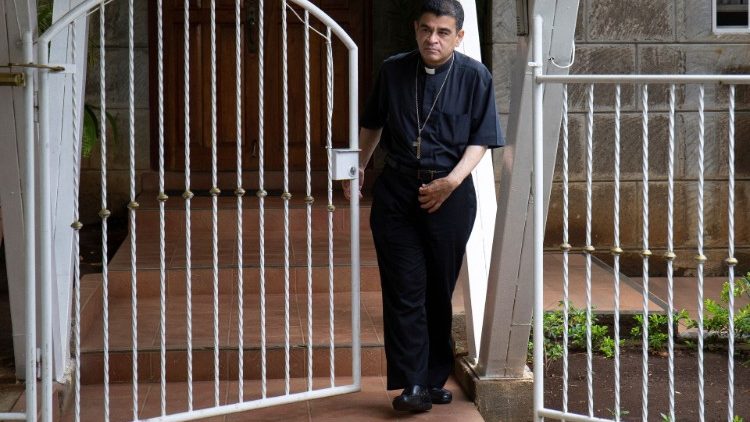
Bishop Rolando Álvarez of Matagalpa, NicaraguaBishop Rolando Álvarez of Matagalpa, Nicaragua  (AFP or licensors)

Holy See receives Bishops Álvarez, Mora, 15 priests after Nicaragua frees them

The Nicaraguan government has confirmed the release of the Bishop of Matagalpa, detained since 2022, together with the Bishop of Siuna, two seminarians, and 15 other priests.

By Salvatore Cernuzio

Bishop Rolando Álvarez, who had been detained for over a year, Bishop Isidoro del Carmen Mora Ortega, two seminarians, and 15 priests have been released.

A total of 19 representatives of the Catholic Church have been freed by the Nicaraguan government.

Government officials in Managua confirmed the news, first reported by local media. All arrived in Rome on Sunday afternoon, with the exception of one who remained in Venezuela. They are now guests of the Holy See.

Bishop Álvarez of Matagalpa and the Apostolic Administrator of the Diocese of Estelí, was sentenced to 26 years in prison where he had been since February last year following house arrest since August 2022. Bishop Mora was arrested in December.

During the Angelus at the beginning of the year, Pope Francis spoke of about the situation of bishops and priests "deprived of their freedom" in the Central American nation. He assured everyone of his "closeness in prayer" and invited God's people to pray for Nicaragua, expressing his hopes "that the path of dialogue will always be sought to overcome difficulties."

Already in October, 12 Nicaraguan priests were released from prison. The Holy See accepted the request to receive them, welcoming them to Rome and providing housing.

Friday, August 18, 2023

U.S. Government condemns continued Catholic persecution by Nicaragua


U.S. State Department spokesman condemns seizure of Jesuit university in Nicaragua


At the U.S. State Department on Thursday, Principal Deputy Spokesperson Vedant Patel condemned the recent seizure of a Jesuit-run university in Nicaragua and called for the release of political prisoners there, including Bishop Rolando Álvarez.

“The Ortega-Murillo seizure of the Jesuit-run Universidad Central Americana represents the further erosion of democratic norms and a stifling civic space,” Patel said in response to a question about the situation from “EWTN News Nightly” correspondent Owen Jensen. “This is a premier center of academic excellence, independent inquiry, and a hope for [the] future in Nicaragua.”

“The U.S. condemns the regime’s ongoing repression of religious figures and institutions and we call for the immediate unconditional release of individuals of conscience imprisoned in Nicaragua, including Bishop Álvarez,” Patel continued.

“The decision is a further sign that Ortega and Murillo continue to embrace authoritarianism and undermine all independent institutions in Nicaragua. Despite their efforts, they cannot extinguish freedom of thought and we’re going to continue to use diplomatic and economic tools to promote accountability for such acts.”

The dictatorship of President Daniel Ortega in Nicaragua on Tuesday confiscated all the assets and bank accounts of the Central American University (UCA), run by the Society of Jesus (Jesuits), accusing the school of “terrorism.”

The university confirmed the government action in an email Wednesday shared on X by Arturo McFields Yescas, former Nicaraguan ambassador to the Organization of American States (OAS).

In its message, the UCA informed the university community that on Aug. 15 the Tenth Criminal District Court of Managua announced “the seizure of real estate, furnishings, money in national or foreign currency from frozen bank accounts, financial products in national or foreign currency owned by the UCA.”

The court also ruled that from now on the regime will be in charge of “all educational programs.”

In its email, the UCA said the measures were taken based on “unfounded allegations” that it “functioned as a center of terrorism, organizing criminal groups.”

“Given all this, the Central American University reaffirms its commitment to Nicaraguan society to top quality higher education faithful to its founding principles for 63 years,” the message continues.

After expressing its gratitude for the messages of trust and solidarity it has received, the UCA announced that beginning Aug. 16 it is suspending “all academic and administrative activities until it is possible to resume them in an ordinary way.”

Nicaraguan lawyer and researcher Martha Patricia Molina posted Aug. 16 on X a picture of UCA staff taking down a large crucifix from the wall of the university chapel, explaining that this was done to “safeguard all the religious and sacred content” of the chapel in order to “avoid any future desecration by the Sandinista dictatorship.”

Just days prior to the expropriation, the dictatorship froze the university’s bank accounts and then blocked any real estate transactions.

Reactions

In an Aug. 16 statement to ACI Prensa, CNA’s Spanish-language news partner, McFields, who is also a former student of the Central American University, said the seizure was an attack “on the Catholic Church, the faith of the people, and the hearts of Nicaraguans.”

McFields pointed out that the university was expropriated because it was “a prophetic voice that condemned the crimes of the dictatorship, corruption.”

However, he stressed that “the persecuted Church has revitalized its faith.”

Félix Maradiaga, a former political prisoner and former Nicaraguan presidential candidate, told ACI Prensa Aug. 16 that the recent confiscation of the UCA is also “a very serious action that represents a blow to education and freedom of thought in Nicaragua” and that “it is crucial to mobilize international support for the Central American University.”

“There are already several people and organizations that are working to obtain the necessary support to face this difficult reality. We have urged the international community, governments, human rights organizations, and people committed to freedom and education at the hemispheric level to join our call for solidarity and support for the UCA,” the political leader said.

He also urged that “the voice of the world rise up in defense of this valuable institution” and oppose “the unjustified attacks of the Ortega-Murillo dictatorship.”

Jesuits’ response

The Central American Province of the Society of Jesus said in an Aug. 16 statement posted on X that “the serious accusations against the Jesuit university of Nicaragua are totally false and unfounded.”

The province stated that the “de facto confiscation of the UCA is the price to pay for the search for a more just society, protecting the life, truth, and freedom of the Nicaraguan people in keeping with its motto: The truth will set you free (John 8:32).”

The province noted that this “aggression” by the dictatorship led by Ortega and his wife, Vice President Rosario Murillo, “is not an isolated event” but rather “is part of a series of unjustified attacks against the Nicaraguan population and other educational and social institutions of civil society.”

The province pointed out that as of April 2018, “as a consequence of its stance in defense of the lives of people who were being repressed by state and parapolice forces, the UCA has been the object of constant siege, harassment, and hassling by the Nicaraguan government institutions.”

The Jesuits emphasized that “it’s necessary and essential” that the UCA be allowed to “exercise its inalienable right to legitimate defense against said accusations.”

They also urged that “the drastic, unexpected, and unjust measure adopted by the judicial body be immediately reversed and corrected” and that “the growing government aggression against the university and its members cease.”

The Jesuits also called for seeking “a rational solution in which truth, justice, dialogue, and the defense of academic freedom prevail.”

“God is the one who has the last word on history and he will also have the last word on Nicaragua,” the Jesuits of Central America said.

About the Central American University

Established in 1960 and by the Society of Jesus, the UCA is the first private university in Nicaragua. Throughout its history, it has taught generations of professionals and was a home to opposition to the dynastic Somoza dictatorship until the dictatorship’s demise in 1979. It also contributed to the process of returning to democracy in the 1990s and denounced the injustices and repression during the anti-government protests in Nicaragua in 2018, in which at least 300 people lost their lives.
Thursday, July 6, 2023

Beleaguered Nicaraguan Bishop released from prison


Nicaraguan Catholic Bishop Alvarez freed, talks going on


July 4 (Reuters) - Nicaraguan Catholic Bishop Rolando Alvarez was released from prison late on Monday, a diplomatic source said, marking a possible turning point in the government's prolonged crackdown on the Catholic Church.

The diplomatic source said on Tuesday that negotiations between the government and the country's Catholic bishops were going on over Alvarez's future, and the prelate was at the Catholic episcopal compound in the capital.

The source, who declined to be identified, added that talks included the possibility that the bishop might be expelled from the Central American country or otherwise sent into exile.

The government did not immediately respond to a request for comment on the release of Alvarez after normal business hours on Tuesday.

If the bishop refused to leave the country, he could be returned to prison, the source said.

Earlier in the day, the news outlet Confidencial reported that Alvarez had been released on Monday night, citing church and diplomatic sources.

Alvarez, the bishop of rural Matagalpa and a prominent critic of President Daniel Ortega, was jailed last year and was this year sentenced to 26 years in prison on treason charges after he refused to be expelled to the United States.

Formal ties between Nicaragua's government and the Vatican were severed this year after Pope Francis derided Ortega's government as a dictatorship.

The root of the conflict date back five years, when church leaders were called in by the government to mediate anti-government protests that turned violent with the death of more than 300 people.

Monday, March 20, 2023

Vatican closes Nicaraguan embassy over ongoing Catholic harassment and governmental persecution


Vatican closes embassy in Nicaragua in response to crackdown on Catholic Church


VATICAN CITY (AP) — The Vatican said Saturday it had closed its embassy in Nicaragua after the country’s government proposed suspending diplomatic relations, the latest episode in a yearslong crackdown on the Catholic Church by the administration of Nicaraguan President Daniel Ortega.

The Vatican’s representative to Managua, Monsignor Marcel Diouf, also left the country Friday, bound for Costa Rica, a Vatican official said, speaking on condition of anonymity.

The Vatican action came a week after the Nicaraguan government proposed suspending relations with the Holy See, and a year after Nicaragua forced the papal ambassador at the time to leave. It’s not clear what more the proposed suspension would entail in diplomatic terms.

Relations between the church and Ortega’s government have been deteriorating since 2018, when Nicaraguan authorities violently repressed anti-government protests.

Some Catholic leaders gave protesters shelter in their churches, and the church later tried to act as a mediator between the government and the political opposition.

Ortega branded Catholic figures he saw as sympathetic to the opposition as “terrorists” who had backed efforts to overthrow him. Dozens of religious figures were arrested or fled the country.

Two congregations of nuns, including from the Missionaries of Charity order founded by Mother Teresa, were expelled from Nicaragua last year.

Prominent Catholic Bishop Rolando Álvarez was sentenced to 26 years in prison last month after he refused to board an airplane that flew 222 dissidents and priests to exile in the United States. He also was stripped of his Nicaraguan citizenship.

Pope Francis had remained largely silent on the issue, apparently not wanting to inflame tensions. But in a March 10 interview with Argentine media outlet Infobae, after Alvarez’s sentencing, he called Ortega’s government a “rude dictatorship” comparable to Hitler’s that was led by an “unbalanced” president.

According to Vatican News, the care of the Vatican’s embassy, or nunciature, was entrusted to the Italian government, according to diplomatic conventions. The report said diplomats of the European Union, Germany, France and Italy gave Diouf, the chargé d’affaires, a farewell salute before he shuttered the diplomatic post and left.

During the farewell ceremony, Germany’s ambassador to Nicaragua, Christoph Bundscherer, expressed regret at the embassy’s closure and asked Diouf to share a message with Pope Francis, according to a statement on the German Embassy’s Facebook page.

“Together with the Catholic Church, the representatives of the European Union in Nicaragua will also always defend the Christian values of freedom, tolerance and human dignity,” Bundscherer said, according to the statement.

The Nicaraguan government, which since September 2018 has banned all opposition demonstrations in the country, also restricted Catholic activities inside churches, including banning the traditional street processions that thousands of Nicaraguans used to celebrate in the lead up to Holy Week and Easter.

The restrictions forced church authorities to hold the Stations of the Cross procession on the grounds of the Metropolitan Cathedral of Managua, as they did Friday.

Selser reported from Mexico City.

Monday, February 27, 2023

Ongoing governmental persecution of the Church in Nicaragua; bans all public devotions for Holy Week and Easter


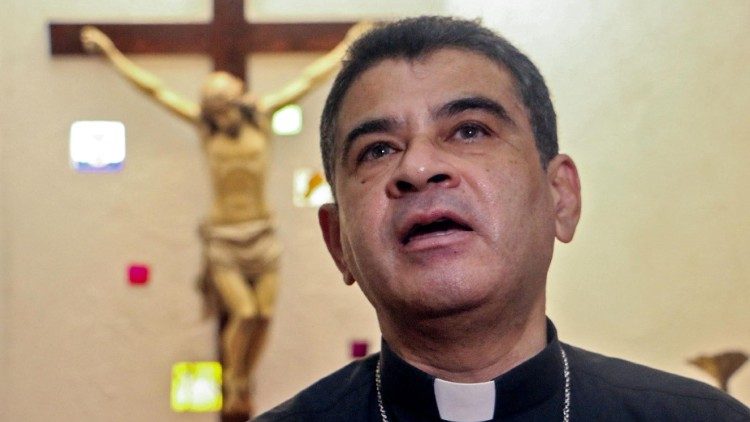
Bishop Rolando Alvarez of MatagalpaBishop Rolando Alvarez of Matagalpa 

Nicaragua: Ortega bans Easter processions and attacks bishops

The Nicaraguan regime forbids the celebration of the traditional public processions of the Way of the Cross and accuses bishops of “grave crimes and horrors".

By Lisa Zengarini

In the latest move against the Catholic Church and government opponents in Nicaragua, Daniel Ortega’s regime has reportedly banned the traditional public processions of the Way of the Cross in all parishes in the country.

During Lent, and also on Good Friday, the ritual will take place inside the churches and not in public venues.

The move comes in the context of President Ortega’s escalating crackdown against the Nicaraguan Church and follows the widespread outcry over the recent sentencing of Bishop Rolando Álvarez of Matagalpa to 26 years’ imprisonment and the deportation to the United States of 222 political opponents. They have all been stripped off citizenship along with other 94 Nicaraguan citizens, including the exiled Auxiliary Bishop Silvo José Baez, of Managua, and a priest from Matagalpa.

Bishops accused of "grave crimes and horrors" 

Tensions between the Sandinista regime and the Catholic Church reached its peak last week when, in a speech for the 89th anniversary of the killing of Nicaraguan national hero Augusto Sandino, President Ortega launched an unprecedented attack against the Church, accusing the Catholic hierarchy of "grave crimes and horrors" and of supporting dictator Somoza, who was ousted by the Sandinista Revolution in 1979. 

In his address to the nation, Ortega also accused the papacy of having supported Italian dictator Mussolini, and the Vatican of being a “mafia organization”.

“I don't believe in popes or kings: who chooses the Pope?”, he said. “If we want to talk about democracy, the people should first elect priests and the bishops”, and “even the Pope” should be “elected by direct vote and not by the organized mafia in the Vatican".

Worldwide solidarity with the Church in Nicaragua

Ortega’s ranting came in the wake of Pope Francis’ appeal for Nicaragua on February 12. During the Angelus prayer, the Pope said he was praying for Bishop Álvarez, “for those who have been deported to the United States, and for all those who suffer in the beloved nation of Nicaragua”, adding his voice to the many expressions of solidarity with the Church in Nicaragua from across the world.

In his speech Ortega made no mention of the 222 exiles, nor  of Bishop Álvarez recent sentencing to 26 years of prison for treason.

In recent days the Nicaraguan Center for Human Rights (Cenidh) called for the immediate release of the prelate, saying he is "unjustly detained", and denounced that, since his imprisonment in La Modelo security prison, there has been no news about him, and no family visits have been allowed. According to the organization his life is in danger.

U.S. Bishops' support to Church in Nicaragua

Following Pope Francis’ appeal, the US Bishops too have expressed their solidarity with the Church in Nicaragua. In a statement last week, the president of the U.S. Conference of Catholic Bishops (USCCB,  Archbishop Timothy P. Broglio, thanked the Catholic community in the United States for the warm welcome given to the Nicaraguan exiles. “At this dark hour, courageous hope, charity, and solidarity are bearing witness to the enduring vitality of the faith of the people of Nicaragua and among Catholics worldwide supporting the Nicaraguan faithful”, Archbishop Broglio said, urging he U.S. government and other partners “to continue to pursue the release of Bishop Álvarez and the restoration of human rights in Nicaragua.”


Increasing attack against the Church between 2018-2022

Relations between the Ortega administration and the Nicaraguan Church deteriorated again after the wave of anti-regime protests that were brutally suppressed by the government in 2018.

Despite attempts to mediate in the crisis, bishops were ultimately banned from mediating, and accused by Ortega of being "putschists" for giving refuge to wounded demonstrators during protests that, according to human rights groups, left at least 328 people dead.

Relations further worsened after the controversial 2021 elections which confirmed the Sandinista leader for another mandate.

Since the outbreak of the crisis the Church has been the target of several attacks and desecrations, as well as harassment and intimidations of bishops and priests.

Between April 2018 and October 2022, the Nicaraguan regime has allegedly carried out 396 attacks against the Catholic Church of Nicaragua, ranging from offensive paintings in churches to physical attacks, exiles, and arrests.

Sunday, February 12, 2023

Pope Francis leads prayers for imprisoned Nicaraguan Bishop


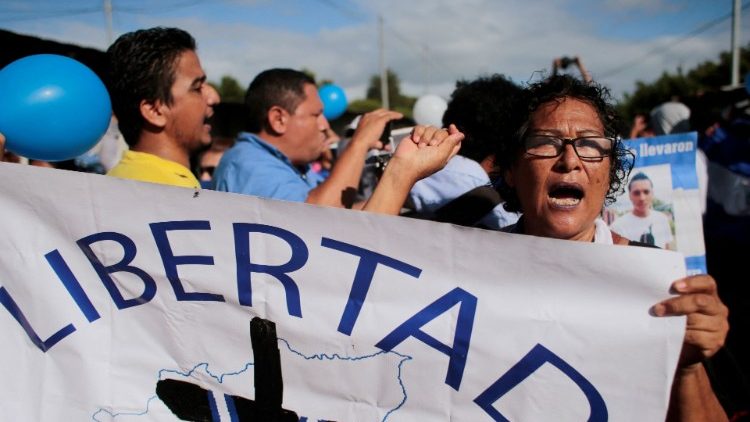
File photo of demonstrators taking part in a protest demanding the release of political prisoners in NicaraguaFile photo of demonstrators taking part in a protest demanding the release of political prisoners in Nicaragua 

Pope prays for Bishop Alvarez sentenced to jail in Nicaragua

Pope Francis decries the imprisonment of Nicaraguan Bishop Rolando Alvarez and the expulsion of dissidents, and appeals to political leaders to open their hearts to truth and justice and engage in dialogue.

By Linda Bordoni

Pope Francis on Sunday issued an appeal to political leaders in Nicaragua to open their hearts to the sincere search for peace and engage in dialogue.

His appeal follows news of the sentencing to imprisonment of the Bishop of Matagalpa, Rolando Alvarez, and the expulsion of 222 people who were detained for political reasons. These include several priests and seminarians accused of conspiring against the government.

Expressing great sadness for the news from Nicaragua, the Pope said he thinks with concern of Bishop Alvarez, “whom I love so much,” and who has been sentenced to 26 years in prison.

The Holy Father said he is praying for him, for those who have been deported to the United States, and for all those who suffer in the beloved nation of Nicaragua.

He invited the faithful to join him in prayers to the Lord asking for the intercession of the Immaculate Virgin Mary.

“[May she] open the hearts of political leaders and all citizens to the sincere search for peace, which is born of truth, justice, freedom and love, and is achieved through the patient exercise of dialogue.”

Pope Francis then led the faithful in the recitation of the Hail Mary.