Showing posts with label Fr. Dwight Longenecker. Show all posts

Thursday, May 27, 2021

The ongoing tale and controversy of the two Fr. Jameses


The Tale of Two Fr. Jameses

Frs. Altman and Martin
Voiced by Amazon Polly

With the news that conservative priest Fr. James Altman has been asked by his bishop to resign, one is faced with the contrast between Fr. James Altman and another controversial priest, Fr. James Martin, SJ.

Both priests have somewhat of a prophetic voice in the Church—Fr. Altman from the conservative side and Fr. Martin from the liberal. Fr. Altman castigates Catholics who voted for Joe Biden. Fr. Martin openly supported Biden. As such, the two Fr. Jameses are poster boys for the two Catholic Churches in America today. Fr. Altman for the traditional, orthodox, strict version of Catholicism; Fr. Martin for the accommodating, relativistic, and subjective version of Catholicism. Fr. Altman: doctrinal. Fr. Martin: pastoral. Fr. Altman: Rational. Fr. Martin: Sentimental.


It is interesting that both priests see themselves as standing up for the true faith and see themselves as speaking truth to power. Fr. Martin campaigns against institutional homophobia and laments the Church’s teaching on homosexuality. Fr. Altman campaigns against a Catholic hierarchy that is in bed with the abortion-loving Democratic Party.

In such situations it is all too easy for folks on one side or the other to throw the “H” words around. The enemy is branded as either a hypocrite, a heretic, or both.
Therefore, it is worth examining the two priests and looking at how they have been treated.

Fr. James Martin is on record for supporting the pro-LGBTQ New Ways Ministry, which has been disciplined by the Church for promoting teachings that are contrary to the Catholic faith. He has lauded the dissident nun Sister Gramick—calling her a saint. In many manipulative and devious ways, he has used his media platform to promote the blessing of same-sex unions and to encourage homosexuality. 


It would seem that Fr. Martin’s sort of “prophetic voice” is beloved of the contemporary Catholic hierarchy. Fr. Martin will not be disciplined in any way. He will not be asked to step down from his prestigious editorship, forsake his celebrity New York lifestyle, or step away from his huge social media pulpit. Instead, he is celebrated and appointed as a communications guru to the Vatican and invited to a personal tête-à-tête with the pope.

Fr. Altman, on the other hand, has fearlessly upheld the traditional Catholic faith and has never come close to preaching anything contrary to the Gospel. His sin? To be “divisive.” Why, may I ask, has no one suggested that New Ways Ministry and Fr. Martin (who have scandalized thousands of Catholics) are divisive?

In addition to questions of content, one might also consider the question of style. Fr. Martin has mastered a sweet and congenial style. Fr. Altman is more confrontational. Which style is most like the Gospel both priests claim to preach? Fr. Martin typifies Jesus the gentle teacher—the pantywaist Jesus with a weak smile and a limp wrist. Fr. Altman, on the other hand, sounds more like the Jesus who called the Pharisees “sons of Satan and whitewashed tombs.” Fr. Martin’s style is “all we are asking is give peace a chance.” Fr. Altman’s is “I have not come to bring peace but a sword.”

The clash between the two churches in America today is reminiscent of the Jansenist-Jesuit conflict in eighteenth-century France. As the faith was under attack from both Protestantism and the Enlightenment, French Catholics fought back with a kind of Catholic Calvinism called Jansenism. Meanwhile, the Jesuits offered an accommodating vision—trying to meet people where they were and adapt the faith to their needs and beliefs.

In his book Rethinking the Enlightenment, historian Joseph Stuart analyzes these two responses—austere resistance fighting and worldly accommodation—and says down through history a third way has been the most positive and fruitful way forward. This is the simple way of radical discipleship…not cursing the dark, but lighting a candle. The answer to the present divide in the Catholic Church typified by the two Fr. Jameses is for ordinary priests and people to eschew the extremes and seek to live radiant, radical, and revolutionary Christianity—doing what they can with what they have where they are.

This is the vision I have set out in my upcoming book, Beheading Hydra—A Radical Plan for Christians in an Atheistic Age. Ironically, this way actually fulfills the desire to fight and the desire to accommodate because the radical Christian life conquers the lies and deceit of the devil while also affirming what is beautiful, good, and true in our society.

Saturday, January 9, 2021

Fr. Longenecker writes to us about these Divided States of America


THE DIVIDED STATES OF AMERICA

The divisions in America reached a climax this week, and they are not going to go away. Donald Trump has now said he will assure a peaceful transition of power, but what next? He’s also said, “This is just the beginning.” Is this more grandstanding and bragging from the braggart in chief or is he planning to start his own media empire, his own political party or just return to making lots of money?

My political stance has always been non-partisan…pretty much a “plague of both your houses.” Nevertheless, my vote went for Trump in November, but I wrote at the time that I was holding my nose and that I wasn’t so much voting for Trump as voting for the policies of the Republican party which were the closest I could get to my own beliefs. Trump and his supporters say the event on Wednesday was “mostly peaceful”. The pictures and videos of crowds storming the Capitol looked pretty violent. Apparently Trump told his people to remain peaceful and law abiding and condemned the violence. OK, but what was he thinking when he called his huge fan base to come to Washington on January 6? That in itself was a recipe for trouble and an invitation to foment civil unrest.

Here are the grim facts facing the United States: Millions of Americans believe Donald Trump is not only a fraud, a bully and a cheat, but that he has also been a disastrous president. For them, Donald Trump (if not a dictator) is just about to become one. They believe he is a psychopath, a malignant narcissist, a criminal, that he locks children in cages, that he is a racist, misogynist gangster. They believed he was in the pocket of the Russians and that he should have been impeached. Some believe he should be removed from office because of insanity. Others that he should be tried and executed for treason. They dismiss out of hand all allegations of fraud and cheating in the election as so much paranoia, and  are completely unconcerned about alleged irregularities in the 2020 election. If the 2020 election was rigged, that’s okay because Trump cheated Hillary in 2016 by getting the electoral college, but not the popular vote, and besides the man had to be got rid of in order to restore sanity and the rule of law to America.  If some extra aggressive politics helped to do that, no problem. They despise, vilify and sneer at Trump supporters as a bunch of naive, Bible thumping, rubes–dangerous fools for having supported such an idiot. Furthermore, they regard the Trump Train as a dangerous, seditious force–angry, hungry and heavily armed and ready to launch a military coup to put Trump back into power. They regard the huge crowds for Trump not as enthusiastic patriots but as a wild group of crazy fundamentalist Christians who “cling to their religion and guns.”

However, millions of other Americans believe Donald Trump was America’s last chance. They believe a globalist elite have been maneuvering into power for the last few decades. This globalist elite consist of the World Economic Forum, the United Nations, the big bankers, big media, big tech, big pharma and the military industrial complex. They believe the real power in America shifted from elected officials to the deep state–the unelected power brokers behind the scenes–the FBI, the FDA, the TSA and the CIA and all the super rich globalists. They believe Obama was a secret communist and his croney Joe Biden is a corrupt, money grabbing hypocritical puppet of the globalist regime. They loathe and fear this gigantic monolithic potentially totalitarian mammoth. They see this totalitarian power structure already using censorship, already tracking and using surveillance on ordinary citizens. For them Donald Trump was the savior. Although he was a flawed character he was their man–an outsider like them. He was going to stand up for them and for their country. He was going to make America great again. He was going to pull the plug on the globalist socialists. They truly believe the 2020 election was rigged by these globalist forces. For them it is obvious. They saw the size of Trump’s crowds while Biden sat at home in his basement. They can’t believe anybody actually likes Biden. They find it totally incredible that he sat at home, didn’t campaign but he received more votes  than Barack Obama. Already inclined to paranoia and conspiracy theories, this has poured gas on the fire.

Now, if you find yourself agreeing with with one of these perspectives, your natural inclination will be to call the other side “Crazy, deluded, naive, and ‘drinking the Kool Aid.” If you take the first point of view you write off the Trump supporters as idiot believers in stupid conspiracy theories. If you take the second position you will view the Trump haters as idiot believers in the mass media lies and fake news. Whatever side you are on you will say, “But those other people are seriously crazy! Why can’t they see that they are believing a pack of lies?” Furthermore, whatever side you are on, you will really, honestly believe your version of events. If you’re a Trump hater you really do believe and trust the mainstream media. You really honestly believe that is the truth. If you are on the Trump Train you also really do, honestly and sincerely believe your version is correct. You trust your dedicated news websites, blogs and social media feeds.

Stop for a moment.

The people on the other side believe their version just as totally and sincerely as you believe your version, and guess what? Just like you think you and your people are the ones who are sane and full of common sense…just like you believe you and your people are good citizens and honest, hard working, law abiding folk…the other side think that about themselves. They really do.

In the heightened emotions people are saying terrible things. “Those people should be taken out and shot.” “Those people should silenced.” I hear this from both sides. The other day on Facebook someone who assumed I was a Trump supporter said, “These priests should not have a platform.” What does this mean? It means the person who wrote it thinks I should be silenced. If you really believe the other side is so very evil and dangerous, then it makes sense that you want them silenced. That’s how censorship starts, and what is the ultimate way of silencing “those people”? First censorship, then isolation, the they are taken away, then they are silenced permanently.

And this kind of horrible talk is going on from both sides. More frighteningly it is increasing and it is coming not from the lunatic fringe of guys dressed in furs with face paint and a buffalo hat. It’s coming from “nice” people who are enraged, frightened and vindictive.

What we are witnessing I have outlined in my book Immortal Combat-Confronting the Heart of Darkness. This is the classic scapegoat cycle. It goes like this:

  1. I am right. I must be right.
  2. The other guy is wrong. He must be wrong.
  3. I will join with other people like me who are right
  4. We will only ever read material that supports our bias
  5. We will get stronger
  6. Those other people? They are wrong, and if wrong, then bad, and if bad then dangerous
  7. We must silence those other people. We must block them out.
  8. They must be removed. Take them away
  9. We are right to take them away. We are good people. They are bad people
  10. Because we are good people God loves us. We are doing God’s work
  11. God is happy that we have taken those people away.
  12. What? They are still there? They are still wrong?
  13. We must silence them for good. God will be even more happy when we silence them for good.

Do you think this cannot happen here? Do not be foolish. Do you think you are not caught up in this cycle of violence? Do not be so proud and foolish. We are all caught up in it. It is the default setting. It is always there–always there just beneath the surface. All it takes to set it all aflame is stress, tension, fear and anxiety. What we are seeing in America in 2020 is classic, and do not be naive. It will not get better on its own.

This kind of problem does not get better by itself.

So stop and think again. Let us imagine the worst case scenario from each side. Let us imagine that Donald Trump or someone else who is able to lead the Trump Train emerges as the first American emperor. Let us say he takes over the military and brings about a fascist dictatorship and begins a military-economic campaign for world domination. What will you be able to do about it? Very little.

Or let us suppose that the vastly powerful global players bring about the United States Socialist Republic…a one party state with the illusion of a two party system with “free and fair” elections that are totally rigged from here on out. Let’s imagine that they bring in a socialistic, atheistic, communist style totalitarianism with the media as their propaganda outlet and some abominable antichrist at its head. What will you be able to do about it? Very little.

So what’s the answer?  The answer is what is has always been:

  1. Listen to the other side. You’re not always right
  2. Do not demonize the other side.
  3. Be aware of the limitations of your power
  4. Be concerned about what you can do
  5. Build up what is good. Turn away from evil of all kinds
  6. Say your prayers. That will help you discern good from evil.
  7. Cast your vote carefully and prayerfully and hope for the best.
  8. Pray for the courage to stand for what is right when the opportunity comes to you
  9. Love God and Love your neighbor
  10. Live local. Love local. Work local. Local is real
  11. Do what you can with what you have where you are
  12. Be at peace.

If bad times come and your worst fears are realized, then do not be afraid. Bad times have come to many people in many places in the past. They have found courage when they needed it.

Remember Frodo and Gandalf: “I wish the Ring had never come to me. I wish none of this had happened.” Gandalf: “So do all who live to see such times, but that is not for them to decide. All we have to decide is what to do with the time that is given to us.”

January 8th, 2021|Categories: Blog|3 Comments

Sunday, August 30, 2020

Will they ever return to Mass? Will Covid19 impact church attendance and for how long?

Why Bother Going to Mass?


Voiced by Amazon Polly
When I was working as a chaplain at a Catholic high school, the parents of a ninth-grade boy made an appointment to see me. Jimmy was a bright, good-looking and popular student from a respectable Presbyterian family. Mother and father turned up on time, neatly dressed, and well-mannered. After some small talk, Jimmy’s mother expressed her concerns.
“Father, we’re very concerned about Jimmy…” She looks to husband here for moral support. “We’re worried. Aren’t we, dear?”
Husband nods dutifully.
“I see. What seems to be the problem?” I ask.

“We’re concerned about his spiritual life and think you may be able to help. Jimmy likes you and might listen to you.”
“Okay. I’ll do what I can. Can you tell me a bit more?”
“Jimmy has announced that he is not going to go to church anymore.” Mother begins to sniffle.
“You’re Presbyterians, correct?”
“That’s right, Father.”
“Does he say why he doesn’t want to go to church?”
Dad speaks up, “He says he can read the Bible and pray just as well at home in his room.”
“I see.” I’m thinking for a moment, and then I reply, “Well, Jimmy’s right, isn’t he?”
This is not the reply Mother wants. Father suddenly sits forward and is interested.
“What do you mean Father?” says Mother, quite flustered.
“What I mean to say is that Jimmy is right. He can sit at home just as well and read the Bible and pray. Let me ask you a question. Does your Church teach that you must attend church to get to heaven?”
“Well, no, not exactly,” hesitates Mother.
“I was brought up in your kind of religion, and as I remember it all you needed to do was get saved, right? You don’t have to go to church.”
“Yes, I suppose that’s right. But Jimmy really ought to come with us to church, shouldn’t he?”
“Don’t get me wrong. I do think it would be better for Jimmy to go to church than not go to church. But he’s a smart kid, and I think he has figured something out which is true. We Catholics have a different take on it. Would you like to hear about that?”
Now Father is really interested, and Mother sits back somewhat alarmed. Dad says, “Yes. What’s your take on it?”
“We say a Catholic has to go to church every Sunday because he or she is supposed to accept the Lord Jesus by participating in the Holy Sacrifice of the Mass, and you can’t do that at home on your own. You need a priest. In John, chapter six, Jesus says, ‘Unless you eat my flesh and drink my blood you do not have life within you.’ So to get to heaven you have to go to church. That’s why Catholics have a rule that you have to go.”
Dad leans forward, “That’s really interesting, Father. I’d like to know more!”
At this point, Mother terminates the conversation thanking me politely for my help, and if I remember correctly Jimmy was withdrawn from the school soon after.
I tell that story because there have been a good number of articles circulating about the post-Covid-19 Church. Most writers have predicted that many of the Christians—both Catholic and Protestant alike—who have got out of the habit of church-going are unlikely to return. I think they’re right about that. Covid-19 will have single-handedly brought about the leaner, smaller, more committed Church that Cardinal Ratzinger predicted some decades ago.
While I think this prediction is accurate, what many commentators have missed is the reason why it is accurate. Many Christians—both Catholic and Protestant—will have asked themselves the same question ninth-grade Jimmy asked and come up with the same answer. “Church? Why bother?”
The monster under the bed here is moralistic, therapeutic Deism. Across America for the last fifty or sixty years, Christian leaders have very quietly substituted a placebo religion for the vital, supernatural, revealed religion that is authentic Christianity. As others have observed, this counterfeit Christianity is all about rules for respectability, a bland moral code, and making the world a better place. It’s doubled with pragmatic advice on spirituality, relationships, and life, and all of it is backed with a vague belief in a benign sugar daddy in the sky who will make everything nice one day.
Because twenty-first-century Christianity has been reduced to this cotton candy, a multitude of ninth-grade Jimmys have concluded that you don’t have to go to church for that sort of religion. You can learn about being nice and respectable at the country club. You can make the world a better place if you feel inclined by volunteering at the soup kitchen, and you can feel spiritual about the great Spirit in the Sky by perhaps lighting a scented candle or watching a beautiful sunrise. Why get up early on a Sunday to drag yourself off to a dreary auditorium to sing religious Joan Baez songs or ersatz Broadway music about Jesus, and then listen to a mediocre pep talk by a fat, aging pastor?
I’m on Jimmy’s side.
Lurking behind the possible (and perhaps inevitable) post-Covid-19 crash in church attendance is a disastrous loss of faith. This is not simply a case of individuals losing their faith, but a whole Christian Church and Christian nation losing their faith by falling for a sentimental substitute—a rationalistic pablum of bromides, which is not only not Christianity, it’s not even a religion.
Religion at all times, and in all places, and for all people everywhere down through history, in whatever form it has taken, has been about mankind’s encounter with the divine. Whether it was Aztecs decapitating their victims or Buddhist monks meditating on a holy mountain, or whether it was a Jehovah’s Witness witnessing or an Amazonian smudging for Pachamama, religion was about our meeting with the other side. America will stop going to church because what they have been given is no longer religion, and people don’t like being sold a bill of goods. They don’t go to a steakhouse for a veggie burger.
The most distressing thing about this very bad news is my personal impression that the vast majority of American Catholics have also come to believe in this bogus version of Christianity. From the church life I have observed among Catholics—from the lamentable level of catechesis to the thick-headed modernism amongst clergy and academics—this same moralistic, therapeutic Deism has spread like a noxious cancer throughout the Church. It would be interesting to ask American Catholics why exactly they should go to church. How many would say, “Because only there can I receive the saving body and blood of my Lord Jesus Christ?”
What will survive of this debacle? I am convinced that Catholicism in the second half of the twenty-first century will be mystical, mythological, and miraculous, or it will be nothing at all. What will survive is authentic religion. Traditional worship will survive, but not because the priest wears a fiddleback chasuble and holds his hands just so, or the ladies wear veils to church. It will survive because traditionalists believe in the mystical, the mythological, and the miraculous. Charismatic religion from Africa and Asia will survive, too, but not because they sing in tongues, dance to the jungle drum, and have long sermons. It will survive because they believe in the mystical, the mythological, and the miraculous.
What will die out? Jimmy’s mother’s Church, with its bland respectability and self-righteous message of social justice. That’s the form of Christianity—both Catholic and Protestant—which is at the end of its lifespan. May it rest in peace

Thursday, September 26, 2019

Ten problems for Catholic converts, and probably life-long Catholics too!

Ten Problems for Catholic Converts


Scott Hahn’s wife Kimberly was once asked what were the three most difficult things about the Catholic faith that she had to overcome to enter full communion with the Catholic Church.
She answered, “Mary, Mary and Mary.”
It is certainly true that for many converts overcoming the Anti-Mary bias in Protestantism is a big hurdle. As an Anglican I was okay with Marian devotion but got stuck on the dogma of the Immaculate Conception. BTW this post explains how I got over that problem.
Mary is a problem for lots of converts before they enter the church, but I’ve been thinking more the last few days about the problems converts have after they enter the church. There are problems in becoming Catholic, but there are also some major problems in staying Catholic.
People convert to the Catholic Church for all sorts of reasons, but the majority of Evangelical Christians who become Catholic have gone on a journey that is mostly intellectual and partly spiritual. They are drawn to the truth claims of the Catholic Church. They’ve dipped into the writings of the Apostolic Fathers and found Catholicism. They’ve read some conversion stories and some books or websites on apologetics. They’ve asked the questions and got the answers. They’re convinced of the truth of the Catholic Church, so they’re prepared to swim the Tiber.
Added to this are the spiritual and aesthetic attractions. They have discovered a deeper spirituality. The Catholic discipline of prayer and the lives of the saints has drawn them. Maybe they have also been to a beautifully celebrated Mass, visited some cathedrals or beautiful churches, heard lovely music and been drawn to the beauty of holiness.
Then with great joy and trepidation–and often at great personal sacrifice–they are received into the Catholic Church.
The reality is often disappointing. After the honeymoon period is over they maybe roll over on a Sunday morning and think, “Who have I married?”
Here are ten problems Catholic converts face and some suggestions on how to deal with them
  1. Lack of Fellowship – Protestant churches offer great fellowship. They are often smaller and friendlier than Catholic parishes. They seem to hold folks together in a real common commitment and faith. Going to Catholic Mass, in contrast, seems cold and impersonal. The main reason this is the case is because Protestant congregations don’t really get together along doctrinal lines. They get together along socio-economic lines. The good, upper middle class white folks who go to the local Presbyterian church are all from the professional, affluent class. The working class folks who go to the Assembly of God live in the same lower income bracket. This is why they have warm fellowship. Catholics, on the other hand, are extraordinarily diverse. In our parish we may have a top end executive and his family sitting in front of a Nigerian refugee–a struggling single mother from a Hispanic background next to a middle class white family with six well scrubbed kids. How to get over it? Don’t expect to find the warm fellowship at Mass. Join one of the sub-groups in the parish–the soup kitchen, the choir, the church cleaners, the men’s fellowship etc. Join a sub set of a religious order. Third order Franciscans, Carmelites or Benedictine oblates. Join one of the new ecclesial communities. Start a home Bible study group. Warm fellowship exists in the Catholic Church, but it is not where you expected to find it.
  2. Lousy Liturgy  – You came to the Catholic Church because it was Catholic. You expected reverence and respect. You found folks in short shorts chewing gum and chatting during Mass. You expected Palestrina. You got Eagle’s Wings. You expected Scott Hahn for your preacher. You got Beto O’Rourke. You expected beauty and ceremony. You got careless and sloppy. What to do about it? I’m not in favor of church shopping, but it’s a reality. Choose a church where the liturgy is at least simple and straightforward and the music is not a rock band. If the music is intolerable choose a Mass where there is no music. If you have the talent and experience, offer to form a schola for one of the masses where there is no music. Be positive and support what is going on and try to gently move it in a better direction. You’ll soon find there are others who share your views and are willing to help make it work.
  3. Diversity – This is linked with the first problem. Protestants are used to unity within their congregation. This is because Protestant churches are sects. They’ve split away from others for some doctrinal or moral teaching. Therefore there is an underlying unity of viewpoint. When this is combined with the socio economic factor that unity is a powerful and attractive force. In the Catholic church it ain’t so. It’s a big tent and we’ve got people from all over the world and from every socio economic background. We’ve also got a range of spiritualities and a range of theological viewpoints. This is one of the strengths of the church, but it’s not easy to cope with if you’re used to agreement on all matters with your fellow churchgoers. The only thing to do about this is to think outside the box, listen and learn from those who are different. Catholic means “universal” get used to it.
  4. Lousy Leadership – The irony of this one is that the Catholic priest, more than the Protestant pastor, is (in theory) much more of an autocrat. Father knows best. Father holds the check book. What father wants father gets. In fact, converts find that it is the other way around. Their Protestant pastor was a much stronger leader. The Catholic priest seems either like a wimp or a spoiled child. He is either passive or aggressive or passive-aggressive. He often seems confused about his role. His teaching of the faith is wishy washy and weak. He doesn’t stand up for what he believes and seems timid and uncertain. Furthermore, the bishops are no better. They seem like the parish priest writ large. Give the guys a break. It’s tough being a Catholic priest these days. Support them in prayer and if the leadership in the parish is weak, all the more reason to form a strong bond with that sub group in the church where you receive orthodox teaching, solid input and a clear vision. Maybe you get that from a website or blog, from a fellowship group or conference or a spiritual growth program.
  5. Bad Buildings – If you appreciate the wonderful history of Catholic architecture maybe you hoped to worship in a beautiful Romanesque or Gothic building. You longed for stained glass windows, beautiful statues and a glorious glimpse of heaven when you went to church. You got instead a carpeted, fan shaped, concrete assembly hall. Even worse maybe you went to a church that was designed to be Gothic or Romanesque but in the 1970s some goofy priest named Fr Kevin came through and yanked out the statues, carpeted over the tile floor, closed the choir loft and put easy chairs in the confessional. What to do? Happily, many of the modernist churches are showing their age. They either need to be renovated or they need to have a serious conversation with a bulldozer. If your church is in such a state do you care enough to work with the pastor to form a committee to raise the money to change things? Be warned. It’s hard work, but there are good pastors who want to bring about change and there are an increasing number of good liturgical architects who can help to renovate and re-build something worthy.
  6. The Gay Mafia – Yes there is a lavender mafia in the church. Some of the men are active homosexuals. Others are sympathetic to the LGBTQ agenda. What to do about it? There’s no point in going on a righteous crusade or a gay witch hunt. Light a candle, don’t curse the dark. Strengthen and purify your own sexuality through prayer, discipline and self control. Build a strong family and support Catholic marriage. Pray for priests and love them. Many are lonely, confused and depressed but many more are strong, confident and optimistic. If you come across LGBTQ activism in the church, don’t condemn and don’t condone. Correct it if you can, avoid it if you can’t.
  7. Bad Bishops – Don’t let the shocking headlines get you down. Are some members of the hierarchy Marxist? It would seem so. Do they support the LGBTQ agenda? Sadly so. Do they speak about ecology, equal rights, immigration and gender identity issues more than the gospel of Our Lord Jesus Christ? Unfortunately they do. You can do very little about this problem. The answer is to support the vast majority of good bishops and to  focus on the positive. You can’t make or unmake a bishop. Some folks have the calling to expose the corruption and immorality. OK, but don’t dwell on a problem you are powerless to correct. Focus on your local parish. Do what you can with what you have where you are.
  8. Ignorant and Indifferent Catholicism – There are lots of your fellow Catholics who are pretty ignorant of their faith. Maybe they’re Catholic because their grandfather was Polish or their grandmother was Irish. You get the idea. Their knowledge about the faith is minimal and their commitment level low. Furthermore, they are pretty resistant to any attempt by their pastor to correct the problem. People blame “the church” for poor catechesis, and that is no doubt a problem, but the other half of the problem is that now we have a slew of excellent materials, resources, speakers, study course, books, videos, conferences and programs to catechize, encourage and assist, but the vast bulk of Catholics simply stay away. They can’t be bothered. If they practice the faith at all it looks like the Democratic party at prayer. Step around them and work with the people who do want to know more and love the faith. As a convert you may have the gift of sharing your conversion story or starting a study group to help the ones who do want to grow.
  9. Politics and Power – As a convert you became a Catholic to grow closer to Christ and his church. You are dismayed to find that many of your fellow Catholics regard the church as some kind of political pressure group. This comes from both sides. You discover right wing Catholics who think the Republican party and the current president are fulfilling the grand Catholic pro life, pro family, pro faith mission. On the other side are the Pelosi and Biden Catholics who believe the Catholic religion gives inspiration to the left wing, pro abortion, egalitarian utopia they all dream of creating. Furthermore, you have discovered that a good number of the clergy and people in the Catholic Church also believe the church is primarily here to make the world a better place–not here to prepare us to go to a better place. So counter that with your own focus on spreading the gospel of Our Lord Jesus Christ. Evangelize with your words and works. Love the Lord and love your neighbor. Combine Eucharistic Adoration with the corporal works of mercy and forget about the rest.
  10. Wheat and Weeds – Much of the content of this post is summed up with the Lord’s parable of the wheat and weeds. The really big problem for converts to the Catholic faith is to come to grips with the fact that in the Catholic Church the sinners and saints are all tumbled in together. The glorious church may be without spot or wrinkle in the final reckoning, but here and now, in human terms, it is spotty and wrinkled. It is dirty and soiled with sin. The heretics and the faithful sit side by side. The biggest problem many converts face is that the Catholic Church is soiled with sin. We want to purify the church. We want to weed the garden. We want to get rid of the rot. We want to clean the ship, patch the leaks and sail on with confidence and strength. The servants in the story of the wheat and tares wanted to do the same thing. Check out Matthew 13:24-30. Jesus says the wheat and tares grow together in the same field. The enemy has planted the weeds among the wheat. Live with it. God will sort it out in the end. That tension is uncomfortable.
Why do we want to sort out the weeds from the wheat? Because we long for the certainty and security of belonging to a pure religious sect. It’s human nature to want to belong to a group that is pure and has all the right answers and has everything all neat and tidy and in place. But that’s simply not the nature of Christ’s kingdom. That’s not the nature of reality. Every church has the wheat and weeds growing together.
Furthermore, we should ask why we want that pure, unpolluted community. We want it because we believe we are right. We are pure. We are good. In other words, part of the desire to have a pure, unpolluted community is an implied self righteousness…and we know where that leads–to another kind of  sin–a sin that is incorrigible–a sin that ends in violence and madness–the sin of self righteousness and pride.
Does that mean we endorse the sin and heresy? Do we just turn a blind eye, shrug and say, “Ho hum. Can’t do anything about it.  Let’s move on.” No. If you have the authority and power to do something about the problems, then it is your calling to do so. If you do not, then get real. Face the truth, then strap on your armor and be a faithful soldier of Christ. Roll up your sleeves and do what you can with what you have where you are. Love Christ and his blessed mother, and love his bride the church…
…and be joyful about it!

Friday, August 16, 2019

Fr. Dwight concerned by a recent interview by Pope Francis


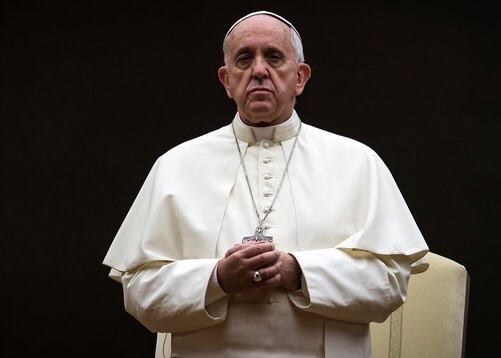
    Pope Francis: Catholicism in Confusion


    Some time ago I made it a policy to not criticize Pope Francis. My attitude to the Vatican corruption, immorality amongst the hierarchy, financial skullduggery and Pope Francis’ ambiguous teaching was simply, “He’s the Pope. He’s from a different culture and background. What can we learn from him? Is he a great pope? Time will tell. Is he a bad pope? I give him the benefit of the doubt and realize, sometimes we have good popes. Sometimes we have bad popes. Sometimes we have incompetent popes. Maybe before long we will have a different pope.”
    Why complain about the Pope if you don’t like him? You can’t do anything about it, so just get on with doing what you can do with what you have where you are. Be real. Be local. Live the faith and perhaps your prayer for the pope will be that of Tevye for the Czar.
    However, I can’t help lamenting this interview of Pope Francis with the Italian paper La Stampa. He speaks about European politics, the immigration crisis and ecology as he looks forward to the upcoming Amazon synod.
    Far be it from me to suggest that a Pope should not comment on politics, ecology and immigration. All of these topics and more may be subjects for papal observation and comment.
    Nevertheless, what struck me most about the interview with La Stampa is that the Holy Father made no mention of Jesus Christ or his Blessed Mother. There was a brief reference to the Christian roots of Europe, but otherwise no mention of sin, the need for redemption, the need for the Catholic faith and the pressing need for repentance, prayer and conversion of souls.
    Nothing.
    An opportunity to evangelize and bring the focus back to the Christian faith was lost completely and all that was given out was mushy sweet talk about politically correct theories.
    Here is the end of the interview:
    Your Holiness, what do you fear most for our planet?
    “The disappearance of biodiversity. New lethal diseases. A drift and devastation of nature that can lead to the death of humanity”.
    Do you see some new awareness on the environment and climate change issue?
    “Yes, especially in the movements of young ecologists, such as the one led by Greta Thunberg, “Fridays for future”. I saw a sign from them that struck me: ‘We are the future!’”.
    Can our daily conduct – separating waste collection, not wasting water at home – have an impact or is it insufficient to counter this phenomenon?
    “It does have an impact, because it is a matter of concrete actions. And then, above all, it creates and spreads the culture of not dirtying creation”.
    This is, quite frankly not only underwhelming, but a total misdirection of the role of the Pope. Ecological campaigning may be vitally important, but that is not his role.
    But let us give him the benefit of the doubt. The interview was clearly edited and cut down by the journalist. It is very possible that the Pope did  speak about the need for repentance and conversion and the opportunity to re-evangelize. It is possible that he spoke powerfully about mankind’s sinful condition and the loving sacrifice of Our Lord to redeem the world. It could be that he promoted the Catholic faith called for the lapsed to return and joyfully proclaimed the Christian gospel.
    It could be that he did all that, and the journalist simply edited out the religious stuff.
    But then again, maybe not.
    This sort of interview is the key cause for the confusion and bewilderment of so many Catholics today. The feel like sheep without a shepherd, that the barque of Peter has no one at the helm.
    The worst thing about this ambiguity and confusion is that it is causing division. I hear more and more Catholics muttering, “This is not my religion” and the problem with that conclusion is that the Catholic who mutters such must therefore set out to create their own religion. They go cherry picking from this magisterial document and that liturgical theory, the teachings of this pope or the life of that pope.
    It’s a pick and mix patch and match do it yourself  approach to Catholicism,  and we know where that leads.
    “This is not my religion…” sounds like Martin Luther or any other sincere Protestant primitivist who thinks they know better than the Pope and sets off to find or found their own “true church.”
    And as they do, they cut themselves off from Rome and will always end up in a backwater. Then, before long they end up in conflict with all the other disgruntled Catholics who have also muttered “this is not my religion” and set off to find their own version of Catholicism.
    Without an agreed source of authority, this path ends in the fissiparous swamp of sectarianism and strife.
    But if the source of authority is itself ambiguous, vague and off target, what else can possibly be the result? What’s to be done?
    Well, talking with a good friend about all this last night we agreed that there are some good things go come from the present crisis and confusion. Firstly, it is a good thing to not put so much trust in the pope. Pope Francis himself would probably agree with this. We’re Catholics. We love the pope. We love the church, but let’s take a deep breath and remember: it’s about Jesus first and foremost. It’s about the gospel of Our Lord Jesus Christ. It’s about conforming our will to His to do his work in the world.
    Secondly, this focus on the real priorities will also help us focus on what we are supposed to be doing. We’re to be getting on with the business of praying, putting God first, serving him and then serving others. We’re to be reading the Sacred Scriptures, learning and teaching the faith from the catechism and sharing that faith with those in need through evangelization and the corporal acts of mercy…
    …and you don’t need the pope looking over your shoulder every minute to do all that.

    Tuesday, June 11, 2019

    Fr. Dwight gets it; there is a bigger agenda behind deaconettes

    The Gnostic Feminism of Phyllis Zagano


    Voiced by Amazon Polly
    One of the most high-ranking feminists in the Catholic Church is Phyllis Zagano, the well-known advocate for the ordination of women to the diaconate. A member of the papal commission to examine the historical precedents of deaconesses, Zagano has researched the subject extensively and is the author of many learned articles and several books.
    Phyllis Zagano is unusual amongst feminist theologians in that, while she is pushing for female ordination to the diaconate, she insists that she has nothing to say about the ordination of women to the Catholic priesthood. Indeed, she is very careful to distance herself from the Catholic women priests movement. She protests vociferously if anyone suggests that her advocacy for women deacons might be part of an incremental campaign for women priests.
    Zagano, along with the dissident Dutch priest John Wijngaards and others, have made arguments over many years for or against women deacons in the Catholic Church. It is a curious proposal. If one digs deeply enough, it does seem that there was an ancient order of deaconesses in the Church. There were even ordination-like rituals for their commissioning. They had various tasks in the Church, among them to retain modesty for female catechumens who would have been unclothed for their baptism by immersion. Ms. Zagano has unearthed some obscure references to deaconesses in the Eastern Churches, but eventually the office of deaconess seems to have died out.
    We should ask why the enthusiasm exists to uncover and restore this particular churchy curiosity? Do we really need female deacons? What would they be able to do that lay women cannot already do? Why the push to bring back deaconesses, for instance, but not the minor orders of subdeacon, acolyte, lector, exorcist and porter?

    Indeed we could uncover a whole range of ecclesiastical antiques. Shall we have a campaign to restore the camelaucum? The sede gestatoria and the peacock fan? Shall we restore these antiquities simply because we are nostalgic for the archaic? Of course not, and neither do the proponents of women’s ordination to the diaconate wish to restore that ancient order. They want Catholic women clergy for other far more obvious reasons.
    This obscure church practice is being discussed because it is part of a feminist agenda. It is possible to wrangle about the wisdom of such a step, but rather than engage in the debate about women deacons, it is worth taking a moment to examine the underlying feminist ideology that drives it.
    As a key Catholic feminist who is in the front line of the discussion, it is worth examining two particular aspects of feminism that Zagano treats. The first is the topic of Christian anthropology and male ordination. The second is the patriarchal imagery associated with God which, for obvious reasons, feminist theologians find irksome.
    “Single Nature Anthropology”
    It is not surprising that Phyllis Zagano has difficulties with these traditional understandings of Christianity. She explains the sore points in an extended passage in her book Holy Saturday – An Argument for the Restoration of the Female Diaconate in the Catholic Church. Zagano doesn’t like what she calls a “dual nature anthropology.” A dual nature anthropology recognizes men and women as complementary— different but equal. Instead Ms. Zagano argues for a “single nature anthropology.” What exactly is a “single nature anthropology”?
    It is the belief that men and women, at the ontological level, are not just equal, but the same. According to Zagano the Church should reflect this reality. So she calls for an ecclesiology that will “ultimately be rooted in a singe-nature anthropology, which sees human nature and existence as the same for both males and females.”
    The “iconic argument” for male priesthood is the understanding that the priest who stands in the place of Christ in the liturgy must be male because Jesus Christ was male. Zagano argues that this explanation for the male priesthood attacks single nature anthropology. Following standard feminist thought, she seems to believe the God-created complementarity of male and female is no more than a cultural construct.
    Speaking about the fact that the male priest is an icon of the male Christ, she writes, “One might agree that the cultural appurtenances of contemporary priesthood are such as to make entrance into it iconically impossible for women. However, this second impossibility is not because of the intrinsic nature of priesthood, but due to the Church’s understanding of priesthood. That is the present ecclesial acceptance of the iconic argument is at root a cultural one.”
    Is the masculinity of Jesus Christ (and by extension the necessary masculinity of the priest) simply a cultural construct? Zagano refers to Pope St. John Paul II’s 1988 letter on the dignity of women, Mulieris Dignitatem, in which the pope specifies the iconography of the male priest as being an intrinsic part of the image of Christ the bridegroom. Biologically, the role of bridegroom (and therefore husband and father) can only be male. Therefore the iconic argument is not simply a cultural construct. It is integrated with the reality of human biology and the mystery of the sacrament of Holy Matrimony and the nuptial imagery of redemption that threads through the Sacred Scriptures and the theology of the Church.
    However, on page 26, Zagano uses some smooth theological sleight-of-hand to dissent from Pope John Paul’s teaching in Mulieris Dignitatum. She declares about his teaching on Christ the bridegroom-priest, “this view is independent of the shift in contemporary theology to a focus on priest as minister who, by and because of his ministry presides at the altar.” In this way, Ms. Zagano deftly corrects Pope John Paul II.
    The mystery and wonder of human sexuality is pondered from the beginning. While men and women are created equal in God’s image, they are clearly not created the same. At the foundational level, Zagano seems to obscure or even obliterate the differences between male and female.  She uses Thomistic terminology to make her point: “That men and women are ontologically identical, that is, ontologically beyond sexuality in their substance while embracing sexuality in their accidents, argues even more strongly for the all-encompassing nature of God…”
    A Caitlyn Jenner Jesus?
    Elsewhere she seems to suggest that Christ himself is somehow androgynous: “God become human, whom Christians know as Christ, is exemplar to women and to men, precisely because in his Incarnation he became fully human. That is, God did not become fully male to the exclusion of becoming fully female; God become ‘man’ means God become ‘human.’ To restrict the Incarnation is to restrict the act of Incarnation. It is the responsibility of the human—male or female—to draw from within his or her likeness to Christ, and that likeness begins with humanity as a whole concept, not with sexuality as a restricting limitation.”
    Let us read that again: “God did not become fully male to the exclusion of being fully female.” I’m sorry, but I can’t help seeing a Caitlyn Jenner Jesus here. I’m not being facetious. It doesn’t take an expert in gender politics to connect the dots and see that a “single nature anthropology” and Zagano’s suggestion that maleness and femaleness are a Thomistic “accident” are academic big-word talk for the current transgender ideology. The idea that one’s gender is fluid, not given but self-chosen, fits perfectly with the neutered humanity Zagano seems to endorse. Watch this video of college students explaining their idea about gender and ask whether (if they understood the philosophical language) they would embrace Zagano’s “single nature anthrolopology” or not.
    How is Zagano’s feminist lingo gnostic? The gnostics taught that the incarnation of God’s son was an illusion. The specific physical and historical details of Jesus of Nazareth were unimportant—distasteful even. What really mattered was “the Christ” who was above and beyond the specificity of the person of Jesus of Nazareth. Zagano has said elsewhere that “The Risen Lord is different from The Christ or Jesus, and it is the Resurrected Christ who lives in all of us.” In Zagano’s version, Jesus Christ’s masculinity comes across as a necessary but messy accident of incarnation.
    If the Church reflects this “single nature anthropology” as Zagano recommends, then our maleness and femaleness will be an accident of hormones and genitalia. Since men and women would be the same, it follows that not only must the diaconate be open to women, but so must the priesthood and it would seem that Zagano is being disingenuous when she pretends to have no interest in promoting the ordination of women to the priesthood.
    The Incarnation of the Son of God presents us with the “scandal of particularity”—that God chose to enter not only human history, but that he took on the form not of an androgynous humanoid, but a man with a beard, broad shoulders, testosterone, testicles and all the rest. His masculinity was not an accident—not in the Thomistic sense nor in the common understanding of the word, and furthermore, his “humanity” is not something that transcends his masculinity. Instead, his masculinity is the sign and seal of his authentic humanity.
    The images of the naked Christ child with his mother and the startling nude crucifixes of Michelangelo and Donatello drive home not only the humanity of Jesus Christ, but his unavoidable masculinity. Likewise, the image of Mary nursing the Christ child reminds us that she is a woman, that breasts are for the nourishment of her child, and that these attributes are what make her and her son fully human. They are not accidents.
    God the “Loving One, Beloved and Co-Beloved”
    One of the agenda points of Christian feminism is the push to redefine God himself. The intrinsically patriarchal terminology of “Father, Son and Holy Spirit” is inimical to feminists. Zagano is unsatisfied with the traditional Trinitarian formula. “Christian tradition is full of images of God that are specifically male,” she writes. “On the philosophical level, God the Father is equally limiting, and equally incorrect, to God the Mother.” The reach of Zagano is astonishing. She asserts that to call God “Father” is “incorrect.” Is it too simplistic to remind ourselves that Our Lord himself commanded us to call God “Our Father”?
    Zagano goes on to ponder other formulas for the Holy Trinity which she suggests are more correct. “The formula Creator, Redeemer and Sustainer can also lend itself to confusions… Perhaps here the formulation of Richard of St Victor diligens, dialects, condilectus (understood as loving one, beloved, and co-beloved) is more appropriate, as the way to know and love the Trinity intellectually and wholly, that is within and beyond sexuality.”
    There is a fundamental problem with this renaming of God. Not only does it blatantly contradict the specific command to call God “Our Father,” but it also eliminates the possibility of a personal encounter with God. If God is reduced to terms that describe what he does rather than who he is, it will be impossible for human beings to enter into an intimate relationship with him. If we call God “Creator, Redeemer and Sustainer” or “Loving One, Beloved and Co-Beloved” we are referring not to him but to his behavior—the roles he performs.
    As men and women—male and female—we respond in relationship to everyone else and indeed everything else as sexual beings. I respond to other females as a man. I respond to other males as a man. The same is true with reference to God. We are commanded to call him “Father” because he is our progenitor. He wants to be in a relationship with us as a Father to his sons and daughters. Simply calling him “Creator” or “Loving One” is to give him an emotionally distant job-related title like Chief Executive Officer or Madame Chairman.
    One only has to read their literature to realize that members of the feminist movement intend to overhaul not just the sacrament of ordination, but the traditional understandings of human anthropology, the doctrine of the incarnation, and the Holy Trinity. Zagano protests vociferously when someone critiques her work, but it is blatantly obvious that feminists are using the discussion of a female diaconate not only as a stalking horse for women priests, but also for the whole feminist agenda.