Showing posts with label Calissta Gingrich. Show all posts

Tuesday, September 1, 2020

Eradicate Human Trafficking: Callista Gingrich

Callista_Gingrich_by_Gage_Skidmore Wikimedia Commons

‘We Remain Committed to Eradicate Global Evil of Human Trafficking,’ Assures Ambassador Gingrich at Talitha Kum Event

Ambassador Gingrich’s welcome remarks at a ‘Conversation among Women of Faith on Human Dignity, Freedom and Care’

Share this Entry

Ambassador Gingrich’s welcome remarks at a “Conversation among Women of Faith on Human Dignity, Freedom and Care”

Rome, Italy
August 31, 2020
Good afternoon.
It’s an honor to welcome you to our discussion today.
I’d like to thank Sister Gabriella Bottani and Sister Pat Murray, for organizing this virtual event.
Today’s conversation is dedicated to exploring how women of all faiths can work together to fight the global scourge of human trafficking.
Human trafficking is a stain on all of humanity. It invades borders, destroys communities, and robs millions of their human dignity.
Combatting the evil of human trafficking is a top priority for the U.S. Embassy to the Holy See, and a cornerstone of our relationship with the Holy See and UISG.
The U.S. Embassy to the Holy See is proud of our long-time friendship and collaboration with UISG and the Talitha Kum Network.
We remain committed to working with women religious and others to eradicate the global evil of human trafficking.
For this reason, we are delighted to partner today with Talitha Kum, UISG, and Women of Faith for Peace.
I look forward to hearing from our distinguished speakers, and to working with all of you, as we fight to end this horrific injustice.
Thank you.

Callista L. Gingrich
U.S. Ambassador to the Holy See 
***
Link on Embassy’s Website:

Monday, April 8, 2019

Ambassador Callista Gingrich addresses religious persecution and religious freedom

© US Embassy to the Holy See

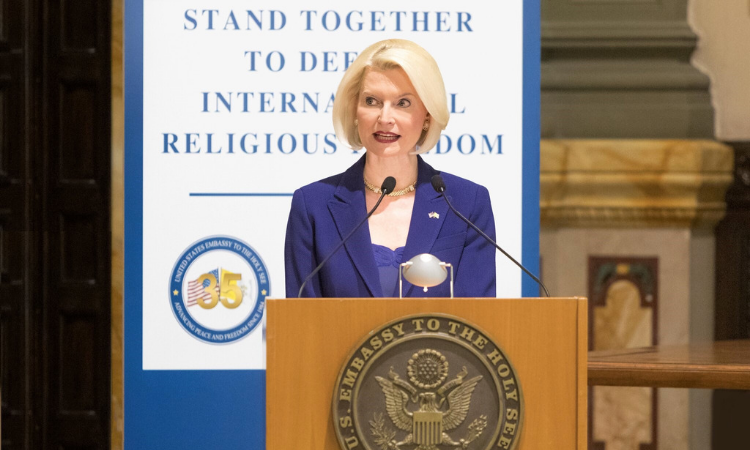
FEATURE: ‘Together We Can Defeat Forces of Religious Persecution & Defend, Advance Religious Freedom,’ Urges US Ambassador to the Holy See Callista Gingrich

At ‘Stand Together to Defend International Religious Freedom’ Symposium, Cardinal Parolin Says With Religious Persecutions Worldwide, ‘There Should Be No Doubt Left in Our Minds We Are Dealing With an Aggressive Attack on Human Rights’

“Together we can defeat the forces of religious persecution and intolerance, and advance and defend religious freedom around the world.”
US Ambassador to the Holy See Callista Gingrich stressed this to various Ambassadors to the Holy See, religious representatives, Vatican officials and cardinals, and select journalists including ZENIT’s Senior Vatican Correspondent of the English Edition, at the “Stand Together to Defend International Religious Freedom” symposium in Rome, sponsored by the US Embassy on April 3, 2019.
“Our symposium today comes at an urgent time,” she stated, decrying that “for millions around the world, religious freedom is currently under threat or restricted entirely.”
According to the Pew Research Center, the diplomat pointed out, more than 80 percent of the global population lives in places with “high” or “very high” religious restrictions, mostly targeting minority faiths.
“This is not acceptable,” she said. Noting the United States is actively working to address this, she reminded that last year,  Secretary Mike Pompeo convened an International Religious Freedom Ministerial in Washington, D.C., where more than 80 countries, including the Holy See, were represented, along with 400 civil society leaders. The key speakers were survivors of religious persecution and repression.
The Holy See, the US Ambassador underscored, has a long history of encouraging religious freedom and tolerance through interreligious dialogue.
“After Pope Francis’s visits to Burma and Bangladesh, he professed that the church “won’t close (its) heart or look away” from the plight of the Rohingya, During his visit to Egypt, Pope Francis called on humanity not to hold entire religions “accountable for the crimes of any small group of followers.”
“And the Holy Father’s recent visits to the United Arab Emirates and Morocco are great examples of the power of interfaith engagement. They mark a significant step toward coexistence, tolerance, and understanding between two of the world’s great religions.”
The U.S. Embassy to the Holy See, Her Excellency highlighted, “looks forward to continuing our important work with Pope Francis and the Vatican to advance interfaith dialogue and religious freedom.”
We Can Defeat Religious Persecution, and Defend, Advance Religious Freedom
“Together,” Ambassador Gingrich stressed, “we can defeat the forces of religious persecution and intolerance, and advance and defend religious freedom around the world.”
“Together,” she continued, “we must confront and counter those who practice, enable, or export religious persecution or violent extremism. All of us, across governments, civil society, faith organizations, and media, must work together to advance and defend this cause.”
The US Ambassador to the Holy See stressed that global crises require global solutions, noting that for this reason, Secretary Pompeo is convening again the International Religious Freedom Ministerial in Washington D.C., July 16-18.
The Symposium, opened with the remarks of Ambassador Gingrich, and closed with those of Cardinal Parolin, and was comprised of two panels, both moderated by Knox Thames, Special Advisor for Religious Minorities U.S. Department of State.
No Doubt Left in Our Minds … Aggressive Attack
The Vatican Secretary of State did not mince words.
“A brief consideration of the numerous violations of religious liberty on the global stage and the appalling number of innocent persons that suffer persecution, because of their beliefs, including many Christians,” he said, “should leave no doubt in our minds that we are dealing with an aggressive attack that strikes at the very core of the enjoyment of fundamental human rights, which are necessary for the flourishing of the human person, of society as a whole, and for the peaceful coexistence among nations.”
“Despite so many efforts to promote and reinforce the fundamental human right of religious freedom, we are actually witnessing a continued deterioration, we might even say an assault, of this inalienable right in many parts of the world.”
The Symposium’s first panel “Media Strategies to Highlight Religious Persecution” included the participation of Paolo Ruffini, Prefect, Dicastery for Communications, Holy See; Alessandro Monteduro, Director, Aid to the Church in Need (Italy) and Roberto Fontolan, Chairman, #StandTogether Project.
Paolo Ruffini underscored: “One cannot fail to be concerned about the drastic increase in violations of religious freedom in the world and the persecution of believers and non-believers.” Moreover, Mr. Thames explained to those present how the US has worked to help persecuted Christians in Iraq and is ensuring those funds go to those in need, without interference.
The second panel “Collaborative Approaches to Advance Religious Freedom” included the participation of Monsignor Khaled Akasheh, Secretary, Pontifical Council for Interreligious Dialogue; Dr. Silvio Ferrari, Professor of Law & Religion, University of Milan and Sister Clare Jardine, General Councilor, Congregation of Our Lady of Sion.
Here are Ambassador Gingrich’s remarks:
******
Good morning.  Your Excellencies, distinguished guests, and friends – welcome to the U.S. Embassy to the Holy See!
I’m delighted to see so many of you here today, who are committed to advancing and defending religious freedom around the world.
I’d like to thank the Stand Together Project for partnering with us on this symposium. Stand Together was created to highlight the importance of religious freedom and to give a voice to persecuted Christians, especially those living in the Middle East.
Finally, I’d like to recognize our colleagues from the Holy See who are with us this morning. We are honored that His Eminence, Cardinal Parolin, will deliver closing remarks today. This year marks the 35th Anniversary of formal diplomatic relations between the United States and the Holy See.
This symposium is the first official event marking our anniversary because securing and defending religious freedom is a fundamental priority for the United States and the Holy See.
The right to worship freely is often called America’s first freedom – a necessary component of U.S. foreign policy and our commitment to ensuring a more peaceful, prosperous, and secure world.
Safeguarding religious freedom is fundamental to the founding principles of the United States.  It’s part of who we are as a people and a nation.
Four centuries ago, the first Pilgrims came to America’s shores searching for religious freedom and a better life. Less than two centuries later, our founding fathers enshrined religious liberty as the First Amendment to our nation’s Constitution. They understood religious freedom not as the state’s creation, but as an unalienable right from God. Religious liberty was vital then, and it remains vital now.
Our symposium today comes at an urgent time. Unfortunately, for millions around the world, religious freedom is currently under threat or restricted entirely.
According to the Pew Research Center, more than 80 percent of the global population lives in places with “high” or “very high” religious restrictions, mostly targeting minority faiths.
This is not acceptable. And the United States is taking all necessary steps to address it.
Last year Secretary Mike Pompeo convened an International Religious Freedom Ministerial in Washington, D.C. More than 80 countries, including the Holy See, were represented, along with 400 civil society leaders.
The key speakers at the Ministerial were survivors of religious persecution and repression, including: A Christian woman who suffered extraordinary atrocities at the hands of North Korean authorities; a Yazidi woman who was cruelly treated by ISIS in Iraq; members of the Baha’I faith who were targeted by the regime in Iran; and a Uighur Muslim who was consigned to years in a labor camp in China, simply for practicing his faith.
Since 2017, Chinese authorities have detained more than one million ethnic Muslims. Uighurs, Kazakhs, and members of other Muslim minority groups have been targeted and forcibly relocated to internment camps. Family members pray and search for their missing loved ones.
The Trump Administration is deeply concerned and considers this a deliberate attempt to persecute and control these Muslim minority groups.
In a few moments, we’ll see a video of a Uighur mother who was separated from her children and subjected to severe torture at the hands of Chinese authorities. Last week, Secretary Pompeo met with this mother, Mihrigul Tursun, and three other Uighurs, to reaffirm the steadfast support of the United States.
Of course, China is not the only center of such hostility. Religious persecution is a borderless phenomenon – and exists on every continent: Today, Anti-Semitism is on the rise around the world; Saudi Arabia routinely imprisons individuals for apostasy and blasphemy; Rohingya continue to suffer ethnic cleansing in Burma, and Russian authorities target and persecute peaceful religious groups at home and abroad – from Christians and Jehovah’s Witnesses to Orthodox Ukrainians and Crimean Tatars.
These examples represent just a portion of religious persecution and repression today. The United States will not hesitate to speak out against these atrocities. We will continue to be a voice for those who are persecuted and repressed.
All of us gathered here today understand that religious liberty and tolerance are central to national security.
They are the bulwarks against the forces of extremism — the foundation of peace and security. History has shown that governments and societies that champion religious liberty are safer, more prosperous, and secure.
Together we must confront and counter those who practice, enable, or export religious persecution or violent extremism. All of us, across governments, civil society, faith organizations, and media, must work together to advance and defend this cause.
Global crises require global solutions. This is why Secretary Pompeo will once again convene the International Religious Freedom Ministerial in Washington D.C., from July 16th-18th. Given widespread interest, we anticipate that participation in this ministerial will be even greater than last year.
When it comes to religious freedom, President Trump’s Administration is combining principle with action.
In 2018 the United States announced over $178 million dollars in foreign assistance to support ethnic and religious minorities in Iraq. This brings the total U.S. assistance for these vulnerable communities to nearly $300 million dollars since 2017 – implemented by both the State Department and the U.S. Agency for International Development.
President Trump also recently signed into law the Iraq and Syria Genocide Relief and Accountability Act, which provides desperately needed humanitarian relief to victims of genocide, as well as persecuted ethnic and religious minorities.
Beyond humanitarian efforts, the United States also understands the importance of interfaith dialogue to build bridges in order to facilitate peace.
During President Trump’s first official overseas trip, he visited Saudi Arabia, Israel, and the Vatican – the three centers of Abrahamic faith.
In a speech in Riyadh to the Arab Islamic American Summit, the president advocated for religious tolerance, freedom, and dialogue. He said that, “For many centuries the Middle East has been home to Christians, Muslims and Jews living side-by-side (and that) we must practice tolerance and respect for each other once again.”
The Holy See also has a long history of encouraging religious freedom and tolerance through interreligious dialogue.
After Pope Francis’s visits to Burma and Bangladesh, he professed that the church “won’t close (its) heart or look away” from the plight of the Rohingya.
During his visit to Egypt, Pope Francis called on humanity not to hold entire religions “accountable for the crimes of any small group of followers.”
And the Holy Father’s recent visits to the United Arab Emirates and Morocco are great examples of the power of interfaith engagement. They mark a significant step toward coexistence, tolerance, and understanding between two of the world’s great religions.
The U.S. Embassy to the Holy See looks forward to continuing our important work with Pope Francis and the Vatican to advance interfaith dialogue and religious freedom.
And our embassy looks forward to working with all of you.  Together we can defeat the forces of religious persecution and intolerance, and advance and defend religious freedom around the world.
Thank you.

Wednesday, July 4, 2018

Special 4th of July remarks from US Ambassador to the Holy See

Photo courtesy of the US Embassy to the Holy See

Fourth of July Forum: Remarks at U.S. Embassy to the Holy See 2018 Independence Day Celebration, by Ambassador Callista Gingrich

‘Working together with the Vatican, the United States Embassy to the Holy See will continue to promote peace, freedom, and human dignity around the world’

Zenit wishes all its readers in the United States of America a Happy Fourth of July. Below are the remarks of American Ambassador to the Holy See Callista Gingrich at the embassy’s Independence Day Celebration in Rome, Italy, at Villa Richardson on July 3, 2018:
***
Good evening. Let’s have a round of applause for our United States Marines and the Navy Maritime Winds Woodwind Quintet.
I’d like to thank our many generous sponsors, whose support makes this evening possible. I’d also like to thank my team at the U.S. Embassy to the Holy See for putting this evening’s celebration together. Let’s give them a round of applause!
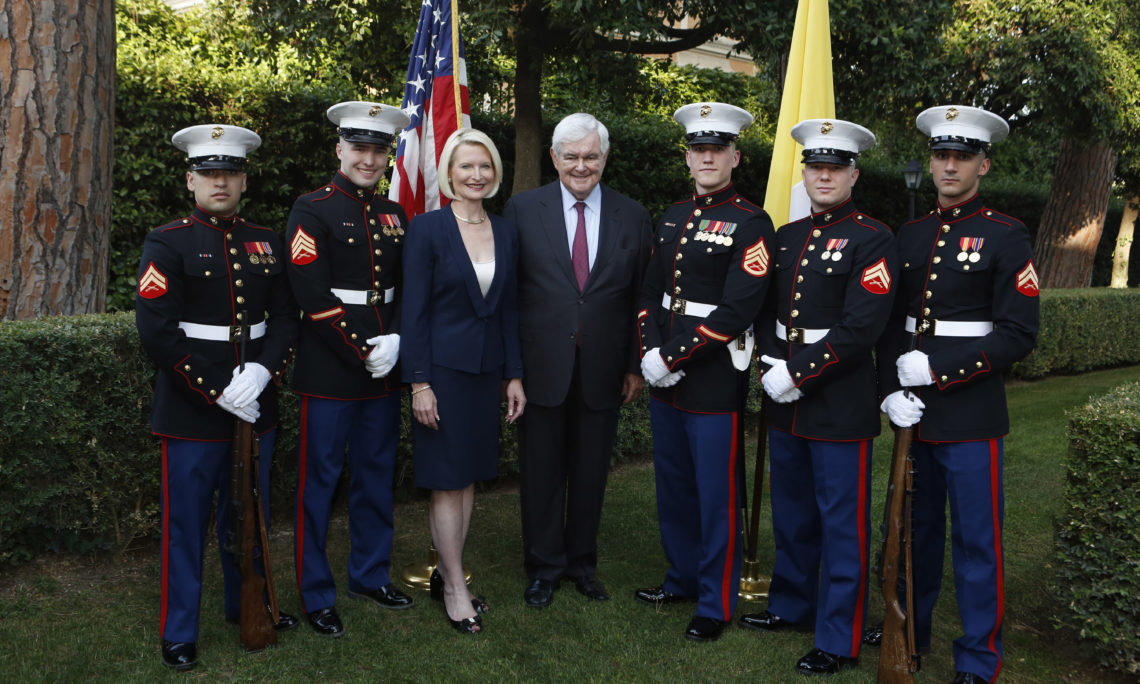
Your Eminences, Your Excellencies, distinguished guests, and friends – Newt and I are so pleased to welcome you to Villa Richardson.
Americans come together with family and friends on the 4th of July to commemorate the signing of the Declaration of Independence and to celebrate the birth of our nation. It’s a time to reflect on a unique and remarkable moment in history, when 56 men from 13 colonies gathered in a simple statehouse in Philadelphia and changed the world.
With one voice they emerged and declared “that all men are created equal.” They mutually pledged to each other, their lives, their fortunes, and their sacred honor on the belief that government must derive its power from the people.
For 242 years, the signing of the Declaration of Independence has been a symbol of liberty, democracy, and justice.
And while each year we pause to celebrate our nation’s birthday, we also reflect on our shared responsibilities as Americans. Our forefathers launched a great experiment in 1776 – one that requires each generation to preserve freedom for the next. As Benjamin Franklin cautioned, “A Republic – if you can keep it.”
The lessons of America’s independence were not meant to be left behind in 1776 – nor confined to the United States. The values and ideals enshrined in America’s constitution have been emulated by democracies around the world.
Of course, challenges remain. Today, millions of people around the world suffer under oppression and tyranny – deprived of freedom, security, and prosperity.
Faced with these great challenges, the United States and the Holy See share a deep and enduring commitment to advancing freedom and justice around the world.
Over the past year we’ve had the good fortune to highlight the many ways in which the United States and the Holy See work together on this noble effort.
Last May President Trump and his family visited the Vatican to meet with the Holy Father. President Trump and Pope Francis discussed the shared priorities of the United States and the Holy See on a number of issues, including combatting terrorism and safeguarding human rights.
The U.S. Embassy to the Holy See has been hard at work with the Vatican to build on these shared objectives, from fighting human trafficking, to highlighting the work of women religious, to advancing and defending religious freedom.
Two weeks ago our embassy held a symposium on defending international religious freedom. Their Eminences Cardinals Parolin, Coutts, and Sandri graciously joined us.
This event amplified our joint efforts to defend religious freedom in the lead-up to the “Ministerial to Advance Religious Freedom,” which will be hosted by Secretary Pompeo later this month in Washington D.C. I’m pleased to announce that His Excellency Archbishop Gallagher will travel to Washington for this Ministerial.
In April, Archbishop Gallagher also joined us for a symposium illustrating the remarkable contributions women religious make to advance peace and human rights around the world.
One of these women, Sister Maria Elena Berini, was honored by the United States as an International Woman of Courage for her service in war-torn communities in Africa.
And earlier this year at the Santa Marta Conference we reaffirmed our shared commitment with the Holy See to combatting the global evil of human trafficking.
Working together with the Vatican, the United States Embassy to the Holy See will continue to promote peace, freedom, and human dignity around the world.
And now, please raise your glass and join me in a toast to the anniversary of our Declaration of Independence, and to the bonds of friendship that unite America and the Holy See. Salute!
Thank you. God bless you all. And God bless the United States of America!
***
On the NET:

Monday, June 25, 2018

A huge effort between the US Embassy to the Holy See and the Vatican to battle religious persecution

Photo by Zenit's Vatican Correspondent, Deborah Castellano Lubov

FEATURE: Inciting International Action to Defeat Religious Persecution & Repression

U.S. Embassy to the Holy See Explores Religious Freedom, an Inalienable Right From God, and Threats to It

A part of a comprehensive, international effort to incite action around the world to defeat religious persecution and repression….
U.S. Ambassador to the Holy See Callista L. Gingrich, stressed this when speaking about the U.S. Embassy to the Holy See-hosted symposium on religious freedom on Monday, June 25, 2018, on “Defending International Religious Freedom: Partnership and Action” at the Pontifical University of Santa Croce.  It included opening remarks by the Ambassador and closing remarks by Vatican Secretary of State Cardinal Pietro Parolin.
Presented in partnership with Aid to the Church in Need and the Community of Sant’Egidio, the symposium will promote the universal right of religious freedom and raise awareness of religious persecution, particularly in the Middle East.
Symposium speakers included Cardinal Leonardo Sandri, Prefect of the Congregation for Oriental Churches, Cardinal-designate Joseph Coutts, Archbishop of Karachi, Pakistan, Monsignor Khaled Akasheh, Secretary of the Pontifical Council for Interreligious Dialogue, Professor Marco Impagliazzo, President of the Community of Sant’Egidio, and Mark Von Riedemann, Director of Public Affairs at Aid to the Church in Need. Yazidi Community Activist Salwa Khalaf Rasho and the Iraqi Ambassador to the Holy See, Omar Al-Barazanji, spoke, and Victoria Alvarado, Senior Advisor for International Religious Freedom at the U.S. Department of State, and former Deputy Chief of Mission at the U.S. Embassy to the Holy See, served as moderator.
America’s 1st Freedom
Ambassador Gingrich stressed: “The right to worship freely is America’s first freedom, codified in the First Amendment to our Constitution. Safeguarding religious freedom is fundamental to the founding principles of the United States. It’s part of who we are as a people and a nation.”
“America’s Founders understood religious freedom not as the state’s creation, but as an inalienable right from God. Our commitment to this ideal remains steadfast.”
“As this year’s report shows – repression, violence, and discrimination are daily realities for millions of believers in every region of the world. In many cases, their human rights are limited or restricted entirely. Indeed, no religious community is immune from persecution.”
The Ambassador highlighted:
  • In Venezuela, President Maduro attacks leaders of the Catholic Church for exposing that
    people are starving and lack medical care.
  • Terrorist groups in parts of Africa kill scores of Christians and Muslims, and abduct
    schoolgirls.
  •  Christian pastors and Baha’i are jailed in Iran for exercising their right to worship freely.
  •  Anti-Semitism is on the rise globally.
  •  Russian authorities target and persecute peaceful religious groups at home and abroad.
  •  Minority groups like Ahmadi Muslims are persecuted in Pakistan.
  •  In China, Uighur Muslims are sent to re-education camps.
  •  Tibetan Buddhists are forbidden to organize — and their leaders are imprisoned.
  •  Rohingya Muslims face ethnic cleansing and displacement in Burma.
  •  Saudi Arabia prohibits non-Muslims from practicing their religion in public, and imprisons individuals for apostasy and blasphemy.
  • And Christians, Shia Muslims, and Yezidis in the Middle East continue to suffer from ISIS atrocities.
“What is most astonishing is that these examples represent just a small portion of religious persecution and repression around the world. As these facts illustrate, it’s a dangerous time to be a person of faith. We are at a critical moment. We can and must do more.”
Unmask Masquerades
Cardinal Parolin adamantly reminded: ‘No violence in the name of religion is acceptable.’
Moreover, the Vatican Secretary of State recalled the Holy Father’s words when he visited Egypt and addressed al-Azhar University, Sunni Islam’s highest institute of learning, on April 28, 2017: “Violence is the negation of every authentic religious expression,” he said. “As religious leaders, we are called, therefore, to unmask the violence that masquerades as purported sanctity and is based more on the ‘absolutizing’ of selfishness than on authentic openness to the absolute.”
Imperative
Cardinal Leonardo Sandri recalled the Holy Father’s Sept. 26, 2015, address at Philadelphia’s Independence Mall: “In a world where various forms of modern tyranny seek to suppress religious freedom, or, as I said earlier, to try to reduce it to a subculture without right to a voice in the public square, or to use religion as a pretext for hatred and brutality, it is imperative that the followers of the various religious traditions join their voices in calling for peace, tolerance and respect for the dignity and the rights of others.”
The Prefect of the Congregation for Oriental Churches highlighted how important it is to preserve Lebanon as well as the need to help Iraq.
Misuse
Cardinal-designate Joseph Coutts, Archbishop of Karachi, Pakistan, expressed how there used to be religious freedom in his country, but over time the right has ‘gradually eroded.’  He stressed, however, that not only the Christians suffer this, but also Muslims are targeted and persecuted.
The Blasphemy Law, he noted, is very easily misused. Even if there is no proof, one can easily be misused, to accuse someone of having ‘broken the law.’ When that person cannot defend himself from that accusation, then they face death.
He stressed that the way this law is formulated is very problematic, as it includes no consideration of ‘intent.’
No Compulsion
The Iraqi Ambassador to the Holy See gave a strong discourse. “One of the Human rights laws established by the United Nation, Article 1,2 and 18 of  the Universal Declaration of Human Rights (UDHR) consists of:  
‘Everyone has the right to freedom of thought, conscience and religion; this right includes freedom to change his religion or belief, and freedom, either alone or in community with others and in public or private, to manifest his religion or belief in teaching, practice, worship and observance.’
“Also the Islamic religion has given this liberty for fourteen centuries in its texts and verses, one is very specific and says: ‘There shall be no compulsion in [acceptance of] the religion.’
Must Change
Monsignor Khaled Akasheh, Secretary of the Pontifical Council for Interreligious Dialogue, stressed that religion should only be used to help other religions, not for any other reasons. He also noted that for progress to be made, they need to focus on helping people, rather than converting them, and that what is most important is not just ‘talking,’ but ‘constructing.’ The attitudes of people, as well as governments, he highlighted, must change.
Professor Marco Impagliazzo, President of the Community of Sant’Egidio, stressed that aside from the early centuries of the Church, those starting from the 20th Century are those where Christians are being persecuted the most. He also stressed how Sant’Egidio has been helping these suffering, but how more has to be done.
Mark Von Riedemann, Director of Public Affairs at Aid to the Church in Need, called for action. He stressed the need ‘to get facts straight,’ warning how much misinformation is circulating. In order to remedy these problems and make those who have had to flee, return, he said it is essential to find ways to help people integrate, get jobs, and set up basic infrastructure, such as water and electricity.
Horror Continues
Yazidi Community Activist Salwa Khalaf Rasho, whose Yezidi community has been subject to 74 genocidal campaigns throughout history, said the Islamic State killed thousands of Yezidi men ‘in the most horrific ways.’
“As a result,” she said, “about 60 mass graves have been found in my town of Sinjar. More than 6000 women and girls were kidnapped, including me and many of my relatives. We have been subjected to all types of sexual and physical abuse and violence. We were sold in slave markets.”
Having been kidnapped by ISIS and held captive for eight months, Salwa observed: ‘During this period I was subjected to unthinkable practices. I finally had the chance to escape from their grip, but other women and girls did not. More than 3,000 of them are still missing, enduring a fate of daily rape and torture which has constituted their lives for the past four years.”
Must Protect
Rev. Luis Navarro,  rector of the Pontifical University of the Holy Cross, reminded: “After right to life, according to St. Pope John Paul II, religious freedom is the next important right. It must be protected.” He expressed his hope this conference helps to protect this fundamental right.
The symposium featured panel discussions on protecting religious minorities in the Middle East, and promoting religious freedom through interreligious dialogue.  Participants included Holy See-accredited diplomats, faith leaders, civil society representatives, academics, and others.
“Defending International Religious Freedom: Partnership and Action” was a precursor to the first-ever “Ministerial to Advance Religious Freedom,” which will be convened by U.S. Secretary of State Mike Pompeo in Washington, D.C., July 25-26.