Showing posts with label Archbishop Joseph Kurtz. Show all posts

Thursday, March 31, 2022

The installation Mass of Archbishop Shelton Fabre in Louisville

 Historic installation of Archbishop Shelton Joseph Fabre heralded as ‘a new era’ for the Catholic church


The Archdiocese of Louisville has a new archbishop.

Archbishop Shelton Joseph Fabre was installed Wednesday during a Catholic Mass held at the Kentucky International Convention Center.

Self-proclaimed “cradle Catholics” Larry and Louise Michalczyk showed up early to the service to witness what they called a historic moment in the city. 

“I think this is the start of a new beginning for the Catholic Church here in Louisville,” Larry Michalczky said. 

He pointed to Fabre’s history of elevating racial justice in his ecclesiastical work.

“And I think that’s particularly pertinent here in Louisville at this time,” Larry Michalczyk, who is white, said. “So he brings a new fresh face, new leadership and new experiences.”

Louise Michalczyk, who is also white, said he’ll face some immense challenges, “undoing some of the damage that has been done, within the church, within the diocese and within the community as well.” 

“We need a fresh start here in the community,” she said.

Fabre accepted his duty to lead the Archdiocese of Louisville “with the love of God in my heart.”

Pope Francis appointed Fabre to the post earlier this year. He’s the Archdiocese of Louisville’s fifth archbishop, its 10th bishop and the area’s first Black leader of the local archdiocese, which encompasses 24 Kentucky counties and more than 200,000 parishioners, in its more than 210-year history. 

Fabre, 58, came to Louisville from his home state of Louisiana, where he had been the bishop of the Diocese of Houma-Thibodaux since late 2013. 

According to his biography on the Archdiocese of Louisville’s website, Fabre studied at the American College of Louvain and the Katholieke Universiteit te Leuven in Belgium. He was ordained as a priest in the Diocese of Baton Rouge in 1989. 

Fabre succeeded Archbishop Joseph Kurtz, who had held the title since 2007 and retired in August on his 75th birthday.


A ‘message of joyful hope’

During a press conference in early February announcing Fabre’s appointment, Kurtz said the area parishes are “getting someone who is a deeply human person, a very healthy person, a holy man and, in a special way, a good pastoral bishop.”

“I’m both humbled and excited by this appointment by the Holy Father, and I pledge to serve the needs of this church to the very best of my ability,” Fabre said during that same press conference.

In March 2020, then-Archbishop Kurtz invited Fabre to give a virtual presentation of “Open Wide Our Hearts: The Enduring Call to Love.” Members of the U.S. Conference of Catholic Bishops’ Ad Hoc Committee Against Racism, of which Fabre serves as chair, penned the anti-racism letter. It states that racism continues to have significant and harmful impacts on society, and it “has no place in the Christian heart.”

“While I recognize that our community has faced, what some may say, is far too great an experience of injustice and disregard for human life and dignity, I come to you with a message of joyful hope,” Fabre said during the February press conference. “I have great faith and great hope in the work already underway within our community regarding racial equality.”

He expressed a conviction that working together will help the local Catholic community in attaining “the promotion of life, charity, justice and peace as we endeavor to build an even greater civilization of love.”

Uniting the region’s Catholic community

Fabre will have his work cut out for him. 

In the months leading up to his appointment, local Black Catholics demanded that the archdiocese and archbishop do more to address the treatment of three parishes in Louisville’s West End. 

“Repeatedly, our assigned Black priest has shown disregard for our voices in managing and leading our congregations,” several parishioners wrote in an opinion column in the Courier Journal in November. 

They said Catholic leadership in the area had failed them on a number of levels, including not addressing concerns about mismanagement of funds and pervasive mistreatment from church leadership.

“Is it too harsh to label this racism?” the parishioners wrote. “No. It is the truth. Do we Black Catholics in struggling, small parishes in marginalized neighborhoods count as much as white Catholics in parishes with corporate and professional parishioners holding country club memberships and living in East End McMansions with four-car garages?”

Upon his appointment as archbishop, Fabre said he hopes Black Catholics in the archdiocese’s region, “will see in me someone who looks like them.” 

“Someone who knows them and wishes to speak with them,” he continued. “Someone who was sent here to serve all members of the archdiocese.”


That gives parishioners, like lifelong Catholic Lisa Johnson of Bardstown, hope.

Johnson, who is Black, said Fabre seems like someone who will listen, “someone who’s going to be available and approachable.” 

“And I think that’s the first step because that opens up the dialogue and opens up that opportunity to improve,” she said.

She was excited to be in attendance Wednesday, and said, “coming from a multicultural church,” the moment felt historic. 

“I know he’s well equipped,” Johnson said. “And I’m excited to see what he’s going to do.”

During his sermon Wednesday, Fabre said the local Catholic community is confronted with many unknowns and challenges, encouraging the attendees to “look to Christ” for hope. 

“We together face the challenges of COVID-19, the effects of past hurts and injustices, and the disregard of human life and dignity through racism,” he said.

He continued that he believes the Archdiocese of Louisville is its people, and that’s why they should face challenges, like racism, as a community. 

“We stand on the precipice of an exciting future,” Fabre said Wednesday. “However, the future will largely be determined by us standing together and keeping our eyes focused on Him, who unites us, rather than on the things that divide us.”

Fabre also noted other challenges he sees the church facing, including “aggressive secularism, assaults on religious freedom, the reality of poverty, and the need for healing the woundedness of marriage and family life.” 

Members of Louisville’s LGBTQ Catholic community have voiced concern over Fabre’s record of speaking against same-sex marriage.

In 2015, Fabre told a Louisiana newspaper that the church believes same-sex marriage is harmful to society, and advised against Catholics attending same-sex ceremonies or providing services for them.

And in early 2021, he put his name on a statement, along with other Catholic bishops, saying they were concerned by President Joe Biden’s executive order to extend federal sex discrimination protections to include sexual orientation and gender identity. 

“Wednesday’s executive order on ‘sex’ discrimination exceeds the Court’s decision,” the statement said. “It threatens to infringe the rights of people who recognize the truth of sexual difference or who uphold the institution of lifelong marriage between one man and one woman.”

During the February press conference, a reporter asked Fabre if he would welcome LGBTQ community members into the Catholic church. 

“I stand ready, certainly, to meet and to listen,” Fabre responded. “I hope they would find in me someone who is willing to listen to them, someone who is willing to journey with them, someone who is willing to invite them to come to know the Jesus Christ that we know.”

Monday, February 7, 2022

Breaking today: Louisiana Bishop Shelton Fabre to Louisville


Bishop Fabre to succeed Abp. Kurtz in Louisville

News: Archdiocese of Louisville

Bishop Shelton Fabre will soon be announced as the new Archbishop of Louisville, Kentucky, Church officials in Rome and the archdiocese have told The Pillar.

The announcement of Fabre’s appointment is expected as soon as this week, and will see the bishop succeed Archbishop Joseph Kurtz, who has led the Kentucky archdiocese since 2007.


Fabre has been since 2013  the Bishop of Houma-Thibodaux in his native state of Louisiana. He was previously an auxiliary bishop of New Orleans. 

Fabre, 58, was ordained a priest of the Diocese of Baton Rouge in 1989, having completed his seminary studies in Belgium.

In addition to leading the Houma-Thibodaux diocese, Fabre also chairs the U.S. bishops’ ad hoc committee against racism, and oversaw the release of the USCCB’s 2018 pastoral letter “Open Wide our Hearts: The Enduring Call to Love,” which addressed the enduring problems of racism in the United States, and the Catholic response to them.

Sources close to the Congregation for Bishops in Rome told The Pillar that the process for selecting a new archbishop for Louisville had been underway since before Christmas, and that several candidates had been considered for the appointment.

Archbishop Kurtz submitted his resignation, in line with the provisions of canon law, when he turned 75 in August 2021, having already contended with serious health issues during his time in office. In 2019, Kurtz announced he would undergo treatment for bladder cancer and be away from the archdiocese for a period of weeks.

Kurtz is a widely respected figure among the U.S. bishops. He was in 2013 elected as president of the USCCB, and in 2014 elected as a delegate of the U.S. bishops to participate in the meeting of the Synod of Bishops on the family in Rome. 

In November 2021, Kurtz was chosen to lead a day of prayer and retreat for the U.S. bishops’ conference, at the opening of the annual USCCB Fall Assembly in Baltimore. Kurtz was tapped as a unifying figure, after months of public division among the bishops over a proposed document on the Eucharist.

Also in 2021, Kurtz was tapped by the Congregation for Bishops to conduct an investigation into the leadership of Bishop Rick Stika of Knoxville, Tennessee, after several priests in the Knoxville diocese raised concerns about Stika's management. Kurtz, who was previously Knoxville's bishop, sent an assessment of the situation to the Vatican, where next steps concerning Stika are reportedly under discussion.

The Archdiocese of Louisville, home to more than 180,000 Catholics, is also the metropolitan see of the province of Louisville, which includes the Kentucky dioceses of Owensboro, Lexington, and Covington, as well as the Tennessee dioceses of Nashville, Knoxville, and Memphis.

One official close to the congregation told The Pillar that Louisville was considered in Rome a “sensitive” appointment, adding that there had been considerable debate about a slate of candidates before Fabre was finally proposed to the Holy Father for approval.

Louisville became the locus of widespread demonstrations for racial justice following the killing of Breonna Taylor in her own apartment by local police in March 2020. Demonstrations after Taylor’s killing were intensified following the murder of George Floyd two months later in Minneapolis.

As chairman of the USCCB committee against racism, Fabre has been a leading voice among the bishops in acknowledging and combating the problem of racism in American society. 

In March last year, Fabre was invited by Kurtz to address the Louisville archdiocese’s online Archdiocesan Leadership Institute, during which he spoke of the need to “recognize and respond to racism as a life issue.” 

“Racism attacks the human life and dignity of its victims,” Fabre told priests and lay leaders of the archdiocese. “To truly and authentically be pro-life, we must strive to dismantle in our own hearts as well as in society all attacks against the sanctity of life and one such attack is racism.”


For months, speculation has circulated amongst the clergy of the archdiocese about who the next archbishop would be, with Bishop John Stowe of Lexington and Bishop Joseph Bambera of Scranton, Pa., two names commonly mentioned among priests in the region. 

Stowe’s name was also floated by progressive-leaning Catholic commentators as a likely choice to succeed Kurtz. The bishop has become well-known for weighing in on national ecclesial affairs in recent months. In November, shortly before the U.S. bishops met in Baltimore for their annual assembly, Stowe said that expecting his brother bishops to show “real discernment, serious discussion, and prayerful listening” before publishing such a document was “probably unrealistic.” 

Bambera, who chairs the bishops’ committee on ecumenism and inter-religious affairs, has been floated in the past as a candidate for a metropolitan see, and was discussed seriously as a possibility for Louisville, while a Vatican official close to the Congregation for Bishops told The Pillar that Stowe was not considered in Rome a plausible candidate for the job. 

“The focus was on candidates who could foster communion in the archdiocese and the province from the beginning,” the official said. “That was the first concern.”

While Fabre is well-regarded for his work leading the Church in the United States’ engagement on racial justice issues, the bishop has not immersed himself in the minutiae of conference politics, and shown himself willing to work on priority issues with broad coalitions.

While Stowe and Bambera were signatories, Fabre did not sign a controversial letter last year calling for discussion of a document on Eucharistic coherence to be dropped from the agenda of the bishops’ June meeting. 

In 2020, Stowe raised concerns about whether the outside funding of USCCB committees, including the ad hoc committee on racism, might impact the bishops’ work or indicate that the issue was not a priority for the USCCB. The committee’s budget is funded through the Catholic Campaign for Human Development, the Black and Indian Missions Office, and the Knights of Columbus.

For his part, Fabre pushed back on the suggestion that committee’s outside funding suggested it was not a priority for the bishops.

The bishop emphasized that “the important thing is that the work is being done…I don’t share, necessarily, all of Bishop Stowe’s concerns, I do know that the bishops have given attention to this, and are dealing with the issue of racism.” 

In recent months, Fabre has placed a pastoral emphasis on hurricane relief, in the wake of Louisiana’s recovery from the devastating September 20201 Hurricane Ida. Fabre urged judges at a recent Red Mass to be merciful to those facing criminal charges amid the elevated stress of hurricane recovery, and urged the Knights of St. Peter Claver, a Black Catholic fraternal society, to coordinate hurricane relief drives around the country.

Monday, August 26, 2019

An update from Archbishop Kurtz

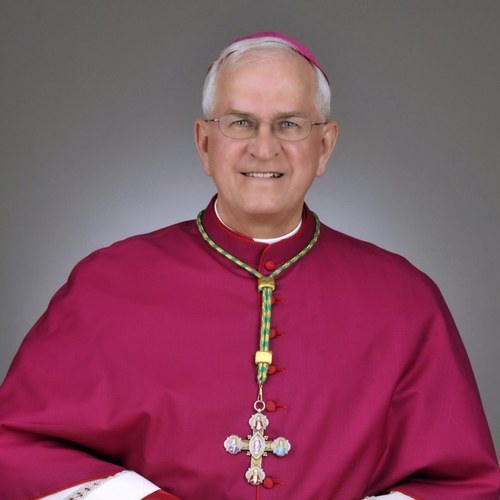
Archbishop Kurtz
Archbishop Kurtz - Twitter Home page

Archbishop Joseph E. Kurtz: ‘An Update to the Faithful’

Former President of US Bishops (2013-2016) Also Comments on Cancer Treatment & Progress

Here is a recent update published by Archbishop Joseph E. Kurtz of Louisville, Kentucky, on his blog on the Archdiocese’s website:
* * *
Dear Sisters and Brothers in Christ,
May God bless you! How grateful I am to you, the faithful of the Archdiocese of Louisville, and the priests, deacons, and religious who serve you. Your thoughtful and kind cards and messages have been a source of great encouragement for me as I continue to reside in North Carolina and receive treatment for cancer at The Duke Cancer Institute.
This week was a special joy because I received a visit from Father Terry Bradshaw, pastor of the Basilica of Saint Joseph Proto-Cathedral in Bardstown, the day after the wonderful and festive celebration of the 200th anniversary of the dedication of this historic Proto-Cathedral.
Of course, Father Terry filled me in on the beautiful Eucharistic celebration. He also  brought me the longest birthday card that I have ever received! It was a 37-foot scroll with signatures from virtually all the faithful of the parish of Saint Joseph. I certainly miss not being home and especially regret not being part of the celebrations that mark us as a people of God with a history, not just the 200 years but going back to Jesus Christ, which is the same yesterday, today, and forever.
Let me give you a little update on my treatment. I now have completed four infusions of chemotherapy, which marks the halfway point. I should complete these cycles in early October. At the same time, I have begun to receive infusions for immunotherapy, which my oncologist tells me is the more successful path in dealing with the type of cancer I have. I continue to have great stamina and energy, and my oncologist encourages me to be as active as I can be. Because I am prone to infection, however, I need to stay somewhat isolated and away from crowds. The plan is for an October surgery to remove the prostate and bladder and then the great opportunity of my returning home. I can’t wait!
As the activities of this fall season begin to increase, there will be more times when I regret not having the opportunity to visit with you. Please be aware of my continued prayers for you. Thank you for allowing me to count on your prayers.
Sincerely yours in our Lord,
Most Reverend Joseph E. Kurtz, D.D.
Archbishop of Louisville

Wednesday, July 24, 2019

Please continue to pray for this Good Shepherd

Archbishop Kurtz
Archbishop Kurtz - Twitter Home page

Archbishop Joseph E. Kurtz Steps Down as Chair of USCCB Committee for Religious Liberty Amid Cancer Treatment

Bishop Robert J. McManus of Worcester to Serve as Acting Chair of Committee

Cardinal Daniel N. DiNardo of Galveston-Houston, President of the U.S. Conference of Catholic Bishops, has appointed Bishop Robert J. McManus to serve as Acting Chair of the USCCB’s Committee for Religious Liberty until the November 2019 General Assembly. The appointment was made following the resignation of Archbishop Joseph E. Kurtz, D.D., of Louisville, previous chair of the committee, after his diagnosis with urothelial carcinoma.
Cardinal DiNardo stated: “We are praying for Archbishop Kurtz, especially as he undergoes an intense treatment plan at Duke Cancer Institute over these next several weeks and months. I very much appreciate Bishop McManus’s agreeing to step into this chairmanship role and lead the important work of the Committee for Religious Liberty.”
Bishop McManus served as Chair of the Subcommittee on Health Care Issues from 2012 to 2018 and served as Chair of the Committee on Catholic Education from 2005 to 2008. He has served as a member of the Committee on Doctrine since 2001 and has previously served as a member of the Committee on Pro-Life Activities and the Committee on Budget and Finance.
Robert J. McManus was born July 5, 1951, in Providence, Rhode Island. He was ordained a priest on May 27, 1978, an Auxiliary Bishop of Providence on February 22, 1999, and was installed as Bishop of Worcester on May 14, 2004. Bishop McManus holds Bachelor and Master of Arts degrees in philosophy from The Catholic University of America in Washington, D.C., and he holds a Master of Divinity from the Toronto School of Theology. He has also earned licentiate and doctoral degrees in sacred theology from The Pontifical Gregorian University in Rome.

Wednesday, July 10, 2019

Prayers needed for Archbishop Joseph Kurtz

Archbishop Kurtz announces cancer diagnosis, asks for prayers 

Archbishop Joseph Kurtz requested prayers Wednesday as he announced that he has been diagnosed with bladder cancer and will soon undergo treatment. The Archbishop of Louisville announced he will be out of the archdiocese for three months while he receives treatment.


Louisville, Ky., (CNA) - "I have been diagnosed with urothelial carcinoma in my bladder and prostate and will take part in a treatment plan that includes immunotherapy and chemotherapy for at least 12 weeks," said Kurtz in a statement posted on the Archdiocese of Louisville website July 9. 
After undergoing chemotherapy, Kurtz said that he will have his bladder and prostate surgically removed. His diagnosis came after several months of health problems and medical tests. 
Kurtz, who served as president of the United States Conference of Catholic Bishops from 2013 to 2016, said that he is "very grateful" to his oncologist Dr. Dan George and the rest of his team at the Duke University Cancer Institute, and that he has "good cause for optimism." 
"I feel well, and with the encouragement of Dr. George, I have remained active during this time," said the archbishop said. He will be staying in North Carolina throughout his treatment, but will be in contact with officials from the archdiocese while he is away. 
Kurtz said that Archbishop Christoph Pierre, the apostolic nuncio to the United States, is aware of his illness and imminent absence from his archdiocese, and is "supportive of the plan I have developed." 
"Needless to say, I will miss the many opportunities I have to visit parishes and talk with so many of you at upcoming events this summer and fall," he said. "You will be in my prayers. Please keep me in yours."
According to the American Cancer Society, urothelial carcinoma is the most common form of bladder cancer. The five-year relative survival rates for all stages of bladder cancer is 77 percent.

Wednesday, January 10, 2018

The other Francis

INTERVIEW: ‘The Other Francis’ by Deborah Castellano Lubov: The Doctor ‘of Souls’ Who Mocks Fans of Soccer Rivals
Cardinals, Leaders of the Church, Pope’s Relatives and Friends Tell Who the Pope Really Is

Pope and Vaticanista Deborah Castellano Lubov © L'Osservatore Romano
The ambitious objective, stated already in the book’s cover, is to offer the reader a portrait of the “Other Francis,” namely, to tell all that has never been said about the Pope Francis. Not an easy task, given the impressive amount of volumes dedicated to Francis, which already crowd the shelves of bookstores.
The author is the American journalist – but transplanted to Rome – Deborah Castellano Lubov, Vaticanista of Zenit. “The Other Francis,” (published in Italian by the prestigious publishing house Cantagalli of Siena, but which soon will be translated into English) contains a preface by the Vatican Secretary of State, Cardinal Pietro Parolin, and 14 interviews with personalities of the Roman Curia (and of the Church), spread throughout the five continents, and relatives and friends of the Argentine Pontiff.
However, not lacking in these 200 pages is interesting news, information , revelations, original and sometimes even courageous opinions about the Argentine Pope and various timely questions raised by him. Jorge Mario Bergoglio is a simple and friendly man, who likes to joke a lot, but who is also the Pope who has been able to focus the attention of all humanity on the topics most dear to him: human dignity, unbridled globalization, the distribution of wealth, the safeguarding of Creation.
* * *
Preface:
Cardinal Pietro Parolin
The Interviewees:
Cardinal Gerhard Muller, Archbishop Georg Gaenswein, Cardinal Timothy Dolan, Cardinal George Pell, Cardinal Peter Turkson, Maria Elena Bergoglio, Cardinal Kurt Koch, Father Federico Lombardi, SJ, Patriarch F.B. Fouad Twal, Archbishop Joseph Edward Kurtz, Cardinal Wilfrid Fox Napier, Cardinal Charles Maung Bo, Adrian Pallarols, and Rabbi Abraham Skorka
* * *
Who is “The Other Francis” (L’Altro Francesco) to which you make reference in the title?
A man that first of all wants to be considered and treated as a “normal” person, even if now, Cardinal Koch told me, it disappoints him that he can no longer easily agree to meet Ecumenical Patriarch Bartholomew at a bar in Rome’s Piazza Navona to have a cappucchino together.
From your many interviews, one would say he is a very friendly man with quite a sense of humor . . .
Indeed! Cardinal Dolan of New York also bore the brunt of it, because, as he told me, he is a ‘man of girth.’ Yet, he told me:  “But thus, I feel immediately at ease with him,” he told me. Cardinal Dolan’s interview shares quite a few fun, heartwarming anecdotes with Francis, especially from when the Pontiff visited New York in September of 2015.
Or Rabbi Abraham Skorka, who then became his great friend. They were in the Cathedral of Buenos Aires, after a solemn celebration. Cardinal Bergoglio made a joke to him about ‘chickens,’ the nickname used by the adversary fans to make fun of the River plate soccer players. It was a way of being ironic about that team’s losing streak, but very inappropriate in that situation. So Rabbi Skorka, a River fan, did not appreciate this at first, feeling offended. Then he understood, he says, that there was a message between the lines: “treat me without formality, like any other person!”
How was the idea to write this book born?
The beginning of the Bergoglio pontificate coincided, more or less, with the beginning of my activity as Vatican correspondent of Zenit. Francis attracted much attention immediately, because of all the novelties brought within and outside the Church. In this atmosphere of great excitement, for journalists used to following the Vatican’s news, I often felt the need to confront truly expert voices. Thus, many interviews came about, day after day, in doing my work, and even many friendships. Then I wondered if they would be able to share with me an unfiltered  account of their view of and relationship with Francis. This is the result.
In regard to interviews, Francis has granted many more than any other predecessor. Did you discover anything particularly interesting about these?
Many things! Once, for instance, during one of the interviews on a plane there was talk of Pope Emeritus Benedict XVI in the Vatican. “It’s like having a wise grandfather at home,” Francis said. Then, he thought about it again and right after landing in Rome, he mentioned it immediately with concern to Archbishop Gaenswein, Prefect of the Papal Household and private secretary of the Pope Emeritus: “Today, I said something a bit strong . . . I hope Benedict XVI won’t be offended!”
Much has been said and written about the relationship between Francis and Benedict, often also with much superficiality, inventing oppositions … is it true?
Suffice it to say what Francis’ sister said, hence a privileged source of news, said to the journalist and my friend Michael Hesemann (German author and historian, co-author of My Brother the Pope co-authored with Georg Ratzinger), whom I thank for having allowed me to include his precious interview in my book. “You owe me obedience. If you are elected, you must accept,” said Pope Ratzinger to Cardinal Bergoglio, when they met the last time before the Conclave.
And what other interesting thing did you discover on the pre-pontificate biography of Pope Bergoglio?
First of all that Bergoglio’s famous grandmother, being a fervent anti-Fascist,  was the reason why the family felt almost constrained to leave Italy for Argentina. Then an episode, which goes back to when Jorge, having finished high school, said to his mother that he wanted to become a doctor. She was so happy that she immediately freed a small room so that he could study peacefully but, one day, she only found books of philosophy, theology and Latin. The explanation, he told her, was that he did want to become ‘a doctor,’ but one ‘of souls.’
Who is Adrian Pallarols, the Pope’s other friend who you interviewed?
Adrian is a Buenos Aires goldsmith, a very dear friend of the Pope. I don’t want to ruin the surprise for the reader. I will tell you only that it was Bergoglio himself to celebrate his marriage and baptized his children. The problem with the wedding was that the parish priest, who held the course that Adrian and his wife had, was very abrupt with all. When Bergoglio called him, introducing himself as “Father Jorge,” to come to an agreement about the celebration of Adrian’s marriage, he began as usual to shout and vehemently protest, until he discovered that . . . you read the rest.
Returning to the topic of the relationship between Francis and the mass media in general, what did you learn?
Archbishop Gaenswein’s judgment seems important to me: the media were never so well disposed with Pope Benedict as they are today with Pope Francis. Even if Francis  — I learned from the former director of the Vatican Press Office, Father Lombardi –, that Pope Francis doesn’t always appreciate journalists’ questions during air travel. Instead, he is often rather disappointed, because he doesn’t find them interesting, or because journalists ask anything that passes through their mind instead of focusing on the contents or the most significant episodes of every trip.
It is said that the ‘normality,” the sobriety of Francis, who for instance lives in a very small space compared to the large apartments of some cardinals, brought much disarray in the Vatican.
This is true in part, but it’s not even necessary to emphasize it. When I went to interview Cardinal Turkson in his office in his dicastery, we spoke about the greatness of the rooms: He also expressed that similarly, his residence,  is large and one of his architect friends once said that in that surface a good four rooms could be made, but certainly not in a building as ancient a structure as that one. And in any case, do you know where Cardinal Turkson went to furnish his house when he arrived in Rome? IKEA!
Francis made everyone understand thoroughly that he cannot endure adulators. He wants everyone to tell him exactly what he thinks. And then, among all the judgments and opinions expressed by various Cardinals and Bishops, is there someone that surprised you for his frankness?
Returning to interviews on a plane, there comes to mind the Patriarch Emeritus of Jerusalem of the Latins, His Beatitude Fouad Twal. On the return flight from Poland, in July 2016, there was talk of terrorism and Islam. It’s true, he told me, that the head of the Catholic Church can’t say explicitly everything about Islam. However, according to him, it was surprising to hear the Pope explain that violence exists in all the religions, including Catholicism, and that one religion alone can’t be accused, or Cardinal Napier of Durban, South Africa, on the post-synodal Apostolic Exhortation Amoris Laetita. How can the African Church go about not losing her credibility? — he wondered. Now, in fact, the Church must tell Africans that she was mistaken 200 years ago, preaching that to become Christians they must abandon customs such as polygamy; because today one can go to Communion even if one has more than one wife, because one cannot turn one’s back on them.
On the list of interviewees there are also personalities of the Church considered not very in tune with Pope Francis. Why did you want to include these voices also in the book?
I believe that a variety of opinions and points of view is a merit, not a defect, for a book of this nature. Therefore, there is also, for instance, Cardinal Muller, who became “former” Prefect of the Congregation for the Doctrine of the Faith precisely while the book was going to press; a man who is certainly very different from Francis in provenance, orientations, mentality. Therefore, it has all the more of an effect to hear him say what is the strongest impression Francis makes on him: It is when he embraces men and women even with a deformed face from a serious sickness, without that aversion that would be simply natural. Cardinal Muller also admits that it is certainly easy to preach love of neighbor, but difficult to practice it.
Then there is also Cardinal Charles Maung Bo, Archbishop of Yangon, in Myanmar, certainly a country “of the periphery” for the Catholic Church, but Francis in fact decided to honor it undertaking an Apostolic Trip there?
Not “periphery” but “periphery of peripheries,” Cardinal Bo corrected me! It’s a Church that has suffered so much, in 60 years of “inhuman” dictatorship, as he himself described it. No contact with the rest of the world, the foreign missionaries expelled overnight . . . Not only “periphery,” “but a country forgotten by the world,” he said, noting the only exception was now by the Church and now by Francis.

Saturday, November 12, 2016

A pledge to work with the new President-elect from the USCCB


US bishops on Trump: “We’ll be eager to work closely with him for the good of all”

"Through the hope Christ offers, may God give us the strength to heal and unite..."


US bishops on Trump: “We’ll be eager to work closely with him for the good of all”
Jeffrey Bruno


“Now that the election is completed, we are, of course, eager to be able to welcome our new President, and all the new elected officials. We’ll be eager to work closely with President Trump, as well as both houses of Congress, as we seek to really promote the good of all. We – as an Episcopal Conference – hope we will be able to continue to do so as we have been doing for the past 100 years.” The Archbishop of Louisville and President of the US Conference of Catholic Bishops, Joseph E. Kurtz, said this in a statement to Vatican Radio on Donald Trump’s election as President of the United States and the role of Catholics in this new phase of American politics.
The archbishop said that for Catholics, for people of good will and for believers, an election is a very important event because it supports a country in its internal search for the common good: the good of the human person, a good which respects the dignity of each person.
He added that when Pope Francis visited the US, during his meeting at Congress, at the White House, in Philadelphia and at the World Meeting of Families, he stressed the importance of effort and commitment in the political process.
The president of US bishops underlined that while bishops do not support specific candidates, they seek the common good, reinforcing Catholic social teaching and the principles that point towards the common good.
With American Catholics in mind, he emphasized that “every election brings a new beginning. Some may wonder whether the country can reconcile, work together and fulfill the promise of a more perfect union. Through the hope Christ offers, I believe God will give us the strength to heal and unite.” The archbishop said Christ’s hope will motivate faithful to join people of goodwill, other faithful and people of other faiths to see this new beginning as a new opportunity, a time to try to end this spiral of violence and enter into an age of civility in public debates.