Tuesday, November 29, 2022

Closing out November with the Feast of an Apostle


St. Andrew the Apostle


Feastday: November 30
Patron: of Fishermen, singers, Scotland, Romania, Russia, Ukraine and Patras
Birth: Early 1st Century
Death: Mid-to late 1st Century


St. Andrew, also known as Andrew the Apostle, was a Christian Apostle and the older brother to St. Peter.

According to the New Testament, Andrew was born in the village of Bethsaida on the Sea of Galilee during the early first century. Much like his younger brother, Simon Peter, Andrew was also a fisherman. Andrew's very name means strong and he was known for having good social skills.

In the Gospel of Matthew, it is said Jesus was walking along the shore of the Sea of Galilee and saw Andrew and Simon Peter fishing. It is then he asked the two to become disciples and "fishers of men."

In the Gospel of Luke, Andrew is not initially named. It describes Jesus using a boat, believed to be solely Simon's, to preach to the multitudes and catch a large amount of fish on a night that originally was dry. Later, in Luke 5:7, it mentions Simon was not the only fisherman on the boat, but it is not until Luke 6:14 that there is talk of Andrew being Simon Peter's brother.

However, the Gospel of John tells a separate story, stating Andrew was a disciple of John the Baptist. When Jesus walked by one day, John the Baptist stated, "Behold, the Lamb of God!" It is then that Andrew and another made the decision to follow Jesus.

Little else is said about Andrew in the Gospels, but it is believed Andrew was one of the closer disciples to Jesus. It was he who told Jesus about the boy with the loaves and fishes, according to John 6:8. When Philip wanted to speak to Jesus about Greeks seeking him, he spoke to Andrew first. Andrew was also present at the last supper.

Per Christian tradition, Andrew went on to preach the Good News around the shores of the Black Sea and throughout what is now Greece and Turkey. Andrew was martyred by crucifixion in Patras. He was bound, rather than nailed, to a cross, as is described in the Acts of Andrew. He was crucified on a cross form known as "crux decussata," which is an X-shaped cross or a "saltire." Today this is commonly referred to as "St. Andrew's Cross." It is believed Andrew requested to be crucified this way, because he deemed himself "unworthy to be crucified on the same type of cross as Jesus."

Andrew's remains were originally preserved at Patras. However, some believe St. Regulus, who was a monk at Patras, received a vision telling him to hide some of Andrew's bones. Shortly after Regulus' dream, many of Andrew's relics were transferred to Constantinople by order of Roman emperor Constantius II around 357. Regulus later received orders in a second dream telling him to take the bones "to the ends of the earth." He was to build a shrine for them wherever he shipwrecked. He landed on the coat of Fife, Scotland.

In September 1964, Pope Paul VI had all of St. Andrew's relics that ended up in Vatican City sent back to Patras. Now, many of Andrew's relics and the cross on which he was martyred are kept in the Church of St. Andrew in Patras.

St. Andrew is venerated in Georgia as the first preacher of Christianity in that territory and in Cyprus for having struck the rocks creating a gush of healing waters upon landing on the shore.

His saltire cross is featured on the flag of Scotland and is represented in much of his iconography. He is commonly portrayed as an old man with long white hair and a beard, often holding the Gospel book or a scroll.

St. Andrew is the patron saint of fishermen and singers. He is also the patron saint to several countries and cities including Scotland, Romania, Russia, Ukraine and Patras and his feast day is celebrated on November 30.

Meanwhile at Fort Knox, 10 Catholics are confirmed


Catholic auxiliary bishop presides over special Fort Knox confirmation ceremony during Advent mass

By Eric PilgrimNovember 28, 2022


FORT KNOX, Ky. — Under the glow of a single Advent candle Nov. 27, several member candidates from Fort Knox received the sacrament of confirmation into the Roman Catholic Church from Auxiliary Bishop F. Richard Spencer.

Part of Spencer’s duties as vicar for the eastern half of the U.S. Vicariate of the Archdiocese for Military Services includes confirming new members into the Church. Spencer also led the congregation in a special Advent mass, which celebrates the birth of Christ Jesus.

The 10 candidates followed a slow procession to the front of Prichard Place Chapel at the beginning of the service. After the first of five Advent candles was lit, Spencer led the candidates through the confirmation process, which included a series of questions to confirm their commitment.

“That’s what we’ve come here to do — reach out and touch the Holy and allow the Holy to touch us,” said Spencer. “So, my friends, today we’re asking for a sacrament.”

Spencer asked if they knew how many sacraments there are, and what the first of those is. He also asked how many formal gifts of the Holy Spirit there are. He then brought two young candidates up for a visual demonstration meant to highlight the truth of their belief in Christ compared with “fake news” about it.

Spencer gave the young man an empty clear bowl and the young woman some coins. He then blindfolded the young man.

“Our objective today is, how do we ascertain what is truth?” asked Spencer. “The basic question is, is there any water in the bowl?”

He shook his head no.

Spencer asked him to feel inside the bowl to experience whether water was in the bowl as a first test. He then asked the young woman to drop her coins in the bowl to allow the young man to use his senses to determine if the bowl had any water in it.

“Young man, if there was water in the bowl, I think I would have heard a different sound,” said Spencer. “For you, based upon your hearing, is there any water in the bowl?”

Again, he shook his head no.

As a final test, Spencer said eyewitnesses are called on for proof of Christianity’s truth.

“Scientists tell us over 85% of what we know is true comes to us by eyewitness accounts,” said Spencer, who called on the young woman to tell them if she sees any water in the bowl.

She shook her head no.

“Now we have an eyewitness report,” said Spencer — no water in the bowl.”

After sharing the application with the congregation, Spencer encouraged the candidates to remember those three tests as they continue to walk through their life of faith.

“We experience the presence of God in so many beautiful ways,” said Spencer, “especially in the presence of each other because God dwells within each of us.”

Candidates and congregants witnessed one testimony of faith at the end of the mass when local member Bridgette Gallagher was honored for “outstanding service” to the church with a medal and certificate from Spencer.

During the confirmation sacrament, Spencer called on the candidates to renew their baptismal promises. He then prayed over them and brought each forward, with their sponsor standing in support, and used oil to mark their foreheads with the sign of the cross as they declared their particular saint’s name. He also charged them to reach out to others in their faith.

“It is you and I that have the eyes to see the poor, and to respond. You and I have the ears to hear the cry of those who are disheartened,” said Spencer. “For those of you receiving confirmation today, you will receive also a special gift of prophesy.

“Today, you are commissioned to become a prophet: to speak the Word of God to others, especially those who have not heard yet the good news.”

Newly created Cardinal dies unexpectedly; Pope grieves for his loss


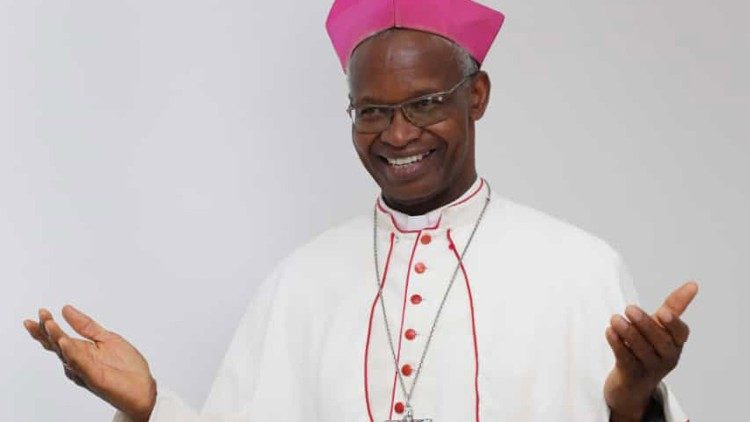
Cardinal Richard Kuuia BaawobrCardinal Richard Kuuia Baawobr 

Pope grieves for “wise and gentle pastor” Cardinal Baawobr

In a telegram of condolences Pope Francis prays for the soul of deceased Ghanean Cardinal Richard Kuuia Baawobr.

By Linda Bordoni

Pope Francis on Tuesday expressed sorrow for the death of Cardinal Richard Kuuia Baawobr, Archbishop of Wa, who died unexpectedly in Rome on Sunday evening.y

In a telegram in which he extends his heartfelt condolences to the Cardinal’s family, to the Missionaries of Africa of which he was part, to the clergy, religious and laity of the Diocese of Wa, the Pope said he is grateful for the Cardinal’s faithful witness to the Gospel, “marked by generous service to the Church in Ghana, especially to those in need.”

“I willingly join the faithful in praying that our merciful Father may grant to this wise and gentle pastor the reward of his labours and welcome him into the light and peace of heaven.”

The Pope’s telegram concluded with words of comfort for all those who are mourning the late Cardinal’s passing in the sure hope of the Resurrection and with his apostolic blessing “as a pledge of consolation and peace in Jesus, the firstborn from the dead.

Created Cardinal in absentia

Richard Kuuia Baawobr, Bishop of Wa, Ghana,  was created a cardinal on 27 August in absentia. He had arrived in Rome the day before but was unable to attend the consistory due to illness. He was hospitalised and spent more than two months in hospital. Only a few days after leaving his hospital room, Cardinal Baawobr passed away on Sunday, while still in Rome.

Priest, missionary and cardinal

Born in 1959, Cardinal Baawobr joined the Society of Missionaries of Africa (White Fathers) in 1981. As a religious, he took the missionary oath on 5 December 1986 at St Edward's College, London, and was ordained a priest in Ghana on 18 July 1987.

He studied theology at the Missionary Institute in London, and then biblical exegesis. He obtained a Licentiate in Scripture and a Doctorate in Theology, specialising in Biblical Theology.

Successively he was then curate of a parish in Kinshasa, Democratic Republic of Congo, formator from 1996 to 1999 of the Missionaries of Africa in Kanhangala, Tanzania, and then director of formation at the Chambre des missionnaires d'Afrique, in Toulouse, France.

He was the first African priest to be elected Superior General of the Society of Missionaries of Africa in 2010.

Bishop of Wa since 2016, Pope Francis named Richard Baawobr a cardinal on 29 May 2022 and elevated him to that rank on 27 August of the same year. On 30 July 2022, he was elected President of SECAM, the Symposium of Episcopal Conferences of Africa and Madagascar, during the 19th plenary assembly of this continental body held in Accra, Ghana.

College of Cardinals

Following the death of Cardinal Richard Kuuia Baawobr, the College of Cardinals consists of 225 cardinals, of whom 126 are electors and 99 are non-electors.

Monday, November 28, 2022

The shocking, unspeakable horror in neighboring Covington and specifically our neighbor church parish of St. Peters


Arrest made in Covington double killing; pastor and associate still listed as missing

Father Daniel Brouillette, the current pastor of St. Peter in Covington, said the two have been missing since Sunday night.
COVINGTON, La. — Update: An arrest has been made in the Covington double homicide.

Antonio Donde Tyson has been taken into custody and booked with: 2 counts of first-degree murder, two counts of second-degree kidnapping, two counts of obstruction, 1 count of resisting an officer and 1 count of possession of stolen things.


The retired pastor of St. Peter Church in Covington and a pastoral associate have been missing since Sunday night, Father Daniel Brouillette confirmed to WWL-TV.

Father Brouillette said that Retired Priest Otis Young and Pastoral Associate Ruth Prats have not been seen since Sunday. He said that he is "unsettled and staying prayerful" about the situation as he awaits the identification of the bodies. 


The news comes as Covington Police investigate the deaths of two as yet unidentified people behind a building downtown. The bodies were burned as to be unrecognizable.

St. Peter Church will hold a prayer vigil at 7 pm in response to the double killing.

The bodies were discovered outside, behind the Dependable Glass building by the owner of the company. WWL-TV's Erika Ferrando said that the owner told her that he got to work at 5 a.m. and when he opened the back door, he saw two bodies badly burned and called 911.

Two people were questioned in the morning by Covington Police in connection to the case, but their exact involvement – if any – was undetermined.


Father Young retired from St. Peter after 10 years this past July due to health issues that included a stroke and heart surgery.

“There is an appointed time for everything,” said Father Young in a letter to parishioners in November 2021, announcing his retirement, effective July 1, 2022.

St. Scholastica Academy and St. Peter School in Covington were releasing students from class early due to the proximity to the scene and police investigation activity, according to the Archdiocese. 

“Our hearts have been shattered by this unfathomable crime,” said Parish President Mike Cooper in a social media post. “We stand behind the Covington Police Department and St. Tammany Parish Sheriffs Office as they investigate this heinous action. Please join me in praying for the families and friends of the victims and the entire Covington community.”

Tuesday Saint of the Day


St. Saturninus


St. Saturninus Bishop of Toulouse and Martyr November 29 A.D. 257     St. Saturninus went from Rome by the direction of pope Fabian, about the year 245, to preach the faith in Gaul, where St. Trophimus, the first bishop of Arles, had some time before gathered a plentiful harvest. In the year 250, when Decius and Gratus were consuls, St. Saturninus fixed his episcopal see at Toulouse. Fortunatus tells us, that he converted a great number of idolaters by his preaching and miracles. This is all the account we have of him till the time of his holy martyrdom. The author of his acts, who wrote about fifty years after his death, relates, that he assembled his flock in a small church; and that the capitol, which was the chief temple in the city, lay in the way between that church and the saint's habitation. In this temple oracles were given; but the devils were struck dumb by the presence of the saint as he passed that way. The priests spied him one day going by, and seized and dragged him into the temple. declaring that he should either appease the offended deities by offering sacrifice to them or expiate the crime with his blood. Saturninus boldly replied: "I adore one only God, and to him I am ready to offer a sacrifice of praise. Your gods are devils and are more delighted with the sacrifice of your souls than with those of your bullocks. How can I fear them who, as you acknowledge, tremble before a Christian?" The infidels, incensed at this reply, abused the saint with all the rage that a mad zeal could inspire, and after a great variety of indignities, tied his feet to a wild bull, which was brought thither to be sacrificed. The beast being driven from the temple, ran violently down the hill, so that the martyr's scull was broken, and his brains dashed out. His happy soul was released from the body by death, and fled to the kingdom of peace and glory, and the bull continued to drag the sacred body, and the limbs and blood were scattered on every side, till, the cord breaking, what remained of the trunk was left in the plain without the gates of the city. Two devout women laid the sacred remains on a bier, and hid them in a deep ditch, to secure them from any further insult, where they lay in "wooden coffin" till the reign of Constantine the Great. Then Hilary, bishop of Toulouse, built a small chapel over this his holy predecessor's body Sylvius, bishop of that city towards the close of the fourth century, began to build a magnificent church in honor of the martyr, which was finished and consecrated by his successor Exuperius, who, with great pomp and piety, translated the venerable relics into it. This precious treasure remains there to this day with due honor. The martyrdom of this saint probably happened m the reign of Valerian, in 257.

Bishops respond to priests fearful of false and malicious accusations

 ‘Everyone’s vulnerable to an accusation’: Bishops respond to priests’ fear of false abuse claims


A recent survey of priests found growing distrust of bishops and major fears that they would not get their support if faced with false abuse accusations.

Eighty-two percent of priests responding to a survey conducted by The Catholic Project, a research group at The Catholic University of America in Washington, D.C., said they live in constant fear of being falsely accused of sexual abuse.

And only 51% of diocesan priests believe their bishop would support them during an abuse investigation, according to the survey, which was released in October. Meanwhile, only 36% are confident their diocese would provide the resources necessary to defend themselves during a legal investigation.

CNA discussed those survey results with bishops attending the fall general assembly of the United States Conference of Catholic Bishops in Baltimore earlier this month. During the annual gathering, the U.S. bishops marked the 20th anniversary of the Dallas Charter protocols the conference adopted in 2002 for responding to abuse allegations against clergy.


Archbishop Salvatore Cordileone of San Francisco called the survey’s findings “very troubling,” adding that bishops must “support the priests that are having difficulties and troubles” and “be compassionate and patient with them.”

Cordileone said the possibility of career-ending accusations is even greater in some parts of the country than in others.

“Priests are under a lot of pressure, and we need to appreciate that, especially in the climate in some states, like our own (California), that once again has lifted the statute of limitations. Now everyone’s vulnerable to an accusation,” Cordileone said.

Auxiliary Bishop Robert Reed of the Archdiocese of Boston voiced his sympathy with priests’ concerns, saying that priests live with the knowledge that they are “just one accusation away from retirement” and that in many cases, “if you are accused of something, that’s pretty much the end.”

Priests’ lack of trust in their bishop contributes directly to burnout. Young priests seem particularly vulnerable, with 60% of diocesan priests under the age of 45 voicing at least some level of burnout, according to the Catholic Project survey.

Connecting with and helping individual priests feel supported is a “challenge for bishops,” Bishop Kevin Rhoades of the Diocese of Fort Wayne-South Bend, Indiana, told CNA.

“I think it is important,” Rhoades said, adding that he’s had to ask his staff for additional support “so that I can have time with the priests.”

Yet, when it comes to sexual abuse investigations, those challenges are further magnified. “You’re trying to be sensitive to the victim, alleged victim, and be there for them. Then there’s the priest,” Rhoades stated. “So it’s a really, really difficult thing to deal with, but we have to.” 

To Reed, the solution to priests’ distrust of bishops is “less administration, more personal contact.” In Reed’s opinion, there “has to be a missionary aspect” of a bishop’s work. “A cup of coffee, you know, with a priest, celebrate the morning Mass, go out to dinner, maybe stay over the rectory, that kind of thing.”

Though a bishop can work hard to improve the trust with his priests, there is “nothing you really can do” about the one-and-done nature of abuse accusations, Reed conceded.

For Cordileone, it depends on the priest in question and his track record. Cordileone said that if “it’s clear that he’s innocent, and he’s been a respected pastor his whole life … (the priest’s bishop) has to protect his reputation … even despite the vitriol he’s going to receive. I think that that’s one thing that can help to rebuild trust with the priests.”

Shannon Mullen and Zelda Caldwell contributed to this story.

Pope encourages clergy and seminarians to be disciples and missionaries

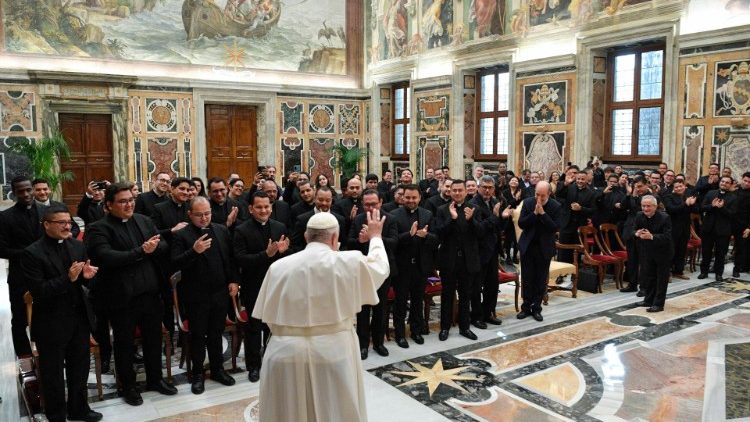
Members of the Pontifical Latin American College in Rome greet Pope FrancisMembers of the Pontifical Latin American College in Rome greet Pope Francis  (Vatican Media)

Pope encourages pastoral outreach of priests from Latin America

Pope Francis meets with community members of Rome's Pontifical Latin American College, encouraging them in their pastoral work as Christ's "disciples and missionaries."

By Vatican News staff writer

Pope Francis met on Monday morning with students and staff of the Pontificio Colegio Pío Latinoamericano (Pontifical Latin American College) studying and living in Rome.

In his address he encouraged them to ask Our Lady of Guadalupe to help us in our journey of 'discipleship-apostolate' to which the Lord calls us, and to accompany us in the vital itinerary of 'going and returning' that starts from Jesus to the brethren, and then returns with the brethren to meet Jesus.

The richness of diversity

Speaking of the years of formation studies spent in Rome while living in community at the College, the Pope said this experience marks "a time of grace" that the Lord grants "to deepen formation, not only at the intellectual and academic level, but also in experiencing the richness and diversity of the universal Church." He also recalled how this richness and diversity characterises the peoples of Latin America to whom they will return in shepherding the flock entrusted to them. The Pope also underscored their pastoral sensitivity and outreach, calling them to be always "pastors of the people."

The example of early Christians

Even the first Christians came from different peoples and cultures, the Pope noted, emphasising how the Holy Spirit descended upon them and made them of "one heart and one soul" (Acts 4:32), speaking the same language - the language of love - and to be disciples and missionaries of Jesus to the ends of the earth (cf. Mt 28:19). 

Recalling the Apostle Andrew, whose liturgy will be celebrated on 30 November, the Pope then focused on the importance of being the Lord's disciples and missionaries.

Regarding the role as disciples, he said this means that Jesus has an active voice in our every decision, as we are his ministers and are called to "be with Him." Speaking off the cuff, the Pope reminded them to pray always, even when tired, and to put down the mobile phone, especially it can become an addiction or escape causing us to miss opportunities to be with the Lord and hear what He has to say to us.

Avoid spiritual worldliness 

Pope Francis again urged everyone to remember the importance of their pastoral service to the People of God and avoid any type of clericalism, to remember their roots, and to "ask for the grace to know how to always be in front, in the midst and behind the people" they serve and the communities from which they hail.

Missionary role of Saint Andrew

Speaking of the witness of Saint Andrew, the Pope recalled how as one of Jesus' first disciples his life changed radically after meeting the Lord. "He was no longer the same as before, and had to go and tell everyone what he had experienced." In this way, Andrew "made his debut" as a missionary, the Pope pointed out.

In a similar way, "our brothers and sisters are also waiting for us, especially those who have not yet experienced the love and mercy of the Lord, so that we can proclaim the Good News of Jesus and lead them to Him. Go out, be on the move, bring the joy of the Gospel, that is, be missionaries."

“This is the meaning of our life. It is an "outward and return" journey, which has Jesus as its starting and ending point. Let us not forget that 'being' with Jesus and 'going out' to proclaim Him also means accompanying the poor, migrants, the sick, prisoners, the least and most forgotten in society, to share life with them and to announce God's unconditional love. Because Jesus is present in our most vulnerable brothers and sisters, and there He waits for us in a special way.”

Full recent interview of the Pope by America Magazine


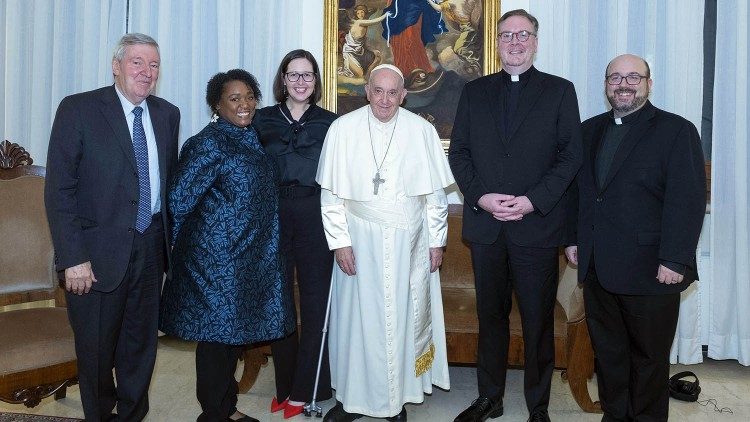
Pope Francis and some of the America Magazine staff at Casa Santa MartaPope Francis and some of the America Magazine staff at Casa Santa Marta  (Antonello Nusca)

Pope: Polarization is not Catholic, dialogue is the only way

Pope Francis grants an exclusive interview to the Catholic ‘"America Magazine" in which he answers a vast range of questions, including topics regarding the US, Church issues, social issues, the war in Ukraine, the Vatican’s relations with China, and his pontificate.

By Vatican News staff reporter

On Monday the US Catholic 'America Magazine' published a wide-ranging interview with Pope Francis, marking the first time that the Pope has agreed to an interview with the editors of an American journal.

The interview was held on November 22 at his Vatican residence at Santa Marta and was conducted in Spanish by five representatives of the American Jesuit magazine including its outgoing editor in chief, Fr. Matt Malone, S.J., and Fr. Sam Sawyer, S.J., the incoming editor in chief. Questions ranged from polarization in the U.S. Church, racism, Church teaching on the ordination of women, the Pope's stance on social issues, the war in Ukraine, the Vatican’s relations with China and his pontificate.

I am happy because I feel God at my side

Fr. Malone introduced the interview by asking Pope Francis what makes him so peaceful and happy in his ministry. The Pope answered that being with people has always given him great joy, and that what makes him feel happy is having the assurance that “God is at his side”. “Throughout my life – he said - He has always guided me on His path, sometimes in difficult moments, but there is always the assurance that one does not walk alone”.

Polarization is not Catholic

Pope Francis was then asked by Fr. Sawyer about the growing polarization of political life in the United States and even in the US Catholic Church itself.

The Holy Father warned against the dangers of ideological partisanship in society, but especially within the Church, noting that US society too has some “ideological Catholic groups”. “Polarization is not Catholic“, he stressed. “A Catholic cannot think either-or ( aut-aut) and reduce everything to polarization. The essence of what is Catholic is both-and (et-et)”. He recalled that Jesus went beyond the divisions among the Jews of the time between the Pharisees, the Sadducees, the  Essenes and the Zealots. proposing the Beatitudes, "which are also something different". 

“[ The more polarization there is, the more one loses the Catholic spirit and falls into a sectarian spirit.]”

Bishops and Bishops’ Conferences

Pope Francis was also asked about the growing distance between the Bishops’ Conference and the Catholic faithful in the U.S. on faith and morals. In this regard he emphasized the crucial role of individual bishops, rather than the collective bodies of bishops,  and of their pastoral relation with their flock, noting that Bishops’ Conferences are organizations “meant to assist and unite, a symbol of unity. “Jesus – he said - did not create bishops’ conferences. Jesus created bishops”

“The grace of Jesus Christ is in the relationship between the bishop and his people, his diocese.”

Abortion should not be politicized

Another sensitive issue discussed during the interview was that of abortion, which has been particularly divisive also in the Catholic Church in the U.S..  

Asked if the bishops should prioritize abortion in relation to other social justice issues, Pope Francis again insisted on the sacramental dimension of this delicate issue which, he stressed, “must not be politicized" and on the pastoral role of each bishop, which “cannot be delegated to the bishops’ conference”.   

“[ The problem arises when this reality of killing a human being is transformed into a political question, or when a pastor of the Church uses political categories. (…) The sacramental part of the pastoral ministry is in the relationship between the pastor and the people of God, between the bishop and his people.]”

Child abuse is a monstruosity

Pope Francis was then asked about the ongoing abuse crisis in the Church and about concerns over the Vatican's transparency policies in light of new recent cases involving bishops. In this regard, the Pope noted that “since the Church made the decision not to cover up [any more] cases”, progress has been made against the “monstruosity” of child abuse.

He mentioned, in particular, the Meeting on the Protection of Minors in the Church he convened in the Vatican from  21-24 February 2019,  and the creation of the Pontifical Commission for the Protection of Minors headed by Cardinal Sean O'Malley. 

He recalled that “the leader in taking these decisions was Benedict XVI”, and that this crime “is a ‘new’ problem in its manifestation, but eternal in that it has always existed” in all spheres of society, starting from the family. A point he had already pointed out during the 2019 Vatican Summit on child abuse.

“When honest people see how the Church is taking responsibility for this monstruosity, they understand that the Church is one thing while the abusers who are being punished by the Church are another.”

Pope Francis, therefore, reiterated that the Church is determined “to go forward in taking responsibility for its own sin”, with “seriousness and shame”, and “with equal transparency”.


Everyone knows my stance on the war in Ukraine

The Holy Father was then asked about his position on the war in Ukraine, and specifically on why he is seemingly unwilling to directly criticize Russia, the aggressor.

He explained that: "Sometimes I try not to specify so as not to offend and rather condemn in general, although it is well known whom I am condemning. It is not necessary that I put a name and surname."

“When I speak about Ukraine, I speak of people who are martyred. If you have a martyred people, you have someone who martyrs them. When I speak about Ukraine, I speak about the cruelty because I have much information about the cruelty of the troops that come in. (…) Certainly, the one who invades is the Russian state. This is very clear.”

He then recalled his personal efforts to end the conflict and to support Ukraine: from his visit to the Russian embassy in Rome on the second day of the war, on February 25, his two phone calls to Ukrainian President Volodymir Zelensky, his interventions to free prisoners of war on both sides, and also his desire to visit both Kyiv and Moscow . He insisted that naming explicitly Putin “is not necessary”.

“Everyone knows my stance, with Putin or without Putin, without naming him.”

Pope Francis further recalled that he has sent two Cardinals several times to Ukraine and also Archbishop Paul R. Gallagher, the Vatican Secretary for Relations with States and International Organizations, to bring the Holy See’s solidarity and humanitarian relief to the Ukrainian people.

He also mentioned the recent commemoration by the Holy See of the Holodomor, the genocide that Stalin committed against the Ukrainians in  1932-33 which, he said, "is an historical antecedent of the [present] conflict".

The Pope insisted that the position of the Holy See "is to seek peace and to seek understanding” and is “is always willing to mediate”.

Racism is an intolerable sin against God

Pope Francis then spoke about the issue of racism, which some Catholics in the U.S. don’t feel as a priority, but that causes many Black Catholics to feel neglected by the Church.

Asked what he would say to Black Catholics to encourage them, the Pope said he would tell them that he is “close to the suffering they are experiencing, which is racial suffering and in this [in this situation], those who should in some way be close to them are the local bishops."

“I would say to African American Catholics that the Pope is aware of their suffering, that he loves them very much, and that they should resist and not walk away. Racism is an intolerable sin against God. The Church, the pastors and lay people must continue fighting to eradicate it and for a more just world.”

He also took the opportunity to say that he also loves “very much the Indigenous peoples of the United States”, and the many Latinos living in the country

The Church is female

Another issue discussed during the interview was women’s priestly ordination.

The Pope explained that it is a theological question that concerns the ministerial dimension of the life of the Church, "that of the Petrine Church".  However, he said, the  Church "is more than a ministry".  "Apart from the Petrine principle there is another principle that is still more important, that is the Marian principle, which is the principle of femininity in the Church, of the woman in the Church, where the Church sees a mirror of herself because she is a woman and a spouse".

The Pope also mentioned a third way: the administrative way.  “I believe we have to give more space to women”, he said, noting that even in the Roman Curia the Church has progressed in giving more responsibilities to women.

“The fact that a woman does not enter into the ministerial life is not a deprivation. Your place is that which is much more important and which we have yet to develop, the catechesis about women in the way of the Marian principle.”

Criticism of market capitalism drawn from the Gospel

Pope Francis was then asked about his frequent criticisms of market capitalism, for which some call him a Marxist. “I try to follow the Gospel”, the Pope replied. “I am much enlightened by the Beatitudes, but above all by the standard by which we will be judged,” he said,  recalling the Gospel of Matthew 25. ‘I was thirsty, and you gave me a drink. I was in prison, and you visited me. I was sick and you cared for me'.  “Is Jesus a communist, then?” he asked, remarking that the problem that is behind this… "is the socio-political reduction of the Gospel message.”

Dialoguing with China despite slow progress

Finally, Pope Francis was asked about the Vatican’s relations with Communist China, with reference to the 2018 Provisional Agreement
between the Holy See and the and Beijing  on the appointment of Bishops
 which was  recently renewed, and about his alleged silence on human rights in People’s Republic of China.

On this point, Pope Francis said:  “It is not a matter of speaking or silence”, but rather if “to dialogue or not to dialogue”.

“With China, I have opted for the way of dialogue” even “if it is slow”, he explained,  citing the late Cardinal Agostino Casaroli's Ostpolitik diplomacy during the Cold War  as “model”.

He also reiterated that Chinese people deserve his respect, because they are people of great wisdom.

“Dialogue is the way of the best diplomacy. With China I have opted for the way of dialogue. It is slow, it has its failures, it has its successes, but I cannot find another way. And I want to underline this: The Chinese people are a people of great wisdom and deserve my respect and my admiration.”