Showing posts with label Latin America. Show all posts

Friday, October 31, 2025

Pope Leo XIV meets with the Organization of Catholic Universities of Latin America


Pope Leo XIV arrives at the meeting with members of the "Organizacion de Universidades Catolicas de America Latina y el Caribe", ODUCALPope Leo XIV arrives at the meeting with members of the "Organizacion de Universidades Catolicas de America Latina y el Caribe", ODUCAL  (@Vatican Media)

Pope: Universities called to become ‘journeys of the mind to God'

In a meeting with members of the Organization of Catholic Universities of Latin America and the Caribbean, Pope Leo says “the proposal of Catholic higher education is none other than to seek the integral development of the human person.”

By Christopher Wells

Driven by the conviction that proclaiming Jesus Christ “is an integral part of the Christian message of salvation,” Catholic universities are called to become “journeys of the mind toward God,” Pope Leo told members of Organization of Catholic Universities of Latin America and the Caribbean (ODUCAL) on Friday morning.

The Holy Father explained that Catholic higher education proposes no less than “to seek the integral development of the human person, forming intellects with a critical sense, believing hearts, and citizens committed to the common good – and all this with excellence, competence, and professionalism.”

Creating encounters between faith and culture

He highlighted, among goals of the educational network, the aim of advancing Catholic higher education and serving society “by creating encounters between faith and culture, in order to proclaim the Gospel within the university setting.”

“This shared journey already speaks volumes,” he said, “because it expresses the very mission for which the university was born within the Catholic Church: to be an ‘incomparable center of creativity and the dissemination of knowledge for the good of humanity,’ in which ‘the combined effort of intellect and faith allows people to reach the full measure of their humanity.’”

Expressions of God's love for every person

Citing his predecessor Francis, Pope Leo said the Catholic university “remains one of the best instruments that the Church offers our time and is an expression of that love which animates every action of the Church, namely, God’s love for every person.”

Acknowledging the challenges facing education today, Pope Leo encouraged ODUCAL to “continue the mission the Church entrusts to you” with creativity, firm in the knowledge “that grace sustains you.”

After thanking them once again for their efforts in pursuing “this great task,” Pope Leo entrusted them to the Blessed Virgin Mary, Seat of Wisdom, before offering his Apostolic Blessing.

Wednesday, September 27, 2023

The state of Hispanic Catholicism in the United States


Analysis: Is the U.S. church's Hispanic Catholic hope slipping away?


(OSV News) -- There is no doubt that the largest force transforming American Catholicism is the Hispanic presence. This has been the case for more than half a century. Hispanics account for nearly 71% of the growth of the Catholic population in the United States since 1960.

Of the 63.7 million Hispanics living in the U.S. in 2023, about 31 million self-identify as Roman Catholic. If Hispanic Catholics constituted a country, demographically we would be the eighth most populated country in the Americas, preceded only by the U.S. (334 million), Brazil (216.5 million), Mexico (128 million), Colombia (52 million), Argentina (46 million), Canada (39.8 million) and Peru (34.5 million).

The Center for Applied Research in the Apostolate, CARA, estimated that in 2022 there were 73.5 million Catholics in the country. That places the 31 million Hispanics just mentioned at about 42% of the entire U.S. Catholic population. The more conservative estimate from the Official Catholic Directory suggests a U.S. Catholic population of 66.5 million for the same year, bringing Hispanics to about 47% of the total U.S. Catholic population.

More than two thirds of Hispanics are U.S. born (about 68%). However, when we look at the Hispanic Catholic population, it is almost equally divided as half immigrant and half U.S. born. The immigrant population tends to be older and most likely to be involved in the life of parishes and other faith-based communities.

Let these numbers be not a source of distraction. What's important to know is that nearly half of all U.S. Catholics self-identify as Hispanic. The majority of Catholics younger than 25 are Hispanic. The present and the foreseeable future of American Catholicism are intimately linked with the Hispanic experience.

The Hispanic presence has dramatically redefined U.S. Catholicism geographically. Since the foundation of the U.S., the majority of Catholics have lived in the Northeast and the Midwest. Because of the fast growth and strong presence of Hispanics, and the regions of the country where most live, that is no longer the case. The majority of U.S. Catholics today live in the South and the West.

This is not to say that the Hispanic presence is weak in the Northeast and the Midwest. On the contrary! It is quite strong and growing, particularly in large urban centers, such as New York, Chicago and Arlington, Virginia, among others, where the majority of Catholics self-identify as Hispanic.

Much of Catholic life in our country in the coming years will be significantly defined in the South and the West, and in the large urban centers where Hispanic Catholics are present in strong numbers.

Source of hope

References to Hispanic Catholics in our church are often impregnated with a profound sense of hope. There are many reasons for that to be the case. Allow me to highlight four.

One, Catholicism is deeply ingrained in the various cultural expressions and ways of life that identify millions of Hispanics in the U.S. This is the result of the centuries of the Catholic Church's strong influence in Latin America and the Caribbean, shaping nearly every realm of people's lives in these regions.

Even when many Hispanics are not actively involved in church life, as is the case for many other Catholics, they remain sustained by various forms of cultural Catholicism that permeate their values and commitments, making them receptive to further evangelization efforts.

Two, Hispanics are very young with a median age of 30.7 compared to a median age of 41.1 among the non-Hispanic population. About half of all Hispanics are younger than 30. Most Hispanics are living at a point in their lives when they are forming families and making career decisions, both crucial moments that demand close pastoral accompaniment.

If you want to get a sense of who the typical Hispanic Catholic is in the U.S., think of a 24-year old young person, a child of immigrants, born or raised in the U.S., looking for a better job, and perhaps deciding whether to get married or postpone this important decision to a later moment in life, although open to welcoming children.

The young Hispanic presence is clearly noticeable in our parish communities where families regularly worship with children. In most parishes with Hispanic ministry, the number of baptisms, first Communions and confirmations is significantly higher. Young Hispanic families and their children are a true renewing presence in thousands of parishes throughout the country.

Three, much of the revitalizing energy coming from the Hispanic Catholic community is rooted in a profound sense of the sacred, which Catholics have traditionally known as "sacramental imagination." Such a sense of the sacred for Hispanics comes to life not only in the celebration of the sacraments, particularly the Eucharist, but also in various expressions of popular Catholicism that imbue nearly every aspect of everyday life.

The spiritual life of many Hispanic Catholics is regularly nurtured by our participation in apostolic movements such as Cursillo, Legion of Mary and the Neo-Catechumenal Way, among others. Nearly half of all parishes with Hispanic ministry have a Catholic Charismatic Renewal group.

This spiritual diversity, influenced by the cultural particularities that shape how Catholicism is lived throughout Latin America, the Caribbean and the various regions of the U.S., makes the Hispanic experience uniquely interesting and attractive.

Four, the experience of Hispanic Catholics in the U.S. is constantly defined by factors that constantly determine our daily existence such as immigration dynamics, cultural identity negotiation, struggles for justice and respect, searching for spaces and resources to belong, full integration into a society that often sees us as foreigners, etc. Rather than mere obstacles to live and practice our faith, Hispanics often turn these factors into opportunities for reflection and pastoral creativity.

Many pastoral efforts in parishes, schools and organizations serving Hispanic Catholics exhibit a distinct level of dynamism as they seek to bring the best of the Gospel and the Catholic tradition to bear upon the challenges that this community faces. U.S. Hispanic Catholic theologians regularly reflect, write and teach in light of these experiences, injecting new life into the traditional questions that occupy the world of theological inquiry.

All in all, Hispanics are a source of hope for the church in the U.S. and for the larger U.S. society insofar as our presence is an invitation to renew the commitment to build communion among the all baptized, without exceptions, respond to the most urgent needs of God's people in the context of a culturally diverse church, and continue to witness Catholicism thrive in this land.

A fragile hope

Hope, however, is to be embraced and nurtured regularly. The gift of the Hispanic presence in the Catholic Church in the U.S. must not be taken for granted. This has been the clarion call of countless leaders, Hispanic and non-Hispanic, since the middle of the 20th century, when all indicators pointed to the process of hispanicization of Catholicism that we are witnessing today.

Pastoral leaders and theologians coming together for the national Encuentros of Hispanic/Latino ministry -- from the First Encuentro in 1972 until the Fifth Encuentro in 2018 -- have unanimously celebrated the presence and contributions of Hispanic Catholics. Many pastoral meetings in between the Encuentros have echoed the same sense of celebration.

The Catholic bishops of the U.S. as a body have also echoed their affirmation of that presence via statements and national initiatives. In 1995, the U.S. Catholic Conference (now the U.S. Conference of Catholic Bishops) published a statement titled "The Hispanic Presence in the New Evangelization in the United States." It is a very insightful document.

In the statement, the bishops say: "We affirm that the Hispanic presence in our church constitutes a providential gift from the Lord in our commitment to that New Evangelization to which we are called at this moment of history." I highlight this affirmation because it directly counters any pretension to see the Hispanic presence as accidental or temporary. Hispanics are part of God's salvation plan for the Catholic community in the U.S.

Recognizing the particular ways in which Hispanic cultures have integrated Catholic values after centuries of evangelization, as described above, the bishops further assert that they "recognize the Hispanic presence in our church as a blessing, a privileged opportunity to work for a culture that reflects the truth about the human person revealed in the truth about Jesus Christ." As such, the bishops acknowledge Hispanic Catholics as partners, true agents of evangelization, thus avoiding any idea of reducing Hispanics as mere recipients of pastoral activity.

Numbers and statistics are important, and they paint a clear picture of current changes and realities in the world of U.S. Catholicism. But more important still is the realization that Hispanic Catholics play a vital role in the process of building the church in the U.S. today. We do so as de facto members of the church because of our baptism and our faith in Jesus Christ. We do so as agents of evangelization, with the rest of the Catholic community.

Has the Hispanic presence and the conviction that Hispanic Catholics play a vital role in the process of building the church in the United States today been fully embraced? I would say that the record is mixed. There is no doubt that in many corners of our church the embrace has been evident with various levels of intentionality. In some parishes and dioceses there is no choice given their geographical location and the large numbers of Hispanics. However, there are far too many corners where such embrace has been rather lukewarm or poorly resourced or simply inadequate.

It is in these corners where the fragility of the hope described until now becomes more obvious, and the consequences can be of major detriment for the life of the church in the U.S. The Catholic bishops recognized this in their 1995 statement: "The Hispanic presence is also a prophetic warning to the church in the United States. For if Hispanic Catholics are not welcomed warmly and offered a home where they can experience our church as their church, the resulting loss of their Catholic identity will be a serious blow to the church in our country. We will have missed an opportunity to be truly Catholic."

I could not have said it better. Not embracing Hispanics and their potential loss of Catholic identity as those who disaffiliate walk away from church life and the practice of the faith constitute a real missed opportunity for the church in the U.S. to be truly Catholic.

A slipping hope?

Thirty-one million is a strong number and it represents much hope for the U.S. Catholic world. Parishes are full with Hispanic families and request sacraments. Hundreds of thousands of Catholics from Latin America migrate every year to the U.S., and many of them quickly search for a parish to build community and worship. Large numbers of Hispanic children are enrolled in religious education programs. A growing number of Hispanic young people enroll in Catholic educational institutions at all levels. All of these examples are much to be hopeful about. Anyone engaged in ministry could easily say, "Our hands are full."

Yet, the number could also be deceiving as it masks realities that should be of major concern to the same U.S. Catholic community.

An April 2003 Pew Research Center report estimated that about 43% of Hispanic adults in the U.S. self-identify as Catholic. In 2010 that estimate was 67%. This significant drop in terms of self-identification points to three concurrent dynamics.

One, the fast growth of the U.S.-born Hispanic population, children and grandchildren of immigrants, who are now reaching adulthood and are not making Catholicism part of their identity in the process, even if their parents and grandparents are Catholic and raised them in Catholic homes. Two, the steady process of Catholic disaffiliation among immigrant Hispanic adults. Three, the smaller number of immigrant Catholics from Latin America and the Caribbean as a result of stricter immigration policies. All this seems to indicate the intensity of these three factors will continue to exacerbate in the following years.

The coalescence of these factors is revealing that for many years the church in the U.S. has relied too confidently on a steady flow of Latin American Catholic and Spanish-speaking Caribbean immigrants into the country, and the assumption that they were prepared and have the resources to pass on the faith to their children in order to keep them engaged within the tradition.

It also reveals that our Catholic community has been rather slow, perhaps unwilling, to develop models of evangelization to evangelize and support the spiritual journey of U.S.-born and U.S.-raised Hispanic Catholics, and invest the necessary resources. We continue to invest significant resources to ministry in Spanish with largely immigrant communities in thousands of parishes throughout the country -- rightly so, and we should continue to do that -- but it is not clear how those same parishes should be developing ministries to accompany intergenerational and intercultural families, and Hispanic families that are fully integrated into the U.S. culture.

In the past, Catholic schools served as a way to help the new generations of young Catholics retain their religious identity and prepare for success in society. Only 3% of Hispanic Catholic children today attend these schools. Just a fraction of students in Catholic colleges and universities -- about 16% -- are Hispanic.

A good indicator to measure how integrated the Hispanic Catholic community is in the structures of the U.S. church is the nature of its leadership. Considering the fact that the majority of youth and young adult Catholics are U.S.-born or U.S.-raised, it would be fair to expect that the new generation of Catholic leaders for church and society are emerging from this particular group.

That is not the case yet. Nearly 85% of Hispanic priests, more than 90% of Hispanic vowed religious women and about 65% of Hispanic lay ecclesial ministers are immigrants. The percentage of Hispanic bishops, theologians, clergy, vowed religious, Catholic higher education leaders, Catholic school teachers and administrators, among other leadership groups, is very small -- in most cases in the single digits percentage-wise. We still have much progress to do.

Rekindling the hope

I share the above numbers and observations not as a way to complain or to focus only on the negative. I share them to encourage the entire Catholic community in the U.S. to be more conscious about the gift and opportunity we have received.

If we have any interest in the future of a strong Catholic presence in the U.S. society, building vibrant communities of faith, engaged in the public square as Catholics addressing the most urgent issues of the time, shaping the direction of this nation toward the common good, and accompanying Catholic families to raise their children as joyful disciples, then we cannot ignore what is happening with the nearly Hispanic half of the U.S. Catholic community. In other words, investing in the Hispanic present will yield a stronger future for U.S. Catholicism.

The responsibility of embracing the Hispanic presence and empowering the next generation of Catholics in the U.S. cannot be left only in the hands of Hispanic leaders or those who choose to accompany this community as part of their ministry. It is everyone's responsibility, just as we all have a shared responsibility for any other community within our church. Let us remember the concern of the U.S. Catholic bishops: The "loss of (Hispanics') Catholic identity will be a serious blow to the church in our country. We will have missed an opportunity to be truly Catholic."

There are many pastoral efforts throughout the country that seek to maintain alive and rekindle the hope that the Hispanic presence engenders. Among these efforts are the work of parishes, diocesan offices, Hispanic pastoral institutes, Catholic universities with programs of ministerial formation focused on Hispanic ministry, national organizations fostering exciting conversations, etc.

Boston College and the University of Notre Dame recently launched a five-year initiative called Haciendo Caminos, which seeks to cultivate the vocation to ministry among U.S.-born and U.S.-raised Hispanic Catholics. In partnership with 16 other universities, these young Hispanic Catholics engage in theological and ministerial formation while receiving support through academic and ministerial networks.

I recently concluded a major report as part of a national study of Catholic organizations serving Hispanic youth. The report, Ministry with Young Hispanic Catholics: Towards a Recipe for Growth and Success, highlights fascinating efforts focused on the pastoral accompaniment of Hispanic youth and young adults.

Organizations like Instituto Fe y Vida (Romeoville, Illinois), Iskali (Chicago), Centro San Juan Diego Arts, Cultural and Faith Formation (El Paso, Texas), Corazón Puro (New York), Fuerza Transformadora (Little Rock, Arkansas) and the Southeast Pastoral Institute (Miami), among others, are leading the way with innovative initiatives and a profound pastoral passion. At the helm of most of these organizations are Hispanic Catholics who are sharing their wisdom with other ministerial groups and leaders about how to best accompany Hispanic youth. Truly inspiring.

Rekindling the hope requires that we trust in the Holy Spirit. God will show us the way into being Catholic in an increasingly Hispanic church. But we must listen attentively, in a spirit of synodality and spiritual humility, ready to make an intentional decision to journey with our Hispanic sisters and brothers. That at least seems to be one of the invitations of the new National Pastoral Plan for Hispanic/Latino Ministry the U.S. Catholic bishops approved in 2023.

Every generation has the responsibility to be good stewards of the treasure it has received, cultivate it and pass it on to the next generation. The Hispanic Catholic presence is a most precious treasure God has placed in our ecclesial hands to build communion at this historical moment in the U.S. Let this treasure slip not through our ecclesial fingers.

Hosffman Ospino is a Catholic theologian teaching at Boston College's School of Theology and Ministry.

Thursday, June 1, 2023

Pope Francis urges entrepreneurs to look to the Gospels for business guidance


Pope Francis with Latin American business leadersPope Francis with Latin American business leaders  (Vatican Media)

Pope: Entrepreneurs must build business models on culture of encounter

Pope Francis meets with members of the Latin American Business Council, and urges entrepreneurs to look to the Gospel to find hope and direction in their business endeavors.

By Devin Watkins

“Work must be founded on a culture of encounter… which encourages people to seek the common good.”

Pope Francis offered that guidance to businessmen and women from across Latin America on Thursday.

The Pope was meeting in the Vatican with participants in the annual Assembly of the Business Council of the Latin America.

Confronting common problems

In his address, the Holy Father urged entrepreneurs to build a network guided by the Gospel and founded on hope.

He noted that the annual Assembly addressed themes such as migration, climate change, and integral human development, adding that these problems can be found in all other parts of the globe.

“Your exchange of ideas can help you join forces to deal together with problems which are currently common to the entire human family,” he said.

Creating culture of encounter

Pope Francis said a business model that imbibes a culture of encounter can push aside any shadows that creep into the workplace, including an excessive drive for profit which seeks to enslave workers.

“A culture of encounter,” he noted, “expresses the search for the common good, and thus contributes to dispel shadows.”

The values of a culture that respects others, said the Pope, are then translated into countless daily sacrifices and efforts to help others grow.

He urged the Latin American entrepreneurs to offer ongoing formation and education for their workers, in order to “avoid conflicts and the pain of redundancies” since every worker represents a family with concrete financial needs.

Daily service on behalf of others

The Pope invited the businessmen and women to look to the first disciples of Jesus, who were fishermen.

He said they learned how to plough the rough seas of their own times to spread the Christian message, something from which he said modern entrepreneurs can learn.

“The service you carry out is not abstract,” he said, “but directed at every person, which makes it necessary to work together, without stepping over anyone or leaving anyone behind.”

Pope Francis said the choice to hold the Assembly in Rome offered participants the opportunity to encounter firsthand the many apostles buried in the Eternal City, including St. Peter.

“Here we encounter the tracks of the numerous disciples of the Lord of all times who transformed their surroundings in the light of the Gospel by offering their daily witness,” he said.

Guiding compass of the Gospel

In conclusion, the Pope said Christian business leaders enjoy the guiding “compass” of the Gospel and the gift of hope.

“Therefore, we are able to navigate correctly,” he said, “trusting that God will guide us and accompany us along our journey.”

Friday, May 26, 2023

Pope speaks out against bullying and for helping the elderly


Pope at Scholas Occurrentes eventPope at Scholas Occurrentes event  (VATICAN MEDIA Divisione Foto)

Pope: ‘Bullying destroys life, respect each person for whom they are'

Pope Francis participates in the closing session of the “Scholas Occurrentes” event on "Eco-Educational Cities" bringing together 50 Mayors from Latin America and Europe.

By Salvatore Cernuzio

The possibility of a trip to Argentina; a stark condemnation of bullying that "destroys" life; the invitation to respect each person "as they are", in their "authenticity"; the dangers for the many children who do not finish school and the alarm over the spread of pornography and the "commercialisation of love" of which adolescents, in particular, are victims were some of the themes upon which Pope Francis reflected during his meeting with Mayors and young people from Latin America and Europe.

With Mayors from Latin America and Europe

Pope Francis answered questions put to him by Latin American and European members of the great Scholas Occurrentes network, the organisation set up in 2001 in Argentina as a cultural response to the country's political, economic and social crisis. It has since spread throughout the world, especially in the poorest areas, thanks to the support and contribution of the then Archbishop, Jorge Mario Bergoglio. Scholas Occurrentes, which has become a Pontifical Foundation, on the occasion of its tenth anniversary organised a congress in Rome entitled “Eco-educational Cities' with 50 Latin American and European mayors. The event ended today, 25 May, with a big meeting in the Augustinianum Institute in Rome in the presence of Pope Francis during which there was dialogue, moments of music and singing, videos, greetings and the exchange of gifts.

The first question put to the Pope regarded a possible visit to his native country. “My idea,” he said, “is to go next year, we will see if we can.”

Educational emergency

Responding to a question on the current educational emergency and the need for a Global Compact on Education, something he has long called for in every country, the Pope decried the fact that so many young people today lack the possibility of receiving a good education.

“How often, the lack of sex education, leads to the commercialisation of love. Love is not to commercialise and young people are not to be used...," he said.

"Educating young people", he said, “is the duty of parents and of society as a whole,” and he noted that children who are unable to complete their schooling end up being a burden on societies.

The Holy Father also reflected on the 'commercialisation’ of sex and said it is the responsibility of schools and educators to focus on this topic and he encouraged those present to carry forward this commitment.

Respect for authenticity

Both virtually and directly, Pope Francis was asked questions about homophobia, racism, bullying.

Bullying, above all, "is very serious and destroys lives," he said, "Every man, every woman, every boy, every girl has the duty to be ‘authentic’, to be themselves and the right to be respected."

The Pope then broadened his gaze to the crises afflicting the world and, reiterating the concept as he did during the hardest moments of the pandemic, he repeated: "In order to come out of a  crisis you have to identify it and accompany it.

“You do not come out of a crisis alone, but accompanied (…), you do not come out of a crisis in the same way: you come out either better, or worse.”

Maradona's jersey

Among the many gifts for the Pope that included a ceramic baby Jesus to books, t-shirts, paintings, and baskets full of handmade products – there was a Napoli football team jersey with the number 10: the number of Armando Maradona.

“You are the number 10 of the Church,” the team President said, and  he asked the Pope to “kick all the injustices in the world.”

Remembering his grandparents in Buenos Aires

The Pope spent time reflecting on a theme that is dear to him, that of the elderly,  of “los abuelos”: the grandparents.

Recalling his own grandparents and roots, Pope Francis said “I had the grace of having my grandparents alive until I was very old, the first grandfather who died I was 16, the other died when I was already a bishop.”

He recalled how they helped with bringing up a numerous family and said they taught him their language and values.

The importance of roots

At 86, the Pope does not forget those moments, nor should anyone else:  “There is always the feeling of having to go back to one’s roots,' he says: "A society is ruined when there is a split between the roots and the trunk. (…) If we do not take the sap from the roots, we dry up."

And quoting from the Prophet Joel, chapter 2, verse 1, he said: "The old shall dream and the young shall see visions.”

“This is something they can do only if they are connected to each other,” he said.

Don't abandon the elderly

Recalling stories he heard as a bishop in Argentina when he visited old-age homes, the Pope issued the appeal never to abandon the elderly, whom he said "must not die in isolation...".

He said the nurses would tell him of “old people left alone for months on end by their relatives,” and he warned that "a society that does not take care of this relationship becomes ideologised, promotes sectarianism..."

Adelante

"Adelante", the Pope finally said to the young people present and to the entire Scholas network: "Go forward,”  before handing the Majors honorary Laudato sì Schools diplomas: "This is not the finishing line, but a new beginning".

Monday, November 28, 2022

Pope encourages clergy and seminarians to be disciples and missionaries

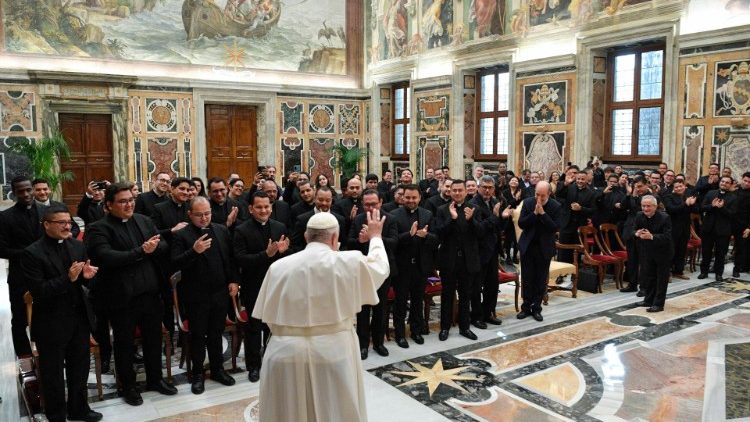
Members of the Pontifical Latin American College in Rome greet Pope FrancisMembers of the Pontifical Latin American College in Rome greet Pope Francis  (Vatican Media)

Pope encourages pastoral outreach of priests from Latin America

Pope Francis meets with community members of Rome's Pontifical Latin American College, encouraging them in their pastoral work as Christ's "disciples and missionaries."

By Vatican News staff writer

Pope Francis met on Monday morning with students and staff of the Pontificio Colegio Pío Latinoamericano (Pontifical Latin American College) studying and living in Rome.

In his address he encouraged them to ask Our Lady of Guadalupe to help us in our journey of 'discipleship-apostolate' to which the Lord calls us, and to accompany us in the vital itinerary of 'going and returning' that starts from Jesus to the brethren, and then returns with the brethren to meet Jesus.

The richness of diversity

Speaking of the years of formation studies spent in Rome while living in community at the College, the Pope said this experience marks "a time of grace" that the Lord grants "to deepen formation, not only at the intellectual and academic level, but also in experiencing the richness and diversity of the universal Church." He also recalled how this richness and diversity characterises the peoples of Latin America to whom they will return in shepherding the flock entrusted to them. The Pope also underscored their pastoral sensitivity and outreach, calling them to be always "pastors of the people."

The example of early Christians

Even the first Christians came from different peoples and cultures, the Pope noted, emphasising how the Holy Spirit descended upon them and made them of "one heart and one soul" (Acts 4:32), speaking the same language - the language of love - and to be disciples and missionaries of Jesus to the ends of the earth (cf. Mt 28:19). 

Recalling the Apostle Andrew, whose liturgy will be celebrated on 30 November, the Pope then focused on the importance of being the Lord's disciples and missionaries.

Regarding the role as disciples, he said this means that Jesus has an active voice in our every decision, as we are his ministers and are called to "be with Him." Speaking off the cuff, the Pope reminded them to pray always, even when tired, and to put down the mobile phone, especially it can become an addiction or escape causing us to miss opportunities to be with the Lord and hear what He has to say to us.

Avoid spiritual worldliness 

Pope Francis again urged everyone to remember the importance of their pastoral service to the People of God and avoid any type of clericalism, to remember their roots, and to "ask for the grace to know how to always be in front, in the midst and behind the people" they serve and the communities from which they hail.

Missionary role of Saint Andrew

Speaking of the witness of Saint Andrew, the Pope recalled how as one of Jesus' first disciples his life changed radically after meeting the Lord. "He was no longer the same as before, and had to go and tell everyone what he had experienced." In this way, Andrew "made his debut" as a missionary, the Pope pointed out.

In a similar way, "our brothers and sisters are also waiting for us, especially those who have not yet experienced the love and mercy of the Lord, so that we can proclaim the Good News of Jesus and lead them to Him. Go out, be on the move, bring the joy of the Gospel, that is, be missionaries."

“This is the meaning of our life. It is an "outward and return" journey, which has Jesus as its starting and ending point. Let us not forget that 'being' with Jesus and 'going out' to proclaim Him also means accompanying the poor, migrants, the sick, prisoners, the least and most forgotten in society, to share life with them and to announce God's unconditional love. Because Jesus is present in our most vulnerable brothers and sisters, and there He waits for us in a special way.”

Friday, May 13, 2022

Promoting Synodal Process with professors across the Americas


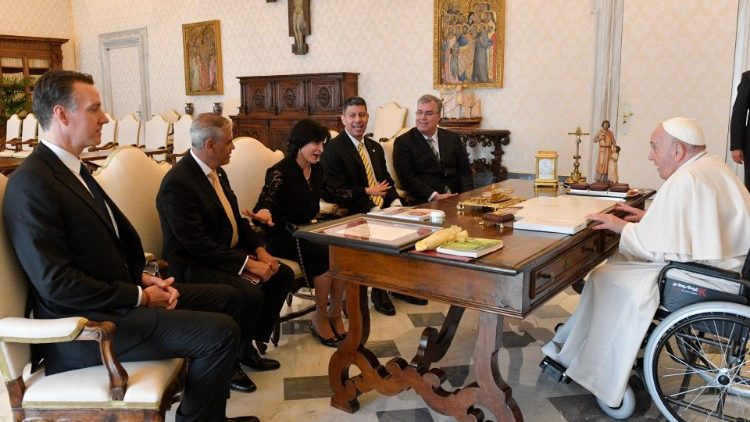
Pope Francis meets with Emilce Cuda, together with professors from Loyola University of ChicagoPope Francis meets with Emilce Cuda, together with professors from Loyola University of Chicago  (Vatican Media)

Pope discusses synodal process with professors from Americas

Pope Francis meets with a group of university professors from across the American continents, and Dr. Peter Jones of Loyola University Chicago talks to Vatican News about the encounter and how the Pope's support will help promote synodality in universities.

By Vatican News staff reporter

Emilce Cuda, Secretary of the Pontifical Commission for Latin America, led a group of university professors in meeting with Pope Francis on Friday, as part of an initiative linked to the Synod of Bishops.

The team of professors hail from Loyola University in Chicago, and were part of the group that held a virtual meeting with the Pope on 24 February entitled “Building Bridges North-South”.

Other educators from the United States and various Latin American universities took part in the papal audience and are holding a series of other meetings at the Holy See.

Synodal process in universities

They aim to promote a “university synodal process”, according to a statement from the Holy See Press Office.

The group will announce the launch of jointly-taught courses—in both humanistic areas and the hard sciences—to be offered at universities across North and South America.

“The objective, in line with the teaching of the current pontiff, is to generate processes of technology transfer and knowledge integration between both hemispheres to promote ecological reform,” reads the statement.

The courses will also focus on several ongoing issues, including migration, energy policy, and “the food crisis.”

'Friendly and concrete meeting with Pope'

Following the papal audience, Dr. Peter Jones, Interim Dean and Professor at the Institute of Pastoral Studies of Loyola University Chicago, spoke to Fr. Felipe Herrera about the encounter.

Q: What was the purpose of your visit to Rome and the aim of this meeting with Pope Francis?

We came to Rome after our meeting with students and Pope Francis. We began to construct a way for university students to participate and listen to each other in a way that mimics or is analogous to the Synod process.

And Dr. Cuda, who had partnered with us to develop the program, shared the information with Pope Francis, and he was excited about that, and he agreed to come and talk with the students. That was on February 24th. So, this meeting is to follow up with that meeting and to continue the work to develop more opportunities for students to connect with the Synod process around the world.

Q: What was the key message Pope Francis gave you this morning, and how was this experience?

Meeting the Pope was personally extraordinary. I've never experienced anything like that. He was warm. He was friendly. He was laughing with us and shared the joy that he felt when he met with the students.

Our conversation was very flexible. We talked about many things. We talked about life in the university. We talked about the experience and transformation of the students. We presented to him a gift, including messages and prayers for him from the students who participated in our events.

The core message today was the need to teach students by modeling ourselves as leaders, listening skills to accept the reality of crisis, of tension, of disagreements, and to commit to a relationship, to work through those moments of transformation in order to find a new reality together, to build a new future together.

Tension is healthy, and we can approach it in a healthy way. And he emphasized that with us more than once.

Q: How do you think that the encouragement you have received this morning from the Pope will impact all the projects that you are fostering with the university?

We are here for one week, and this is our first working meeting about the work that we're doing. And Pope Francis wanted to meet with us for the full 45 minutes in order to encourage us, to support us.

It’s his support that’s invaluable in pulling together the resources and the persons necessary for this to be successful. The Pope desires action just like students.

Students are tired of hearing leaders talk and do nothing. The Pope is encouraging us. With his support, we will be able to support the students, pursue their actions, and continue this important work of collaborating with students across the world, especially across the Americas, where we began with our events on February 24th, but even more importantly, students around the world.