Friday, April 29, 2022

Pope Francis makes clear that all abuse, especially by clergy, is unacceptable


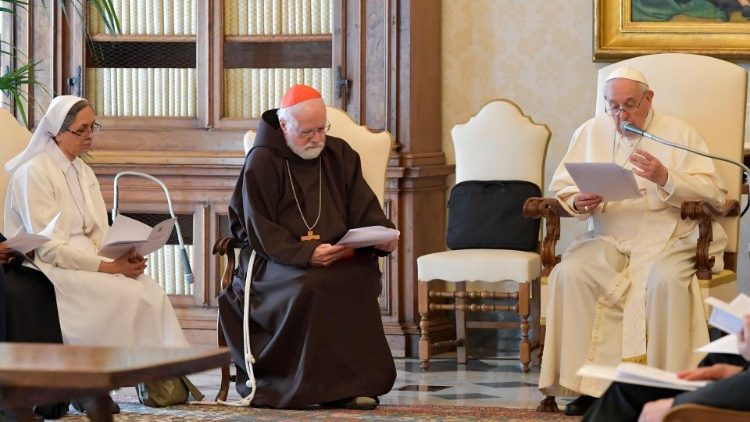
Pope with Pontifical Commission for the Protection of MinorsPope with Pontifical Commission for the Protection of Minors  (Vatican Media)

Pope to Protection Commission: All abuse unacceptable, Church must be trustworthy

Addressing the Pontifical Commission for the Protection of Minors, Pope Francis requests an annual report on the Church's safeguarding initiatives to help competent authorities respond to allegations of abuse on the part of clergy, and praises the work being done by the Commission.

By Deborah Castellano Lubov

Abuse in any form is unacceptable.

This was at the heart of Pope Francis' address Friday morning to the Pontifical Commission for the Protection of Minors at the conclusion of their plenary meeting.

The Pope decried clerical sexual abuse and stressed the individual responsibility of each member of the Church to prevent abuse and work for justice and healing. The Holy Father also expressed his direct availability to the Commission, to ensure they maintain their freedom to help and act.

He also requested the Commission provide him with an annual report on the Church’s initiatives for the protection of minors and vulnerable adults, in an effort to provide greater transparency and accountability.  

Commission’s direct access to Pope

In the long-awaited Apostolic Constitution on the Roman Curia Praedicate Evangelium published 19 March, the Pope gave the Pontifical Commission for the Protection of Minors special importance and prominence with its placement under the responsibility of the Congregation for the Doctrine of the Faith.

At the time, the President of the Commission, Cardinal Sean O'Malley, Archbishop of Boston, praised the decision to maintain the Commission "as a separate body within the Dicastery that enjoys direct access to the Holy Father and with its own leadership and staffing."  

Welcoming the Commission, the Pope thanked Cardinal O’Malley and all its members for their commitment to protecting children, saying "thanks to your efforts, minors and vulnerable persons are safer in the Church."

Church must prove completely trustworthy

The Pope reminded the Commission that the service entrusted to them must be carried out with care.  

“Constant attention is required of the Commission so that the Church may not only be a safe place for minors and a place of healing, but may prove completely trustworthy in promoting their rights worldwide.”

The Pope decried situations that continue to exist where the dignity of children is threatened. "This must be a source of concern for all the faithful and for all people of good will."

Abuses against children are grave and permanent

The Pope went on to deplore the everlasting effects of sexual abuse.

“Abuse in any form is unacceptable. The sexual abuse of children is particularly grave, as an offence against a life that is just beginning to flower. Instead of flourishing, one who is abused is deeply injured, at times permanently.”

The Holy Father recalled a letter from a father whose son had been abused and as a result for many years could not even leave his room, decrying how profound the effects were on the son and also the family. “Those who were abused sometimes feel almost trapped between life and death. These are realities that, painful as they are, we cannot take away,” he insisted.

The Pope encouraged them to continue "diligently and courageously making these wounds known." He said this involves seeking out those who are still suffering, and recognizing in those persons the witness of our Saviour who suffered.

“This is the road that all of us must take: bishops, religious superiors, priests, deacons, consecrated persons, catechists and lay faithful. Each member of the Church, in accord with his or her proper state, is called to assume responsibility for preventing cases of abuse and to work for justice and for healing.”

Never lose your freedom

Speaking about his having formally instituted the Commission as part of the Roman Curia, within the Dicastery for the Doctrine of the Faith, the Pope observed, “Someone might think that this could put at risk your freedom of thought and action, or even take away importance from the issue with which you deal." 

“That is not my intention, nor is it my expectation," he said. "And I invite you to be watchful that this does not happen.”

“I have made your leadership and personnel distinct, and you will continue to relate directly with me through your President Delegate.”

The Holy Father called on them “to propose better methods to enable the Church to protect minors and vulnerable persons and to assist the healing of survivors, in the recognition that justice and prevention are complementary. Indeed, your service provides a proactive and prospective vision of the best practices and procedures that can be implemented in the entire Church.”

A new beginning with Apostolic Constitution

The Pope said important seeds have been sown, even if "yet much remains to be done."

“The Apostolic Constitution marks a new beginning.  It is your responsibility to expand the scope of this mission in such a way that the protection and care of those who have experienced abuse may become normative in every sector of the Church’s life.  Your close collaboration with the Dicastery for the Doctrine of the Faith and with other Dicasteries ought to enrich your work, while your work can enrich in turn that of the Curia and the local Churches."  

Speaking off-the-cuff, the Pope emphasized the Commission's independence.

“Even if the Commission on the Roman Curia diagram is part of the Dicastery, it is independent, with a president nominated by the Pope. Independent.”

The duty to protect the young and the vulnerable, the Pope suggested, "is grounded in the conception of the human person in his or her intrinsic dignity, with special concern for the most vulnerable," and requires concrete collaboration.

Factor of transparency so authorities can act

The Holy Father expressed appreciation that seeds that have been sown are starting to bear good fruit, noting, "Cases of the abuse of minors by members of the clergy have decreased for several years now in those parts of the world where data and reliable resources are available."  

“I would like you, on an annual basis, to prepare for me a report on the Church’s initiatives for the protection of minors and vulnerable adults. This might be difficult at the beginning, but I ask you to begin where necessary, in order to furnish a reliable account on what is presently being done and what needs to change, so that the competent authorities can act.”

This report, the Pope said, "will be a factor of transparency and accountability and – I hope – will provide a clear audit of our progress in this effort." 

Without that progress, the Pope recognized, "the faithful will continue to lose trust in their pastors, and preaching and witnessing to the Gospel will become increasingly difficult."

Assisting Bishops conferences

Addressing "immediate needs" for the welfare and pastoral care of persons who have experienced abuse, the Pope said he has followed with interest the ways that the Commission has always provided opportunities for listening and encounter with victims and survivors, saying they have helped him in his pastoral mission.

"For this reason," he said, "I urge you to assist Conferences of Bishops--and this is very important: to help and surveillance, in dialogue with the bishops' conferences' --in establishing suitable centres where individuals who have experienced abuse, and their family members, can find acceptance and an attentive hearing, and be accompanied in a process of healing and justice."

“Don't forget the Summit we had almost three years ago with the presidents of the [world's] bishops' conferences. They have to set up the commissions and all the means to carry out the processes for taking care of the abused with all the methods you have and also those for punishing the abusers. You must supervise this. I insist. Please.”

Pope Francis concluded by offering his heartfelt thanks for their work. “You are in my prayers and I ask you to keep me in your own.  Thank you!  May God continue to pour out upon you his abundant blessings,” he said.

Thursday, April 28, 2022

She is the Friday Saint of the Day


St. Catherine of Siena


St. Catherine of Siena was born during the outbreak of the plague in Siena, Italy on March 25, 1347. She was the 25th child born to her mother, although half of her brothers and sisters did not survive childhood. Catherine herself was a twin, but her sister did not survive infancy. Her mother was 40 when she was born. Her father was a cloth dyer.

At the age of 16, Catherine's sister, Bonaventura, died, leaving her husband as a widower. Catherine's parents proposed that he marry Catherine as a replacement, but Catherine opposed this. She began fasting and cut her hair short to mar her appearance.

Her parents attempted to resist this move, to avoid marriage, but they were unsuccessful. Her fasting and her devotion to her family, convinced them to relent and allow her to live as she pleased. Catherine once explained that she regarded her father as a representation of Jesus and her mother as Our Lady, and her brothers as the apostles, which helped her to serve them with humility.

Despite Catherine's religious nature, she did not choose to enter a convent and instead she joined the Third Order of St. Dominic, which allowed her to associate with a religious society while living at home.

Fellow Dominican sisters taught St. Catherine how to read. Meanwhile, she lived quietly, isolated within her family home.

St. Catherine developed a habit of giving things away and she continually gave away her family's food and clothing to people in need. She never asked permission to give these things away, and she quietly put up with their criticisms.

Something changed her when she was 21. She described an experience she referred to as her "mystical marriage to Christ." There are debates over whether or not St. Catherine was given a ring with some claiming she was given a bejeweled ring, and other claiming the ring was made of Jesus's skin. St. Catherine herself started the rumor of the latter in her writings, but she was known to often claim the ring itself was invisible.

Such mystical experiences change people, and St. Catherine was no exception. In her vision, she was told to reenter public life and to help the poor and sick. She immediately rejoined her family and went into public to help people in need.

She often visited hospitals and homes where the poor and sick were found. Her activities quickly attracted followers who helped her in her mission to serve the poor and sick.

St. Catherine was drawn further into the world as she worked, and eventually she began to travel, calling for reform of the Church and for people to confess and to love God totally. She became involved in politics, and was key in working to keep city states loyal to the Pope. She was also credited with helping to start a crusade to the Holy Land. On one occasion, she visited a condemned political prisoner and was credited with saving his soul, which she saw being taken up to heaven at the moment of his death.

St. Catherine allegedly was given the stigmata, but like her ring, it was visible only to herself. She took Bl. Raymond of Capua has her confessor and spiritual director.

From 1375 onwards, St. Catherine began dictating letters to scribes. She petitioned for peace and was instrumental in persuading the Pope in Avignon to return to Rome.

She became involved in the fractured politics of her time, but was instrumental in restoring the Papacy to Rome and in brokering peace deals during a time of factional conflict and war between the Italian city states.

She also established a monastery for women in 1377 outside of Siena. She is credited with composing over 400 letters, her Dialogue, which is her definitive work, and her prayers. These works are so influential that St. Catherine would later be declared a Doctor of the Church. She is one of the most influential and popular saints in the Church.

By 1380, the 33-year-old mystic had become ill, possibly because of her habit of extreme fasting. Her confessor, Raymond, ordered her to eat, but she replied that she found it difficult to do so, and that possibly she was ill.

In January of 1380, her illness accelerated her inability to eat and drink. Within weeks, she was unable to use her legs. She died on April 29, following a stroke just a week prior.

St. Catherine's feast day is April 29, she is the patroness against fire, illness, the United States, Italy, miscarriages, people ridiculed for their faith, sexual temptation, and nurses.

Enslaved and tortured in the USSR for preaching Christ, this Priest is now being considered for canonization


The incredible story of Father Walter Ciszek

 
Walter Ciszek
Father Walter Ciszek's grave at the Jesuit Center in Wernersville, Pennsylvania. Antonio G Colombo, Public domain, via Wikimedia Commons
image_pdfimage_print

Msgr. Owen F. CampionFor tourists, even for pilgrims, the headquarters of the Society of Jesus, or Jesuits, in Rome is off the beaten path. It is nothing special in a city filled with landmarks. Rather ordinary in function, history and purpose, it houses officials of the Jesuits, Jesuits working in various jobs in the Vatican and the bureaucracy needed to operate the society.
Its chapel, although perhaps not frequented by visitors, is a place sure to inspire any believer. In view in the chapel are relics of Jesuit martyrs — Frenchman St. Jean de Brebeuf, who was killed under appalling circumstances in present upstate New York; Japanese St. Paul Miki, who preached the Gospel from the cross upon which he was crucified; and the martyrs of the English Reformation, who faced “dungeon, fire and sword,” as the old Catholic hymn, “Faith of Our Fathers,” recalls.

Father Walter J. Ciszek

Jesuit Father Walter J. Ciszek, a Pennsylvania-born missionary to the Soviet Union, is pictured in an undated file photo. (CNS photo/A.D. Times)

Bravery in the cause of Christ did not end for the Jesuits with martyrs who died 500 years ago. A more recent addition to the list was a native of the United States and an American citizen, Father Walter Joseph Ciszek.

He was born on Nov. 4, 1904, in Shenandoah, Pennsylvania, the son of immigrants from what today is Poland. They were not wealthy. As happens at times with less than advantaged youth, he fell in with the wrong kind, so he surprised everyone by announcing his wish to be a Jesuit priest.

Pursuing this goal, he began studies in 1928. Then he declared an even more startling ambition. He wanted to go to Russia, when Russia was first experiencing communism, and it was bitter, especially for religion. The Communists played for keeps, and they despised religion, especially Catholicity.

(It is no wonder that today the former Soviet-dominated, prominently Catholic, societies of western Ukraine, Poland, Lithuania, Slovakia and others, want no part of Russia. They remember the past and how Catholics suffered.)

Walter Ciszek wanted to step into the footprints of Jesuit missionaries. Above all else, he wanted to bring Christ to others. He wanted to strengthen commitments to Christ. He wanted to embed the sweetness of the Gospel, in hearts, and in societies, where hatred and meanness prevailed.

Ordained on June 24, 1937, Father Ciszek was sent to Poland, to a Jesuit mission near the Russian border. He dared to cross into the then-Soviet Union to search for Catholics. In 1941, the authorities caught him. He underwent severe torture, accused of being a “Vatican spy.” In the end, they sent him to a slave labor camp in Siberia.

Life was wretched. Father Ciszek risked everything, and he knew it, but in the camp, he secretly found Catholics, prayed with them, nursed them, consoled them, heard their confessions and, in the strictest secrecy, celebrated the Eucharist, according to the Byzantine Catholic rite, for them.

Had authorities discovered it, consequences would have been terrifying.

He was never forgotten back home. Word somehow reached President John F. Kennedy, who decided to involve himself in Father Ciszek’s situation. The U.S. Department of State proposed a deal to the Soviets. Release the priest, allow him to go home to the United States, and in return, the Americans would permit two Russians, held in this country for espionage, to return to Russia.

Agreement came only a month before Kennedy’s assassination in Dallas on Nov. 22, 1963, but the plan held.

Back in the United States, Father Ciszek was assigned to teach at the University of Scranton, a Jesuit school. He died on Dec. 8, 1984. He is being considered for canonization. His autobiography, “With God in Russia,” is still in print. So is “He Leadeth Me,” his spiritual testimony. Both are fascinating reads.

The martyrs, like Father Ciszek, who endured living deaths, should make us all ask why Christ, and the Catholic faith, were so precious that to keep the knowledge of Christ alive they went through so much.

Cardinal Dolan interview in Rome ahead of mission trip to Ukraine


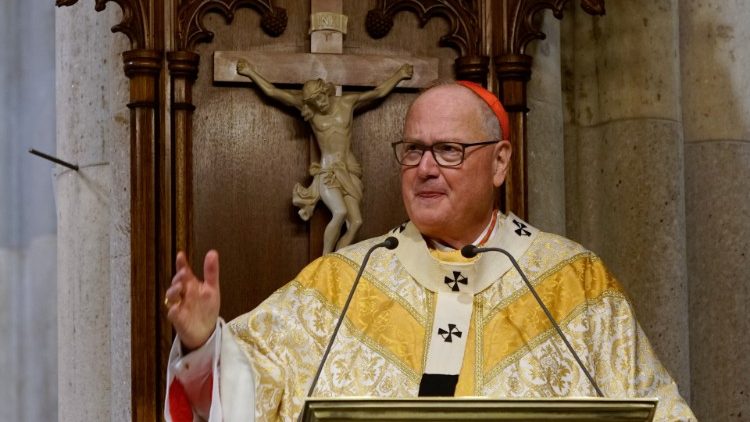
Cardinal Dolan of New York (Reuters)Cardinal Dolan of New York (Reuters) 

A conversation with Cardinal Dolan ahead of mission to help Ukraine

In an in-depth interview with Vatican News in Rome, the Archbishop of New York discusses the war in Ukraine ahead of his imminent visit to help refugees on borders, violence, and protecting life. After not having been in Eternal City for 25 months due to the pandemic, Cardinal Timothy Dolan also discusses the resonance of Pope Francis’ appeals throughout the United States, and praises New York’s Latinos as being the heart and life of the Church.

By Deborah Castellano Lubov

Cardinal Timothy Dolan, Archbishop of New York, is stopping through Rome on his way to the Ukrainian border nations of Poland in his capacity as Chair of the Catholic Near East Welfare Association (CNEWA). During his travel to Rome, for the first time since the outbreak of the pandemic, he sat down with Vatican News, to discuss his upcoming visit to meet with suffering Ukrainian refugees. Since the outbreak of the war, more than 5 million Ukrainians have been forced to flee their homes and millions more have been displaced within the country.

In this interview, he discusses whether the war and whether he is fearful it may expand, as well as the power of Pope Francis’ appeals for peace and how the Pope’s voice resounds across the United States. He also tells Vatican News about the upsurge in violence in New York, especially in the wake of the pandemic, reflects on how abortion legislature is changing throughout the country, the beautiful faith of New York’s Hispanics, and his hopes this Easter season.

Q: Your Eminence, welcome back to Rome after 25 months. While you are busy here with the Papal Foundation and at the Pontifical North American College where you served as rector for its annual Rector’s Dinner, what has really brought you this time to Europe?

Cardinal Timothy Dolan:  My trip to Rome now is the ‘antipasto’ for my trip to the border countries of Poland, Slovakia, Hungary and possibly across the border to Ukraine. I go there, first of all, out of a sense of duty, because the Archbishop of New York happens to be ex-officio, the chairman of the board of a great organization called the Catholic Near East Welfare Association, CNEWA, which was founded a century ago by Pope Pius XI to assist our beloved Eastern right Catholics, who very often live in persecuted areas and often are under great stress. In the Middle East, India, Ukraine, and in Central and Eastern Europe, there are many Eastern Rite Catholics. We are very active, having boots on the ground, and wish bring them alms, the gifts that Catholic people have given us to help these people. We want to just embrace them and say, we love you. We have not forgotten about you. We want to pray with you, encourage you and help. I will then go to Poland, which has just so heroically welcomed millions of refugees, and Hungary and Slovakia which have done the same, along with others. We're gearing up, by the way, in the Archdiocese of New York.

Q: How so?

Our renowned Catholic Charities has a great track record of welcoming immigrants and refugees. We're getting ready. There's a bit of a difference this time, because refugees from Ukraine, want to go back home and are saying, ‘well, maybe this war will be over and maybe we'll be able to go back home.’ The longer it goes on, the more they say we're probably going to have to go somewhere for a while until our beloved country is rebuilt. That just compounds the tragedy, doesn't it?

In the midst of tragedy, aggression and separation, I'll see it face to face their resilience, hope, and determination. We have observed this from the distance. You know that we're going to get through this. And right now, it's a struggle. Right now, it's like that darkness and earthquake of a Good Friday. But we know that Easter's going to come. They're going to teach me that.

Pope Francis’ moral voice resounds in United States

Q: What value, Cardinal Dolan, do you give Pope Francis's appeals for peace?

They've had tremendous value. First of all, they've gotten a lot of coverage in the United States. The Pope's moral voice has been very strenuous and very effective. And you know what? I think he's been part of helping the world discover that this is a moral issue, one of oppression of vulnerable people, of an abuse of power, of unprovoked and illicit use of violence and military force. He's helped us understand this. Pope Francis has an understanding that this is cultural, not just economic. It's not just about land. The people of Ukraine have a proud, vibrant culture that even though some of it is shared with its neighbouring countries, including Russia, it's independent, autonomous, historic, deeply ingrained, and it cannot be crushed or taken over by any other culture.  Even if that culture says "you're the same as us, we're absorbing you, drop it."


When I'm at home, when I go on news programs, they will unfailingly say, "we didn't know Ukraine was such a believing country, so faithful." Every scene we see of houses destroyed, we see crucifixes and images of the Blessed Mother. We always see churches in the background. We always see at the funerals, the priests. We always see the people at prayer. We always hear the people praying. Nor do they know that the Orthodox Church in Russia has been so historically strong. The Pope has helped us understand the spiritual value here of prayer and how faith and hope are getting people through.


Fear of War Expanding

Q: There’s a certain tension between the United States and Russia at this time. Do you believe or do you have any fear that the war could expand?

Oh, I'm afraid it is. Russia has always historically had its eye on nations beyond the Russian borders. If you know your history, you would see that their desire for land beyond has been very, very strong. Why Russia, which has to be the biggest country in the world, would want more land is beyond me. When you look back to the detente 1989, the fall of the Berlin Wall, the collapse of the Soviet Union, thanks be to God, we kind of took a deep breath and said, maybe we'll have an era of peace. For a time, it seemed that way.

These ancient horrors, these ancient tyrannies have risen up again. Pope Francis has helped us understand this. We naively thought that there was no real evil in the world. You might see every once in a while, some vestiges of systematic evil. But in general, everybody knows the power of raw evil, objective evil, in the sense that this is not right. It's like the world understands us. Everybody but Putin understands this, and his generals. This is objectively wrong. We have to be careful in the United States. It's not that we don't do mea culpas. As we look back on our history, we've fallen into this too. It doesn't work. It's counterproductive. We should all learn from that history that there is raw evil in the world. As Pope Francis has suggested, if we don't get back to God's Law, if we don't get back to right and wrong, if we don't get back to biblical values, this is going to haunt us forever.

Upsurge of Violence, Post-Pandemic New York

Q: Speaking about evil, but perhaps on a more local level, or rather difficulties even in the city of New York, there was that terrible subway shooting recently in the city. We've seen other acts of violence. Cardinal, could you tell us why you believe there has been this upsurge in the city and how is the city also doing since the pandemic?

I'm afraid you're right. This is it's very haunting for us in New York and other American cities where violence and crime seem to be on the uptick. Obviously COVID didn't help. The extremities of COVID--the isolation, emptiness of streets, desperation of people--all intensified some of the crime and violence. I don't think we can minimize the power of evil here. It's complicated whenever you're dealing with the problems of crime. We have to maturely and realistically look at poverty and at mental illness. But we also maturely and realistically have to look again at raw, blatant evil. There are people who thrive on violence. There are people who just want to wreck and destroy and steal and take lives. We have to conclude this. We're not naive. We believe in good law. We agree with prudent law enforcement. We know that you have to be strict with these crimes. Some of that, I'm afraid, tapered off.

There's always a beautiful balance that you have to have when dealing with social injustices that could lead to crime, poverty, homelessness, quite often division and tension within families, and raw evil and sin. If you stress either one too much, you're going to have problems. I worry in recent years, we may have stressed that first and forgotten about the duty we have to protect people for a for a secure and safe environment. That does mean that you support your police, that you have strict laws without ignoring the other factors contributing to this crime.

Unborn babies’ civil rights, human rights issue 

Q: Speaking about lives and protecting people, there's a movement within the United States, even in terms of legislature, working to on the one hand let states decide that they will not force religious structures to provide abortions, and setting limits on late-term abortions.

Another balance. So, we always have to look we always have to look to the health needs of the woman, and have to make sure that a woman, especially a pregnant mother, has the healthcare and support she needs and which would extend into after the baby's born. All right. But sometimes the emphasis on the health care of women has seen the mortal complication for the other side, namely the baby in the womb. For us, it's “both” “and.” We love the mom. We love the baby. It's a "both” “and” thing. It's not an "either." The pro-abortionists would make it an “either” “or.” For them, it's the mom at all costs. Forget the baby and we can't do that. I would welcome and, I for one, would rejoice in some of the new laws that are protecting the civil rights of the unborn baby. This is a human rights issue. This isn't a religious issue. This is a human rights issue, a civil rights issue. We say we are founded on the right to life and we are founded to the equal protection of law in our Constitution. And the baby in the womb doesn't have that equal protection of the law. And he and she, he or she needs that.

Q: On the federal level, what reaction do you have to the legislation that is trying to remove restrictions limiting abortions at state levels?

Before the Supreme Court as we speak, we're waiting for the Dobbs case, which is the very constitutionality of Roe v Wade, which allows the unrestricted abortion license, which we're hoping is tempered, if not eliminated. That's the biggie coming up.

But, in different states, there are in my mind very wise laws that would restrict an unrestricted access to abortion. There has not been any state that has restricted the right to abortion totally, but there would be welcome legislation that has defended the life of the baby in the womb after a certain number of months of pregnancy. That is very good.

Hispanic Community ‘Is the Church’

Q:  In terms of looking at other human rights and the dignity of people and thinking about also the pope's attention to migrants and refugees and people who have found new lives for themselves. The United States is a country of immigrants. In New York, you have a very large Hispanic speaking community and also in throughout the country. But if you could just maybe speak about sort of a general sense of the situation of the Hispanic community in New York and how the church is close to them?

Well, the Church is not close to them. The Church is them. I'm glad we have an office for Hispanic ministry, but that's our duty. They are the church. It's not like they're a segment of the Church. somebody said once, “What are you doing about the Hispanic problem?” I said, “problem? It's a gift. It's not a problem.” Are there certain challenges? Sure, there are. But that is the case for any group. I'm a historian of the Catholic Church in the United States and its beautiful to see the progress of peoples. It is beautiful to see the last almost 200 years where immigrants to the United States were still able to proudly protect their unique characteristics while becoming a full part of the Church in society. American culture is a beautiful, beautiful assimilation. When I go obviously when I go to the Bronx, for instance, I know those are going to be heavily Hispanic areas, and I rejoice in that. But now you know what I'm seeing when I go up north to little farm towns, there's second or third-generation Hispanics who have moved there. They've settled there as had done the Irish, Italians, Lithuanians, Poles and Germans. The Ukrainians will do the same we welcome them.

Wednesday, April 27, 2022

Another Protestant minister comes home to Rome


Former Protestant minister embraces the truth of the Catholic faith


Recent convert Steve Dow and his wife, Amanda, pose for a photo with Deacon M.J. Kersenbrock, left, and Father Bernard Starman after the Easter Vigil April 16 at St. Patrick Church in O’Neill. COURTESY PHOTO


What would drive a Protestant minister to give up his ministry, to wander in spiritual darkness and eventually follow God’s call in a new direction?

For Steve Dow, it was the truths of the Catholic faith that, despite his best efforts for several years, he ultimately couldn’t ignore.

Eventually stepping out in faith and trust in the Lord, he responded to God’s call and was finally welcomed into the Catholic Church during the Easter Vigil, April 16 at St. Patrick Church in O’Neill.

“Like any non-Catholic, especially a minister, it’s a jump into the unknown,” said Father Ross Burkhalter, senior associate pastor of St. Patrick, who helped lead the Rite of Christian Initiation of Adults (RCIA) classes Dow attended.

But Dow was willing to step away from the path he was on and explore with openness what the Church actually teaches, said Father Burkhalter, who also serves at St. Joseph in Amelia, Sacred Heart in Boyd County, St. Boniface in Stuart and St. Joseph in Atkinson.

As a minister in the Wesleyan Church, which has historic ties to the Methodist Church, Dow’s journey to the Catholic faith began several years ago when he started viewing programs on EWTN (Eternal Word Television Network – a Catholic television network), mostly out of curiosity, he said.

“I started realizing that a lot of the things that I’ve heard about and thought were crazy (about the Catholic faith), there’s actually good reasons for some of the things these Catholics believe and practice, and I kind of felt drawn towards it.

“At the same time I’m thinking, ‘I’m a Protestant minister. If I pursue this direction, I lose my ministry. I lose my source of income. How will I provide for my family?’”

So, he had to shut out those influences, and in doing so, he said, “I was cutting myself off from God and the direction that he was leading me.”

“I found myself questioning everything, questioning my faith, questioning God’s existence. I’d become more of an atheist, so for integrity’s sake, I had to leave the ministry,” he said.

SPIRITUAL DARKNESS

That was 2013, and for the next eight years, although sometimes dabbling in the teachings of various denominations and attending their services, Dow mostly lived in a state of spiritual darkness.

“I started feeling spiritually dead inside,” Dow said.

After leaving the ministry, Dow worked for a time with his father on the family farm near Orchard, Nebraska, and joined NorthStar Services in O’Neill, an agency providing support services to people with developmental disabilities.

But his wife, Amanda, herself a former Catholic, found the transition difficult.

The couple, who met and married during Bible college, had gone straight into ministry after graduation, Dow said.

“So that was kind of all we’d known,” he said. “It was very hard on her, very hard on our marriage. She continued to believe and continued to go to church some, but with me not going and supporting it, it was hard on her.”

All the while, something kept gnawing at Dow’s heart. “I was just feeling like, there’s got to be more to life than this,” he said.

One day, while watching the movie “The Shack,” a Christian film with themes of redemption and being open to God’s invitation, Dow reached a turning point.

“I remember just breaking down and weeping, realizing there’s a lot more to life,” he said. “It started waking me up to faith again.”

With that, he started praying and reading, “devouring Catholic literature,” Dow said. He began using the Catholic prayer and meditation app “Hallow,” which encouraged him to pray the Rosary.

Dow also began viewing St. Patrick Parish Masses online, and heard about upcoming RCIA classes.

Then, last September he took the plunge.

‘FULLY CONVINCED’

“By the time I signed up for RCIA, I was fully convinced,” he said. “It was a good confirmation of what I was already coming to believe.”

Deacon M.J. Kersenbrock, who led RCIA classes at St. Patrick, noted Dow’s knowledge of and his openness to Catholic understanding of Scripture, and his receptivity to the Church’s teachings.

“There was a certain resolve in his heart. He knew where he wanted to go, … and when there were questions about Catholic dogma, his heart was open to receiving the truth of the Catholic Church.”

One thing Dow found confirming was the Church’s faithfulness to Scripture.

“I always thought that Protestants were the ones that took the Bible more seriously or more literally, and I was shocked at realizing that’s not really true,” Dow said.

“When it comes to things like the real presence in the Eucharist, when Jesus says ‘this is my body and this is my blood’ … Catholics are the ones that are taking this more literally and more straightforward, and not trying to explain it all away.”

Protestants view it more symbolically, he said, “we’re feeding on him, by faith in our hearts, … we’re just remembering what he did.”

“Coming with an open mind and an open heart, it’s amazing how the Scriptures opened up,” Dow said. “It’s like, how did I not see that before in all these years?”

And it was the Eucharist that most strongly drew him to become Catholic.

“I can go to Mass, I can listen, I can watch, but I couldn’t fully participate and receive the Eucharist,” he said.

That all changed at the Easter Vigil.

“It was so meaningful, especially after receiving the Eucharist for the first time, he said. “I just went back to my place and knelt down. I found myself praying thank you, thank you, thank you, over and over again – that’s all I could pray. It was really overwhelming and very emotional.”

TOGETHER IN FAITH

And Dow’s wife, who had been raised Catholic and received the sacraments as a youth, but had left the Church along with her family during her teens, returned to the Church.

Having attended RCIA classes with her husband, she decided during Holy Week to rejoin the Church by going to confession, then received Communion during the Vigil.

“That made it very nice too, for us to be able to do that together,” Dow said.

And following the Vigil, their marriage was also sacramentally blessed by Father Bernard Starman, pastor.

“It was almost like sacramental overload,” Dow said.

Dow’s faith journey may also have planted some additional seeds.

Their 22-year-old son, who had begun attending Mass with the couple, has expressed an interest in Catholicism. The Dows also are considering baptism for their two youngest children, 8 and 11, who, in line with common Protestant practice, went through a dedication ceremony as infants but had not yet been baptized.

The couple now prays and reads the Bible together as they had in the past, and can now participate fully in the Holy Sacrifice of the Mass.

“One of the things I found most meaningful is how rich and deep the Mass is,” Dow said. “Everything means something … and everything is backed up by Scripture. Everything has a reason and a purpose.”