Showing posts with label Praedicate evangelium. Show all posts

Saturday, June 13, 2026

Pope Leo XIV approves new Statutes while renewing the mandate to protect and safeguard minors and vulnerable adults


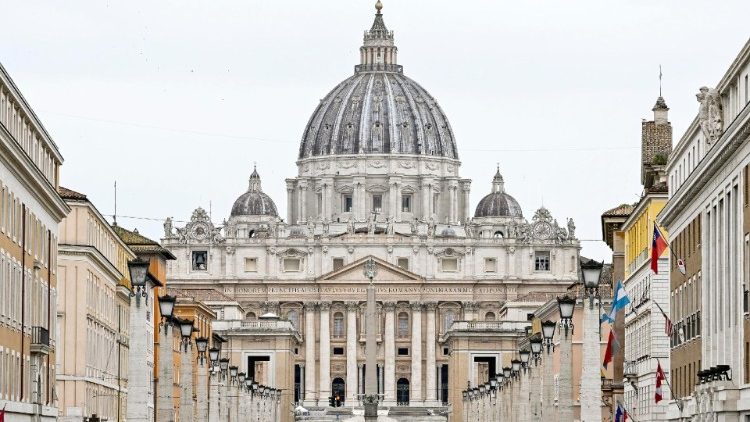
A view of St. Peter's BasilicaA view of St. Peter's Basilica 

Protection of Minors Commission receives new Statutes, renewed mandate

Pope Leo XIV approves new Statutes for the Pontifical Commission for the Protection of Minors, reinforcing the Church's commitment to safeguarding minors and vulnerable persons.

Vatican News

Pope Leo XIV has approved new Statutes for the Pontifical Commission for the Protection of Minors, replacing those promulgated in 2015 and bringing the Commission's structure and mandate in line with the Apostolic Constitution Praedicate Evangelium.

The new Statutes have been approved ad experimentum for a period of three years and were published on Saturday, 13 June 2026.

A Rescript signed by Cardinal Secretary of State Pietro Parolin notes that the Holy Father approved the revised text during an audience on 20 May 2026 and ordered its immediate entry into force.

Pontifical Commission’s role to promote accountability

In a press release accompanying the publication of the Statutes, the Pontifical Commission for the Protection of Minors said the revised text strengthens its role in promoting safeguarding practices across the universal Church and forms part of a broader effort “to ensure that safeguarding is fully integrated into the life and structures of the Church.”

Archbishop Thibault Verny, President of the Pontifical Commission for the Protection of Minors, said the Statutes “mark an important step in deepening our shared responsibility to protect and care for the most vulnerable.”

“They reflect listening—to victims/survivors, to safeguarding experts, and to the experience of local Churches—and reaffirm that safeguarding remains a central priority,” he continued.

New aspects of Commission’s mandate

According to the Commission, the revised Statutes strengthen its mandate and operational effectiveness, continue to emphasize victim- and survivor-informed approaches.

The Statutes also clarify the Commission’s relationship with other Dicasteries of the Roman Curia, and reinforce its role in promoting “accountability, transparency, and good safeguarding practices globally.”

The Commission reports directly to the Pope and advises him on the protection of minors and vulnerable persons from abuse.

“It is established alongside the Dicastery for the Doctrine of the Faith and therefore collaborates closely with the Dicastery in the exchange of information, the development of safeguarding methodologies, preparation of the Annual Report and formation programs,” noted the press release. “The President or Secretary are nominated members of the Dicastery, and one or more Dicastery officials are nominated by the Prefect as observers at the Commission’s Plenary Assemblies.”

The Commission does not govern but helps to guide the Curia’s service to the universal Church by promoting local responsibility and competencies of the various Vatican Dicasteries.

Among the developments highlighted by the Commission is its continued support for local Churches in developing safeguarding frameworks and promoting stable and accessible reporting systems, as well as listening centers that “welcome, listen to and accompany victims/survivors”, while protecting confidentiality and personal data.

Annual reports

The Commission also noted its responsibility for preparing the Annual Report on Church Policies and Procedures for Safeguarding.

The report draws on contributions from Dicasteries and local ecclesial bodies and seeks to map “the status of safeguarding in the global Church” by distinguishing between verified policies, declared practices, information received, systemic issues, and recommendations.

Pope Leo has repeatedly affirmed that the protection of minors and vulnerable persons is a fundamental responsibility of the Church.

The Commission said the revised Statutes reaffirm this commitment and support its mission of accompanying local Churches in strengthening safeguarding efforts throughout the world.

Thursday, January 8, 2026

Pope Leo XIV opens his 1st Extraordinary Consistory of Cardinals: "I am here to listen"


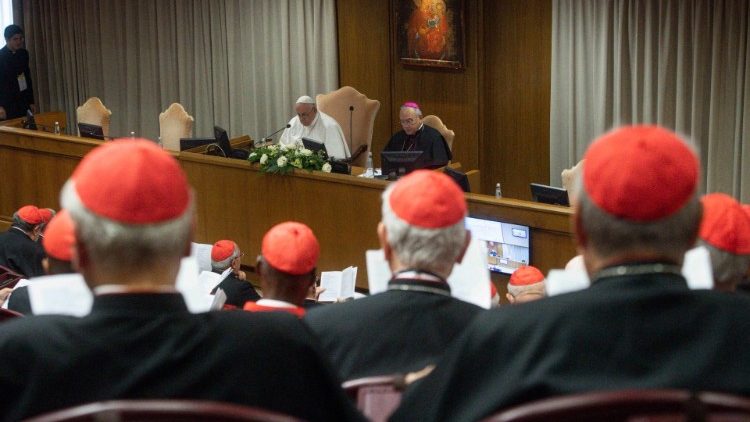
Pope Leo XIV addresses the Opening of the Extraordinary Consistory of Cardinals in the VaticanPope Leo XIV addresses the Opening of the Extraordinary Consistory of Cardinals in the Vatican  (@Vatican Media)

Pope at Consistory: It's not the Church that attracts but Christ

Pope Leo XIV opens the Extraordinary Consistory of Cardinals and recalls that Christ draws us to follow Him, warning that division in the Church scatters the faithful.

By Deborah Castellano Lubov

“I am here to listen,” Pope Leo XIV said in his opening address of the Extraordinary Consistory of Cardinals taking place in the Vatican, on 7-8 January.

The Pope began by expressing his joy at welcoming the Cardinals to Rome on the day after Epiphany, praying that the Holy Spirit may guide them during these two intense but important days of reflection and dialogue.

The Pope said their day-and-a-half together “will point the way for our path ahead."

“We must not arrive at a text," he said, "but continue a conversation that will help me in serving the mission of the entire Church.” 

READ POPE LEO'S FULL DISCOURSE HERE

The Holy Father acknowledged that the College of Cardinals is a very diverse group, “enriched by a wide range of backgrounds, cultures, ecclesial and social traditions, formative and academic paths, pastoral experiences, not to mention personal characteristics and traits.” 

"We are called to get to know one another and to dialogue, so that we may work together in serving the Church," he said. "I hope that we can grow in communion and thus offer a model of collegiality.”

In his remarks, the Holy Father had reminded the participants of the significance of the Second Vatican Council and reflected on his predecessor Popes.

"I invite us to pay close attention to what Pope Benedict signaled as the “power” that drives this movement of attraction," he said. "Indeed, this power is Charis, it is Agape, it is the love of God that became incarnate in Jesus Christ and that, in the Holy Spirit, is given to the Church, sanctifying all her actions." 

"Furthermore," Pope Leo underscored, "it is not the Church that attracts, but Christ; and if a Christian or an ecclesial community attracts, it is because through that 'channel' flows the lifeblood of Charity that cascades from the Heart of the Savior."

"While unity attracts, division scatters," he warned.

The Holy Father recognized that the Cardinals would reflect on two themes, choosing from among: Evangelii Gaudium, that is, the mission of the Church in today’s world; Praedicate Evangelium, namely the service of the Holy See, especially to the particular Churches; the Synod and synodality as both an instrument and a style of cooperation; and the liturgy, the source and summit of the Christian life.

Yet, "due to time constraints, and in order to encourage a genuinely in-depth analysis," he said, only two of them will be discussed specifically, being guided by this question: “Looking at the path of the next one or two years, what considerations and priorities could guide the action of the Holy Father and of the Curia regarding each theme?”

This, he said, would be the Cardinals' way of proceeding, as they seek to be "attentive to the heart, mind and spirit of each, listening to one another and expressing only the main point and in a succinct manner, so that all can speak."

"In the future," the Holy Father said, "this way of listening to each other, seeking the guidance of the Holy Spirit, and walking together will continue to be a great help for the Petrine ministry entrusted to me." 

"Even the way in which we learn to work together, with fraternity and sincere friendship," he said, "can give rise to something new, something that brings both the present and the future into focus."

Pope Leo XIV concluded by praying that the Holy Spirit may guide the Cardinals in their reflections, under the gaze of the Blessed Virgin Mary, Mother of the Church.

Monday, November 24, 2025

The Vatican releases new Regulations of the Roman Curia


St. Peter's BasilicaSt. Peter's Basilica  (ANSA)

Vatican publishes new Regulations of the Roman Curia

Pope Leo XIV approves the publication of new Regulations of the Roman Curia, which implement the reform put in place by the Apostolic Constitution "Praedicate Evangelium."

By Vatican News

The Regulation of the Roman Curia and the Regulation of Personnel of the same institution were published on Monday, 24 November.

They were signed on Sunday, 23 November, by Pope Leo XIV, on the Solemnity of Our Lord Jesus Christ, King of the Universe, commonly known as the Feast of Christ the King.

The Regulation of the Roman Curia applies to the Institutions and Offices that make up the Roman Curia, namely the Secretariat of State, the Dicasteries, the Judicial Bodies, and the Economic Bodies.

The Regulation of Personnel concerns the norms of an organizational, disciplinary, and economic character pertaining to the employment relationship of personnel serving in the Secretariat of State, the Dicasteries, the Bodies and Offices that constitute the Roman Curia, as well as the Institutions connected with the Holy See.

The new Regulations replace those approved by Pope Saint John Paul II on 15 April 1999, which entered into force on 1 July of the same year.

They incorporate and implement the modifications, the innovations, and the indications introduced by the late Pope Francis with the Apostolic Constitution Praedicate Evangelium of 19 March 2022.

Here are links to the full texts (in Italian):

GENERAL REGULATION OF THE ROMAN CURIA

GENERAL REGULATION OF THE PERSONNEL OF THE ROMAN CURIA


Tuesday, December 3, 2024

Council of Cardinals has December meeting with Pope Francis


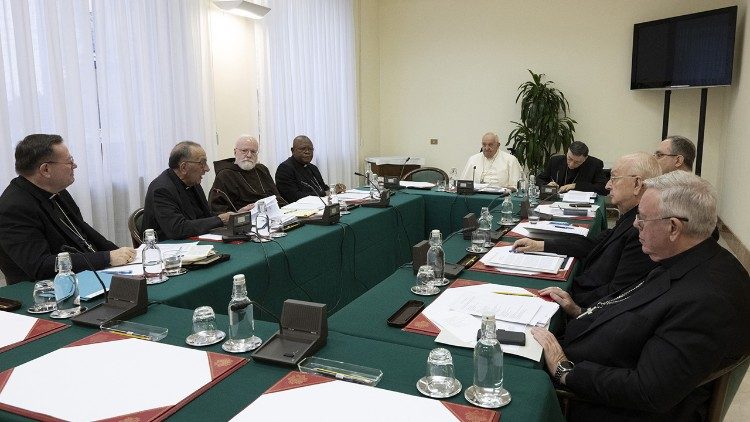
The 3 December 2024 meeting of the "C9" Council for Cardinals with Pope FrancisThe 3 December 2024 meeting of the "C9" Council for Cardinals with Pope Francis 

C9 focuses on collegiality, role of women, nuncios, and world crises

At the December session of the Council of Cardinals (C9), held on 2nd and 3rd December at the Casa Santa Marta in the presence of Pope Francis, several current issues concerning the Church and the world were discussed, as also discussed at the recent Synod. The meetings also provided an opportunity to reflect on the situation in the various countries represented by the Cardinals, “to share concerns and hopes about the ongoing reality of conflict and crisis.”

Vatican News

Collegiality in the Church, the role of women, the recent Synod, the implementation of the Apostolic Constitution Praedicate Evangelium in diocesan Curias, the role of nuncios, concerns and hopes for the global reality amid crises and conflicts marked the varied topics addressed during the December session of the Council of Cardinals, known as the C9, the working group composed of nine cardinals that assists and advises Pope Francis.

Collegiality in the Church

The meeting marked the final gathering for 2024, following the ones in February, April, and June, taking place on Monday 2nd and Tuesday 3rd December at the Casa Santa Marta, in the presence of the Pope, the Cardinals of the Council, and the Secretary. As reported by the Holy See Press Office, “various topics were discussed during the session’s meetings,” starting with Cardinal Marcello Semeraro, Prefect of the Dicastery for the Causes of Saints, “on collegiality in the Church, specifically the relationship between particular churches and ecclesial assemblies, followed by a common conversation on the recently concluded Synod.”

The role of women and service of nuncios

Additionally, during the meetings, “the role of women in the Church was explored, seeking a synthesis of the issues raised over the past four sessions of the Council of Cardinals. Finally – the statement continues – time was dedicated to studying and implementing the principles and criteria of the Apostolic Constitution Praedicate Evangelium in diocesan Curias, and to the topic 'The role of Papal Representatives in a synodal missionary perspective', in conversation with Cardinal Oswald Gracias, Archbishop of Bombay, President of the relevant study group.”

Reflection on the Church and world

“As always,” the Vatican Press Office reports, “the Council marked an opportunity for a comprehensive reflection on the reality of the Church and the world in the various areas represented by the Cardinals, to share concerns and hopes regarding the ongoing conditions of conflict and crisis.”

The next session of the Council of Cardinals is scheduled for April 2025.


Tuesday, March 7, 2023

Some internal Vatican workings described below


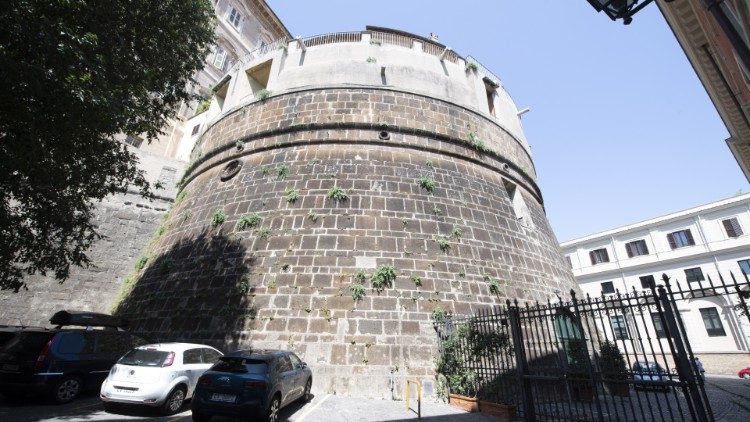
IOR offices at the Torrione di Niccolò VIOR offices at the Torrione di Niccolò V  (© Vatican Media)

New statutes issued for IOR in papal Chirograph

The Institute for the Works of Religion (IOR) receives new statutes that bring it in line with the new Apostolic Constitution 'Praedicate Evangelium.' The governing structure is simplified with new roles clearly defined for the various management offices to avoid duplication. New norms are issued regarding conflicts of interest. Management changes from a collegial body to one led by a single Director.

By Vatican News

The statutes guiding the Institute for the Works of Religion (IOR) have been renewed, now four years since their last revision. The changes are intended to bring the statutues in line with the new Apostolic Constitution Praedicate Evangelium. They include five-year mandates with the possibility of renewal only once, and a simpler governing structure with roles more clearly defined among the various offices in order to avoid overlap or duplication of activities.

The changes came in the Chirograph of Pope Francis with the new statutes made public on Tuesday 7 March, marking a renewal of the IOR's service whose purpose is "to provide for the care and administration of movable and immovable goods transfered or entrusted to it by individuals or legal persons and intended for religious or charitable works."

The primary changes contained in the two texts concern conformity with the five-year mandate and its possible renewal only once, for a maximum term of ten years. Also added are the non-concurrent character of the mandate of members of the Commission of Cardinals and the Board of Superintendence, and a specific provision concerning conflicts of interest, which states that "each member of the Board of Superintendence abstains from participating in voting on measures where an interest is held, current or potential, on their own account or by third parties."

Another change regards a clearer definition and distinction of respective roles and responsibilities of the IOR offices. The Board of Superintendence will handle the development of strategic guidelines, general policies, and oversight of IOR activities. The Director General will have responsibility for IOR management and administration.

Lastly, management will change from a collegial body composed of a Director and a Deputy Director, to a monocratic body composed of the Director General alone. Thus, the position of Deputy Director ceases to have a governing role and now becomes a "function," which the Director General may delegate to one of the managers.

The Director General continues to be appointed by the Board of Superintendence and approved by the Commission of Cardinals, but from now onwards will be chosen "based on a shortlist of at least three suitable candidates." The Director General can be hired for an indefinite or a fixed term.

Thursday, September 8, 2022

Pope meets with Pontifical Reps and again calls for peace in a world at war


Pope to Pontifical Representatives: ‘World shaken by risk of nuclear war’

Pope Francis holds a triennial meeting with Pontifical Representatives in the Vatican, and calls attention to the Holy See’s efforts to seek peace amid a “third world war fought piecemeal”.

By Devin Watkins

The Pope’s representatives in nations across the globe met with the Holy Father on Thursday as part of their triennial encounter in the Vatican.

The group includes 91 Apostolic Nuncios and 6 Permanent Observers, while 5 Pontifical Representatives were unable to attend due the health reasons or other impediments.

Pope Francis spoke to his representatives about various global issues affecting nations and the Church in the world.

World shaken by war

The Pope noted that this encounter comes in the wake of the pandemic.

“The tempest of the Covid-19 pandemic forced various constraints on our daily lives and pastoral activities,” he said. “Now it seems the worst may be behind us, and thank God we are able to meet.”

However, added Pope Francis, the spectre of war has descended on Europe and the world.

“Unfortunately, Europe and the entire world are shaken by a particularly serious war, due to the violation of international law, the risks of nuclear escalation, and the grave economic and social consequences.”

Pope’s closeness amid world war

The Pope added that a “third world war fought piecemeal” has gripped the globe, and that Pontifical Representatives are present in the countries involved in the various conflicts.

He thanked them for bringing his closeness to peoples who are suffering.

“You bring the Pope’s closeness to peoples and the Church. You are points of reference in moments of extreme bewilderment and turbulence.”

Focusing on mission

Pope Francis urged his representatives to entrust their work to the Lord, as they labor in the “today of the Church and world”.

He noted that the Church is currently journeying through the Synod on synodality, while the Roman Curia seeks to apply the Apostolic Constitution Praedicate Evangelium.

The Pope also recalled two Apostolic Nuncios who died while in office: Archbishop Joseph Chennoth and Archbishop Aldo Giordano.

“Our brothers have preceded us in our journey, and they invite us to keep our gaze fixed on the path ahead and on the heavens.”

Tuesday, August 30, 2022

Recap of Day 1 meeting with the Cardinals and the Pope


Meeting of the Cardinals with Pope Francis to discuss Praedicate EvangeliumMeeting of the Cardinals with Pope Francis to discuss Praedicate Evangelium  (Vatican Media)

Cardinals discuss importance of Church's communion and outreach

The first day of the two-day meeting of the Cardinals with Pope Francis to reflect on Praedicate Evangelium focuses on the importance of communion in the Church and the missionary calling to witness to God's love for all.

By Vatican News staff reporter

Italian Cardinal Enrico Feroci, parish priest of Santa Maria del Divino Amore (Our Lady of Divine Love) in Castel di Leva, spoke to Vatican News about the first session of the Cardinals' meeting with Pope Francis on Monday, describing the very fraternal atmosphere characterizing it. 

After the opening prayer, Pope Francis offered some brief introductory words inviting everyone to participate and offer their own contribution to the discussions during these two days of reflection on Praedicate Evangelium, the Apostolic Constitution reforming the Roman Curia. 


The cardinals then divided into various language groups, and later met all together again to share their reflections. 

Cardinal Feroci said the cardinals addressed two main themes: that of communion, about witnessing to mutual love between Christians; then the issue concerning the difficulty of today's society to being open to the Gospel message and ways to overcome these challenges.

Cardinal Marcello Semeraro, Prefect of the Dicastery for the Causes of Saints, emphasized to Vatican News the great participation of the cardinals in the meeting with an open and lively dialogue, particularly on the missionary dimension that the new Apostolic Constitution underscores, as well as the need to focus on the proclamation on the greatest commandment, that we should love one another.

Cardinal Dolan checks in from Rome meeting of Cardinals


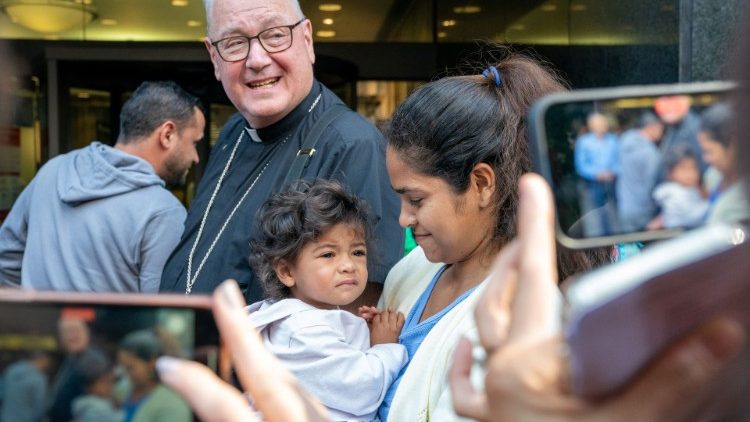
Cardinal Timothy Dolan greets migrant families outside of Catholic Charities of New YorkCardinal Timothy Dolan greets migrant families outside of Catholic Charities of New York  (David Dee Delgado)

Cardinal Dolan on Curia Reform meeting: an opportunity to learn from those 'on front lines'

In an interview with Vatican News, Cardinal Timothy Dolan, Archbishop of New York, calls Pope Francis' meeting of the world's Cardinals to study the Roman Curia reform 'extraordinarily uplifting'; and, as the war wages in Ukraine, praises the encounter as an opportunity to learn from the service of those Cardinals on the front lines.

By Deborah Castellano Lubov

As the war wages on in Ukraine, Cardinal Timothy Dolan, Archbishop of New York, says another advantage of this meeting Pope Francis summoned of the world's Cardinals is to be with Cardinals who are on the front lines, to hear about the challenges they face, and to learn from their service.

In an interview with Vatican News on Monday, Cardinal Dolan, who serves as Chair of the Catholic Near East Welfare Association (CNEWA), reflected on the first day of the two-day encounter in the Vatican to discuss reform of the Roman Curia, and specifically highlighted the solidarity of the Cardinals in combating war and helping those in need.

Pope Francis requested that the world's Cardinals should gather in the Vatican on 29-30 August to reflect on the recently-published Apostolic Constitution Praedicate Evangelium on reforming the Roman Curia.


According to UN statistics from July, at least 12 million people have been forced to flee their homes since the outbreak of the war, with at least 5 million fleeing outside Ukraine to bordering nations, and at least 7 million displaced inside the war-torn nation.

Since Russia invaded Ukraine, some 2 million Ukrainians have found welcome in Poland, and numerous others in Hungary, Slovakia, and other bordering nations. Some Ukrainians have started to return to their country.

Listening to Cardinals on 'front lines'

Cardinal Dolan told Vatican News that after his own visit to Ukraine and the bordering nations, that being among the other Cardinals of the Universal Church, and those closest to the conflict, has been particularly meaningful.

"That's another great advantage of being here," the Cardinal said.

"The Cardinals, by their very nature, mirror the Church Universal, the catholicity of the Church. To be with them now, to talk to Cardinal Péter Erdő of Budapest, as they have been so extraordinarily generous and welcoming, to be with Cardinal Stanisław Dziwisz in Krakow, where they have been welcomed by the people of Poland, close to 4 million refugees."

“To be with these Cardinals who are on the front lines and to hear the challenges, but also to see how uplifting it is to be in service and to hear them so grateful for the solicitude of the world. That's very good.”

During an earlier visit to Rome, in April - his first since the outbreak of the pandemic - Cardinal Dolan sat down with Vatican News to discuss his upcoming journey to meet with suffering Ukrainian refugees and bring them, and those welcoming them, aid.

'Extraordinarily uplifting' encounter in the Vatican

On Monday evening, the Cardinal of New York also gave his impressions of the discussions taking place among the Cardinals, and in their small groups, calling it a "beautiful experience."

"It is a beautiful experience of something that is in danger of becoming too theoretical, namely, collegiality, apostolic fraternity, synodality. No, we experience it there," he said.

“We talk as friends, as brothers, with immense charity and deep love for the Church about very practical issues. It has been extraordinarily uplifting.”

He expressed his appreciation for the encounter.

"I'm glad this has taken place. You look forward to it," but, to some extent, he suggested, out of a sense of duty.

"But I said, 'wow', duty is rewarded because this is a very good thing."

Boots on the ground, wishing to help

Cardinal Dolan's visit to Ukraine and border countries earlier this year was because the Archbishop of New York is ex-officio the chairman of the board of CNEWA.

CNEWA was founded a century ago by Pope Pius XI to assist Eastern-rite Catholics, who very often live in persecuted areas and often are under great stress.

There are many Eastern-rite Catholics in the Middle East, India, Ukraine, and in Central and Eastern Europe.

For that occasion, he told Vatican News, "we are very active, having boots on the ground, and wish to bring them alms, the gifts that Catholic people have given us to help these people. We want to just embrace them and say, 'We love you. We have not forgotten about you. We want to pray with you, encourage you and help.'"