Saturday, June 24, 2017

This monastery founder is Sunday Saint of the Day

St. William of Vercelli


Image of St. William of Vercelli

Facts

Feastday: June 25
Patron of Irpinia
Birth: 1085
Death: 1142


William of Vercelli, Saint 1085-1142. founder, born in Vercelli Italy he was brought up as an orphan became a hermit on Monte Vergine, Italy after a pilgrimage to Compostella and attracted so many followers that a monastery was buillt. By 1119 his followers were united in the Benedictine congregation, the Hermits of Monte Vergine (Williamites) which he headed. The austerity of his rule led to dissension among his monks to restore peace he left and was taken under the protection of Roger I of Naples who built a monastery for him in Salerno. He founded monasteries through out Naples, and died at the Guglielmo monastery near Nusco Italy. He is also called William of Monte Vergine. Feast day June

A great inside look at our new Priests

Typical new US priest: 34-year-old who prays Rosary, takes part in Eucharistic adoration

June 09, 2017
The typical member of the priestly ordination class of 2017 is a 34-year-old cradle Catholic, according to a recently released survey of 444 of the 590 men slated to be ordained to the priesthood in the United States this year. The survey was conducted for the United States Conference of Catholic Bishops by the Center for Applied Research in the Apostolate.
The typical ordinand also prayed the Rosary and regularly took part in Eucharistic adoration before entering seminary, according to the survey.
77% of the men were preparing for the diocesan priesthood, with the largest ordination classes in Paterson, NJ (13 men), St. Paul and Minneapolis (11), and Wichita (10). Among religious ordinations, the Jesuits (27 men), Dominicans (12), and Capuchin Franciscans (8) have the largest ordination classes.
25% of the ordinands are foreign born, with the most typical foreign countries of birth being Mexico (4%), Vietnam (3%), the Philippines (2%), and Colombia (2%). On average, these foreign-born seminarians have lived in the United States for 12 years and arrived in the US at age 25.
A disproportionately high percentage of ordinands attended a Catholic elementary school (50%), Catholic high school (41%), or Catholic college (40%).
In addition, a disproportionately high percentage were home schooled: 8% were home schooled, typically for eight years, at a time when less than 2% of US children were educated at home. If one assumes that all of the homeschooled seminarians came from the United States, then 11% of US-born ordinands were home schooled.
Among the survey’s findings:
  • the typical diocesan ordinand lived in his diocese for 16 years before entering seminary
  • 70% of ordinands are white, 14% are Latino, 10% are Asian, and 4% are black
  • 7% are converts, with the average age of reception into the Church being 21
  • 35% have a relative who was a priest or religious
  • in 80% of cases, both parents were Catholic
  • 5% have served in the US Armed Forces; 12% had a parent with a military career
  • 69% prayed the Rosary, and 77% regularly participated in Eucharistic adoration, before entering the seminary
  • ordinands typically first began to consider the priesthood at 16
  • 70% were encouraged by a parish priest to consider a vocation; 45% were encouraged by a friend, 44% by a parishioner, 40% by their mother, and 32% by their father. The average ordinand received encouragement from four people.
  • 7% were discouraged by a priest from considering a vocation; 11% were discouraged by their fathers, 13% by their mothers, and 23% by other family members
  • ordinands, on average, have three siblings, with only 4% being only children
  • 42% are the oldest children in their families; 23% are the youngest
  • 43% had earned their undergraduate degree before entering seminary, and 16% had earned a graduate degree
  • 57% worked full time before entering seminary
  • 48% took part in a parish youth group, 31% took part in Boy Scouts, and 23% took part in the Knights of Columbus or Knights of St. Peter Claver
  • 15% took part in a World Youth Day, and 13% took part in a Franciscan University of Steubenville summer conference
  • 75% had served as altar servers, 52% as readers, and 43% as extraordinary ministers of Holy Communion before entering seminary

A beautiful prayer for a widow or widower

A Widow(er)’s Prayer

JOSE OTO / BSIP
   

Give me the strength to say, thy will be done.

June 23 is the UN International Widows’ Day.
As in Jesus’ time, widows today in many parts of the world still face grave economic and social challenges. Joining in this day of recognition of those challenges, we offer to widows, widowers and all those who mourn with them this prayer:


Father you have taken my husband/wife home to you.
We were created by you in order to return to you, and for a portion of this journey, we were side-by-side.
We shared joys and sorrows, happiness and difficulty.
It was beautiful, though not always easy. I thank you for all of it.
Now, my spouse has gone and I am left alone. Give him/her eternal joy, and give me the strength to say, thy will be done.
And allow us to one day find each other again in our eternal homeland.
Mary, solace of the afflicted, pray for us.  Amen.


“Widowhood, accepted bravely as a continuation of the marriage vocation, should be esteemed by all” (The Vatican II document Gaudium et spes, 48)

Translated and adapted from Church Forum, through Aleteia Spanish

Friday, June 23, 2017

Also for Saturday, after the Sacred Heart, we remember the Immaculate Heart of Mary

Ordinary Time

The Immaculate Heart of Mary


In the midst of the second world war Pope Pius XII put the whole world under the special protection of our Savior's Mother by consecrating it to her Immaculate Heart, and in 1944 he decreed that in the future the whole Church should celebrate the feast of the Immaculate Heart of Mary. This is not a new devotion. In the seventeenth century, St. John Eudes preached it together with that of the Sacred Heart; in the nineteenth century, Pius VII and Pius IX allowed several churches to celebrate a feast of the Pure Heart of Mary. Pius XII instituted today's feast of the Immaculate Heart of Mary for the whole Church, so as to obtain by her intercession "peace among nations, freedom for the Church, the conversion of sinners, the love of purity and the practice of virtue" (Decree of May 4, 1944).
Three things made Francis of Caracciolo stand out from his wealthy Neapolitan friends: he was powerfully drawn to our Lord in the Blessed Sacrament, he fasted every Saturday in honor of the Virgin Mary, and he had a generous love for the poor. When he was seriously ill at the age of twenty-two, he vowed that if he were cured he would devote himself to the service of God and his fellow men. He became a priest and in 1588 joined the order of Minor Clerks Regular. Francis instituted perpetual adoration as one of the works of his Order. According to the 1962 Missal of St. John XXIII the Extraordinary Form of the Roman Rite, today is his feast. It is also the feast of Our Lady, Queen of Apostles.


Immaculate Heart of Mary
The attention of Christians was early attracted by the love and virtues of the Heart of Mary. The Gospel itself invited this attention with exquisite discretion and delicacy. What was first excited was compassion for the Virgin Mother. It was, so to speak, at the foot of the Cross that the Christian heart first made the acquaintance of the Heart of Mary. Simeon's prophecy paved the way and furnished the devotion with one of its favourite formulae and most popular representations: the heart pierced with a sword. But Mary was not merely passive at the foot of the Cross; "she cooperated through charity", as St. Augustine says, "in the work of our redemption".
It is only in the twelfth, or towards the end of the eleventh century, that slight indications of a regular devotion are perceived in a sermon by St. Bernard (De duodecim stellis).
Stronger evidences are discernible in the pious meditations on the Ave Maria and the Salve Regina, usually attributed either to St. Anselm of Lucca (d. 1080) or St. Bernard; and also in the large book De laudibus B. Mariae Virginis (Douai, 1625) by Richard de Saint-Laurent.
In St. Mechtilde (d. 1298) and St. Gertrude (d. 1302) the devotion had two earnest adherents. A little earlier it had been included by St. Thomas Becket in the devotion to the joys and sorrows of Mary, by Blessed Hermann (d.1245), one of the first spiritual children of St. Dominic, in his other devotions to Mary, and somewhat later it appeared in St. Bridget's Book of Revelations.

St. Ambrose perceived in her the model of a virginal soul. St. Bernardine of Siena (d.1444) was more absorbed in the contemplation of the virginal heart, and it is from him that the Church has borrowed the lessons of the Second Nocturn for the feast of the Heart of Mary. St. Francis de Sales speaks of the perfections of this heart, the model of love for God, and dedicated to it his Theotimus.
In the second half of the sixteenth century and the first half of the seventeenth, ascetic authors dwelt upon this devotion at greater length. It was, however, reserved to St. Jean Eudes (d. 1681) to propagate the devotion, to make it public, and to have a feast celebrated in honor of the Heart of Mary, first at Autun in 1648 and afterwards in a number of French dioceses.
In 1799 Pius VI, then in captivity at Florence, granted the Bishop of Palermo the feast of the Most Pure Heart of Mary for some of the churches in his diocese. In 1805 Pius VII made a new concession, thanks to which the feast was soon widely observed. Such was the existing condition when a twofold movement, started in Paris, gave fresh impetus to the devotion. The two factors of this movement were first of all the revelation of the "miraculous medal" in 1830 and all the prodigies that followed, and then the establishment at Notre-Dame-des-Victoires of the Archconfraternity of the Immaculate Heart of Mary, Refuge of Sinners, which spread rapidly throughout the world and was the source of numberless graces. On 21 July 1855, the Congregation of Rites finally approved the Office and Mass of the Most Pure Heart of Mary without, however, imposing them upon the Universal Church

On Saturday we remember the birth of St John the Baptist

Ordinary Time: June 24th

Solemnity of the Birth of St. John the Baptist

MASS READINGS

June 24, 2016 (Readings on USCCB website)


This feast, a segment of Advent in the season of Ordinary Time, makes us aware of the wonderful inner relationship between the sacred mysteries; for we are still in the midst of one Church year and already a bridge is being erected to the coming year of grace.
Ordinarily the Church observes the day of a saint's death as his feast, because that day marks his entrance into heaven. To this rule there are two notable exceptions, the birthdays of Blessed Mary and of St. John the Baptist. All other persons were stained with original sin at birth, hence, were displeasing to God. But Mary, already in the first moment of her existence, was free from original sin (for which reason even her very conception is commemorated by a special feast), and John was cleansed of original sin in the womb of his mother. This is the dogmatic justification for today's feast. In the breviary St. Augustine explains the reason for today's observance in the following words:
"Apart from the most holy solemnity commemorating our Savior's birth, the Church keeps the birthday of no other person except that of John the Baptist. (The feasts of the Immaculate Conception and of the Nativity of the Blessed Virgin had not yet been introduced.) In the case of other saints or of God's chosen ones, the Church, as you know, solemnizes the day on which they were reborn to everlasting beatitude after ending the trials of this life and gloriously triumphing over the world.


"For all these the final day of their lives, the day on which they completed their earthly service is honored. But for John the day of his birth, the day on which he began this mortal life is likewise sacred. The reason for this is, of course, that the Lord willed to announce to men His own coming through the Baptist, lest if He appeared suddenly, they would fail to recognize Him. John represented the Old Covenant and the Law. Therefore he preceded the Redeemer, even as the Law preceded and heralded the new dispensation of grace."
In other words, today's feast anticipates the feast of Christmas. Taking an overall view, we keep during the course of the year only two mysteries, that of Christ's Incarnation and that of His Redemption. The Redemption mystery is the greater of the two; the Incarnation touches the human heart more directly. To the Redemption mystery the entire Easter season is devoted, from Septuagesima until Pentecost; and likewise every Sunday of the year, because Sunday is Easter in miniature.
The Christmas season has for its object the mystery of God-become-Man, to which there is reference only now and then during the remaining part of the year, e.g., on Marian feasts, especially that of the Annunciation (March 25) and today's feast in honor of the Baptist. In a sense, then, we are celebrating Christ's incarnation today. The birth of Jesus is observed on December 25 at the time of the winter solstice, while the birth of His forerunner is observed six months earlier at the time of the summer solstice. Christmas is a "light" feast; the same is true today. The popular custom centering about "St. John's Fire" stems from soundest Christian dogma and could well be given renewed attention. St. John's Fire symbolizes Christ the Light; John was a lamp that burned and shone. We Christians should be the light of the world.
Excerpted from The Church's Year of Grace, Pius Parsch
Today is also the Feast of the Immaculate Heart of Mary.
Click here for commentary on the readings in the Extraordinary Form of the Roman Rite.

St. John the Baptist
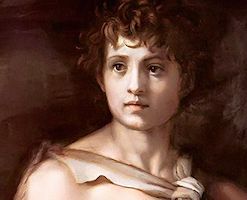
We are given the story of the ministry of John the Baptist, called the Precursor or Forerunner of the Lord, with some variation of detail, in the three synoptic Gospels of Matthew, Mark, and Luke, as well as in the Book of John. Luke tells us of the birth of John the Baptist in a town of Judaea, about six months before the birth of the Saviour. The attendant circumstances, which we have already recounted under the headings of and , his parents, suggest the miraculous and wonderful. The New Testament tells us nothing of John's early years, but we know that his pious, virtuous parents must have reared the boy with care, conscious always of the important work to which he was appointed, and imbuing him with a sense of his destiny.
When John began final preparations for his mission, he was probably in his thirty-second year. He withdrew into the harsh, rocky desert beyond the Jordan to fast and pray, as was the ancient custom of holy men. We are told that he kept himself alive by eating locusts and wild honey and wore a rough garment of camel's hair, tied with a leathern girdle. When he came back to start preaching in the villages of Judaea, he was haggard and uncouth, but his eyes burned with zeal and his voice carried deep conviction. The Jews were accustomed to preachers and prophets who gave no thought to outward appearances, and they accepted John at once; the times were troubled, and the people yearned for reassurance and comfort. So transcendant was the power emanating from the holy man that after hearing him many believed he was indeed the long-awaited Messiah. John quickly put them right, saying he had come only to prepare the way, and that he was not worthy to unloose the Master's sandals. Although his preaching and baptizing continued for some months during the Saviour's own ministry, John always made plain that he was merely the Forerunner. His humility remained incorruptible even when his fame spread to Jerusalem and members of the higher priesthood came to make inquiries and to hear him. "Repent, for the Kingdom of Heaven is at hand,"-this was John's oft-repeated theme. For the evils of the times his remedy was individual purification. "Every tree," he said, "that is not bringing forth good fruit is to be cut down and thrown into the fire." The reformation of each person's life must be complete—the wheat must be separated from the chaff and the chaff burned "with unquenchable fire."
The rite of baptism, a symbolic act signifying sincere repentance as well as a desire to be spiritually cleansed in order to receive the Christ, was so strongly emphasized by John that people began to call him "the baptizer." The Scriptures tell us of the day when Jesus joined the group of those who wished to receive baptism at John's hands. John knew Jesus for the Messiah they had so long expected, and at first excused himself as unworthy. Then, in obedience to Jesus, he acquiesced and baptized Him. Although sinless, Jesus chose to be baptized in order to identify Himself with the human lot. And when He arose from the waters of the Jordan, where the rite was performed, "the heavens opened and the Spirit as a dove descended. And there came a voice from the heavens, Thou art my beloved Son, in Thee I am well pleased" (Mark i, 11).
John's life now rushes on towards its tragic end. In the fifteenth year of the reign of the Roman emperor, Tiberias Caesar, Herod Antipas was the provincial governor or tetrarch of a subdivision of Palestine which included Galilee and Peraea, a district lying east of the Jordan. In the course of John's preaching, he had denounced in unmeasured terms the immorality of Herod's petty court, and had even boldly upbraided Herod to his face for his defiance of old Jewish law, especially in having taken to himself the wife of his half-brother, Philip. This woman, the dissolute Herodias, was also Herod's niece. Herod feared and reverenced John, knowing him to be a holy man, and he followed his advice in many matters; but he could not endure having his private life castigated. Herodias stimulated his anger by lies and artifices. His resentment at length got the better of his judgment and he had John cast into the fortress of Machaerus, near the Dead Sea. When Jesus heard of this, and knew that some of His disciples had gone to see John, He spoke thus of him: "What went you to see? A prophet? Yea, I say to you, and more than a prophet. This is he of whom it is written: Behold I send my angel before thy face, who shall prepare thy way before thee. For I say to you, amongst those that are born of women there is not a greater prophet than John the Baptist" (Matthew xi, 10-12).
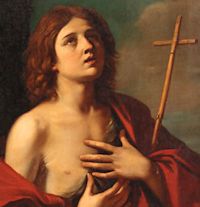
Herodias never ceased plotting against the life of John, who was not silenced even by prison walls. His followers now became even more turbulent. To Herodias soon came the opportunity she had long sought to put an end to the trouble-maker. On Herod's birthday he gave a feast for the chief men of that region. In Matthew xiv, Mark vi, and Luke ix, we are given parallel accounts of this infamous occasion which was to culminate in John's death. At the feast, Salome, fourteen-year-old daughter of Herodias by her lawful husband, pleased Herod and his guests so much by her dancing that Herod promised on oath to give her anything that it was in his power to give, even though it should amount to half his kingdom. Salome, acting under the direction and influence of her wicked mother, answered that she wished to have the head of John the Baptist, presented to her on a platter. Such a horrible request shocked and unnerved Herod. Still, he had given his word and was afraid to break it. So, with no legal formalities whatever, he dispatched a soldier to the prison with orders to behead the prisoner and return with it immediately. This was quickly done, and the cruel girl did not hesitate to accept the dish with its dreadful offering and give it to her mother. John's brief ministry was thus terminated by a monstrous crime. There was great sadness among the people who had hearkened to him, and when the disciples of Jesus heard the news of John's death, they came and took the body and laid it reverently in a tomb. Jesus, with some of his disciples, retired "to a desert place apart," to mourn.
The Jewish historian Josephus, giving further testimony of John's holiness, writes: "He was indeed a man endued with all virtue, who exhorted the Jews to the practice of justice towards men and piety towards God; and also to baptism, preaching that they would become acceptable to God if they renounced their sins, and to the cleanness of their bodies added purity of soul." Thus Jews and Christians unite in reverence and love for this prophet-saint whose life is an incomparable example of both humility and courage.
Excerpted from Lives of the Saints, Published by John J. Crawley & Co., Inc.

Catholic Bishop issues several decrees concerning same-sex couples; sure to solicit tons of reactions

Illinois Bishop Decrees: No Communion and No Funeral Rites for Same-Sex Couples

CNS News                  

Rained out, burned out yet God is faithful, and on time, always!

Hope everyone in the southeast Louisiana area had a good week despite the weather.  A tropical disturbance named Cindy visited us and thankfully, she was nuisance and not a major threat.  Cindy moved far west of the New Orleans area but drug her wet side smack over our area and we have had tons of rain since Tuesday.  Now the rain, for most of us, was not as bad as some of the more dire forecasts.

Being summer, the weather was not a major distraction as there were no schools to close, etc. although almost all the Archdiocese summer camps were told to close for two days.  Honestly, this turned out to be extreme abundance of caution but it is what it is. 

Once again we learned that living in southeast Louisiana during hurricane season is a burden.  Remember this was a tropical storm, not a hurricane and it made landfall some 300 miles west of New Orleans.  Still, several areas received damaging impacts from rising rivers, coastal flooding and a full Lake Pontchartrain.  If nothing else, we should all be reminded that any storm later in the season with more punch will require planning, preparation and vigilance.  Hurricanes are nothing to mess with.

So every hurricane season we pray, we ask for the assistance of Mary under the title of Our Lady of Prompt Succor and we pray various prayers like this one; pray along with us in Louisiana:

O God, Master of this passing world, hear the humble voices of your children.  The Sea of Galilee obeyed your order and returned to its former quietude; you are still the Master of land and sea.  We live in the shadow of a danger over which we have no control.  The Gulf, like a provoked and angry giant, can awake from its seeming lethargy, overstep its conventional boundaries, invade our land and spread chaos and disaster.  During this hurricane season, we turn to You, O loving Father.  Spare us from past tragedies whose memories are still so vivid and whose wounds seem to refuse to heal with the passing of time.  O Virgin, Star of the Sea, Our Beloved Mother, we ask you to plead with your Son in our behalf, so that spared from the calamities common to this area and animated with a true spirit of gratitude, we will walk in the footsteps of your Divine Son to reach the heavenly Jerusalem where a storm-less eternity awaits us. Amen.

Pope Francis preaches on Feast of Most Sacred Heart

Pope's homily: Become small to hear the voice of the Lord


At the chapel in the Casa Santa Marta, Pope Francis celebrates Mass for the Solemnity of the Most Sacred Heart of Jesus.

23/06/2017 12:36

(Vatican Radio) In order to hear the voice of the Lord, you need to make yourself small. That was the message of Pope Francis in his homily at the daily Mass at the Casa Santa Marta on Friday morning, as the Church celebrates the Solemnity of the Most Sacred Heart of Jesus.
The Lord has chosen us, He has “mixed Himself up with us in the journey of life,” and has given “His Son, and the life of His Son, for our love.” In the first Reading, taken from the book of Deuteronomy, Moses says that God has chosen us “from all the nations on the face of the earth to be a people peculiarly His own.” Pope Francis explained how God is praised because “in the Heart of Jesus He gave us the grace to celebrate with joy the great mystery of our salvation, of His love for us”; that is, celebrating “our faith.” In particular, the Pope dwelt on two words contained in the reading: “to choose,” and “smallness.” With regard to choosing, the Holy Father said it is not we who have chosen God, but rather, God has made Himself a “our prisoner”:
“He has attached Himself to our life; He cannot detach Himself. He is strongly yoked! And He remains faithful in this attitude. We were chosen for love and this is our identity. ‘I have chosen this religion, I have chosen…’ [we might say]. No, you have not chosen. It is He Who has chosen you, has called you, and has joined Himself to you. And this is our faith. If we do not believe this, we don’t understand the message of Christ, we don’t understand the Gospel.”
For the second word, “smallness,” Pope Francis recalled how Moses said that the Lord had chosen the people of Israel because it was “the smallest of all nations”:
“He was enamoured of our smallness, and for this reason He has chosen us. And He chooses the small: not the great, the small. And He is revealed to the small: ‘you have hidden these things from the wise and the learned you have revealed them to little ones.’ He is revealed to the little ones: if you want to understand something of the mystery of Jesus, lower yourself: make yourself small. Be mindful of being nothing. And He not only chooses and reveals Himself to the little ones; He calls the little ones: ‘Come to me, all you who labour and are burdened, and I will give you rest.’ You that are the smallest – because of suffering, because of fatigue – He chooses the little ones, He is revealed to the little ones, and He calls the little ones. But the great, does He not call them? His heart is open, but the great do not recognize His voice because they are not able to hear it because they are full of themselves. To hear the voice of the Lord, you must make yourself little.”
And thus we come to the mystery of the Heart of Christ, which is not a “holy card” for the devout: the transfixed Heart of Christ is “the heart of revelation, the heart of our faith, because He made Himself small, He has chosen this way”: that of humbling Himself, of emptying Himself “even to death on the Cross.” It is, the Pope said, “a choice for smallness, so that the glory of God might be manifest.” From the Body of Christ transfixed by the soldier’s lance, “blood and water” flowed out, the Pope reminded us; and “this is the mystery of Christ” in today’s celebration of “a Heart that loves, that chooses, that is faithful,” and that “is joined to us, is revealed to the little ones, calls the little ones, makes itself little”:
“We believe in God, yes; yes in Jesus too, yes… ‘Is Jesus God?’ [someone asks.] ‘Yes,’ [we respond]. This is the manifestation, this is the glory of God. Fidelity in choosing, in joining Himself and making Himself little, even for Himself: to become small, to empty Himself. The problem of the faith is the core of our life: we can be so much, so virtuous, but with little or no faith; we must start from here, from the mystery of Jesus Christ, Who has saved us with His faithfulness.”
Pope Francis concluded his homily with the prayer that the Lord might grant us the grace to celebrate in the Most Sacred Heart of Jesus, “the great acts, the great works of salvation, the great works of redemption.”

Thursday, June 22, 2017

Friday we celebrate the Solemnity of the Most Sacred Heart of Jesus

Jun 23 Sacred Heart of Jesus


Friday After the Second Sunday After Pentecost

The Most Sacred Heart of Jesus

Solemnity
“…an unending spring of life, giving hope to every person, has streamed precisely from the Heart of God’s Son, who died on the Cross. From the Heart of Christ crucified is born the new humanity redeemed from sin. The man of the year 2000 needs Christ’s Heart to know God and to know himself; he needs it to build the civilization of love.”[1]


Today is the solemnity of The Most Sacred Heart of Jesus. The feast dates back to the 11th century, but prior to the 17th century the devotion was embraced mainly by mystics such as St. Bernard of Claivaux and Gertrude of Helfta. In 1673, Margaret Mary Alacoque, received a vision of Jesus’ compassionate heart, pierced by the sins of the world, which gave impetus to the devotion. In 1899, Pope Leo XIII consecrated humanity to the Sacred Heart of Jesus. He explained the Sacred Heart as both, “a symbol and living image of the infinite love of Christ.” [2][3]