Showing posts with label Immaculate Heart of Mary. Show all posts

Friday, June 12, 2026

Saturday is the Memorial of the Immaculate Heart of Mary


Ordinary Time: June 13th

Memorial of the Immaculate Heart of Mary


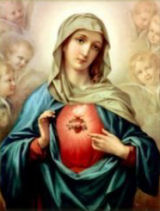
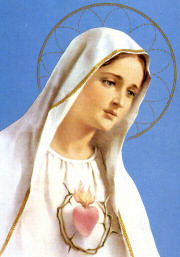
In the midst of the World War II, Pope Pius XII put the whole world under the special protection of our Savior's Mother by consecrating it to her Immaculate Heart, and in 1944 he decreed that in the future the whole Church should celebrate the Memorial of the Immaculate Heart of Mary. This is not a new devotion. In the seventeenth century, St. John Eudes preached it together with that of the Sacred Heart; in the nineteenth century, Pius VII and Pius IX allowed several churches to celebrate a feast of the Pure Heart of Mary. Pius XII instituted today's feast of the Immaculate Heart of Mary for the whole Church, so as to obtain by her intercession "peace among nations, freedom for the Church, the conversion of sinners, the love of purity and the practice of virtue" (Decree of May 4, 1944).

The Immaculate Heart of Mary

The attention of Christians was early attracted by the love and virtues of the Heart of Mary. The Gospel itself invited this attention with exquisite discretion and delicacy. What was first excited was compassion for the Virgin Mother. It was, so to speak, at the foot of the Cross that the Christian heart first made the acquaintance of the Heart of Mary. Simeon's prophecy paved the way and furnished the devotion with one of its favorite formulae and most popular representations: the heart pierced with a sword. But Mary was not merely passive at the foot of the Cross; "she cooperated through charity," as St. Augustine says, "in the work of our redemption."

It is only in the twelfth, or towards the end of the eleventh century, that slight indications of a regular devotion are perceived in a sermon by St. Bernard (De duodecim stellis).

Stronger evidence are discernible in the pious meditations on the Ave Maria and the Salve Regina, usually attributed either to St. Anselm of Lucca (d. 1080) or St. Bernard; and also, in the large book De laudibus B. Mariae Virginis (Douai, 1625) by Richard de Saint-Laurent.

In St. Mechtilde (d. 1298) and St. Gertrude (d. 1302) the devotion had two earnest adherents. A little earlier it had been included by St. Thomas Becket in the devotion to the joys and sorrows of Mary, by Blessed Hermann (d.1245), one of the first spiritual children of St. Dominic, in his other devotions to Mary, and somewhat later it appeared in St. Bridget's Book of Revelations.
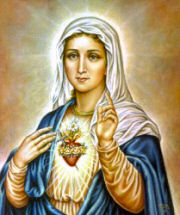
St. Ambrose perceived in her the model of a virginal soul. St. Bernardine of Siena (d.1444) was more absorbed in the contemplation of the virginal heart, and it is from him that the Church has borrowed the lessons of the Second Nocturn for the feast of the Heart of Mary. St. Francis de Sales speaks of the perfections of this heart, the model of love for God, and dedicated to it his Theotimus.

In the second half of the sixteenth century and the first half of the seventeenth, ascetic authors dwelt upon this devotion at greater length. It was, however, reserved to St. Jean Eudes (d. 1681) to propagate the devotion, to make it public, and to have a feast celebrated in honor of the Heart of Mary, first at Autun in 1648 and afterwards in a number of French dioceses.

In 1799 Pius VI, then in captivity at Florence, granted the Bishop of Palermo the feast of the Most Pure Heart of Mary for some of the churches in his diocese. In 1805 Pius VII made a new concession, thanks to which the feast was soon widely observed. Such was the existing condition when a twofold movement, started in Paris, gave fresh impetus to the devotion. The two factors of this movement were first of all the revelation of the "miraculous medal" in 1830 and all the prodigies that followed, and then the establishment at Notre-Dame-des-Victoires of the Archconfraternity of the Immaculate Heart of Mary, Refuge of Sinners, which spread rapidly throughout the world and was the source of numberless graces. On 21 July 1855, the Congregation of Rites finally approved the Office and Mass of the Most Pure Heart of Mary without, however, imposing them upon the Universal Church.
—Excerpted from Catholic Encyclopedia, 1913 edition


Sunday, August 3, 2025

The Catholic Devotion for the month of August: The Immaculate Heart of Mary


Month of the Immaculate Heart

facebook sharing button Share
twitter sharing button Tweet
linkedin sharing button Share
pinterest sharing button Pin
email sharing button Email
sharethis sharing button
O Mary Immaculate, inflame our hearts with one ray of the burning love of thy pure heart.
Highlights
Prayer of the Month


Novena to the Immaculate Heart of Mary

O Most Blessed Mother, heart of love, heart of mercy, ever listening, caring, consoling, hear our prayer. As your children, we implore your intercession with Jesus your Son. Receive with understanding and compassion the petitions we place before you today, especially ...(special intention).


Devotions to the Immaculate Heart of Mary

Documents


Websites

The month of August is dedicated to the Immaculate Heart. Since the 16th century Catholic piety has assigned entire months to special devotions. The month of August is traditionally dedicated to the Immaculate Heart of Mary. The physical heart of Mary is venerated (and not adored as the Sacred Heart of Jesus is) because it is united to her person and is the seat of her love (especially for her divine Son), virtue, and inner life. Such devotion is an incentive to a similar love and virtue.

This devotion has received new emphasis in this century from the visions given to Lucy Dos Santos, oldest of the visionaries of Fatima, in her convent in Tuy, in Spain, in 1925 and 1926. In the visions Our Lady asked for the practice of the Five First Saturdays to help make amends for the offenses committed against her heart by the blasphemies and ingratitude of men. The practice parallels the devotion of the Nine First Fridays in honor of the Sacred Heart.

On October 31, 1942, Pope Pius XII made a solemn Act of Consecration of the Church and the whole world to the Immaculate Heart. Let us remember this devotion year-round, but particularly through the month of August.

Excerpted from The Prayer Book by Reverend John P. O'Connell, M.A., S.T.D. and Jex Martin, M.A.

Consecration to the Immaculate Heart

Pope Paul VI, on the floor of the Vatican Council at the close of the third session, renewed publicly the consecration of the Church and the world to Mary's Immaculate Heart. He said that his thoughts turned to the whole world "which our venerated predecessor Pius XII . . . not without inspiration from on high, solemnly consecrated to the Immaculate Heart of Mary. . . . O Virgin Mary, Mother of the Council, to you we recommend the entire Church." When he visited Fatima on May 13, 1967, the same Pope recalled this "consecration which we ourselves have renewed on November 21, 1964 — we exhort all the sons of the Church to renew personally their consecration to the Immaculate Heart of the Mother of the Church and to bring alive this most noble act of veneration through a life ever more in accord with the divine will and in a spirit of filial service and of devout imitation of their heavenly Queen."

Before making a consecration, it is most desirable to make a careful preparation extending over some period of time. One good way to make that preparation is described in the last part of St. Louis de Montfort's True Devotion book.

The most essential thing is not making an act of consecration, with or without some solemnity, though that is important. The essential thing is to live that consecration.

Living a consecration could be described as following three attitudes or spirits:

 Union — Imitation of Jesus and Mary, so as to become like them, and trying to develop as constant as possible a realization of His and her presence.

 Dependence — Give to Jesus and Mary the right to dispose of everything we have, temporal and spiritual.

 Obedience — Jesus and Mary have the right to ask us to do anything at all, even without reward. In consecration, we recognize that right, give it on a basis of love, and plan to carry it out with fullest generosity.

St. Maximilian Kolbe liked to speak of the relation of consecration to our baptismal promises, in which we promised to renounce Satan and all his works, and to follow Jesus, by whom we are "sealed" in baptism as His property. Consecration is the fullest kind of response to and carrying out of these promises. Mary, in view of her Immaculate Conception, was most fitted to respond most fully, and that she did, with a fullness and perfection beyond our ability to visualize — for we recall that Pius IX told us that even at the start of her existence, her holiness was so great that "none greater under God can be thought of, and no one but God can comprehend it."

Excerpted from Our Father's Plan, Fr. William G. Most

Reparation to the Immaculate Heart

Our very consecration to the Immaculate Heart of Mary calls upon us to make reparation for the offenses that we and others have committed against her. The Church, in inviting us to consecrate ourselves to her Immaculate Heart, implicitly calls upon us for this reparation. But more explicitly, and even before Fatima, Saint Pius X offered a plenary indulgence to all who on the first Saturday of the month would observe special devotions in honor of the Immaculate Virgin in a spirit of reparation for the blasphemies uttered against her.

There is, however, an even more basic reason why each one of us owes reparation to the Immaculate Heart of Mary: every sin of ours caused grief and suffering to her in union with her divine Son. For sin was the cause of that terrible day on Calvary when she, as the New Eve, shared in the torment of the great sacrifice, and, amidst indescribable pain, brought forth spiritually all the members of the Mystical Body of her divine Son. God willed that Mary should be intimately associated with His Son in bearing the burden of all sin; surely then, her Immaculate Heart, in union with His divine Heart, should receive reparation from us who have caused them such pain. If anyone causes hurt to even a very ordinary human being, he does not overlook the need to make amends. How much more do we owe to the Hearts of Jesus and Mary!

Excerpted Mary in Our Life, Fr. William G. Most

Friday, June 27, 2025

Saturday is the Memorial of the Immaculate Heart of Mary


Ordinary Time: June 28th

Memorial of the Immaculate Heart of Mary

facebook sharing button Share
twitter sharing button Tweet
linkedin sharing button Share
pinterest sharing button Pin
email sharing button Email
sharethis sharing button

MASS READINGS

June 28, 2025 (Readings on USCCB website)

PROPERS [Show]

COLLECT PRAYER

Memorial of the Immaculate Heart of Mary: O God, who prepared a fit dwelling place for the Holy Spirit in the Heart of the Blessed Virgin Mary, graciously grant that through her intercession we may be a worthy temple of your glory. Through our Lord Jesus Christ, your Son, who lives and reigns with you in the unity of the Holy Spirit, God, for ever and ever.

show

Recipes (3)

show

Activities (10)

show

Prayers (3)

show

Library (12)

show

Blog & Podcasts (7)


In the midst of the World War II, Pope Pius XII put the whole world under the special protection of our Savior's Mother by consecrating it to her Immaculate Heart, and in 1944 he decreed that in the future the whole Church should celebrate the Memorial of the Immaculate Heart of Mary. The Memorial is celebrated on the Saturday following the Solemnity of the Sacred Heart.

This is not a new devotion. In the seventeenth century, St. John Eudes preached it together with that of the Sacred Heart; in the nineteenth century, Pius VII and Pius IX allowed several churches to celebrate a feast of the Pure Heart of Mary. Pius XII instituted today's feast of the Immaculate Heart of Mary for the whole Church, so as to obtain by her intercession "peace among nations, freedom for the Church, the conversion of sinners, the love of purity and the practice of virtue" (Decree of May 4, 1944).

Religious Freedom Week, June 22-29, continues.


The Immaculate Heart of Mary
The attention of Christians was early attracted by the love and virtues of the Heart of Mary. The Gospel itself invited this attention with exquisite discretion and delicacy. What was first excited was compassion for the Virgin Mother. It was, so to speak, at the foot of the Cross that the Christian heart first made the acquaintance of the Heart of Mary. Simeon's prophecy paved the way and furnished the devotion with one of its favourite formulae and most popular representations: the heart pierced with a sword. But Mary was not merely passive at the foot of the Cross; "she cooperated through charity," as St. Augustine says, "in the work of our redemption."

It is only in the twelfth, or towards the end of the eleventh century, that slight indications of a regular devotion are perceived in a sermon by St. Bernard (De duodecim stellis).

Stronger evidences are discernible in the pious meditations on the Ave Maria and the Salve Regina, usually attributed either to St. Anselm of Lucca (d. 1080) or St. Bernard; and also in the large book De laudibus B. Mariae Virginis (Douai, 1625) by Richard de Saint-Laurent.

In St. Mechtilde (d. 1298) and St. Gertrude (d. 1302) the devotion had two earnest adherents. A little earlier it had been included by St. Thomas Becket in the devotion to the joys and sorrows of Mary, by Blessed Hermann (d.1245), one of the first spiritual children of St. Dominic, in his other devotions to Mary, and somewhat later it appeared in St. Bridget's Book of Revelations.
St. Ambrose perceived in her the model of a virginal soul. St. Bernardine of Siena (d.1444) was more absorbed in the contemplation of the virginal heart, and it is from him that the Church has borrowed the lessons of the Second Nocturn for the feast of the Heart of Mary. St. Francis de Sales speaks of the perfections of this heart, the model of love for God, and dedicated to it his Theotimus.

In the second half of the sixteenth century and the first half of the seventeenth, ascetic authors dwelt upon this devotion at greater length. It was, however, reserved to St. Jean Eudes (d. 1681) to propagate the devotion, to make it public, and to have a feast celebrated in honor of the Heart of Mary, first at Autun in 1648 and afterwards in a number of French dioceses.

In 1799 Pius VI, then in captivity at Florence, granted the Bishop of Palermo the feast of the Most Pure Heart of Mary for some of the churches in his diocese. In 1805 Pius VII made a new concession, thanks to which the feast was soon widely observed. Such was the existing condition when a twofold movement, started in Paris, gave fresh impetus to the devotion. The two factors of this movement were first of all the revelation of the "miraculous medal" in 1830 and all the prodigies that followed, and then the establishment at Notre-Dame-des-Victoires of the Archconfraternity of the Immaculate Heart of Mary, Refuge of Sinners, which spread rapidly throughout the world and was the source of numberless graces. On 21 July 1855, the Congregation of Rites finally approved the Office and Mass of the Most Pure Heart of Mary without, however, imposing them upon the Universal Church.
—Excerpted from Catholic Encyclopedia, 1913 edition

Friday, June 7, 2024

The Immaculate Heart of Mary


Ordinary Time: June 8th

Memorial of the Immaculate Heart of Mary

facebook sharing button Share
twitter sharing button Tweet
linkedin sharing button Share
pinterest sharing button Pin
email sharing button Email
sharethis sharing button

MASS READINGS

June 08, 2024 (Readings on USCCB website)

PROPERS [show]

COLLECT PRAYER

Memorial of the Immaculate Heart of Mary: O God, who prepared a fit dwelling place for the Holy Spirit in the Heart of the Blessed Virgin Mary, graciously grant that through her intercession we may be a worthy temple of your glory. Through our Lord Jesus Christ, your Son, who lives and reigns with you in the unity of the Holy Spirit, God, for ever and ever.

show

RECIPES (3)

show

ACTIVITIES (10)

show

PRAYERS (3)

show

LIBRARY (12)

show

BLOG & PODCASTS (7)


In the midst of the second world war Pope Pius XII put the whole world under the special protection of our Savior's Mother by consecrating it to her Immaculate Heart, and in 1944 he decreed that in the future the whole Church should celebrate the Memorial of the Immaculate Heart of Mary. The Memorial is celebrated on the Saturday following the Solemnity of the Sacred Heart.

This is not a new devotion. In the seventeenth century, St. John Eudes preached it together with that of the Sacred Heart; in the nineteenth century, Pius VII and Pius IX allowed several churches to celebrate a feast of the Pure Heart of Mary. Pius XII instituted today's feast of the Immaculate Heart of Mary for the whole Church, so as to obtain by her intercession "peace among nations, freedom for the Church, the conversion of sinners, the love of purity and the practice of virtue" (Decree of May 4, 1944).


The Immaculate Heart of Mary
The attention of Christians was early attracted by the love and virtues of the Heart of Mary. The Gospel itself invited this attention with exquisite discretion and delicacy. What was first excited was compassion for the Virgin Mother. It was, so to speak, at the foot of the Cross that the Christian heart first made the acquaintance of the Heart of Mary. Simeon's prophecy paved the way and furnished the devotion with one of its favourite formulae and most popular representations: the heart pierced with a sword. But Mary was not merely passive at the foot of the Cross; "she cooperated through charity", as St. Augustine says, "in the work of our redemption".

It is only in the twelfth, or towards the end of the eleventh century, that slight indications of a regular devotion are perceived in a sermon by St. Bernard (De duodecim stellis).

Stronger evidences are discernible in the pious meditations on the Ave Maria and the Salve Regina, usually attributed either to St. Anselm of Lucca (d. 1080) or St. Bernard; and also in the large book De laudibus B. Mariae Virginis (Douai, 1625) by Richard de Saint-Laurent.

In St. Mechtilde (d. 1298) and St. Gertrude (d. 1302) the devotion had two earnest adherents. A little earlier it had been included by St. Thomas Becket in the devotion to the joys and sorrows of Mary, by Blessed Hermann (d.1245), one of the first spiritual children of St. Dominic, in his other devotions to Mary, and somewhat later it appeared in St. Bridget's Book of Revelations.
St. Ambrose perceived in her the model of a virginal soul. St. Bernardine of Siena (d.1444) was more absorbed in the contemplation of the virginal heart, and it is from him that the Church has borrowed the lessons of the Second Nocturn for the feast of the Heart of Mary. St. Francis de Sales speaks of the perfections of this heart, the model of love for God, and dedicated to it his Theotimus.

In the second half of the sixteenth century and the first half of the seventeenth, ascetic authors dwelt upon this devotion at greater length. It was, however, reserved to St. Jean Eudes (d. 1681) to propagate the devotion, to make it public, and to have a feast celebrated in honor of the Heart of Mary, first at Autun in 1648 and afterwards in a number of French dioceses.

In 1799 Pius VI, then in captivity at Florence, granted the Bishop of Palermo the feast of the Most Pure Heart of Mary for some of the churches in his diocese. In 1805 Pius VII made a new concession, thanks to which the feast was soon widely observed. Such was the existing condition when a twofold movement, started in Paris, gave fresh impetus to the devotion. The two factors of this movement were first of all the revelation of the "miraculous medal" in 1830 and all the prodigies that followed, and then the establishment at Notre-Dame-des-Victoires of the Archconfraternity of the Immaculate Heart of Mary, Refuge of Sinners, which spread rapidly throughout the world and was the source of numberless graces. On 21 July 1855, the Congregation of Rites finally approved the Office and Mass of the Most Pure Heart of Mary without, however, imposing them upon the Universal Church.
—Excerpted from Catholic Encyclopedia, 1913 edition

Patronage: Angola; Ecuador; Philippines; Congregation of the Holy Ghost; Congregation of the Holy Ghost and of the Immaculate Heart of Mary; Franciscan Missionaries of the Immaculate Heart of Mary; Society of the Sacred Hearts of Jesus and Mary; Missionary Society of the Heart of Mary; Congregation of Missionaries, Sons of the Immaculate Heart of the Blessed Virgin Mary (Claretians); Castelnuovo, Italy; Cava d’Aliga, Italy; Lido Bruca, Italy.

Friday, October 27, 2023

Pope Francis leads today's special prayer for peace as he consecrates the world, especially those countries at war, to Mary


Pope: May Mary inspire the leaders of nations to seek paths of peace

In a broken world, lacerated by war and suffering, Pope Francis asks believers to join him in prayer for peace and reconciliation. He implores the Virgin Mary, Queen of Peace, to offer the solace, guidance, and hope of a mother who has seen her children endure pain and loss throughout history. To Her, he consecrates “the world, especially those countries at war.”

By Linda Bordoni

Consecrating our lives, the Church and the world to the Queen of Peace, Pope Francis prayed to the Mother of God to touch the hearts of those imprisoned by hatred, and convert those who fuel and foment conflict.

May the Virgin Mary, he implored, “inspire the leaders of nations to seek paths of peace.  Queen of all peoples, reconcile your children, seduced by evil, blinded by power and hate.“

“Inspire the leaders of nations to seek paths of peace”

Day of Prayer, Fasting and Penance for Peace

The Holy Father raised his prayer during a prayer service in St Peter’s Basilica on Friday evening at the culmination of a Day of Prayer, Fasting and Penance for Peace that he called for in the context of the devastating wave of violence unfolding in the Holy Land.

Announcing the initiative on 18 October, the Pope extended his invitation to join the Day of Prayer to “the various Christian confessions, members of other religions, and all who hold the cause of peace in the world at heart.”

Presiding at the prayer service that alternated gospel readings, prayers and meditations as well as the Rosary and with Adoration and Benediction of the Blessed Sacrament, the Pope turned to Our Lady asking her to look at us: “We stand here before you. You are our Mother, and you know our struggles and our hurts."

“Queen of Peace, you suffer with us and for us, as you see so many of your children suffering from the conflicts and wars that are tearing our world apart.”

At this dark hour, the Pope prayed, “we entrust ourselves and our problems to your maternal heart which knows our anxieties and fears.”

Alone we cannot succeed

Invoking her as a beacon of light and a source of hope, he recalled how Mary always responded to the trials she endured with tenderness, love, and acceptance and he prayed for her help “to keep alive the hope of Easter through the night of sorrow.”

The Holy Father prayed to Mary to again “take the initiative for us, in these times rent by conflicts and laid waste by the fire of arms,“ because by ourselves we cannot succeed.

“Turn your eyes of mercy towards our human family, which has strayed from the path of peace,” Pope Francis prayed, and invoked her to  “Intercede for our world, in such turmoil and great danger.”

“Teach us to cherish and care for life – each and every human life! – and to repudiate the folly of war, which sows death and eliminates the future,” he said.

“Teach us to cherish and care for life and to repudiate the folly of war, which sows death and eliminates the future.”

Recalling that Mary has often urged us to pray and repent, the Pope said our worldly distractions have often led us astray: “Help us once again to put God first.”

He continued: “By ourselves, we cannot succeed“; without your Son, we can do nothing. And appealed for peace and conversion he “You bring us back to Jesus, who is our Peace.”

“Mother of mercy, we appeal for mercy! Queen of Peace, we appeal for peace! Touch the hearts of those imprisoned by hatred; convert those who fuel and foment conflict.”

“Dry the tears of children, be present to those who are elderly and alone; strengthen the wounded and the sick; protect those forced to leave their lands and their loved ones; console the crestfallen; awaken new hope,” Pope Francis implored.

Consecration to Mary's Immaculate Heart

Entrusting and consecrating ourselves and all we possess to Mary’s Immaculate Heart, the Pope said: “To you we consecrate the Church, so that in her witness to the love of Jesus before the world, she may be a sign of harmony and an instrument of peace.”

“To you we consecrate our world, especially those countries and regions at war.”

The Pope concluded by praying that a “glimmer of light may illumine the dark night of conflict,” and that the leaders of nations may seek paths of peace.

“Queen of all peoples, reconcile your children, seduced by evil, blinded by power and hate.  You, who are close to all, shorten our distances. You, who have compassion on everyone, teach us to care for one another.  You, who reveal the Lord’s tender love, make us witnesses of his consolation and peace.  Queen of Peace, pour forth into our hearts God’s gift of harmony.”

“Queen of Peace, pour forth into our hearts God’s gift of harmony.”

Thursday, August 3, 2023

August Devotion: The Immaculate Heart of Mary


Month of the Immaculate Heart

     
O Mary Immaculate, inflame our hearts with one ray of the burning love of thy pure heart.
Highlights
Prayer of the Month


Novena to the Immaculate Heart of Mary

O Most Blessed Mother, heart of love, heart of mercy, ever listening, caring, consoling, hear our prayer. As your children, we implore your intercession with Jesus your Son. Receive with understanding and compassion the petitions we place before you today, especially ...(special intention).


Devotions to the Immaculate Heart of Mary

Documents


Websites

The month of August (Overview - Calendar) is dedicated to the Immaculate Heart. Since the 16th century Catholic piety has assigned entire months to special devotions. The month of August is traditionally dedicated to the Immaculate Heart of Mary. The physical heart of Mary is venerated (and not adored as the Sacred Heart of Jesus is) because it is united to her person and is the seat of her love (especially for her divine Son), virtue, and inner life. Such devotion is an incentive to a similar love and virtue.

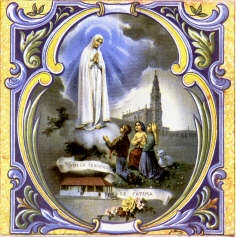
This devotion has received new emphasis in this century from the visions given to Lucy Dos Santos, oldest of the visionaries of Fatima, in her convent in Tuy, in Spain, in 1925 and 1926. In the visions Our Lady asked for the practice of the Five First Saturdays to help make amends for the offenses committed against her heart by the blasphemies and ingratitude of men. The practice parallels the devotion of the Nine First Fridays in honor of the Sacred Heart.

On October 31, 1942, Pope Pius XII made a solemn Act of Consecration of the Church and the whole world to the Immaculate Heart. Let us remember this devotion year-round, but particularly through the month of August.

Excerpted from The Prayer Book by Reverend John P. O'Connell, M.A., S.T.D. and Jex Martin, M.A.

Consecration to the Immaculate Heart

Pope Paul VI, on the floor of the Vatican Council at the close of the third session, renewed publicly the consecration of the Church and the world to Mary's Immaculate Heart. He said that his thoughts turned to the whole world "which our venerated predecessor Pius XII . . . not without inspiration from on high, solemnly consecrated to the Immaculate Heart of Mary. . . . O Virgin Mary, Mother of the Council, to you we recommend the entire Church." When he visited Fatima on May 13, 1967, the same Pope recalled this "consecration which we ourselves have renewed on November 21, 1964 — we exhort all the sons of the Church to renew personally their consecration to the Immaculate Heart of the Mother of the Church and to bring alive this most noble act of veneration through a life ever more in accord with the divine will and in a spirit of filial service and of devout imitation of their heavenly Queen."

Before making a consecration it is most desirable to make a careful preparation extending over some period of time. One good way to make that preparation is described in the last part of St. Louis de Montfort's True Devotion book.

The most essential thing is not making an act of consecration, with or without some solemnity, though that is important. The essential thing is to live that consecration.

Living a consecration could be described as following three attitudes or spirits:

 Union — Imitation of Jesus and Mary, so as to become like them, and trying to develop as constant as possible a realization of His and her presence.
 Dependence — Give to Jesus and Mary the right to dispose of everything we have, temporal and spiritual.

 Obedience — Jesus and Mary have the right to ask us to do anything at all, even without reward. In consecration, we recognize that right, give it on a basis of love, and plan to carry it out with fullest generosity.

St. Maximilian Kolbe liked to speak of the relation of consecration to our baptismal promises, in which we promised to renounce satan and all his works, and to follow Jesus, by whom we are "sealed" in baptism as His property. Consecration is the fullest kind of response to and carrying out of these promises. Mary, in view of her Immaculate Conception, was most fitted to respond most fully, and that she did, with a fullness and perfection beyond our ability to visualize — for we recall that Pius IX told us that even at the start of her existence, her holiness was so great that "none greater under God can be thought of, and no one but God can comprehend it."

Excerpted from Our Father's Plan, Fr. William G. Most

Reparation to the Immaculate Heart

Our very consecration to the Immaculate Heart of Mary calls upon us to make reparation for the offenses that we and others have committed against her. The Church, in inviting us to consecrate ourselves to her Immaculate Heart, implicitly calls upon us for this reparation. But more explicitly, and even before Fatima, Saint Pius X offered a plenary indulgence to all who on the first Saturday of the month would observe special devotions in honor of the Immaculate Virgin in a spirit of reparation for the blasphemies uttered against her.
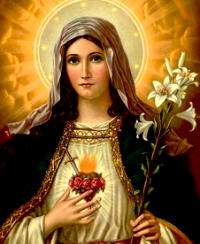
There is, however, an even more basic reason why each one of us owes reparation to the Immaculate Heart of Mary: every sin of ours caused grief and suffering to her in union with her divine Son. For sin was the cause of that terrible day on Calvary when she, as the New Eve, shared in the torment of the great sacrifice, and, amidst indescribable pain, brought forth spiritually all the members of the Mystical Body of her divine Son. God willed that Mary should be intimately associated with His Son in bearing the burden of all sin; surely then, her Immaculate Heart, in union with His divine Heart, should receive reparation from us who have caused them such pain. If anyone causes hurt to even a very ordinary human being, he does not overlook the need to make amends. How much more do we owe to the Hearts of Jesus and Mary!

Excerpted Mary In Our Life, Fr. William G. Most