Showing posts with label work. Show all posts

Saturday, September 5, 2026

Pope Leo XIV to contemplative nuns: prayer, work & Eucharistic Adoration


Pope Leo XIV meets with the Perpetual Adorers of the Most Blessed SacramentPope Leo XIV meets with the Perpetual Adorers of the Most Blessed Sacrament  (@VATICAN MEDIA)

Pope: Church needs a Eucharistic spirituality of unity in love

Meeting with contemplative nuns, Pope Leo XIV upholds their role in the Church as weavers of communion with the threads of prayer, work, and Eucharistic adoration.

By Devin Watkins

Pope Leo XIV met on Saturday with several members of the Perpetual Adorers of the Most Blessed Sacrament, also known as the Sacramentine Nuns.

Founded in Rome in 1807 by Blessed Maria Maddalena of the Incarnation, the contemplative nuns devote their lives to the adoration of the Blessed Sacrament Day and night and follow the rule of St. Augustine.

Those who met with the Pope form part of the Federation of the Holy Spirit, a group of around 30 convents, mostly in Mexico, which was founded 50 years ago and includes roughly half of the congregation’s convents spread across the globe.

In his address, Pope Leo called the Sacramentine Nuns’ presence “a radiant testimony to the gratuitousness of God, who sows within the human heart the desire to seek and contemplate His face.”

Their devotion to Eucharistic adoration, he said, offers a response to the profound longing for God written deep in the human heart.

“This constant search for the face of God, which particularly characterizes monastic life, takes on a special dimension in the vocation you have received,” he said. “It is expressed in a life devoted entirely to the continuous and silent adoration of God who has made Himself bread and who invites us to unite ourselves with Him in the sacrifice of the altar, so as to form one body.”

Pope Leo pointed to St. Augustine’s explanation that the bread and wine upon the altar are the “sacrament of the unity of the faithful in Christ.”

“For this reason,” he said, “we need a Eucharistic spirituality, that is, a spirituality of ecclesial unity in love.”

In their daily lives devoted to adoration, the contemplative nuns “radiate throughout the world the beauty of the face of Christ in the Blessed Sacrament.”

“By manifesting within the Church the specific charism you received from your foundress,” he said, “you are called to be weavers of communion with the threads of prayer and work, Eucharistic adoration, and fraternal sharing within the monastery.”

In conclusion, Pope Leo XIV invited the Sacramentine Nuns to live their consecration to God with renewed hope and a desire for holiness.

Remember, he urged, “that fidelity to the ancient and ever-new wisdom of the Gospel is the best path for those who, guided by the Holy Spirit, dedicate themselves to loving God and their neighbor.”

Thursday, April 30, 2026

May 1st brings the celebration of St. Joseph the Worker


Easter: May 1st

Friday of the Fourth Week of Easter; Opt. Mem. of St. Joseph the Worker


Optional Memorial of St. Joseph the Worker: O God, Creator of all things, who laid down for the human race the law of work, graciously grant that by the example of Saint Joseph and under his patronage we may complete the works you set us to do and attain the rewards you promise. Through our Lord Jesus Christ, your Son, who lives and reigns with you in the unity of the Holy Spirit, God, for ever and ever.


The Optional Memorial of St. Joseph the Worker was established by Pope Pius XII in 1955 in order to Christianize the concept of labor and give to all workmen a model and a protector. By the daily labor in his shop, offered to God with patience and joy, St. Joseph provided for the necessities of his holy spouse and of the Incarnate Son of God, and thus became an example to all laborers. "Workmen and all those laboring in conditions of poverty will have reasons to rejoice rather than grieve, since they have in common with the Holy Family daily preoccupations and cares" (Leo XIII).


St. Joseph the Worker
"May Day" has long been dedicated to labor and the working man. It falls on the first day of the month that is dedicated to the Blessed Virgin Mary. Pope Pius XII expressed the hope that this feast would accentuate the dignity of labor and would bring a spiritual dimension to labor unions. It is eminently fitting that St. Joseph, a working man who became the foster-father of Christ and patron of the universal Church, should be honored on this day.

The texts of the Mass and the Liturgy of the Hours provide a catechetical synthesis of the significance of human labor seen in the light of faith. The Opening Prayer states that God, the creator and ruler of the universe, has called men and women in every age to develop and use their talents for the good of others. The Office of Readings, taken from the document of the Second Vatican Council on the Church in the modern world, develops this idea. In every type of labor, we are obeying the command of God given in Genesis 2:15 and repeated in the responsory for the Office of Readings. The responsory for the Canticle of Zechariah says that "St. Joseph faithfully practiced the carpenter's trade. He is a shining example for all workers." Then, in the second part of the Opening Prayer, we ask that we may do the work that God has asked of us and come to the rewards he has promised. In the Prayer after Communion, we ask: "May our lives manifest your love; may we rejoice forever in your peace."

The liturgy for this feast vindicates the right to work, and this is a message that needs to be heard and heeded in our modern society. In many of the documents issued by Pope John XXIII, Pope Paul VI, the Second Vatican Council and Pope John Paul II, reference is made to the Christian spirit that should permeate one's work, after the example of St. Joseph. In addition to this, there is a special dignity and value to the work done in caring for the family. The Office of Readings contains an excerpt from the Vatican II document on the modern world: "Where men and women, in the course of gaining a livelihood for themselves and their families, offer appropriate service to society, they can be confident that their personal efforts promote the work of the Creator, confer benefits on their fellowmen, and help to realize God's plan in history" (no. 34).
—Excerpted from Saints of the Roman Calendar by Enzo Lodi

Patronage: against doubt and hesitation; against pain; dying people; exiles; expectant mothers; families; fathers; happy and holy death; house hunters; immigrants; interior souls; married people; orphans; people who fight Communism; pioneers; pregnant women; social justice; travelers; unborn children

Vocational: accountants; attorneys; barristers; bursars; cabinetmakers; carpenters; cemetery workers; children; civil engineers; confectioners; craftsmen; educators; emigrants; furniture makers; grave diggers; joiners; laborers; lawyers; solicitors; teachers; wheelwrights; workers; working people

Church: Catholic Church; Oblates of Saint Joseph; protection of the Church; Universal Church; Vatican II

Countries: Americas; Austria; Belgium; Bohemia; Canada; China; Croatia; Croatian people; Indonesia; Korea; Mexico; New France; New World; Papal States; Peru; Philippines; Russia; Vatican City; Vietnam


Symbols and Representation: Bible; branch; carpenter's square; carpenter's tools; chalice; cross; hand tools; infant Jesus; ladder; lamb; lily; monstrance; old man holding a lily and a carpenter's tool such as a square; old man holding the infant Jesus; plane; rod.

Monday, September 1, 2025

A Prayer for Labor Day, for workers and the unemployed


Prayer for Labor Day


God, in your goodness, you have made a home for the worker. Make a place in our hearts for compassion to the men and women who labor tirelessly for basic necessities. Ensure a place for the men and women who are struggling to find work. Grant us your wisdom to greet and care for those who are unable to work due to illness or circumstances that prevent their participation. Be with the children who are not able to run and play but instead must put in a hard day’s work to help their family afford to eat, to live. Be with us all, Christ Jesus, as we go about the busyness of our work. Hold us accountable not only for our actions, but most importantly to each of our neighbors. May we continue to work together to bring about your reign! We ask this in your holy name, through the power of the Holy Spirit. Amen.

Monday, September 2, 2024

In time for Labor Day: Key Church Documents that deal with social justice and the rights of workers


Six Key Church Documents Addressing Labor

Catholic principles of social justice are as old as the Gospel and the Church itself. Catholic social teaching on the rights of workers, and specifically on their right to organize in labor unions, has been clear, consistent, and explicit for more than a century. These six documents are required reading for anyone who wishes to understand Catholic social teaching on labor.

1. Rerum Novarum, 1891

This encyclical letter by Pope Leo XIII is often considered the founding document of modern Catholic social teaching. Alarmed that industrialization and laissez-faire economics were becoming the occasion of great injustice and misery for the working classes, the Holy Father called on the faithful to “save unfortunate working people from the cruelty of men of greed, who use human beings as mere instruments for money-making. It is neither just nor human so to grind men down with excessive labor as to stupefy their minds and wear out their bodies (42).” Leo argued that the worker’s right to a living wage took precedence over the free market. “Wages, as we are told, are regulated by free consent… nevertheless, there underlies a dictate of natural justice more imperious and ancient than any bargain between man and man, namely, that wages ought not to be insufficient to support a frugal and well-behaved wage-earner. If through necessity or fear of a worse evil the workman accept harder conditions because an employer or contractor will afford him no better, he is made the victim of force and injustice (43,45).” He argued against the laissez-faire ideology, stating that “if employers laid burdens upon their workmen which were unjust, or degraded them with conditions repugnant to their dignity as human beings; finally, if health were endangered by excessive labor, or by work unsuited to sex or age – in such cases, there can be no question but that, within certain limits, it would be right to invoke the aid and authority of the law (36).” He also endorsed the formation of “workingmen’s unions,” arguing that “it were greatly to be desired that they should become more numerous and more efficient (49).”

2. Quadragesimo Anno, 1931

On the fortieth anniversary (quadragesimo anno) of Rerum Novarum, Pope Pius XI reaffirmed and elaborated its teaching. Pius expressed continuing concern about the unjust distribution of wealth, asserting that that “the distribution of created goods, which, as every discerning person knows, is laboring today under the gravest evils due to the huge disparity between the few exceedingly rich and the unnumbered propertyless, must be effectively called back to and brought into conformity with the norms of the common good, that is, social justice (58).” Against those who continued to advocate the laissez-faire state, he insisted that social regulation of the market was essential to justice and the common good. “Just as the unity of human society cannot be founded on an opposition of classes, so also the right ordering of economic life cannot be left to a free competition of forces. For from this source, as from a poisoned spring, have originated and spread all the errors of individualist economic teaching (88).” Finally, the Holy Father explained in some detail the idea of subsidiarity and its application in society. “The supreme authority of the State ought, therefore, to let subordinate groups handle matters and concerns of lesser importance, which would otherwise dissipate its efforts greatly. Thereby the State will more freely, powerfully, and effectively do all those things that belong to it alone because it alone can do them: directing, watching, urging, restraining, as occasion requires and necessity demands. Therefore, those in power should be sure that the more perfectly a graduated order is kept among the various associations, in observance of the principle of “subsidiary function,” the stronger social authority and effectiveness will be the happier and more prosperous the condition of the State (80).”

3. Gaudium Et Spes, 1965

After holy Scripture itself, the statements of an ecumenical council are the most authoritative of all Church documents. The Council declared that the right to form labor unions without fear of retaliation a basic human right. “Among the basic rights of the human person is to be numbered the right of freely founding unions for working people. These should be able truly to represent them and to contribute to the organizing of economic life in the right way. Included is the right of freely taking part in the activity of these unions without risk of reprisal (68).”

4. Laborem Exercens, 1981

On the 90th anniversary of Rerum Novarum, Pope John Paul II revisited the themes laid out by his predecessors, devoting a substantial section of his Encyclical to “The Importance of Unions (20).” The Holy Father observed that “the experience of history teaches that organizations of this type are an indispensable element of social life” and that they serve as “a mouthpiece for the struggle for social justice.” He clarified further the right to strike: “workers should be assured the right to strike, without being subjected to personal penal sanctions for taking part in a strike.”

5. Economic Justice For All, 1986

America’s Catholic Bishops issued this “Pastoral Letter on Catholic Social Teaching and the U.S. Economy” to help our nation’s faithful think through the implications of Catholic Social Teaching for our social and economic life. While the world measures economic success in the number of goods produced, the Bishops remind us that Catholic teaching would hold instead “the most urgent priority for domestic economic policy is the creation of new jobs with adequate pay and decent working conditions (136).” They noted that although “Catholic social teaching does not require absolute equality in the distribution of income and wealth” it entailed “a strong presumption against extreme inequality of income and wealth as long as there are poor, hungry, and homeless people in our midst (185).” The Bishops defended the right to organize in the strongest terms, and called for labor law reform to better protect that right. “The Church fully supports the right of workers to form unions or other associations to secure their rights to fair wages and working conditions…. No one may deny the right to organize without attacking human dignity itself. Therefore, we firmly oppose organized efforts, such as those regrettably now seen in this country, to break existing unions and prevent workers from organizing. Migrant agricultural workers today are particularly in need of protection, including the right to organize and bargain collectively. U.S. labor law reform is needed to meet these problems as well as to provide more timely and effective remedies for unfair labor practices (105).” Nor did the bishops exempt the Church from these obligations of social justice. “On the parish and diocesan level, through its agencies and institutions, the Church employs many people; it has investments; it has extensive properties for worship and mission. All the moral principles that govern the just operation of any economic endeavor apply to the Church and its agencies and institutions; indeed the Church should be exemplary… We bishops commit ourselves to the principle that those who serve the Church—laity, clergy, and religious—should receive a sufficient livelihood and the social benefits provided by responsible employers in our nation…. All church institutions must also fully recognize the rights of employees to organize and bargain collectively with the institution through whatever association or organization they freely choose. (347, 351, 353)”

6. Caritas in Veritate, 2009

Catholic thinkers in the United States (seldom elsewhere in Christendom) who oppose labor unions can frequently be heard asserting that Church teaching on unions applied only to the conditions at the start of the industrial revolution. In his Encyclical letter Caritas in Veritate, Pope Benedict XVI addressed this error directly. “Through the combination of social and economic change, trade union organizations experience greater difficulty in carrying out their task of representing the interests of workers, partly because Governments, for reasons of economic utility, often limit the freedom or the negotiating capacity of labour unions. Hence traditional networks of solidarity have more and more obstacles to overcome. The repeated calls issued within the Church’s social doctrine, beginning with Rerum Novarum, for the promotion of workers’ associations that can defend their rights must therefore be honoured today even more than in the past (25).”

— Clayton Sinyai, Catholic Labor Network

Friday, May 3, 2024

Pope Francis encourages greater job opportunities/training for young people


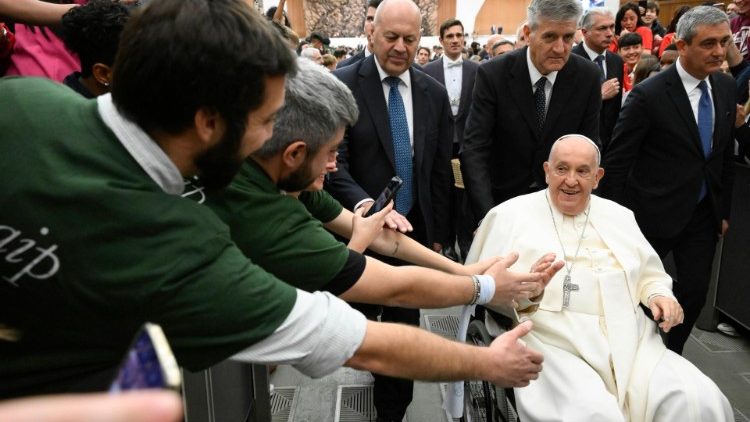
Pope meeting National Vocational Training Confederation (CONFAP) in the Paul VI HallPope meeting National Vocational Training Confederation (CONFAP) in the Paul VI Hall  (VATICAN MEDIA Divisione Foto)

Pope: 'All young people deserve equal job opportunities'

Meeting with the National Vocational Training Confederation (CONFAP), Pope Francis encourages the Italian Catholic network to focus its attention on young people from disadvantaged backgrounds who are marginalized by the job market and feel rejected by society.

By Lisa Zengarini

Pope Francis welcomed to the Vatican on Friday members of the Italian Vocational Training Confederation (CONFAP) on the occasion of the fiftieth anniversary of foundation.

The Confederation was established in 1974, upon the initiative of the Italian Episcopal Conference (CEI), to serve as a coordinating body of existing faith-based vocational education and training organizations that help lower-skilled young people and adults learn new skills to find an employment and remain employable.  

Today it is a network of 36 organizations and associations with a total of 285 Professional Training Centres, some 8,000 trainers and around 70,000 students trained every year.

An important service to society

Addressing some 6,000 members of CONFAP in the Paul VI Hall, Pope Francis warmly thanked them for their work which, he said, , inspired by the social doctrine of the Church, provides a “vital service” to society,  not only because they offer state-of-the-art courses but, most importantly, because they reserve special care and attention to disadvantaged and marginalized young people.

“With your daily commitment, you are an expression of the rich and varied spirituality of various Religious Institutes, which have in their charism service to young people through professional training.”

The vulnerabiliy of young people in the work market

The Pope noted that young people  are particularly vulnerable in the work market today: some are neither employed nor in education (NEEN), some are forced to seek a job elsewhere often not finding opportunities that match their dream; other  are employed in precarious and underpaid jobs, and others even resign.

In the face of this situation, Pope Francis stressed the need of an adequate labour legislation, but also to build a “generational turnover where the skills of those leaving are at the service of those entering the job market”, that is where “ adults share the dreams and desires of young people, introduce them, support them, encourage them without judging them.”

The Pope urgedthe Catholic vocational training agencies to focus their attention in particular on young people from disadvantaged backgrounds who often feel rejected by society and are therefore exposed to the risk of other forms of degrading exploitation.

New technologie and AI changing the work landscape 

He then reflected on their mission of training which, he noted, is all the more important  today in an ever-changing work landscape due to the new technologies and the development of artificial intelligence.

In this regard, Pope Francis warned against two opposite temptations: that of technophobia, that is, the fear of technology, and technocracy, that is, “the illusion that technology can solve all problems.”  

The only answer to this challenge, he stressed, is instead  “continuous, creative and always updated training.” At the same time, the Pope  added, we must also commit to restoring dignity to some jobs, especially manual ones, which are still socially little recognized today.”

Valid professional training antidote to school dropout 

“Valid professional training is an antidote to school dropout and a response to the demand for work in different sectors of the economy,” Pope Francis insisted, remarking the need for a close collaboration with families and a “healthy and effective” relationship with companies who offer work.

“Together with technical skills, human virtues are important: a technique without humanity becomes ambiguous, risky and is not truly educational.”

Finally, Pope Francis reflected on their work of qualifying young people for a profession, which, he recalled, is what defines us a people.

“Work is a fundamental aspect of our life and our vocation”

Work must be at the service of the common good

He noted that today we are witnessing a degradation of the meaning of work, “which is increasingly interpreted in relation to our earnings rather than as an expression of one's dignity and contribution to the common good”. Hence the importance of training courses that “are at the service of the overall growth of the person, in his spiritual, cultural and working dimensions.”

Concluding, Pope Francis encouraged CONSAP to continue  their valuable service: “Through your creativity you demonstrate that it is possible to combine work and a person's vocation”, he said, because “good vocational training enables us to do a job and, at the same time, to discover the meaning of our  being in the world and in society.”

Monday, September 11, 2023

Pope Francis advocates for safe, secure workplaces for every employee


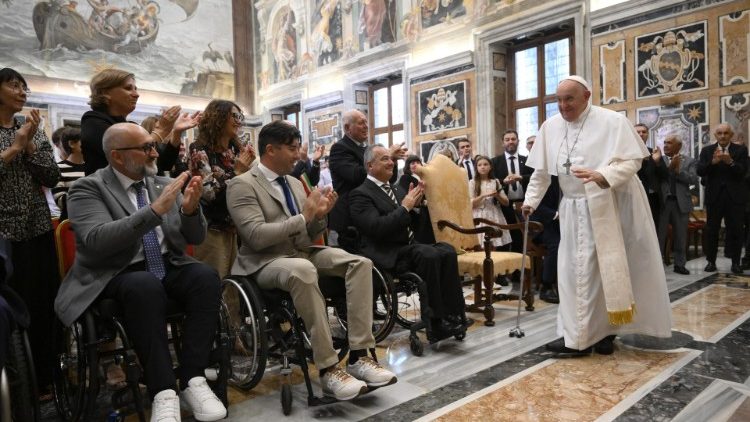
Pope Francis meets with the ANMIL Workers AssociationPope Francis meets with the ANMIL Workers Association  (VATICAN MEDIA Divisione Foto)

Pope to Workers Association: Workplaces must be safe for employees

Pope Francis appeals for workers to be protected properly in the workplace, decries when they are treated like 'spare parts,' and entrusts them to St. Joseph, as he addressed members of Italy’s National Association for those injured or disabled at work (ANMIL) in the Vatican on Monday.

By Deborah Castellano Lubov

Workplaces must be safe for workers, and those workers must be cared for and protected, underscored Pope Francis on Monday morning as he received members of the Italian Association for Injured Workers (ANMIL) in the Vatican.

While applauding the Association for its efforts to promote safety in the workplace and support victims of work accidents and their families, the Holy Father highlighted employers' great responsibility, while decrying when corners are cut for profit, or when one tries to clear one's conscience or image with charity work.

Madness of war

Welcoming the ANMIL members on the 80th anniversary of their association, the Pope recalled that 1943 had been a "decisive year" for Italy in the Second World War.

"You took your first steps in that context, which reminds us that every armed conflict brings with it legions of amputees," the Pope said, lamenting that "even today" this happens, as the "madness of war" causes the civilian population to suffer dramatic consequences.

"Even once conflict is over," the Pope said "rubble remains," even "in bodies and hearts," noting that "peace must be rebuilt day by day, year by year, through the protection and promotion of life and its dignity, starting with the weakest and, beginning with the most disadvantaged." 

Work-related deaths resembling a war bulletin

The Holy Father thanked the workers' association for drawing attention to the issue of safety in the workplace, "where too many deaths and misfortunes still occur."

In particular, he praised their initiatives aimed at improving civil legislation on workplace accidents and the rehabilitation of people with disabilities. "Indeed, it is not only a matter of guaranteeing proper welfare and social security care for those suffering from forms of disability," he said, "but also of giving new opportunities to people who can be reintegrated and whose dignity demands to be fully recognised."

He also encouraged them to continue raising public awareness of accident prevention and safety policies, particularly in favour of women and young people, as he lamented ongoing tragedies in the workplace, despite technology available to promote safety.

"Sometimes it sounds like a war bulletin," he said.


Tragedies, he observed, "begin when the goal is no longer man, but productivity, and man becomes a production machine."

With this in mind, he called their commitment to educating and training workers, employers, and society, "crucial."

"Safety at work," he noted, "is like the air we breathe we realize its importance only when it is tragically lacking, and it is always too late!"

Cannot get used to work accidents

The Pope said, "We cannot get used to accidents at work, nor resign ourselves to indifference towards them."

"We cannot accept the waste of human life," he appealed, noting, "Deaths and injuries are a tragic social impoverishment that affects everyone, not just the companies or families involved."

Pope Francis reiterated the importance of good and enforced legislation, but also the need to coexist properly as brothers and sisters in the workplace.

"One cannot, in the name of greater profit," the Pope exhorted, "demand too many working hours, decreasing concentration, or think of counting insurance or security demands as unnecessary expenses and loss of earnings."

Safety at work employer's first duty

Ensuring safety at work, the Pope said, is an employer's "first duty," and expressed disgust "when entrepreneurs or legislators, instead of investing in safety, prefer to wash their consciences with some charity work."

Employers' first task, he insisted, "must be caring for their brothers and sisters."

Workers are not 'spare parts'

"We are human beings and not machines, unique persons and not spare parts," the Pope pointed out, saying that regardless, "many times some workers are treated like spare parts."

Human beings, he underscored, come "before economic interest," stressing that each person is a gift to the community, and when someone becomes impaired or disabled, it "wounds the entire social fabric."

"I entrust you to the protection of St Joseph, patron of all workers," he said.

The Holy Father concluded by entrusting the workers to the protection of St. Joseph, Patron Saint of workers, and the Blessed Mother, and requesting their prayers.

Monday, August 14, 2023

Pope Francis: The Church must accompany workers


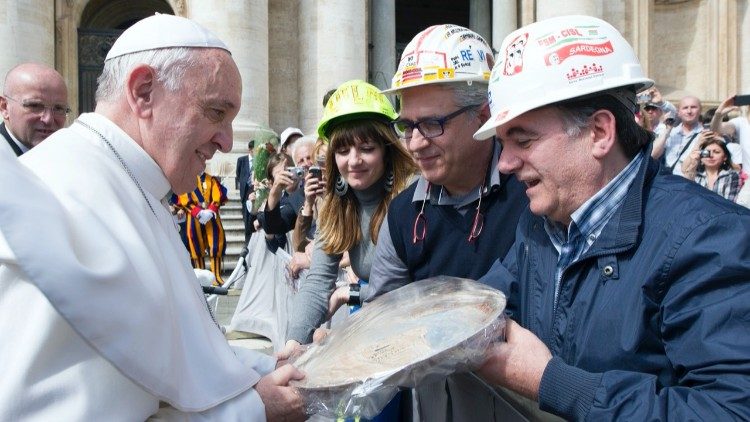
File photo of Pope Francis with a group of workers in St. Peter's Square on 2 April 2014File photo of Pope Francis with a group of workers in St. Peter's Square on 2 April 2014 

Pope: Church must accompany workers in midst of job insecurity

Pope Francis sends a message to a meeting of the Christian Workers’ Movement in the Spanish city of Segovia and urges the Church to accompany people struggling on the margins of the economy.

By Devin Watkins

Members of the Christian Workers’ Movement of the Spanish Catholic Action (HOAC) have gathered in the Spanish city of Segovia for their 14th General Assembly, held on 12-15 August.

Pope Francis sent his encouragements on Sunday in a message to participants in the HOAC meeting, which bears the theme “Building Bridges, Tearing Down Walls: The Church in the World of Work Weaving Bonds of Fraternity”.

Work founded in human dignity

In his message, the Pope expressed his appreciation for the organization’s dedication to helping the Church accompany Catholics in the workforce.

Recalling his words in Evangelii Gaudium, he noted that work is “an essential component of life and human dignity”.

“Work is not simply a productive activity, but a means by which we cooperate with God in the work of creation and realize ourselves as human beings,” he said.

The Pope added that human labor helps us to be “co-creators and to participate in building a more just and fraternal world.”

Church’s solidarity amid joblessness

Pope Francis went on to reflect on the Church’s mission to walk with people in all aspects of their lives, including participation in the workforce.

He said the Church especially needs to accompany people who are on the peripheries of the world of work.

“Our commitment cannot be limited to isolated speeches or actions,” he said, “but must be a constant witness of solidarity and support to people in situations of labor and social vulnerability.”

The Church’s mission with workers, he added, includes being close to people who have lost their jobs or suffer from a lack of employment opportunities.

Christians cannot remain enclosed in the walls of our church buildings, he urged, inviting everyone to reach out actively to those in need and to seek “just and lasting solutions” to job insecurity.

Weaving bonds of fraternity

The Pope lamented the fact that unemployment continues to affect many families, saying the Church bears the responsibility of standing in solidarity with “people who face despair and exclusion due to joblessness.”

He concluded his message by encouraging the members of Catholic Action to “weave bonds of fraternity, bear the light of the Gospel, and build a more just society.

“I urge you to continue to be God's people in the midst of working life, and to continue to weave stories of love and solidarity,” concluded Pope Francis. “The Church needs you.”

HOAC 14th General Assembly

Over 800 people from 41 dioceses across Spain are attending the General Assembly in Segovia.

Participants, who including archbishops, bishops and members of the movement, are meeting to discuss and make decisions regarding the challenges, priorities and proposals of HOAC for the next six years.

The movement seeks to reflect a Christian view of reality while confronting the challenges facing the Church in a world burdened by social malaise, inequality, and injustice that particularly affect the workforce.

Saturday, June 3, 2023

Pilgrims and Pope Francis remember Sts. John XXIII and Paul VI


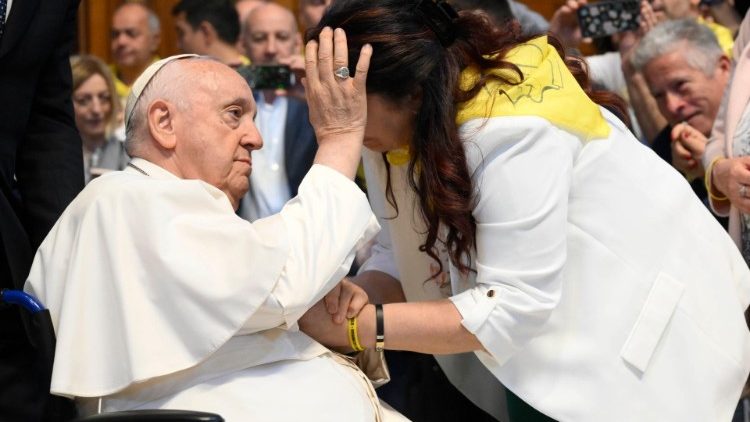
Pope Francis blesses a pilgrims from northern ItalyPope Francis blesses a pilgrims from northern Italy  (VATICAN MEDIA Divisione Foto)

Pope Francis: God makes us saints in the ‘worksite’ of daily life

Pope Francis greets pilgrims from the birthplaces of Sts. John XXIII and Paul VI in northern Italy, and urges them to appreciate the roots of their faith and become saints themselves.

By Devin Watkins

A sizable group of pilgrims from northern Italy met with Pope Francis on Saturday morning, to mark the 60th anniversary of the encyclical Pacem in terries, the death of Pope John XXIII and the election of Pope Paul VI.

The pilgrims hail from the towns of Sotto il Monte and Concesio, the birthplaces of the two saintly Popes.

Importance of family

In his address, Pope Francis recalled that his two predecessors lived in a time of great enthusiasm surrounding the Second Vatican Council, as well as one of daunting challenges including terrorism and the Cold War.

He thanked God for the Christian witness of these two Popes, and urged the pilgrims from their homelands to follow in their saintly footsteps.

“These men were able to be great pastors because they encountered good companions along their way, witnesses of the Gospel who helped them grow in faith, until the light of the call was kindled in them,” said the Pope.

He added that the two Popes’ families instilled in them a love for solid Christian piety through hard work.

“God doesn’t create saints in a laboratory,” said Pope Francis. “He creates them in vast worksites in which the work of all, under the guidance of the Holy Spirit, digs deep to make a solid base on which to build, taking care to construct in an ordered and perfect manner, with Christ as the cornerstone.”

Roots help defend against selfishness

The Pope went on to encourage the pilgrims from the two northern Italian towns to draw inspiration from John XXIII and Paul VI, as well as from their parents and grandparents who worked hard in joy and hardship to build a better future for their children.

“Always appreciate your roots, not so much as to build them into a defensive wall, but as a richness to share with others,” he said. “We work the ground together, on behalf of peace.”

Pope Francis also warned against selfishness and divisions in Christian communities, which threaten the faithful in many parts of the world.

John XXIII and Paul VI as cultural heritage

In conclusion, the Pope recalled that the regional capitals of Bergamo and Brescia have been chosen as the “Italian Capital of Culture” for 2023.

And he urged local residents to imbibe their rich heritage in the faith to help build up their parishes and families, according to the example of John XXIII and Paul VI.