In direct appeal to Trump, Catholic bishops' president urges end of mass deportations of Haitians
(RNS) — The letter marks a shift toward a more direct and pointed tone in challenging President Donald Trump’s immigration policy.

By Linda Bordoni
Standing on the docks of Arguineguín, a port on the southern coast of Gran Canaria that has become one of Europe’s most poignant symbols of migration, Pope Leo XIV on Thursday issued an urgent appeal for compassion, responsibility and solidarity, insisting that “human dignity has no passport and does not lose its value when crossing a border.”
On the sixth day of his Apostolic Journey to Spain, the Pope met with migrants and the organizations that rescue, welcome and accompany them along one of the world’s deadliest migration routes.
The gathering took place at the so-called “Port of Shame,” where in 2020, thousands of migrants arrived within days as the COVID-19 pandemic unfolded. For many fleeing poverty, conflict and exploitation in West Africa, the Canary Islands represent the nearest gateway to Europe, reached after perilous journeys across the Atlantic in overcrowded wooden boats.
Against the backdrop of the harbor and the Atlantic Ocean, Pope Leo listened to testimonies from a maritime rescuer, a Caritas volunteer, a survivor of human trafficking, and a migrant entrepreneur who rebuilt her life after years of hardship.

Reflecting on the Gospel passage of Matthew 25, the Pope said the Word of God takes on flesh in places such as Arguineguín, where people arrive “stripped of almost everything, but never of their dignity.”
“Here the Gospel pulls us out of our comfortable position as spectators and places before us a brother or a sister who has arrived,” he said. “It asks us if we have recognized Christ in those who disembark, marked by fear, hunger and violence, after enduring the desert, the night and the sea.”
Recalling the symbolism of the Fisherman's Ring he wears as Successor of Peter, Pope Leo reflected on Christ’s call to Peter to become a “fisher of people.”
“Here, people are rescued from the sea, and lifeless bodies are recovered from the waters,” he said. “For this reason, the Successor of Peter cannot ignore these docks. The Church cannot ignore these waters.”
Drawing on biblical imagery, the Pope described the sea as a place where danger and chaos coexist with hope.
“Even today, monsters lurk in these seas,” he warned, referring to “mafias that profit from despair, traffickers who enslave women and children, and those whose indifference allows the poor to be swallowed up by exploitation or forgetfulness.”
Yet he insisted that faith cannot be paralyzed by fear.
“If Christ commands the sea to be still, the Church cannot remain silent about those who are abandoned to its waters,” he said.
One salient moment of the meeting was the testimony of Tito Villarmea, a Maritime Rescue captain who has helped save more than 20,000 people at sea.
He recalled a rescue operation involving a woman travelling with what appeared to be her teenage son. Once safely aboard the rescue vessel, she removed the child’s cap and jacket and placed gold earrings in the youngster’s ears. “It was a girl,” he said, remembering how both of them burst into tears.
The Pope thanked those who shared their stories and praised the work of rescuers, Caritas volunteers and parish communities, saying their witness reveals how “the migrant ceases to be ‘just one more’, a mere category or a statistic.”
“Only then can we understand that that little girl could be our daughter, and that those faces could be part of our family,” he said.
He also highlighted the testimony of María Reyes Alemán Cruz, who coordinated parish efforts during the migration emergency and spoke of discovering that accompanying others often begins with simple gestures: a pair of shoes, a coat, a cup of coffee, or simply being present.
“Mercy begins with small gestures,” the Pope said, “The goal is not to solve everything, but to place everything in God’s hands and to be present where people suffer.”

One emotionally charged testimony came through the story of Blessing; a Nigerian woman trafficked for sexual exploitation whose account was read on her behalf for security reasons.
She described leaving her homeland because poverty left her no alternative, being subjected to a ritual of coercion, crossing the sea under terrifying conditions, and ultimately being forced into prostitution.
Addressing her directly, Pope Leo offered words of consolation and affirmation. “If others have put a price on your body, know that God has never ceased to recognize your inestimable worth,” he said.
“If others treat you like an object, the Church wants to tell you today that you are a daughter and a sister; you are a blessing.”
He assured trafficking victims that their dignity remains intact despite the violence they have suffered. “Your life belongs to God, who has given you a dignity that cannot be taken from you,” he reiterated.

Affirming that he bows before the dignity of every migrant, Pope Leo addressed them directly, saying, “You are not just numbers or files. You are people who have left behind families and homes. You have dreams that no one has the right to despise.”
At the same time, he warned them against traffickers and criminal networks that prey on desperation, calling their false promises “siren songs” and “industries of death.”
And broadening his appeal to governments and international institutions, he insisted that responsibility must be shared. The tragedy of migration, he continued, challenges countries of origin to create conditions for peace, justice and development; transit countries to protect vulnerable people from criminal networks; and Europe not to become accustomed to “the Mediterranean and the Atlantic becoming unmarked graves.”
“It is not enough to manage arrivals, distribute statistics, reinforce borders or lament deaths after they have occurred,” he affirmed.
“Every boat that arrives brings a question along with the migrants," Pope Leo highlighted, posing the question: "What kind of world have we built, if so many brothers and sisters must risk death to seek life?”
Pope Leo also stressed that migration policy must be rooted in respect for human dignity, and he called for legal and safe pathways, effective protection for trafficking victims, international cooperation against smugglers, and meaningful processes of reception and integration.
While reaffirming the right to seek refuge, he also spoke of another often overlooked right: the right not to be forced to flee: “There is also the right not to have to migrate,” he said, the right to remain in one’s homeland free from hunger, war, persecution, corruption and environmental degradation.
The meeting concluded with a floral tribute and a minute of silence in memory of those who have died attempting sea crossings. The Pope then blessed a cross fashioned from the wood of a migrant boat at the nearby shrine of Our Lady of Mount Carmel, patroness of seafarers.
Before departing, he greeted volunteers and migrants gathered along the waterfront as his warning echoed across the harbor and beyond:
“Today, here by the sea, every individual that arrives asks us what remains of our humanity, (...) Sooner or later, it will be known whether we protected life or whether we yielded to indifference.”
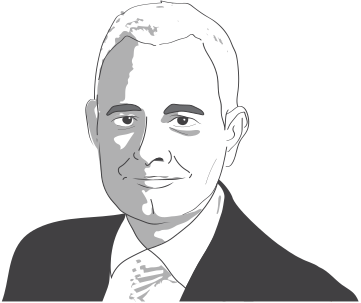

Pope Leo XIV called on US authorities to consider and attend to the rights and especially the spiritual needs of immigrants under detention, as the Trump administration continues to draw sharp criticism for its immigration policy and enforcement tactics.
“I think that there’s a deep reflection that needs to be made in terms of what’s happening,” Leo said in response to a journalist’s question outside Castel Gandolfo on Tuesday evening, one of several the pontiff fielded during another of the informal question-and-answer sessions at the gate of the papal summer residence that have been a semi-regular feature of his still young pontificate.
“[M]any people who have lived for years and years and years, never causing problems, have been deeply affected by what’s going on right now,” the pontiff said.
Spiritual rights of detainees
“The spiritual rights of people who have been detained should also be considered,” Leo said, “and I would certainly invite the authorities to allow pastoral workers to attend to the needs of those people.”
“Many times, they’ve been separated from their families for a good amount of time,” Leo continued, “no one knows what’s happening – but their own spiritual needs should be attended to.”
Weekend Chicago-area incident
The journalist asking the question referred to a high-profile incident over the past weekend, at an Immigration and Customs Enforcement (ICE) facility near Leo’s native Chicago, in which an auxiliary bishop of the Chicago archdiocese and a religious sister were denied access when they tried to bring Communion to detainees.
Bishop Jose María García-Maldonado celebrated Mass on Nov. 1, the Solemnity of All Saints, for hundreds of people gathered outside the Broadview ICE facility near Chicago, where advocates allege detainees’, rights are being violated.
The US Department of Homeland Security has denied allegations of rights violations. According to participants in the Mass and effort to bring Communion to persons held at the Broadview facility, federal officials cited safety concerns as the reason for refusing entry.
Crux asked ICE to comment on the Nov. 1 events but received no immediate reply.
Pope Leo XIV framed the broad issue in terms of the Gospel imperative to welcome the stranger.
“[L]et me say that I think in the first place, the role of the Church is to preach the Gospel,” Leo also said. “It’s just a couple of days ago we heard Matthew’s Gospel,” Leo continued, “chapter 25, which says, Jesus says very clearly: At the end of the world, we’re going to be asked, how did you receive the foreigner?”
“Did you receive him and welcome him or not?” Leo said.
Jesuit Father David Inczauskis, who worked with Mass organizers at the Chicago-based Coalition for Spiritual and Public Leadership on the request to access the Broadview facility, told Crux he found the pope’s remarks “a great statement of solidarity with detained migrants in Broadview and with CSPL’s efforts.”
By Isabella H. de Carvalho
Pope Leo XIV highlights how migrants and refugees are witnesses of hope and tenacity amidst adversity and calls for a future of peace and respect for human dignity, in his Message for the 111th World Day of Migrants and Refugees, released on Friday, July 25.
This year, rather than being celebrated on September 24 as usual, the World Day will coincide with the Jubilee of Migrants and of Missions, which takes place on October 4 and 5. This annual event encourages the faithful to show support and closeness to the millions of people who are forced to leave their homes and places of origin. According to the United Nations, at the end of 2024, around 123.4 million people were forcibly displaced across the world due to persecution, conflict, violence or other issues.
Pope Leo XIV begins his Message underlining how the world is “faced with frightening scenarios and the possibility of global devastation”.
“The prospect of a renewed arms race and the development of new armaments, including nuclear weapons, the lack of consideration for the harmful effects of the ongoing climate crisis, and the impact of profound economic inequalities make the challenges of the present and the future increasingly demanding”, he explained, adding that these issues have forced millions to leave their homelands.
He points out that the “widespread tendency” to look at “the interests of limited communities” poses a threat to sharing “responsibility, multilateral cooperation, the pursuit of the common good and global solidarity”.
For Pope Leo, “it is important there be a growing desire in people’s hearts for a future of peace and of respect for the dignity of all”. He stresses that “such a future is essential to God’s plan for humanity and the rest of creation”, citing passages from the biblical book of Zechariah emphasizing that, as Christians, “we believe and hope in its full realization, for the Lord is always faithful to His promises”.
The Pope explains that migrants and refugees thus have an important role to play in showing hope in a better future. For the Catholic Church, “the virtue of hope responds to the aspiration to happiness which God has placed in the heart of every man and woman”; and this search is “certainly one of the main motivations” for migrants, refugees and displaced persons, making them “messengers” and “privileged witnesses of hope”.
“Indeed, they demonstrate this daily through their resilience and trust in God, as they face adversity while seeking a future in which they glimpse that integral human development and happiness are possible”, he says, comparing the experience of the people of Israel described in the Bible.
“In a world darkened by war and injustice, even when all seems lost", he stresses, “their courage and tenacity bear heroic testimony to a faith that sees beyond what our eyes can see and gives them the strength to defy death on the various contemporary migration routes”.
At the same time, Pope Leo explains that communities that welcome migrants and refugees can also be “a living witness to hope” as they show “the promise of a present and a future where the dignity of all as children of God is recognized”.
“In this way, migrants and refugees are recognized as brothers and sisters, part of a family in which they can express their talents and participate fully in community life”, he says.
On a spiritual level, Pope Leo highlights that migrants and refugees also remind the Church “of her pilgrim dimension, perpetually journeying towards her final homeland, sustained by a hope that is a theological virtue”. He encourages the Church and its members to be “God’s people journeying towards the heavenly homeland” and avoid the “temptation of ‘sedentarization’” and becoming “of the world”.
In this regard, the Pope believes Catholic migrants and refugees have a special mission in becoming “missionaries of hope in the countries that welcome them, forging new paths of faith where the message of Jesus Christ has not yet arrived or initiating interreligious dialogue based on everyday life and the search for common values”.
“This is a true missio migrantium, a mission carried out by migrants, for which adequate preparation and ongoing support must be ensured through effective inter-ecclesial cooperation”, he says.
“With their spiritual enthusiasm and vitality, they can help revitalize ecclesial communities that have become rigid and weighed down, where spiritual desertification is advancing at an alarming rate”, he says. “Their presence, then, should be recognized and appreciated as a true divine blessing, an opportunity to open oneself to the grace of God, who gives new energy and hope to His Church”.

In the months since the November 2024 elections, Isaac Cuevas has gone from parish to parish saying the same things at educational workshops for immigrants.
Amid concerns that the new Trump administration would toughen immigration laws and ramp up deportations, Cuevas, who works as director of immigration and public affairs for the Archdiocese of Los Angeles, invited anxious parishioners to take a “Know Your Risk” approach to clear up misinformation and false rumors about immigration enforcement.
“Every time I gave this presentation, it was like, look: ‘These are the priorities that ICE (U.S. Immigration & Customs Enforcement) focuses on. They don’t go out on the streets, and they don’t pick people up because that’s racial profiling.’ ”
But Cuevas would end every presentation with a disclaimer: “This is what we know today. This can all change tomorrow.”
Sure enough, it did.
Since the first June 6 raids in downtown LA’s Fashion District, all that guidance is “out the window,” Cuevas said, as immigration agents raided garment factories, car washes, and store parking lots in search of people without legal status to arrest and deport.
The sweeps represent a shift from the Trump administration’s previous policy of targeting undocumented immigrants with criminal backgrounds for arrest and deportation.
In some majority-Hispanic neighborhoods, checkpoints have been set up on city streets, while agents have been seen stopping people on sidewalks in seemingly indiscriminate fashion. Parks are empty, as are some stores. Many popular food vendors are missing from their regular spots.
For Catholics, the result has been a climate of fear. Several Los Angeles priests contacted by Angelus noticed fewer parishioners at daily and Sunday Masses in the week after the initial June 6 raids. Retreats and ministry meetings were canceled. At least one parish had to postpone first Communions.
“It feels like COVID again. People are hiding,” said one priest who serves in a parish in a heavily Latino suburb of LA.
To make people feel safe at his parish, during Masses a team of parish staff with walkie-talkies lock entry points to the parish property — parking lot gates, church doors — after the First Reading.
“If someone wants to get in [for Mass] after that, they have to knock, and if they’re not ICE, we let them in,” said the priest, who requested anonymity to protect the identity of his parish. Some neighboring parishes in the deanery have followed similar procedures, the priest said.
Parishioners who have witnessed sweeps in places like a nearby Walmart parking lot were rattled by how arbitrary the stops seemed.
“You look like you don’t have papers, they just stop you. If it looks like you don’t comply, they just take you,” said the priest. “At this point, it’s just profiling. How can they know?”
Cuevas confirmed that as of press time, there had been no immigration enforcement operations conducted on church property in the archdiocese. But at least one encounter came uncomfortably close.
In Downey, a video shared widely on social media showed several unmarked ICE vehicles surrounding a Hispanic man riding his bicycle in front of Our Lady of Perpetual Help Church. Agents emerged to question the man while bystanders recorded the encounter with their phones.
After a few minutes, the agents “were satisfied and decided not to pursue,” said Msgr. Michael Meyers, temporary administrator at the parish.
At Our Lady of Lourdes Church in East LA, administrator Father Ricardo Gonzalez, SVD, described a climate of paranoia that has set in, with people worried about what others may suspect about their legal status if they don’t show up to work or even church services.
“This is dividing the community,” said Gonzalez, who has witnessed multiple raids while walking the streets of his neighborhood.
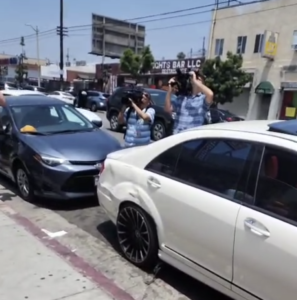
Gonzalez believes one lasting consequence of the raids will be the loss of credibility of law enforcement officers, who people perceive as not protecting the community from the raids. Perhaps even more serious, he believes, is the toll that so much fear and anxiety is taking on people’s mental health.
“It’s going to hurt our [parish] finances, but that’s not as important as the damage this is causing to our psyche,” said Gonzalez, a native of Mexico who was ordained in Argentina. “Our parish structure is very limited; we weren’t ready for this.”
Since the June 6 raids, Cuevas’ office has been flooded with calls, e-mails, and messages from parishes and families around the archdiocese. Many ask for guidance and advice on “what’s safe and what’s not safe,” said Cuevas.
Others inquire about ways they can help.
“It’s been a whirlwind,” said Cuevas. “It’s been nonstop, trying to respond to everybody who understands that this is unprecedented. There’s been an outpouring of support for a community that’s hurting.”
Just a few weeks ago, Cuevas gave an immigration workshop at St. Joseph’s Church in Carpinteria, where many parishioners are Hispanic immigrants who work in the nearby orchards and nurseries.
While the area hasn’t seen the kinds of sweeps being conducted in LA, pastor Msgr. Richard Martini said he’s noticed a lot of suffering among the youngest of his flock.
“The biggest anxiety is with children,” said Martini. “Children are anxious that their parents might be deported.”
Catholic Charities’ St. Margaret’s Center in Lennox mostly serves immigrant families, some of them close to homelessness. But since the raids, which included sweeps in nearby Inglewood and Westchester, director Mary Agnes Erlandson has seen fewer of them accessing their services, which include a food pantry and a program that distributes diapers and baby supplies to families.
The center has been working to reach out to households with members who’ve been detained to send help. But the climate of fear makes it even more difficult.
“Families may be in need of food but fearful to go to grocery stores,” said Erlandson. “If any communicate that to us, we'll work with volunteers to try to get food to them. But until the raids stop, the fear and trauma will be there.”
As arrests and deportations continued into a second week, Cuevas' office is working to establish migrant ministry groups in several "key parishes" to offer information and support.
But in the meantime, Cuevas says he's been especially impressed by the courage of LA priests serving immigrant communities in their parishes while participating in prayer vigils and marches.
“There are priests who are taking a very vocal stance on this,” said Cuevas. “The clergy of this archdiocese realize this is happening in our backyard, and they’re being a public witness to the need for compassion and understanding.”
Cuevas said that while the circumstances around immigration enforcement have changed suddenly, his job description hasn’t.
“The [Catholic] Church doesn't typically get involved in law or policy until those laws and those policies are unfair and unjust. And that’s when we’re called to be prophetic, and to defend people who can’t defend themselves.”

