Showing posts with label mass attendance. Show all posts

Wednesday, December 4, 2024

Recent trends of Americans attending Church for Christmas


Survey: Fewer Than Half of Americans Attend Church at Christmas

By Aaron Earls

As Americans make their Christmas plans, slightly less than half say they usually attend a church service during the holiday season.

A Lifeway Research study finds U.S. adults are split on whether they’ll be at church sometime this Christmas—47% say they typically attend church at Christmastime, while 48% say they do not, and 5% aren’t sure.

“The very name ‘Christmas’ originates in the church’s celebration of Jesus Christ’s birth. In the mid-14th century, the words ‘Christ’s Mass’ were first merged as a single term for this celebration,” said Scott McConnell, executive director of Lifeway Research. “While 9 in 10 Americans do something to celebrate Christmas, less than half typically attend church at Christmastime today.”

Christmas churchgoers

Pastors plan for larger crowds during the Christmas season. In 2023, Lifeway Research found U.S. Protestant pastors say they usually plan four events or activities to help their churches celebrate Christmas.

Around 4 in 5 pastors (81%) say Christmas is one of their three highest attendance worship services, according to a 2024 Lifeway Research study. Specifically, 28% say Christmas draws the most people to their church. During the season, churches see more people at their Christmas Eve service than other worship services, according to a 2022 Lifeway Research study.


This Christmas season, 47% of Americans say attending church is part of their usual holiday traditions, but some are more likely to show up than others.

Unsurprisingly, those who attend church most often are most likely to be there for Christmas. Christians who attend a worship service more than once a week (95%) are the most likely to say they typically attend this time of year.

Protestants (57%), Catholics (56%) and those from other religions (53%) are more likely than the religiously unaffiliated (21%) to report usually attending a church service. The religiously unaffiliated are the most likely to say no (71%). Those with evangelical beliefs are also far more likely than those without such beliefs to show up to church during Christmas (72% v. 40%).

Most of those attending church at Christmastime say they do so primarily because of their faith. Three in 5 (60%) of those who typically attend church during this season say they do so to honor Jesus. Fewer say their church attendance comes from a desire to observe tradition (16%), to be with family and friends (15%) or to get in the Christmas spirit (8%). Few (1%) aren’t sure.

“While church services draw more people in the Christmas season, their prime motivation isn’t unified. The majority are drawn to celebrate the birth of Jesus, honoring Him as the Christ or promised Messiah. But others mostly join in because of the importance of family, their embrace of Christmas church tradition or to jumpstart Christmas vibes,” said McConnell.

Christians who attend church less often are more likely to say their Christmas attendance comes from tradition. Those who rarely or never attend (22%) and those who attend once or twice a month or only on religious holidays (27%) are more likely than those who attend about once a week (10%) and those who attend more than once a week (6%) to say they show up to observe tradition.

Americans with evangelical beliefs are more likely than other Americans to say they attend services to honor Jesus (74% v. 53%). The religiously unaffiliated are the most likely to say they attend to be with family and friends (42%) and to get in the Christmas spirit (21%).

Potential Christmas churchgoers

Those who don’t typically show up at Christmas may simply be waiting on an invitation.

Most (56%) say they would likely attend church if someone they know invited them to attend with them at Christmas time, including 17% who are very likely. Around a third (36%) say they’re unlikely, including 24% who are very unlikely. Another 8% say they’re not sure.


“More than 1 in 8 Americans are convinced they would not attend a Christmas service if an acquaintance invited them. However, the majority of Americans who do not typically attend church at Christmastime say they probably would if they were invited by someone they know,” said McConnell.

“But anticipating a positive response may not be the best motivation for a churchgoer to invite people to a Christmas service. A different motivation in the chorus of an African American spiritual appeals to everybody: ‘Go tell it on the mountain that Jesus Christ is born.’ This chorus suggests that the Hallelujah-inspiring good news of Jesus being born is reason enough to tell it on the mountain or on the city wall.”

Catholics (71%), Protestants (65%) and Americans of other religions (58%) who don’t typically attend during Christmas are more likely than the religiously unaffiliated (40%) to say they’re likely to attend a service if invited. The religiously unaffiliated are the most likely to say they are unlikely to attend if invited (55%).

Christians who already attend church at least occasionally are more likely to show up this time of year if invited. Christians who attend a worship service about once a week (76%) and those who attend once or twice a month or only on religious holidays (69%) are more likely than those who rarely or never attend (52%) to say they’re likely to show up if invited.

Christmas invitations also may be effective for women (61% say they’re likely to attend), Hispanics (72%), those in Midwest (65%) and Northeast (60%) and those with evangelical beliefs (69%).

Older Americans who don’t typically attend aren’t looking for an opportunity to start. Those 65 and older (48%) are the most likely to say they are unlikely to go to a church service with a friend if invited during Christmas.

This article originally appeared at Lifeway Research.

Wednesday, February 15, 2023

In Nigeria 94% of Catholics attend mass weekly; Cardinal Okpaleke tells us why


Nigeria’s newest cardinal shares secret behind the highest Mass attendance in the world


After Nigeria was recognized as having the highest Mass attendance in the world, the African nation’s youngest cardinal has shared some of the secrets behind his country’s vibrant sacramental life.

recent study found that 94% of Nigeria’s 30 million Catholics say they attend Mass at least weekly or more, while only 17% of American Catholics attend Mass weekly.

Cardinal Peter Ebere Okpaleke, 59, who leads the southern Nigerian diocese of Ekwulobia, sees three key factors behind the active participation of Catholics in Nigeria.

In an interview with CNA when the cardinal was in Rome this month, Okpaleke said that he believes Nigeria’s traditional worldview, the role of the family, and a sense of community within parishes have kept Nigerians close to the sacraments generation after generation.

Awareness of God’s presence

Nigerian society as a whole has “a traditional worldview” that recognizes the presence of God in life and society, according to Okpaleke. Nigerians have not lost sight of how the spiritual world imbues everyday life.

“There is a general awareness of the role of the divine in human life. It is this awareness that translates into Mass attendance for Catholics, who come to Mass to encounter Christ in the Eucharist,” the cardinal said.

He noted that high Mass attendance “cuts across income brackets” with the poor and the rich, the uneducated and the educated all drawn to the sacraments by a shared desire for God.

In other parts of the world where secularization has atrophied a culture’s sense of the divine, the Church can benefit by emphasizing how it is a “gateway” that fulfills the “inner hunger in the human being to relate to the divine,” he said.

Family as ‘the domestic church’

In Nigeria, there is a strong sense that “the family is ‘the domestic church,’” a term used by early Church Fathers and emphasized by St. John Paul II in Familiaris Consortio.

The family is viewed as the primary place where the “faith is handed over to the next generation,” Okpaleke said.

The cardinal noted that while the family is “facing a lot of pressure because of the socioeconomic and cultural situation in Nigeria,” most families have held out against this pressure, drawing “from the faith to surmount the challenges thrown at them.”

He recommends that Catholics around the world “pay pastoral attention to the family as the domestic church because that is where everyone’s faith experience is formed.”

Sense of community

Catholic parishes and dioceses in Nigeria provide people with a strong sense of  “community and belongingness.”

“Largely, people feel a sense of community in the Church,” Okpaleke said. The cardinal has seen this firsthand in his own diocese, which is only 3 years old, where diocesan Synod on Synodality discussions felt like “traditional sessions in village squares where matters of interest to the community were discussed.”

Okpaleke leads the southern Nigerian Diocese of Ekwulobia, a new diocese created in 2020.

With the creation of the diocese amid the COVID-19 pandemic and the economic challenges that followed, the cardinal has been touched by how Catholics in his diocese “made and continue to happily make sacrifices for the growth of our diocese.”

He is now working to establish a diocesan retreat center that can also serve as a hub for ongoing formation for priests and lay Catholics.

“The creation of the diocese unleashed so much joy and energy in both the priests and the lay faithful. The new diocese was taken up by all as their project,” he said.

What the world can learn from Nigeria

The cardinal sees Nigeria’s high Mass attendance as “both something to cheer and a challenge” to work to preserve “this invaluable gift from God.”

Okaleke acknowledged that the vibrant faith in Nigeria is in part the fruit of missionaries who brought the Gospel to the country.

“There was a time when the percentage of Mass attendance in some parts of the world was almost 100%. This has changed in many places,” he said.

“It is therefore important for the Church in these areas to reflect on what caused the shift in worldview that resulted in the drop in Mass attendance.”

Today Nigeria sends priests to serve the Church in Europe and the United States, for example, where the number of priests in the U.S. dropped by 70% from 1970 to 2020.

Okpaleke, who was made a cardinal by Pope Francis in 2022, underlined the important role of the family and of parish communities cultivating a living faith.

“The Church as a community has also to strive to embody the yearning of human beings for love, community, and belongingness in order to effectively proclaim Jesus,” he said.

Tuesday, January 10, 2023

Church attendance continues to take a hit post pandemic


In pandemic’s wake, churchgoing takes a hit, survey indicates


Denver, Colo., Jan 9, 2023 / 16:00 pm (CNA).

The percentage of Americans who attend religious services is now “significantly lower” than before the COVID-19 pandemic, especially among young people and other groups identified as less likely to regularly attend, a new survey indicates.

“The COVID-19 pandemic disrupted much of American society, including religious worship,” said a January 2023 report on the survey “Faith After the Pandemic” from the American Enterprise Institute’s Survey Center on American Life.

“Rather than completely upending established patterns, the pandemic accelerated ongoing trends in religious change. Young people, those who are single, and self-identified liberals ceased attending religious services at all at much higher rates than other Americans did.”

“At least in terms of religious attendance, the pandemic appears to have pushed out those who had maintained the weakest commitments to regular attendance,” the American Enterprise Institute report said.

As of spring 2022, 33% of Americans said they never attend religious services, up from 25% before the World Health Organization declared a pandemic in March 2020. Religious affiliation, though, is largely unchanged, according to the survey.

The results come from researchers at the NORC at the University of Chicago, who conducted the 2022 American Religious Benchmark Survey on behalf of the American Enterprise Institute (AEI).

The pre-pandemic responses about religious practice came from 9,425 randomly selected interviewees who participated in NORC’s AmeriSpeak panel from the period 2018 to March 2020. The same interviewees were surveyed again from February to April 2022.

Among white Catholics, the percentage of those who do not attend religious services increased from 11% to 18%. Hispanic Catholics who never attend increased from 10% to 20%. Almost half of Catholic respondents continued to say they attended religious services “infrequently,” the survey found.

However, consistent Mass-goers tended to continue their churchgoing habits. The percentages of white Catholics and Hispanic Catholics who regularly attend religious services now compared with before the pandemic were relatively unchanged at 30% and 23%, respectively.

The groups most likely to attend religious services, and to attend regularly, are political conservatives, adults age 50 and older, women, married adults, and people with a college degree. Their frequency of attendance was “largely similar” to before the pandemic and spring of 2022, the AEI report said.

Young people, political liberals and moderates, and Americans without a college degree were the most likely groups not to attend religious services before the pandemic and as of spring 2022.

The habits of the young adult population, those aged 18–29, showed significant changes. About 30% of young adults attend religious services less often now, while only 12% are more religiously active compared with before the pandemic.

The survey found relatively little changes in church attendance among Mormons, white evangelical Christians, and Jews.

Nineteen percent of adults changed religious affiliation between March 2020 and March 2022, 6% were unaffiliated before the pandemic but are now affiliated, and 5% had a religious affiliation but now are not. Twice as many adults decreased religious attendance than increased attendance.

The observed changes could mean that religious affiliation tells us less about Americans and their religious beliefs and theological commitments, the AEI report said. The changes could mean more polarization between regular attendees of religious worship and their self-identified co-religionists.

“Past research has shown that Americans who regularly attend services are more likely to embrace the formal tenets of their faith and share a similar cultural worldview as their coreligionists,” the report said.

The AEI report appears to set the end of the COVID-19 pandemic in spring 2022. However, the Centers for Disease Control and Prevention has not declared an end to the pandemic, and some localities are reimplementing some public health measures in response to trends.

As of Jan. 6, 1,091,184 people have died of the virus in the U.S. More than 10,000 people have died in the last four weeks, and over 41,400 are currently hospitalized, according to the CDC website. Hospitalization numbers have been rising since November.

Older people, pregnant women, or people with weakened immune systems face a higher risk from infection.

The arrival of the pandemic resulted in many bans on public gatherings and other changes. Some churches fully shut down in compliance with public authorities, while others sought to adapt through outdoor services or internet outreach. Some congregations fully rebelled against legal regulations.

After the first waves of the pandemic, legal challenges to restrictions on public worship tended to prevail in court, especially when religious gatherings were treated more strictly than similar gatherings.

Tuesday, October 4, 2022

Catholics weigh in on Joe Biden, abortion, mass attendance, the Real Presence and more in this poll


New EWTN poll: Most Catholics don’t want Biden to run for a second term


Matthew Bunson

Most Catholics believe that President Joe Biden, the nation’s second Catholic president, should not run for a second term in 2024, according to a new EWTN News/RealClear Opinion Research Poll of likely Catholic voters released Monday.

The poll, conducted Sept. 12–19, shows Biden continues to face challenges in garnering support among Catholic voters in the run-up to Election Day on Nov. 8. In particular, the poll indicates waning support for the president among Hispanic Catholic voters, traditionally a strong source of support for the Democratic Party.

Among other highlights of the poll, Catholic voters rank inflation and the economy as the most critical issues facing the country, and most say they are very concerned about the state of education, especially after the lockdowns caused by the COVID-19 pandemic.

Much of the poll’s results provide a snapshot of how Catholic voters assess Biden’s performance after two years in office

When asked how they feel Biden is handling his job as president, nearly 52% of Catholic voters said they either disapproved (5%) or strongly disapproved (47%); around 46% either approved (32%) or strongly approved (14%). Notably, the strong disapproval number was significantly higher than strongly approved. Only 2% of voters had no opinion.

A majority of Catholics (58%) feel that Biden should not run for a second term in 2024, while only 22% support a possible re-election bid; 19% of Catholics are not sure. Most Catholics (67%-27% with 10% not sure) also do not want former President Donald Trump to run for president again in 2024.

The president’s challenges may also be reflected in the fact that the survey found Democrats trailing Republicans by four points in the generic ballot for Congress. When asked if they would vote for a Democrat or Republican candidate, almost 49% of Catholics would vote for the Republican candidate while 45% would choose the Democrat, with the rest not sure. This margin underestimates the Republican advantage in the race for control of Congress since Democrat voters are more geographically clustered.

The well-documented statistical disparity that exists between Mass-attending Catholics and those who attend only yearly or never remains in this latest poll.

Among Catholics who attend Mass once a week or more often, 75% say they would vote for the Republican candidate, while 54% of those who attend a few times a year or less would vote for the Democrat candidate.

Catholics are also divided on the president’s job approval. A substantial majority of Catholics (75%) who attend Mass at least weekly or more disapprove of the president’s handling of his job while his approval rating among Catholics who attend Mass a few times a year or less stands at 53%.

The poll, conducted by the Trafalgar Group, surveyed 1,581 Catholic voters and has a margin of error of 2.5%. The questionnaire was administered using a mix of six different methods, including live phone calls, text messages, and email.

A third and final EWTN News/RealClear poll will focus on the Catholic vote in the days just before the midterms.

Catholics divided on abortion

On the issue of abortion, the survey of Catholic voters taken after the release of the Supreme Court’s June 24 Dobbs v. Jackson Women’s Health decision, which overturned Roe v. Wade and Planned Parenthood v. Casey, found that Catholics remain very divided even as a massive majority (87%) wants various restrictions on abortion.

Surveyed on whether they agree or disagree with the Supreme Court’s decision to overturn Roe v. Wade, Catholic voters are almost evenly split, with 48% saying that abortion should be a federally protected right and 46% saying each state should determine its own abortion policy; 6% were not sure. Still, 13% of Catholics say abortion should be available to a woman at any time she wants one during her entire pregnancy while 8% say that abortion should never be permitted under any circumstances.

Overall, most Catholics favor restrictions ranging from abortion should be allowed only in cases of rape, incest, or to save the life of the mother, 27%; until 15 weeks, when the baby can feel pain, 20%; only during the first six months of pregnancy, 13%; until a heartbeat can be detected, 10%; or only to save the life of the mother, 9%. Catholics who attend Mass once a week or more favor the overturn of Roe by 75%, while 50% of those who attend a few times a year or less believe abortion should be a federally protected right.

Catholics are similarly divided on whether they would be more or less likely to support a candidate who agrees with the overturn of Roe v. Wade, with 42% saying they would be more likely and 42% saying they would be less likely; 16% are not sure.

On the recent controversy surrounding pregnancy resource centers, some two-thirds of Catholic voters support public funding for these centers, where pregnant women can seek help with alternatives to abortion, while 18% are opposed and the remainder are not sure. Likewise, 62% say that political and church leaders should be speaking out against the recent attacks and acts of vandalism on pregnancy resource centers, compared with 15% who say they should not and another 23% who are not sure.

Inflation, jobs are major worries

Abortion, however, is not the most important issue to Catholic voters as they look to the midterms. While a major element of the Democrat campaign for the 2022 election, abortion trails significantly behind other issues, including inflation and the economy, as most important. Only 10% of Catholics say abortion is the most important issue facing the nation — tied with immigration, while 34% say inflation and another nearly 20% say the economy/jobs.

Like most Americans, Catholics are feeling the impact of inflation. Asked how much their personal finances have been affected by rising prices and inflation, 81% of Catholic voters say that inflation has impacted them, while only 19% say not much or not at all.

A plurality (41%) place the blame for inflation on Biden and his administration, while nearly 32% blame it on the global slowdown due to COVID-19 or the Russian invasion of Ukraine (more than 9%), and 17% say all of the above or they don’t know. As for the Inflation Reduction Act that the president recently signed into law, Catholics express little confidence that it will reduce inflation. A majority of Catholics (54%) say they don’t have much or any confidence that it will reduce inflation, while 37% say they have a great deal or some confidence and the rest are not sure.

Hispanic support slipping for Biden, Democrats

One potentially significant development the poll found was a decline in support for the president and Democrats in general among Hispanic Catholics — historically a reliable Democrat voting bloc.

When asked how they feel Biden is handling his job as president, 50% of Hispanic Catholics say they strongly approve (11%) or approve (39%), while nearly 47% say they either disapprove (7%) or strongly disapprove (40%). Biden’s numbers among white Catholics are much worse, with 54% strongly disapproving (51%) or disapproving (4%), compared with 44%, who either strongly approve (16%) or approve (28%). Among African-American Catholics, he enjoys a very high approval rate of 90%, with 12% approving strongly and 78% approving. The first EWTN/RealClear poll in July found that Biden’s approval rating among white Catholics was 36%, 59% among Hispanic Catholics, and 72% among Black Catholics.

As for whether he should run for re-election, the president is facing a serious electoral and demographic challenge. Only 17% of white Catholics think he should run, while 62% say he should not. Among Hispanic Catholics, only 28% say he should run, and 53% say he should not. Almost all African-American Catholics (94%) think he should run again.

When asked about their preference for candidates in the midterms, Hispanic Catholics are now evenly divided, with 45% favoring the Democrat and 44% preferring the Republican. Among white Catholics, Republicans hold an edge of 51%-44%. Black Catholics favor the Democrat 90%-10%.

Education concerns

One other area of concern to many Catholics is that of education, especially in the aftermath of the COVID-19 pandemic and the lockdowns that impacted schools across the country. Three-quarters of Catholics said they are concerned about a “COVID deficit” in schoolchildren that has caused them to have lost significant intellectual and social development; around 17% said they were not concerned and 10% said they were not sure.

A majority of Catholics (nearly 78%) either strongly support (47%) or support (21%) school choice, a policy that allows public education funds to follow students to the schools or services that best fit their needs, including a public school, private school, charter school, home school, parochial school, or any other learning environment a family might choose; 26% either strongly oppose (17%) or oppose (9%) school choice.

Majorities of Catholics also support parents of K–12 students helping determine what is being taught in schools (64%-31%), oppose biological boys who identify as girls competing against biological girls on school sports teams (76%-14%), and oppose introducing Critical Race Theory (CRT) into the classroom (60%-29%).

Half of Catholics believe in Real Presence

Finally, in the area of Catholic belief and practice, some 84% of Catholics believe in heaven. Previous polls found that 77% believe in hell and 65% believe in purgatory. A majority of Catholic voters (77%) also believe in guardian angels.

When asked about their Mass attendance post-COVID, only 1% of Catholics attend daily, 7% attend more than once a week, 24% once a week, 10% once or twice a month, 26% a few times a year, 5% once a year, and 26% less than once a year or never.

The numbers for Mass attendance are matched by belief in the Real Presence of the Eucharist. As found also in the last poll, 50% of Catholics believe that the transformed bread and wine are the Body and Blood of Christ while 40% say the bread and wine are symbols of the Body and Blood of Christ; almost 10% say they are not sure. At the same time, only 26% of Catholics go to confession at least monthly or yearly, while 50% never go.

Saturday, May 29, 2021

Going home to church again


Back home again (in Indiana)

 
INDIANA PUBLIC MASS
Susie Dickman of Batesville, Ind., prays after receiving Holy Communion at St. Louis Church. (CNS photo/Katie Rutter)

Scott Richert (New)In the Diocese of Fort Wayne-South Bend, and across the entire state of Indiana, May 23 was the first Sunday since March 2020 that Catholics could worship in their parish churches without social distancing and wearing masks. Being greeted at the front door to Sts. Peter and Paul here in Huntington by an usher not wearing a mask was initially jarring, but that first reaction quickly turned to joy.
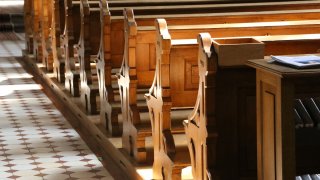
As the congregation filed in, some were wearing masks, while most weren’t. While Father Tony Steinacker has designated the row of shorter pews on St. Joseph’s side of the church to remain under the previous rules for social distancing (every other pew roped off) and mask wearing, those who wore masks sat with the rest of the congregation, and St. Joseph’s side remained empty. Most of those wearing masks were older adults, vaccinated or unvaccinated, with various health conditions, and children, such as ours, who either have not been vaccinated (because vaccinations haven’t been opened to them) or aren’t fully vaccinated yet. The majority of children who aren’t eligible yet for vaccination went maskless, as their parents did.

Amy and I are both fully vaccinated, and we chose not to wear masks. From the beginning, I have resisted attempts to politicize mask-wearing, or even to view it as a social statement, but it did strike me that, in our family’s pew, the mix of unmasked, fully vaccinated adults; masked, partially vaccinated young adults; and masked, unvaccinated children represents a snapshot of this particular moment in time in the course of this pandemic. Over the next few weeks, the balance of masked and unmasked members of our family at Sunday Mass will shift in favor of the unmasked; but it will likely be months before our youngest, who turned 9 in January, will join her parents and older brothers and sisters in worshiping without a mask.

Of course, the entirely unmasked family across the aisle from us represented a snapshot of a different sort: not necessarily an ideological or political one, but a reminder that, from the beginning, different people have viewed the threat posed by this virus differently. As Our Sunday Visitor’s editorial board discussed last week (“Navigating new COVID guidelines as a Church”), that reality will make these next few months, as dioceses restore the Sunday obligation and more and more people (we hope and pray) return to Mass, fraught with threats to parish unity.

Unless, of course, we all act like Christians and treat one another with charity. That’s why I was happy to see that Father Tony had made accommodations for those who might continue to feel more comfortable socially distanced and among others wearing a mask, and that everyone (at the 8 a.m. Mass, at least) who was wearing a mask felt comfortable sitting among the unmasked. It was good to see friends and fellow parishioners whom I’ve only seen outside of church over the last year once again in the pews with us (and before June 13, when the Sunday obligation will be restored in the dioceses of Indiana). And despite my own certainty that we can’t snap our fingers and return overnight to the status quo ante COVID-19, it was good to feel that we’re on the road back.

Will there be obstacles on that road? Of course. Were there people wearing masks today thinking uncharitable thoughts about those who weren’t wearing masks (and vice versa)? Probably. Will there be a news story or 10 about an outbreak (hopefully minor) traced back to a Catholic parish now that restrictions have been lifted? Almost certainly.

But here on May 23, 2021, the situation looks very different from May 23, 2020. The COVID-19 pandemic changed society in many ways — some, we hope, for the better; others, undoubtedly for the worse. For the Church, as we come back home again, let us pray that charity will prevail, and every parish community — and the entire Church in the United States — will emerge stronger than before.

Scott P. Richert is publisher for OSV.

Monday, May 10, 2021

How they are returning to Mass in Connecticut


Dispensation Allowing CT Catholics to Miss Mass Expires May 22, Churches to Return to 100% Capacity

Shutterstock

File photo of a church.

The dispensation for Connecticut Roman Catholics from their obligation to attend Mass will expire on May 22, according to Hartford Archbishop Leonard Blair.

When it was put into place on March 16, 2020, the dispensation coincided with the cancelation of weekend and weekday Masses. Those cancelations remained in effect through June 8, 2020, but the dispensation allowing Catholics in Connecticut to miss Mass was extended several times out of an abundance of caution for parishioners and clergy, Most Rev. Blair said in a release Monday.

The Bishops from the Dioceses of Bridgeport and Norwich joined Archbishop Blair in making Monday's announcement.

Following the state guidelines that will take effect May 19, parishes can return to 100% capacity with no special social distancing requirements, with the following exceptions:

  • Pew barriers and tape, signs, etc. that were previously used to direct the flow of traffic in aisles can be removed.
  • Masks remain required for all who enter the church.
  • Choirs and musicians can be reintroduced as deemed appropriate by the pastor, and congregational singing is once again allowed with masks remaining on during singing and throughout the liturgy.
  • The procedures for distributing Holy Communion will remain in place:
  • Ministers of Holy Communion sanitize their hands prior to distributing.
  • Both the ministers of Holy Communion and those receiving are to wear masks.
  • Communicants will receive the consecrated host in their hand, step to the side, lower their mask, consume the host, replace their mask, and return to their pew.
  • Communion on the tongue should continue to be discouraged for the sake of the health of others. For those that continue to insist, they can be given Communion only after everyone else has received.
  • There is still to be no distribution of the Precious Blood, and this continues to apply to deacons as well.