Showing posts with label human rights. Show all posts

Friday, August 21, 2026

While addressing the Catholic Legislators Network, Pope Leo XIV urges protection of human rights & human dignity in the age of AI


Pope Leo XIV addresses International Catholic Legislators Network in the VaticanPope Leo XIV addresses International Catholic Legislators Network in the Vatican  (@Vatican Media)

Pope Leo XIV: In age of AI, the family is the first school of humanity

Addressing the International Catholic Legislators Network, Pope Leo XIV urges legislation that protects human rights and human dignity, warning that artificial intelligence must never be allowed to erode the family, the 'first school of humanity.'

By Deborah Castellano Lubov

"Sound legislation should encourage scientific and technological creativity while safeguarding fundamental human rights and freedoms.  It should protect users from exploitation, preserve personal privacy, ensure transparency in the use of emerging technologies and guarantee that they strengthen democratic institutions."

Pope Leo XIV expressed this conviction to the International Catholic Legislators Network in the Vatican on Friday.

Reflecting on legislation, the Pope reiterated that “robust legal frameworks, independent oversight, informed users and a political system that does not abdicate its responsibility are required.”

He observed that such oversight can operate at multiple levels — local, national and international — facilitating open discussion of “the ethical frameworks involved and subjecting them to shared standards of social justice,” ensuring "that no single ideology or interest dictates the values embedded in artificial intelligence systems."

At the same time, the Holy Father underscored, the rapid development of artificial intelligence risks creating new forms of technological dependence, with poorer nations increasingly reliant on wealthier ones.  

Subtle forms of domination

"We must remain vigilant in this regard," he said, "lest innovation become another vehicle for ideological or economic colonialism."

Sadly, he lamented, "we are presented with a subtle form of domination when algorithms decide who is seen, and who remains invisible, when digital platforms shape public discourse without accountability, and when the dignity of workers is subordinated to the optimization of systems."  

Such developments, Pope Leo warned, "reveal a new face of the ancient temptation to domination and mastery without service."

The family as the first school of humanity

Against this culture of power, the Holy Father suggested, the Church proposes “the civilization of love.”

"In such a society," Pope Leo said, "the first school of humanity would be the family." 

"For it is within the family," he insisted, "that we first learn trust before calculation, generosity before competition, dialogue before division, and love before power." 

With this in mind, he said that artificial intelligence "must never be allowed to erode this primary cell of society — whether by reducing persons and relationships to data and simulations, by flooding young minds with content that distorts desire, or by economic models that make family life economically precarious."

Strengthen marriage and families  

"For this reason," the Holy Father stated, "I encourage you to promote policies that strengthen marriage and families, support parents in their educational mission and enable young people to look to the future with confidence."

"Dear friends, the world does not need an artificial intelligence that diminishes humanity; rather," Pope Leo insisted, "it needs human intelligence enlightened by wisdom, political authority guided by conscience and technological innovation directed by charity." 

Only then, he said, will artificial intelligence become not a rival to humanity but a servant of the common good.

Pope Leo XIV concluded by saying that with these thoughts, he prays that the Network's deliberations will bear abundant fruit for your nations and for the entire human family.

Friday, January 9, 2026

Human rights, freedoms, peace are all under attack due to zeal for power and war


Pope raises alarm over human rights and a spreading “zeal for war”

Meeting members of the Diplomatic Corps, Pope Leo XIV warns that human rights and freedoms are under strain as diplomacy gives way to the logic of power and war.

Vatican News

Warning that “war is back in vogue” and that peace is increasingly sought through force rather than justice, Pope Leo XIV issued a strong appeal for humility, dialogue, and a renewed commitment to multilateralism in his address to the Diplomatic Corps accredited to the Holy See.

Speaking on Friday, 9 January, during the traditional exchange of New Year greetings, the Pope cautioned that the foundations of international coexistence are being steadily undermined, as diplomacy based on dialogue gives way to the logic of power and deterrence.

“The principle established after the Second World War, which prohibited nations from using force to violate the borders of others, has been completely undermined,” he said, warning that such a mindset gravely threatens the rule of law itself.

A defining moment in the Vatican’s diplomatic year

The annual meeting between the Pope and Ambassadors accredited to the Holy See is considered one of the most significant moments in the Vatican’s diplomatic calendar.

Often dubbed the "State of the World" Address, the Pope's discourses in these occasions tend to offer a moral reading of international life - an appeal not to interests, but to conscience - offered at the beginning of a new year as a call to responsibility, restraint, and renewal.

For Pope Leo XIV, who said the occasion is “a new experience,” having been called only months ago to “shepherd Christ’s flock,” the address also served to articulate the moral horizon within which the Holy See understands diplomacy: a patient work of encounter, a defense of the vulnerable, and a commitment to peace rooted in truth.

Borders, law, and the return of “peace through weapons”

Pope Leo XIV lamented the weakening of the principle established after the Second World War, by which nations pledged not to use force to violate the borders of others.

“The principle… has been completely undermined,” he said, warning that peace is increasingly sought “through weapons as a condition for asserting one’s own dominion,” a mentality that “gravely threatens the rule of law, which is the foundation of all peaceful civil coexistence.”

The Pope turned repeatedly to Saint Augustine to support his points, especially to De Civitate Dei (The City of God), in which Augustine reflects on pride, power, and the illusion of security.

Even those who wage war, the Pope recalled, ultimately desire peace - yet not peace as a shared good, but peace as possession. Citing Augustine, he said, “They do not, therefore, wish to have no peace, but only the peace that they desire.”

It was precisely this distortion, the Pope implied, that led humanity into catastrophe in the twentieth century. From that tragedy, he noted, the United Nations emerged, established eighty years ago as a center of multilateral cooperation “for safeguarding peace, defending fundamental human rights and promoting sustainable development.”

Humanitarian law “must always prevail”

From the principles of law, Pope Leo XIV moved to the concrete cost of war - especially when civilians become targets, and when essential infrastructure is destroyed.

“I would like to draw particular attention to the importance of international humanitarian law,” he said. Compliance cannot depend on “mere circumstances and military or strategic interests.”

Rather, he said, humanitarian law “is a commitment that States have made,” and “must always prevail over the ambitions of belligerents.”

He underscored that attacks on “hospitals, energy infrastructure, homes and places essential to daily life” constitute serious violations, and reiterated the Holy See’s condemnation of “any form of involvement of civilians in military operations.”

The moral measure, he insisted, is not advantage but dignity: “the protection of the principle of the inviolability of human dignity and the sanctity of life always counts for more than any mere national interest.”

Naming conflicts, appealing for peace

The Pope then applied this moral framework to specific crises across the world.

He spoke of the “ongoing war in Ukraine” and the suffering of civilians, reiterating “the pressing need for an immediate ceasefire,” and calling for dialogue “motivated by a sincere search for ways leading to peace.”

He appealed to the international community not to waver, and reiterated the Holy See’s willingness “to support any initiative that promotes peace and harmony.”

In the Holy Land, he noted that despite a truce announced in October, civilians continue to endure “a serious humanitarian crisis.”

He reaffirmed attention to initiatives aimed at guaranteeing Palestinians in Gaza “a future of lasting peace and justice,” and reiterated that the two-State solution remains the institutional perspective for meeting the aspirations of both Palestinians and Israelis. He also lamented increased violence in the West Bank against Palestinian civilians, who have “the right to live in peace in [their] own land.”

Pope Leo XIV also expressed concern about “escalating tensions in the Caribbean Sea and along the American Pacific coast,” renewing an appeal for peaceful political solutions.

He also addressed the crisis in Venezuela “in light of recent developments,” calling for respect for the will of the people and for the safeguarding of human and civil rights.

He invoked the witness of two Venezuelan saints canonized last October - José Gregorio Hernández and Sister Carmen Rendiles - as inspirations for building a society founded on “justice, truth, freedom, and fraternity.”

He spoke too of the violence and instability in Haiti, calling for concrete international support. Likewise, he pointed to the Great Lakes region of Africa; Sudan and South Sudan; tensions in East Asia; and Myanmar’s humanitarian crisis, worsened by last March’s earthquake, and called for “peace and inclusive dialogue” and access to humanitarian aid.

Nuclear risk and the ethical governance of AI

At the root of many of these crises, Pope Leo XIV said, lies the persistent belief that peace is possible only through force and deterrence. Yet peace, he warned, requires continuous construction and vigilance - especially among those with the greatest capacity for destruction.

He pointed to the urgency of nuclear arms control, noting the impending expiry of the New START Treaty in February, and warned of a return to an arms race with increasingly sophisticated weapons, including those shaped by artificial intelligence.

AI, he said, “requires appropriate and ethical management,” together with regulatory frameworks that protect freedom and human responsibility.

Migrants, prisoners, and the Jubilee’s “structural” spirit

The Pope’s defense of dignity extended to migrants and prisoners - two groups often treated as problems rather than persons.

“Every migrant is a person,” he said, and therefore has “inalienable rights that must be respected in every situation.” Not all migration is chosen. He explained that many flee “violence, persecution, conflict, and even the effects of climate change.”

Marking the seventy-fifth anniversary of the International Organization for Migration (IOM), the Pope warned that efforts against crime and trafficking must not become a pretext “for undermining the dignity of migrants and refugees.”

He also spoke of prisoners, insisting they “can never be reduced to the crimes they have committed.” He thanked governments that responded to Pope Francis’ Jubilee appeal for gestures of clemency, and expressed hope that the Jubilee spirit would inspire justice systems “permanently and structurally,” ensuring humane conditions and proportionate penalties.

Above all, he stressed, this includes abolishing the death penalty, which the Pope called a measure that “destroys all hope of forgiveness and renewal.” He did not forget “prisoners held for political reasons in many countries.”

The crisis of language and the shrinking of freedom

Another theme of the Pope's address was the warning about language itself: its weakening, its manipulation, and its conversion into an instrument of harm.

“Rediscovering the meaning of words is perhaps one of the primary challenges of our time,” he said, because when words lose their connection to reality, reality itself becomes “debatable and ultimately incommunicable.”

He recalled how Saint Augustine describes two people forced to remain together without a shared language: “dumb animals… understand each other more easily than these two individuals,” Augustine writes; indeed, “a man would more readily converse with his dog than with a foreigner!”

Yet, the Pope warned, semantic ambiguity today is not merely accidental. “Language is becoming more and more a weapon with which to deceive, or to strike and offend opponents,” he said, calling for words “to express distinct and clear realities unequivocally,” so that authentic dialogue can resume - in families, in politics, in the media, on social media, and in international relations.

He noted a paradox: this weakening of language is often defended “in the name of freedom of expression,” yet, “on closer inspection, the opposite is true,” because freedom is protected precisely when language is anchored in truth.

“It is painful to see how, especially in the West, the space for genuine freedom of expression is rapidly shrinking,” he said, warning of “a new Orwellian-style language” which, while seeking to be inclusive, “ends up excluding those who do not conform.”

Freedom of conscience and religious freedom

From language, the Pope moved to rights increasingly threatened in contemporary societies: freedom of conscience and religious freedom.

He defended conscientious objection as a safeguard for dignity, noting that “Conscientious objection is not rebellion, but an act of fidelity to oneself.” It reflects the truth that a free society “does not impose uniformity but protects the diversity of consciences,” preventing authoritarian tendencies and fostering ethical dialogue.

Religious freedom, the Pope said, is also at risk. Quoting Pope Benedict XVI, he recalled it as “the first of all human rights.” He noted that violations are rising worldwide, with “sixty-four percent of the world’s population” suffering serious violations of this right.

The Holy See, he said, asks full respect for Christians, and “the same for all other religious communities.” On the sixtieth anniversary of Nostra Aetate, he reiterated the “categorical rejection of all forms of antisemitism,” and stressed the importance of Jewish-Christian dialogue and deeper common roots.

At the same time, he said, the persecution of Christians remains among the most widespread human rights crises today, affecting “over 380 million believers worldwide,” with high or extreme levels of discrimination and violence.

He recalled victims of violence in Bangladesh, the Sahel, and Nigeria, and those killed in the terrorist attack last June on the parish of Saint Elias in Damascus, as well as victims of jihadist violence in Cabo Delgado, Mozambique.

He also pointed to subtler discrimination against Christians even in majority-Christian societies, including in Europe and the Americas, where Christians may be restricted from proclaiming the Gospel - especially when they defend “the dignity of the weakest, the unborn, refugees and migrants, or promote the family.”

The right to life

Pope Leo XIV reaffirmed that the right to life is the foundation of every other right and warned that the contemporary human rights framework risks losing its vitality when rights become detached from reality and truth.

“In the current context, we are seeing an actual ‘short circuit’ of human rights,” he said, as fundamental freedoms - speech, conscience, religion, even life - are restricted “in the name of other so-called new rights,” creating space for force and oppression.

The Pope spoke about the family as the privileged place where human beings learn to love and to serve life.

He described two urgent challenges: the tendency to marginalize the family’s role in the international system, and the painful reality of fragile families afflicted by hardship and domestic violence.

He reiterated the Church’s categorical rejection of practices that “deny or exploit the origin of life" as well as projects that assist people in doing so. Public resources, he said, should support mothers and families rather than “suppress life.” 

Seeds of peace and the courage to forgive

Despite the gravity of his diagnosis, Pope Leo XIV insisted that peace remains “a difficult yet realistic good.” Quoting Augustine, he called peace “the aim of our good,” a foretaste of the City of God even within the earthly city.

Peacemaking, he said, requires “humility and courage: the humility to live truthfully and the courage to forgive.” These virtues, he added, are revealed at Christmas - when Truth becomes humble flesh - and at Easter, when the condemned Righteous One forgives and grants life as the Risen One.

Bringing his discourse to a close, Pope Leo pointed to signs of hope: the Dayton Accords that ended the war in Bosnia and Herzegovina thirty years ago; the Joint Declaration of Peace between Armenia and Azerbaijan signed last August; and efforts by Vietnamese authorities to improve relations with the Holy See. These are “seeds of peace,” he said, that must be cultivated.

Looking ahead to October’s eighth centenary of the death of Saint Francis of Assisi, “a man of peace and dialogue,” the Pope concluded by invoking the saint’s witness of humility and truth, and wishing “a humble and peace-loving heart” for all at the beginning of the new year.

Sunday, December 10, 2023

Pope: Commitment to human rights is never finished


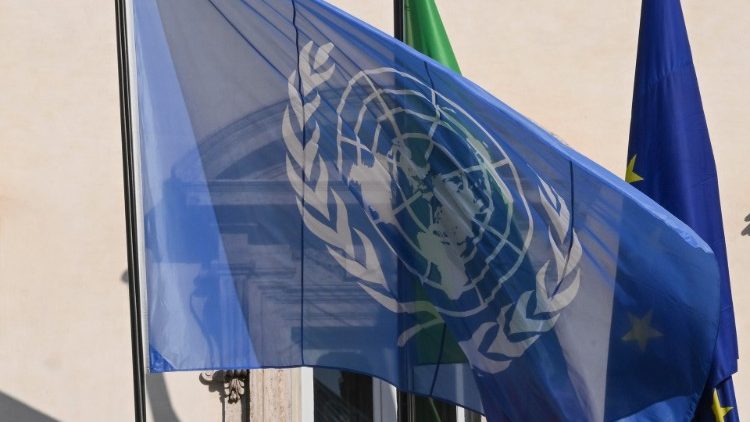
The flag of the United NationsThe flag of the United Nations  (ANSA)

Pope at Angelus: The commitment to human rights is never finished!

Following the Angelus on Sunday, Pope Francis notes the anniversary of the Universal Declaration of Human Rights, and prays for all people who are suffering due to war.

By Christopher Wells

Pope Francis on Sunday marked the 75th anniversary of the signing of the Universal Declaration of Human Rights. “It is like a master plan,” he said. “Many steps have been taken, many still need to be made, and, unfortunately, at times, steps backward have been taken.”

“The commitment to human rights is never finished!” he said, adding that he is close to all those who work and fight to defend human rights in the concrete situations of everyday life.

Hopes for peace in the South Caucasus

In his remarks following the Angelus on Sunday, the Holy Father expressed his joy at the release of Armenian and Azerbaijani prisoners. “I look with great hope on this positive sign between Armenia and Azerbaijan, for peace in the South Caucasus,” the Pope said, while encouraging both nations, with their leaders, to conclude a peace treaty “as soon as possible.”

Taking concrete steps for peace

Pope Francis went on to ask for prayers for all peoples suffering from war. “We are heading toward Christmas: Are we able, with God’s help, to take concrete steps for peace?” he asked. While acknowledging the difficulties of resolving conflicts that have deep historical roots, the Pope invited everyone to follow the example of “men and women who have worked wisely and patiently for peaceful coexistence.”

Defence of human rights in war zones

And, returning to the issue of human rights, the Pope called for civilians, hospitals, and places of worship to be protected, for hostages to be freed, and for humanitarian aid to be guaranteed in conflict areas.

“And let us not forget tormented Ukraine, Palestine, and Israel,” he added.

Finally, with the COP28 Conference on Climate Change drawing to a close in Dubai, Pope Francis asked for prayers “for a good outcome for the care of our common home and the protection of populations.”

Monday, April 17, 2023

Pope Francis commends religious order that contributes to interreligious dialogue, promotes peace and defends human rights


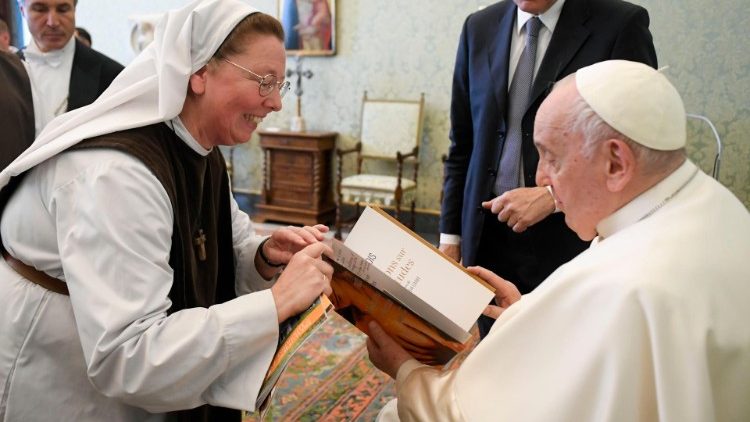
Pope Francis meeting with representatives of the Community of the BeatitudesPope Francis meeting with representatives of the Community of the Beatitudes  (Vatican Media)

Pope: Charism of the Community of the Beatitudes is a gift

On the fiftieth anniversary of its foundation, Pope Francis highlights the Pentecost experience and the eschatological dimension of the charism of the Community of the Beatitudes.

By Vatican News staff reporter

Pope Francis welcomed members of the Community of the Beatitudes to the Vatican on Monday, on the occasion of the fiftieth anniversary of their foundation.

After several reorganizations, the group, which rose out of the Catholic Charismatic Renewal, was recognized by the Vatican’s Congregation for Institutes of Consecrated Life as “an Ecclesial Family of Consecrated Life of diocesan right” in 2020. It is the first community of this kind.

A gift to the Church and the world

In a prepared address that was handed to representatives of the community, Pope Francis described their charism as “a gift for the Church and for the world.” He highlighted both the “eschatological dimension” and the “experience of Pentecost” as central to their identity, noting that “with their impetus, [their charism] still expands and manifests itself through life in the Spirit, the communion of states of life, and the apostolate.”

The eschatological dimension, he said, makes present the Kingdom of God in liturgy, song, and fraternal life, while the experience of Pentecost is expressed in “the constant search for union with God,” realized through Mass, Adoration, prayer in the Carmelite tradition, and continuous prayer in accordance with Eastern Christian spirituality.

Wide and varied apostolates

Pope Francis praised the “vast and varied” apostolates undertaken by the Community, including liturgies, retreats, and humanitarian projects in developing countries. He noted, in particular, the groups work aiding minors in need, assisting disabled or malnourished children, and helping disadvantaged families and single mothers.

“All this,” the Pope said, “is cause for giving thanks to God, especially your commitment to the service of the most fragile and marginalized people in a society polluted by the culture of waste.”

'Your witness is an inspiration'

After mentioning several other ministries fulfilled by members of the Community, Pope Francis said he was grateful to them “for the commitment you show in consecrated life and the service you offer to the Church and to the world.” He expressed gratitude, too, for the “valuable contribution” they make to interreligious dialogue, the promotion of peace, and the defence of human rights, saying, “Your witness is an inspiration to many.”

Concluding his address to the group, Pope Francis invited them “to go forward and persevere in your mission with zeal and without fear, to bear witness to the faith with joy and hope, and to remain always open and docile to the guidance of the Holy Spirit.”

Thursday, March 30, 2023

Vatican repudiates Doctrine of Discovery; defends the human rights of indigenous peoples


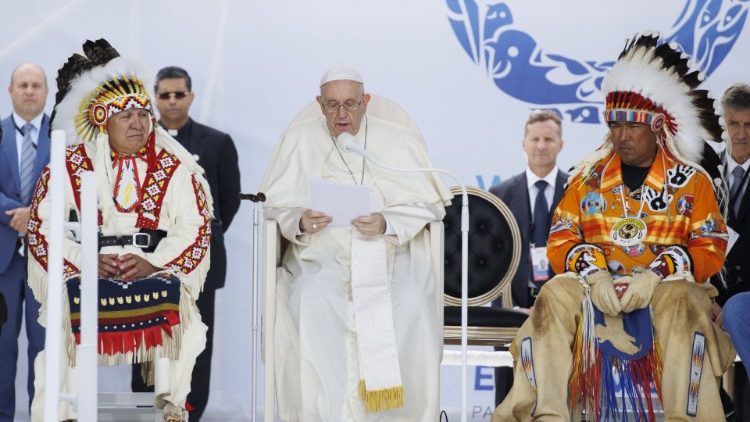
Pope Francis meets with indigenous people and communities during his penitential piligrimage to Canada in July 2022Pope Francis meets with indigenous people and communities during his penitential piligrimage to Canada in July 2022  (2022 Getty Images)

Church defends Indigenous peoples: ‘Doctrine of Discovery’ was never Catholic

A “Joint Statement” from the Dicastery for Culture and the Dicastery for Integral Human Development formally repudiates "those concepts that fail to recognize the inherent human rights of indigenous peoples, including what has become known as the legal and political ‘doctrine of discovery’."

Vatican News

Thanks to dialogue with indigenous peoples, “the Church has acquired a greater awareness of their sufferings, past and present, due to the expropriation of their lands … as well as the policies of forced assimilation, promoted by the governmental authorities of the time, intended to eliminate their indigenous cultures,” according to a “Joint Statement” issued by the Dicastery for Culture and Education and the Dicastery for Promoting Integral Human Development, and published on Thursday.

The document states that the “Doctrine of Discovery” – a theory that served to justify the expropriation by sovereign colonizers of indigenous lands from their rightful owners – “is  not a part of the teaching of the Catholic Church.” It further affirms that the papal bulls that granted such “rights” to colonizing sovereigns have never been a part of the Church’s Magisterium.
 

This important text, coming eight months after Pope Francis' penitential journey to Canada, clearly reaffirms the Catholic Church's rejection of the colonizing mentality. “In the course of history,” the document recalls, “the Popes have condemned acts of violence, oppression, social injustice, and slavery, including those committed against indigenous peoples.” It also notes the numerous examples of bishops, priests, women and men religious and lay faithful who gave their lives in defense of the dignity of those peoples.” At the same time, it acknowledges that “many Christians have committed evil acts against indigenous peoples for which recent Popes have asked forgiveness on numerous occasions.”

Regarding the so-called “Doctrine of Discovery", the Statement explains: “The legal concept of ‘discovery’ was debated by colonial powers from the sixteenth century onward and found particular expression in the nineteenth-century jurisprudence of courts in several countries, according to which the discovery of lands by settlers granted an exclusive right to extinguish, either by purchase or conquest, the title to or possession of those lands by indigenous peoples.” According to some scholars, this “doctrine” found its basis in several papal documents, specifically two bulls of Nicholas V, Dum diversas (1452) and Romanus Pontifex (1455); and Alexander VI’s bull Inter caetera (1493). These are legal acts by which these two Pontiffs authorized the Portuguese and Spanish sovereigns to seize property in colonized lands by subjugating the original populations.

“Historical research clearly demonstrates that the papal documents in question, written in a specific historical period and linked to political questions, have never been considered expressions of the Catholic faith,” the Statement declares. Nonetheless, “the Church acknowledges that these papal bulls did not adequately reflect the equal dignity and rights of indigenous peoples.” The Statement goes on to say that “ It adds that “the contents of these documents were manipulated for political purposes by competing colonial powers in order to justify immoral acts against indigenous peoples that were carried out, at times, without opposition from ecclesiastical authorities.” The two Dicasteries, therefore, affirm, “It is only just to recognize these errors, acknowledge the terrible effects of the assimilation policies and the pain experienced by indigenous peoples, and ask for pardon.”

The Statement then quotes the words of Pope Francis: “Never again can the Christian community allow itself to be infected by the idea that one culture is superior to others, or that it is legitimate to employ ways of coercing others.” The Statement goes on to say that, “in no uncertain terms, the Church’s Magisterium upholds the respect due to every human being,” and concludes, “The Catholic Church therefore repudiates those concepts that fail to recognize the inherent human rights of indigenous peoples, including what has become known as the legal and political ‘doctrine of discovery’.”

“The Catholic Church therefore repudiates those concepts that fail to recognize the inherent human rights of indigenous peoples, including what has become known as the legal and political ‘doctrine of discovery’.”

The Statement recalls the “numerous and repeated” declarations of the Church and the Popes in favour of the rights of indigenous peoples, beginning with the 1537 bull Sublimis Deus of Paul III, which solemnly declared that indigenous peoples “are by no means to be deprived of their liberty or the possession of their property, even though they be outside the Christian faith; and that they may and should, freely and legitimately, enjoy their liberty and possession of their property; nor should they be in any way enslaved; should the contrary happen, it shall be null and have no effect.”

Concluding, the Statement notes that, more recently, “the Church’s solidarity with indigenous peoples has given rise to the Holy See’s strong support for the principles contained in the United Nations Declaration on the Rights of Indigenous Peoples.” It adds, “the implementation of those principles would improve the living conditions and help protect the rights of indigenous peoples as well as facilitate their development in a way that respects their identity, language, and culture.”