Showing posts with label common good. Show all posts

Thursday, September 10, 2026

USCC appeals to Supreme Court to uphold human dignity of non-citizens


U.S. bishops urge Supreme Court to rule against indefinite detention of noncitizens

The bishops argue that strong due process protections are consistent with American principles and good governance in accordance with Catholic teaching.


Detainees stand by a window inside the federal immigration center at Delaney Hall, where ICE is housing detained immigrants, on May 26, 2026, in Newark, New Jersey. | Credit: Adam Gray/Getty Images


Tyler Arnold

September 9, 2026

The U.S. Conference of Catholic Bishops (USCCB) is asking the U.S. Supreme Court to rule in favor of stronger due process rights for noncitizens who are facing deportation proceedings and against indefinite detention without judicial review.

In a legal filing to the Supreme Court, the USCCB and the Catholic Legal Immigration Network (CLINIC) argued that stronger due process protections would help uphold the human dignity of noncitizens and safeguard the common good, based on Catholic teaching.

The bishops sent the petition in relation to the ongoing case Genalo v. Keisy G.M., in which a U.S. permanent resident from the Dominican Republic argues that Immigration and Customs Enforcement (ICE) violated his Fifth Amendment right to due process.

Keisy G.M., whose full name is not public, was detained for 21 months. Although he did appear before a judge, he did not receive a bond hearing to determine whether he could be released on bond.

In spite of his permanent residency status, he faced deportation proceedings after he was convicted of felonious assault. He was later pardoned by the State of New York, ending the threat of deportation.

Dignity of the human person

In their legal brief, the bishops argued that due process protections are consistent with the law, American tradition, and Catholic teaching, saying “executive detention has never been wholly insulated from judicial scrutiny,” adding that “this accords with Catholic social teaching, which recognizes both the legitimate authority of the state and the dignity of the individual.”

“Indefinite confinement without individualized review by a neutral tribunal is anathema to our constitutional system and the ordered liberty it enshrines,” the bishops said. “The consequences of abandoning that system are severe and concrete.”

“Prolonged detention can cost people their jobs, homes, health, and the ability to participate meaningfully in their own legal proceedings,” they said. “It can separate parents from children, destabilize entire families, and inflict harms that cannot be undone by eventual release. Although such detention may at times be necessary to further important state interests, such as ensuring public safety, it must be subject to justification before a neutral tribunal.”

In the court filing, they cited Pope John XXIII’s 1963 encyclical Pacem in Terris, which teaches that “the common good is best safeguarded when personal rights and duties are guaranteed.”

Quoting from the document, they said authorities must “ensure that these rights are recognized, respected, co-ordinated, defended and promoted, and that each individual is enabled to perform his duties more easily” because “safeguard[ing] the inviolable rights of the human person” and “facilitat[ing] the performance of his duties” is “the principal duty of every public authority.”

The bishops also quoted Archbishop Paul Gallagher, the Holy See’s secretary for relations with states, from his statement during the general debate at the opening of the 80th session of the United Nations General Assembly’s high‑level week.

In his statement, Gallagher said the “principles of equality before the law, accountability, the equitable application of the law, the separation of [four] powers, legal certainty, due process, the prevention of arbitrariness, as well as transparency in both procedural and legal matters, must always be observed.”

“Those principles,” the bishops continued, “are effectuated by procedures that require the government to justify significant deprivations of liberty based on individualized circumstances rather than categorical assumptions.”

Oral arguments for the case are scheduled for Oct. 13. Keisy G.M. is represented by the American Civil Liberties Union (ACLU) and other civil liberties organizations.

Wednesday, July 29, 2026

Pope Leo XIV encourages communications using new technologies serve truth & the common good


International Seminar on Church Communication at the Pontifical Catholic University of Chile in SantiagoInternational Seminar on Church Communication at the Pontifical Catholic University of Chile in Santiago 

Pope Leo XIV: Technology must serve truth and the common good

Pope Leo XIV encourages communicators at a seminar in Chile to promote communication that, in “the face of the new opportunities offered by technological development, knows how to safeguard the dignity of the human person."

By Giovanni Zavatta

Pope Leo XIV has encouraged communicators to ensure that every technological tool is placed "at the service of truth and the common good," as the Church reflects on the opportunities and challenges presented by artificial intelligence.

His message, signed by Cardinal Secretary of State Pietro Parolin, was sent to participants in the Seventh International Seminar on Church Communication, taking place on 27-28 July at the Pontifical Catholic University of Chile in Santiago.

The seminar, entitled The Challenges of Artificial Intelligence, has brought together communicators, pastoral workers, academics and Church representatives from across Latin America and the Caribbean to reflect on the ethical, cultural and religious implications of artificial intelligence in light of Pope Leo XIV's Encyclical Magnifica humanitas.

Wisdom and responsibility in the age of AI

Addressing Archbishop René Osvaldo Rebolledo Salinas, President of the Chilean Bishops' Conference, the Pope expresses the hope that participants will promote "a communication that, in the face of the new opportunities offered by technological development, knows how to safeguard the dignity of the human person and place every tool at the service of truth and the common good."

Pope Leo also entrusts the seminar to the guidance of the Holy Spirit, praying that its participants may address the challenges posed by artificial intelligence "with wisdom and responsibility, so that ecclesial communication may foster encounter among people and contribute to the proclamation of the Gospel."

Social media as human spaces

Opening the seminar, Cardinal Fernando Natalio Chomalí Garib, Archbishop of Santiago de Chile, reflected on the impact of social media, describing them as "truly human" spaces because they reflect emotions, relationships and conflicts.

"Everything that happens to us also happens there," he said, proposing four essential criteria for communication: truth, goodness, beauty and usefulness.

The Cardinal highlighted that Magnifica humanitas, dedicated to safeguarding the human person in the age of artificial intelligence, should not be read solely from a technological perspective.

"Today there is much discussion about artificial intelligence," he noted, "but this Encyclical speaks above all about human dignity and truth."

Building Jerusalem, not Babel

Cardinal Chomalí said communication rooted in those principles can strengthen community life in an increasingly individualistic society.

"We will promote dialogue, we will promote fraternity; in the end, we will build Jerusalem, not Babel," he said.

The same themes were echoed in the homily he delivered during the Eucharistic celebration that followed. Describing Magnifica humanitas as a "Christological" Encyclical, he called for communication marked by discernment and expressed the hope that artificial intelligence would always remain at the service of human dignity.

A shared journey for the Church

Among the other speakers on the opening day were Juan Carlos de la Llera, Rector of the Pontifical Catholic University of Chile, and Archbishop Rebolledo Salinas, who described the gathering as a concrete expression of synodality and of the Church's shared journey.

He said the publication of Magnifica humanitas has given renewed depth to the Church's pastoral reflection on emerging technologies.

"The inviolable dignity of the human person must constitute the principle, the criterion and the ultimate goal of both technological development and scientific progress," he said.

Friday, July 11, 2025

Pope Leo XIV wants to be sure that AI is used for the common good and the dignity of all peoples


AI for Good Global Summit in GenevaAI for Good Global Summit in Geneva  (ANSA)

Pope: AI development must build bridges of dialogue and promote fraternity

In a message signed by the Cardinal Secretary of State Pietro Parolin, to the United Nations’ AI for Good Summit happening in Geneva, Pope Leo XIV encourages nations to create frameworks and regulations to work for the common good.

By Isabella H. de Carvalho

Pope Leo XIV encouraged nations to establish frameworks and regulations on AI so that it can be developed and used according to the common good, in a message sent on July 10 to the participants of the AI for Good Summit, taking place in Geneva, Switzerland, from July 8 to 11.  

“I would like to take this opportunity to encourage you to seek ethical clarity and to establish a coordinated local and global governance of AI, based on the shared recognition of the inherent dignity and fundamental freedoms of the human person”, the message, signed by the Secretary of State, Cardinal Pietro Parolin, said.

The summit is organized by the United Nations’ International Telecommunication Union (ITU) and is co-hosted by the Swiss government. The event sees the participation of governments, tech leaders, academics and others who are interested and work with AI.

In this “era of profound innovation” where many are reflecting on “what it means to be human”, the world “is at crossroads, facing the immense potential generated by the digital revolution driven by Artificial Intelligence”, the Pope highlighted in his message. 

AI requires ethical management and regulatory frameworks 

“As AI becomes capable of adapting autonomously to many situations by making purely technical algorithmic choices, it is crucial to consider its anthropological and ethical implications, the values at stake and the duties and regulatory frameworks required to uphold those values”, the Pope underlined in his message. 

He emphasized that the “responsibility for the ethical use of AI systems begins with those who develop, manage and oversee them” but users also need to share this mission. AI “requires proper ethical management and regulatory frameworks centered on the human person, and which goes beyond the mere criteria of utility or efficiency,” the Pope insisted. 

Building peaceful societies 

Citing St. Augustine’s concept of the “tranquility of order”, Pope Leo highlighted that this should be the common goal and thus AI should foster “more human order of social relations” and “peaceful and just societies in the service of integral human development and the good of the human family”. 

While AI can simulate human reasoning and perform tasks quickly and efficiently or transform areas such as “education, work, art, healthcare, governance, the military, and communication”, “it cannot replicate moral discernment or the ability to form genuine relationships”, Pope Leo warned. 

For him the development of this technology “must go hand in hand with respect for human and social values, the capacity to judge with a clear conscience, and growth in human responsibility”. It requires “discernment to ensure that AI is developed and utilized for the common good, building bridges of dialogue and fostering fraternity”, the Pope urged. AI needs to serve “the interests of humanity as a whole”.

Thursday, July 3, 2025

USCCB Reacts to passage of the One Big Beautiful Bill via Archbishop Broglio


U.S. Bishops’ President Reacts to Passage of One Big Beautiful Bill Act

Reacting to the passage of the One Big Beautiful Bill Act, Archbishop Broglio, president of the USCCB, lamented the great harm the bill will cause to many of the most vulnerable in society, making steeper cuts to Medicaid and clean energy tax credits, and adding more to the deficit.


WASHINGTON – Reacting to the passage of the One Big Beautiful Bill Act by the U.S. Congress, Archbishop Timothy P. Broglio, president of the U.S. Conference of Catholic Bishops, lamented the great harm the bill will cause to many of the most vulnerable in society, making steeper cuts to Medicaid and clean energy tax credits, and adding more to the deficit. While the bishops had commended the positive aspects of an earlier version of the bill, the restriction on federal funds to abortion providers such as Planned Parenthood was reduced to one year, the parental choice in education provision was greatly weakened, and the restriction on federally funding “gender transition” procedures was removed. 

Archbishop Broglio said: 

“My brother bishops and I have repeatedly and consistently urged lawmakers to use the budget reconciliation process to help families in need and to change course on aspects of the bill that fail the poor and vulnerable. The final version of the bill includes unconscionable cuts to healthcare and food assistance, tax cuts that increase inequality, immigration provisions that harm families and children, and cuts to programs that protect God’s creation. The bill, as passed, will cause the greatest harm to those who are especially vulnerable in our society. As its provisions go into effect, people will lose access to healthcare and struggle to buy groceries, family members will be separated, and vulnerable communities will be less prepared to cope with environmental impacts of pollution and extreme weather. More must be done to prevent these devastating effects. 

“The Catholic Church’s teaching to uphold human dignity and the common good compels us to redouble our efforts and offer concrete help to those who will be in greater need and continue to advocate for legislative efforts that will provide better possibilities in the future for those in need.”

Friday, June 27, 2025

40 Faith leaders, including 20 Catholic Bishops oppose the One Big Beautiful Bill


20 US bishops join interfaith effort opposing ‘Big Beautiful Bill’


Archbishop John C. Wester of Santa Fe, N.M., (right) takes part in a demonstration in El Paso, Texas, against mass deportation alongside Bishop Peter Baldacchino of Las Cruces, N.M.; Archbishop Gustavo García-Siller of San Antonio and Bishop Mark J. Seitz of El Paso. Archbishop Wester promulgated June 26, 2025, a letter by 40 leaders of several faiths — including 20 Catholic bishops — calling the budget bill before Congress a “moral failure” that should be opposed. (OSV News photo/Bob Roller)


WASHINGTON (OSV News) — Twenty U.S. Catholic bishops have signed onto an interfaith effort opposing the One Big Beautiful Bill Act, which would enact key provisions of President Donald Trump’s legislative agenda on taxes and immigration, calling it a “moral failure.”

The Senate is drafting its version of the budget legislation that House Republicans passed in May under rules that would allow it to pass with a simple majority and avoid a filibuster. Trump has called for the Senate to pass the bill by July 4.

A letter from more than 40 faith leaders of several faith traditions — promulgated by Archbishop John C. Wester of Santa Fe, New Mexico, on June 26 — urged senators to reject the One Big Beautiful Bill Act.

“We, the undersigned faith leaders, write to ask for your opposition to HR 1, the budget reconciliation legislation currently being considered by the U.S. Senate,” the letter said. “We believe that the changes made by the U.S. Senate to the legislation are insufficient and do not significantly mitigate its adverse effects.”

Diverse Voices Raised over Trump’s ‘Big Beautiful Bill’

Archbishop Wester, who was joined by 19 U.S. bishops in signing the letter, told OSV News they thought it would be “a good idea for faith leaders to come together to express our deep and profound concern about this bill, because it’s going to hurt and harm so many people, particularly immigrants and families and those who depend on the government to assist them for their medical needs.”

“This (legislation) is really violating our Catholic social teaching in terms of a preferential option for the poor, welcoming the stranger in our midst, the common good, subsidiarity,” he said. “It’s a very draconian kind of a bill that seems to have little or no regard for the people that will be affected by it.”

The letter objected to the One Big Beautiful Bill Act allocating millions of dollars to the government’s mass deportation campaign, expressing concern that campaign would also infringe upon their houses of worship. 

“We have already witnessed a reduction in attendance at many of our religious services in our denominations, as the threat of enforcement has deterred many families from practicing their faith,” the letter said.

It also objected to “severe cuts in healthcare coverage and food assistance to millions of both low-income citizens and legal residents, including asylum-seekers and refugees.” It argued those cuts would drive them “deeper into poverty.”

“From our various faith perspectives, the moral test of a nation is how it treats those most in need of support. In our view, this legislation will harm the poor and vulnerable in our nation, to the detriment of the common good,” the letter said. “Its passage would be a moral failure for American society as a whole.”

Among the bishops leading dioceses joining Archbishop Wester were Cardinal Robert W. McElroy of Washington; Cardinal Joseph W. Tobin of Newark, New Jersey; Bishop Steven Biegler of Cheyenne, Wyoming; Bishop John P. Dolan of Phoenix; Archbishop Paul D. Etienne of Seattle; Bishop Joseph R. Kopacz of Jackson, Mississippi; Bishop Michael M. Pham of San Diego; Archbishop Mitchell T. Rozanski of St. Louis; Bishop Jaime Soto of Sacramento, California; Bishop John Stowe of Lexington, Kentucky; Bishop Joseph J. Tyson of Yakima, Washington; and Archbishop Edward J. Weisenberger of Detroit. Retired Bishop Nicholas DiMarzio of Brooklyn, New York, several other auxiliary bishops, and representatives of the Sisters of Mercy of the Americas rounded out the Catholic signatories on that letter, which also included representatives from Protestant, Jewish and Islamic faith

US Bishops Conference Raises Substantial Concerns

In a separate letter issued the same day through the U.S. Conference of Catholic Bishops, the conference commended senators for “provisions that promote the dignity of human life and support parental choice in education” in that legislation. But it also made clear “drastic changes” to the legislation are needed to prevent “provisions that will harm the poor and vulnerable.”

In a statement on the One Big Beautiful Bill Act, Archbishop Timothy P. Broglio of the U.S. Archdiocese for the Military Services, president of the USCCB, said, “Congress must be consistent in protecting human life and dignity.”

“As Pope Leo XIV recently stated, it is the responsibility of politicians to promote and protect the common good, including by working to overcome great wealth inequality,” Archbishop Broglio said. “This bill does not answer this call. It takes from the poor to give to the wealthy. It provides tax breaks for some while undermining the social safety net for others through major cuts to nutrition assistance and Medicaid. It fails to protect families and children by promoting an enforcement-only approach to immigration and eroding access to legal protections. It harms God’s creation and future generations through cuts to clean energy incentives and environmental programs.”

Citing the letter the conference sent to senators, Archbishop Broglio said he urged them to “think and act with courage and creativity to protect human dignity for all, to uphold the common good, and to change provisions that undermine these fundamental values.”

The letter from the bishops’ conference said that it supports provisions of the One Big Beautiful Bill Act that would strip some taxpayer funds from Planned Parenthood, one promoting school choice, and another they said would incentivize charitable giving and development.

However, they objected to Medicaid and SNAP cutscuts to environmental efforts, and to an increase in funds for “punitive” immigration policies

“We urge you to remain consistent in protecting human life and dignity by pursuing a better way forward that protects rather than harms poor and vulnerable people,” the letter said. “Before advancing this bill, we ask you to think and act with courage and creativity to preserve human dignity and uphold the common good and to change the provisions that undermine these fundamental values.”

Asked about the USCCB’s letter to senators, Archbishop Wester said he was “pleased that the USCCB did list in their letter their objections to the bill.”

“I think that was a good thing from my perspective,” he said, adding that his own personal view, and that of the signatories on the interfaith letter, is that “this bill is so awful that it has to be rejected out of hand.”

Impact of ‘Big Beautiful Bill’ on Abortion

Meanwhile, several pro-life groups are urging senators to approve the One Big Beautiful Bill Act based on the provision that would strip some funds from Planned Parenthood. While Planned Parenthood has warned the decision could lead to the closure of 200 out of its 600 nationwide clinics, it is not clear how many lives would be saved from abortion as a result. 

A #WeCount report published in June shows abortion in the U.S. has actually increased after the Dobbs v. Jackson Women’s Health Organization decision, in part due to an uptick in abortion facilitated by telehealth abortion providers.

Asked about how he would respond to those who support the One Big Beautiful Bill Act due to that provision, Archbishop Wester said abortion is “a terrible scourge.” But he emphasized if more people are “forced deeper into poverty,” it would likely further increase the abortion rate. 

“We know there’s a direct correlation between poverty and abortions,” Archbishop Wester said. “In my estimation, this bill is probably going to increase the gap.”

Abortion in the U.S. is heavily correlated with poverty and low incomes. Guttmacher Institute, which supports legal abortion, reported 75% of women seeking abortion were low-income, with 50% below the federal poverty line. About six out of 10 women seeking abortion were already mothers. The top concerns reported included not being able to afford another child, losing the ability to work or continue education, or having to care for dependents or other family responsibilities.

Republicans hold 53 seats in the Senate and can only afford three defections from their members if they are to pass the One Big Beautiful Bill Act without any Democratic support. 

Kate Scanlon is a national reporter for OSV News covering Washington. Follow her on X @kgscanlon.

Saturday, June 14, 2025

Pope Leo XIV asks Iran and Israel to stand down and dialogue for the common good


Aftermath of Israeli strikes, in TehranAftermath of Israeli strikes, in Tehran 

Pope appeals for 'responsibility and reason' in Iran-Israel escalation

Pope Leo XIV decries the military escalation between Iran and Israel and renews his appeal for dialogue and the pursuit of a world free from the nuclear threat.

By Linda Bordoni

Pope Leo XIV on Saturday appealed to Iranian and Israeli leaders to step back from war and engage in dialogue for the common good.

Speaking during an Audience for the Jubilee of Sport in St. Peter’s Basilica, he said “No one should ever threaten another’s existence.”

"In these days, news continues to arrive that causes great concern. The situation in Iran and Israel has seriously deteriorated, and at such a delicate moment, I wish to strongly renew an appeal to responsibility and reason,” he said.

The Pope also upheld the need for the “commitment to building a safer world, free from the nuclear threat,” that he added, “must be pursued through respectful encounters and sincere dialogue, in order to build a lasting peace founded on justice, fraternity, and the common good.

“No one should ever threaten another’s existence.”

“It is the duty of all countries to support the cause of peace by initiating paths of reconciliation and promoting solutions that guarantee security and dignity for all," he concluded.

The Pope’s appeal comes as Israel and Iran continue to exchange fire and missile strikes after Israel targeted Iran’s nuclear facilities and military bases on Friday. Iran immediately retaliated with waves of missiles.  Three people were reportedly killed in Israel and dozens injured, while 78 people were killed and at least 320 injured in Iran.

Thursday, November 14, 2024

Pope Francis on the 'Common Good'; a cornerstone of Catholic social teaching


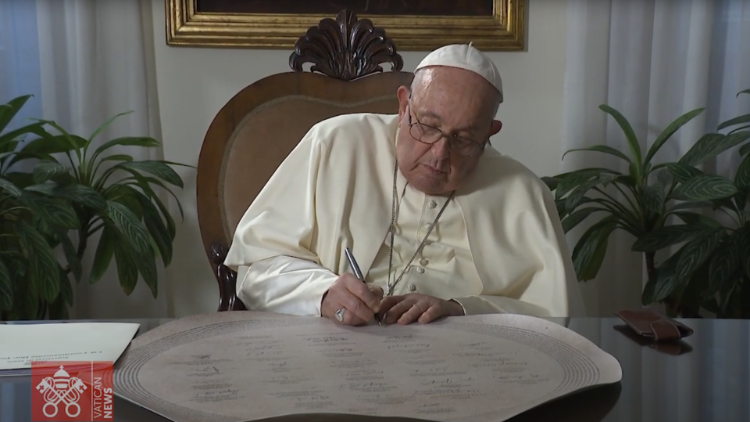
Pope Francis writingPope Francis writing 

Pope: Female voices have much to contribute to building the 'Common Good'

Pope Francis writes to participants in the Pontifical Academy for Life's dialogue on "Common Good: Theory and Practice," noting that the common good is a cornerstone of Catholic social teaching, and as such, life issues must always be kept at heart.

By Deborah Castellano Lubov

"It is of great importance to recall the common good, one of the cornerstones of the Church’s social teaching."

Pope Francis stressed this in his letter to an event - a "Dialogue on Common Good: Theory and Practice" - organized by the Pontifical Academy for Life and taking place on 14 November in the Vatican

This dialogue first featured the reading of the Pope's message by Archbishop Vincenzo Paglia, President of Academy, and is being followed by the dialogue between  Professor Mariana Mazzucato of Economics of Innovation and Public Value at University College in London, who serves as member of the Vatican’s Pontifical Academy of Life and Prime Minister Mia Mottley of Barbados.

The dialogue is considering how a new economics of the common good can help create urgent well-designed action for our economic and social problems, related to health, the environment, including biodiversity, climate and water, and the future of artificial intelligence.

Earlier in the day, the Holy Father received Prime Minister Mottley in the Vatican.

Encouragement to promote the common good

In his letter, the Pope warmly greeted the participants, noting that within the wide range of reflections on the theme of the common good, this meeting he sees as being particularly significant for at least two reasons.

The first, he said, is that it is promoted by the Pontifical Academy for Life.

"If we truly wish to safeguard human life in every context and situation," he appealed, "we cannot ignore placing the themes of life, even those more classical in bioethical debates, within the social and cultural contexts in which these phenomena occur."

"A defence of life that is limited to only certain aspects or moments, and that does not integrally consider all existential, social, and cultural dimensions," Pope Francis warned, "risks being ineffective and may fall into the temptation of an ideological approach, where abstract principles are defended more than real people."

Given this, the pursuit of the common good and justice, he said, "are central and essential aspects of any defence of every human life," especially "the most fragile and defenceless, with respect to the entire ecosystem we inhabit."

Societal needs

The second point he said he wished to highlight was that the event would feature the presence of two women with different responsibilities and backgrounds.

"We need, both in society and in the Church," the Pope implored, "to listen to female voices."

"We need," Pope Francis continued, "different forms of knowledge to collaborate in the development of a broad and wise reflection on the future of humanity."

And, he said, "We need the genuine contributions of all the world's cultures, allowing them to express their needs and resources."

Only in this way, he suggested, can we “think and generate an open world,” which the Pope recalled, he had encouraged in Chapter 3 of his Encyclical Fratelli tutti on human fraternity.

Referring to the Encyclical, the Pope emphasized that universal fraternity is, in some way, "a 'personal,' warm way of understanding the common good," not "simply an idea, a political or social project, but rather a communion of faces, stories, and people."

Cornerstone of Church's social teaching

In addition, the Holy Father recalled, the common good is, "above all," a "practice made up of fraternal acceptance and a shared search for truth and justice."

"In our world marked by so many conflicts and divisions, which are often the result of an inability to look beyond individual interests," the Pope lamented, "it is of great importance to recall the common good, one of the cornerstones of the Church’s social teaching."

Moreover, he stressed, "We need solid economic theories that embrace and develop this theme in its specifics so that it can become an effective guiding principle in political decision-making" and "not merely a category often invoked in words, but disregarded in practice."

Pope Francis concluded by imparting his Apostolic Blessing and inviting them to pray for him.