Showing posts with label chrism. Show all posts

Thursday, April 18, 2019

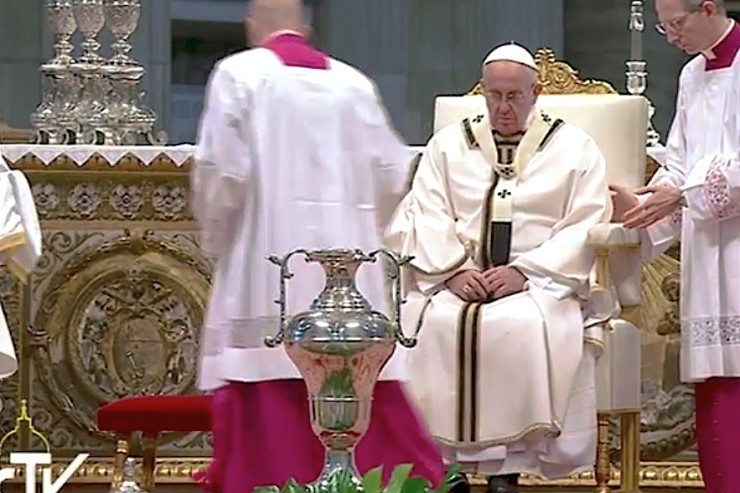
On Holy Thursday morning Pope Francis and the Priests of Rome celebrate the Chrism Mass

Pope's Chrism Mass 2019 © Zenit/María Langarica

‘We Anoint by Dirtying Our Hands in Touching Sins, Wounds & Worries of Our People,’ Says Pope at Chrism Mass

Tells Brother Priests That Jesus ‘Never Lost That Direct Contact With the People’

‘The Lord never lost direct contact with his people,’ Pope Francis underscored during the Chrism Mass in St. Peter’s Basilica this Holy Thursday morning.
Encouraging his brother priests to join him in being near the people, and reject temptations toward clericalism and creating distances, he said to follow the Lord’s example. Jesus, amid the crowds, Francis reminded, always kept the grace of closeness with the people as a whole, and with each individual.
“We see this throughout his public life,” Francis observed, adding: “and so it was from the beginning:the radiance of the Child gently attracted shepherds, kings and elderly dreamers like Simeon and Anna. So it was on the cross: his Heart draws all people to himself: Veronicas, Cyreneans, thieves, centurions…”
The Pope reminded that the people all had their eyes fixed on Christ.
“The Church,” he underscored, “always has her eyes fixed on Jesus Christ, the Anointed One, whom the Spirit sends to anoint God’s people,” recalling that the Gospels frequently present us with this image of the Lord in the midst of a crowd.
“In the Gospel,” Francis recalled, “we see that when the crowd interacts with the Lord – who stands in their midst like a shepherd among his flock – something happens. Deep within, people feel the desire to follow Jesus, amazement wells up, discernment grows apace.”
The Holy Father then reflected on three graces that characterize the relationship between Jesus and the crowd.
First, the Pope spoke about the ‘grace of following,’ reminding when St Luke observed that the crowds “looked for Jesus” (4:42) and “traveled with him.”
Their “following,” is something completely unexpected, unconditional and full of affection, he said, underscoring it “contrasts with the small-mindedness of the disciples, whose attitude towards people verges on cruelty when they suggest to the Lord that he send them away, so that they can get something to eat.”
“Here, I believe,” Francis continued, “was the beginning of clericalism: in this desire to be assured of a meal and personal  comfort without any concern for the people. The Lord cut short that temptation: “You, give them something to eat!” was Jesus’ response. “Take care of the people!”
The second grace, Francis said, is that of ‘amazement.’
“People were amazed by Jesus, by His miracles, but above all by His very person,” the Pope said. “People loved to meet him along the way, to receive his blessing and to bless him, like the woman in the midst of the crowd who blessed His Mother.”
“The Lord himself,” he pointed out, “was amazed by people’s faith; He rejoiced and he lost no opportunity to speak about it.”
The third grace, Francis said, is that of ‘discernment.’
The Jesuit Pope recalled how in St. Matthew’s Gospel, it noted how the people “were astounded by his teaching, for he taught them as one having authority.”
“Christ, the Word of God come in the flesh,” Francis said, “awakens in people this charism of discernment, which is certainly not the discernment of those who specialize in disputed questions.”
“When the Pharisees and the teachers of the law debated with him,” the Pope continued, “what people discerned was Jesus’ authority, the power of his teaching to touch their hearts, and the fact that evil spirits obeyed him (leaving momentarily speechless those who tried to trap him by their questions; the people liked that).”
The Pontiff called on those present to take a closer look at the way the Gospel views the crowd, and remember how St. Luke points out four groups “who are the preferred beneficiaries of the Lord’s anointing”: the poor, the blind, the oppressed and captives.
While the Evangelist speaks of them in general terms, Francis expressed appreciation that over the course of the Lord’s life, “these anointed ones gradually take on real names and faces.”
“We priests,” the Pope said, “are the poor man and we would like to have the heart of the poor widow whenever we give alms, touching the hand of the beggar and looking him or her in the eye. We priests are Bartimaeus, and each morning we get up and pray: ‘Lord, that I may see.’”
“We priests are, in some point of our sinfulness,” he also said, “the man beaten by the robbers. And we want first to be in the compassionate hands of the good Samaritan, in order then to be able to show compassion to others with our own hands.”
A Confession
The Holy Father then went on to make a confession.
” I confess to you that whenever I confirm and ordain, I like to smear with chrism the foreheads and the hands of those I anoint,” he said, noting: “In that generous anointing, we can sense that our own anointing is being renewed.”
“I would say this: We are not distributors of bottled oil. We anoint by distributing ourselves, distributing our vocation and our heart. When we anoint others, we ourselves are anointed anew by the faith and the affection of our people.
“We anoint by dirtying our hands in touching the wounds, the sins and the worries of the people. We anoint by perfuming our hands in touching their faith, their hopes, their fidelity and the unconditional generosity of their
self-giving.
The one who learns how to anoint and to bless, Francis underscored, is healed of meanness, abuse and cruelty.
Pope Francis concluded, saying: “By setting us with Jesus in the midst of our people, may the Father renew deep within us the Spirit of holiness.”
***
On Zenit’s Web page:

Monday, April 15, 2019

What is the Chrism Mass

Posting this tonight because tomorrow in St. Louis Cathedral at 10 am the Archdiocese of New Orleans holds the Chrism Mass.  If an Archdiocese or Diocese is small enough, geographically, this Mass is often celebrated on the morning of Holy Thursday.  In New Orleans, it is held on Tuesday of Holy Week because of travel requirements.

All clergy are invited and all Pastors expected to be in attendance.  As a Permanent Deacon who very much works full time I have never witnessed the Chrism Mass.  I hope to remedy this in the coming years.

Here is a reoccurring article I post every year to remind us all about the beauty and significance of the Chrism Mass:

What is the Chrism Mass?


Q: Would you please explain the significance of the Chrism Mass?
On Holy Thursday morning (in some dioceses it may be another morning during Holy Week) (in Archdiocese of New Orleans the Mass is Tuesday morning of Holy Week), the bishop, joined by the priests of the diocese, gather at the Cathedral to celebrate the Chrism Mass. This Mass manifests the unity of the priests with their bishop.
Here the bishop blesses three oils — the oil of catechumens (oleum catechumenorum or oleum sanctorum), the oil of the infirm (oleum infirmorum) and holy chrism (sacrum chrisma) — which will be used in the administration of the sacraments throughout the diocese for the year. This tradition is rooted in the early Church as noted in the Gelasian Sacramentary (named after Pope Gelasius I, d. 496), but was later absorbed into the Holy Thursday evening Mass; Pope Pius XII issued a new Ordinal for Holy Week, which reinstituted a special Mass of the chrism distinct from the evening Mass.
Throughout the Bible, various references indicate the importance of olive oil in daily life. Oil was used in cooking, particularly in the making of bread, that basic food substance for nourishment (e.g. Nm 11:7-9); as a fuel for lamps (e.g. Mt 25:1-9); and as a healing agent in medicine (e.g. Is 1:6 and Lk 10:34). Moreover, with oil the Jews anointed the head of a guest as a sign of welcome (e.g. Lk 7:46), beautified one’s appearance (e.g. Ru 3:3) and prepared a body for burial (e.g. Mk 16:1).

In religious practices, the Jews also used oil to offer sacrifices (e.g. Ex 29:40); to dedicate a memorial stone in honor of God (e.g. Gn 28:18); and to consecrate the meeting tent, the ark of the covenant, the table, the lampstand, the laver, the altar of incense, and the altar of holocausts (e.g. Ex 31:26-29). The use of oil was clearly a part of the daily life of the people.
Sacred Scripture also attests to the spiritual symbolism of oil. For instance, Psalm 23:5 reads, “You anoint my head with oil,” signifying favor and strength from the Lord; and Psalm 45:8 reads, “You love justice and hate wickedness; therefore, God your God, has anointed you with the oil of gladness above your fellow kings,” signifying the special designation from God and the joy of being His servant. Moreover, to be “the anointed” of the Lord indicated receiving a special vocation from the Lord and the empowerment with the Holy Spirit to fulfill that vocation: Jesus, echoing the words of Isaiah, spoke, “The spirit of the Lord is upon me; therefore, He has anointed me” (Lk 4:18). St. Paul emphasized this point, “God is the one Who firmly establishes us along with you in Christ; it is He Who anointed us and has sealed us, thereby depositing the first payment, the Spirit in our hearts” (2 Cor 1:21). Therefore, the symbolism of oil is rich sanctification, healing, strengthening, beautification, dedication, consecration and sacrifice.
Given this heritage, the early Church adopted the use of olive oil for its sacramental rituals. The Oil of Catechumens is used in connection with the sacrament of baptism. St. Hippolytus, in his Apostolic Tradition (A.D. 215), wrote of an “oil of exorcism” used to anoint the candidates immediately before baptism. This practice continues: In the current baptismal liturgy, the priest offers the prayer of exorcism and then with the oil of catechumens anoints the person to be baptized on the chest, saying, “We anoint you with the oil of salvation in the name of Christ our Savior; may He strengthen you with His power, Who lives and reigns forever and ever.”
Anointing with the oil of catechumens following a prayer of exorcism may also take place during the period of the catechumenate on one or several occasions. In both cases this anointing symbolizes the person’s need for the help and strength of God to sever the bondage of the past and to overcome the opposition of the devil so that he may profess his faith, come to baptism and live as a child of God.
The oil of the infirm is used in the sacrament of the anointing of the sick (formerly known as extreme unction). St. James wrote, “Is there anyone sick among you? He should ask for the priests of the Church. They in turn are to pray over him, anointing him with oil in the name of the Lord. This prayer uttered in faith will reclaim the one who is ill, and the Lord will restore him to health. If he has committed any sins, forgiveness will be his” (Jas 5:14-15).
The Apostolic Tradition of St. Hippolytus recorded one of the earliest formulas for blessing the oil of the infirm. Also, in the early Church, a priest (or several priests) would bless this oil at the time it was to be used, a tradition that has been retained in the Eastern Churches. However, in the Latin Rite, at least since the time of the Middles Ages, priests have used oil blessed by the bishop; for instance, St. Boniface in 730 ordered all priests in Germany to use the oil of the infirm blessed by bishops only. Presently, the priest, anointing the forehead of the person, says, “Through this holy anointing, may the Lord in His love and mercy help you with the grace of the Holy Spirit,” and then anointing his hands, says, “May the Lord who frees you from sin, save you and raise you up.” Another body part may also be anointed if the hands are not accessible or if there is another particular need.
Finally, holy chrism is a mixture of olive oil and balsam, an aromatic resin. This oil is linked with the sanctification of individuals. In the Old Testament times, the priest, prophets and kings of the Jewish people were anointed. This oil is used in the sacraments of baptism, confirmation, and holy orders, since they impart an indelible sacramental character. The blessing of the holy chrism is different from that of the other oils: Here the bishop breathes over the vessel of chrism, a gesture which symbolizes both the Holy Spirit coming down to consecrate this oil, and the life-giving, sanctifying nature of the sacraments for which it is used. (Recall how our Lord “breathed” on the Apostles on the night of Easter, saying, ‘Receive the Holy Spirit’” (Jn 20:22).) The concelebrants at the Chrism Mass also extend their right hands toward the chrism as the bishop says the consecratory prayer, signifying that in union with their bishop they share “in the authority by which Christ Himself builds up and sanctifies and rules His Body,” the Church (Vatican II, Decree on the Ministry and Life of Priests, No. 2).
Regarding baptism, St. Hippolytus in the Apsotolic Tradition spoke of an anointing after the actual baptism with the “oil of thanksgiving.” Similarly, right after the actual baptism in the present rite, the priest anoints the person on the crown of the head with chrism, saying, “God the Father of our Lord Jesus Christ has freed you from sin and given you a new birth by water and the Holy Spirit. He now anoints with the chrism of salvation. As Christ was anointed Priest, Prophet and King, so may you live always as a member of His body, sharing everlasting life. Amen.”
In the sacrament of confirmation, the bishop anoints the forehead of the candidate with chrism saying, “Be sealed with the gift of the Holy Spirit.”
Sacred chrism is also used in the sacrament of holy orders. In the ordination rite of a priest, the bishop anoints with chrism the palms of each new priest. In the ordination rite of a bishop, the consecrating bishop anoints the head of the new bishop.
Finally, holy chrism is used in the dedication ceremony of a church. Here the bishop anoints the altar, pouring holy chrism on the middle of the altar and on each of its four corners. It is recommended that the bishop anoint the entire altar. After anointing the altar, he anoints the walls of the church in 12 or four places marked by crosses.
As our bishop blesses these three oils at the Chrism Mass this year, our hearts turn to our gracious Lord who bestows His infinite love and mercy to us through these sacraments. Let us also pray for our bishop and the priests who are the ministers of the sacraments in the parish, that they may be the humble and generous servants of the Lord.
Editor’s note: This article is courtesy of the Arlington Catholic Herald

Thursday, March 29, 2018

Pope Francis at today's Chrism Mass

Pope at Chrism Mass: Homily Is Touchstone for Judging a Pastor’s Closeness
Says Priests Are to Make Faithful Feel Presence of Jesus

COPYRIGHT / VATICAN MEDIA
“The homily,” Pope Francis says, “is the touchstone for judging a pastor’s closeness and ability to communicate to his people. In the homily, we can see how close we have been to God in prayer and how close we are to our people in their daily lives.”
Pope Francis underscored this during the Chrism Mass in St. Peter’s Basilica this Holy Thursday morning, as he underscored that priests’ fundamental role is to make faithful feel the presence of Jesus.
He began his Holy Thursday homily reminding his brother priests that when he was reading the texts of today’s liturgy, he kept thinking of the passage from Deuteronomy: “For what great nation is there that has a god so near to it as the Lord our God is to us, whenever we call upon him?” (4:7), and specifically the closeness of God, our apostolic closeness.
Lord Always Draws Close to Us
Recalling the reading from the prophet Isaiah, the Pontiff noted how we contemplate the Servant, “anointed and sent” among his people, close to the poor, the sick, the prisoners, as well as the Spirit who is “upon him”, who strengthens and accompanies him on his journey.
Likewise, in Psalm 88, the Holy Father noted, we see God’s closeness, as He leads King David when he was young, and sustained him as he grew old, takes on the name of fidelity: closeness maintained over time is called fidelity.
“The Lord always comes to us, if we choose to draw near, as “neighbors”, to the flesh of all those who suffer, especially children.”
At the heart of today’s Gospel, we see the Lord through the eyes of his own people, which were “fixed on him” (Lk 4:20). Jesus stood up to read in his synagogue in Nazareth. He was given the scroll of the prophet Isaiah. He unrolled it until he found, near the end, the passage about the Servant. He read it aloud: “The Spirit of the Lord is upon me, because he has anointed and sent me…” (Is 61:1).
Jesus, the Pope stressed, finds the passage and reads it with the proficiency of a scribe. “He could have been a scribe or a doctor of the law, but he wanted to be an “evangelizer”, a street preacher, the “bearer of joyful news” for his people, the preacher whose feet are beautiful, as Isaiah says.”
God’s Great Choice: Closeness
“This is God’s great choice: the Lord chose to be close to his people. Thirty years of hidden life! Only then did he began his preaching. Here we see the pedagogy of the Incarnation, a pedagogy of inculturation, not only in foreign cultures but also in our own parishes, in the new culture of young people…”
Closeness, the Pope stressed, is more than the name of a specific virtue. it is an attitude that engages the whole person, our way of relating, our way of being attentive both to ourselves and to others.
“When people say of a priest, “he is close to us”, they usually mean two things. The first is that “he is always there” (as opposed to never being there: in that case, they always begin by saying, “Father, I know you are very busy…”). The other is that he has a word for everyone. “He talks to everybody”, they say, with adults and children alike, with the poor, with those who do not believe… Priests who are “close”, available, priests who are there for people, who talk to everyone… street priests.”
Closeness, the Pope stressed, is crucial for an evangelizer because it is a key attitude in the Gospel (the Lord uses it to describe his Kingdom).
We can be certain that closeness is the key to mercy, for mercy would not be mercy unless, like a Good Samaritan, it finds ways to shorten distances. But I also think we need to realize even more that closeness is also the key to truth. Can distances really be shortened where truth is concerned? Yes, they can. Because truth is not only the definition of situations and things from a certain distance, by abstract and logical reasoning. It is more than that. Truth is also fidelity.”
“It makes you name people with their real name, as the Lord names them,” Francis stressed, “before categorizing them or defining “their situation.”
We must be careful, the Pontiff warned, not to fall into the temptation of making idols of certain abstract truths.
“They can be comfortable idols, always within easy reach; they offer a certain prestige and power and are difficult to discern. Because the “truth-idol” imitates, it dresses itself up in the words of the Gospel, but does not let those words touch the heart. Much worse, it distances ordinary people from the healing closeness of the word and of the sacraments of Jesus.”
Homily Is a Measure of a Pastor’s Closeness
The Pope suggested that priests meditate on three areas of priestly closeness  “spiritual accompaniment”, “confession” and “preaching”.
Speaking on closeness in preaching, the Pope gave priests some homily advice.
“The homily is the touchstone “for judging a pastor’s closeness and ability to communicate to his people” (Evangelii Gaudium, 135). In the homily, we can see how close we have been to God in prayer and how close we are to our people in their daily lives.”
The good news, he highlighted, becomes present when these two forms of closeness nourish and support one another.
“If you feel far from God, draw nearer to your people, who will heal you from the ideologies that cool your fervor. The little ones will teach you to look at Jesus in a different way. For in their eyes, the person of Jesus is attractive, his good example has moral authority, his teachings are helpful for the way we live our lives.”
Remember How Precious Each Person Is in Jesus’ Eyes
If you feel far from people, the Pope recommended, approach the Lord and His word.
“In the Gospel, Jesus will teach you his way of looking at people, and how precious in his eyes is every individual for whom he shed his blood on the Cross. In closeness to God, the Word will become flesh in you and you will become a priest close to all flesh. Through your closeness to the people of God, their suffering flesh will speak to your heart and you will be moved to speak to God. You will once again become an intercessory priest.”
A priest who is close to his people, Francis noted, walks among them with the closeness and tenderness of a good shepherd. In shepherding them, the Pope said, he goes at times before them, at times remains in their midst and at other times walks behind them.
“Not only do people greatly appreciate such a priest,” the Pope said, “even more, they feel that there is something special about him: something they only feel in the presence of Jesus. That is why discerning our closeness to them is not simply one more thing to do. In it, we either make Jesus present in the life of humanity or let him remain on the level of ideas, letters on a page, incarnate at most in some good habit gradually becoming routine.”
Pope Francis concluded, saying: “Let us ask Mary, ‘Our Lady of Closeness’ to bring us closer to one another, and, when we need to tell our people to ‘do everything Jesus tells them,’ to speak with one tone of voice, so that in the diversity of our opinions, her maternal closeness may become present. For she is the one who, by her ‘yes’, has brought us close to Jesus forever.”

Wednesday, March 28, 2018

A beautiful reflective homily by Cardinal O'Malley at the Chrism Mass

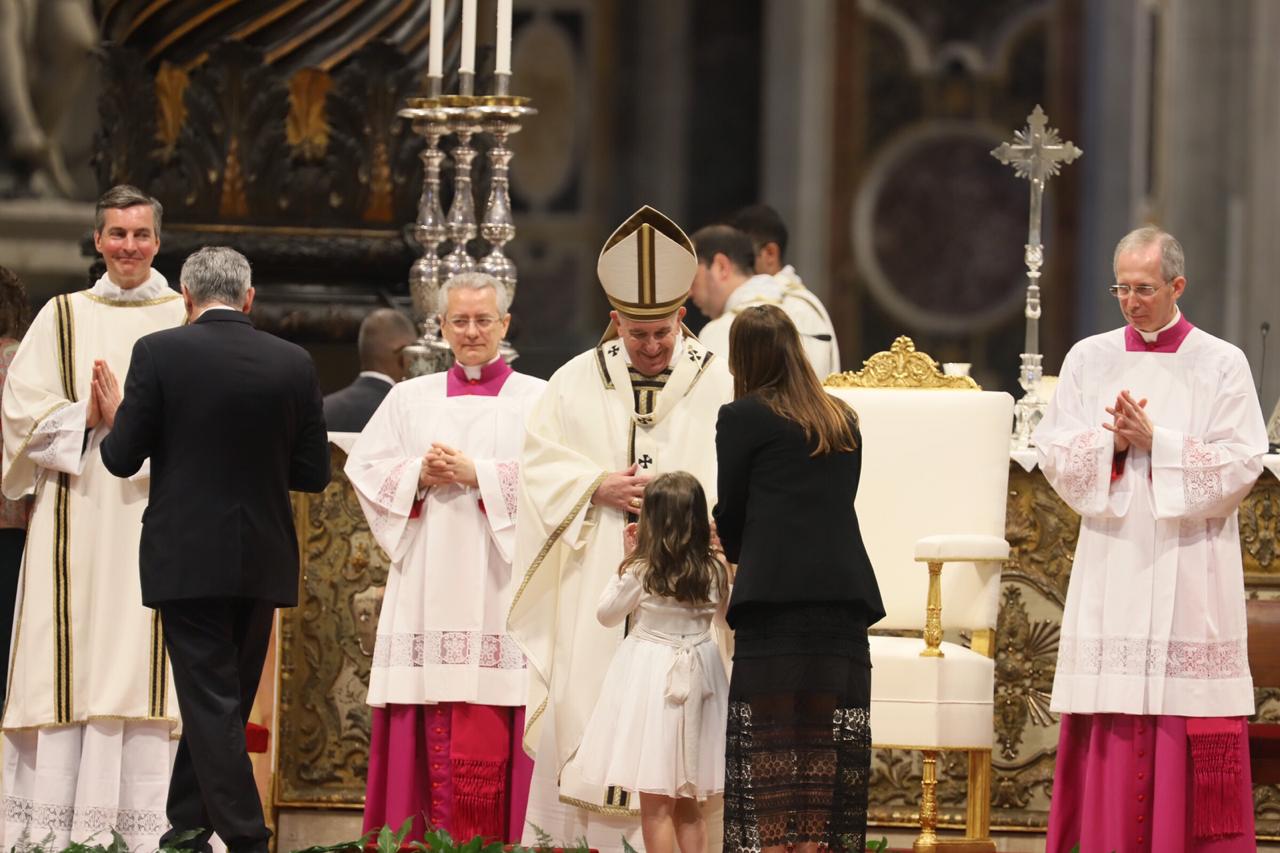
March 27, 2018 - Cardinal Seán P. O'Malley Chrism Mass Homily

SOM Chrism Mass 2018
 
Immaculate Conception Church, Malden, MA
When I was studying at Saint Fidelis of Sigmaringen Seminary, there were of course no computers or internet. In fact there were no televisions or radios and very seldom was a seminarian allowed to make a telephone call. The one concession to modernity was the practice of showing a movie on the eve of big feast days, in part because we would not have to rise at 4:30 the next day. All the movies had something in common: John Wayne. The Dean of students was a very strict censor and was not about to let any worldly films corrupt his seminarians. John Wayne films were considered safe and appropriate.
Father Maurice’s diligence in screening the films puts me in mind of the pastor in the movie, Cinema Paradiso, which takes place in a village in Sicily a few decades ago. In Italy there are still many communities where the venue for the local cinema is the parish hall and is under the supervision of the priest. In Cinema Paradiso, the pastor would review the films ahead of time, and when he rang a little bell, that was a signal to the projectionist to stop the film and edit out the love scenes, which in those days consisted of a kiss. When the pictures were shown, the parishioners would routinely boo every time one of these spliced and edited scenes would be projected on the screen.
Father Maurice did not have to cut out any scenes, because in John Wayne movies there were no kisses. In contrast to John Wayne, the Catholic priest in the performance of his duties is called upon by the church to kiss on various significant occasions. Today as we gather to celebrate priesthood, I would like to reflect on some of the priests’ kisses. There are four kisses of the Catholic priest. The priest kisses the altar. The priest kisses the Gospel. The priest gives a kiss of peace to his people. The priest kisses the cross.
One of the principles of Catholic theology is lex orandi lex credendi. Literally: the law of praying is the law of believing. In other words, the liturgy reveals a lot about what we believe. Looking at the kiss in the liturgy helps us to discover those loves that define the heart of a priest.
The Altar
The celebration of Mass always begins with a priest drawing near to kiss the altar. This liturgical custom dates from the first centuries of the Church.
In our tradition the altar is a symbol of Christ, who is the rock, the cornerstone on which our Church is built. We describe Christ as being the priest, the victim, and the altar.
Hence, when the priest is about to kiss the altar, he is kissing Christ. The same gesture is repeated at the conclusion of the Eucharist.
The priest must be the friend of the Bridegroom, John the Baptist said: “I am not the Messiah, I am but the friend of the Bridegroom.” Yes, Jesus is the Bridegroom, never the widower. He does not exist separate from his Bride, the Church. Like John the Baptist, the priest must be the friend of the Bridegroom.
The basis for our ministry in life has to be our friendship with Christ. Kissing the altar cannot be a formalistic or empty gesture. It must betoken our attachment to Christ, our loyalty to him, our friendship.
In the liturgy of St. John Chrysostom before receiving Communion, the priest prays: “Of thy mystic supper receive me today, O Son of God, as a partaker; for I will not speak of the mystery to thine enemies; I will not kiss Thee as did Judas; but as the thief, I will confess Thee: “Lord, remember me in thy kingdom.”
Judas’s kiss was a lie. It did not betoken friendship and love for Christ, but rather love of power and money. The authentic priestly kiss is one that betokens self-emptying and renunciation for the sake of the Beloved. I always like to say that poverty does not always lead to love. But love always leads to poverty. Our love of Christ must lead us to embrace his kenosis.
As we renew our priestly vows today, let us be mindful of how these promises can deepen our friendship with Jesus. Our fidelity to prayer and to our commitment to celibacy can draw us closer to Christ, the High Priest and Bridegroom. Ironically enough, in today’s world where fewer people are getting married, more people attack the Church’s practice of celibacy.
Often times in our culture the avoidance of marriage is based on a will to live for oneself and therefore is a no to the bond of marriage. Celibacy is meant to be the opposite: it is a definitive yes. It is to give oneself into the hands of the Lord. And therefore, it is an act of loyalty and trust, and that also implies the fidelity of marriage. Celibacy is a sign of the presence of God in the world, a reminder that God is to be loved above all else. The pastoral life of the Church has benefited greatly from the generous availability of men and women who have embraced a vocation of celibacy.
I know of a wonderful, faith-filled, young couple who are both doctors and want to be missionaries. They asked me to suggest different missions where they might go to offer their gifts and serve the poor. I put them in touch with bishops in Papua New Guinea and in Paraguay. In the end they came to me and said it would be impossible for them to go to those countries because they want to have children and they worried about zika. I certainly understand the logic.
When I was in seminary and three of my classmates left for Papua New Guinea, they were told: “you are going to get malaria, dengue, leeches, and fleas. Not necessarily in that order, but you will get them all.” I daresay if my classmates had wives and children, they would have had to think long and hard before answering the call to go to Papua New Guinea.
Our celibacy is to make us even more available to love Christ and serve His people. Theologically it is meant to be the sign of Jonah, the sign of the Resurrection. That we are all called to live forever and therefore it is not necessary for everyone to have children in order to live on in their posterity.
A priest is above all, a friend of Christ. Our love for Him is what draws us to our vocation and allows us to find meaning and purpose in our ministry. We kiss the altar as we approach and we kiss it as we leave, just as a husband kisses his wife when he comes home and kisses her when he leaves.
In the Maronite liturgy there is a beautiful apostrophe the priest addresses to the altar before leaving at the end of Mass. The priest says:
“Remain in peace, O holy altar of God. I hope to return to you in peace. May the offering I have received from you forgive me my sins and prepare me to stand blameless before the throne of Christ. I know not whether I shall be able to return to you again to offer sacrifice. Guard me, O Lord, and protect your Holy Church, that she may be the way to salvation and the light of the world. Amen.”
And when a Maronite priest dies, his brother priests carry the coffin, walking around the altar praying this prayer of farewell to the altar.
Gospel Book
The next kiss a priest bestows is after the proclamation of the Gospel. He kisses the Word of God as he prays: “Per evangelica dicta deleantur nostra delicta.” “May the reading of the Gospel cleanse me of my sins.”
The priest is a man of the Gospel. Jesus’ words and actions are what must mold the priest’s heart so that he may become an icon of the Good Shepherd.
In today’s Gospel Jesus tells us that He has been anointed to announce the Gospel to the poor and the downtrodden. We priests are also anointed to be heralds of the same Gospel. We are ordained to be missionaries on fire with the desire to share the good news with everyone. Christ has called us to be fishers of men and too often we are keepers of the aquarium.
We must meditate on the Gospels frequently so that the words and the inflections of the voice of the Good Shepherd become our own. Our role as preacher and teacher is crucial. We must be constantly preparing for this responsibility by our life of prayer, study, and reflection. Everything a priest does should teach the Gospel. Our words, our actions, our attitudes. Being a missionary is born of a constant struggle to deepen our own conversion; so that like the Baptist we can say, I must decrease, He must increase.
Kiss of Peace
Having kissed the Altar, and the Gospels, the next kiss is bestowed on the Bride of Christ, the People of God, our brothers and sisters whom we are called to serve. We must love our people and share their life. It is not a matter of being popular, but of being a spiritual father.
In the film Ryan’s Daughter, there is a touching portrayal of a parish Priest, Father Hugh Collins, who demonstrates such concern for his people in an Irish village during the uprising. His constant companion is a man who is developmentally challenged, Michael. When the village rises up against Rosy Ryan, accusing her of being a collaborator with the British, they beat her and cut off her hair. It is her pastor who protects and consoles her. As priests we need to have a special love for those on the margins, on the periphery as Pope Francis is wont to say.
We need to love our people and help them find meaning in life, to discover their purpose and embrace their mission. We must emulate the Curé of Ars who used to pray to the Lord: “Grant me the conversion of my parish, and I accept to suffer all you wish for the rest of my life.” St. John Vianney did everything he could to pull people away from their own lukewarm attitude in order to lead them back to love.
The Kiss of Peace is part of the liturgy from the earliest centuries and is a stark reminder that we are priests not for ourselves, but for our people. We must love them as the Good Shepherd who lays down His life. It is only when they know that we love them that they be willing to listen to us and accept our message.
Yes, even the message of the Gospel can be rejected because of the messenger who does not know how to communicate the Gospel with love, with a kiss.
The Cross
The last kiss is at the veneration of the Cross which is part of the Good Friday service.
We live in a culture that sees pain and suffering as the greatest evil. This attitude has helped spur the opiate crisis. We are often like Peter who tries to keep Jesus from even talking about the Cross. Jesus rebukes St. Peter: “Get behind me Satan. Thou savorest of the things of men and not of God.” And like Peter we often flee from Gethsemane and Calvary.
To savor the Cross is to savor the things of God. At our ordinations we all received the chalice and paten as the Bishop said: “Understand what you do, imitate what you celebrate, and conform your life to the mystery of the Lord’s Cross.”
On the Cross Jesus is offering Himself with the very compassion that transforms the suffering of the world into a cry to the Father. We must learn to accept more profoundly the sufferings of pastoral life which is entering into the mystery of Christ. Rejection of the cross breeds mediocrity.
On Good Friday the Bishop and Priests are invited to kiss the Cross first, to give our people an example of faithful discipleship that takes up the Cross each day to follow Christ our Master.
I am also mindful that when a man is installed as a bishop, the first thing the Church demands of him is to kiss the Cross.  Indeed when I think of my own installation here in the Cathedral of the Holy Cross, everything is kind of a blur. On that fateful day, I entered the Church passing through demonstrators and a crowd of reporters. Then, following the ancient ritual, I banged on the door with the crosier and stepped into a packed Cathedral. I was in a daze. However, I can still hear plainly the voice of a Master of Ceremonies, trying to rouse me from a state of stupor, saying in a stage whisper: “Kiss the Cross!” Outside there was so much turmoil. The love and faith of the people in the cathedral gave me the courage to kiss the cross.  
Jesus didn’t suffer and die so that we wouldn’t have to. He suffered and died in order to endow our sufferings with the redemptive value, something they would never possess on their own. He suffered and died in order to invest his love with us. He did this so that our love, while not diminishing our suffering or sparing us from pain, will transform pain into holy passion, suffering into sacrifice. 
Yet it is not the magnitude of Christ’s suffering that saved us, but rather the magnitude of His love. Love turned His suffering into an offering at the Last Supper, and that love is the Eucharist. It is the Eucharist that transforms Calvary into a sacrifice rather than merely an execution. There the Cross of Jesus turned death upside down. Death is the moment we usually associate with loss of life, but Jesus made it the occasion of giving life. Jesus gave His life freely and fully. He transformed it into a gift, a prayer, and a sacrifice.
As we continue to kiss the Altar, the Gospel, the People of God and the Cross, let us not allow our kisses to be routine or perfunctory, but rather let our kiss be a striking gesture of the profound loves that define us as Catholic priests.
Monday, March 26, 2018

The Chrism Mass; what is it's meaning

What is the Chrism Mass?


Q: Would you please explain the significance of the Chrism Mass?
On Holy Thursday morning (in some dioceses it may be another morning during Holy Week) (in Archdiocese of New Orleans the Mass is Tuesday morning of Holy Week), the bishop, joined by the priests of the diocese, gather at the Cathedral to celebrate the Chrism Mass. This Mass manifests the unity of the priests with their bishop.
Here the bishop blesses three oils — the oil of catechumens (oleum catechumenorum or oleum sanctorum), the oil of the infirm (oleum infirmorum) and holy chrism (sacrum chrisma) — which will be used in the administration of the sacraments throughout the diocese for the year. This tradition is rooted in the early Church as noted in the Gelasian Sacramentary (named after Pope Gelasius I, d. 496), but was later absorbed into the Holy Thursday evening Mass; Pope Pius XII issued a new Ordinal for Holy Week, which reinstituted a special Mass of the chrism distinct from the evening Mass.
Throughout the Bible, various references indicate the importance of olive oil in daily life. Oil was used in cooking, particularly in the making of bread, that basic food substance for nourishment (e.g. Nm 11:7-9); as a fuel for lamps (e.g. Mt 25:1-9); and as a healing agent in medicine (e.g. Is 1:6 and Lk 10:34). Moreover, with oil the Jews anointed the head of a guest as a sign of welcome (e.g. Lk 7:46), beautified one’s appearance (e.g. Ru 3:3) and prepared a body for burial (e.g. Mk 16:1).

In religious practices, the Jews also used oil to offer sacrifices (e.g. Ex 29:40); to dedicate a memorial stone in honor of God (e.g. Gn 28:18); and to consecrate the meeting tent, the ark of the covenant, the table, the lampstand, the laver, the altar of incense, and the altar of holocausts (e.g. Ex 31:26-29). The use of oil was clearly a part of the daily life of the people.
Sacred Scripture also attests to the spiritual symbolism of oil. For instance, Psalm 23:5 reads, “You anoint my head with oil,” signifying favor and strength from the Lord; and Psalm 45:8 reads, “You love justice and hate wickedness; therefore, God your God, has anointed you with the oil of gladness above your fellow kings,” signifying the special designation from God and the joy of being His servant. Moreover, to be “the anointed” of the Lord indicated receiving a special vocation from the Lord and the empowerment with the Holy Spirit to fulfill that vocation: Jesus, echoing the words of Isaiah, spoke, “The spirit of the Lord is upon me; therefore, He has anointed me” (Lk 4:18). St. Paul emphasized this point, “God is the one Who firmly establishes us along with you in Christ; it is He Who anointed us and has sealed us, thereby depositing the first payment, the Spirit in our hearts” (2 Cor 1:21). Therefore, the symbolism of oil is rich sanctification, healing, strengthening, beautification, dedication, consecration and sacrifice.
Given this heritage, the early Church adopted the use of olive oil for its sacramental rituals. The Oil of Catechumens is used in connection with the sacrament of baptism. St. Hippolytus, in his Apostolic Tradition (A.D. 215), wrote of an “oil of exorcism” used to anoint the candidates immediately before baptism. This practice continues: In the current baptismal liturgy, the priest offers the prayer of exorcism and then with the oil of catechumens anoints the person to be baptized on the chest, saying, “We anoint you with the oil of salvation in the name of Christ our Savior; may He strengthen you with His power, Who lives and reigns forever and ever.”
Anointing with the oil of catechumens following a prayer of exorcism may also take place during the period of the catechumenate on one or several occasions. In both cases this anointing symbolizes the person’s need for the help and strength of God to sever the bondage of the past and to overcome the opposition of the devil so that he may profess his faith, come to baptism and live as a child of God.
The oil of the infirm is used in the sacrament of the anointing of the sick (formerly known as extreme unction). St. James wrote, “Is there anyone sick among you? He should ask for the priests of the Church. They in turn are to pray over him, anointing him with oil in the name of the Lord. This prayer uttered in faith will reclaim the one who is ill, and the Lord will restore him to health. If he has committed any sins, forgiveness will be his” (Jas 5:14-15).
The Apostolic Tradition of St. Hippolytus recorded one of the earliest formulas for blessing the oil of the infirm. Also, in the early Church, a priest (or several priests) would bless this oil at the time it was to be used, a tradition that has been retained in the Eastern Churches. However, in the Latin Rite, at least since the time of the Middles Ages, priests have used oil blessed by the bishop; for instance, St. Boniface in 730 ordered all priests in Germany to use the oil of the infirm blessed by bishops only. Presently, the priest, anointing the forehead of the person, says, “Through this holy anointing, may the Lord in His love and mercy help you with the grace of the Holy Spirit,” and then anointing his hands, says, “May the Lord who frees you from sin, save you and raise you up.” Another body part may also be anointed if the hands are not accessible or if there is another particular need.
Finally, holy chrism is a mixture of olive oil and balsam, an aromatic resin. This oil is linked with the sanctification of individuals. In the Old Testament times, the priest, prophets and kings of the Jewish people were anointed. This oil is used in the sacraments of baptism, confirmation, and holy orders, since they impart an indelible sacramental character. The blessing of the holy chrism is different from that of the other oils: Here the bishop breathes over the vessel of chrism, a gesture which symbolizes both the Holy Spirit coming down to consecrate this oil, and the life-giving, sanctifying nature of the sacraments for which it is used. (Recall how our Lord “breathed” on the Apostles on the night of Easter, saying, ‘Receive the Holy Spirit’” (Jn 20:22).) The concelebrants at the Chrism Mass also extend their right hands toward the chrism as the bishop says the consecratory prayer, signifying that in union with their bishop they share “in the authority by which Christ Himself builds up and sanctifies and rules His Body,” the Church (Vatican II, Decree on the Ministry and Life of Priests, No. 2).
Regarding baptism, St. Hippolytus in the Apsotolic Tradition spoke of an anointing after the actual baptism with the “oil of thanksgiving.” Similarly, right after the actual baptism in the present rite, the priest anoints the person on the crown of the head with chrism, saying, “God the Father of our Lord Jesus Christ has freed you from sin and given you a new birth by water and the Holy Spirit. He now anoints with the chrism of salvation. As Christ was anointed Priest, Prophet and King, so may you live always as a member of His body, sharing everlasting life. Amen.”
In the sacrament of confirmation, the bishop anoints the forehead of the candidate with chrism saying, “Be sealed with the gift of the Holy Spirit.”
Sacred chrism is also used in the sacrament of holy orders. In the ordination rite of a priest, the bishop anoints with chrism the palms of each new priest. In the ordination rite of a bishop, the consecrating bishop anoints the head of the new bishop.
Finally, holy chrism is used in the dedication ceremony of a church. Here the bishop anoints the altar, pouring holy chrism on the middle of the altar and on each of its four corners. It is recommended that the bishop anoint the entire altar. After anointing the altar, he anoints the walls of the church in 12 or four places marked by crosses.
As our bishop blesses these three oils at the Chrism Mass this year, our hearts turn to our gracious Lord who bestows His infinite love and mercy to us through these sacraments. Let us also pray for our bishop and the priests who are the ministers of the sacraments in the parish, that they may be the humble and generous servants of the Lord.
Editor’s note: This article is courtesy of the Arlington Catholic Herald

Leading up to and entering into Holy Week

Holy Week began with evening prayer and the anticipated Masses of Palm Sunday this past Saturday afternoon.  Whether celebrated Saturday or Sunday the liturgy was so different.  A Gospel was read at the entrance of the Church describing the triumphant entry of Jesus into Jerusalem.  Palm branches were held high as they were blessed.  The vestments were red.  When it came for the Gospel, the Priest(in most cases) read the parts of Jesus' own words, a narrator proclaimed most of the Gospel and the congregation was able to participate.  For the congregation how poignant to proclaim the words: Crucify Him.  The homily helps us to enter fully into the celebration and mysteries of Holy Week.

Mass ends and Holy Week is fully upon us.  For me, I was able to bring Holy Communion on this Palm Sunday to my daughter and to bless baby Brennan.  The evening concludes with evening mass, night prayer and we move on to Monday of Holy Week.  I spent the day at work, but I left to assist at a funeral Mass of a wonderfully faith-filled parishioner, almost a matriarch of the parish.  I think that she would be well pleased that her funeral Mass occurred during Holy Week.  After an afternoon back at the office I was off to pray the Stations of the Cross with our PSR students, grade 1-10.  They did a great job and we offered the Stations with special reflections for children.  Monday of Holy Week is complete.

On Tuesday, while I have to be at work, the Archdiocese of New Orleans will celebrate the Chrism Mass.  Our clergy, mostly all the Priests along with many Deacons, will gather to celebrate their Priesthood and to receive the holy oils, the oil of anointing, the oil of the sick and the sacred Chrism oil.  Each Pastor returns to his home parish with these oils to be used for the year until next Easter.

Wednesday is known as Spy Wednesday; to be explained in a later post, followed by Holy Thursday and Good Friday.  Easter celebrations begin after dark on Saturday evening.

This is a beautiful week, this is a spiritual week, this is a faith-filled week.  Enter fully into this special Holy Week.

Thursday, April 13, 2017

Pope Francis celebrates Chrism Mass

‘Without Mary, We Can’t Move Forward in Our Priesthood,’ Says Pope at Chrism Mass
Tells Brother Priests Three New Wineskins to Keep the ‘Good News’ Fresh, and to Not Underestimate the Power of ‘the Little Things’
PHOTO.VA - L'OSSERVATORE ROMANO
While there are important ways to keep the Good News fresh and effective, priests must turn to their mother, Mary, Pope Francis underscored during the Chrism Mass in St. Peter’s Basilica this Holy Thursday morning.
He began his Holy Thursday homily reminding his brother priests that everything He proclaims, and all priests proclaim, is good news, and that, “Like Jesus, the priest makes the message joyful with his entire person.”
In the Little Things
“When he preaches – briefly, if possible! –, he does so with the joy that touches people’s hearts with that same word with which the Lord has touched his own heart in prayer.”
“As we all know,” the Argentine Pontiff continued, “it is in the little things that joy is best seen and shared: when by taking one small step, we make God’s mercy overflow in situations of desolation; when we decide to pick up the phone and arrange to see someone; when we patiently allow others to take up our time…

Message of Joy
While recognizing that the phrase “good news” might appear as just another way of saying “the Gospel,” Francis clarified that those words point to something essential: the joy of the Gospel. The Gospel, he stated, is good news because it is, in essence, a message of joy.
The good news, Francis highlighted, is not a thing, but a mission, and is born of Anointing.
“Jesus’ first “great priestly anointing” took place, by the power of the Holy Spirit, in the womb of Mary. The good news of the Annunciation inspired the Virgin Mother to sing her Magnificat. It filled the heart of Joseph, her spouse, with sacred silence, and it made John leap for joy in the womb of Elizabeth, his mother.”

3 Graces of the Gospel
“We should never attempt to separate these three graces of the Gospel: its truth, which is non-negotiable; its mercy, which is unconditional and offered to all sinners; and its joy, which is personal and open to everyone. Truth, mercy and joy: these three go together.
The truth of the good news, he stressed, can never be merely abstract, “incapable of taking concrete shape in people’s lives because they feel more comfortable seeing it printed in books.”   “The mercy of the good news can never be a false commiseration, one that leaves sinners in their misery without holding out a hand to lift them up and help them take a step in the direction of change.
Neither, he warned, can this message every be “gloomy” or “indifferent.”
It is “the joy of the Father, who desires that none of his little ones be lost” (Evangelii Gaudium, 237). It is the joy of Jesus, who sees that the poor have the good news preached to them, and that the little ones go out to preach the message in turn (ibid., 5).
The joys of the Gospel are special joys, he said.
3 Icons
“I say “joys” in the plural, for they are many and varied, depending on how the Spirit chooses to communicate them, in every age, to every person and in every culture. They need to be poured into new wineskins, the ones the Lord speaks of in expressing the newness of his message.”
The Pontiff went on to share with his brother priests three images or icons of those new wineskins in which the good news is kept fresh.
The Virgin Mary

A first icon of the good news would be the stone water jars at the wedding feast of Cana (cf. Jn 2:6). In one way, they clearly reflect that perfect vessel which is Our Lady herself, the Virgin Mary.
The Gospel tells us that the servants “filled them up to the brim” (Jn 2:7). I can imagine one of those servants looking to Mary to see if that was enough, and Mary signaling to add one more pailful. Mary is the new wineskin brimming with contagious joy.
“Without her, dear priests, we cannot move forward in our priesthood! She is “the handmaid of the Father who sings his praises” (Evangelii Gaudium, 286), Our Lady of Prompt Succour, who, after conceiving in her immaculate womb the Word of life, goes out to visit and assist her cousin Elizabeth.
Her “contagious fullness” helps us overcome the temptation of fear, the temptation to keep ourselves from being filled to the brim and even overflowing, the temptation to a faint-heartedness that holds us back from going forth to fill others with joy. This cannot be, for “the joy of the Gospel fills the hearts and lives of all who encounter Jesus” (ibid., 1)
Inclusive Concreteness
A second icon of the good news that I would like to share with you today is the jug with its wooden ladle that the Samaritan woman carried on her head in the midday sun (cf. Jn 4:5-30). It speaks to us of something crucial: the importance of concrete situations.
The Lord gave us another new vessel or wineskin full of this “inclusive concreteness” in that Samaritan soul who was Mother Teresa. He called to her and told her: “I am thirsty”. He said: “My child, come, take me to the hovels of the poor. Come, be my light. I cannot do this alone. They do not know me, and that is why they do not love me. Bring me to them”. Mother Teresa, starting with one concrete person, thanks to her smile and her way of touching their wounds, brought the good news to all.
The way we touch wounds with our hands, our priestly way of caressing the sick and those who have lost hope. The priest must be a man of tender love. Concreteness and tenderness!

Lord’s Pierced Heart
The third icon of the good news is the fathomless vessel of the Lord’s pierced Heart: his utter meekness, humility and poverty which draw all people to himself.
From Him, we have to learn that announcing a great joy to the poor can only be done in a respectful, humble, and even humbling, way.
For priests to carry out joyful evangelization, the Pope stressed, they must always be concrete, tender and humble.
“The Spirit,” he noted, “tells us in every situation what we need to say to our enemies (cf. Mt 10:19), and at those times he illumines our every small step forward. This meekness and integrity gives joy to the poor, revives sinners, and grants relief to those oppressed by the devil.”
Pope Francis concluded, saying, “Dear priests, as we contemplate and drink from these three new wineskins, may the good news find in us that “contagious fullness” which Our Lady radiates with her whole being, the “inclusive concreteness” of the story of the Samaritan woman, and the “utter meekness” whereby the Holy Spirit ceaselessly wells up and flows forth from the pierced heart of Jesus our Lord.”

Monday, April 10, 2017

Chrism Mass in Archdiocese of New Orleans is Tuesday of Holy Week, so, what is a Chrism Mass?

What is the Chrism Mass?


Q: Would you please explain the significance of the Chrism Mass?
On Holy Thursday morning (in some dioceses it may be another morning during Holy Week), the bishop, joined by the priests of the diocese, gather at the Cathedral to celebrate the Chrism Mass. This Mass manifests the unity of the priests with their bishop.
Here the bishop blesses three oils — the oil of catechumens (oleum catechumenorum or oleum sanctorum), the oil of the infirm (oleum infirmorum) and holy chrism (sacrum chrisma) — which will be used in the administration of the sacraments throughout the diocese for the year. This tradition is rooted in the early Church as noted in the Gelasian Sacramentary (named after Pope Gelasius I, d. 496), but was later absorbed into the Holy Thursday evening Mass; Pope Pius XII issued a new Ordinal for Holy Week, which reinstituted a special Mass of the chrism distinct from the evening Mass.
Throughout the Bible, various references indicate the importance of olive oil in daily life. Oil was used in cooking, particularly in the making of bread, that basic food substance for nourishment (e.g. Nm 11:7-9); as a fuel for lamps (e.g. Mt 25:1-9); and as a healing agent in medicine (e.g. Is 1:6 and Lk 10:34). Moreover, with oil the Jews anointed the head of a guest as a sign of welcome (e.g. Lk 7:46), beautified one’s appearance (e.g. Ru 3:3) and prepared a body for burial (e.g. Mk 16:1).
In religious practices, the Jews also used oil to offer sacrifices (e.g. Ex 29:40); to dedicate a memorial stone in honor of God (e.g. Gn 28:18); and to consecrate the meeting tent, the ark of the covenant, the table, the lampstand, the laver, the altar of incense, and the altar of holocausts (e.g. Ex 31:26-29). The use of oil was clearly a part of the daily life of the people.
Sacred Scripture also attests to the spiritual symbolism of oil. For instance, Psalm 23:5 reads, “You anoint my head with oil,” signifying favor and strength from the Lord; and Psalm 45:8 reads, “You love justice and hate wickedness; therefore, God your God, has anointed you with the oil of gladness above your fellow kings,” signifying the special designation from God and the joy of being His servant. Moreover, to be “the anointed” of the Lord indicated receiving a special vocation from the Lord and the empowerment with the Holy Spirit to fulfill that vocation: Jesus, echoing the words of Isaiah, spoke, “The spirit of the Lord is upon me; therefore, He has anointed me” (Lk 4:18). St. Paul emphasized this point, “God is the one Who firmly establishes us along with you in Christ; it is He Who anointed us and has sealed us, thereby depositing the first payment, the Spirit in our hearts” (2 Cor 1:21). Therefore, the symbolism of oil is rich sanctification, healing, strengthening, beautification, dedication, consecration and sacrifice.
Given this heritage, the early Church adopted the use of olive oil for its sacramental rituals. The Oil of Catechumens is used in connection with the sacrament of baptism. St. Hippolytus, in his Apostolic Tradition (A.D. 215), wrote of an “oil of exorcism” used to anoint the candidates immediately before baptism. This practice continues: In the current baptismal liturgy, the priest offers the prayer of exorcism and then with the oil of catechumens anoints the person to be baptized on the chest, saying, “We anoint you with the oil of salvation in the name of Christ our Savior; may He strengthen you with His power, Who lives and reigns forever and ever.”
Anointing with the oil of catechumens following a prayer of exorcism may also take place during the period of the catechumenate on one or several occasions. In both cases this anointing symbolizes the person’s need for the help and strength of God to sever the bondage of the past and to overcome the opposition of the devil so that he may profess his faith, come to baptism and live as a child of God.
The oil of the infirm is used in the sacrament of the anointing of the sick (formerly known as extreme unction). St. James wrote, “Is there anyone sick among you? He should ask for the priests of the Church. They in turn are to pray over him, anointing him with oil in the name of the Lord. This prayer uttered in faith will reclaim the one who is ill, and the Lord will restore him to health. If he has committed any sins, forgiveness will be his” (Jas 5:14-15).
The Apostolic Tradition of St. Hippolytus recorded one of the earliest formulas for blessing the oil of the infirm. Also, in the early Church, a priest (or several priests) would bless this oil at the time it was to be used, a tradition that has been retained in the Eastern Churches. However, in the Latin Rite, at least since the time of the Middles Ages, priests have used oil blessed by the bishop; for instance, St. Boniface in 730 ordered all priests in Germany to use the oil of the infirm blessed by bishops only. Presently, the priest, anointing the forehead of the person, says, “Through this holy anointing, may the Lord in His love and mercy help you with the grace of the Holy Spirit,” and then anointing his hands, says, “May the Lord who frees you from sin, save you and raise you up.” Another body part may also be anointed if the hands are not accessible or if there is another particular need.
Finally, holy chrism is a mixture of olive oil and balsam, an aromatic resin. This oil is linked with the sanctification of individuals. In the Old Testament times, the priest, prophets and kings of the Jewish people were anointed. This oil is used in the sacraments of baptism, confirmation, and holy orders, since they impart an indelible sacramental character. The blessing of the holy chrism is different from that of the other oils: Here the bishop breathes over the vessel of chrism, a gesture which symbolizes both the Holy Spirit coming down to consecrate this oil, and the life-giving, sanctifying nature of the sacraments for which it is used. (Recall how our Lord “breathed” on the Apostles on the night of Easter, saying, ‘Receive the Holy Spirit’” (Jn 20:22).) The concelebrants at the Chrism Mass also extend their right hands toward the chrism as the bishop says the consecratory prayer, signifying that in union with their bishop they share “in the authority by which Christ Himself builds up and sanctifies and rules His Body,” the Church (Vatican II, Decree on the Ministry and Life of Priests, No. 2).
Regarding baptism, St. Hippolytus in the Apsotolic Tradition spoke of an anointing after the actual baptism with the “oil of thanksgiving.” Similarly, right after the actual baptism in the present rite, the priest anoints the person on the crown of the head with chrism, saying, “God the Father of our Lord Jesus Christ has freed you from sin and given you a new birth by water and the Holy Spirit. He now anoints with the chrism of salvation. As Christ was anointed Priest, Prophet and King, so may you live always as a member of His body, sharing everlasting life. Amen.”
In the sacrament of confirmation, the bishop anoints the forehead of the candidate with chrism saying, “Be sealed with the gift of the Holy Spirit.”
Sacred chrism is also used in the sacrament of holy orders. In the ordination rite of a priest, the bishop anoints with chrism the palms of each new priest. In the ordination rite of a bishop, the consecrating bishop anoints the head of the new bishop.
Finally, holy chrism is used in the dedication ceremony of a church. Here the bishop anoints the altar, pouring holy chrism on the middle of the altar and on each of its four corners. It is recommended that the bishop anoint the entire altar. After anointing the altar, he anoints the walls of the church in 12 or four places marked by crosses.
As our bishop blesses these three oils at the Chrism Mass this year, our hearts turn to our gracious Lord who bestows His infinite love and mercy to us through these sacraments. Let us also pray for our bishop and the priests who are the ministers of the sacraments in the parish, that they may be the humble and generous servants of the Lord.
Editor’s note: This article is courtesy of the Arlington Catholic

Thursday, March 24, 2016

Pope Francis begins Holy Thursday with Chrism Mass

Pope Francis’ Homily at Chrism Mass
“Let us ask him to cleanse us of all sin and free us from every evil. And with the grace of the Holy Spirit let us commit ourselves anew to bringing God’s mercy to all men and women, and performing those works which the Spirit inspires in each of us.”
cresima3-740x493
Pope at Chrism Mass
Below is the Vatican-provided prepared text of the Pope’s homily given at the Chrism Mass in St. Peter’s Basilica this morning:
***
After hearing Jesus read from the Prophet Isaiah and say: “Today this Scripture has been fulfilled in your hearing” (Lk 4:21), the congregation in the synagogue of Nazareth might well have burst into applause. They might have then wept for joy, as did the people when Nehemiah and Ezra the priest read from the book of the Law found while they were rebuilding the walls. But the Gospels tell us that Jesus’ townspeople did the opposite; they closed their hearts to him and sent him off. At first, “all spoke well of him, and wondered at the gracious words that came from his mouth” (4:22). But then an insidious question began to make the rounds: “Is this not the son of Joseph, the carpenter?” (4:22). And then, “they were filled with rage” (4:28). They wanted to throw him off the cliff. This was in fulfilment of the elderly Simeon’s prophecy to the Virgin Mary that he would be “a sign of contradiction” (2:34). By his words and actions, Jesus lays bare the secrets of the heart of every man and woman.
Where the Lord proclaims the Gospel of the Father’s unconditional mercy to the poor, the outcast and the oppressed, is the very place we are called to take a stand, to “fight the good fight of the faith” (1 Tim 6:12). His battle is not against men and women, but against the devil (cf. Eph 6:12), the enemy of humanity. But the Lord “passes through the midst” of all those who would stop him and “continues on his way” (Lk 4:30). Jesus does not fight to build power. If he breaks down walls and challenges our sense of security, he does this to open the flood gates of that mercy which, with the Father and the Holy Spirit, he wants to pour out upon our world. A mercy which expands; it proclaims and brings newness; it heals, liberates and proclaims the year of the Lord’s favour.
The mercy of our God is infinite and indescribable. We express the power of this mystery as an “ever greater” mercy, a mercy in motion, a mercy that each day seeks to make progress, taking small steps forward and advancing in that wasteland where indifference and violence have predominated.
This was the way of the Good Samaritan, who “showed mercy” (cf. Lk10:37): he was moved, he drew near to the unconscious man, he bandaged his wounds, took him to the inn, stayed there that evening and promised to return and cover any further cost. This is the way of mercy, which gathers together small gestures. Without demeaning, it grows with each helpful sign and act of love. Every one of us, looking at our own lives as God does, can try to remember the ways in which the Lord has been merciful towards us, how he has been much more merciful than we imagined. In this we can find the courage to ask him to take a step further and to reveal yet more of his mercy in the future: “Show us, Lord, your mercy” (Ps 85:8). This paradoxical way of praying to an ever more merciful God, helps us to tear down those walls with which we try to contain the abundant greatness of his heart. It is good for us to break out of our set ways, because it is proper to the Heart of God to overflow with tenderness, with ever more to give. For the Lord prefers something to be wasted rather than one drop of mercy be held back. He would rather have many seeds be carried off by the birds of the air than have one seed be missing, since each of those seeds has the capacity to bear abundant fruit, thirtyfold, sixtyfold, even a hundredfold.
As priests, we are witnesses to and ministers of the ever-increasing abundance of the Father’s mercy; we have the rewarding and consoling task of incarnating mercy, as Jesus did, who “went about doing good and healing” (Acts 10:38) in a thousand ways so that it could touch everyone. We can help to inculturate mercy, so that each person can embrace it and experience it personally. This will help all people truly understand and practise mercy with creativity, in ways that respect their local cultures and families.
Today, during this Holy Thursday of the Jubilee Year of Mercy, I would like to speak of two areas in which the Lord shows excess in mercy. Based on his example, we also should not hesitate in showing excess. The first area I am referring to is encounter; the second is God’s forgiveness, which shames us while also giving us dignity.
The first area where we see God showing excess in his ever-increasing mercy is that of encounter. He gives himself completely and in such a way that every encounter leads to rejoicing. In the parable of the Merciful Father we are astounded by the man who runs, deeply moved, to his son, and throws his arms around him; we see how he embraces his son, kisses him, puts a ring on his finger, and then gives him his sandals, thus showing that he is a son and not a servant. Finally, he gives orders to everyone and organizes a party. In contemplating with awe this superabundance of the Father’s joy that is freely and boundlessly expressed when his son returns, we should not be fearful of exaggerating our gratitude. Our attitude should be that of the poor leper who, seeing himself healed, leaves his nine friends who go off to do what Jesus ordered, and goes back to kneel at the feet of the Lord, glorifying and thanking God aloud.
Mercy restores everything; it restores dignity to each person. This is why effusive gratitude is the proper response: we have to go the party, to put on our best clothes, to cast off the rancour of the elder brother, to rejoice and give thanks… Only in this way, participating fully in such rejoicing, is it possible to think straight, to ask for forgiveness, and see more clearly how to make up for the evil we have committed. It would be good for us to ask ourselves: after going to confession, do I rejoice? Or do I move on immediately to the next thing, as we would after going to the doctor, when we hear that the test results are not so bad and put them back in their envelope? And when I give alms, do I give time to the person who receives them to express their gratitude, do I celebrate the smile and the blessings that the poor offer, or do I continue on in haste with my own affairs after tossing in a coin?
The second area in which we see how God exceeds in his ever greater mercy is forgiveness itself.  God does not only forgive incalculable debts, as he does to that servant who begs for mercy but is then miserly to his own debtor; he also enables us to move directly from the most shameful disgrace to the highest dignity without any intermediary stages. The Lords allows the forgiven woman to wash his feet with her tears. As soon as Simon confesses his sin and begs Jesus to send him away, the Lord raises him to be a fisher of men. We, however, tend to separate these two attitudes: when we are ashamed of our sins, we hide ourselves and walk around with our heads down, like Adam and Eve; and when we are raised up to some dignity, we try to cover up our sins and take pleasure in being seen, almost showing off.
Our response to God’s superabundant forgiveness should be always to preserve that healthy tension between a dignified shame and a shamed dignity. It is the attitude of one who seeks a humble and lowly place, but who can also allow the Lord to raise him up for the good of the mission, without complacency. The model that the Gospel consecrates, and which can help us when we confess our sins, is Peter, who allowed himself to be questioned about his love for the Lord, but who also renewed his acceptance of the ministry of shepherding the flock which the Lord had entrusted to him.
To grow in this “dignity which is capable of humbling itself”, and which delivers us from thinking that we are more or are less than what we are by grace, can help us understand the words of the prophet Isaiah that immediately follow the passage our Lord read in the synagogue at Nazareth: “You will be called priests of the Lord, ministers of our God” (Is 61:6). It is people who are poor, hungry, prisoners of war, without a future, cast to one side and rejected, that the Lord transforms into a priestly people.
As priests, we identify with people who are excluded, people the Lord saves. We remind ourselves that there are countless masses of people who are poor, uneducated, prisoners, who find themselves in such situations because others oppress them. But we too remember that each of us knows the extent to which we too are often blind, lacking the radiant light of faith, not because we do not have the Gospel close at hand, but because of an excess of complicated theology. We feel that our soul thirsts for spirituality, not for a lack of Living Water which we only sip from, but because of an excessive “bubbly” spirituality, a “light” spirituality. We feel ourselves also trapped, not so much by insurmountable stone walls or steel enclosures that affect many peoples, but rather by a digital, virtual worldliness that is opened and closed by a simple click. We are oppressed, not by threats and pressures, like so many poor people, but by the allure of a thousand commercial advertisements which we cannot shrug off to walk ahead, freely, along paths that lead us to love of our brothers and sisters, to the Lord’s flock, to the sheep who wait for the voice of their shepherds.
Jesus comes to redeem us, to send us out, to transform us from being poor and blind, imprisoned and oppressed, to become ministers of mercy and consolation. He says to us, using the words the prophet Ezekiel spoke to the people who sold themselves and betrayed the Lord: “I will remember my covenant with you in the days of your youth… Then you will remember your ways, and be ashamed when I take your sisters, both your elder and your younger, and give them to you as daughters, but not on account of the covenant with you. I will establish my covenant with you, and you shall know that I am the Lord, that you may remember and be confounded, and never open your mouth again because of your shame, when I forgive you all that you have done, says the Lord God” (Ezek 16:60-63).
In this Jubilee Year, we celebrate our Father with hearts full of gratitude, and we pray to him that “he remember his mercy forever”; let us receive, with a dignity that is able to humble itself, the mercy revealed in the wounded flesh of our Lord Jesus Christ. Let us ask him to cleanse us of all sin and free us from every evil. And with the grace of the Holy Spirit let us commit ourselves anew to bringing God’s mercy to all men and women, and performing those works which the Spirit inspires in each of us for the common good of the entire People of God.
[Original Text: Italian] © Copyright – Libreria Editrice Vaticana