Showing posts with label UAE. Show all posts

Friday, November 3, 2023

Pope Francis headed back to Dubai in the UAE


File photo of Pope Francis departing for a papal journeyFile photo of Pope Francis departing for a papal journey  (Vatican Media)

Pope Francis to visit Dubai for COP28 in early December

Pope Francis will travel to Dubai, in the United Arab Emirates, for the COP28 climate summit on 1-3 December, just two months after the publication of his Apostolic Exhortation 'Laudate Deum' on the climate crisis.

By Deborah Castellano Lubov

Pope Francis will visit Dubai for COP28, according to Matteo Bruni, the Director of the Holy See Press Office.

"Accepting the invitation of His Highness Sheikh Mohammed bin Zayed Al Nahyan, President of the United Arab Emirates," Mr. Bruni announced in a statement on Friday, "His Holiness Pope Francis will make the previously announced trip to Dubai from 1 to 3 December 2023, on the occasion of the upcoming Conference of the Parties to the United Nations Framework Convention on Climate Change (COP28)."

In a recent interview with an Italian television programme, the Holy Father said he would be traveling to the UAE for the occasion.

This marks the first time a Pope has attended the UN climate summit.

Second visit to the UAE

The early December visit will mark Pope Francis' second visit to the United Arab Emirates, after his first Apostolic Journey to the Muslim-majority nation's capital of Abu Dhabi in February 2019.

Pope Francis had been the first Pope to ever visit the Arabian Peninsula, and the first to celebrate Mass for the Gulf nation's very small Catholic community, composed primarily of expat workers.

During that visit, the Holy Father signed the Document on Human Fraternity for World Peace and Living Together at an interfaith summit, along with the Grand Imam of Al Azhar, Ahmed Al Tayyeb, which would inspire the foundations for the Pope's subsequent encyclical on human fraternity, Fratelli Tutti, in 2020.

Appealing to protect Creation

Pope Francis, who chose his name after St. Francis of Assisi, has drawn attention to the need to protect our Common Home.

This dedication led him to write his 2015 landmark encyclical on the environment, Laudato siand his subsequent Apostolic Exhortation which built on the encyclical, Laudate Deumwhich was published recently, on 4 October 2023, the Feast Day of St. Francis.

In the recent Exhortation, addressed to all people of good will on the climate crisis, the Pope warns that we are at "a breaking point," and that action must be taken before it is too late, to protect future generations.

Monday, December 23, 2019

The Apostolic Journeys of 2019 by Pope Francis

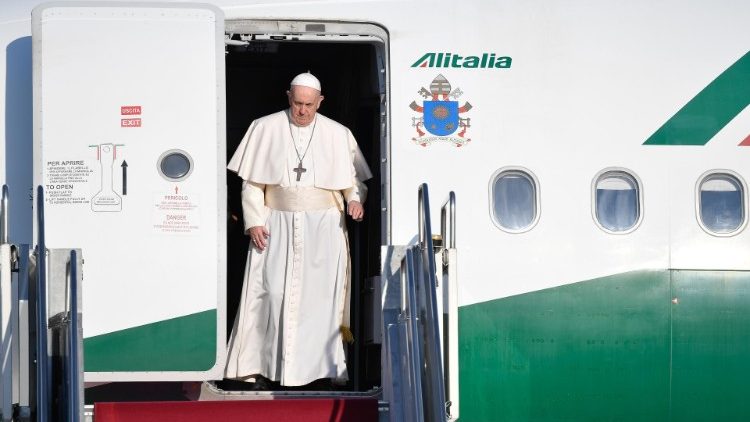
Pope Francis boarding a plane to Maputo, Mozambique. Pope Francis boarding a plane to Maputo, Mozambique.   (ANSA)


A Pontificate on the roads of the world


In 2019 Pope Francis made 7 international Apostolic Journeys to 11 countries. His has been an “itinerant pontificate” that has focused on the world’s geographical and existential peripheries.


By Alessandro Gisotti
 “I'll tell you something: I don't like to travel.”  These are the surprising words that Pope Francis pronounced on 9 June when addressing a group of children whom he received in the Vatican as part of the “Children's Train” initiative.  
It is a well-known fact that as Archbishop Jorge Mario Bergoglio of Buenos Aires, he rarely left his diocese.  There were few international trips, mostly to Latin America or to Rome for synods and consistories.  
However, the future Pope always kept alive the missionary spirit of a traveller, which as a young man made him dream of going to Japan in the footsteps of Saint Francis Xavier. This dream which he was unable to realize as a young Argentine Jesuit, was fulfilled this year when he visited the Land of the Rising Sun.  
Frankly speaking, the future Pope never stood still in his vast Archdiocese of Buenos Aires.   He travelled far and wide, and almost always used public transport.  It was a “normal thing” for the Argentine bishop and then cardinal.  However, this caused a sensation when, immediately after his election to the papacy, some earlier photos of the new Pope in a clerical shirt sitting like an ordinary commuter in a bus in the Argentine capital began circulating. 
Hence, he was a “callejero”  (itinerant) bishop, in the midst of the people, who preferred to spend time in the “Villas Miserias” (shanty towns) in the “existential peripheries” of the metropolis, rather than in the city centre.  As bishop, he always travelled within his diocese.  And so, when he became the Shepherd of the Universal Church, Pope Francis immediately felt that his diocese was now the world and that he had to set out again, with the same spirit that had animated him until then, but on a much larger space.
In his encounter with the “Children's Train”, Pope Francis admitted that in travels “you always find people, good people and you learn a lot”.  In these candid words, one can discover the purpose of Pope Francis’ travels - meeting people and understanding the contexts.  In some way, as the Washington Post also noted recently in an article by Chico Harlan, the Pope uses his Apostolic Journeys to “reform the Church” by focusing on the peripheries from which to draw the sap to initiate new processes of evangelization.
With a record number of Apostolic Journeys, 2019 has been a remarkable year of an “itinerant”, “synodal” pontificate.  This year, Pope Francis made 7 foreign trips, visiting 11 countries on 4 continents, equalling Pope Saint John Paul II, who also visited 11 countries in 1982.
On the other hand, it is significant that this year, so full of international journeys, coincides with the centenary of Pope Benedict XV's Maximum Illud on the Church’s missionary action in the world. With his travels, Pope Francis emphasizes precisely this intrinsically missionary dimension of the Lord's disciple,  who is called to be “outward going” to announce the Good News throughout the world, because no land is far away and no people is alien to the Word of God.
“Re-reading” the Pope’s 7 foreign trips this year, one can also find the great features of his pastoral thrust:  young people, in the trip to Panama for WYD; interreligious dialogue, in trips to the Arab Emirates and Morocco; ecumenical dialogue, in visits to Bulgaria and North Macedonia and then to Romania.   In his visits to Mozambique, Madagascar and Mauritius, the themes of the protection of the environment and care of the poor were predominant.  Finally, peace and the promotion of women's and children's rights were the key points of his Asian trip to Thailand and Japan.
In his remarks to journalists, on his flight to Thailand, he noted that “it is so good for people to be informed and also to know the cultures that are far from the West”.   With his travels, the Pope actually brings light to corners of the world where the mass media would never go, but which, thanks to his presence, become “visible” to the international community, which is called to care for peoples and lands otherwise forgotten.  
These Apostolic Journeys also promote the “culture of encounter” well beyond the moment after the Pope flies back to Rome.  This is true not only for the people but also for him.  In an interview, he confided carrying in his heart the people he met in his travels, that he prayed "for them, for the painful and difficult situations", so that the inequalities he saw may be reduced.

Friday, February 8, 2019

US Bishops commend statement between Pope Francis and the Grand Imam

© Vatican Media

US: Bishops Commend Joint Statement of Pope Francis and Grand Imam

‘We welcome with great joy this historic joint statement on human fraternity.’

Cardinal Blase J. Cupich, Archbishop of Chicago, Chair of the United States Conference of Catholic Bishops (USCCB) National Catholic-Muslim Dialogue; and Bishop Joseph C. Bambera of Scranton, PA, Chairman of the USCCB Committee on Ecumenical and Interreligious Affairs, issued the following statement on February 8, 2019:
“In our increasingly hostile world in which violence too often predominates between Christians and Muslims—violence that has led to tragic consequences for the most vulnerable humans—we welcome with great joy this historic joint statement on human fraternity by Pope Francis and the Grand Imam of Al-Azhar, Ahmad Al-Tayyeb. The statement, which represents the culmination of the first papal visit to the Arabian Peninsula and marks the occasion of the 800th anniversary of the encounter between St. Francis of Assisi and Sultan al-Malik al-Kamil in Egypt, is a clarion call for robust dialogue that leads to peace. We commend it to all people of good will, especially leaders of nations and religious groups, in the hope that it might serve as a resource to overcome division through a renewed commitment to dialogue and the establishment of goodwill.”

Tuesday, February 5, 2019

Pope Francis on plane returning from UAE

Copyright: Vatican Media

FEATURE: Pope Francis’ In-Flight Presser: I Found Good Will to Start a Peace Process in Yemen (Zenit Was on the Papal Flight)

On Papal Flight, Francis spoke on Venezuela, Islam, Abuse, and More

Pope Francis says, that during his historic trip to the United Arab Emirates, he found goodwill to start a peace process in Yemen.
He made this strong statement during his in-flight press conference returning from the UAE’s capital of Abu Dhabi to Rome, marking his 27th Apostolic Visit abroad and 41st nation visited, when he had been asked about whether he believes his warnings about the suffering and bloodshed in the Arabian country have had an impact.
ZENIT Senior Vatican Correspondent, Deborah Castellano Lubov, has been covering Francis’ historic trip from the papal flight, the first time a Pope has ever visited the Arabian Peninsula, and the first time there has ever been a public Mass in the Islamic country.
The United Arab Emirates has been seen by many as a model of peaceful coexistence among religions and cultures, despite limitations. They have proclaimed 2019 the Year of Tolerance, instituted a Ministry of Tolerance, renamed the Grand Mosque to be called ‘Mary, Mother of Jesus’ Grand Mosque, and promoted initiatives to help Hindus. The few Catholic parishes throughout the Emirates are thriving and vital, Deborah Lubov was told in her exclusive interviews with the Apostolic Vicar of Southern Arabia, Bishop Paul Hinder, Jordanian Sister Madeleine Dababneh of the Sisters of the Rosary, who pioneers Catholic education there and has been living in UAE, as well as by faithful she spoke to on the ground.
The Catholic Church in the UAE makes up nearly 10 percent of the population, numbering some 900,000, and they are all foreigners who have come to the UAE for work, and primarily from India and the Philippines.
During this Feb. 3-5 visit, Pope Francis and the Grand Imam of Al Azhar signed a joint declaration on Human Fraternity, calling for all concerned parties to promote religious freedom, protect places of worship, and offer citizenship, even to religious minorities.
When responding to questions on the declaration on “Human Fraternity,” signed between Francis and the Grand Imam of Al-Azhar, the Holy Father underscored that it condemns every form of terrorism.
Asked how it would be applied, he said: “The document has been prepared through a lot of reflection and prayer. Both the Grand Imam and myself…we prayed a lot. To be able to produce this document.”
“Because there is only one great danger in this moment in time: destruction, war and hatred between us, if we believers are not able to give each other a hand and hug each other,” he warned, “our faith will be defeated.”
“This document is born out of the faith in God, who is father to all, the father of peace. And it condemns all destruction, all terrorism.”
The document, he explained in response to a related question, has been made in the spirit of the Second Vatican Council. “Before taking the decision, I wished for some theologians to say it was acceptable including the official theologian of the papal household, a Dominican,  to make sure it was right. “He approved” and we signed it, Francis said.
During the Pope’s address at the International Interfaith Meeting on Human Fraternity, he praised the model of coexistence and tolerance he found in the UAE, but also referenced the suffering in Yemen, who the UAE has been an ally of Saudi Arabia in a military coalition in the Civil War which has been raging on for four years against Iran. According to UN statistics, the humanitarian crisis has left nearly 10 million starving, including many children.
When asked by journalists aboard the flight about the UAE’s support in the war against rebels in Yemen, Francis expressed he “found good will to start a peace process.”
Asked about recent reports of sexual abuse against nuns by the clergy, the Pope admitted it “is a problem” and that “more should be done” to prevent it. He also praised his predecessor, Benedict XVI, who made great personal efforts to counter this problem.
Yesterday, journalists, including ZENIT, spoke to Vatican Secretary of State Cardinal Pietro Parolin, who used to be Apostolic Nuncio in Venezuela. Inquiring if the Pope received a letter from Maduro of Venezuela requesting mediation, Cardinal Parolin confirmed this. Today, during the conference, the Pope clarified he received a letter from Venezuela’s President before leaving for Abu Dhabi, but he hasn’t had the opportunity to read it yet.
“I will open the letter. I will see what can be done, but the initial conditions are that both sides need to ask for it,” Francis underscored, noting: it is the same when both sides go to the priest, because there is a problem between husband and wife. ‘[Is one] coming or not coming? Someone wants it or doesn’t want it? Always it must be requested or wanted by both of the parties,” he said.
When asked by a local journalist about the little girl who surprisingly ran to the pope-mobile during today’s historic Mass, he admitted he has not yet had time to go through his letters, but gave his impression: “She was courageous…I said no let her come…that girl has a future…I dare say: “poor husband!” She was courageous, I liked it…it takes courage to do that…then another girl followed her…”
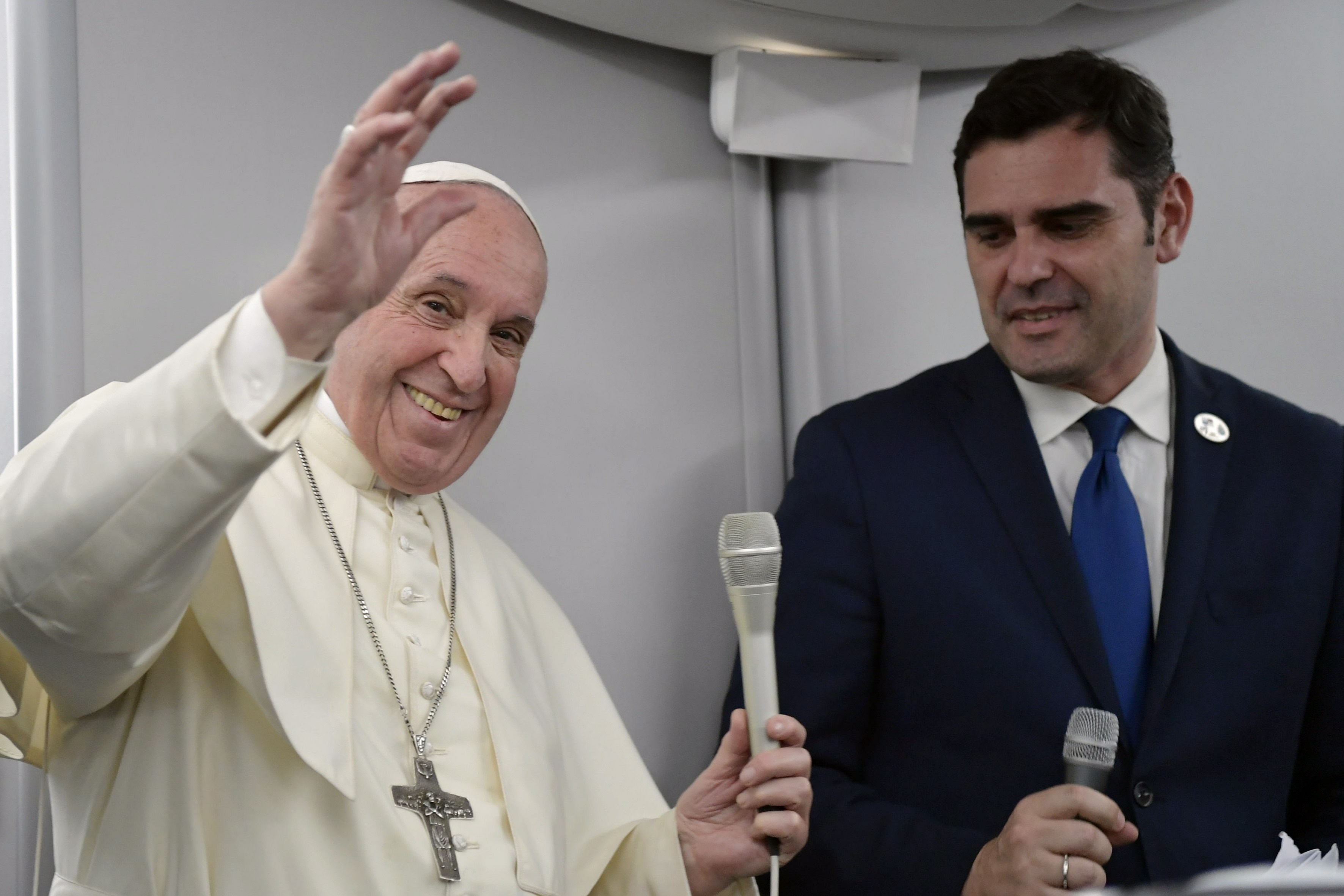
At the end of the airborne press conference, Pope Francis congratulated a journalist on board, Valentina Alazraki Crastich, for her 150th papal flight. The crew brought a cake, and the Pope said (jokingly):” They told me we celebrate Valentina’s 150th birthday (laughs)…I don’t see her this mummified…she is a woman with very interesting roots. If she goes for a blood exam, the hematologist would be surprised…”
Pope Francis concluded, telling the journalists present to pray for him. “I need it,” he said.

Pope Francis first Pope to deliver a Homily on the Arabian Peninsula; in the UAE

© Vatican Media

Abu Dhabi: Holy Father Reminds Faithful They are Blessed

‘The Christian life, first and foremost, is not this; rather, it is the knowledge that, in Jesus, we are the Father’s beloved children.’

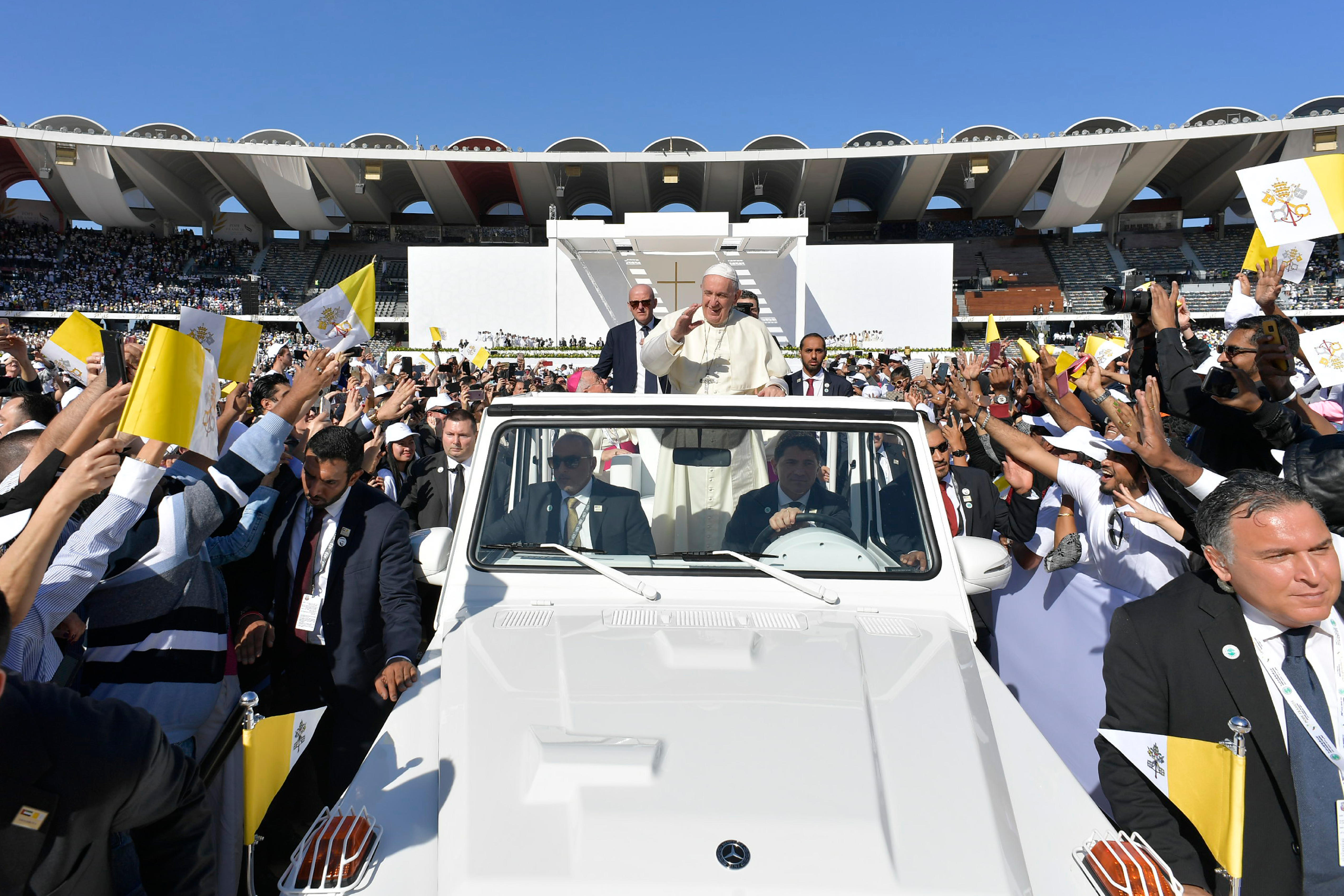
You are blessed. This was the simple but profound message Pope Francis brought to a crowd of some 180,000 on February 5, 2019, in his homily at Mass in Zayed Sports City.
It was a mostly expat crowd with workers in the United Arab Emirates hailing from more than 100 foreign countries. And it was an enthusiastic crowd.
“Blessed: this is the word with which Jesus begins his preaching in Matthew’s Gospel. And it is the refrain he repeats today, as if to fix in our hearts, more than anything, an essential message: if you are with Jesus, if you love to listen to his word as the disciples of that time did, if you try to live out this word every day, then you are blessed,” the Pope proclaimed. “Not you will be blessed, but you are blessed; this is the first truth we know about the Christian life. It is not simply a list of external prescriptions to fulfill or a set of teachings to know.
“The Christian life, first and foremost, is not this; rather, it is the knowledge that, in Jesus, we are the Father’s beloved children. The Christian life means living out the joy of this blessedness, wanting to live life as a love story, the story of God’s faithful love, he who never abandons us and wishes to be in communion with us always.”
The Holy Father reminded the faithful present that the joy of being a Christian cannot be taken from us, no matter what our circumstances. He cited the Beatitudes, in which those called blessed are not the rich and powerful but the poor, the meek, and those who are persecuted.
This is the reason for our joy, a joy that no one in the world and no circumstance in our lives can take from us. It is a joy that gives peace also in the midst of pain, a joy that already makes us participate in that eternal happiness which awaits us. Dear brothers and sisters, in the joy of meeting you, this is the word I have come to say to you: blessed!
“Who is correct here: Jesus or the world?” the Pope asked. And he answered: “To understand this, let us look at how Jesus lived: poor in respect to things, but wealthy in love; he healed so many lives but did not spare his own. He came to serve and not to be served; he taught us that greatness is not found in having but rather in giving.”
The Holy Father noted that “living out the Beatitudes does not require dramatic gestures.” He pointed out that Jesus left nothing written, built nothing imposing, and didn’t ask his followers to build great works or draw attention to themselves. He said those who follow the Beatitudes are the meek and those who are peacemakers.
“The Beatitudes are not for supermen, but for those who face up to the challenges and trials of each day,” Francis explained. “Those who live out the Beatitudes according to Jesus are able to cleanse the world. They are like a tree that even in the wasteland absorbs polluted air each day and gives back oxygen. It is my hope that you will be like this, rooted in Christ, in Jesus and ready to do good to those around you. May your communities be oases of peace.”

Pope Francis first major address in Abu Dhabi

Vatican Media Screenshot

Abu Dhabi: Pope Francis’ Address to Interfaith Meeting at Founder’s Memorial (Full Text)

‘No Violence Can be Justified in the Name of Religion’

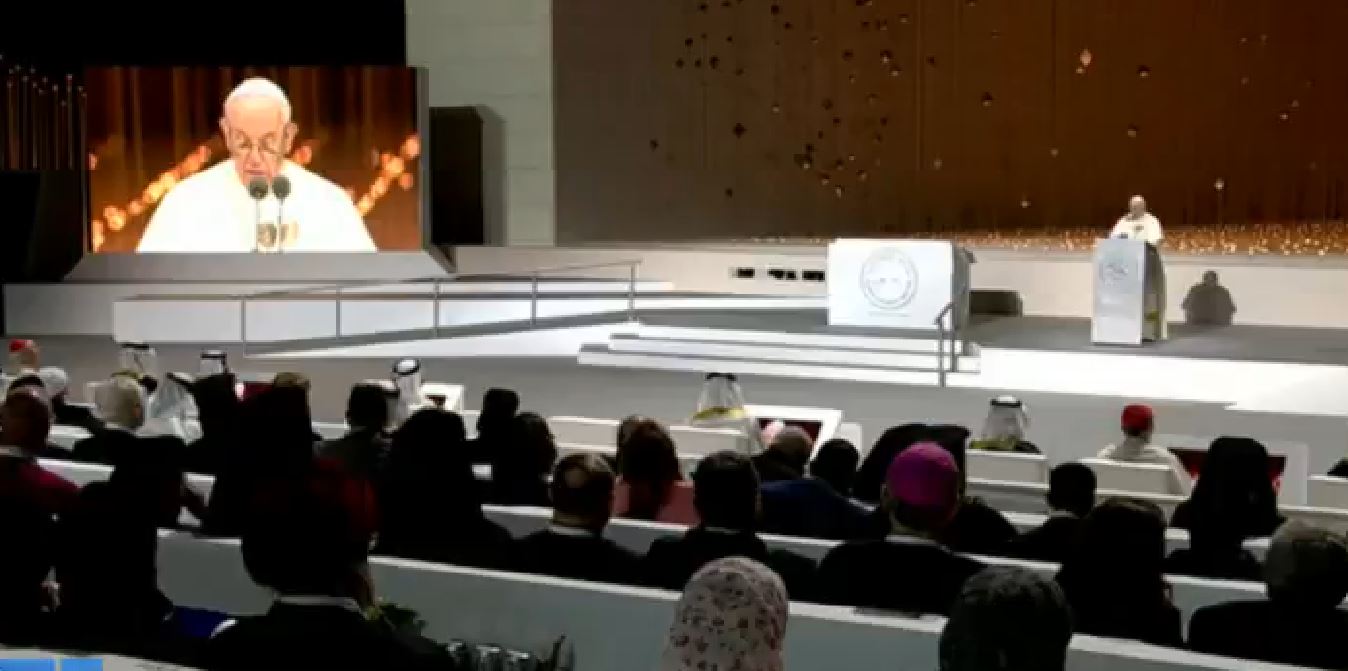
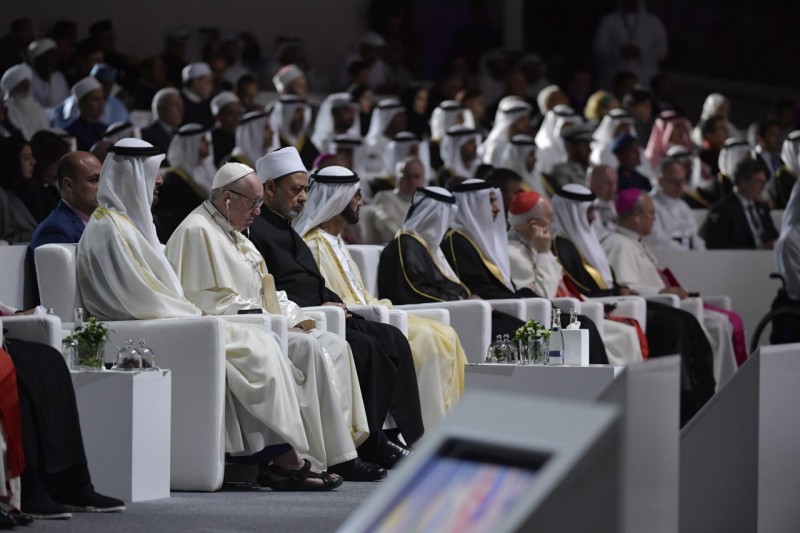
Pope Francis on February 4, 2019, addressed the Interfaith Meeting at the Founder’s Memorial in Abu Dhabi.  Following is the Vatican-provided text of his address.
******
As-salāmu alaykum! Peace be with you!
I give heartfelt thanks to His Highness Sheikh Mohammed bin Zayed Al Nahyan and Doctor Ahmad Al-Tayyib, Grand Imam of Al-Azhar, for their words. I am grateful to the Council of Elders for the meeting that we have just had at the Grand Mosque of Sheikh Zayed.
I cordially greet the civil and religious authorities and the Diplomatic Corps. Allow me also to thank you sincerely for the warm welcome that you all have given to me and our delegation.
I also thank all those who have contributed to making this journey possible and who have worked with dedication, enthusiasm, and professionalism towards this event: the organizers, those in the Protocol Office, the security personnel, and all who have made their contribution in various ways “behind the scenes”. A special word of thanks also to Mr. Mohamed Abdel Salam, former Adviser to the Grand Imam.
From your country, my thoughts turn to all the countries of this peninsula. To them, I address my most cordial greetings, with friendship and esteem.
With a heart grateful to the Lord, in this eighth centenary of the meeting between Saint Francis of Assisi and Sultan al-Malik al Kāmil, I have welcomed the opportunity to come here as a believer thirsting for peace, as a brother seeking peace with the brethren. We are here to desire peace, to promote peace, to be instruments of peace.
The logo of this journey depicts a dove with an olive branch. It is an image that recalls the story – present in different religious traditions – of the primordial flood. According to the biblical account, in order to preserve humanity from destruction, God asked Noah to enter the ark along with his family. Today, we too in the name of God, in order to safeguard peace, need to enter together as one family into an ark which can sail the stormy seas of the world: the ark of fraternity.
The point of departure is the recognition that God is at the origin of the one human family. He who is the Creator of all things and of all persons wants us to live as brothers and sisters, dwelling in the common home of creation which he has given us. Fraternity is established here at the roots of our common humanity, as “a vocation contained in God’s plan of creation”.[1] This tells us that all persons have equal dignity and that no one can be a master or slave of others.
We cannot honor the Creator without cherishing the sacredness of every person and of every human life: each person is equally precious in the eyes of God, who does not look upon the human family with a preferential gaze that excludes, but with a benevolent gaze that includes. Thus, to recognize the same rights for every human being is to glorify the name of God on earth. In the name of God the Creator, therefore, every form of violence must be condemned without hesitation, because we gravely profane God’s name when we use it to justify hatred and violence against a brother or sister. No violence can be justified in the name of religion.
The enemy of fraternity is an individualism which translates into the desire to affirm oneself and one’s own group above others. This danger threatens all aspects of life, even the highest innate prerogative of man, that is, the openness to the transcendent and to religious piety. True religious piety consists in loving God with all one’s heart and one’s neighbor as oneself. Religious behavior, therefore, needs continually to be purified from the recurrent temptation to judge others as enemies and adversaries. Each belief system is called to overcome the divide between friends and enemies, in order to take up the perspective of heaven, which embraces persons without privilege or discrimination.
I wish to express appreciation for the commitment of this nation to tolerating and guaranteeing freedom of worship, to confronting extremism and hatred. Even as the fundamental freedom to profess one’s own beliefs is promoted – this freedom being an intrinsic requirement for a human being’s self-realization – we need to be vigilant lest religion be instrumentalized and deny itself by allowing violence and terrorism.
Fraternity certainly “also embraces variety and differences between brothers and sisters, even though they are linked by birth and are of the same nature and dignity”.[2] Religious plurality is an expression of this; in such a context the right attitude is neither a forced uniformity nor a conciliatory syncretism. What we are called to do as believers is to commit ourselves to the equal dignity of all, in the name of the Merciful One who created us and in whose name the reconciliation of conflicts and fraternity in diversity must be sought. Here I want to reaffirm the conviction of the Catholic Church: “We cannot truly call on God, the Father of all if we refuse to treat in a brotherly way any man, created as he is in the image of God”.[3]
Various questions, however, confront us: how do we look after each other in the one human family? How do we nourish a fraternity which is not theoretical but translates into authentic fraternity? How can the inclusion of the other prevail over exclusion in the name of belonging to one’s own group? How, in short, can religions be channels of fraternity rather than barriers of separation?
The human family and the courage of otherness
If we believe in the existence of the human family, it follows that it must, as such, be looked after. As in every family, this happens above all through a daily and effective dialogue. This presupposes having one’s own identity, not to be foregone to please the other person. But at the same time, it demands the courage of otherness,[4] which involves the full recognition of the other and his or her freedom, and the consequent commitment to exert myself so that the other person’s fundamental rights are always affirmed, everywhere and by everyone. Without freedom, we are no longer children of the human family, but slaves. As part of such freedom, I would like to emphasize religious freedom. It is not limited only to freedom of worship but sees in the other truly a brother or sister, a child of my own humanity whom God leaves free and whom, therefore, no human institution can coerce, not even in God’s name.
Dialogue and Prayer
The courage of otherness is the heart of dialogue, which is based on sincerity of intentions. Dialogue is indeed compromised by pretense, which increases distance and suspicion: we cannot proclaim fraternity and then act in the opposite way. According to a modern author, “The man who lies to himself and listens to his own lie comes to such a pass that he cannot distinguish the truth within him, or around him, and so loses all respect for himself and for others”.[5]
In all this, prayer is essential: while sincerely intended prayer incarnates the courage of otherness in regard to God, it also purifies the heart from turning in on itself. Prayer of the heart restores fraternity. Consequently, “as for the future of interreligious dialogue, the first thing we have to do is pray, and pray for one another: we are brothers and sisters! Without the Lord, nothing is possible; with him, everything becomes so! May our prayer – each one according to his or her own tradition – adhere fully to the will of God, who wants all men and women to recognize they are brothers and sisters and live as such, forming the great human family in the harmony of diversity”.[6]
There is no alternative: we will either build the future together or there will not be a future. Religions, in particular, cannot renounce the urgent task of building bridges between peoples and cultures. The time has come when religions should more actively exert themselves, with courage and audacity, and without pretense, to help the human family deepen the capacity for reconciliation, the vision of hope and the concrete paths of peace.
Education and Justice
Let us return, then, to the initial image of the dove of peace. Peace, in order to fly, needs wings that uphold it: the wings of education and justice.
Education – in Latin it means “extracting, drawing out” – is to bring to light the precious resources of the soul. It is comforting to note how in this country investments are being made not only in the extraction of the earth’s resources but also in those of the heart, in the education of young people. It is a commitment that I hope will continue and spread elsewhere. Education also happens in a relationship, in reciprocity. Alongside the famous ancient maxim “know yourself”, we must uphold “know your brother or sister”: their history, their culture and their faith, because there is no genuine self-knowledge without the other. As human beings, and even more so as brothers and sisters, let us remind each other that nothing of what is human can remain foreign to us.[7] It is important for the future to form open identities capable of overcoming the temptation to turn in on oneself and become rigid.
Investing in culture encourages a decrease of hatred and a growth of civility and prosperity. Education and violence are inversely proportional. Catholic schools – well appreciated in this country and in the region – promote such education on behalf of peace and reciprocal knowledge in order to prevent violence.
Young people, who are often surrounded by negative messages and fake news, need to learn not to surrender to the seductions of materialism, hatred, and prejudice. They need to learn to object to injustice and also to the painful experiences of the past. They need to learn to defend the rights of others with the same energy with which they defend their own rights. One day, they will be the ones to judge us. They will judge us well if we have given them a solid foundation for creating new encounters of civility. They will judge us poorly if we have left them only mirages and the empty prospect of harmful conflicts of incivility.
Justice is the second wing of peace, which often is not compromised by single episodes, but is slowly eaten away by the cancer of injustice.
No one, therefore, can believe in God and not seek to live in justice with everyone, according to the Golden Rule: “So whatever you wish that men would do to you, do so to them; for this is the law and the prophets” (Mt 7:12).
Peace and justice are inseparable! The prophet Isaiah says: “And the effect of righteousness will be peace” (32:17). Peace dies when it is divorced from justice, but justice is false if it is not universal. A justice addressed only to family members, compatriots, believers of the same faith is a limping justice; it is a disguised injustice!
The world’s religions also have the task of reminding us that greed for profit renders the heart lifeless and that the laws of the current market, demanding everything immediately, do not benefit encounter, dialogue, family – essential dimensions of life that need time and patience. Religions should be the voice of the least, who are not statistics but brothers and sisters, and should stand on the side of the poor. They should keep watch as sentinels of fraternity in the night of conflict. They should be vigilant warnings to humanity not to close our eyes in the face of injustice and never to resign ourselves to the many tragedies in the world.
The desert that flourishes
Having spoken of fraternity as an ark of peace, I now want to take inspiration from a second image, that of the desert which surrounds us.
Here, in just a few years, with farsightedness and wisdom, the desert has been transformed into a prosperous and hospitable place. From being an unapproachable and inaccessible obstacle, the desert has become a meeting place between cultures and religions. Here the desert has flourished, not just for a few days in the year, but for many years to come. This country, in which sand and skyscrapers meet, continues to be an important crossroads between the West and East, between the North and South of the planet: a place of development, where once inhospitable spaces supply jobs for people of various nations.
Nonetheless, development, too, has its adversaries. If the enemy of fraternity is the individualism referred to above, I want to point to indifference as an obstacle to development, an indifference which ends up converting flourishing realities into desert lands. In fact, a purely utilitarian development cannot provide real and lasting progress. Only an integral and cohesive development provides a future worthy of the human person. Indifference prevents us from seeing the human community beyond its earnings and our brothers and sisters beyond the work they do. Indifference, in fact, does not look to the future; it does not care about the future of creation, it does not care about the dignity of the stranger and the future of children.
In this context, I am delighted that here in Abu Dhabi last November the first Forum of the Interreligious Alliance for Safer Communities took place, whose theme was child dignity in the digital world. This event recalled a message issued a year before in Rome during an international congress on the same theme, a congress to which I had given my complete support and encouragement. I thank, therefore, all the leaders who are engaged in this field, and I assure them of my support, solidarity and participation and that of the Catholic Church, in this very important cause of the protection of minors in all its forms.
Here, in the desert, a way of fruitful development has been opened which, beginning from the creation of jobs, offers hope to many persons from a variety of nations, cultures, and beliefs. Among them, many Christians too, whose presence in the region dates back centuries, have found opportunities and made a significant contribution to the growth and well-being of the country. In addition to professional skills, they bring you the genuineness of their faith. The respect and tolerance they encounter, as well as the necessary places of worship where they pray, allow them a spiritual maturity which then benefits society as a whole. I encourage you to continue on this path, so that those who either live here or are passing through may preserve not only the image of the great works erected in the desert but also the image of a nation that includes and embraces all.
It is with this spirit that I look forward to concrete opportunities for meeting, not only here but in the entire beloved region, a focal point of the Middle East. I look forward to societies where people of different beliefs have the same right of citizenship and where only in the case of violence in any of its forms is that right removed.
A fraternal living together, founded on education and justice; a human development built upon a welcoming inclusion and on the rights of all: these are the seeds of peace which the world’s religions are called to help flourish. For them, perhaps as never before, in this delicate historical situation, it is a task that can no longer be postponed: to contribute actively to demilitarizing the human heart. The arms race, the extension of its zones of influence, the aggressive policies to the detriment of others will never bring stability. War cannot create anything but misery, weapons bring nothing but death!
Human fraternity requires of us, as representatives of the world’s religions, the duty to reject every nuance of approval from the word “war”. Let us return it to its miserable crudeness. Its fateful consequences are before our eyes. I am thinking in particular of Yemen, Syria, Iraq, and Libya. Together, as brothers and sisters in the one human family willed by God, let us commit ourselves against the logic of armed power, against the monetization of relations, the arming of borders, the raising of walls, the gagging of the poor; let us oppose all this with the sweet power of prayer and daily commitment to dialogue. Our being together today is a message of trust, an encouragement to all people of good will, so that they may not surrender to the floods of violence and the desertification of altruism. God is with those who seek peace. From heaven, he blesses every step which, on this path, is accomplished on earth.