Showing posts with label U.S. Catholics. Show all posts

Friday, October 31, 2025

There is a "silent majority" of American Catholics who support current immigration efforts


A ‘silent majority’ of U.S. Catholics support Trump’s immigration enforcement efforts

Former U.S. Acting Deputy Secretary of Homeland Security Ken Cuccinelli. | Credit: DHSgov, Public domain, via Wikimedia Commons


Catholics who do not gather for anti-enforcement rallies organized by high-ranking Catholic prelates are a “silent majority,” according to conservative Catholic immigration experts. 

As the Trump administration’s immigration enforcement efforts continue to intensify, Catholics across the country have committed to observe days of prayer and public witness for migrants through efforts such as the One Church One Family initiative spearheaded by the western Jesuits. However, according to some conservative Catholic immigration experts, the number of Catholics who are opting out of such vigils are “a silent majority.”

The initiative calls on dioceses, parishes, schools, religious communities, and other Catholic institutions to host and promote “public actions that lift up the dignity of migrants,” such as “a vigil in front of a detention center, a prayer service at a place where migrants were publicly detained, or a rosary accompanying people who are going to immigration court hearings.” 

“I think that there are a large number of American Catholics who are supportive of what the president is doing with respect to immigration,” Center for Immigration Studies Resident Fellow in Law and Policy Andrew Arthur told CNA. “I think he received a majority of Catholic votes in the last election, depending on which poll you look at.”

Immigration enforcement, he pointed out, acted as a major touchstone of President Donald Trump’s 2024 campaign. That Trump did not lean more heavily on this key issue in the 2020 campaign was also considered “one of the key failings” of his second White House attempt. 

While Catholics who oppose the Trump administration’s enforcement efforts have been forthright in their advocacy for migrants, organizing vigils, Eucharistic processions, and protests, Arthur observed that the demographic of Catholics who support the administration are “not a monolith” and do not organize demonstrations in the same way. 

“I don’t really know that there’s a huge Catholic enforcement group that I could point to,” he said in terms of open advocacy for enforcement. “But that’s more or less to be expected. In my mind, it’s the silent majority in this country.”

“One of the things that we see is that the Catholic Church, anecdotally, that we see that the Catholic Church, that especially younger Catholics are more conservative, and therefore, more in line with law enforcement, generally, and immigration enforcement, in particular,” he continued. “But there’s no reason to form a group to support what the administration is actually doing.” 

Regarding the concerns posed by many groups, including the United States Conference of Catholic Bishops, Arthur insisted that there is “nothing that Donald Trump or ICE or [border czar] Tom Homan, another good Catholic, are doing that is contrary to the laws that Congress has written.” Despite the widespread critical narrative, Arthur denied there being anything particularly exceptional or specific to the Trump administration’s approach to enforcement. 

“I have been involved in immigration and enforcement for 33 years and served under four different presidents, beginning with George H.W. Bush,” he said. “There’s nothing about immigration enforcement today [that’s different from enforcement] under H.W., Clinton, George W. Bush, or Barack Obama.”

‘This is what the law requires’

“This is what the law requires. This is what the agents are doing,” he continued, adding: “I think really the only exceptional part is the response that they’re receiving for it.”

Addressing concerns surrounding enforcement from a Catholic perspective, former U.S. Acting Deputy Secretary of Homeland Security Ken Cuccinelli told CNA: “I am aware of the two basic points contained in the paragraph in the Catholic catechism on immigration: 1) Wealthier nations should be generous with their immigration policies; and 2) Migrants should respect the laws and customs of the nation to which they are emigrating.”

“I believe America is historically the most generous nation on Earth when it comes to inviting in people from all over the world, so we meet the first Catholic expectation,” he continued, adding: “However, an illegal alien by definition does not meet the second expectation found in the catechism, and thus the need on the part of America to enforce the law at a large scale.”   

Cuccinelli emphasized the need for America’s immigration system to work for Americans first as well as the economic pitfalls for poor working-class Americans of allowing large-scale “low skill” illegal immigration.

In the end, Cuccinelli, who also previously served as director of U.S. Citizenship and Immigration Services, told CNA he hopes the Trump administration’s efforts to demonstrate its commitment to the rule of law will prompt a return to “gradually move back to a legal immigration regime soon.” 

The director of Franciscan University of Steubenville’s Center for Criminal Justice, Law, and Ethics, Charles Nemeth, also weighed in on the subject from a Catholic perspective, telling CNA: “If this be about justice, it is better to adopt the Aristotelian-Thomistic view that justice is about what is ‘due’ — nothing more and nothing less. Illegals commence their journey already in a faulted state — for they have jumped the line and disregarded our laws and traditions.”

In order for a society to be just, he said, it must look to the common good of the nation-state first rather than “the individualized needs or demands of those lacking a legal right to assimilate without the adherence to the rules and regulations that border entry calls for.”

Nemeth stated that the Biden administration’s “open-door policy” subverted the rights of U.S. citizens by permitting mass migration, which he said resulted in “a dramatic rise in crime and social unrest and made a comedy of the rule of law.” He further cited undocumented migrants’ access to benefits such as health care, food stamps, and education “while our own citizens are being crushed by the costs of the same services.”

“It is one thing to display compassion,” referencing Catholics who protest the administration’s enforcement efforts, “but quite another to undermine the social fabric of a society that allows special rules for special categories of inhabitants.

Friday, October 10, 2025

Pope Leo XIV meets USCCB leadership and Archbishop Brogolio


Archbishop Timothy P. Broglio and Pope Leo XIVArchbishop Timothy P. Broglio and Pope Leo XIV  (@VATICAN MEDIA)

Archbishop Broglio: Pope Leo understands the Church in the U.S

Following the first formal meeting of Pope Leo XIV with the leadership of the U.S. Catholic Bishops’ Conference, Archbishop Timothy Broglio speaks of the American bishops’ unity with the Holy See and its shared mission to proclaim the Gospel amid polarization and social challenges.

By Christopher Wells and Linda Bordoni

The leadership of the United States Conference of Catholic Bishops (USCCB), headed by its president, Archbishop Timothy Broglio, was received in audience on Friday morning by Pope Leo XIV. Following the meeting, Archbishop Broglio spoke with Vatican News about the encounter and the significance of the new pontificate for the Church in the United States.

“It was a very pleasant meeting,” Archbishop Broglio said, expressing gratitude for the opportunity to meet with the Holy Father. He noted that he had met Pope Leo previously when the latter served as Prefect of the Dicastery for Bishops and during the Synod of Bishops.

Asked about his feelings regarding having “an American Pope on the throne of Peter", the archbishop highlighted the Holy Father’s “vast experience” and deep familiarity with the global Church.

“He lived here in Europe for many years, was a missionary and then a bishop in Peru, and later served as prefect of the dicastery,” he said. “The fact that you can speak to the Holy Father in your native language, which is also his, gives a certain immediacy. You feel you have an older brother walking with you—and that is a great blessing.”

A deep understanding of the U.S. Church

Answering a question about whether Pope Leo’s background might affect relations between the Holy See and the Church in the United States, the USCCB President said he believed it would.

“He certainly knows that reality and has grown up in it,” he noted. “The refrain that ‘they don’t understand us over here’ doesn’t fit anymore, because he certainly does understand us.”

At the same time, Archbishop Broglio underlined that the U.S. bishops have always maintained close communion with the Bishop of Rome.

“The bishops and the Church in the United States as a whole have always been very closely allied to the Pope, with a desire to work in unity with him,” he said, adding, “We have been very faithful to Peter, very anxious to hear Peter’s voice and to follow it.”

Dialogue on migration and the Gospel

During Friday’s audience, the bishops discussed key pastoral concerns, including migration and the transmission of the Gospel: “We talked about the challenges we face when people align themselves more quickly with political positions than with the message of the Gospel,” Archbishop Broglio said.

 “I took home some good lessons from the Holy Father about that very subject,” he said.

Migration, he added, was a topic close to both the Pope’s heart and that of the U.S. bishops. “We are a country of migrants,” he said, noting, “That has been, some might view it as our trial, but also our greatest strength.”

Migrants, he agreed, make up a huge part of the American church, recalling that when his own father started school in New York City, “he was unable to say a word of English!”

Collegiality in action

The archbishop also reflected on the spirit of collaboration between the Holy See and the U.S. episcopate. He recalled a letter about the issue of migration that Pope Francis had sent to the bishops and how the bishops had reacted and welcomed it: “That letter represents a clear example of collegiality—of Peter working with the apostolic college to bring the Gospel message home,” he noted.

“I was grateful we could use that letter to preach the Gospel to our brothers and sisters in the United States,” he said.

Overcoming polarization

Turning to the theme of polarization, Archbishop Broglio echoed Pope Leo’s frequent appeals for unity. “What unites us is the Gospel of Jesus Christ,” he said.

“Every bishop is ordained to be an effective preacher of the Word of God. Sometimes there’s a tendency to listen to other voices, but the bishop of the diocese and the Holy Father for the universal Church are really the voice that speaks of Jesus Christ,” he reiterated.

He acknowledged the diversity among U.S. bishops but highlighted their unity of purpose: “We try to give space for bishops to speak their mind, but in the end, when we speak to our people, we strive to speak with a united voice.”

“It’s not enough to preach the truth,” we must also find a way to preach it so that people can accept it, the archbishop affirmed.

A message of encouragement

Archbishop Broglio said he would bring back to his brother bishops the Holy Father’s encouragement and affection.

 “I will take back the fact that the Pope loves us very much, that he understands us, and that he wants us to work harder to make the Gospel come alive,” he said, adding, “We have to help our brothers and sisters recognize that the truth of the Gospel surpasses any other sort of division that might separate us.”

Expressing gratitude for the audience, he added, “The Pope gave us almost an hour of his time, which is very precious. I am also grateful for the tremendous availability of the Apostolic See to the bishops.”

Wednesday, February 26, 2025

Surveys still show U.S. Catholics ok with social ills like abortion and same-sex marriage


US Catholics support progressive policies on 'culture war' issues, new study finds

Twice as many US Catholics identify as conservative than do as liberal, finds a new Religious Landscape Study by the Pew Research Center


Advocates of same-sex marriage cheer during a rally outside the 9th Circuit Court of Appeals in San Francisco on Feb. 7, 2012, moments before hearing the court's decision on Proposition 8. By a 2-1 vote, a three-judge panel struck down the California ban on same-sex marriage, saying that it violates the 14th Amendment to the U.S. Constitution. (CNS/Reuters/Beck Diefenbach)


by Heidi Schlumpf

February 26, 2025

Majorities of U.S. Catholics support progressive policies on "culture war" issues, such as abortion and gay marriage, according to a new survey of the country's religious landscape. Still, twice as many Catholics describe themselves as conservative than identify as liberal.

For example, nearly three quarters of Catholics believe homosexuality should be supported by society, 70% support same-sex marriage and 59% want abortion legal in all or most cases. Almost four in 10 Catholics said greater acceptance of people who are transgender is a change for the better. Acceptance of progressive policies has increased among Catholics, for the issues tracked over time.

In general, however, the more religious Americans are, the more likely they are to express traditional views, especially about gender roles, the study found. 

The Religious Landscape Study — the third conducted by the Pew Research Center over the past 17 years — also looked at religious identification, spiritual beliefs and practice, the role of religion in family life and religion's place in society. Previous surveys were in 2007 and 2014. The latest iteration was delayed because of COVID.

Religion and political affiliation

The survey found that the trend continues of "political/religious sorting" — in which conservatives and Republicans tend to be more religious, and Democrats and liberals tend to be less so. The share of self-described political liberals who identify as Christians has fallen 25 percentage points since 2007, the report said [see the Pew Research Center graphic below].

In addition, higher levels of religious engagement are related to leaning toward the Republican Party, with Black Americans as a notable exception. At all levels of religiousness, most Black respondents identified with the Democratic Party. Hispanic Americans, Asian Americans and Americans of other races and ethnicities are also somewhat politically divided depending on religiosity, but the gaps are not as wide as with white Americans.

Among Catholics as a whole, 49% said they identify as Republican or lean Republican, compared to 44% who are Democrats or lean Democratic. Catholics' rates of conservatism are slightly higher than those of U.S. adults as a whole. The largest group of Catholics identify as moderate.

Hispanic Catholics favor the Democratic Party, however, while white Catholics favor the GOP. For decades, the Catholic vote in presidential elections had been evenly divided, until Donald Trump garnered as many as 58% of Catholics in 2024, according to exit polls.

"In terms of politics, the report suggests that many religious communities have become more homogenous politically, thus generating less internal controversies over political issues," said John C. Green, distinguished professor of political science at the University of Akon and a senior fellow with Pew Research Center.

This is especially true among evangelical Protestants and members of the Church of Jesus Christ of Latter-Day Saints (Mormons) on the conservative/Republican side, and of members of non-Christian religions and the unaffiliated on the liberal/Democratic side.

Government aid, immigration, environment

Catholics are not so easily categorized, given the majorities who support same-sex marriage and legal abortion. For some issues, however, political party affiliation seems to be more influential than religious teachings.

Catholics are actually less likely than the general population to believe the government should increase help to people in need, and more likely than Americans as a whole to support cutting assistance. In general the more religious people are, the less likely they are to support government aid to the needy, the study found.

Catholics' views on immigration are mixed. While a majority of Catholics are positive about the United States' openness to people from around the world, again their views are slightly more negative than the general population. Four in 10 Catholics say a growing population of immigrants has been a change for the worse. In general, white Americans and those who are highly religious are more likely to be negative about the country's diversity.

Survey questions designed to distinguish a "stewardship" mindset from a "dominionist" one on environmental issues found that many Americans hold both views. Catholics were more likely to agree with the stewardship statement that "God gave humans a duty to protect and care for the Earth" and to believe that stricter environmental regulations are worth the cost.

Family values and religiosity

A majority of Americans, and Catholics, support women in the paid workforce, but Catholics are more likely than the general population to say children with two parents are better off when a parent stays home to focus on the family. A quarter of Catholics believe that should be the mother.

Views about traditional, patriarchal gender and family arrangements are key to understanding recent religious trends, Penny Edgell, professor of sociology at University of Minnesota, said at a Feb. 19 press conference presenting the survey findings.

A rejection of traditional gender and family beliefs is contributing to a decline in commitment to mainstream religious institutions, she said. "It's not an effect of this polarization; it's driving it."

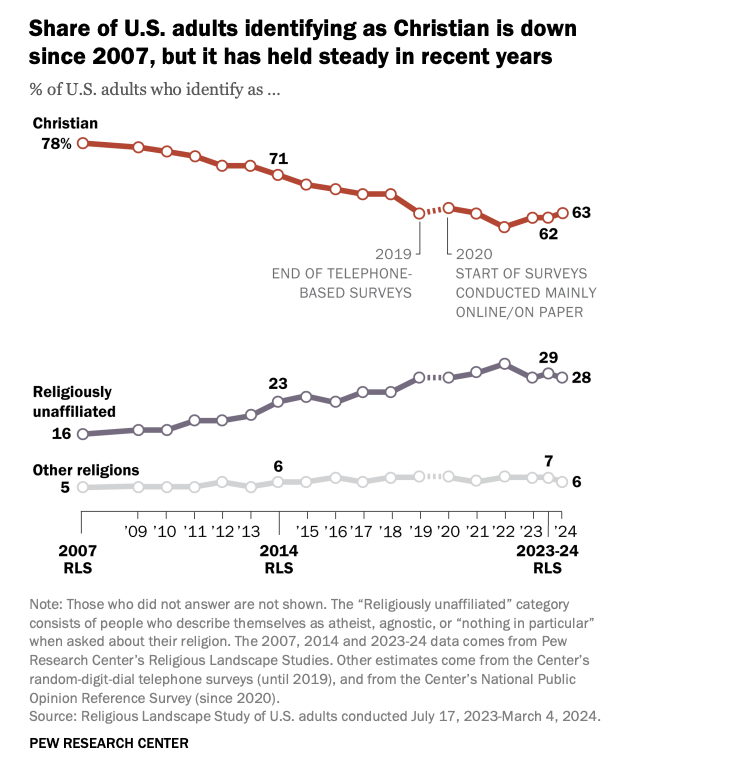
But the latest Pew survey found that the Christian population of the country has been relatively stable since 2019 and the rise of the "nones" or religiously unaffiliated has leveled off, for now.

"After many years of decline, it's very striking … to observe this recent period of stability in American religion," said Gregory A. Smith, senior associate director of research at Pew.

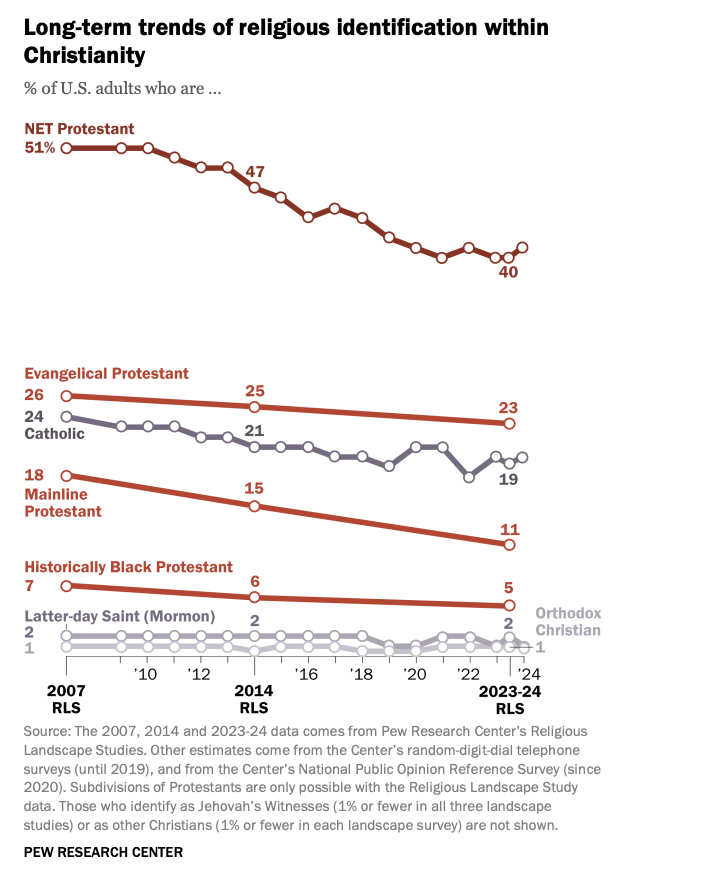
Nearly two thirds of respondents identify as Christians; almost 30% as unaffiliated and 7% belong to religions other than Christianity. The number for Catholics, who make up 19% of the population, are down significantly since 2007, but have been stable since 2014, the report says [see the Pew Research Center graphic below].

But further declines in the religiousness of the American public are likely, as young adults are far less religious than older adults and the "stickiness" of religious upbringing seems to be declining, the report said.

"The forces that undergirded the long-term declines we've seen in American religion are still in place, namely young adults continue to come of age with lower levels of religiousness than their elders, who themselves have grown less religious over time," Smith said.

The survey also found that some religious practices, such as praying and going to religious services, have held fairly steady in recent years. Large majorities maintain spiritual beliefs, in God, that people have a soul or spirit, that there is something spiritual beyond the natural world.

Among Catholics, less than half say religion is very important in their lives, and only 29% say they attend services weekly or more often. Four in 10 say they attend monthly or more often. Nearly half of Catholic attenders go to Mass at a church in which all or most other congregants are white, the report said. Just over a quarter of Catholic attenders go to a church that is mostly Hispanic or Latino, while one in five say they attend a church where no racial group makes up a majority.

Just over half of Catholics say they pray daily, although this is down from 2007 and 2014. Only a third of Catholics say they ever read Scripture outside of church and less than a quarter participate in prayer groups, scripture-study groups or religious education programs.

The infographics are from Pew Research Center's report on its third Religious Landscape Study. 

Monday, November 18, 2024

Four Cabinet selections by President-elect Trump are Catholics


Trump picks several Catholics for Cabinet: Kennedy, Rubio, Stefanik, Ratcliffe


Left to right: John Ratcliffe, Marco Rubio, Elise Stefanik, and Robert F. Kennedy Jr. | Credit: Win McNamee/Getty Images; Chip Somodevilla/Getty Image; MANDEL NGAN/AFP via Getty Images; Jason Mendez/Getty Images

President-elect Donald Trump has chosen several Catholics to serve in his Cabinet and other parts of his administration, including environmental lawyer Robert F. Kennedy Jr., three-term Sen. Marco Rubio, and Rep. Elise Stefanik.

The 45th and soon-to-be 47th president made more than a dozen announcements within 10 days of his electoral victory over Vice President Kamala Harris. Many of his Cabinet nominees and other administration official picks have yet to be announced.

Among the Catholics Trump has chosen for his Cabinet are Kennedy, who was nominated to be the secretary of Health and Human Services; Rubio as secretary of state; Stefanik as ambassador to the United Nations; and John Ratcliffe, nominated as director of the Central Intelligence Agency (CIA).

These four Cabinet-level positions require Senate confirmation. 

Trump also announced he will appoint Tom Homan as the “Border Czar,” a position that does not require Senate confirmation. Homan is a Catholic and was previously the director of Immigration and Customs Enforcement during the president-elect’s first administration.

Robert F. Kennedy Jr. 

Kennedy, an environmental lawyer and the son of former Sen. Robert F. Kennedy and nephew of President John F. Kennedy, was nominated by Trump to lead the Department of Health and Human Services, which oversees 10 agencies, including the Food and Drug Administration (FDA) and the Centers for Disease Control and Prevention (CDC). 

“For too long, Americans have been crushed by the industrial food complex and drug companies who have engaged in deception, misinformation, and disinformation when it comes to public health,” Trump said in his announcement. “... HHS will play a big role in helping ensure that everybody will be protected from harmful chemicals, pollutants, pesticides, pharmaceutical products, and food additives that have contributed to the overwhelming health crisis in the country.”

A lifelong Democrat before launching an independent bid for president of the United States during the 2024 election, Kennedy dropped out of the race in August and endorsed Trump after the former president promised him a health-related role. He is Catholic and credits “a profound spiritual enlightenment” for his recovery from drug addiction in his early adulthood. However, he deviates from Church teaching on life by supporting legal abortions.

Kennedy has been critical of the childhood vaccine schedule. Kennedy has said he would not “take vaccines away from anybody” as secretary of Health and Human Services but that he would promote more inquiry into side effects. He has long been critical of large pharmaceutical companies influencing regulations and the impact that processed food has on the nation’s health.

“I look forward to working with the more than 80,000 employees at HHS to free the agencies from the smothering cloud of corporate capture so they can pursue their mission to make Americans once again the healthiest people on Earth,” Kennedy said in a statement.

Marco Rubio

Trump nominated Rubio, a one-time rival for the presidency, to serve as secretary of state.

“Marco is a highly respected leader and a very powerful voice for freedom,” a statement from the Trump transition team read. “He will be a strong advocate for our nation, a true friend to our allies, and a fearless warrior who will never back down to our adversaries.” 

Rubio has served as a senator from Florida since 2011 and was previously in the Florida House of Representatives. His parents immigrated to the United States from Cuba. He was raised in the Catholic faith at an early age, but his family began attending a Mormon church during his childhood before returning to Catholicism. Although the senator is Catholic, he sometimes attends a Baptist church with his wife. 

“As secretary of state, I will work every day to carry out [Trump’s] foreign policy agenda,” Rubio said in a statement after the announcement. “Under the leadership of President Trump, we will deliver peace through strength and always put the interests of Americans and America above all else.”

Rubio has historically supported a hawkish foreign policy, which is at times at odds with Trump’s campaign rhetoric that is skeptical of American involvement in foreign wars. In recent years, however, he has moved closer to Trump’s view on foreign policy. He was initially in favor of the United States providing aid to Ukraine but voted against the most recent aid bill.

Elise Stefanik

The president-elect nominated Stefanik to serve as the United States ambassador to the United Nations, which primarily represents American interests in the international organization. 

“[Stefanik] was the first member of Congress to endorse me and has always been a staunch advocate,” Trump said in a statement. “... [She] led the charge against antisemitism on college campuses. She will be an incredible ambassador to the United Nations, delivering peace through strength and America First national security policies.” 

Stefanik is the chair of the House Republican Conference, which makes her the fourth-ranking Republican in the chamber. She will be replaced by Rep. Lisa McClain in this role. Stefanik is a strong and vocal supporter of Israeli military action in the Palestinian Gaza Strip and southern Lebanon. She is Catholic and is opposed to abortion but supports same-sex marriage. 

“The work ahead is immense as we see antisemitism skyrocketing coupled with four years of catastrophically weak U.S. leadership that significantly weakened our national security and diminished our standing in the eyes of both allies and adversaries,” Stefanik said in a statement.

“I stand ready to advance President Donald J. Trump’s restoration of America First peace through strength leadership on the world stage on Day 1 at the United Nations,” she said.

Stefanik, like Rubio, has historically been more hawkish on foreign policy but has moved closer to Trump’s views of late. She initially backed American aid to Ukraine but later opposed it. She has previously supported Ukraine joining the North Atlantic Treaty Organization (NATO).

John Ratcliffe

Ratcliffe, who briefly served as the director of national intelligence during Trump’s first term and is a former congressman, will head the Central Intelligence Agency (CIA). 

“From exposing fake Russian collusion to be a Clinton campaign operation to catching the FBI’s abuse of civil liberties at the FISA court, John Ratcliffe has always been a warrior for truth and honesty with the American public,” Trump said in a statement. “When 51 intelligence officials were lying about Hunter Biden’s laptop, there was one, John Ratcliffe, telling the truth to the American people.”

Like Rubio and Stefanik, Ratcliffe has also been historically hawkish. He has been strongly critical of Chinese officials and Iran. He has criticized the Biden administration for not providing more intelligence and military aid to Israel. 

Thursday, May 30, 2024

USCCB releases a report concerning the Synod process in the United States


Synod report for U.S. shows growth, tensions and 'deep desire to rebuild' the body of Christ


Growth, undeniable tensions and "a deep desire to rebuild and strengthen" the body of Christ have emerged as key themes in the latest synod report for the Catholic Church in the U.S.

Released by the U.S. Conference of Catholic Bishops May 28, the "National Synthesis of the People of God in the United States of America for the Interim Stage of the 2021-2024 Synod" summarizes responses from more than 35,000 participants and over 1,000 listening sessions, with 76% of the nation's dioceses and eparchies submitting reports to the U.S. synod team.

In addition, over 350 people met in some 15 listening sessions that focused on church life, social justice and vocations, while U.S. bishops also met for a synod listening session.

Launched by Pope Francis in October 2021, the first session of the 16th Ordinary General Assembly of the Synod of Bishops, organized around the theme "For a Synodal Church: Communion, Participation, Mission," was held Oct. 4-29, 2023, in Rome.

Ahead of the concluding session of the synod, which will take place in Rome in Oct. 2-27, dioceses across the U.S. were asked to hold additional listening sessions during Lent 2024, following a request from the Vatican's Secretariat for the Synod of Bishops. Those responses were incorporated into the newly released synthesis.

"We had to be nimble with the Spirit," U.S. synod team member Alexandra Carroll, who serves as the U.S. bishops' conference communications manager for social mission, told OSV News, adding that even with short notice of the extra sessions, "our diocesan synod leaders took it on and really owned the process."

Fellow synod team members Richard Coll, executive director of the conference's Department of Justice, Peace and Human Development, and the senior adviser for the synod Julia McStravog agreed.

Coll said he was "very, very taken by the commitment that was evident" in the responses to the listening sessions.

"The diocesan directors continue to be very devoted to this path," he told OSV News. "It's a wonderful thing to see, because it is now the third year of this process, but it didn't seem … to me that there was any kind of 'synod fatigue.' People seem to be even more enthusiastic."

"Synodality is really taking root," said McStravog. "People are getting accustomed not only to sharing, but to listening in a deeper way."

In his introduction to the synthesis, Bishop Daniel Flores of Brownsville, Texas — who serves as chairman of the bishops' Committee on Doctrine, and who has shepherded the synodal process in the U.S. — noted that "while no document could cover the full range of topics on the hearts and minds of Catholics" who took part in the listening sessions, the report showed the synodal journey has made progress in the U.S.

Among their insights, many of which were directly quoted in the report, participants expressed "two basic hopes for the church" — that it be both a "safe harbor" and a "fiery communion."

As a "safe harbor," the church can be a place "where the faithful are embraced, sustained and loved," said the synthesis, citing one respondent who observed, "People come when they are broken. … At my parish, I feel I have a family there."

That welcome must be more than "superficial," the report said, pointing to parishes with numerous small communities and prayer groups as being "most successful" in reaching and integrating people from diverse backgrounds. With the church in the U.S. comprising "countless cultural and ethnic groups," the report noted a desire "to promote interculturality, so that there is more unity between cultures that share the same church."

At the same time, respondents described the church as a "fiery communion," with the synodal process digging up a number of tensions within the church.

In particular, a lack of clear communication from church hierarchy and from media, both Catholic and secular, creates confusion and division over what it means to be Catholic — and hinders the church's mission, said synod participants.

That uncertainty can be especially evident when trying to balance welcoming LGBTQ and other marginalized persons while making known the truths of the Catholic faith, said synod participants.

Catholic social teaching was "another area where division was keenly experienced," with "conversations 'on social justice and inclusion … filled with moments of profound pain and generational hurt,'" the report said. "Participants expressed concerns that the church has allowed the ongoing polarization and conflict (in civil society) to lead to a denial of the church's social magisterium in many situations."

The liturgy itself can be a flashpoint for tension, with the celebration of the Mass using the Roman Missal of 1962 (informally known as the "Latin Mass") becoming "a focal point of broader debates about tradition, modernity, and the best ways to nurture faith across the diverse spectrum of Catholic belief and practice," the interim synthesis said.

Another sore spot identified by participants was complacency in many parts of the church, which potentially stands to pave the way for "grave institutional sins such as sexual abuse and racism" — both of which remain "enduring wounds" that "continue to inflict pain today," said the document.

"The trauma and scandal (of the clerical abuse crisis) have had a generational impact," keeping youth and young adults distrustful and desiring an apology "for abuses that happened not to them, but to their parents, grandparents or further generations," the interim synthesis said.

Likewise, the sin of racism, and "the sin of enslaving Black people for the betterment of the church," continue to haunt the church, the report said.

At the same time, the listening sessions revealed a commitment to the importance of evangelization, and the need for catechesis and formation to sustain such witness. Participants also articulated a desire to actively participate in the church's mission, seeking greater co-responsibility for the laity (especially women and young adults) in that task through their "baptismal dignity."

Both clericalism and a lack of vocations to the priesthood and religious life were lamented, as was division among priests, with one priest participant sharing that clergy "need to be better at getting past the bitterness and different theologies and political preferences."

Bishops who attended the listening session also highlighted polarization among priests, with some shepherds likening themselves to "the episcopal referee" among an increasingly diverse clergy, many of whom hail from other countries. The Ukrainian Catholic bishops of the U.S. expressed their gratitude for the positive relationships they enjoyed with the U.S. bishops' conference and the Roman Catholic Church in the U.S., noting that "sometimes the Latin Church in other parts of the world (is) not so accepting and supportive."

The bishops also applauded recent changes in the structure of their biannual meetings, which have facilitated more small group encounters reminding them they are "spiritual brothers and not just ecclesial figures."

On balance, bishops' relations with the Holy See were "generally positive," and although "direct contact with Rome is not very frequent," the report said that the apostolic nuncio, Cardinal Christophe Pierre, has succeeded in "fostering a spirit of communion" and in "facilitating communication with the Holy See." At the same time, the bishops "did express some frustration that communication between bishops and the offices of the Holy See could be better," but described their ad limina visits to Rome — during which they provide the pope with an update on the status of their respective dioceses — as "occasions of fraternity and joy."

The interim synthesis concluded by noting that "a major theme" articulated by participants was "the deepening awareness of how our trust in God expresses itself in relation to our imperfect institutions within the church."

"It was noted by many that the faithful 'should not be embarrassed about recognizing that our church might be a little messy — it's better not to pretend that we are the perfect institution, but that we belong to the perfect and one, true faith,'" said the report.

Carroll, Coll and McStravog told OSV News that the synodal process of listening and dialogue is essential to healing the church's wounds — and that dynamic is for all the faithful, they said.

"Synodality isn't just in Rome or at the USCCB," said Coll. "It's right here. It's with you. It's with all of us."

Saturday, May 18, 2024

Pope Francis in 60 minutes interview says U.S. Catholic conservatives have a suicidal attitude


Pope Francis says US Catholic conservatives have 'suicidal attitude'

(Reuters) - Pope Francis said his conservative critics within the Roman Catholic Church in the United States are trapped in a "suicidal attitude," according to an interview with CBS.

During the April 24 interview with "60 Minutes" that will air this Sunday, Pope Francis was asked his thoughts on the conservative backlash against his papacy, with many of his critics being American clergy members.

Pope Francis responded by saying a conservative is someone who "clings to something and does not want to see beyond that."

"It is a suicidal attitude," the pontiff said, according to a brief transcript excerpt made available by CBS Thursday.

"Because one thing is to take tradition into account, to consider situations from the past, but quite another is to be closed up inside a dogmatic box."

Pope Francis has clashed with the conservative wing almost since he was elected as head of the church in 2013.

Moves conservatives have opposed include papal attempts to make the church more welcoming to the LGBT community and to give lay people more responsibility in the church.

Francis last year dismissed a conservative U.S. bishop who was a withering critic of his papacy, and said the conservative wing in the U.S. church was "reactionary." He also stripped a conservative American cardinal of some Vatican privileges.