Ordinary Time: June 29th
Solemnity of Saints Peter and Paul, Apostles

Today the Church universally celebrates the Solemnity of Saints Peter and Paul, Apostles (d. 64-67). This is a holyday of obligation in some countries. For 2025, the Solemnity supersedes the Thirteenth Sunday in Ordinary Time, following the "Table of Liturgical Days According to Their Order of Precedence" in the General Norms for the Liturgical Year and the Calendar: Solemnities inscribed in the General Calendar, whether of the Lord, of the Blessed Virgin Mary or of Saints are higher (3) than Sundays of the Christmas season and Sundays in Ordinary Time (6).
Veneration of the two great Apostles, Saints Peter and Paul, has its roots in the very foundations of the Church. They are the solid rock on which the Church is built, the origin of her faith and will forever remain her protectors and her guides. To them Rome owes her true greatness, for it was under God's providential guidance that they were led to make the capital of the Empire, sanctified by their martyrdom, the center of the Christian world whence should radiate the preaching of the Gospel.
St. Peter suffered martyrdom under Nero, in A.D. 66 or 67. He was buried on the hill of the Vatican where recent excavations have revealed his tomb on the very site of the Basilica of St. Peter's. St. Paul was beheaded in the Via Ostia on the spot where now stands the basilica bearing his name. Down the centuries Christian people in their thousands have gone on pilgrimage to the tombs of these Apostles. In the second and third centuries the Roman Church already stood pre-eminent by reason of her apostolicity, the infallible truth of her teaching and her two great figures, Sts. Peter and Paul.
A partial indulgence may be gained today by anyone who makes devout use of a religious article blessed by any priest but "if the article of devotion has been blessed by the Sovereign Pontiff or by any Bishop, the faithful, using it, can also gain a plenary indulgence, provided they also make a profession of faith (e.g. the Apostles Creed), as long as the usual conditions are satisfied.
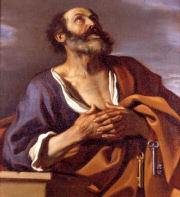 Peter's original name was Simon. Christ Himself gave him the name Cephas or Peter when they first met and later confirmed it. This name change was meant to show both Peter's rank as leader of the apostles and the outstanding trait of his character — Peter (in Hebrew Kephas) the Rock. Peter was born in Bethsaida on the Sea of Galilee. Like his younger brother Andrew, he was a fisherman and dwelt at Capernaum. Peter's house often became the scene of miracles, since the Master would stay there whenever He was teaching in that locality. Together with his brothers John and Andrew, Peter belonged to the first of Jesus' disciples (John 1:40-50).
After the miraculous draught of fish on the Sea of Galilee, Peter received his definitive call and left wife, family, and occupation to take his place as leader of the Twelve. Thereafter we find him continually at Jesus' side, whether it be as spokesman of the apostolic college (John 6:68; Matt. 16:16), or as one specially favored (e.g., at the restoration to life of Jairus' daughter, at the transfiguration, during the agony in the garden). His sanguine temperament often led him into hasty, unpremeditated words and actions; his denial of Jesus during the passion was a salutary lesson. It accentuated a weakness in his character and made him humble.
After the ascension, Peter always took the leading role, exercising the office of chief shepherd that Christ had entrusted to him. He delivered the first sermon on Pentecost and received the first Gentiles into the Church (Cornelius; Acts 10:1). Paul went to Jerusalem "to see Peter." After his miraculous deliverance from prison (Easter, 42 A.D.), Peter "went to a different place," most probably to Rome. Details now become scanty; we hear of his presence at the Council of Jerusalem (Acts 15:1), and of his journey to Antioch (Gal. 2:11).
It is certain that Peter labored in Rome as an apostle, that he was the city's first bishop, and that he died there as a martyr, bound to a cross (67 A.D.). According to tradition he also was the first bishop of Antioch. He is the author of two letters, the first Christian encyclicals. His burial place is Christendom's most famous shrine, an edifice around whose dome are inscribed the words: Tu es Petrus, et super hanc petram aedificabo ecclesiam meam.
—Excerpted from The Church's Year of Grace, Pius Parsch
Patronage: Against frenzy; bakers; bridge builders; butchers; clock makers; cobblers; Exeter College Oxford; feet problems; fever; fishermen; harvesters; locksmiths; longevity; masons; net makers; papacy; Popes; ship builders; shipwrights; shoemakers; stone masons; Universal Church; watch makers; Poznan, Poland; Rome; Diocese of Jackson, Mississippi; Diocese of Las Vegas, Nevada; Diocese of Marquette, Michigan; Archdiocese of Philadelphia, Pennsylvania; Diocese of Providence, Rhode Island; Diocese of Scranton, Pennsylvania. See the full list at CatholicSaints.info.
St. Paul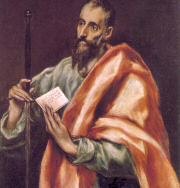 Paul, known as Saul (his Roman name) before his conversion, was born at Tarsus in the Roman province of Silicia about two or three years after the advent of the Redeemer. He was the son of Jewish parents who belonged to the tribe of Benjamin, was reared according to the strict religious-nationalistic party of the Pharisees and enjoyed the high distinction of Roman citizenship.
As a youth he went to Jerusalem to become immersed in the Law and had as a teacher the celebrated Gamaliel. He acquired skill as a tentmaker, a work he continued even as an apostle. At the time of Jesus' ministry, he no longer was at Jerusalem; neither did he see the Lord during His earthly life. Upon returning to the Holy City, Paul discovered a flourishing Christian community and at once became its bitter opponent. When Stephen impugned Law and temple, Paul was one of the first at his stoning; thereafter his fiery personality would lead the persecution. Breathing threats of slaughter against the disciples of Jesus, he was hurrying to Damascus when the grace of God effected his conversion (about the year 34 A.D.; see January 25, Conversion of St. Paul).
After receiving baptism and making some initial attempts at preaching, Paul withdrew into the Arabian desert (c. 34-37 A.D.), where he prepared himself for his future mission. During this retreat he was favored with special revelations, Christ appearing to him personally. Upon his return to Damascus, he began to preach but was forced to leave when the Jews sought to kill him. Then he went to Jerusalem "to see Peter." Barnabas introduced him to the Christian community, but the hatred of the Jews again obliged him to take secret flight. The following years (38-42 A.D.) he spent at Tarsus until Barnabas brought him to the newly founded Christian community at Antioch, where both worked a year for the cause of Christ; in the year 44 he made another journey to Jerusalem with the money collected for that famine-stricken community.
The first major missionary journey (45-48) began upon his return as he and Barnabas brought the Gospel to Cyprus and Asia Minor (Acts 13-14). The Council of Jerusalem occasioned Paul's reappearance in Jerusalem (50). Spurred on by the decisions of the Council, he began the second missionary journey (51-53), traveling through Asia Minor and then crossing over to Europe and founding churches at Philippi, Thessalonia (his favorite), Berea, Athens, Corinth. He remained almost two years at Corinth, establishing a very flourishing and important community. In 54 he returned to Jerusalem for the fourth time.
Paul's third missionary journey (54-58) took him to Ephesus, where he labored three years with good success; after visiting his European communities, he returned to Jerusalem for a fifth time (Pentecost, 58). There he was seized by the Jews and accused of condemning the Law. After being held as a prisoner for two years at Caesarea, he appealed to Caesar and was sent by sea to Rome (60 A.D.). Shipwrecked and delayed on the island of Malta, he arrived at Rome in the spring of 61 and passed the next two years in easy confinement before being released. The last years of the saint's life were devoted to missionary excursions, probably including Spain, and to revisiting his first foundations. In 66 he returned to Rome, was taken prisoner, and beheaded a year later. His fourteen letters are a precious legacy; they afford a deep insight into a great soul.
—Excerpted from The Church's Year of Grace, Pius Parsch
Patronage: Against snakes; authors; Cursillo movement; evangelists; hailstorms; hospital public relations; journalists; lay people; missionary bishops; musicians; poisonous snakes; public relations personnel; public relations work; publishers; reporters; rope braiders; rope makers; saddle makers; saddlers; snake bites; tent makers; writers; Malta; Rome; Poznan, Poland; newspaper editorial staff, Archdiocese of Philadelphia, Pennsylvania; Diocese of Covington, Kentucky; Diocese of Birmingham, Alabama; Diocese of Las Vegas, Nevada; Diocese of Providence, Rhode Island; Diocese of Worcester, Massachusetts. See the full list at CatholicSaints.info.


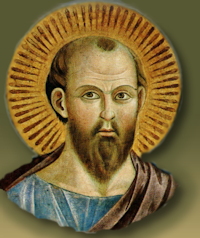
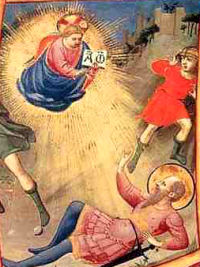 To complete his schooling, St. Paul was sent to Jerusalem, where he sat at the feet of the learned Gamaliel and was educated in the strict observance of the ancestral Law. Here he also acquired a good knowledge of exegesis and was trained in the practice of disputation. As a convinced and zealous Pharisee, he returned to Tarsus before the public life of Christ opened in Palestine.