Showing posts with label NASA. Show all posts

Saturday, July 16, 2022

Vatican Observatory marvels at images from the NASA Webb Telescope


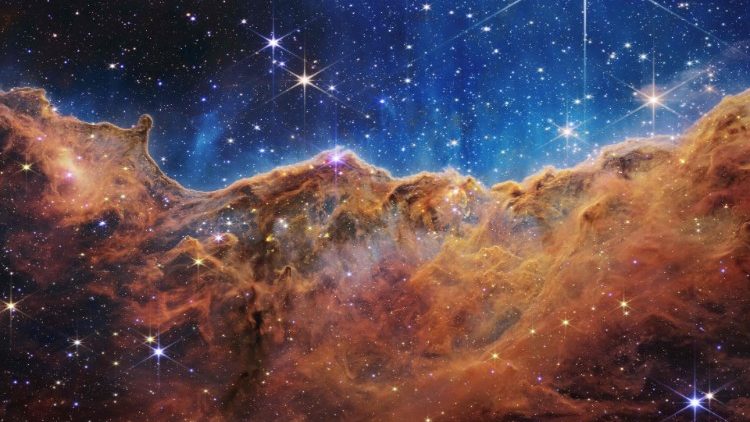
Image released by NASA from the James Webb telescope Image released by NASA from the James Webb telescope  

Vatican astronomer: Webb telescope images ‘beyond a dream’

The Director of the Vatican Observatory, Br Guy Consolmagno SJ, describes the new photos from the James Webb telescope as “jaw droppingly exciting,” images that offer “a tantalizing glimpse of what we’ll be able to learn about the universe with this telescope in the future.”

By Lydia O’Kane

This week NASA unveiled stunning images from the James Webb Space Telescope, saying the most powerful observatory ever launched to space exceeds expectations.

The telescope was built to look farther than ever before, and with greater clarity to the dawn of the universe.

The $9 billion infrared observatory was launched on Dec. 25, 2021 after nearly two decades in the making.

It reached its destination in solar orbit nearly 1 million miles from Earth a month later.

The first image revealed was a "deep field" photo of a distant galaxy cluster, SMACS 0723, showing the most detailed glimpse of the early universe recorded to date.

The new images have been hailed by astronomers, including Br Guy Consolmagno SJ, Director of the Vatican Observatory, who spoke with excitement about the photos, which he said, offer “a tantalizing glimpse of what we’ll be able to learn about the universe with this telescope in the future.”

The Jesuit Brother, an expert in the particular field of planetary astronomy, explained, “we are able to see things that we could never see before because the Webb is designed to look at wavelengths that don’t penetrate the Earth’s atmosphere.” He also said the Webb’s large mirror allows us to see detail that we were previously unable to see.


Food for the spirit

Commenting that these images “are a necessary food for the human spirit,” Br Consolmagno elaborated by recalling his decision, 40 years ago, to join the US Peace Corps, saying to himself, “why am I doing astronomy when there are so many people starving in the world.” He soon found that people in rural Africa, where he was based at the time, were fascinated by the sky, and wanted to know what the rest of the world was finding out. As human beings, “we all have this curiosity about who we are, how we fit into this universe, what’s out there, what’s beautiful… it’s what makes us human,” he said.

The science behind this telescope, noted the Vatican Observatory director, “is our attempt to use our God-given intelligence to understand the logic of the universe. The universe wouldn’t work if it weren’t logical. But as these images show, the universe is not only logical, it is also beautiful. This is God’s creation being revealed to us, and in it we can see both His astonishing power and his love of beauty.”

New generations

He also said that the astronomers involved with the telescope have been given the gift “of being born in the right place at the right time, where they could take advantage of that God given talent… not everybody has that opportunity.”

One of the programmes run at the Vatican Observatory, situated at Castelgandolfo in the Roman Hills, is a biennial Summer School which gives young scientists from around the world an opportunity to learn with the world’s leading experts in astronomy.

Asked what the Webb telescope, and its images mean for new generations of astronomers, Br Consolmagno said it “opens up a whole new window into the origins of the universe and the nature of the atmosphere around other planets, and what it means to be on our planet, and this is something that is being opened up to anyone who is young.”

“I thought it would have been impossible. I wouldn’t have even dreamt that we’d have known about planets around other stars, much less that we could actually measure their atmosphere.”

Future possibilities

Discussing what more we can expect from the Webb, the Jesuit Brother explained that this telescope “is looking both through space and time so that we can see planets around other stars and measure what’s in their atmospheres; we can see stars being formed in distant parts of our own galaxy, and we can see how the galaxies themselves have changed and evolved and grown since they were first made in the Big Bang thirteen plus light billion years ago, at a distance of thirteen billion light years from us.”

Colleagues and friends

Br Consolmagno said there was also a personal reason why he is delighted with this success. “Astronomy is a small field, we astronomers all tend to know one another. Many of the scientists who built the instruments and planned the observations are personal friends of mine.” He also pointed out that two of the instruments on the web telescope were designed at the University of Arizona, which is where the Vatican Observatory has its telescope.

Beyond a dream

Over the decades, the director has witnessed may key events in the field of space exploration, but asked if he ever thought he would be seeing powerful images such as these, he answered, "absolutely not.”

“I thought it would have been impossible. I wouldn’t have even dreamt that we’d have known about planets around other stars, much less that we could actually measure their atmosphere. This is beyond a dream; this is just jaw droppingly exciting for me. I’m turning 70 this year; I only regret that I won’t be around for another 50 years to see what comes up by then.”

Monday, January 28, 2013

It's been 27 years; remembering Challenger

27th anniversary of the Space Shuttle Challenger tragedy

The worst explosion in space exploration
27th anniversary of the Space Shuttle Challenger tragedyThe Challenger Tripulation. SanDiegoRed Services.
The Challenger Tripulation. SanDiegoRed Services.
 
27 years ago, the worst tragedy in space exploration occurred, in which 7 astronauts lost their lives when the space shuttle Challenger exploded after take-off.
The explosion happened 73 seconds after the Challenger was airborne, at around 16km above sea level. And although the crewmembers did not die instantly, like one would think. The cabin did not suffer any damages, but was shot up in the air about 5km more after the explosion, and descended towards the earth at a speed rate of 333km/hr into the sea and disintegrating completely on impact.
Regarding the details about the safety measures of the cabin, the Titanic effect took place, in which NASA had previously felt that an escape system was not necessary, due to that they considered it to be a very safe and secure shuttle.
Among the crewmembers on board was Christa McAuliffe, who was a teacher from Concord, New Hampshire, and winner of the NASA’s “Teacher in Space Program” who would be the first civilian to travel in a space mission.
Astronauts Dick Scobee and Michael J Smith remains were buried in individual graves, and everyone else was buried together at the Arlington National Cemetery.
After this tragedy the space program was put on hold for 32 months, until the space shuttle Discovery was introduced which then soon after the Challenger’s successor the “Endeavour” made its first flight.

Monday, July 23, 2012

Remembering Astronaut Sally Ride; first woman in space

NASA Offers Condolences on the Passing of Pioneering Astronaut Sally Ride

07.23.12


S84-37256: Sally Ride Ride's official astronaut portrait. She joined the astronaut corps in 1978. Credit: NASA Ride floats alongside Challenger's middeck airlock hatch. Ride floats on the shuttle Challenger's mid-deck during her historic STS-7 flight in 1983. Credit: NASA
›View Photo Gallery
In a space agency filled with trailblazers, Sally K. Ride was a pioneer of a different sort. The soft-spoken California physicist broke the gender barrier 29 years ago when she rode to orbit aboard space shuttle Challenger to become America’s first woman in space.

"Sally Ride broke barriers with grace and professionalism – and literally changed the face of America’s space program," said NASA Administrator Charles Bolden. "The nation has lost one of its finest leaders, teachers and explorers. Our thoughts and prayers are with Sally's family and the many she inspired. She will be missed, but her star will always shine brightly."

“Sally was a personal and professional role model to me and thousands of women around the world,” said NASA Deputy Administrator Lori Garver. “Her spirit and determination will continue to be an inspiration for women everywhere.”

Ride’s contribution to America’s space program continued right up until her death at age 61 this week. After two trips to orbit aboard the shuttle, she went on an award-winning academic career at the University of California, San Diego, where her expertise and wisdom were widely sought on matters related to space. She holds the distinction of being the only person to serve as a member of both investigation boards following NASA’s two space shuttle accidents. She also served as a member of the Review of U.S. Human Spaceflight Plans Committee, also known as the Augustine Committee, in 2009, which informed many of the decisions about NASA’s current human spaceflight programs.

However, Ride’s place in history was assured on June 18, 1983 when she rocketed into space on Challenger’s STS-7 mission with four male crewmates.

“The fact that I was going to be the first American woman to go into space carried huge expectations along with it,” Ride recalled in an interview for the 25th anniversary of her flight in 2008. “That was made pretty clear the day that I was told I was selected as a crew. I was taken up to Chris Kraft’s office. He wanted to have a chat with me and make sure I knew what I was getting into before I went on the crew. I was so dazzled to be on the crew and go into space I remembered very little of what he said.”

“On launch day, there was so much excitement and so much happening around us in crew quarters, even on the way to the launch pad,” Ride said. “I didn’t really think about it that much at the time . . . but I came to appreciate what an honor it was to be selected to be the first to get a chance to go into space.”

Ride joined NASA as part of the 1978 astronaut class, the first to include women. She and five other women, along with 29 men, were selected out of 8,000 applicants. The class became known as the “Thirty-Five New Guys” and reported to the Johnson Space Center the next summer to begin training. Ride trained for five years before she and three of her classmates were assigned to STS-7. The six-day mission deployed two communications satellites and performed a number of science experiments.


Following that historic flight, Ride returned to space on another shuttle mission, STS-41G in 1984. The 8-day mission deployed the Earth Radiation Budget Satellite, conducted scientific observations of Earth, and demonstrated potential satellite refueling techniques. She was assigned to a third flight, but transitioned to a role on the Rogers Commission that investigated the Challenger accident after that shuttle was lost in January 1986. When the investigation was completed, she accepted a job as a special assistant to the NASA administrator for long range and strategic planning.

Ride left NASA in August 1987 to join the faculty at the University of California, San Diego, as a professor of physics and director of the University of California’s California Space Institute. In 2001, she founded her own company, Sally Ride Science, to pursue her long-time passion of motivating girls and young women to pursue careers in science, math and technology.

A native of Los Angeles, Ride graduated from high school there in 1968 and enrolled at Stanford University. At Stanford, she earned four degrees, including a doctorate in physics in 1978. She also was an accomplished athlete who played varsity tennis at Stanford after being nationally ranked as a youth.

Ride received numerous honors and awards during the course of her career. Most notably, she was inducted into the National Women's Hall of Fame and the Astronaut Hall of Fame, and received the Jefferson Award for Public Service, the von Braun Award, the Lindbergh Eagle, and the NCAA’s Theodore Roosevelt Award.

Friday, January 28, 2011

Challenger 25 years later: to touch the face of God

Today marked the 25th anniversary of the explosion of the space shuttle Challenger resulting in the death of all 7 astronauts onboard, including school teacher Christa McAuliffe. It was a beautiful but cold Florida morning when the instructions to Challenger could be heard: Challenger, go at throttle up. Immediately, Challenger was gone and you just knew instantly so were the crew.

In the evening President Reagan addressed the nation and became the mourner in chief, helping an entire nation deal with the grief. Speaking of the 7 men and women who gave their lives that day he said: "they slipped the surley bonds of earth and touched the face of God.

This too must be a day and an event in the history of America that we never forget.

http://www.aolnews.com/2011/01/28/nasa-marks-25th-anniversary-of-challenger-disaster/