Showing posts with label Jubilee for Deacons. Show all posts

Sunday, February 23, 2025

Pope Francis prepared a homily for today's Jubilee for Deacons


Archbishop Fisichella celebrates Holy Mass for the Jubilee of DeaconsArchbishop Fisichella celebrates Holy Mass for the Jubilee of Deacons  (VATICAN MEDIA Divisione Foto)

Pope to deacons: ‘Be apostles of forgiveness and selfless servants’

Celebrating Holy Mass for the Jubilee of Deacons, Archbishop Rino Fisichella reads Pope Francis's homily in which he encourages deacons to be apostles of forgiveness, selfless servants and builders of communion. He also asks for prayers for the Pope who is receiving treatment for double pneumonia in Rome's Gemelli Hospital.

By Lisa Zengarini

At Mass for the Jubilee of Deacons, on Sunday, Pope Francis focused his reflection on the theme of gratuity which, he said, is particularly relevant to the diaconate but is also vital for all Christians in their journey of faith.  

The Mass was celebrated by Archbishop Rino Fisichella, the Pro-Prefect of the Dicastery for Evangelization as the Pope continues to be treated at Gemelli Hospital for his bilateral pneumonia.

"Brothers and sisters, and especially you, dear deacons, and you who will soon enter the sacred order of the diaconate through the laying on of hands," said the Archbishop, "it is a particular joy for me to read the Homily that Pope Francis himself would have delivered to all of you on this special Sunday."

"In the Eucharistic celebration, where communion takes on its fullest and most meaningful dimension, we feel Pope Francis—though in a hospital bed—close to us, present among us. This compels us to make our prayer even stronger and more fervent, so that the Lord may assist him in this time of trial and illness," he said.

“[Let's] make our prayer even stronger and more fervent, so that the Lord may assist Pope Francis in this time of trial and illness.”

Forgiveness

Drawing from today’s readings, Pope Francis reflected on three declinations of gratuity, the first of which is forgiveness, summarized by Jesus' command to love our enemies (Luke 6:27).

With this call, the Pope explained, Jesus reminds us that “we need to be able to forgive and to ask forgiveness, to rebuild relationships and even to choose not to withhold our love from those who hurt or betray us” because ”a world that feels nothing but hatred towards its adversaries is a world without hope and without a future, doomed to endless war, divisions and vendettas”, as we sadly see today.

“Forgiveness means preparing a welcoming and safe future for us and our communities.”


Forgiveness is therefore an essential part of the Christian vocation, and of the deacons’ ministry, in particular, that “carries them to the peripheries of our world.”

As models’ of forgiveness the Pope referenced David’s loyalty and restraint towards King Saul who persecuted him from today’s first reading; Saint Stephen, and Jesus Himself, who prays for those who crucify Him and offers salvation to the good thief (Luke 23:34, 43).

Selfless service

The Pope then highlighted selfless service, emphasizing Jesus’ words, "Do good and lend, expecting nothing in return" (Luke 6:35).

Recalling that selfless service is “not a secondary aspect” of their activity but “an essential dimension” of their identity Pope Francis encouraged deacons to serve joyfully and with humility without seeking recognition, thus heeding the example of Jesus who teaches us that greatness comes through serving others (Mark 10:45).

“Through your cooperation and generosity, said the Pope, “you will be a bridge linking the altar to the street and the Eucharist to people’s daily lives.”

“Charity will be your most beautiful liturgy and the liturgy your humblest service.”

Communion

The third aspect of gratuity the Pope mentioned was communion, which is “nurtured” by giving freely without expecting anything in return.

Communion, he remarked, is built by extending their mission and embracing the poor, the “treasures of the Church”, as Saint Lawrence, their patron saint said.  Deacons express communion by making others feel valued and included, not just with words but through their actions. “Your mission sets you apart from society only to be re-immersed in it in order to enable it to be an ever more open and welcoming place for everyone,” the Pope said.

Humility

Finally, Pope Francis turned to those preparing for priesthood, urging them not to consider their priestly ordination not as a "promotion" to a higher status but rather as a “descent” into humility, because ordination is about lowering oneself to serve others.

Concluding, Pope Francis entrusts deacons to the Virgin Mary, and to Saint Lawrence, their patron so o they may become apostles of forgiveness, selfless servants of our brothers and sisters, and builders of communion.

Friday, February 21, 2025

Deacons converge in Rome for Jubilee 2025


The proclamation of the Word of God, one of a deacon's sacred tasksThe proclamation of the Word of God, one of a deacon's sacred tasks  (VATICAN MEDIA Divisione Foto)

6,000 pilgrims arrive in Rome for Jubilee of Deacons

The fourth major event of the Jubilee of Hope is dedicated to deacons: from February 21 to 23, 4,000 of them will be in Rome to pass through the Holy Door and participate in a series of meetings. The Jubilee will conclude with Mass presided over by the pro-prefect of the Dicastery for Evangelization, Archbishop Rino Fisichella, on Sunday February 23 in St Peter’s Basilica.

By Jean-BenoĆ®t Harel 

Etymologically, the word 'deacon' means “servant”.

4,000 of these “servants”, together with 2,000 others, are gathering in in Rome for three days, starting this Friday, February 21.

The deacons are coming to Rome for a Jubilee pilgrimage from over a hundred countries, including the United States, France, Brazil, India, Cameroon and Australia.

However, the “Servant of the Servants of God”, Pope Francis, will not be present: he has been in hospital for the past week at Rome's Gemelli Hospital.

Prayer vigil

The event kicks off this Friday in 12 of Rome's churches, with prayer at 3:30 p.m., followed by a series of meetings on the theme “Concrete signs of hope in diaconal ministry”.

On Saturday morning, Jubilee participants will be able to pass through the Holy Door of St. Peter's Basilica, one of the conditions for receiving the plenary indulgence granted during the Jubilee year, while a conference on the role of deacons in the Synodal Church will be held in the Auditorium de la Conciliazione, from 9:30 a.m. to 1 p.m.

The day will conclude with a prayer vigil in the Vatican's Paul VI Hall.

On the final day, Sunday February 23, 23 deacons will be ordained during a mass in St. Peter's Basilica, presided over by the pro-prefect of the dicastery for evangelization, Archbishop Rino Fisichella.

Becoming pilgrims of hope

“This Jubilee will strengthen our faith and help us to reach out even more to those on the peripheries.”

That’s the hope of FranƧois Fayol, a deacon in the diocese of CrĆ©teil, France, who is taking part in the Jubilee with France’s National Diaconate Committee (CND).

The three days in Rome will be a time of encounter, prayer and renewal for the 4,000 deacons and their families.

Archbishop Bertrand Lacombe, who is accompanying the CND during its Jubilee visit to Rome, adds that “we come bearing what we have in our hearts – charity, liturgy and the Word”.

“Let us be surprised by the way we become ever more ‘pilgrims of hope’,” the Archbishop urged, “first here in Rome, and then on our return to France.”

Saturday, June 11, 2016

From Rome: A Catechesis for the Jubilee for Deacons

During the Jubilee for Deacons in Rome, all the Permanent Deacons and their wives, were given several opportunities to hear powerful presentations at some of Rome's holiest sites.  Our Archdiocese was represented by 18 of our brother Deacons and our director, Deacon Ray Duplechain, has forwarded to all us these powerful presentations.

This first one is by James Keating and focuses on The Deacon and The Family!

Here is a very brief excerpt:

Each deacon is formed in the Word of God, desires to pray his life through the Scriptures until death, and longs to have the Gospel be the heart of his—and all people’s—imagination. The deacon derives his ministerial grace from the Sacrament of Holy Orders, as Christ configures the deacon’s heart to his own mysteries of mission and service. As the deacon subjectively maintains union with Christ through prayer and ministry, he continues through the grace of ordination to be objectively affected by Christ’s own servant mysteries. It is this same deacon who also identifies himself as spouse and father.[2] As such, the deacon is a man submerged in relationships of love, of self-gift, through spousal love, fatherhood, and Holy Orders. These relationships of love bestow upon him an identity, one that he is charged by virtue to protect and develop.

And here is the link to the entire presentation:


Please continue to pray for your Permanent Deacons and their wives who give so generously of their time and talent to the Church.

Sunday, June 5, 2016

Deacon Greg Kendra's address to the Permanent Deacons in Rome last week for the Jubilee for Deacons

The Deacon as Image of Mercy in Promoting the New Evangelization at Work


The Deacon as Image of Mercy in Promoting the New Evangelization at Work
by Deacon Greg Kandra
A few years ago, Cardinal Walter Kasper wrote about leadership in the Church, and he turned his attention to permanent deacons.
“It is the deacon’s special call,” he wrote, “to be on the front line.”
Webster’s defines “front line” as “a military line formed by the most advanced tactical combat unit… an area of potential or actual conflict or struggle.”
For some of us, that may sound like just another day at the parish.
But Cardinal Kasper had something else in mind: the “front line” of daily living. The front line is an office, a restaurant, a bank. It’s where we live, and where we work. And in the workplace, it can be dangerous—landmines are everywhere, made of ego and gossip and competition and stress. And often, the deacon is right there—in the foxhole, striving to bring the grace of Holy Orders to a world often lacking in either grace or order.
And that’s just where we should be, because this is what we were ordained to do.
At ordination, the deacon is literally handed the Gospel, and charged to “practice what you teach.” Well, very often it is in the work world where we truly put that teaching, put the Gospel, into practice.
This evening, I want to reflect on how this is done, and how the deacon can best approach “the front line” with a heart of mercy.
I hasten to add: I come to you not as an academic or a theologian. I’m not a scholar. I’m simply a deacon and a worker—a journalist and writer whose “frontline” has been newsrooms and TV studios. But like all of you, I am also a missionary.
The Directory for the Ministry and Life of Permanent Deacons, put it this way: “The deacon’s ministry of service is linked with the missionary dimension of the Church…Mission includes witness to Christ in a secular profession or occupation.”
Reflecting on this, and the “ministry of service,” I kept thinking about one moment in the Gospels: Jesus at the Last Supper, a defining moment which beautifully illustrates “the one who came not to be served, but to serve.” In St. John’s Gospel, we encounter Christ in an apron, washing the feet of his followers, and we hear those challenging words: “I have given you a model to follow.”
Well, this moment is our model, a model of diakonia, Christ the Servant. But it is also a model of Christ the Worker: Son of God but also Son of Man—the son of Joseph, the carpenter. Here is an image of Jesus as a humble laborer.
I think it is an image to embrace during this historic moment in the life of the church, this Jubilee of Mercy—and for this simple reason: It is an image of mercy.
If a deacon wants to understand how to reflect mercy in the workplace, it begins here: We need to wash one another’s feet.
We do this in many ways in our lives and our ministry. But I’d like to suggest three ways that have special bearing in the workplace.
It all goes back to something I mentioned earlier: being a witness.
First, the deacon is called to be a witness to compassion. Last year, a young entrepreneur named David Williams wrote in Forbes magazine that he believes the least understood leadership trait in the workplace isn’t time management or budgeting or knowing how to run a spreadsheet.
No. The least understood leadership trait…is forgiveness.
He said the small company he founded flourished when all its members learned the value of forgiveness—how to give one another a second chance. He quoted Abraham Lincoln, who said, “The man who can’t make a mistake can’t make anything.”
Being able to forgive is key to practicing mercy. But there can be no forgiveness or mercy without, first, compassion.
In his ministry of charity, the deacon often reaches out to those who are hungry or poor. But we cannot forget: there are many kinds of hunger, many kinds of poverty.
There are those who hunger for hope. Or respect. Or friendship. Others suffer from poverty of the soul. These poor may be closer than we realize. You may see them every morning on the elevator, or the subway. They might work in the cubicle next to yours.
When I was in formation, a priest told us about a monk at a monastery who had gotten into some sort of trouble. He was being disciplined. The other monks wanted nothing to do with him. He ended up eating all his meals in the refectory alone. But one of his brother monks saw that he was hurting. He decided to do something a little courageous. He started to sit next to the other monk during meals. They would eat together, just the two of them, in silence. In this way, the monk was made to feel a little less alone, a little less ashamed.
With that gesture, that small act of compassion, one man did more than just keep another company. He washed his brother’s feet.
The deacon is called to do just that, to be a model of Christ—especially toward the marginalized, the troubled, the lonely, the outcast. Even in the workplace, especially the workplace, the deacon is called to be a witness to compassion.
Secondly, the deacon is called to witness to the dignity of work—and the dignity of the worker.
That means standing up for just wages and just working conditions, but that also means being an instrument for God’s grace. It means being leaven in the world.
At work, that means quieting gossip. Honoring privacy. Intercepting the rude joke or the sarcastic e-mail. Listening to grievances. Speaking up for those who may not have a voice. Those at work who know we are deacons, that we are ordained clergy, expect that—and, whether they will admit it or not, they hold us to a higher standard.
One way to try and live up to that standard is by remembering that work is not only honorable; it is, in fact, holy.
Seventy years ago, young Karol Wojtila labored long hours in a stone quarry. It was arduous, back-breaking, soul-crushing work. Yet decades later, as Pope John Paul, he wrote that labor uplifts us. It draws us closer to God. “By means of work,” he wrote, “man participates in the activity of God himself, his Creator.” Work, he explained, offers “a particular facet of man’s likeness with God.”
Recently, a Franciscan priest, Fr. Brian Jordan, celebrated a special Mass at St. Patrick’s Cathedral in New York for construction workers. And he said something beautiful. “Our hands,” he said, “are sacred. Not just my hands as a priest, or as a piano player, as a violin player…Everyone here who works, you have sacred hands.”
Think of that. Think of the hands that lay the bricks, or answer the phone, or seal the envelope, or wash the dishes. The hands that dry the tears, or change the bandages. They all reflect “a facet of man’s likeness with God.”
In honoring the hands that work, the deacon extends to others the work of his own hands—those hands of his that carry God’s Word, hands that bring people the Eucharist, hands that raise the chalice containing the Precious Blood.
This, too, is part of who we are: in the humblest sense, we are men ordained to be vessels, conveying Christ to others.
How fitting that we gather this weekend just hours after Pope Francis made that idea manifest, with the Corpus Christi procession through the streets of Rome. The Deacon is ordained to do that in a unique and grace-filled way where he lives and where he works. The deacon can never forget that night of the Last Supper, when the hands that blessed and broke the bread also washed the feet.
Sometimes, in the workplace culture, people may see the deacon as counter-cultural, living in two worlds, “different.” But that very difference can be illuminating and helpful. He’s the one they go to with questions about the pope, or the saints, or that mysterious grey smudge you have on your forehead on a Wednesday in February.
He might also be the one they go to when a teenager is in trouble, or a marriage is strained, or someone just needs a strong shoulder and a sympathetic ear. The front line is a place where many people suffer from battle fatigue or shell shock.
Simply by his presence, the deacon is there to serve them. And in that service, he may become a foot soldier of the New Evangelization.
Do not underestimate the impact this can have—or the boundless creativity of the Holy Spirit. Some of the most important missionary activity in the world today may begin in unlikely places: not in a jungle or a desert or a far off country, but around the water cooler, or on a bus, or over coffee in the company cafeteria.
And it may happen because a deacon was on the job.
Finally, the deacon stands as a witness to God’s continuing presence in the world. Looked at another way: What began at the altar on Sunday continues in the workplace on Monday. Because we are never not deacons. The ministry never ends. And neither does the mission.
That may take us where we never expected.
In the summer of 2014, Liberia was facing the worst Ebola outbreak in history. Thousands were dying. Thousands more were critically ill. The country found itself cut off from the rest of the world, as people became terrified that an international pandemic was about to break lose. Dr. Timothy Flanigan, an infectious disease specialist from Providence, Rhode Island, felt the need to do something.
But Timothy Flanigan isn’t just a doctor. He’s also a deacon. And it was Deacon Timothy Flanigan who responded to the need at that moment as much as Doctor Timothy Flanigan.
After talking it over with his wife, his family and his pastor, he did something exceptional. Deacon Flanigan boarded a plane and flew to Liberia on one of the last flights available, before air traffic was suspended. He spent two months there, helping to contain the outbreak and re-open a closed hospital. He did this at great personal risk, knowing that he could possibly become infected himself.
For countless suffering people, Deacon Tim Flanigan became not just a healing presence, not just a doctor. He became the face of Christ.
In interviews after his return, Deacon Flanigan spoke of the power of prayer, but he also spoke of how the faith of the people sustained him. It was profound. They regularly attended Mass and Adoration. They never gave in to despair. He felt blessed to participate with them and absorbed this lesson from his experience: “God,” he said, “does not abandon us. God is always present.”
God is always present.
That, in four words, summarizes the deacon’s great mission in the missionary field of work. To a world that is weary, or frightened, or grieving, or overworked, or underappreciated, the deacon carries that simple message of hope. God is always present.
We can’t all fly to Liberia to fight Ebola. But I’m reminded of what Mother Teresa used to tell people who would show up at her door in Calcutta, volunteering to help. She would tell them: “You don’t need to be here. Find your own Calcutta.”
So it is with all of us. Calcutta is Brooklyn. It is Beverly Hills. It is where all of us live and struggle and suffer and hope. It could be in the cubicle next door, or the office down the hall.
Who are the poor, the hungry, the lepers in our own lives?
In his prayer for the Jubilee of Mercy, Pope Francis wrote: “Lord Jesus Christ, let the Church be Your visible face in the world, its Lord risen and glorified.”
In other words, let the Church — let us— be the face of mercy.
As deacons, are called to do that, and in places where it is needed the most—on “the front line” of the world. Let us, then, make this our prayer:
Lord, put us to work.
Lead us to the front line.
Lead us to those whose backs are weary, whose hands are worn, whose hearts are heavy from the work they do—and help us stand with them and work with them.
Help us remind the world of the dignity of work—and may we never tire of bending to wash the feet of your children.
Put the hands that serve at your altar to work serving the world.
Lord, help us to see the entire world as Your cathedral, and every desk an ambo, every table an altar, every sidewalk a sanctuary, every face in the crowd another person hungry to receive Christ.
Help us to help You to uplift the world with Your grace.
Help us, Father, to be witnesses of mercy.
Your servants are waiting.
Lord, put us to work.
Amen.

Wednesday, June 1, 2016

A nice look back on an intimate gathering of a few Deacons and wives with Joan Lewis from Rome

Looking back to last week and the Jubilee for Deacons I found this charming article by Joan Lewis, the EWTN Rome correspondent.  She had several Permanent Deacons from the USA over on Sunday evening and one of them is Dan Borne from the Diocese of Baton Rouge.  He spent several months in formation with us in the Archdiocese of New Orleans and is the stadium voice of the LSU Tigers!!  Deacon Greg Kendra is my, and many others, go to Deacon in the world of Deacons blogging.  He actually met the Pope one-on-one this past Sunday.  As did Deacon Harold who has his own TV series from time to time on EWTN and is not shy about sharing the diaconate. The other couple I know of the wife more than the Deacon as I enjoy her morning radio show on my drive in to work most mornings.  Joan does a great job with this post.  Enjoy:


A MINI JUBILEE OF DEACONS – A SHORT HISTORY OF THE PERMANENT DIACONATE


Today, Memorial Day, is a holiday for EWTN staff and I was going to take the day off but have postponed it in order to share with you the story of four permanent deacons, their wives and families. Today, for upcoming editions of “Vatican Insider,” I interviewed two of the four who graced my home last night, Deacon Dan BornĆ© of Baton Rouge and Deacon Harold Burke-Sivers of Portland. Below is a brief account of that mini Jubilee and a few photos.
A MINI JUBILEE OF DEACONS
When one of Lexington, Ohio’s own indicated that, as a permanent deacon, he would be in Rome for the Jubilee of Deacons, richlandsource.com did a story about the Jubilee, beginning with these words: In more than 2,000 years of its existence, the Catholic Church has never hosted an event specifically addressing deacons — the dispensers of charity for the Christian community.
That rather startled me and, as I looked back over the years I worked for the Vatican and these last years that I have covered the Vatican and papacy, I did not remember a single event focusing solely on deacons. That fact alone doubled my interest in the just-concluded Jubilee of Deacons, given that I know so many permanent deacons.
I decided to invite four deacons to my home to celebrate the final day of their Jubilee, a day that started with Mass in St. Peter’s Square presided over by Pope Francis.
Two of my four guests were deacons whom I’ve know some time: Dan BornĆ© who was with his wife, Lissette (who did a beautiful second reading at the papal Mass) and Dom Pastore, Teresa Tomeo’s husband. The other two deacons were men I’d only “met” through the media – by reading their blogs and Facebook pages an learning of their travels and speeches and retreats and so much more: Greg Kandra and his wife Siobhain (pronounced Shevawn) and Harold Burke-Sivers (his wife Colleen was in Portland preparing for next weekend’s graduation of their oldest daughter Clare.
Dan, Lissette and Deacon Harold –
20160529_194256
I had prepared some snacks to enjoy with the magnum of champagne I’d received on my birthday last year but should have prepared a pasta dinner, tossed salad and some dessert! My guests arrived promptly at 6:30 and no one made a move to say good night until 9:30!
Greg and Siobhain
20160529_194438
The conversation was stimulating, enlightening and full of surprises – mainly for me, I am sure, but I could tell that, as each deacon shared part of their story or made comments about the diaconate that the others were learning as well. Four stories, but eight lives. Four dioceses, four bishops, four different ways of understanding and living the permanent diaconate.
Teresa and Dom
20160529_194326
I learned so very much last night about the permanent diaconate and about the wonderful men who dedicate their lives – every moment – to God – to the ministry of diaconate and also to their marriage, their wives, their families. A “vocation within a vocation” as Deacon Harold called it.
20160529_194551
If you look at Church statistics, this is a ministry that is growing by leaps and bounds around the world.
I was in the company of four enthusiastic men who love their ministry and love their wives, wives who share deeply in both vocations, the vocation of marriage and that of the diaconate.
20160529_194403
What we all shared last night were the stories of four men and how they felt called to the diaconate, how they lived the years leading up to ordination with their wives and families, the role of wives in this ministry, how the perception of the permanent diaconate has changed over the years (Deacon Harold has been a deacon the longest at 14 years), and the Jubilee experience in Rome (the talks they gave and attended, the Papal Mass, Francis’ homily, etc).
These topics and others were also the focus of the interviews I did today with Dan and Harold for Vatican Insider. It is not my intent here to re-live last evening – we’ll do that in a way in the interviews.
I have such admiration for these four men and there are tens of thousands like them around the world. Three thousand were in Rome for the Jubilee and Greg, Dom, Dan and Harold all said they are going home with a greater insight into the ministry of the diaconate, especially as it is experienced around the world.
I felt privileged at the end of the evening to have shared several hours with such amazing people, 4 deacons, 3 wives (I did not meet Deacon Harold’s wife but what he told me today was the story of a loving, caring, spiritually gifted, amazing woman – rather like what I saw last night!)
May God bless you all – the deacons I know but who were not in Rome and especially the four who graced my home.
Thanks for being in my life and for making a difference in so many lives!
A SHORT HISTORY OF THE PERMANENT DIACONATE 
The following paragraphs are excerpts from the website of the Diocese of Fall River, Office of the Permanent Diaconate. They offer a brief, comprehensive and easy to read history of the diaconate. There are the orders of ordianed ministry: deacon, priest and bishop. (http://www.frpermanentdiaconate.com/the-permanent-diaconate/a-brief-history-of-the-perm.html)
“From the earliest days of the Christian Church the deacon has been intimately associated with the ministry of the Bishop and Priests. In the primitive Church of the Apostolic and Post Apostolic age, as witnessed to in the Christian Scriptures, the deacon was described as a minister in the liturgicalassembly and preacher of the word. The deacon prepared catechumens for entrance into the Church and was a dispenser of aid and food to the poor and distressed. The very term “Diakonia”announces the central characteristic of this Order, the deacon is called to service. …”
“After the fifth century there was a steady decline in the permanent diaconate in the Latin Church. From the early Middle Ages the diaconate remained only as a traditional order that men received as part of their preparation for ordination to the sacred priesthood. There were occasional exceptions to this rule hover, Saint Francis of Assisi, for example, was ordained a deacon but not a priest. In the sixteenth century the Council of Trent directed that the permanent diaconate should be restored to the Latin Church but this directive was not carried into effect. The reality was that the permanent character of this Order was abandoned by the Latin Church for many centuries.
“The permanent character of the Order, however, was restored and renewed when the Second Vatican Council (October 30, 1963) called for the reestablishment of the ministry of the Permanent Deacon for the Universal Church. On 18 June 1967, Pope Paul VI carried out the desire of the Council when he published the Apostolic Letter Sacrum diaconatuus ordinem in which he reestablished the permanent diaconate in the Latin Church.  The Council, in its Dogmatic Constitution of the Church (Lumen Gentium 29), echoes the ancient image and concerns of the New Testament when it speaks of the ministry and nature of the diaconate:…”

Monday, May 30, 2016

Deacon Bill Ditewig captures perfectly the mission of Deacon as shared by Pope Francis at the Jubilee for Deacons

Holy Jubilee and Deacons: “Proclaim and Serve”


unnamed-2-740x493The Extraordinary Jubilee of Mercy focused over the last few days on the ministry of deacons.  Today the Holy Father celebrated Mass in Saint Peter’s Square and thousands of the world’s deacons were there.  The Holy Father’s homily is a short but powerful lesson in diakonia.
In one sense, Pope Francis picks up where St. John Paul II left off sixteen years ago at the 2000 Jubilee.  In his address to deacons during this audience with us, Pope John Paul challenged deacons to be “active apostles of the New Evangelization.”  Today Pope Francis began his homily by quoting St. Paul:
“A servant of Jesus Christ” (Gal 1:10). We have listened to these words that the Apostle Paul, writing to the Galatians, uses to describe himself. At the beginning of his Letter, he had presented himself as “an apostle” by the will of the Lord Jesus (cf. Gal1:1). These two terms – apostle and servant – go together. They can never be separated. They are like the two sides of a medal. Those who proclaim Jesus are called to serve, and those who serve proclaim Jesus.
Active apostles, active servants: no better challenge for deacons!  Not surprisingly Pope Francis reflects what Pope-emeritus Benedict once referred to as “the great et. . .et” (both-and) as contrasted to “aut. . . aut” (either-or).  Pope Benedict was responding to a question from an older priest who had recalled that his seminary spiritual director had once criticized him for preferring playing football over studying, and Pope Benedict rather humorously reassured the priest:
Catholicism. . . has always been considered the religion of the great “et. . . et” [“both-and”]: not of great forms of exclusivism but of synthesis. The exact meaning of “Catholic” is “synthesis”. I would therefore be against having to choose between either playing football or studying Sacred Scripture or Canon Law.
DEACONS JUBILEE MASS
Today, Pope Francis says the same thing about apostles and servants.  We are called to be both, not one or the other.  His simple simile captures it perfectly: apostle and servant “are like the two sides of a medal.”  “A disciple of Jesus cannot take a road other than that of the Master. If he wants to proclaim him, he must imitate him. Like Paul, he must strive to become a servant. In other words, if evangelizing is the mission entrusted at baptism to each Christian, serving is the way that mission is carried out.”
Pope Francis offers three ways deacons can live this great “et. . . et” in our lives:
  1. Be Available.  Most deacons I’ve known over the years readily joke that there’s no such thing as a deacon’s “day off”!  Between responsibilities for our families, our various jobs and professions, as well as ministries, most deacons wouldn’t know what a real “day off” feels like, any more than we can take a “sabbatical” from any of those responsibilities.  I’m sure that Pope Francis’ words touched many a deacon and his family when he observed:
A servant daily learns detachment from doing everything his own way and living his life as he would. . . . [He] has to give up the idea of being the master of his day. He knows that his time is not his own, but a gift from God which is then offered back to him. Only in this way will it bear fruit. One who serves is not a slave to his own agenda, but ever ready to deal with the unexpected, ever available to his brothers and sisters and ever open to God’s constant surprises.
The pope had some words about trying to keep to a “timetable” for service, too:
One who serves is not worried about the timetable. It deeply troubles me when I see a timetable in a parish: “From such a time to such a time”. And then? There is no open door, no priest, no deacon, no layperson to receive people… This is not good. Don’t worry about the timetable: have the courage to look past the timetable. In this way, dear deacons, if you show that you are available to others, your ministry will not be self-serving, but evangelically fruitful.
2.  Be Meek.  Using the example of the centurion who pleads with Jesus to save his servant, the pope stresses that even though the centurion was a man in authority, he was also a man under authority.  The centurion could have thrown his weight around to get help for his servant, but he did not: he approached the Lord meekly and in acknowledgment of Christ’s authority, power, and mercy.  “Meekness,” says Francis, “is one of the virtues of deacons.”
When a deacon is meek, then he is one who serves, who is not trying to “mimic” priests; no, he is meek. . . .  For God, who is love, out of love is ever ready to serve us. He is patient, kind and always there for us; he suffers for our mistakes and seeks the way to help us improve. These are the characteristics of Christian service; meek and humble, it imitates God by serving others: by welcoming them with patient love and unflagging sympathy, by making them feel welcome and at home in the ecclesial community, where the greatest are not those who command but those who serve (cf. Lk 22:26). And never shout, never. This, dear deacons, is how your vocation as ministers of charity will mature: in meekness.
3.  Be Healed.  Finally, Pope Francis turns to the example of the servant whom Christ heals.
The Gospel tells us that he was dear to his master and was sick, without naming his grave illness (v. 2). In a certain sense, we can see ourselves in that servant. Each of us is very dear to God, who loves us, chooses us and calls us to serve. Yet each of us needs first to be healed inwardly. To be ready to serve, we need a healthy heart: a heart healed by God. . . .  .
Dear deacons, this is a grace you can implore daily in prayer. You can offer the Lord your work, your little inconveniences, your weariness and your hopes in an authentic prayer that brings your life to the Lord and the Lord to your life. When you serve at the table of the Eucharist, there you will find the presence of Jesus, who gives himself to you so that you can give yourselves to others. . . ,  to encounter and caress the flesh of the Lord in the poor of our time.
Those final words echo the promise we make at ordination.  The bishop asks, “Are you resolved to shape your way of life always according to the example of Christ, whose body and blood you will give to the people?”  We respond:”I am, with the help of God.”  This Jubilee — this holy season of Mercy — gives us a chance to re-affirm that promise:
“I am, with the help of God!”

Sunday, May 29, 2016

Homily For the Solemnity of Corpus Christi and the Jubilee for Deacons

A couple of weeks ago I had the incredible privilege of preaching at my daughter's wedding.  In my homily I referred to a beautiful song that the children's choir sings at Most Holy Trinity Parish: Love, Love, Jesus is Love, God's greatest gift is the gift of Love.  All creation sings together praising God for Love.  Today we celebrate anew that Love.  In this Solemnity of the Most Precious Body and Blood of Christ, we celebrate Love.  So much Love for us that God sent us a Savior in the person of His Son.  Becoming flesh and dwelling among us; Jesus is love!  Teaching, preaching and healing; Jesus is love!  Emptying Himself on dying for us on the Cross, stretching out His arms between Heaven & Earth; Jesus is Love!  Rising from the dead and opening for us the gates of Heaven; Jesus is Love!  And today, in the Eucharist, the Real Presence of His Body & Blood, Jesus is Love!

Today we hear St. Paul telling us that he received what was handed on to him, the celebration of the Eucharist as 1st occurred at the Last Super on that Holy Thursday night.  And that same Eucharist is handed on to us today.  At every Mass, we have the consecration of those simple gifts of bread and wine as they become the real Body and Blood of Jesus Christ.  We understand that this is not a new sacrifice or re-crucifying Jesus; no!  By the grace of God, time and space is suspended and every Mass is a celebration of that one Sacrifice on the Cross, re-presented in an un-bloody manner.  All of us, in the proper state of grace, can participate in the worthy reception of Jesus, really present, really His Body and Blood!

We must recall that worthy reception means being free of mortal sin, therefore it is expected that we will make a good confession before receiving Jesus if mortal sin exists.  We also want to participate fully in the celebration of the Mass in which we are to receive Jesus an we also remember before Communion to forgive those who have hurt us.  When we go to Communion we should remember that we receive, not take, therefore we should receive the Sacred Host reverently in a true spirit of thanksgiving.  And the same from the Chalice, if the Chalice is available to us.  Now that we have received Jesus in Holy Communion, now what?  Do we leave Mass and become what we believe; do we become what we received?  For us, nourished by the Body and Blood of Jesus Christ, we must be ambassadors of Christ in the community, the workplace, out there, among those who perhaps do not believe or simply do not know what they are missing.  And we must witnesses of great joy because, as the song tells us, I received the living God and my heart is full of Joy! 

Today is also a day of great joy for the Permanent Deacons around the world and the four of us who serve you in this wonderful parish of St. Jane de Chantal and St. Michael's Mission.  This weekend is the celebration of the Jubilee for Deacons.  Just this morning, Permanent Deacons from across the world gathered with Pope Francis for Holy Mass in St. Peter's Square.  In this Jubilee Year of Mercy our Holy Father wished to remind the faithful that the Deacon is the minister of mercy, the minister of charity, the minister of service.  Deacons are indeed ordained ministers of Holy Mother Church and receive the Sacrament of Holy Orders upon ordination.  While they assist at Mass, where most of the faithful see us in action, it is the Deacon's charge to minister all week long in nursing homes, hospice care, food banks, jails and prisons, juvenile detention facilities, hospitals, in the streets, among the poor and broken-hearted and in so many other ways.  Our presence here on Sundays at the altar of the Lord sacramentalizes the service shared with the people of God all week long.  Here in the parish, in addition to seeing us at Mass, your Deacons prepare couples for marriage, assist those seeking annulments, help families prepare for baptism, lead prayer groups, Bible studies and offer spiritual direction.  The Deacon serves as an icon of Christ the Servant, who came to serve and not be served.  We honor the service of Deacon Frans LaBranche, ordained in 1981, Deacon Don Bourgeois, ordained in 1989, Deacon Mark Coudrain, ordained in 2006 and yours truly, ordained in 2008.  We also remember those Deacons who, as members of this parish, went on to service elsewhere, Deacons Ed Kelly, Steve Ferran, Norbert Billiot and Kenny Uhlich.

It is a joy for all of us to serve each of you as Permanent Deacons and our prayer that perhaps someone listening to this today may be called to the Diaconate.  Please feel free to contact any one of us for answers, prayers, encouragement and support.  May we also remember to serve and never be served and in the Eucharist, receive Him who we give back to you in our charity, mercy and service!

Hot off the Vatican Press: The Holy Father's Homily for the Jubilee for Deacons

Pope’s Homily at Jubilee for Deacons
‘Available in life, meek of heart and in constant dialogue with Jesus, you will not be afraid to be servants of Christ, and to encounter and caress the flesh of the Lord in the poor of our time’
Papa giubileo diaconi
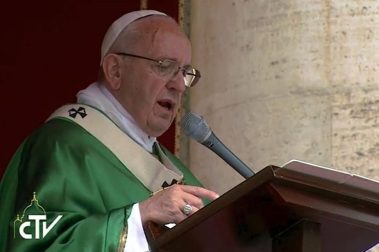
CTV Screenshot - Pope at Mass for Jubilee of Deacons
Below is the Vatican-provided translation of the Pope’s prepared homily during the Holy Mass concluding the Jubilee for Deacons this morning in St. Peter’s Square. Deacons and their families from all around the world were invited to make a pilgrimage to Rome in order to participate in this major gathering on the occasion of the Extraordinary Jubilee of Mercy. This Jubilee for Deacons, May 27-29 in Rome, was a celebration for deacons, along with their wives and children:
***
“A servant of Jesus Christ” (Gal 1:10). We have listened to these words that the Apostle Paul, writing to the Galatians, uses to describe himself. At the beginning of his Letter, he had presented himself as “an apostle” by the will of the Lord Jesus (cf. Gal 1:1). These two terms – apostle and servant – go together. They can never be separated. They are like the two sides of a medal. Those who proclaim Jesus are called to serve, and those who serve proclaim Jesus.
The Lord was the first to show us this. He, the Word of the Father, who brought us the good news (Is 61:1), indeed, who is the good news (cf. Lk 4:18), became our servant (Phil 2:7). He came “not to be served, but to serve” (Mk 10:45). “He became the servant (diakonos) of all”, wrote one of the Church Fathers (Saint Polycarp, Ad Phil. V, 2). We who proclaim him are called to act as he did. A disciple of Jesus cannot take a road other than that of the Master. If he wants to proclaim him, he must imitate him. Like Paul, he must strive to become a servant. In other words, if evangelizing is the mission entrusted at baptism to each Christian, serving is the way that mission is carried out. It is the only way to be a disciple of Jesus. His witnesses are those who do as he did: those who serve their brothers and sisters, never tiring of following Christ in his humility, never wearing of the Christian life, which is a life of service.
How do we become “good and faithful servants” (cf. Mt 25:21)? As a first step, we are asked to be available. A servant daily learns detachment from doing everything his own way and living his life as he would. Each morning he trains himself to be generous with his life and to realize that the rest of the day will not be his own, but given over to others. One who serves cannot hoard his free time; he has to give up the idea of being the master of his day. He knows that his time is not his own, but a gift from God which is then offered back to him. Only in this way will it bear fruit. One who serves is not a slave to his own agenda, but ever ready to deal with the unexpected, ever available to his brothers and sisters and ever open to God’s constant surprises. A servant knows how to open the doors of his time and inner space for those around him, including those who knock on those doors at odd hours, even if that entails setting aside something he likes to do or giving up some well-deserved rest. Dear deacons, if you show that you are available to others, your ministry will not be self-serving, but evangelically fruitful.
Today’s Gospel also speaks to us of service. It shows us two servants who have much to teach us: the servant of the centurion whom Jesus cures and the centurion himself, who serves the Emperor. The words used by the centurion to dissuade Jesus from coming to his house are remarkable, and often the very opposite of our own: “Lord, do not trouble yourself, for I am not worthy to have you come under my roof” (7:6); I did not presume to come to you” (7:7); “I also am a man set under authority” (7:8). Jesus marvels at these words. He is struck by the centurion’s great humility, by his meekness. Given his troubles, the centurion might have been anxious and could have demanded to be heard, making his authority felt. He could have insisted and even forced Jesus to come to his house. Instead, he was modest and unassuming; he did not raise his voice or make a fuss. He acted, perhaps without even being aware of it, like God himself, who is “meek and humble of heart” (Mt 11:29). For God, who is love, out of love is ever ready to serve us. He is patient, kind and always there for us; he suffers for our mistakes and seeks the way to help us improve. These are the characteristics of Christian service; meek and humble, it imitates God by serving others: by welcoming them with patient love and unflagging sympathy, by making them feel welcome and at home in the ecclesial community, where the greatest are not those who command but those who serve (cf. Lk 22:26). This, dear deacons, is how your vocation as ministers of charity will mature: in meekness.
After the Apostle Paul and the centurion, today’s readings show us a third servant, the one whom Jesus heals. The Gospel tells us that he was dear to his master and was sick, without naming his grave illness (v. 2). In a certain sense, we can see ourselves in that servant. Each of us is very dear to God, who loves us, chooses us and calls us to serve. Yet each of us needs first to be healed inwardly. To be ready to serve, we need a healthy heart: a heart healed by God, one which knows forgiveness and is neither closed nor hardened. We would do well each day to pray trustingly for this, asking to be healed by Jesus, to grow more like him who “no longer calls us servants but friends” (cf. Jn 15:15). Dear deacons, this is a grace you can implore daily in prayer. You can offer the Lord your work, your little inconveniences, your weariness and your hopes in an authentic prayer that brings your life to the Lord and the Lord to your life. When you serve at the table of the Eucharist, there you will find the presence of Jesus, who gives himself to you so that you can give yourselves to others.
In this way, available in life, meek of heart and in constant dialogue with Jesus, you will not be afraid to be servants of Christ, and to encounter and caress the flesh of the Lord in the poor of our time.
[Original text: Italian] [Vatican-provided translation]